Thursday, July 4th – Dublin
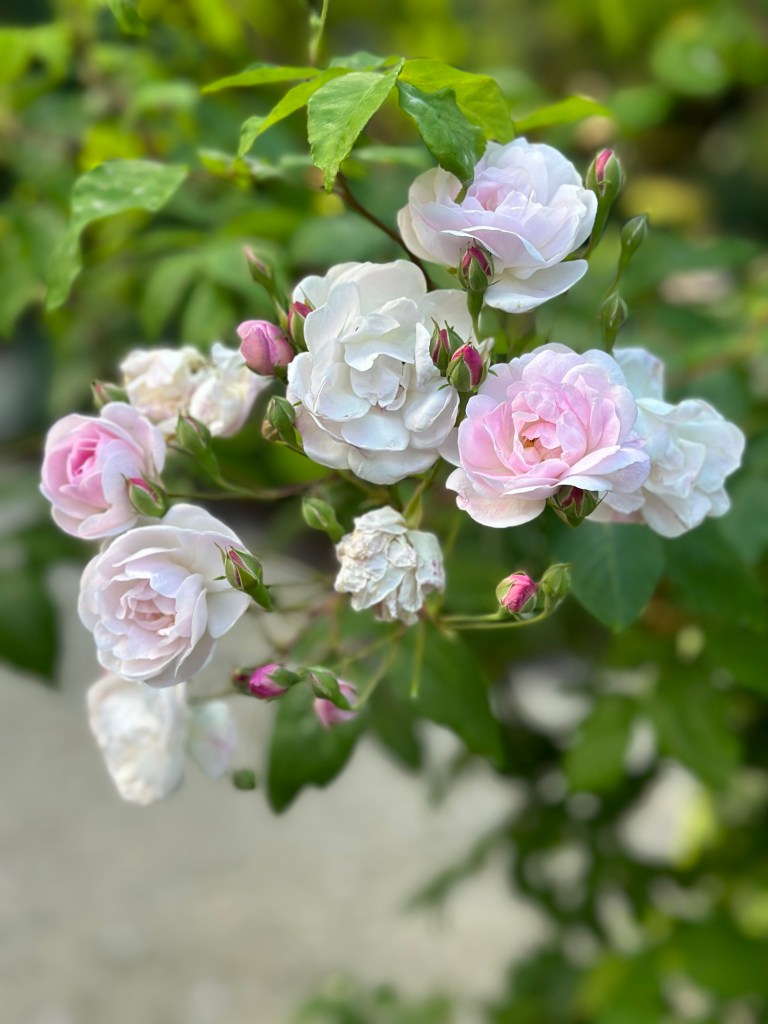
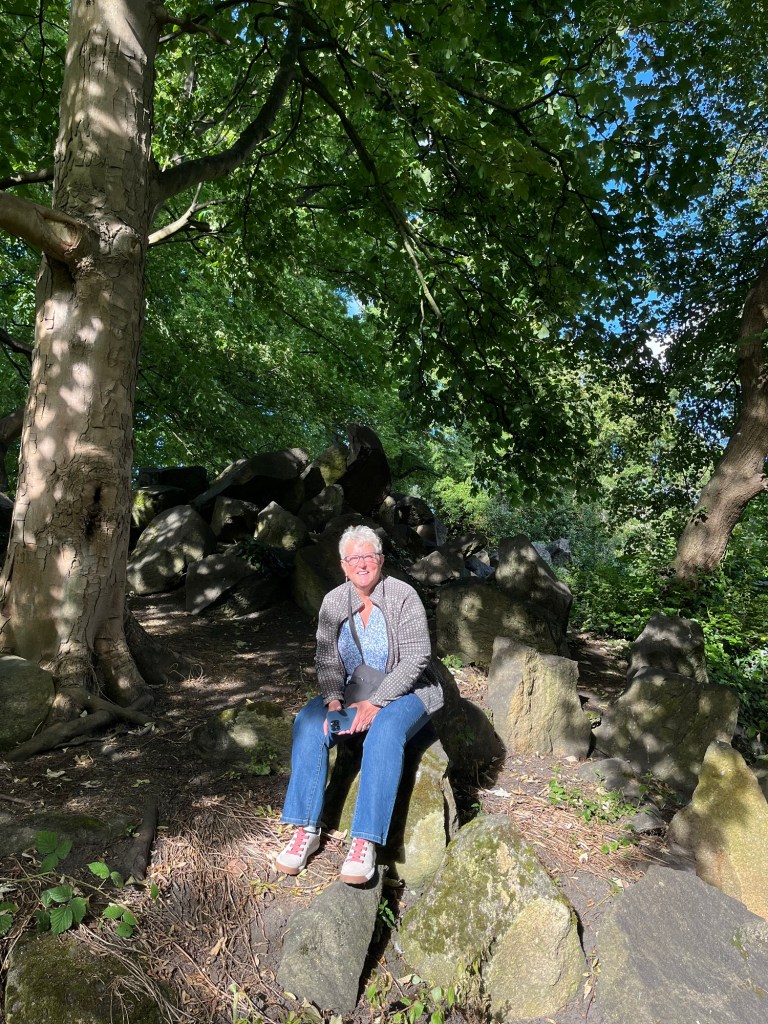
Before starting with an update on our day 2 in Dublin, let me back up a bit. After I signed off last night, Charlene and I walked over to our hotel’s name sake, Iveagh Gardens. The public gardens were really pleasant, if not well kept with several beds of different coloured roses. We even spent some time walking around the maze of boxwoods.

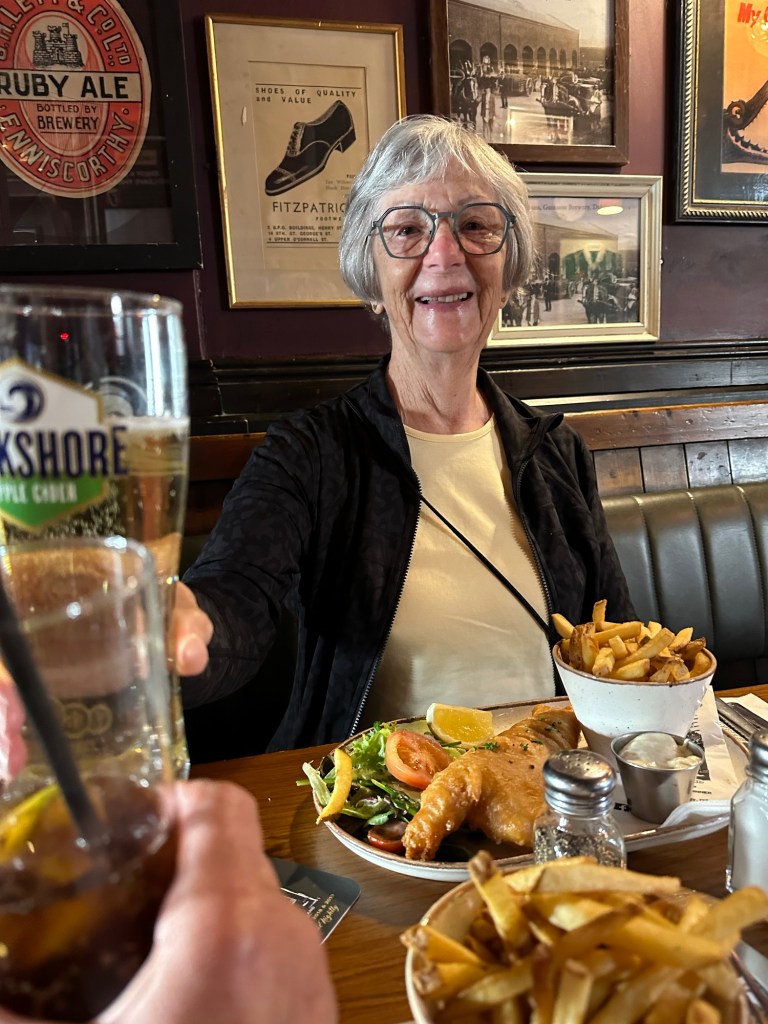
Then we were off to dinner and at the recommendation of our Bell Captain, we headed through a couple of alleyways to the closest pub for dinner. We were a little leery of the “live music” on the second floor that was offered to us because the first level was full, but it turned out to a really pleasant singer, guitar player with a wide ranging repertoire of Irish Ballads, and old favourites including Cohen’s Hallelujah. The fish and chips were great and hit the spot. A really pleasant experience.
Today was our only full day in Dublin, and after a bit of a sleep-in and late breakfast we headed out to jump on a Hop On, Hop Off bus to get an overview of Dublin. We actually Hopped on and stayed for almost two laps around the route to absorb more of the things to see and the commentary. It didn’t cover a large geographic area and we had walked much of it yesterday but so much history. I’ll try and pick the most interesting things we heard about, but there is so much more to this wonderful city.
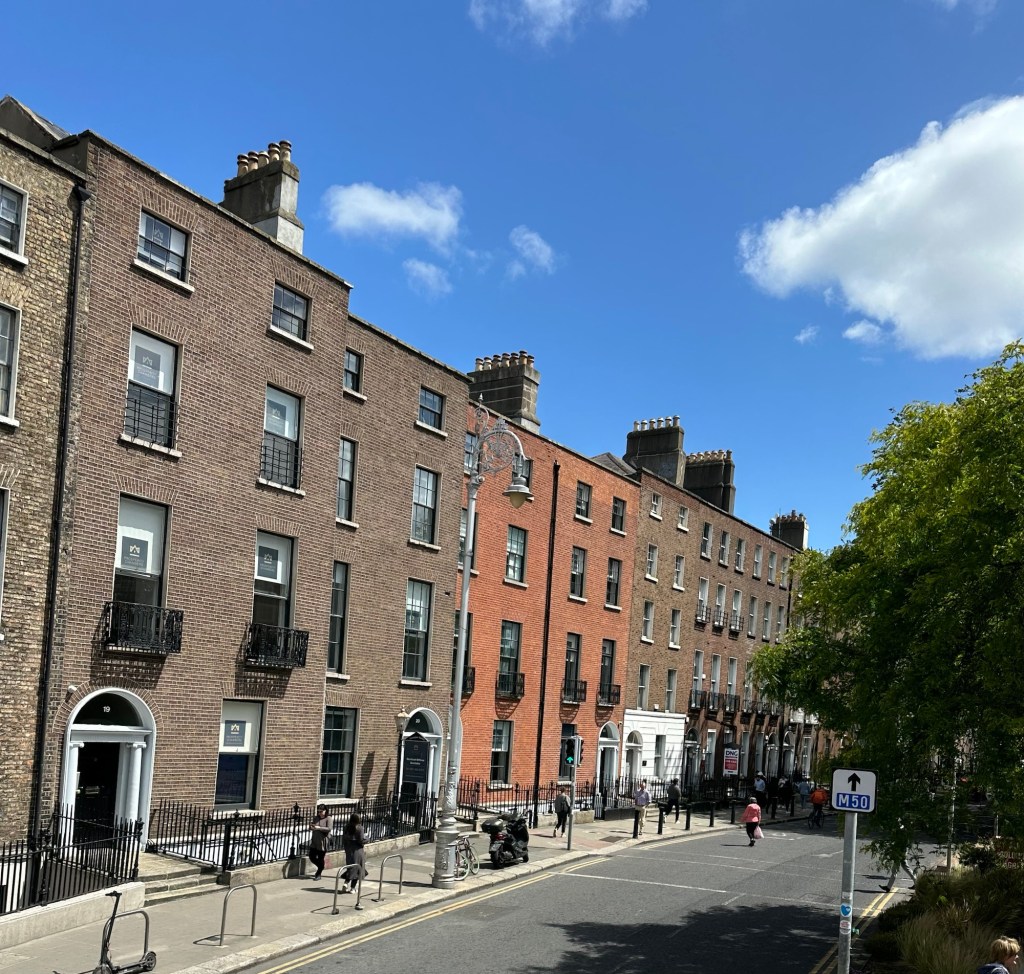
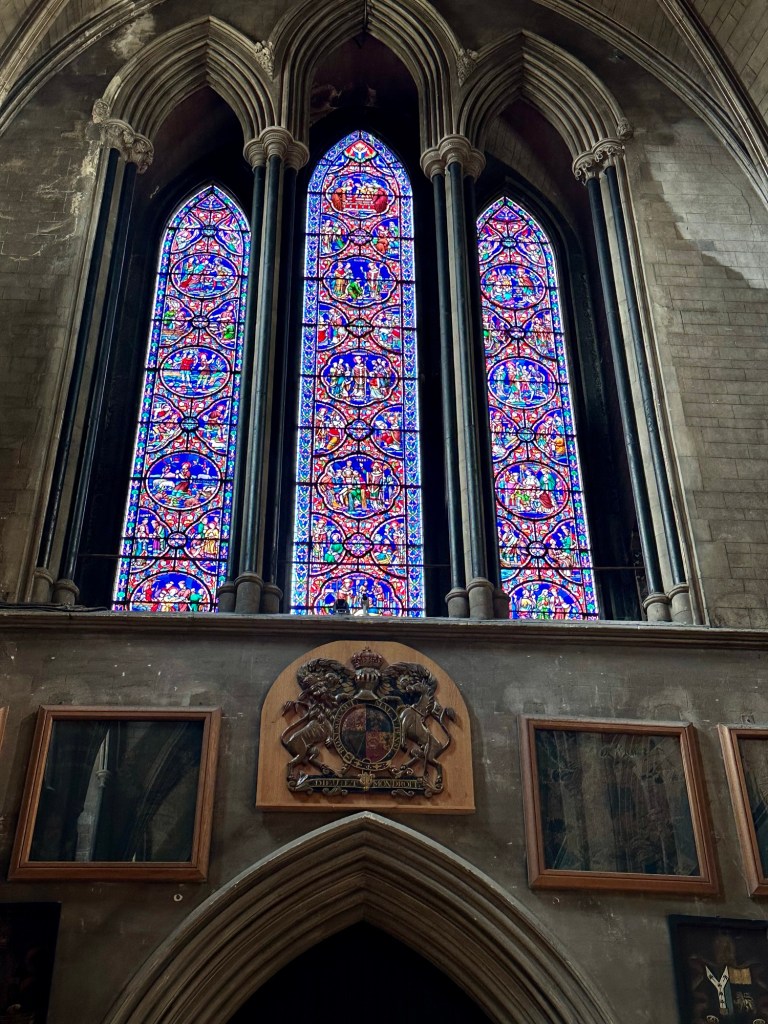
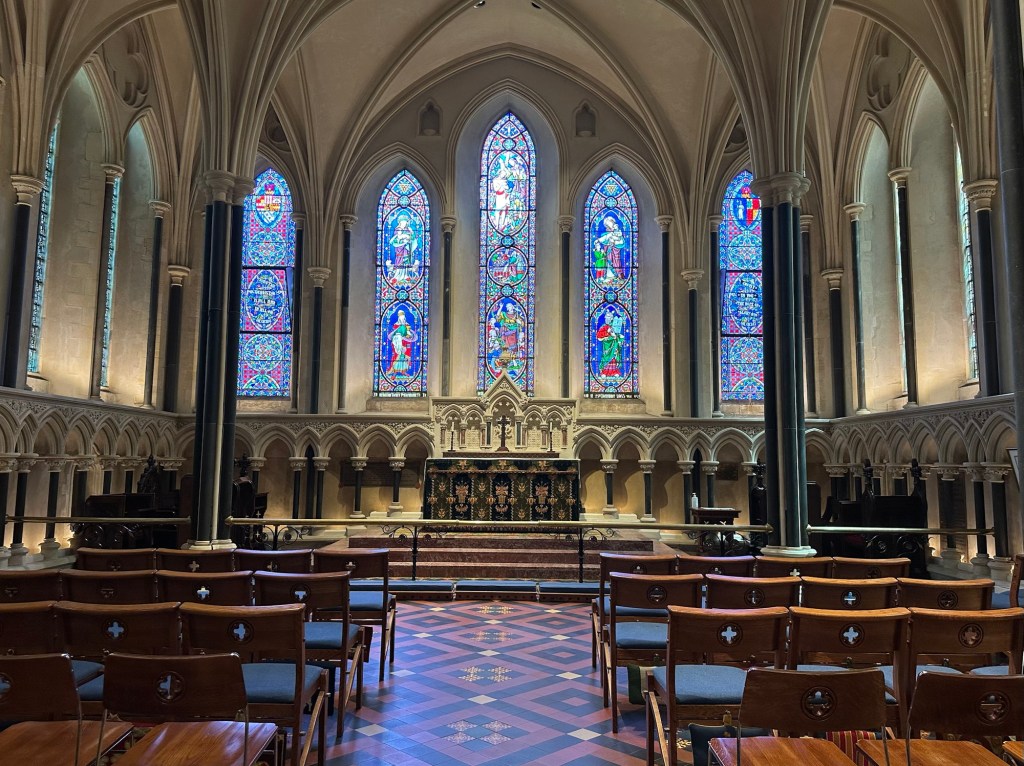
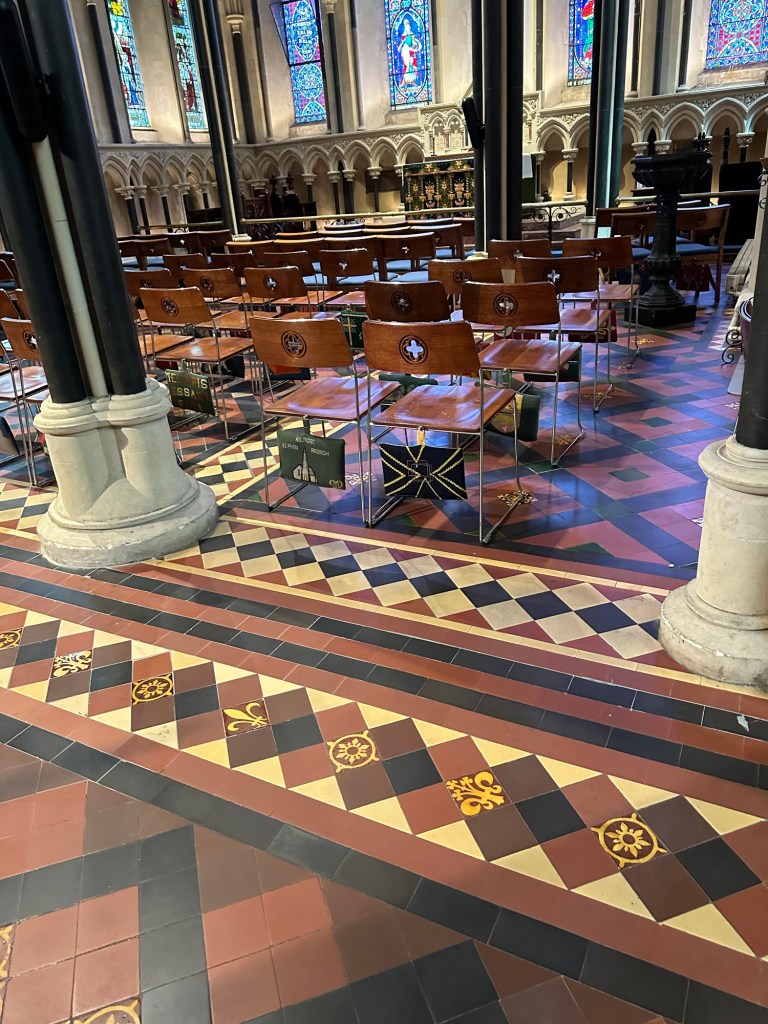
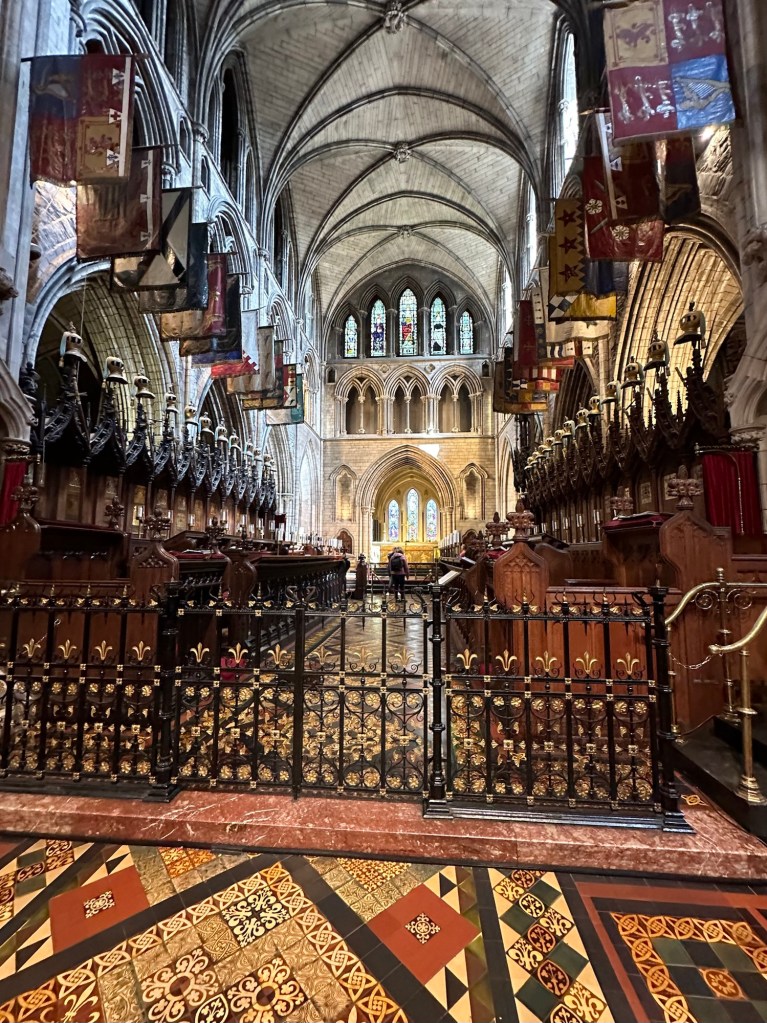
Yesterday you saw pictures of Christchurch Cathedral and St. Patrick’s Cathedral. We learned a little more about them today and actually toured St. Patrick’s. Both cathedrals were built of wood in the 1000s by the Vikings, then in stone in the 1100’s, and renovated extensively in the late 1800s.
St. Patrick’s is the oldest and largest of the many churches and cathedrals in Dublin and it is rich in history. The audio tour of the cathedral was really well done and interesting. It’s a beautiful and active place with lots of the history explained and educational opportunities even for school children. The Guinness Family (yes, the beer one) spent something like $22 million in the late 1800s to renovate and restore St. Patricks.
As I mentioned yesterday, Jonathon Swift, the author of Gulliver’s Travels was the Dean of the Cathedral and he apparently gave long sermons, sometimes as long as 6 hours. He was obsessed with people who fell asleep in church and rumour has it that he had wheels installed on the pulpit and if he saw anyone asleep he would have the pulpit wheeled to within striking distance when he would use a stick to prod them awake.
Our HOHO bus took us outside of the core of the city a little today to an area called “Liberties”, where historically there were textile and alcohol factories. The name comes from the fact that this area was outside the walls of the city and therefore were not required to pay taxes.
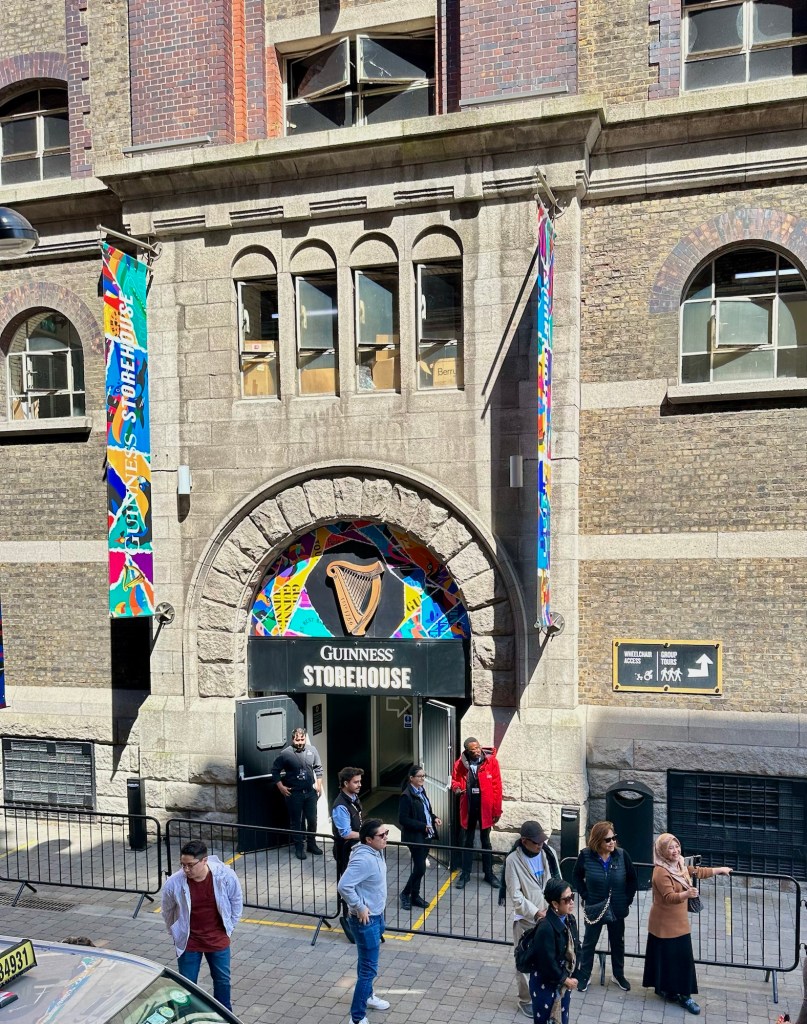
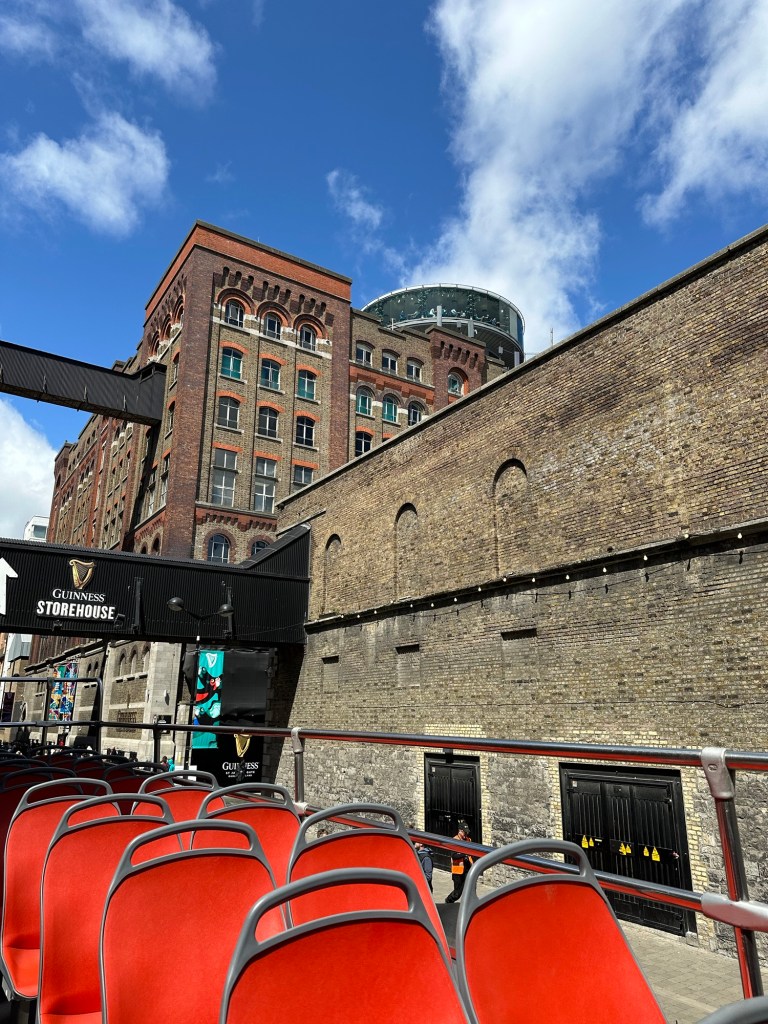
One of the highlights of the tour for most tourists is the Guinness distillery set nearby the River Liffey for ease of transportation in the early days. We didn’t stop as neither of us are big beer drinkers but one can’t help but be impressed with the huge site. The apparent secret to its success are that hops are roasted at a high temperature (232 degrees) causing the dark red colour of the beer. They brew 3 million pints a day and ship to over 150 countries around the world. (The 3 countries that consume the most Guinness are UK, Nigeria and Ireland.) The facility includes a bar in a building overlooking the complex where one can learn how to properly pour a Guinness, including receiving a diploma to prove one’s competency.
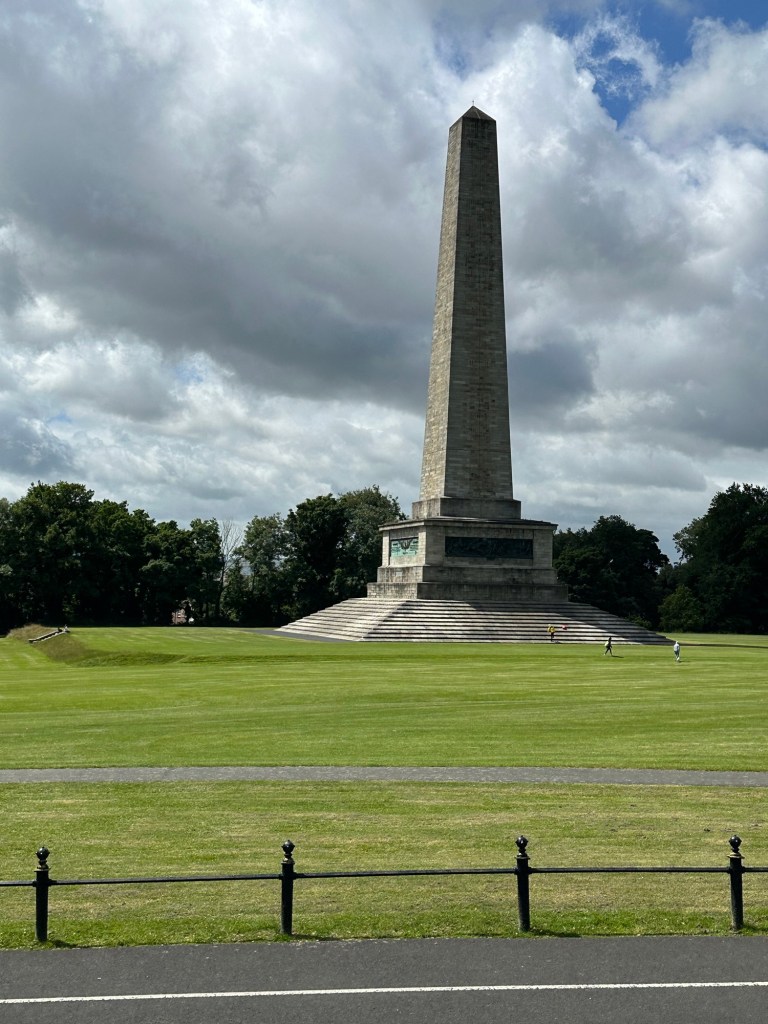
The River Liffey (river of life in Irish), divides the city into North and South and there are 20 bridge crossings, many of them pedestrian only. We are staying on the south side but we crossed over to the north side on our HOHO bus today. The most popular stop on the north side is Phoenix Park where the Dublin Zoo is located along with lots of open parkland and the prominent Wellington Monument. The monument was built to commemorate the victories of Arthur Wellesley, 1st Duke of Wellington, over Napoleon at Waterloo and the only Prime Minister of United Kingdom to be born in Ireland.
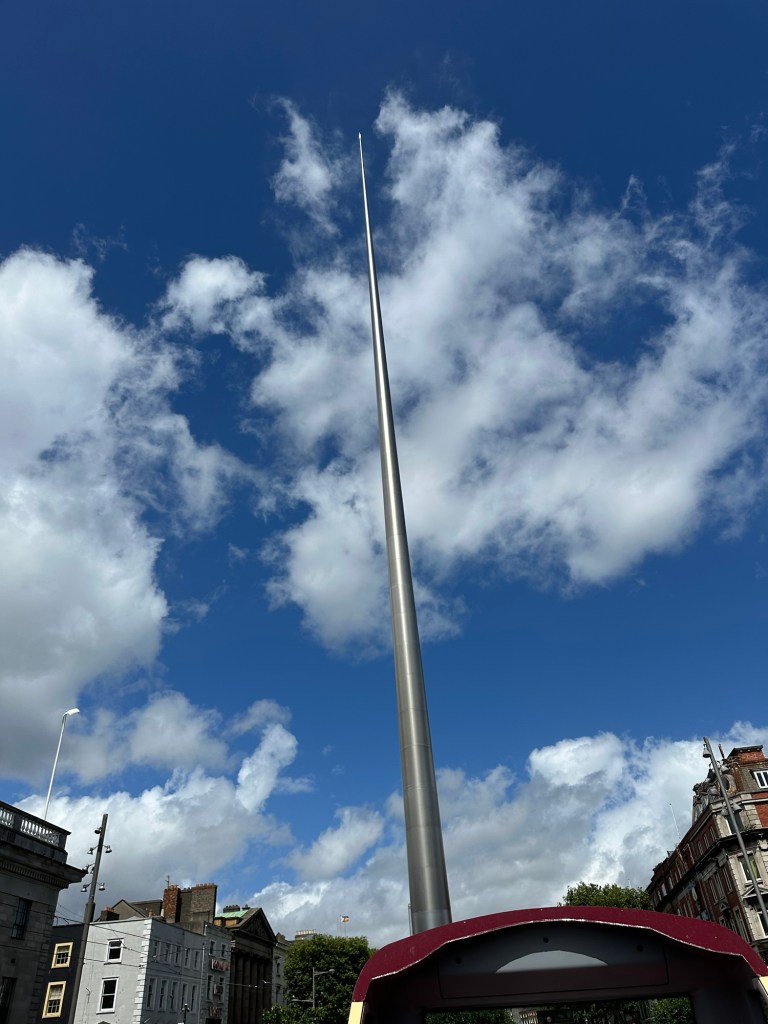
Also on the North Side is the Spire of Dublin, or Millennial Spire completed not in the millennial but in 2003, (bet there is a story there!) which is 335 ft high.
Its nicknames are “Stiletto in the ghetto” and “Rod to God” according to our tour guide.
An imposing O’Connell Statue sits on the north side of the river on O’Connell Street in honour of Daniel O’Connell, who is largely responsible for the 1829 Act of Catholic Emancipation giving freedom to Catholics to vote, own horses and such.
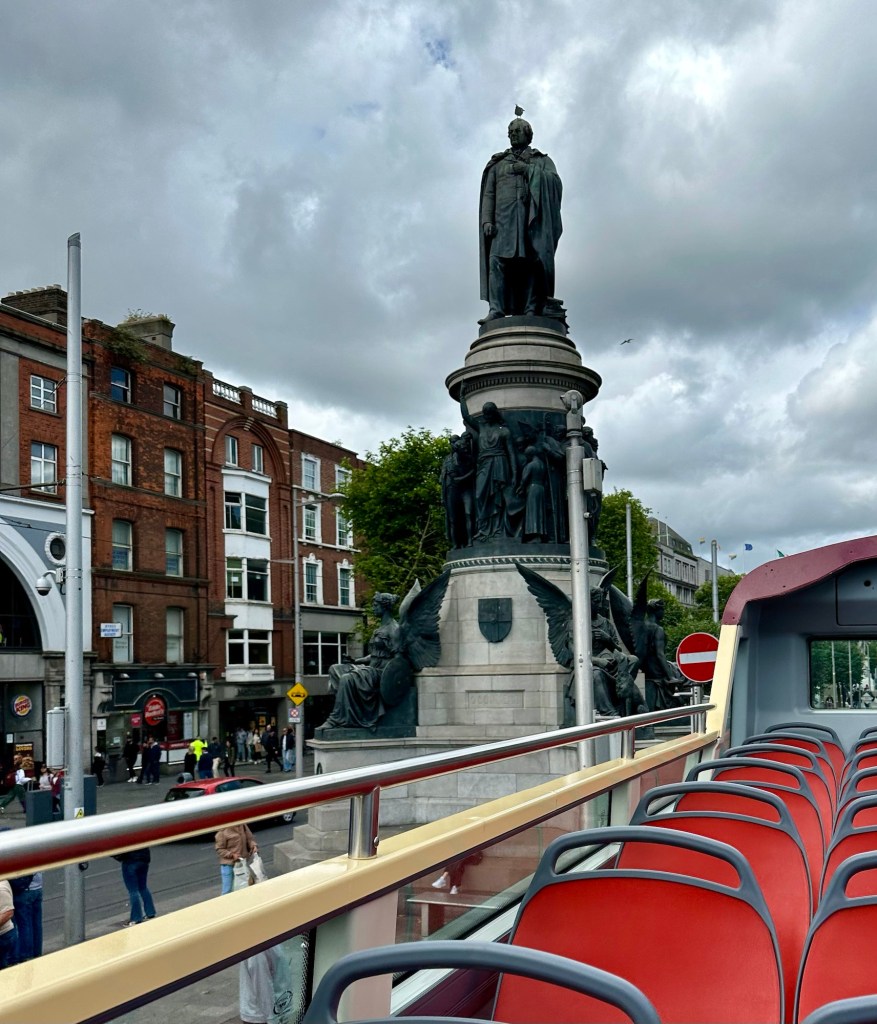
We got off the HOHO at a spot where we could easily walk home and found a really nice place to eat a very late lunch. We then walked back along Grafton Street and even stopped in a couple of shops. One was a Marks and Spencers that I wish we still had in Canada. Another, the Brown Thomas Department Store where I’m sure the gentleman standing outside in the hat and tails scowled as we went past him to enter the store. Every luxury brand you’ve heard of was available. The prices were through the roof. Blue jeans for 315 Euros and a rack of thin, wrinkled solid coloured t-shirts were 250 Euros each. Definitely out of my league.
Fun Facts: (the reader is reminded that much of this and my account from today is taken from accounts by tour guides and here-say and is to be taken with some grains of salt and suspicion).
⁃ The Irish language is the official language of Ireland and it appears first on any formal signage, but is only spoken by approximately 85,000 of the 5 million population, primarily on the west coast of the island.
⁃ English is spoken by most Dubliners, however, I have to say Charlene and I have walked away from a conversation saying, “I have no idea what they were saying” more than once.
⁃ Ireland was the first state to legalize same sex marriage through a public referendum in 2015 when 63% of the 61% of the population who turned out voted in favour of allowing it.
⁃ Just off Dame street in South Dublin is a statue of Molly Malone, who in stories is represented as a fish hawker by day and a lady of the night by night and has many nicknames none of which I can now remember. She was possibly a historical figure and definitely a legendary figure. The famous Irish song by the Dubliners, “Cockles and Mussels” was apparently written about the legend. It has become the unofficial anthem of Dublin.
⁃ We have heard 4 different versions of why the Temple Bar area is called the Temple Bar area:
1. it is an area where lots of lawyers ply their trade;
2. it is where there is a sand bar in the nearby River Liffey;
3. it’s named after the famous Temple family bar;
4. it’s named after the Irish word for walkway which is barre.
⁃ The heart of Dublin was original surrounded by a stone wall (now 900 years old), some small parts of which can be seen standing around the city.
⁃ Handel’s Messiah was first performed in Dublin in 1742.
⁃ Christchurch Cathedral has 19 bells and has become a place to hangout on New Year’s Eve to wait for them to ring in the new year.
⁃ 2 million people left Ireland during the potato famine in 1840s.
⁃ the average temperature in Ireland year round is 62 degrees, with 3 inches of rain monthly, one of the most rainy countries in Europe (there is a reason it’s so green)
⁃ since its independence in 1922 when the Irish police were established they have not worn guns.
⁃ the movie Educating Rita (1982) was filmed on the Trinity College campus
⁃ Oliver Cromwell is reported to have bedded down his horses in the nave of St. Patrick’s church in the mid 1600s during his conquest of Ireland to show his disrespect for the Anglican religion.


 Lois' Adventures
I love that in this blog you have a voting stat (I would expect no less than one from you lol) and a picture of a statue with a bird on its head 🙂
LikeLike
Fascinating to read and wonderful to see your great pics – thanks for the tour, Lois! 😊
LikeLike