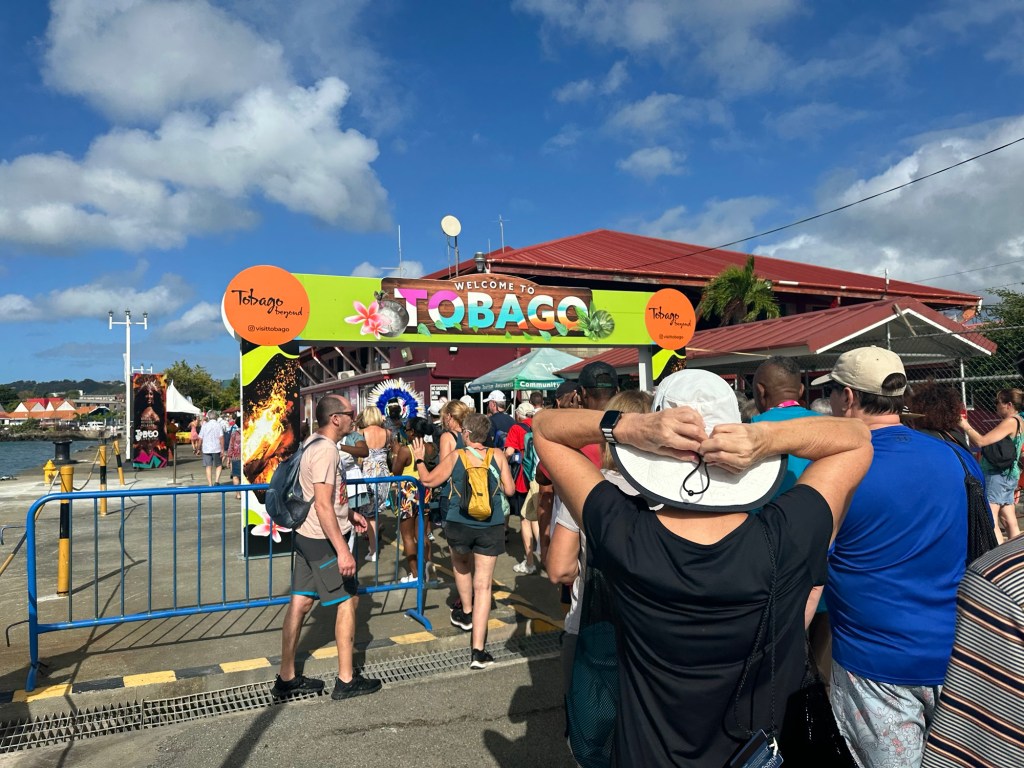
As promised, we travelled overnight to the country of Trinidad and Tobago (T&T) which is located southwest of Barbados closer to and northeast of Venezuela. Tobago is one of the two main islands of the archipelago of Trinidad and Tobago and is home to only approximately 4% of the population (52,000). Trinidad used to be part of South America and sits on the continental shelf whereas Tobago is part of a sunken mountain chain. The archipelago is safe from the hurricanes of the region sitting south of the hurricane belt in the shadow of South America.
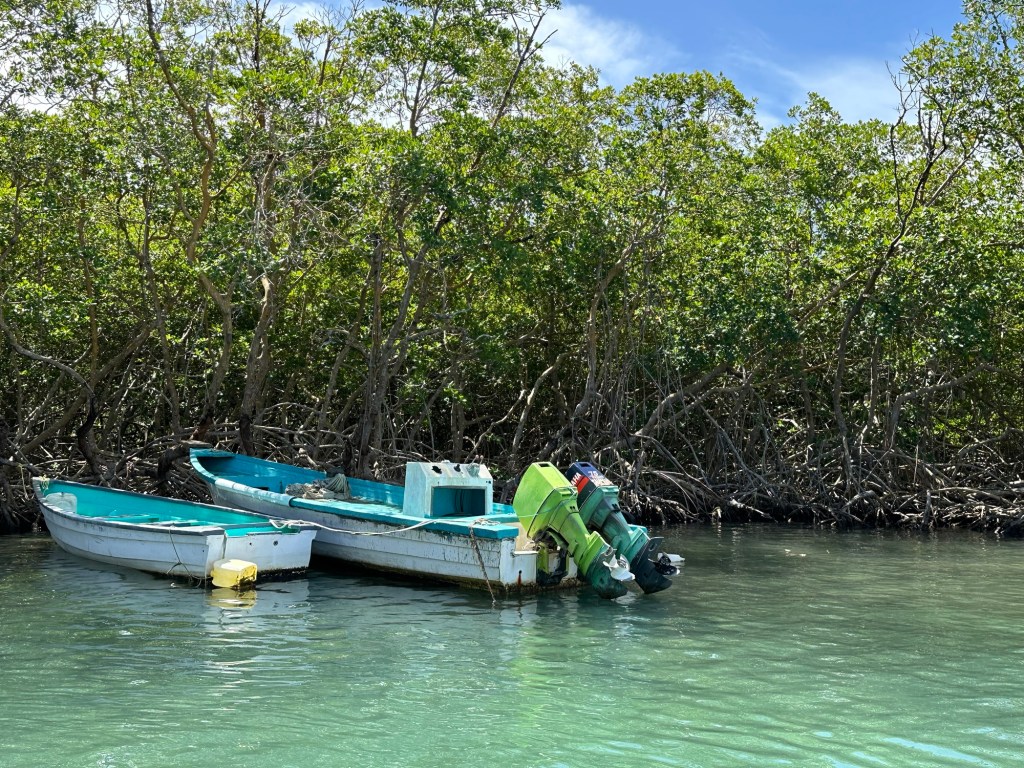
Tobago originated from volcanic action leaving a hilly terrain with elevations up to 640 meters (Pigeon Peak), but there are no active volcanoes. Much of the island is covered in forests and the coastline is irregular with bays, beaches and mangroves. There are several satellite islands surrounding Tobago.
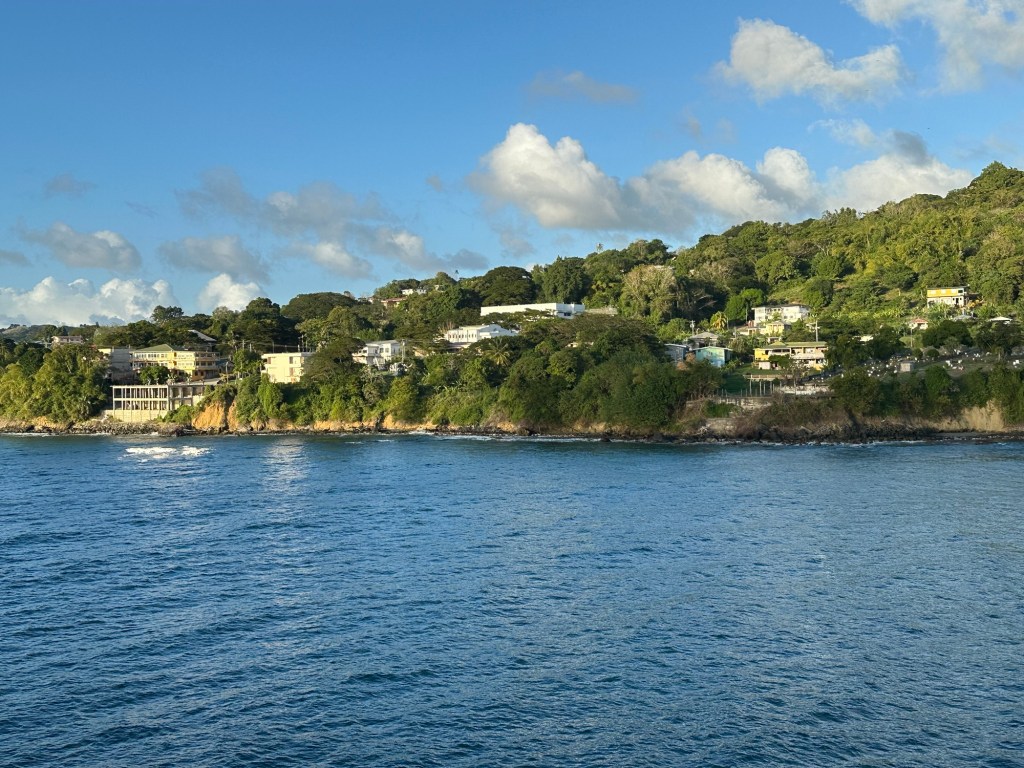
The history of the islands is similar to others with settlement happening through colonization and slavery and indentureship or apprenticeship systems. As a result, the current population consists of people of African, Indian, European, Middle Eastern and Chinese descent.
The original inhabitants of Trinidad were the Arawak and Caribbean speaking peoples (called Amerindians) and the first European visitors (Christopher Columbus) arrived in 1498. Columbus apparently promised to name his next discovery after the Holy Trinity, and thus the name Trinidad. Although in Spanish control until 1797, Trinidad was largely settled by French colonists but control of Tobago moved between the British, French, Dutch and Courlanders (early day Latvians! ). In fact it changed hands 32 times and is nickname the “Gem of the Caribbean” as a result. In 1704 it was declared neutral and the pirates moved in and used it as a base for the exploits. It ended up in the hands of the British in 1814 with the Treaty of Paris and they established sugar, indigo and cotton plantations using slave labour. Have we heard this story before? Non-violent protests in 1834 started the process of abolishing the “apprentice” system and emancipation was accomplished by 1838. Tobago joined Trinidad in 1889 and despite growing anti-colonist sentiment, it didn’t become independent from the UK until 1962 and a republic in 1976. And yes, their government is based on the Westminster System but also on a two party system.
With T&T sitting next to Venezuela, it shouldn’t come as a surprise that oil was discovered on Trinidad in the early 1900s and it remains a major industry in the country although with help from government programs, it is moving toward LNG from oil and it is one of the largest exporters of LNG in the world, supplying a huge percentage of the US Market. Tourism and manufacturing also play a role in the Trinidad economy.
Fun Facts about Tobago
⁃ famous for its pre-Lenten Carnival including J’Ouvert where revellers get up in the middle of the night, cover themselves and throw paint, chocolate and mud and dance along the parade route.
⁃ Birthplace of the limbo which was originally performed at wakes!
⁃ Also, as you may know, it is the birthplace of the steel pan drum. But some said that drumming, was banned by the slave overlords because of a fear that it would be used to “drum up” protests over slavery. And the development of the steel drum from used paint pots, oil drums and biscuit tins is a result.
⁃ The first black winner of Miss Universe in 1977, the then 24 yr old Janelle Commissiong, was from T&T
⁃ Tobago is only 26 miles long by 7 miles across
⁃ Trinidad and Tobago is a leading member of the Caribbean Community (CARICOM) and the CARICOM Single Market and Economy (CSME) an organization of 15 countries in the Caribbean whose objective is integrate the economies by lowering trade barriers and increasing cooperation among its member states.
⁃ It’s said the sea around Tobago can be as warm as your bath. Guess it depends on how warm you like your bath, but you get the idea.
⁃ Tobago is known as one of the best Caribbean destinations for drift diving.
⁃ Bacolet Bay Beach on Tobago is famous as the location for the movie Swiss Family Robinson (1960 so some of you may not remember it 😂) and because the Beatles hung out there in the 1960/70s.
⁃ There is a bay called Bloody Bay, which was named after a bloody naval battle, that supposedly turned the waters red with blood, however it’s entirely likely it’s because of the red earth deposits which stained it. (Like in PEI).
⁃ Of course cricket is not only popular in T&T but rather an obsession. But football (NA Soccer) and basketball are also played and watched.
⁃ The Moruga Scorpion pepper from T&T has a heat rating of 1.2 million Scoville heat units (SHUs). According to the experts that makes it the third hottest chilli pepper in the world.
⁃ Because it was once part of South America T&T has the greatest abundance of wildlife in the Caribbean. Over 400 species of birds (including 17 varieties of hummingbirds), 600 butterflies, 100 species of mammals, 85 species of reptiles, and 30 species of amphibians. Not to mention over 700 orchids species and thousands of other flowering species.
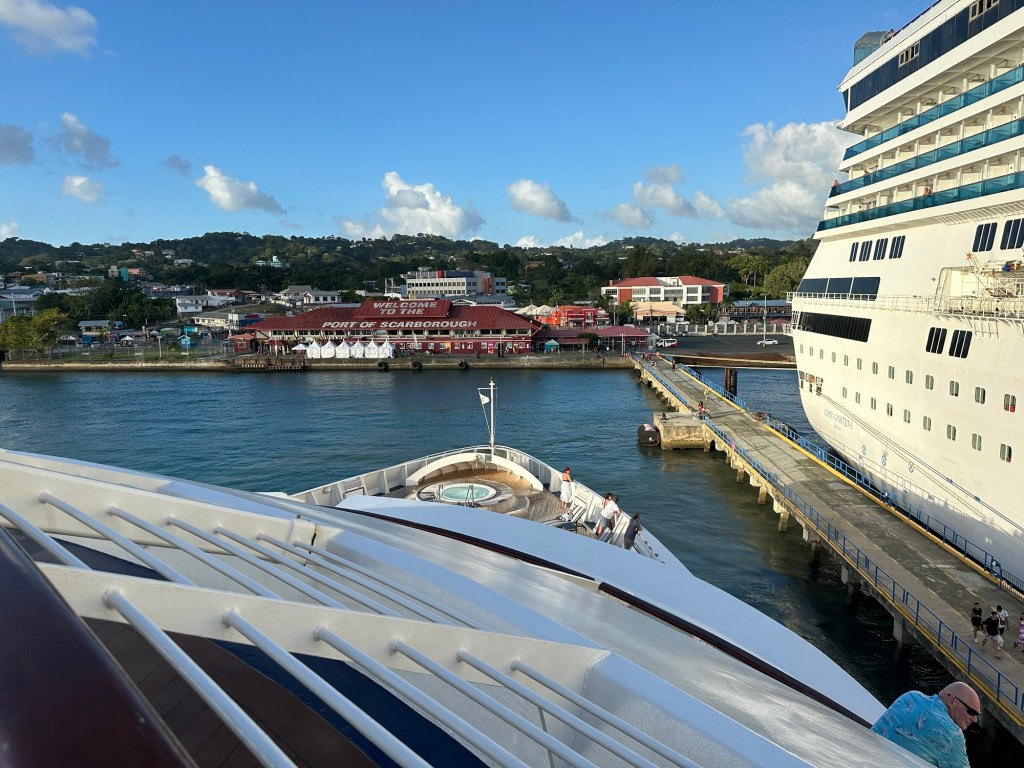
When I awoke this morning after a great sleep being rocked gently in my ever so comfortable bed, we were docked in Scarborough, (no, not the one in the GTA), the main city of Tobago. This was the alternate stop because the swells in our original destination, Man-O-War Bay, were too high for us to tender. Before I’d grabbed breakfast on the upper deck, a much larger Costa ship had docked right beside us and I’m reminded why I like the smaller Windstar ships.
On my schedule for this port was reef viewing on a glass bottom boat, snorkelling and a swim stop on a sand bar for those who wanted to swim in shallower water. Our group (and several others both from our ship and our dock neighbour it turned out) loaded on to buses and headed to the crude dock where the boats were moored. On our way, we drove through Scarborough and many little fishing towns along the way to get to the Atlantic side of the island. I always love to take excursions because they get you on to the island and to sometimes see the places where real people live and not just the tourist spots.
On our drive I saw more goats per square mile than I’ve ever seen in my life. Everyone seemed to have a few in their yards. Turns out that during Carnival, known here as the “Greatest Show on Earth” they have all sorts of activities, including goat races! Each goat has a jockey, but instead of riding on the goat, they run along behind. I can just imagine the chaos. After a few years of races, when the goats are grown… well, I’m sure you can imagine the reason for their demise.
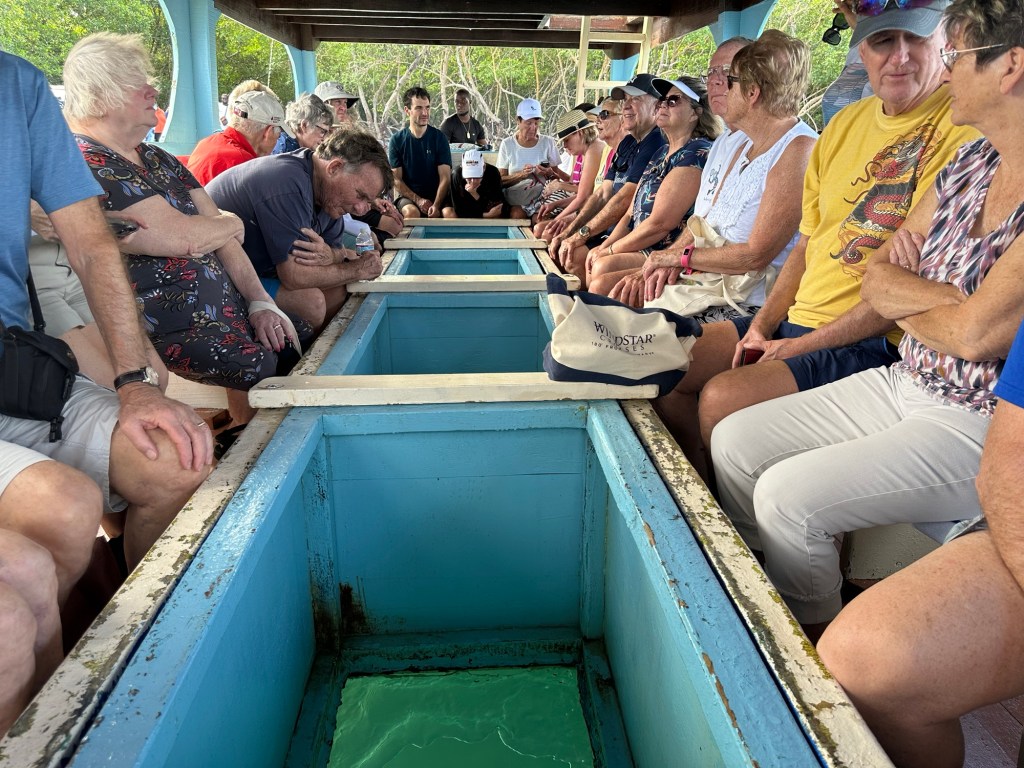
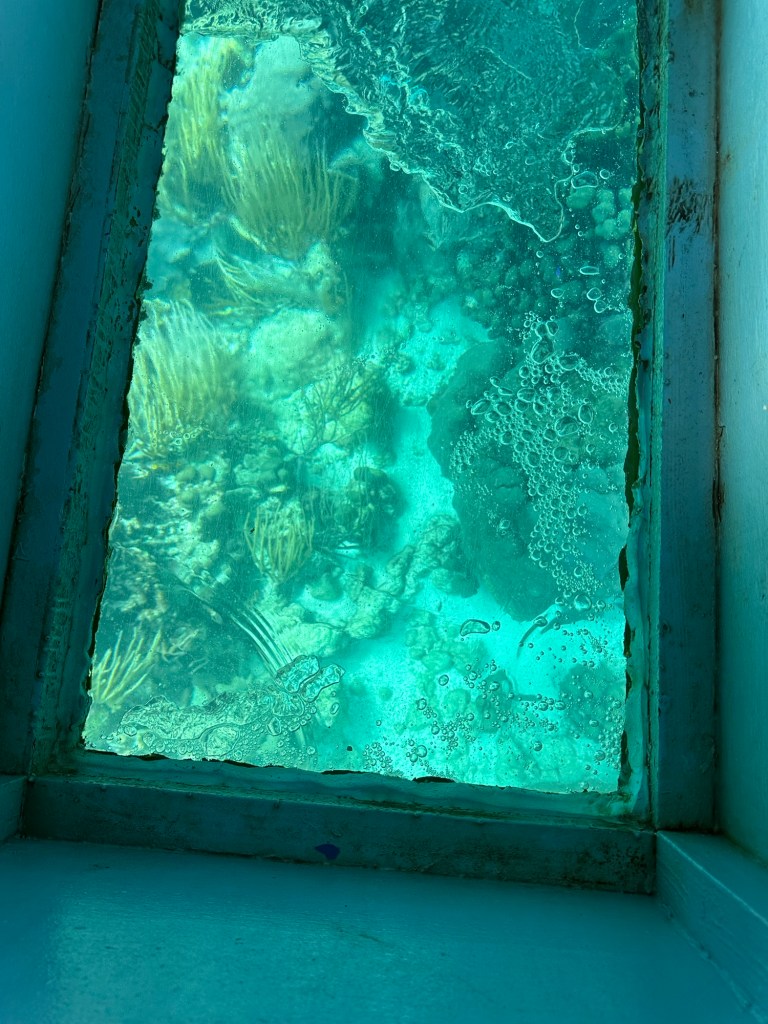
The reef where we were supposed to drift in the boat was the Angel Reef on the other side of the island where there is one of the world’s largest corals. But we ended up at Buccoo Reef, which was still interesting with lots of corals, sponges and fish.
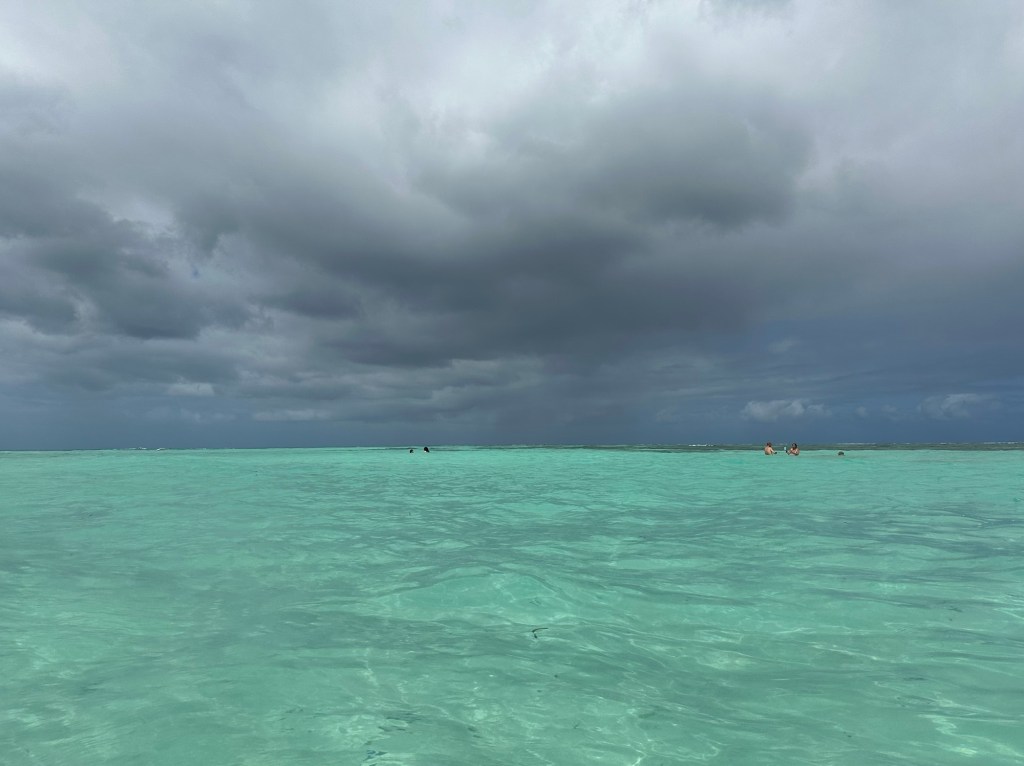
There is a barrier reef along the east coast of Tobago which we could see, and the water colour with the white line of waves breaking on the reef and the dark clouds made for a gorgeous view. The swells were quite high, the weather a little threatening, and since we’d seen the reef through the glass bottom window, only 4 of our group snorkelled, and I wasn’t one of them.
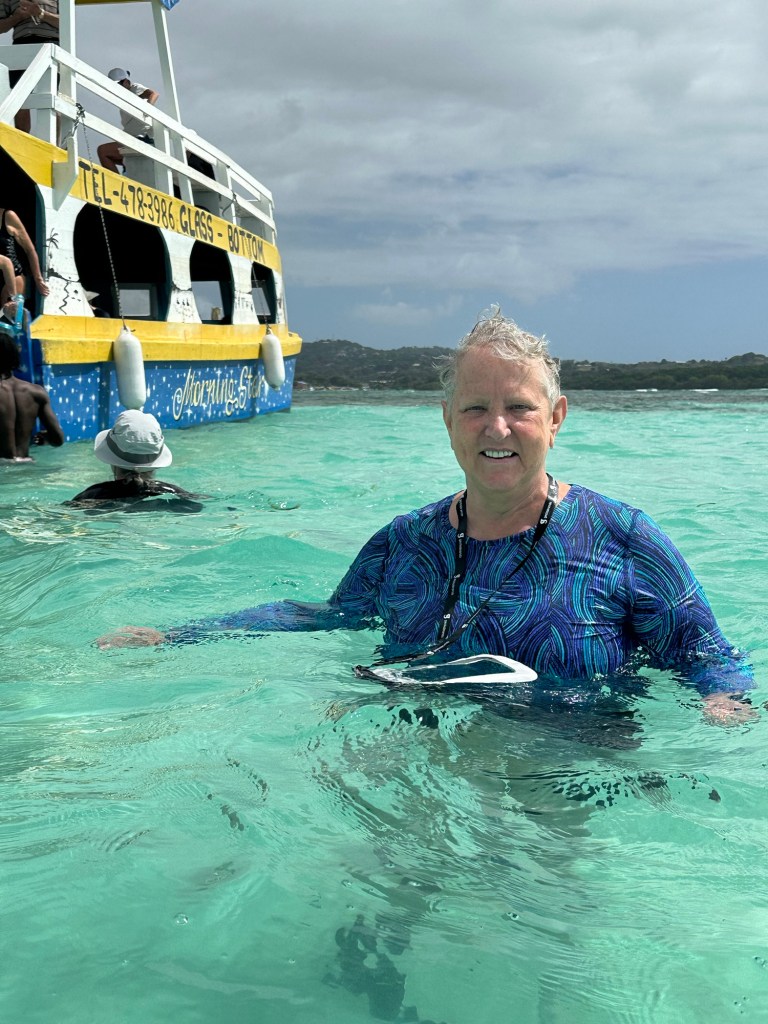
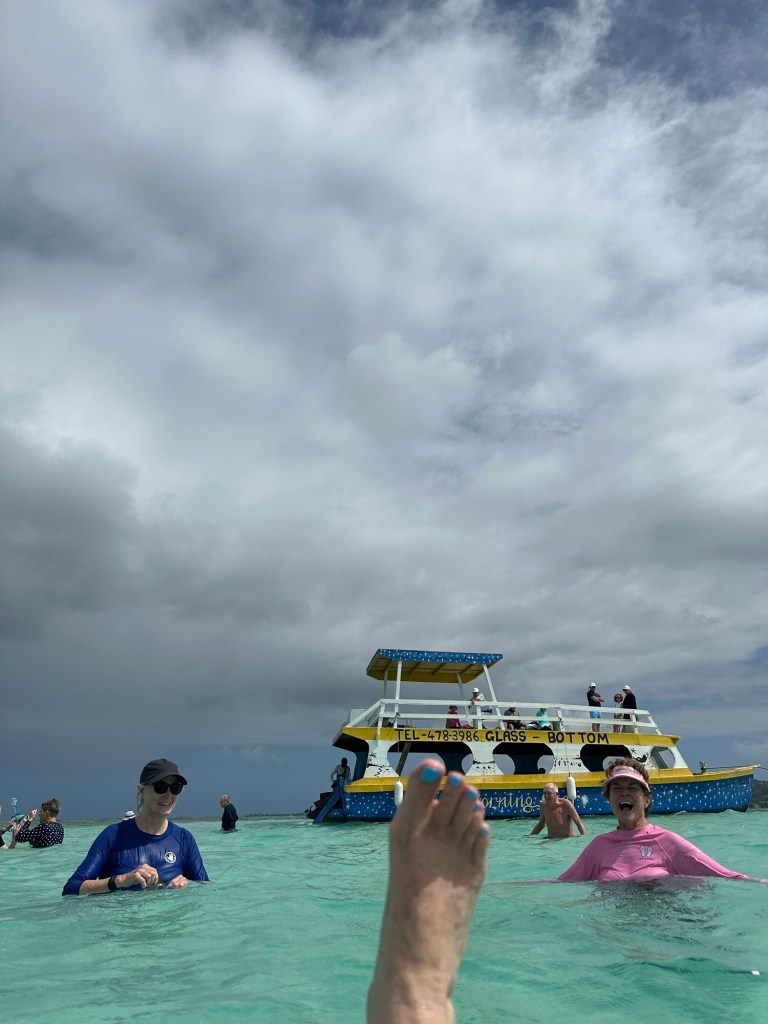
After the short snorkel spot, our next stop was the opportunity for people to swim in the warm, waist-high, turquoise water with a beautiful white sand floor. It turns out this swimming spot has a name and a history! “Nylon Pool” is a shallow white ground coral pool in the sea off Pigeon Point, near Buccoo Reef. Princess Margaret named it Nylon Pool in 1962 because it felt to her like a swimming pool. The locals claim if you swim there you will look 10 years younger, or live 10 years longer and if married couples swim there they will stay married forever, and then something about if you kiss underwater, but I missed the last part of that one!
Once back, lunch was an immediate necessity, since it had been a few hours since breakfast, and then a nap might have happened. But my alarm was set to attend the talk by the on-board naturalist, from Costa Rica. She spoke really knowledgeably about the Rain Forest, the Panamanian Land Bridge, and Ecozones. She had done research in the rain forests of Costa Rica for many years so she knew her stuff, both academically and hands on. She is going to speak about sloths, butterflies and other things in the coming days.
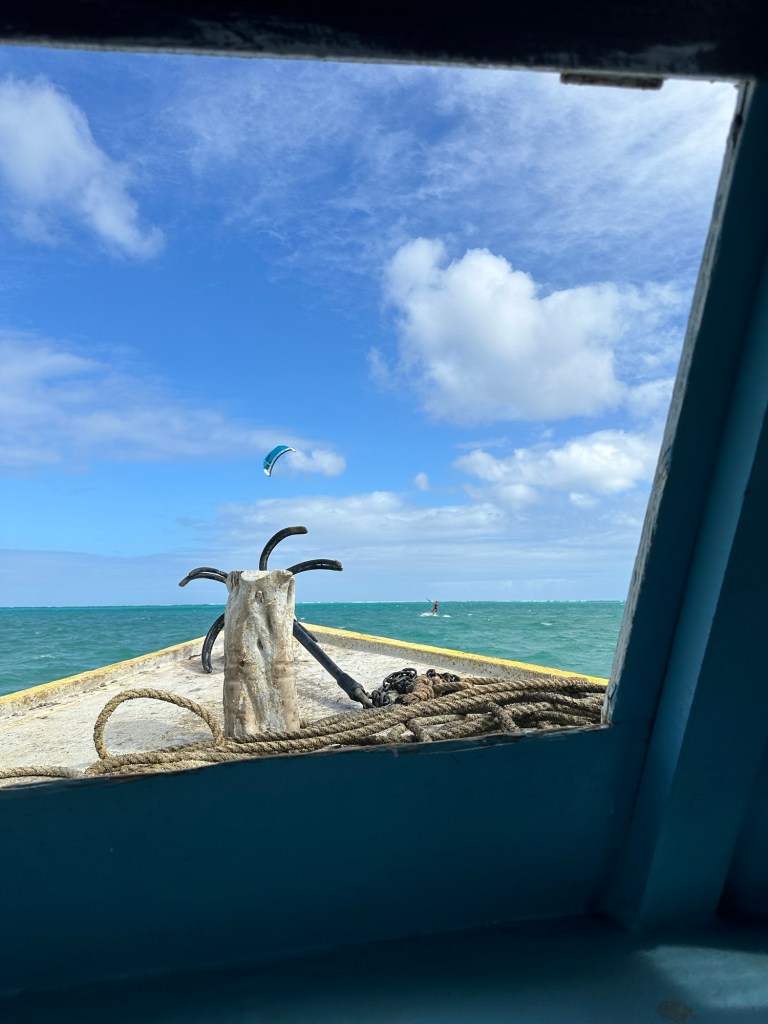
We have now departed Tobago under clear beautiful blue skies and our next stop will be Mayreau, on Saint Vincent and the Islands. It’s our beach party day tomorrow, so no excursions, but rather beach chairs set up on the beach with a BBQ lunch and bar set up for everyone. Looking forward to chilling under an umbrella tomorrow sipping iced tea.

 Lois' Adventures
Funny, I was just looking up T&T last night. I’d love to visit. This was very informative loves it all. Sounds like you are having an great cruise..I’ve only sailed in MSC..but I’ve seen windstar adds. Going to look them up. Cheers enjoy your beacg party.. limbo
LikeLike
<
div dir=”ltr”>Why are you all
LikeLike