Tuesday, February 3rd
Today we got to know a little bit about this island paradise of Moorea by taking a tour around the north side of the island with Mario Safari Tours. I guess the 4×4 transportation is the reason it’s called “safari”. And our guide was not Mario, but Dan, who is not Italian but Dutch. Dan was really knowledgable about the island, and it’s flora, history, etc. And a really good driver going up and around difficult and undulating roads.

To give you some context and background, here is some info about Moorea (also spelled Mo’orea). Moorea is one of the more than 100 islands of French Polynesia, in the Society Islands group, located in the South Pacific. The islands stretch over 2000 km, south of Hawaii and north and a little east of New Zealand. In addition to Society Islands, there are 4 other groups of islands or archipelagos in French Polynesia named Austral, Gambier, Marquesas, and Tuamotu. I think the TV show Survivor has used some of the islands as the location for their seasons.
French Polynesia is described as a “overseas collectivity” of France. From my reading my understanding is (and I hasten to post my normal warning that I may have some of this information wrong or partial or misinterpreted) there is a local elected government that overseas the administration of the islands, but that France still holds some administration function over more national and international issues such as national defence and post secondary education.
The islands are known for the over-the-water-bungalows which you will have seen pictures on in my last post, as well as the beautiful clear water, coral reefs and safe lagoons. The beach at our resort is similar to beaches we’ve seen all over the island (except I heard rumour that the beach at the Hilton is imported sand) and is hard packed sand with lots of sun bleached shells. It’s excellent for swimming with a gentle drop and sandy bottom. Within the lagoon in front of the hotel, which is closed to motorized boat traffic except those owned by the hotel. We’re hopefully going to snorkel here before we leave.
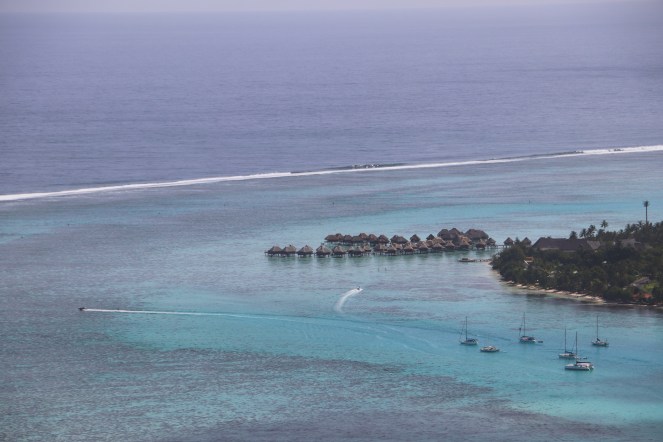
The islands of Polynesia (an area including Hawaii and Samoa as well as French Polynesia) were formed by volcanoes where hot spots in the earths crust allowed eruptions of lava to form the islands. The mountains are irregular and rugged and mostly covered in lush vegetation making for breathtaking scenery. Around Moorea, like most islands in the area, there is almost a complete circle of coral reef some distance off shore. It has a couple of breaks in the reef, where rivers of fresh water come down from the mountains and pour into the ocean in levels high enough to keep coral from growing in those areas. These natural breaks in the coral allowed for early exploring and allow for ships to enter the bays also formed by the rivers. Dan explained to us that the island is shrinking but the coral reef is growing and in some millions of years, there will be no island but just an atoll left (circle of coral reef) on which to live.
So, with that background, here is our day.
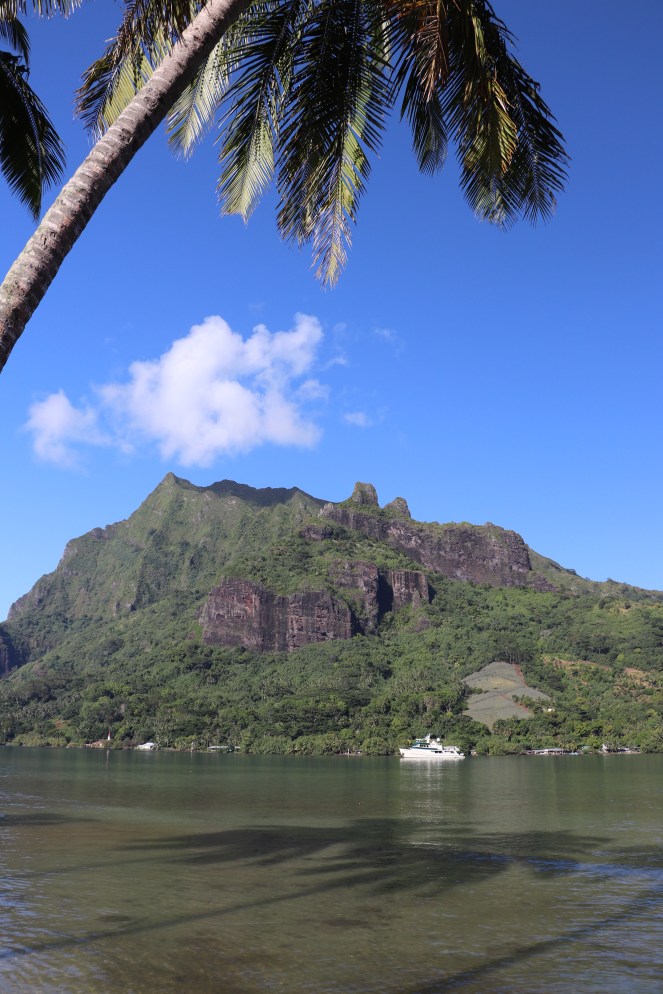
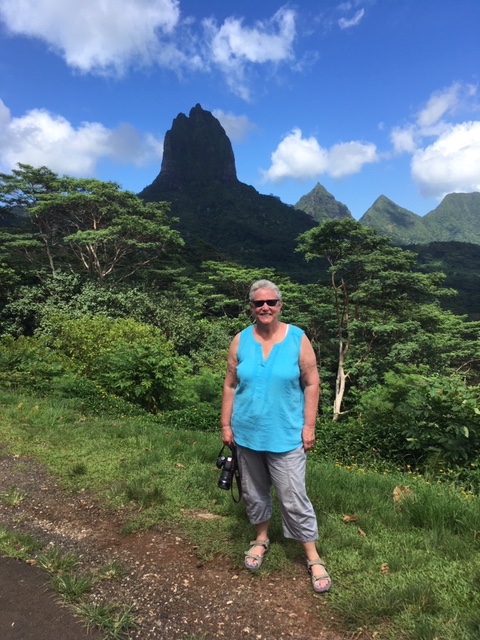
Dan picked us up at the hotel and we headed north west on one of the only roads on the island, the one that circumnavigates it. We passed by the local airport and a Jack Nicholas designed golf course. It looked challenging from the small bits we saw, very undulating. We had our first stop at Cooks Bay which was named after Captain Cook who visited the island in 1777. Cook actually explored a bay to the west of Cook Bay but the name of that Bay was too sacred to the Polynesians to change, so they named this one after him. Mount Ratui at just under 900 metres overlooks Cooks Bay. It is one of the highest peaks in French Polynesia.
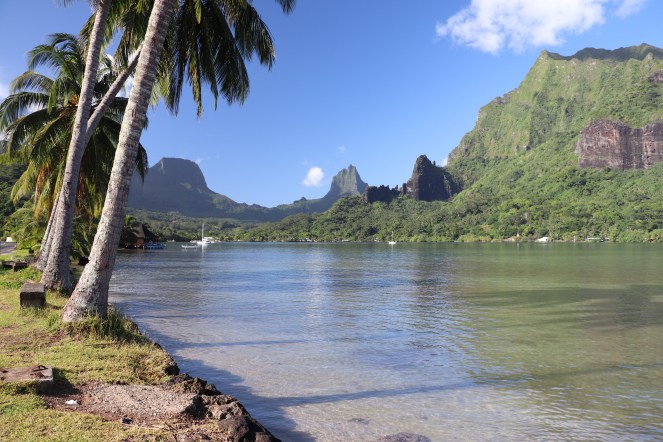
We also got a look at Mount Mouaputa (830 metres) which has the distinction of having a hole right through the top of the peak. Ron helped us to use our imaginations to see the princess with her hands in prayer in the profile of the mountain. Later in the day when we came back through Cooks Bay, the cloud had covered up the hole and most of the princess.
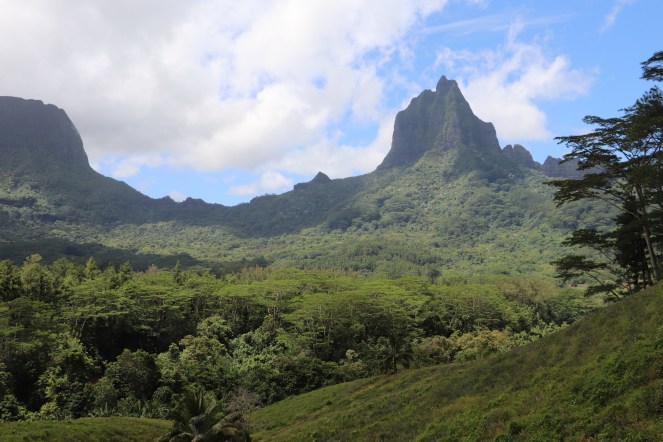
After picking up two couples at the Hilton Hotel, (one from San Francisco and the other from Kona, Hawaii) we headed for a rustic Tropical Garden to see various native fruits growing. The road up to the Garden was very steep and narrow. I was glad that Dan was driving. He was great a pointing out the various species and explaining how some of the growing processes worked. The gardeners have vanilla growing under a shade tent. It’s not indigenous to the islands, but grows well here. Dan pointed out some of the local flowers including the national flower of Moorea, Tiara Tahiti or gardenia. This flower worn behind your right ear, means you are single/available, however if you wear it behind your left ear you are married, engaged or otherwise taken. One source I read said if worn behind both ears it means you’re married but available and worn backwards means you are available immediately! The women wear the bloom fully open and the men wear it closed. We also got to try samples of the jam that they make from the various fruits that they grow and enjoy the amazing view from the mountain side location.

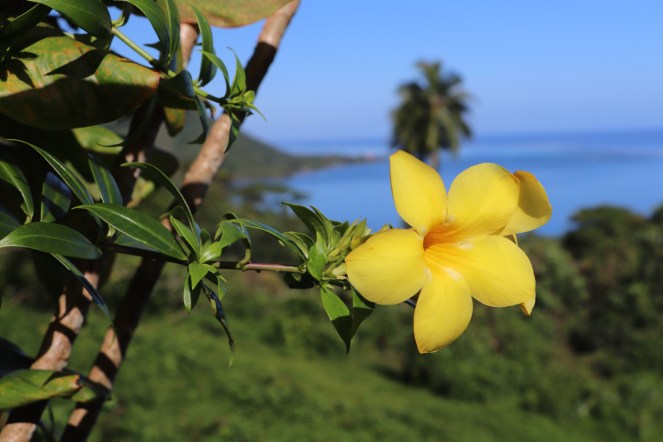
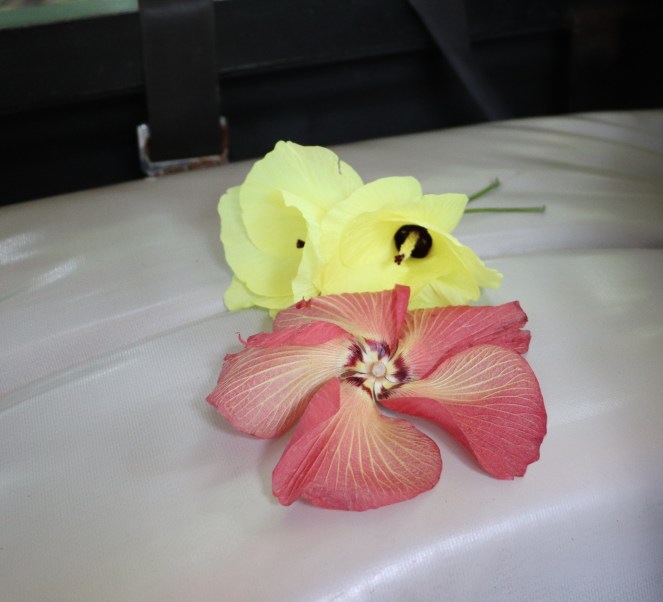
This flower below is called a Monet Flower. For some reason I missed taking a picture of the national flower.
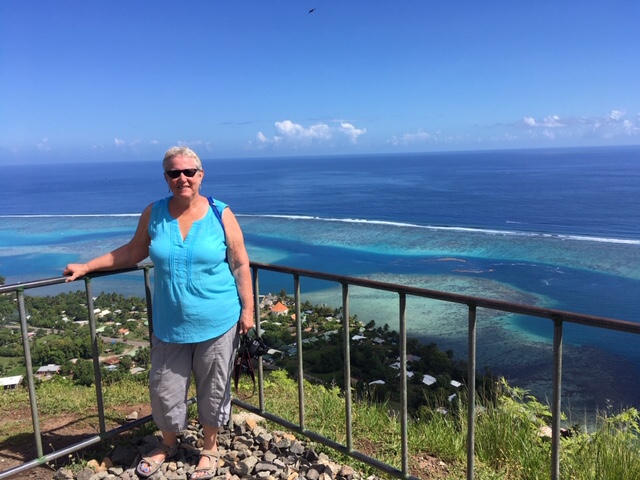
Back into the 4 X 4 and down the narrow road and on to drive around the largest bay on the island, Opunohu Bay on our way to Magic Mountain. Again up a narrow winding one way road. And I have the bruises on the inside of my upper arms to show as to how difficult it was to stay put in the 4 X 4. At the top of the road was a short steep path to get to the look out, but it was worth every step. It’s beautiful everywhere you look on this island but they were extra special from this view point. We could see down over the entrance to Opunohu Bay where a medium size cruise ship was unloading it’s passengers on to tenders to spend the day on the island. You could really see the different depths of water from this vantage point and the natural break in the coral reef at the entrance to the bay.
After sufficient Kodak moments we loaded up again and headed down the mountain and back to the main road again. At the head of Opunohum Bay, we turned on to a side road that lead to the Agricultural School. This school is the only post secondary school on the island, and students who wish to study something other than agriculture must travel by ferry to neighbouring Tahiti either daily, weekly or for the term. Those that stay over, usually stay with a family member. This time we were on our way to another lookout point called Belvedere. The road traveled through the agricultural school and some pineapple fields. The thing that struck me was how well kept and tidy everything was.
The view from Belvedere, which is the highest point you can get to by car on the island, was special because we could see both Opunohum Bay as well as Cook Bay and the mountains surrounding each. We ran in to a pile of ATVs who were touring around the island as well.
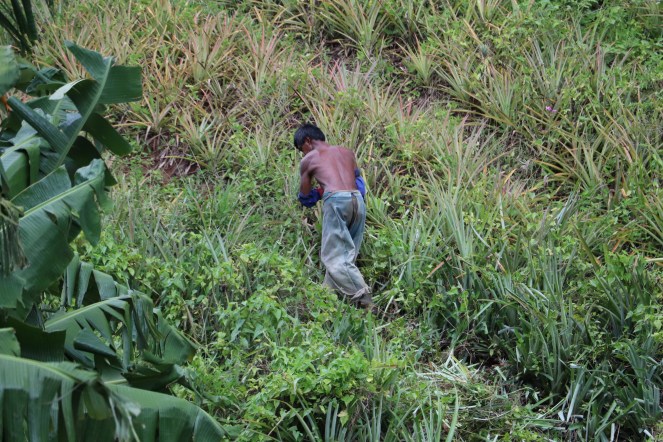
Back on the road, we followed an inland road through the PaoPao Valley and into Cooks Valley to join up with the main road again. Along the way, we got to see the commercial growing of pineapples. It’s very labour intensive and we saw one fellow at work with a machete carving back the weeds to expose the pineapple plants. He had to wear protective clothing on his arms and legs to prevent him from getting cut by the razor sharp leaves of the pineapple plants. A full 80% of the pineapples grown commercially (generally by farmers renting small plots of land from the owners) are sold to the pineapple juice factory on the island. The rest is sold domestically and we’ve had great pineapple on our fruit plates while we’ve been here.
Ron explained how pineapples and bananas grow including the male and female parts. So much to learn, so little time. The bottom purple coloured part at the bottom is the male part which is lopped off at the appropriate time to allow all the energy of the growth to go into the fruit.

He even showed us how to make a plate out of leaves – the ultimate in recycling. The Ti plant is used for all sorts of things from grass skirts, to decoration, to making harnesses for harvesting cocoanuts. He showed us a wild hibiscus whose bloom opens as yellow in the morning and by the afternoon after being in the sun it is peach colour.
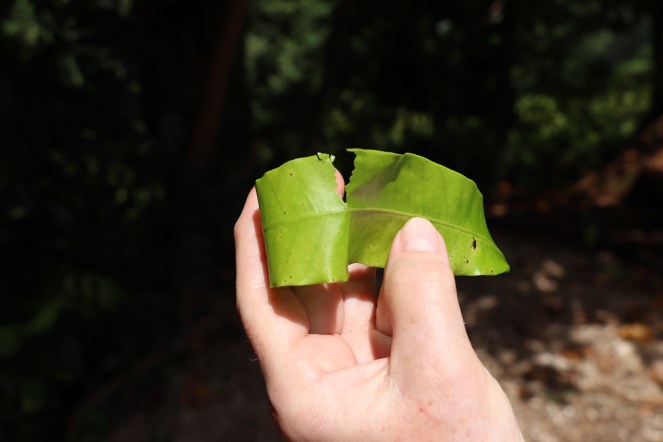
Dan also showed us how much the leaves of some plants smell like their fruit. He ripped some mango and lime leaves and let us smell them, and lo and behold, they smelled just like their fruit. All these years and I didn’t know that.
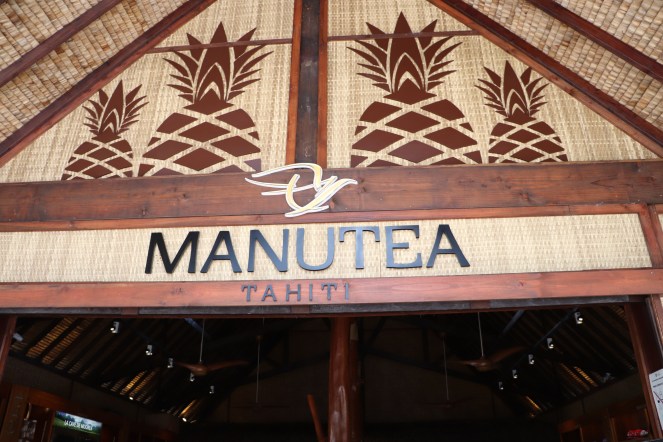
Our last stop was at the pineapple juice plant, where we got to taste some of their products. They make juice as well as alcoholic drinks and they had all of them for sale in their small on-site shop.Some were delicious, although some were a tad strong for my liking, and they were all really sweet. We didn’t actually get to see how the juice was produced, unfortunately.
After dropping off the other tourists, it was back to our hotel for a lovely late lunch on the outside deck, but under the cover of the roofline because what started out as a beautiful day had turned cloudy and the heavens opened as we were having lunch. We really did well with our choice to go snorkelling yesterday and take the tour this morning instead of this afternoon.
Much of the afternoon was spent on the porch of our bungalow reading and working on blogs, etc. It was raining off and on, but the temperature stayed the same. I found it so relaxing to be sitting still not feeling like I have to be somewhere, and enjoying the unbelievably beautiful scenes around me.
There are a few restaurants on the island that cater to those staying in hotels that didn’t rent a car by providing transportation and last night we got the concierge to book at one of them for us. We were just leaving the hotel to jump in their van with another couple who were also headed to the same restaurant and there were another group of four who were also waiting but for a ride to another restaurant. I looked at one of the fellows and thought I know that guy, but then thought, couldn’t be, your around the world away from home. But I stopped and looked back and realized who it was and I did in fact know him. I called out his name and he answered. It took him a minute to remember me, as it’s been 18 years since we’ve seen each other. We only had a chance to shake hands and marvel at the coincidence and I had to leave, but how weird is that.
It was a wonderful dinner of fresh seafood, mine a seafood casserole and Nanci’s a shrimp curry. And we both saved room for a delicious dessert – mine a guava and something tart, (sorry, I forget) and Nanci’s cocoanut and chocolate ice cream. Yum.

What an excellent day.
I’m having trouble uploading pictures this morning, so I’ll add more when/if I get better wifi.

 Lois' Adventures
Thanks, as always, for your wonderful descriptions and beautiful photos of your adventures, Lois! We’re enjoying the journey and learning along with you. Have a great trip!
LikeLike
Lois, thank you so much for sharing your experience. What a beautiful place you are at. Look forward to hearing and seeing more. Have a wonderful time!
LikeLike
Your shirt matches the water. Stunning scenery.
LikeLike
Your posts have been keeping me sane (busy season at work). Love the photos and the details, I feel like I’m right there with you, which is where I’d rather be 🙂
LikeLike