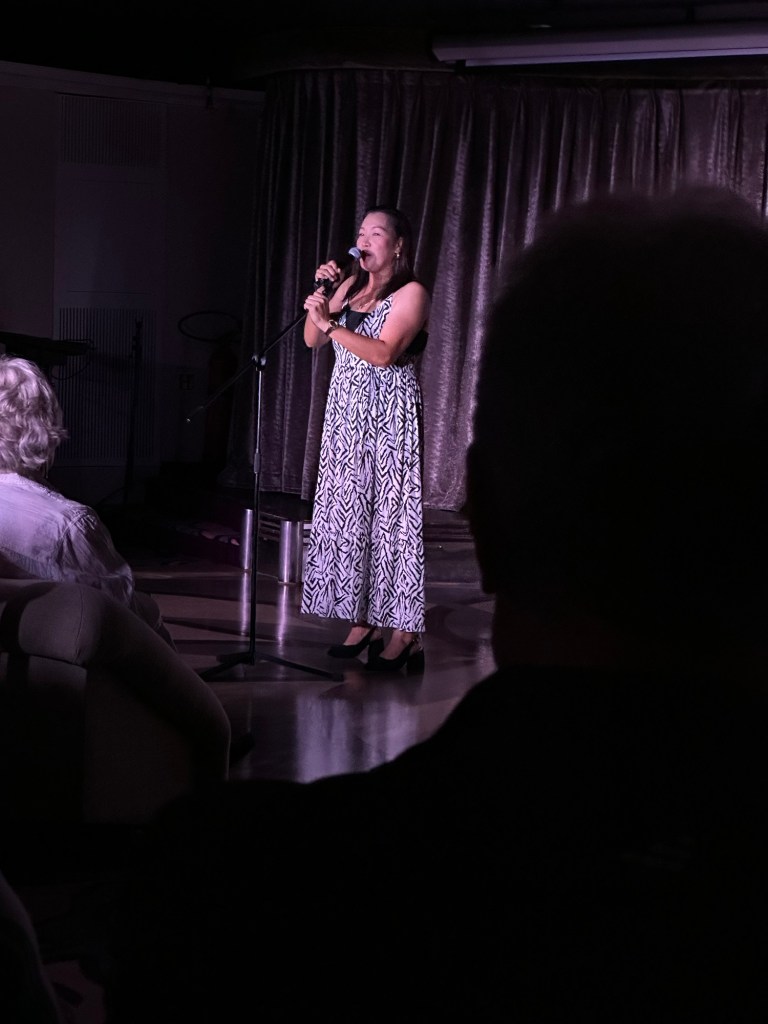
Last night (after I’d sent my blog for the day) it was the much lauded Crew Talent show on the Star Pride. I have seen a couple of them before and they were fun. It is pretty amazing the talent on board. There are many countries represented among the crew and they are proud to show their culture to the passengers. Last night was a guitar/singer from the Philippines, a group from Indonesia doing some choreographed drumming, a singer from the housekeeping crew (mine actually) singing Lady Gaga’s part of Shadow, a fabulous singer from the Bar server team who did justice to The Prayer, and the ever popular grand finale, the synchronized swimming team. A group of about 8 of the housekeeping staff put up a barrier about thigh high to represent the water, and then they do various formations behind it like synchronized swimmers. Hard to explain, but it was hilarious. And the neat thing is that the crew seem to really enjoy doing it. Now on to Bonaire.
Bonaire started out the same way most of the Caribbean islands, with the native Arawaks, and discovered by the Spanish in 1499. The Spanish depopulated the island by sending the Arawaks to work in mines throughout their empire. Then the Dutch took power in 1634 and saw the potential from the flat topography for harvesting salt. It was very labour intensive and so slaves were put to work in horrific conditions in the salt fields until the abolition of slavery when the salt flats were closed. They lay dormant until World War II when mechanization allowed them to be productive.
In 1954 the country of the Netherlands Antilles came into being and Bonaire was part of it along with Curaçao, Saba, and Sint Eustatius, with the capital in Curaçao. However, the Netherlands Antilles was dissolved in 2010 and Bonaire and other islands, not including Curaçao, now have a “special territory” relationship with the Netherlands.
The islands we’ve visited so far have been quite hilly and lush vegetation with villages dotting the mountain sides, and in flats areas along the shore, however the south of Bonaire is relatively flat with mangroves in places and salt flats in the south. The north is more rugged and hilly, and protected by the Washington-Slagbaai National Park.
Tourism has grown on Bonaire revolving around the bounty of the sea in the form of well preserved coral reefs growing on the leeward side of the island, very close to shore. There are 50+ dive sites available just off shore around the island so it makes for extraordinary access. In fact, just walking along the sea wall this morning we could see beautiful fish in blues, and purples. The island is quite arid with little rainfall because of its location, and the lack of rainfall makes the waters exceptionally clear of silt. The reefs have been protected by establishing an underwater national park that surrounds the island in recent years, although enforcement is always an issue.
Although there has been no industry to have a negative impact on the environment, in recent years concerns have been raised about the health of the reefs, and the growing number of tourists visiting the island. Too much of a good thing. Although many tourists come to stay on the island, ship passenger traffic has increased exponentially.
In 2022 the government implemented a “one ship a day” policy to limit the number of daily visitors and increase both the quality of life of islanders and the tourist experience. Only one of the big cruise ships is allowed into port each day, with the exception of those carrying under 600 passengers which can dock along with the one larger vessel. This is the first full season of this policy so it will be interesting to see how that works out for them.
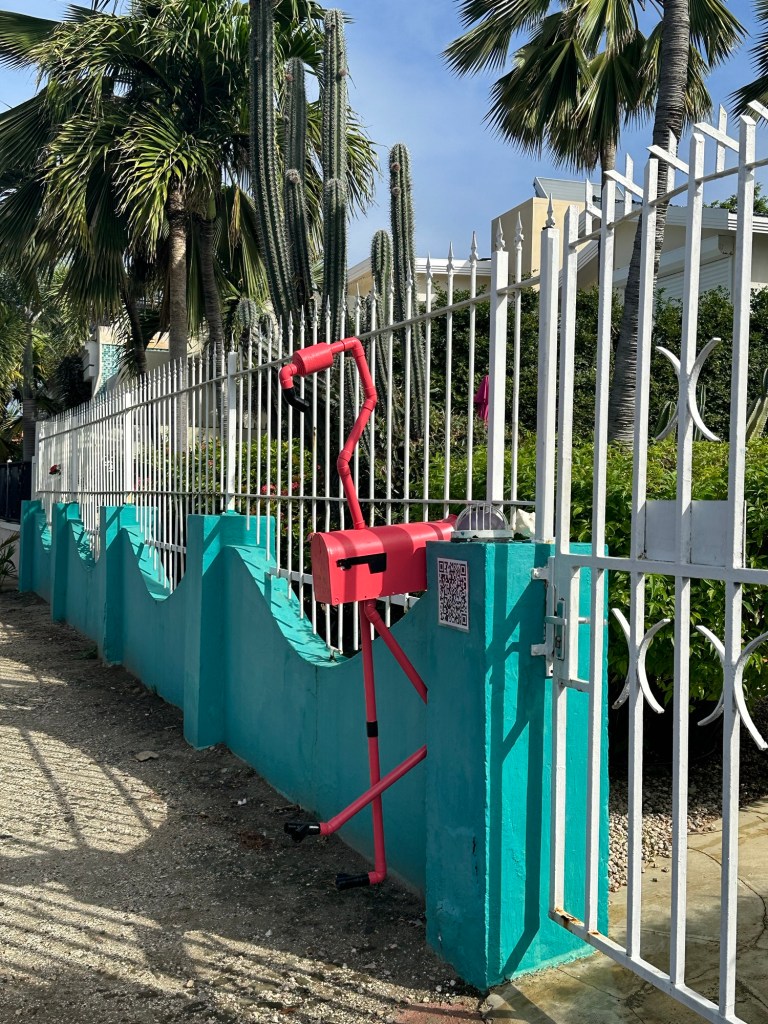
Bonaire is home to 10,000 Caribbean Flamingos, and it is Bonaire’s national bird. It is one of only four major breeding sites for the Caribbean Flamingo. Three thousand pairs have historically landed in Bonaire in December and some in June to mate, laying just one egg each. In recent years, biologists have noticed that the hatchlings are undernourished and not doing well. Drought, large amounts of Sargassum weed piling up on the shores and stronger winds are all potential causes that are being investigated.
Fun Facts:
⁃ Bonaire is a part of the so-called ABC (Aruba, Bonaire, Curacao) islands close together and near the north coast of Venezuela. They are protected from most hurricanes and have only been hit by the eye of a hurricane on average every 29 years.
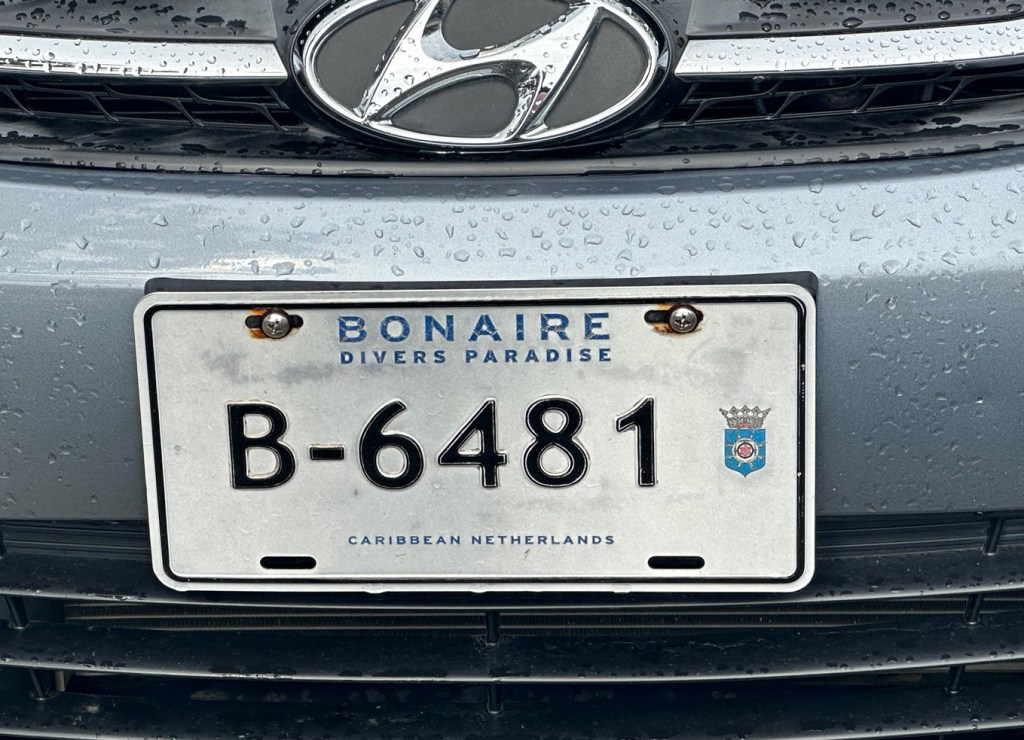
⁃ “Divers Paradise” is on the license plates of vehicles in Bonaire.
⁃ Bonaire’s airport is called Flamingo Airport.
⁃ Rincon is Bonaire’s only other town, founded by the Spanish in 1527. It was strategically placed by the Spanish in a valley with lookout points surrounding it so that pirates and other country’s ships couldn’t see it when passing by Bonaire.
⁃ Bonaire has an extensive wet and dry cave system where thousands of bats from nine species call home. They are active at dusk and after dark, hunting for insects, nectar, fish, pollen and fruit.
⁃ Bonaire is south of the hurricane belt, but right in the path of the trade winds, and its almost constant breezes from the east push off rain making it a true island desert.
⁃ Drinking water for the approximate 20,000 inhabitants of Bonaire is produced from desalinated seawater via reversed osmosis and additional treatment steps
⁃ Salt produced on Bonaire by the American company Cargill, can be seen piled in huge pyramids on the southeastern part of the island. The salt is produced by moving sea water through a series of condenser ponds with the water evaporating by the wind and sun. Then when the salinity reaches 25 – 30 percent it’s moved to crystallizer ponds and when more water evaporates and it reaches 37% the salt starts to crystallize and precipitate out of the brine. A microorganism which flourishes in high salinity causes pigments which give the ponds the pink-red colour.
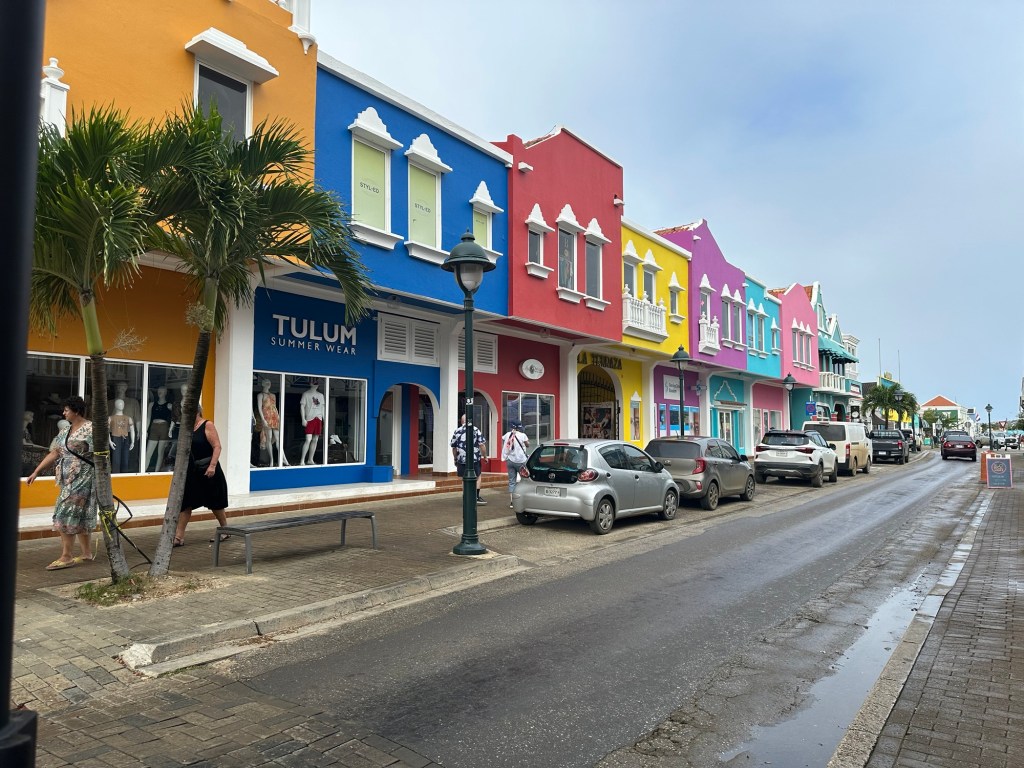
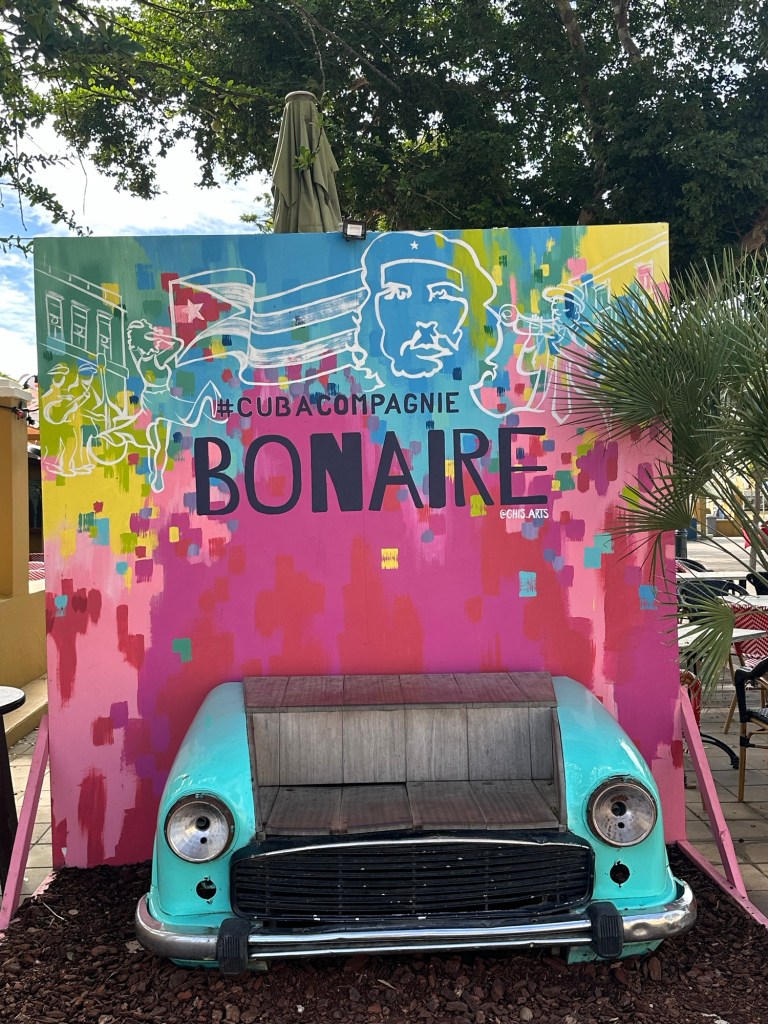
Having said how arid it is in Bonaire and that the weather systems get pushed away from the island, today is the first day we’ve had pretty consistent rain! We are docked in the port in Kralendijk, the capital city of Bonaire, and this morning we took a walk down the Main Street of the tourist area, and along a boardwalk right on the sea.
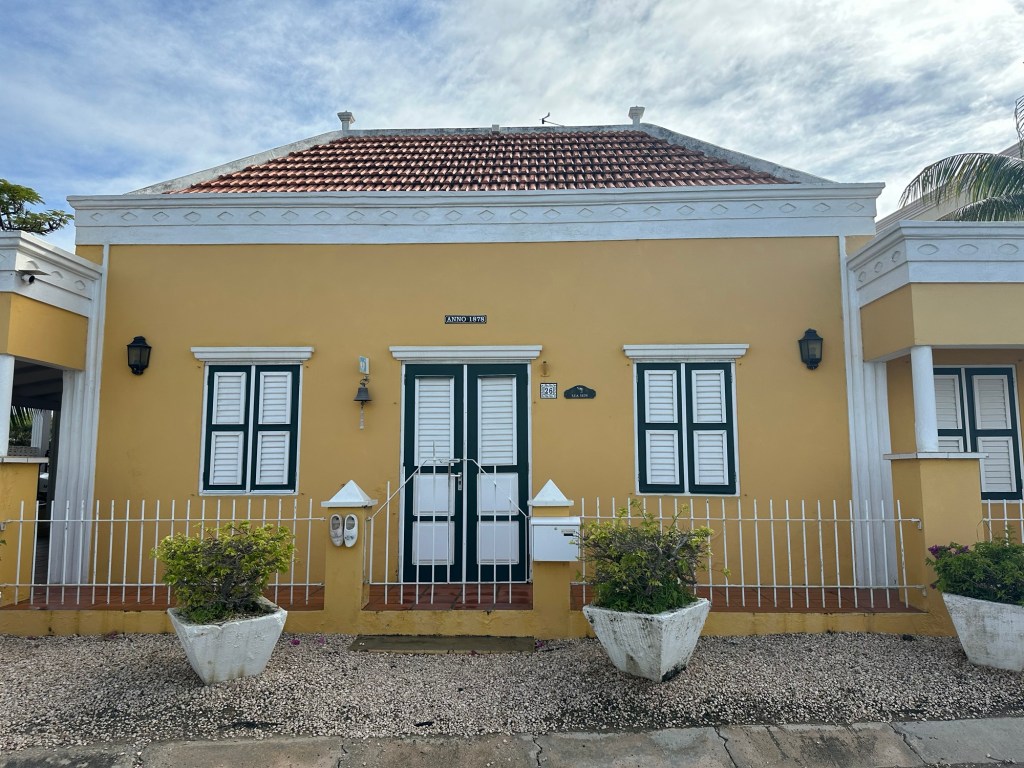
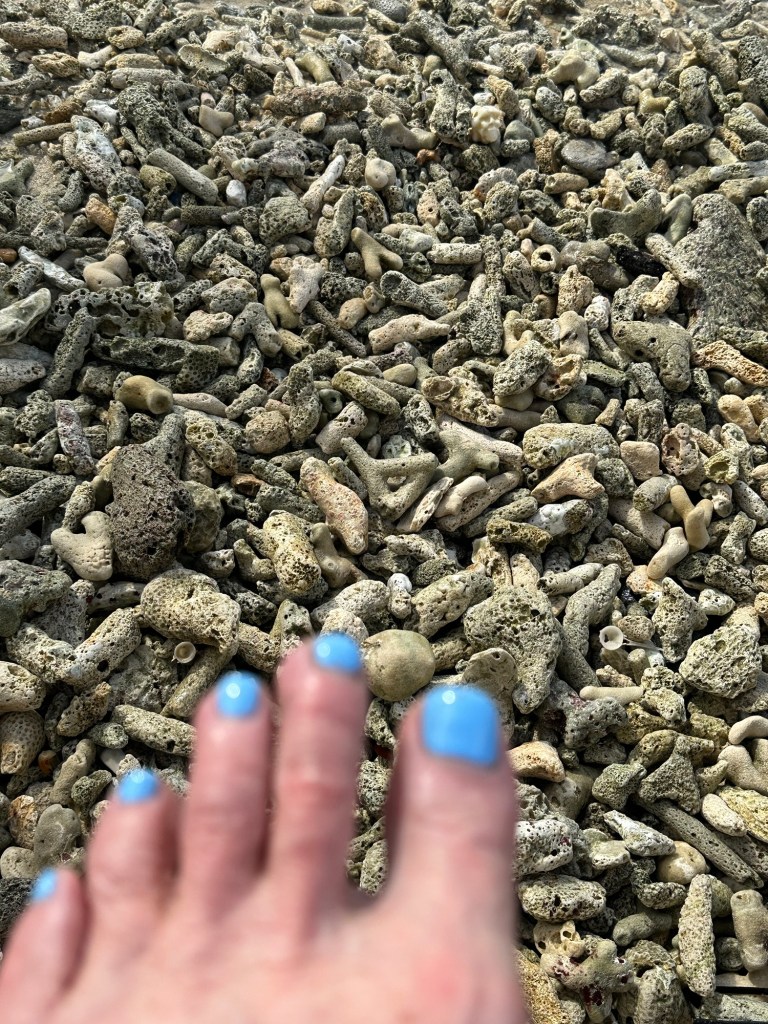
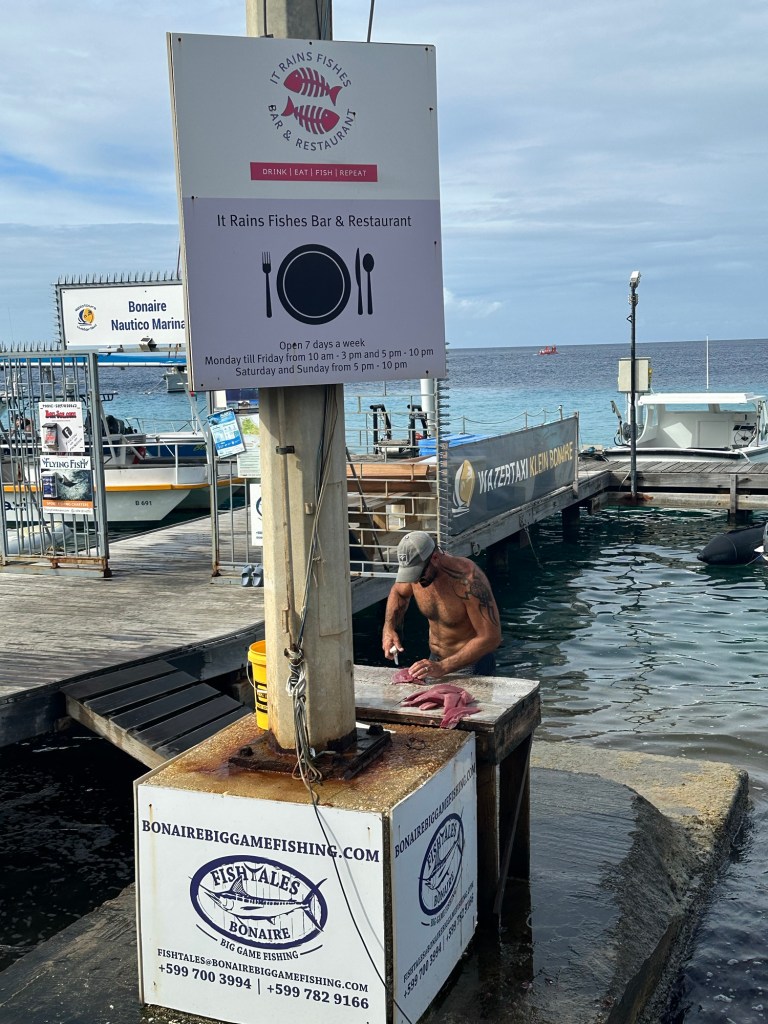
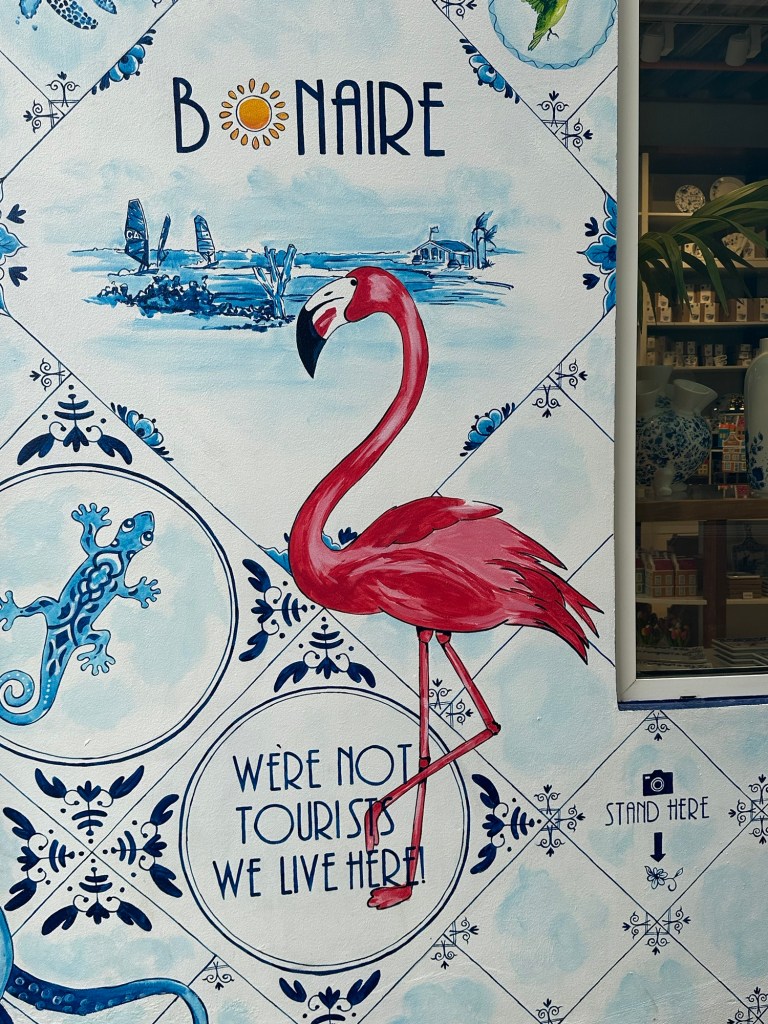
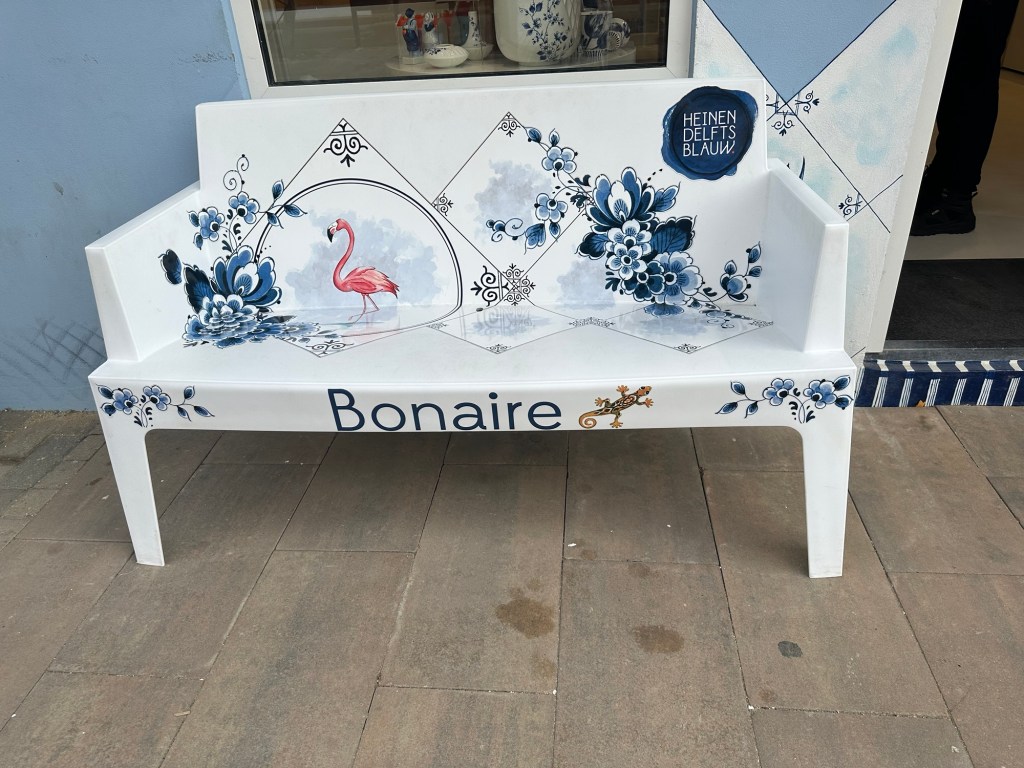
Fortunately the rain held off and it was actually quite hot and sunny. It is a very neat, colourful, orderly, clean and friendly city with many nice shops and restaurants. It feels very Dutch here, with the sound of their language (one of the official languages), and shops with Delft Blue everything. It’s one of the few islands that I might consider a longer visit some time.
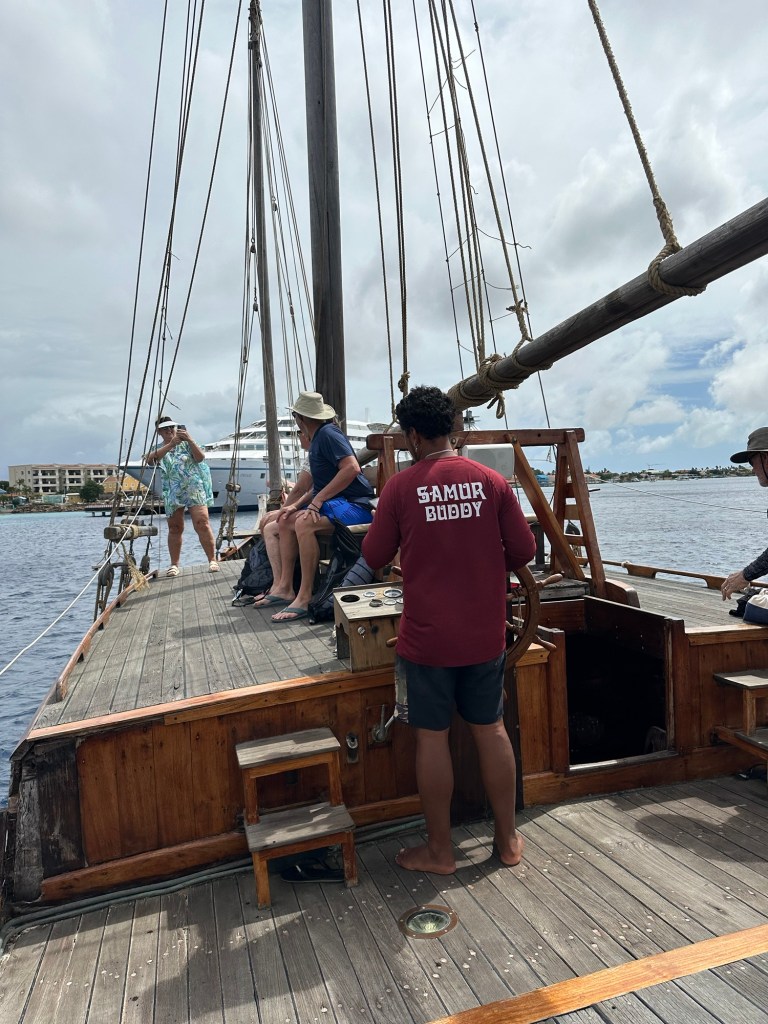
We came back to the ship to get ready for our afternoon snorkel adventure on the Samur Sailing Ship. It is an authentic Siamese junk – hand build and carved. It has seen better days. And it was an adventure. We were transferred from the dock in a rubber dingy to the Samur where we had to go from the dingy up the side of the boat, with foot holds that were quite far apart, especially for short people, hanging on for dear life to window frames and railings. Oh, and did I mention while the dingy is bouncing in the waves. Once all aboard, we headed off to an island a short distance off Kralendijk called Klein Bonaire. Oh, and it’s about now that the rain started. And it continued for most of the rest of our excursion until just as we arrived back at the ship’s dock when the sun broke through the clouds for a while.
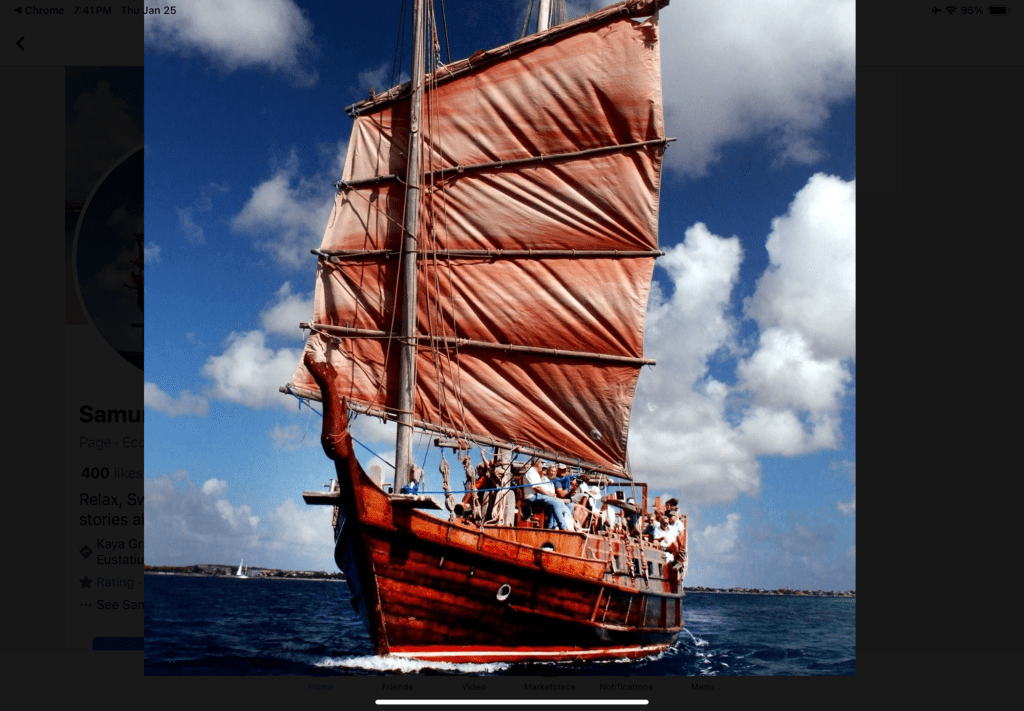
We motored much of the way over to Klein Bonaire, but they did put up the sail for a short time, and it’s a very different design. The boat tied up to a buoy (not allowed to anchor to preserve the reef) and we climbed back down into the dingy and were taken to the start of the drift snorkel. Snorkel gear on and over the side.
There is a reef that runs parallel to and not far off the beach that we would be drift snorkelling along. It was full of life, both fish and coral and I think it’s the best snorkelling I’ve had in the Caribbean. The water was warm and for most of the way we were able to drift with little effort while watching the undersea world. Part way along the reef, the current shifted and all of a sudden we were meeting it head on, and so we ended up having to put quite a lot of effort into making any progress. But with the plethora of things to look at below, it was worth it. We made it to the beach, where we would be for a while longer, and it was chilly in the rain and wind, so we headed into the water where it was warmer. Then the process was reversed and we were on our way back to the Star Pride. Along the way, those who were interested were rewarded with a rum punch on the return trip.
It was quite the experience, rain and all, but I was very glad to have done it. And I really enjoyed my warm shower once back in my home away from home.
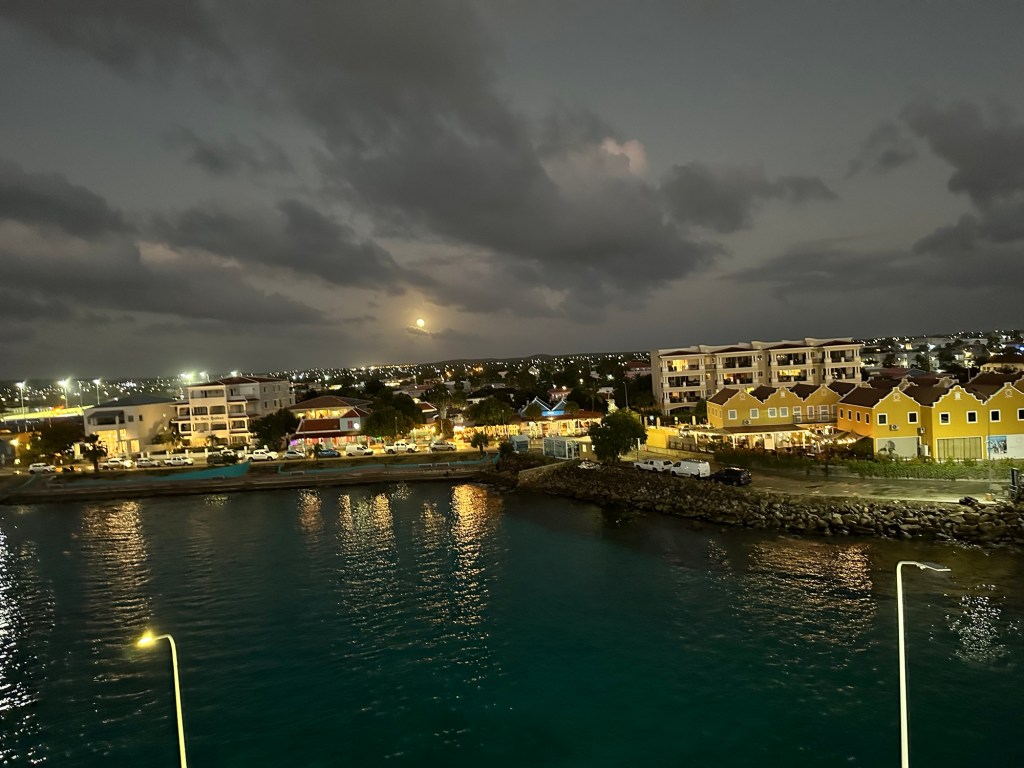
Tonight was the deck barbecue and I sure wouldn’t have wanted to be the one making the call on whether to hold it on the deck or move it inside, because it’s been raining off and on all day. But they went for it and luckily it stayed clear, and the full moon was visible rising quickly over the town. So we enjoyed fabulous food once again. Like we needed it!
A fabulous day on Bonaire. But it’s on to Curaçao tomorrow.
 Lois' Adventures