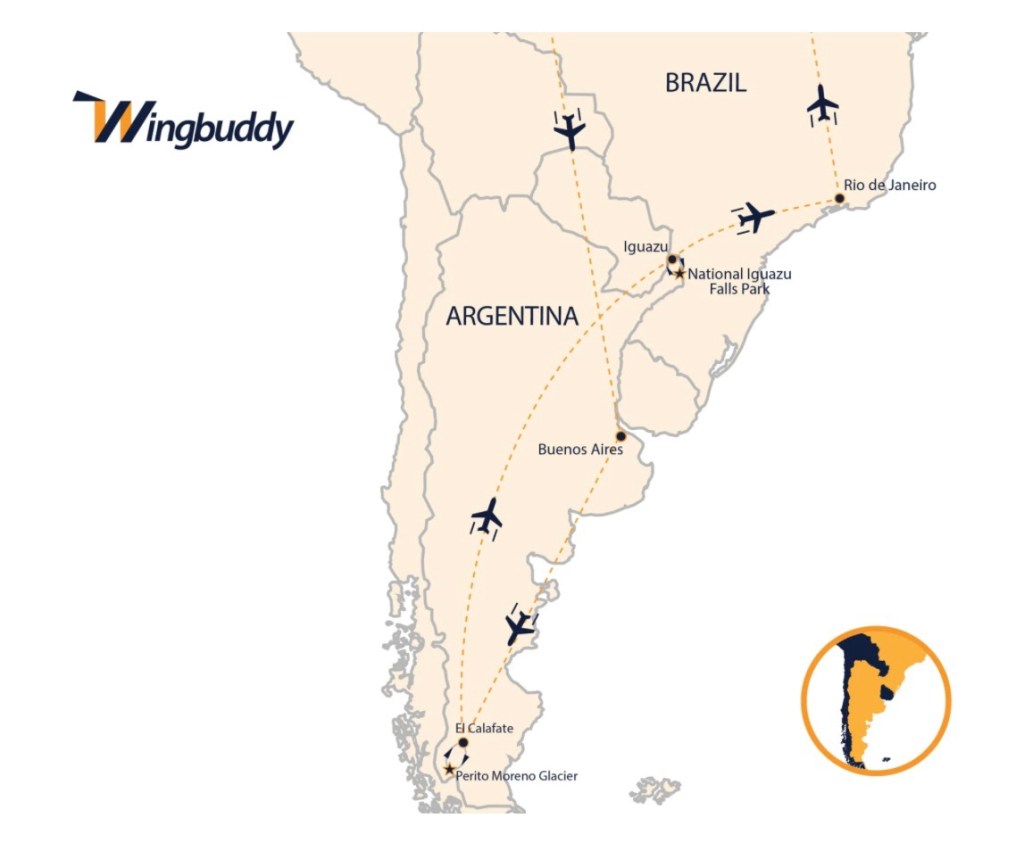
2025 South America

Bucket List ✅

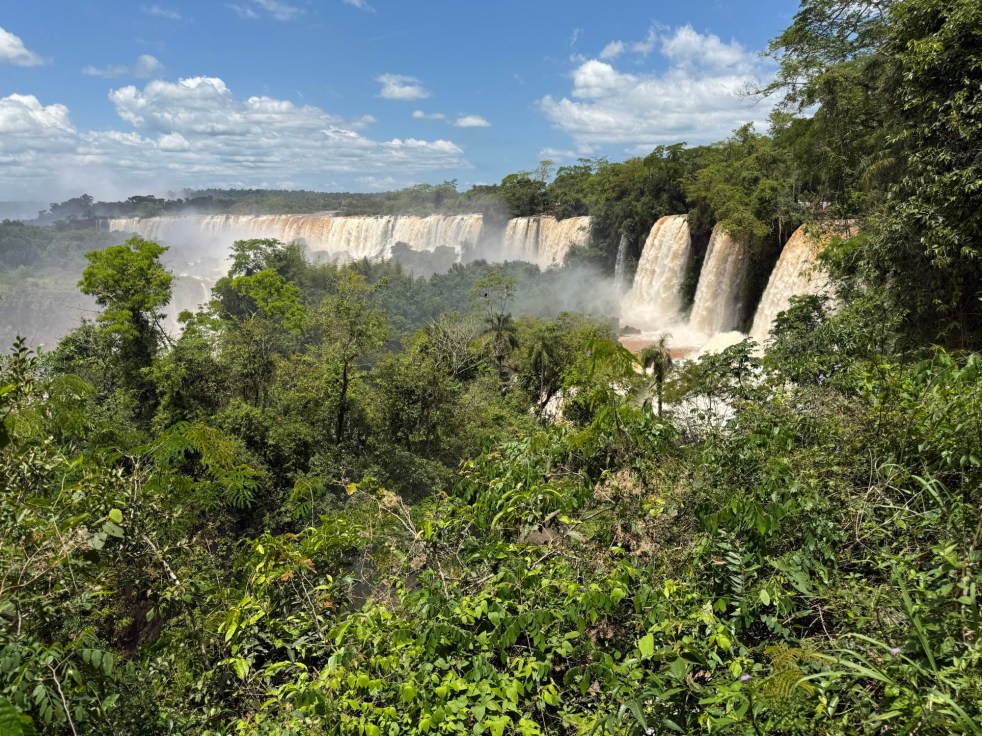
Today, and our excursion to Iguazu Falls, is the main reason I booked this trip. I am so very grateful that the forecast for today is for sun and warm weather so we can enjoy our day and hopefully get some good pictures.  

Gabrielle was our guide for today, and on route to the Park he gave us some information about this region. He spoke with pride about the beautiful jungle around us, and the falls and the fact that the government has protected 80% of the jungle in this area. This area apparently holds 60% of the biodiversity of Argentina in the way of animals, bird life and plants so it’s really important. 

Iguazu National Park is in the farthest northern tip of Argentina at the border with Brazil, created in 1934 to protect the falls and the surrounding subtropical jungle. Across the Iguazu River from the Argentinian Iguazu National Park is the Brazilian one of the same name and both are designated as UNESCO World Heritage sites.  

There are apparently threatened species of jaguar in the park, although thankfully we didn’t see one! Many other threatened species reside here as well including the jaguarundi, tapir, ocelot, and anteater. There is also a member of the raccoon family, a Coati, that is not at all endangered but rather is a huge pest, particularly in eating areas where they have built big screened in eating areas to keep the animals from ransacking people’s back packs and literally taking food from their hands.  

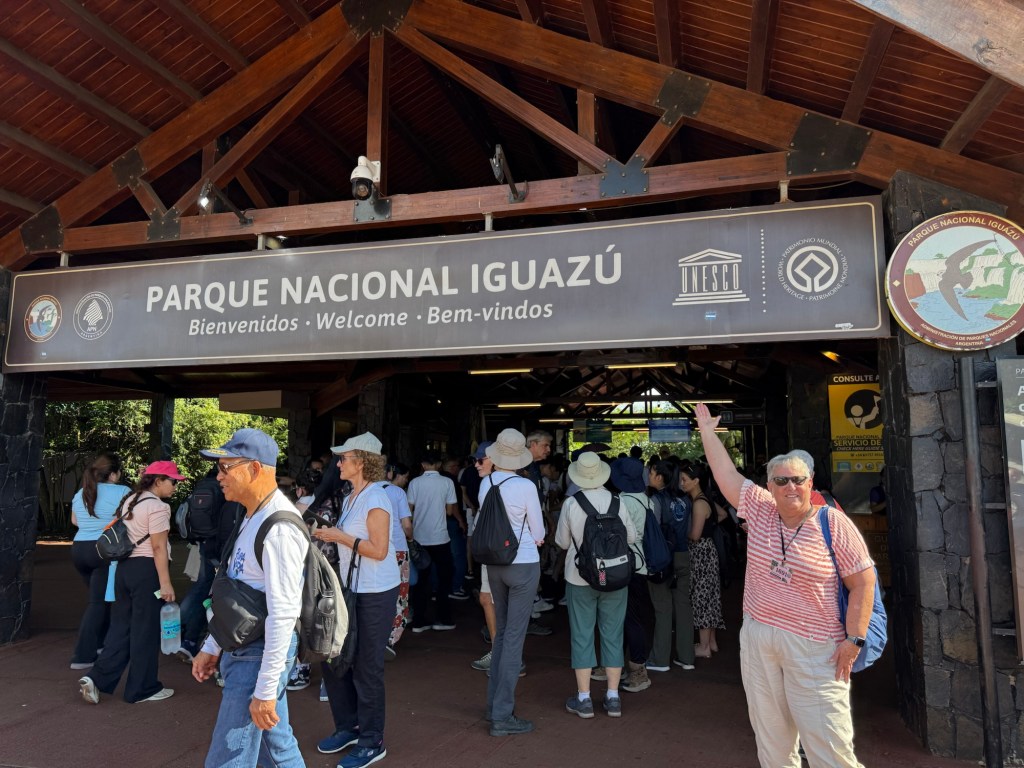
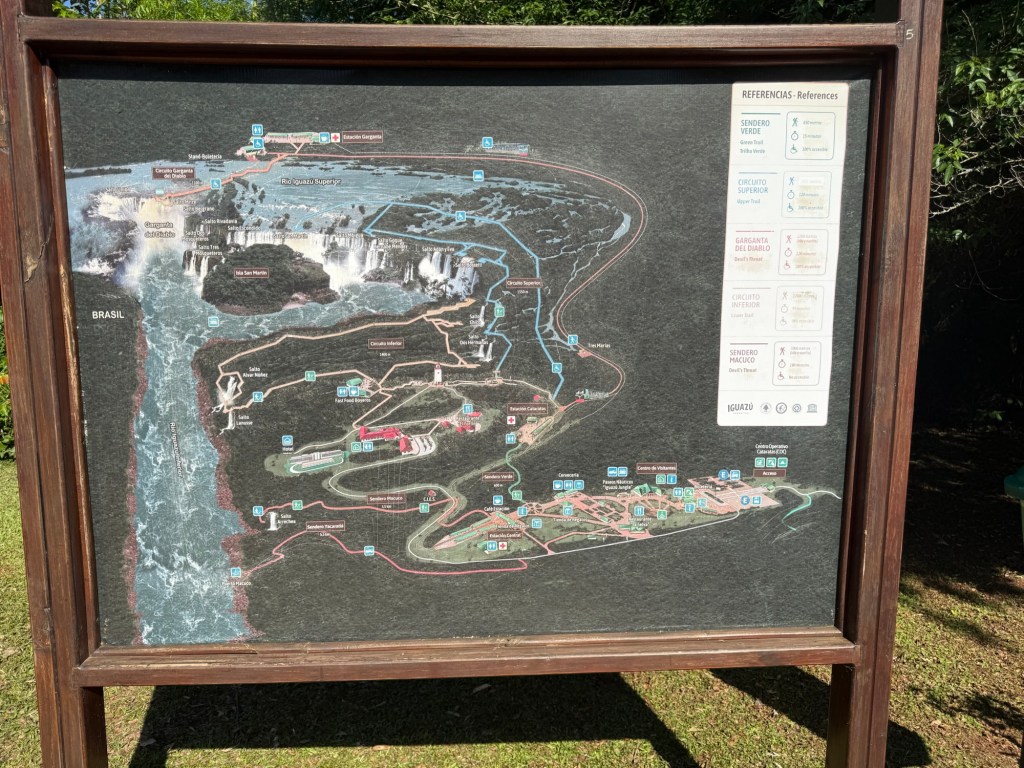
We started our day as we have with most of our tours, zig zagging from hotel to hotel picking up passengers along the way. Once at the park Gabrielle explained what the day would look like and off we went.  There are three loops in the park where metal-grated walkways take visitors along an upper loop of the river bank, lower loop of the river bank, and one to the Devil’s Gorge at the beginning of the falls.  We would see all by the end of the day. The map below gives you a good perspective of how big the park is and how much of an area the waterfalls cover.
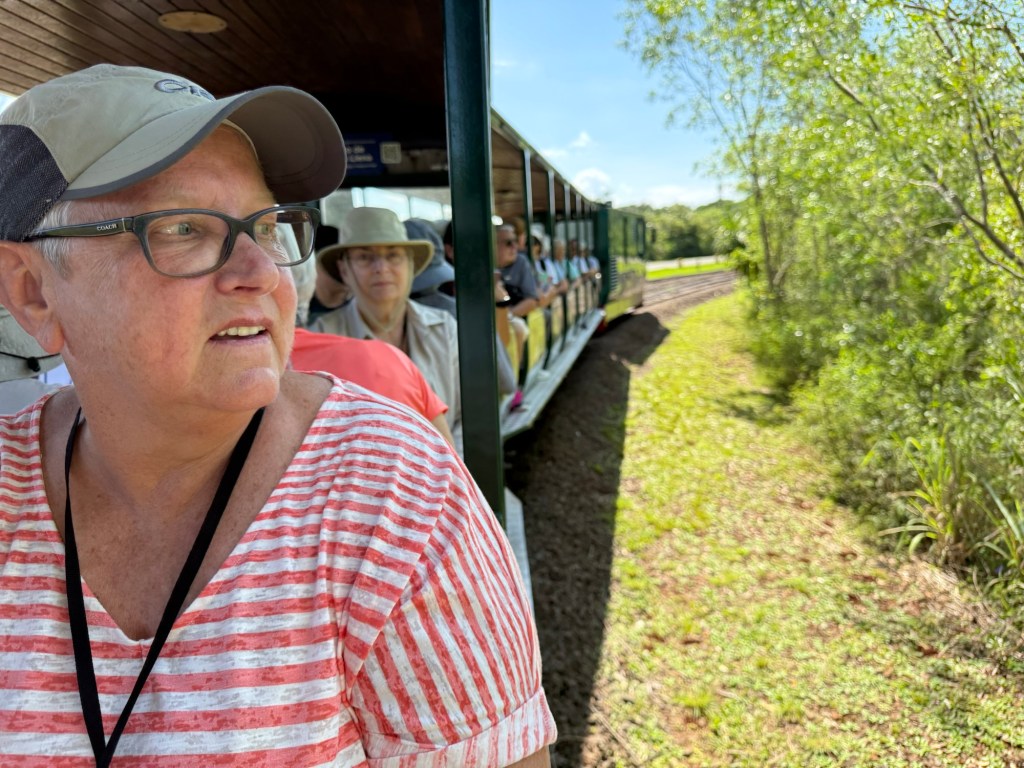
There is a small train that takes passengers from one end of the park to the other and we took it to the end of the line to get to the walkway to Devil’s Gorge.

The walkway took us over top of the delta of the Iguazu River which the guide told us is only knee to hip deep at this point in the wide delta. This is where the falls start and continue down the river on both sides for 2700 metres, 2100 on the Argentinian side. 
At the end of the walkway is a “balcony” where we stood to look down into a huge hole into which hundreds of litres of water flows known as the Devil’s Throat.  And it’s just one of the approximately 275 falls!  It drops 82 meters or 269 feet and is the largest drop in the park. 
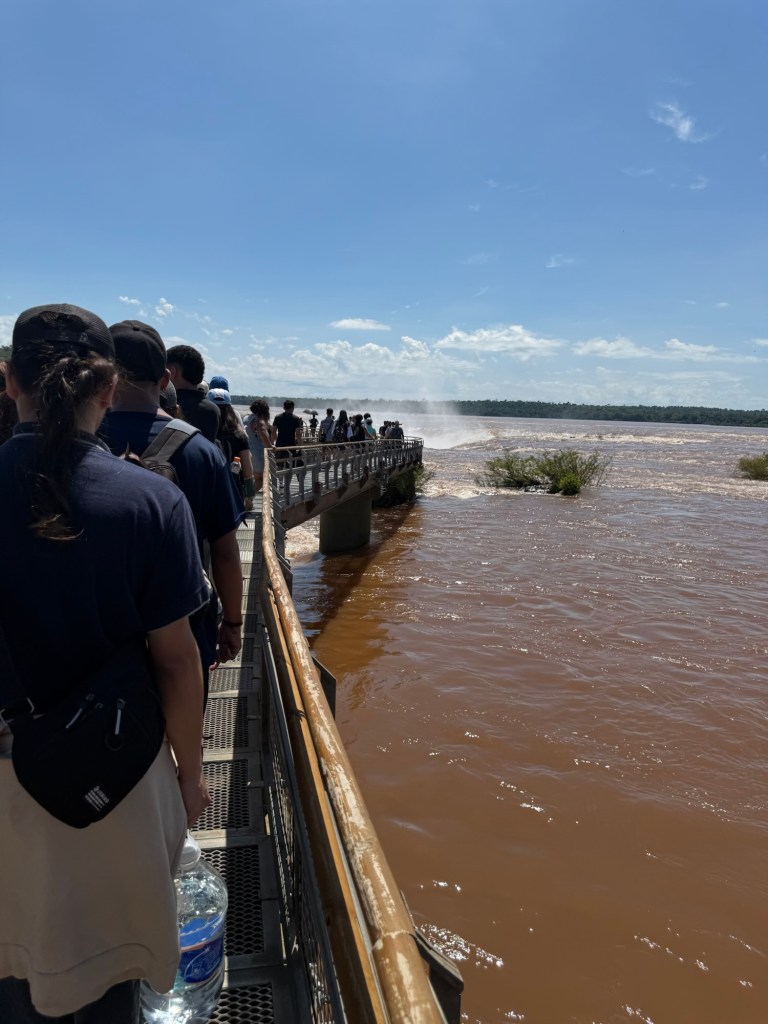
We have been told that currently the flow rate is 3 million litres per second over the total of all the falls on both sides whereas normally it’s closer to 850,000 – 1.5 million litres per second. Yes litres per second.
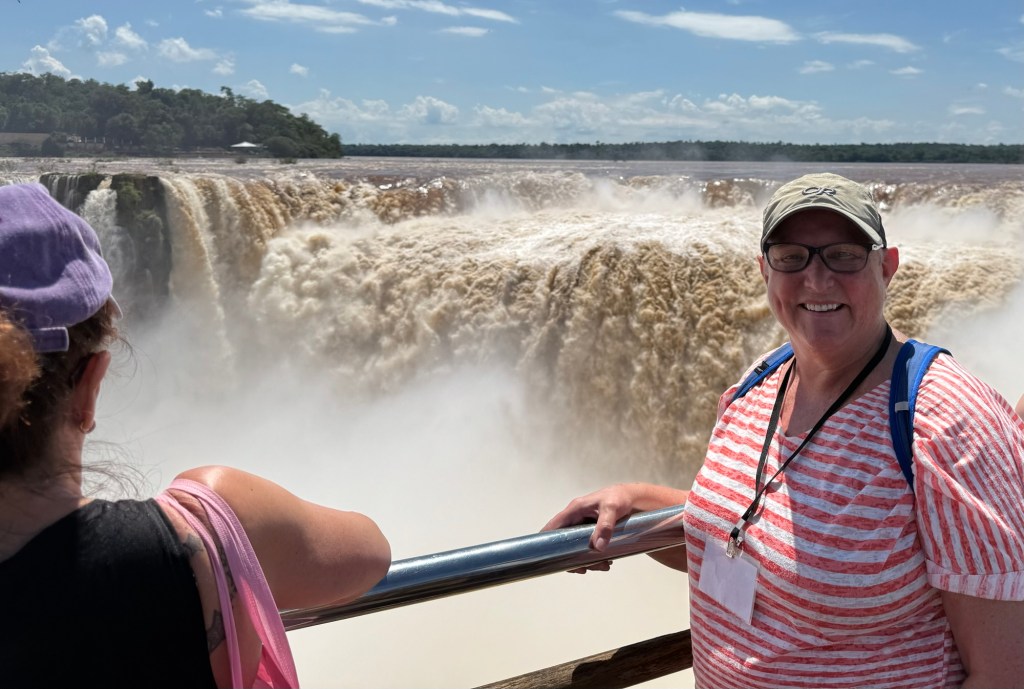
The sound at Devil’s Throat is deafening and you can’t see too far down toward the river bed below because of so much spray. We got the odd blast of spray as we walked around the balcony taking pictures but it felt good as it was a hot and humid day. You can imagine the jockeying for position along the railing at the best photo spots!  Iguazu Falls gets over 1 million visitors a year with most visiting both the Argentinian side as well as the Brazil side.  
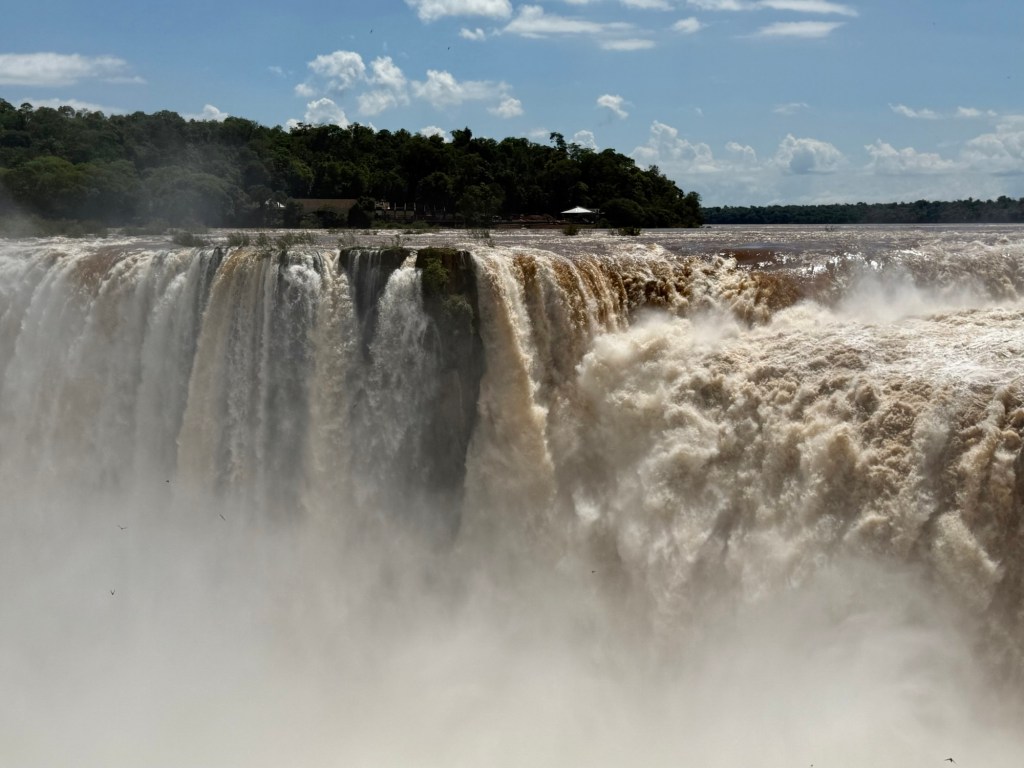
Devil’s Throat
Devil’s Throat

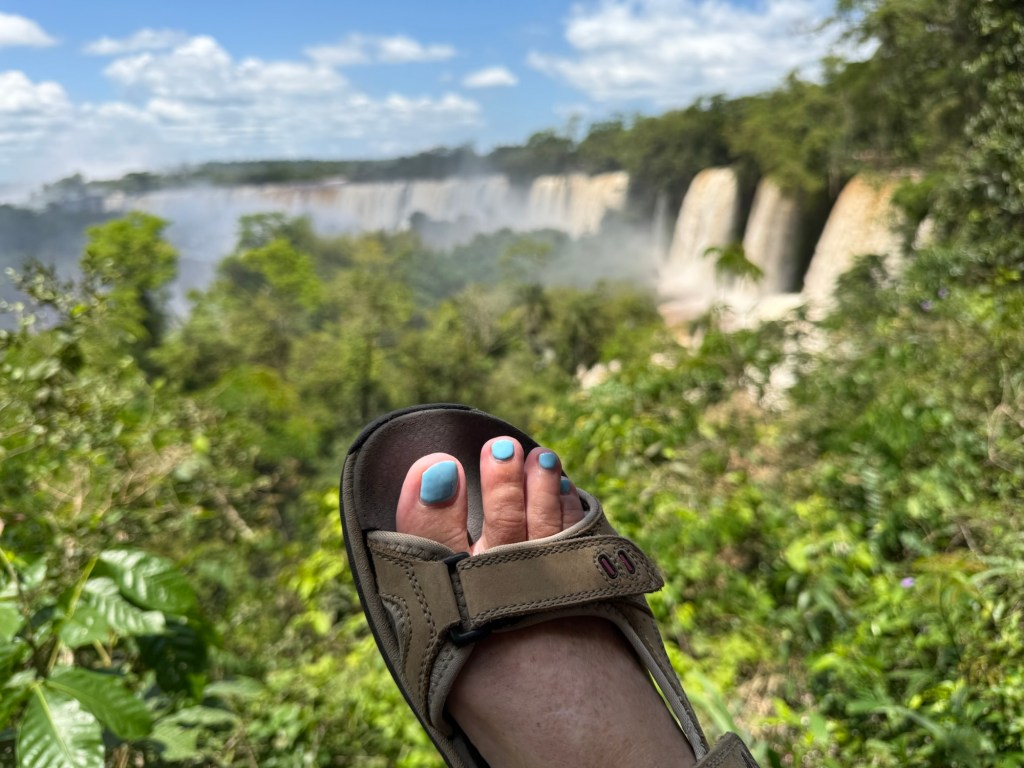
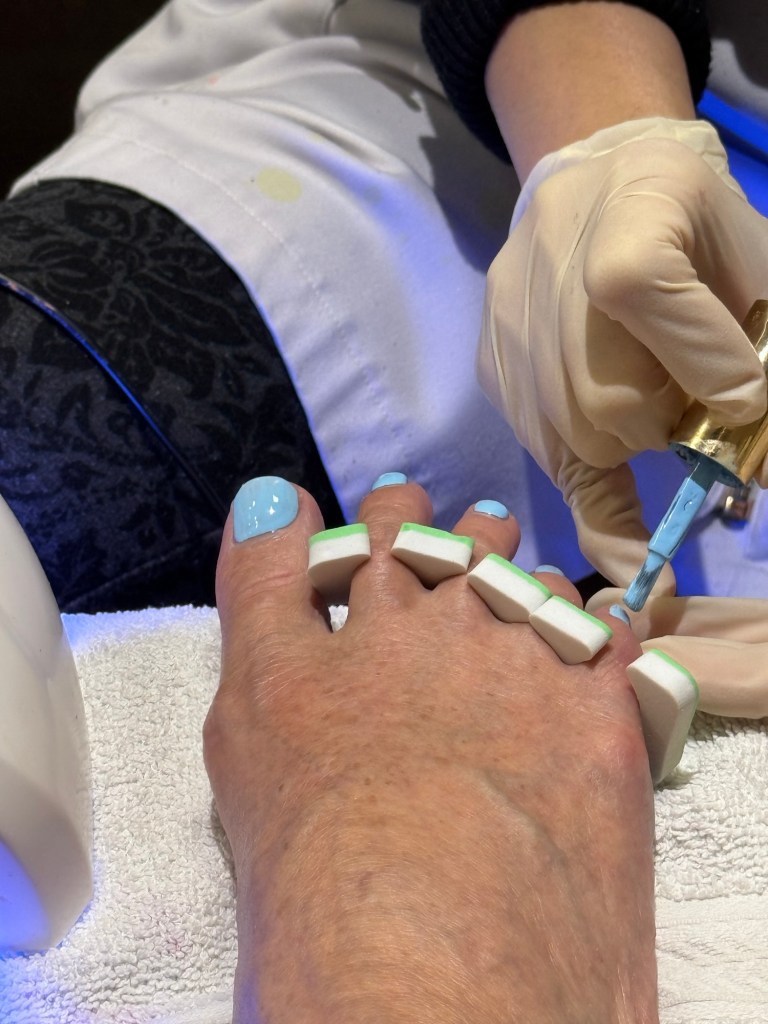
We made our way back to the beginning of the walkway and took the train back to the beginning of the upper walkway which follows the bank on the Argentine side where the majority of the falls are located. Since we were looking down on the falls on the Argentinian side, sometimes we could only see where the water went over the edge and not see where it was going, but because the walkways wound around the various features and the river winds as well, we could see many falls right down to the river bed as well. My toes picture is taken along this walkway. At the end of this walkway was the San Martin Falls, in tribute to the hero of the Argentinian liberator, whose tomb we had seen in the Cathedral of Buenos Aires. 
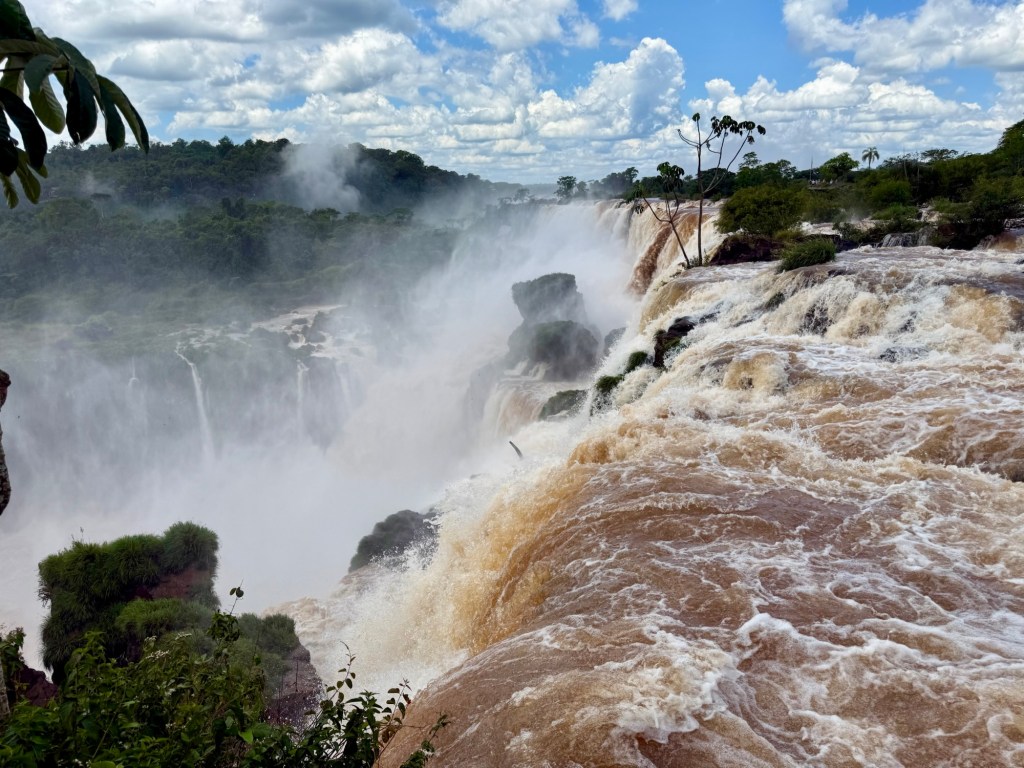
San Martin Falls
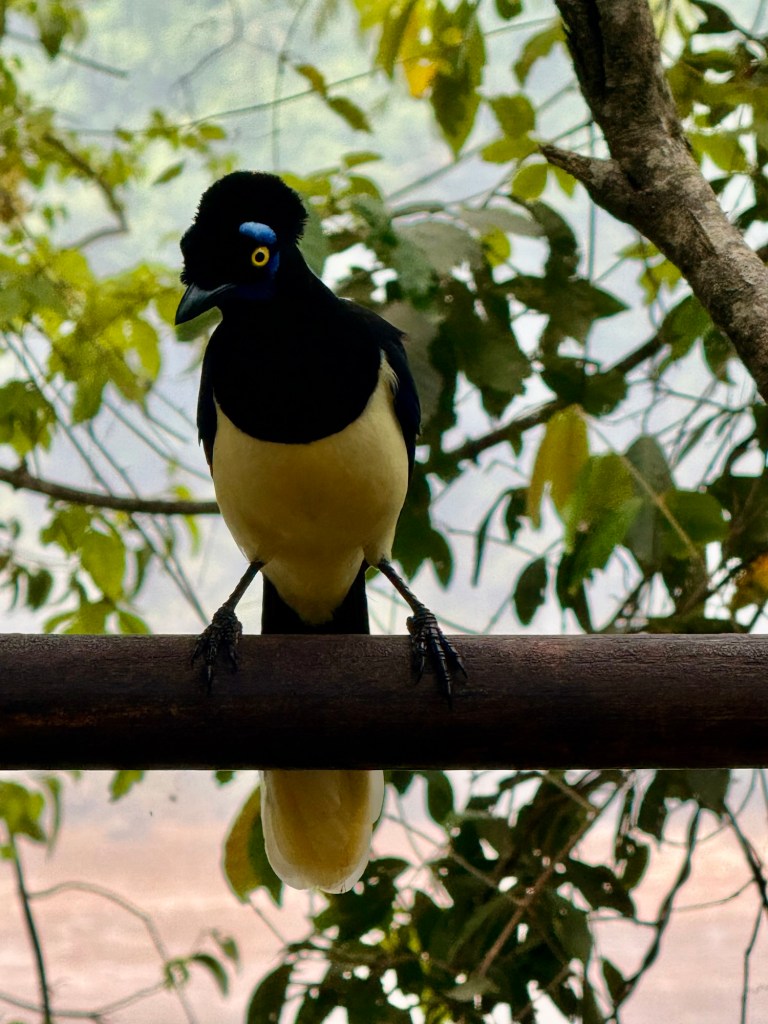
Haha, check out the eyebrows on this guy

By now we were starving but good news, it was time for lunch. It felt really good to sit as we’d already hiked over our 10,000 steps. 

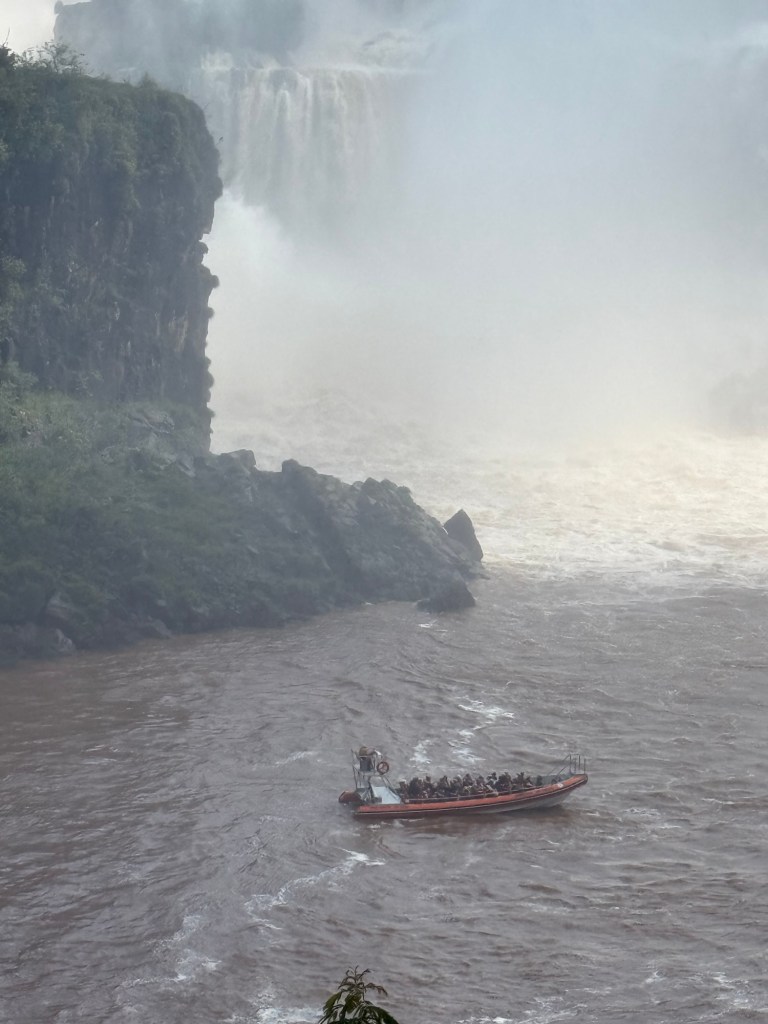
After lunch, some people who had opted to take the boat into the gorge left our group and headed out for their adventure. It was much like a combination of the “maid of the mist” at Niagara Falls, and the fast boat that whips along the river down stream from the falls. It was 2 hours out of the day, and having done both those experiences at Niagara Falls I opted not to do it today. 
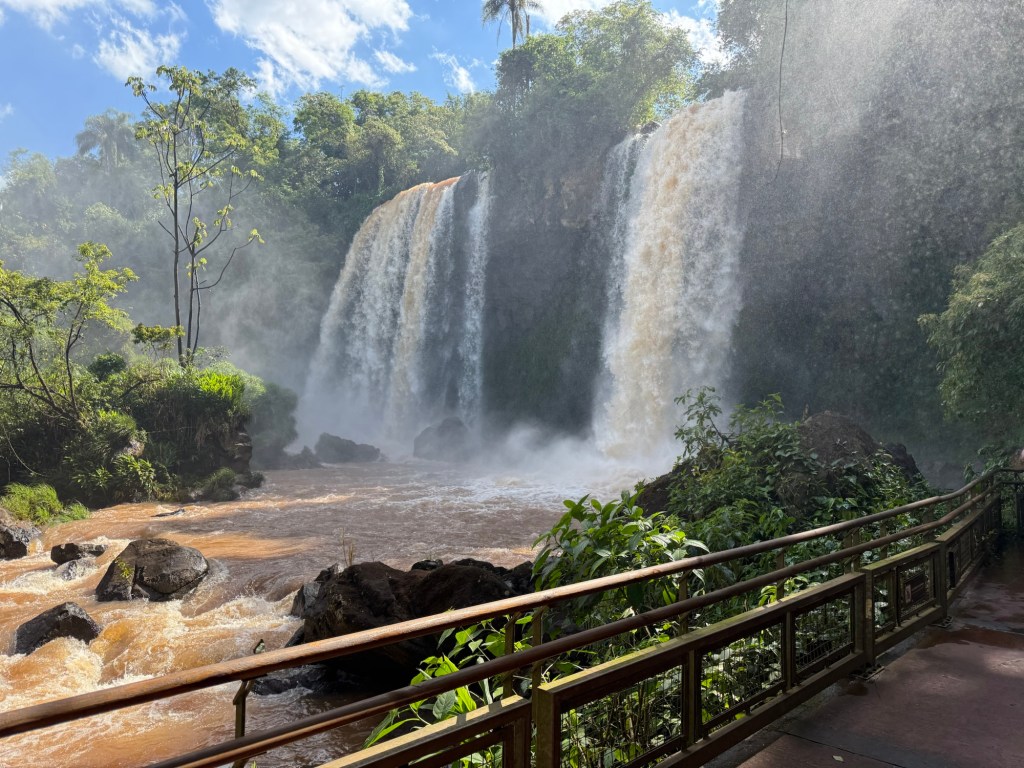
The rest of us carried on to trek along the lower walkway where at the beginning we saw the Iquazu River at the completion of all the falls. It was relatively narrow across but now instead of only knee deep it got very deep. Sorry can only remember I was surprised by how deep it was.
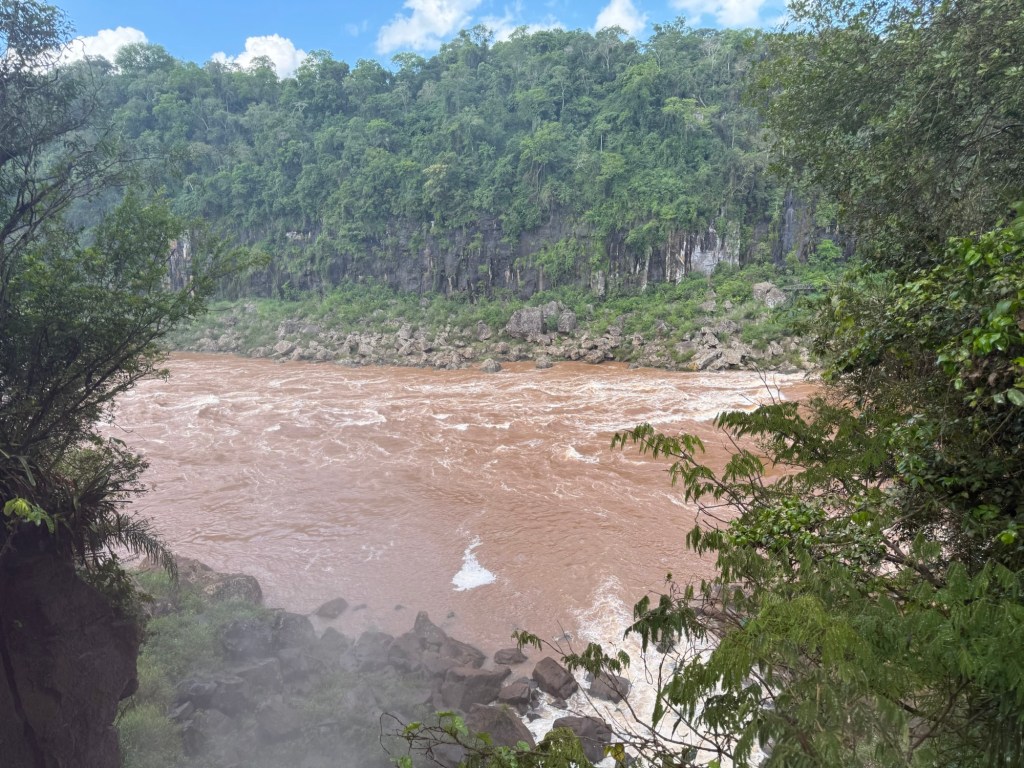
The river at the end of the falls

Further along we were able to see the power boat and its passengers far below making their way as close to the falls as they could safely.

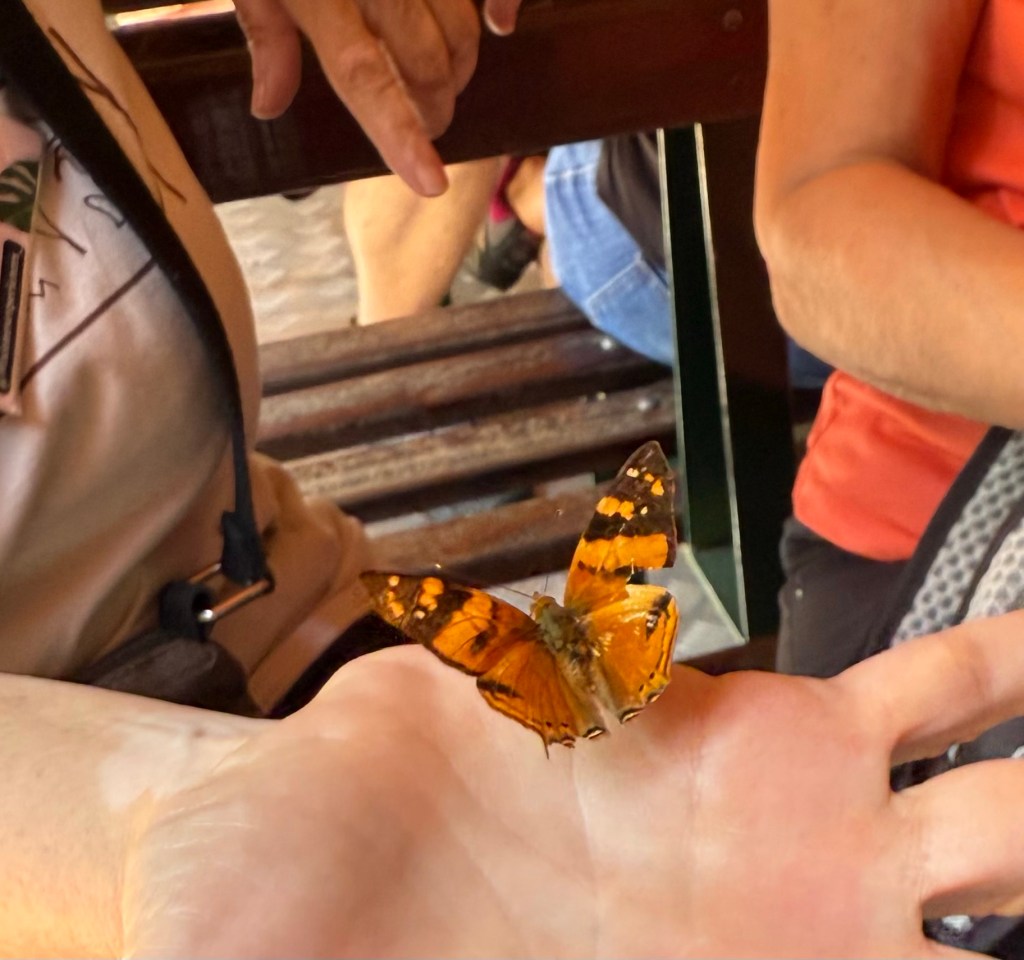
Along this walkway we saw a toucan in the trees and a couple of lizards. All along the walkways, roads and train tracks as we travelled throughout the park, we saw hundreds of butterflies mostly on the small size. There were yellow ones, called Lemon Butterflies, which flitted along in groups of 5 – 6, occasionally dozens were around a puddle of water on the road. Others seemed to want to ride along with the visitors and Nanci got this shot of one on my shoulder. 
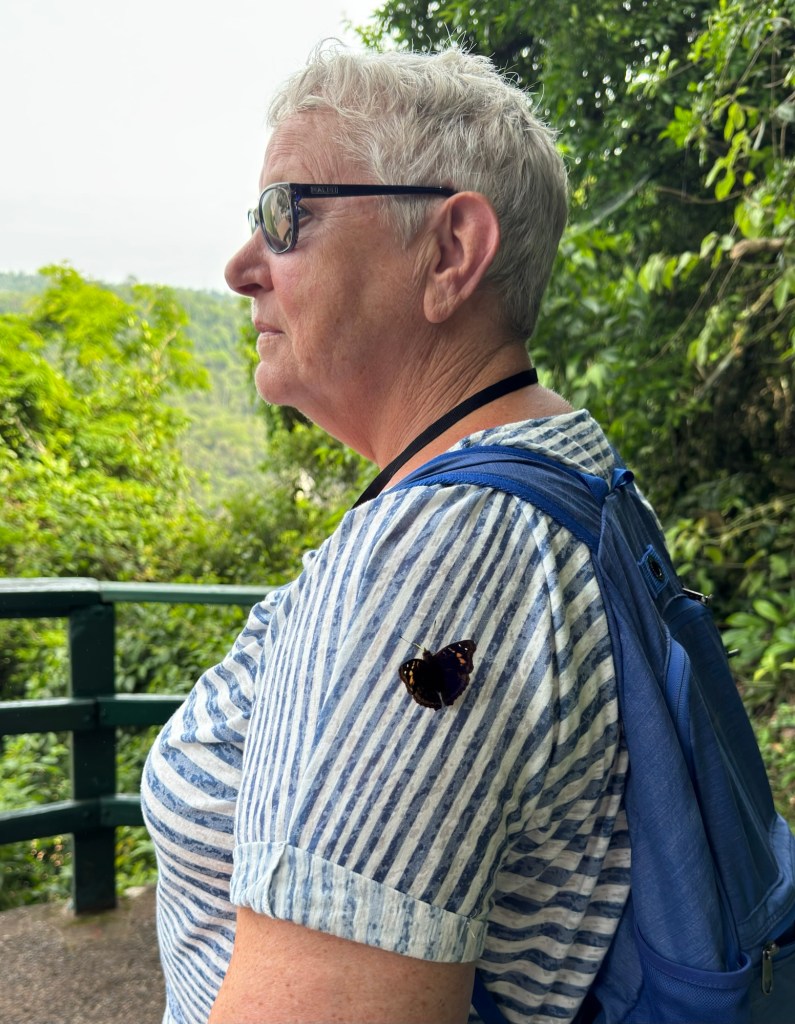
This one lit on a woman on the train

It sounds like a lot of repetition going up and down this 2700 metre stretch of the river but a more beautiful sight or potential picture was around every corner. Before touring the park today, the guide told us that we’d see the falls closer up but that tomorrow when we see the Brazil side we would see move of a panoramic view of the falls on the Argentinian side. 

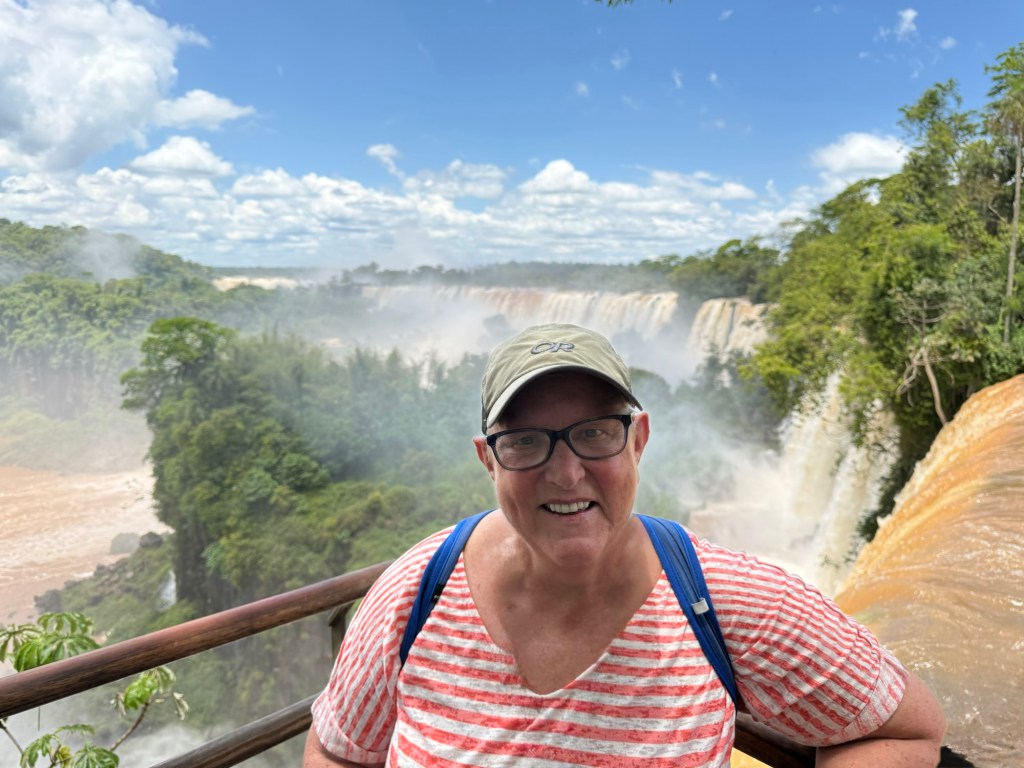
I wasn’t sure what to expect from today, and I can’t overstate how amazing these falls are. They are not like Niagara Falls where one large curtain of water, is impressive to say the least and rivals the total flow at Iguazu at approximately 2.8 million litres per second, but the sheer number of falls, and also the ability to be in such close proximity to them is quite the experience. I left very happy and very tired.  Over 16,000 steps today. 
On the way back to the hotel we had one stop at a restauant/bar for a complimentary wine and small charcuterie of locally produced cheese, meat and olives. I was so tired that I didn’t really appreciate it and it was an early night once back to the hotel, after packing because we leave this hotel in the morning.  
2025 South America

You gotta go with the flow I guess

Monday, November 5th

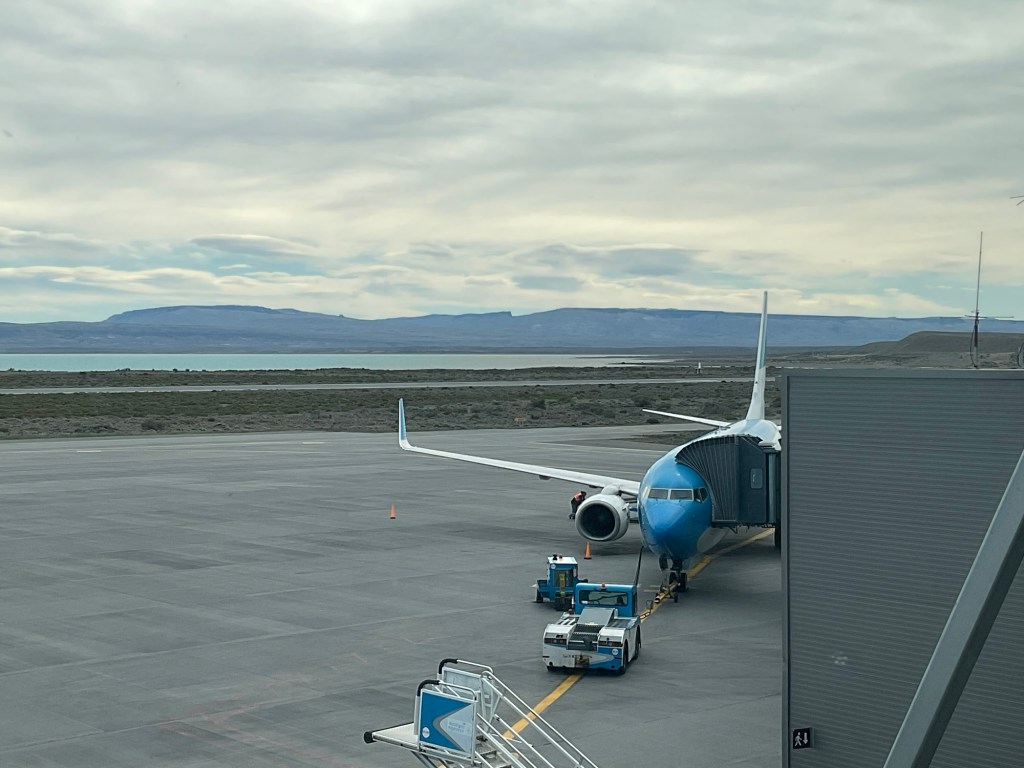
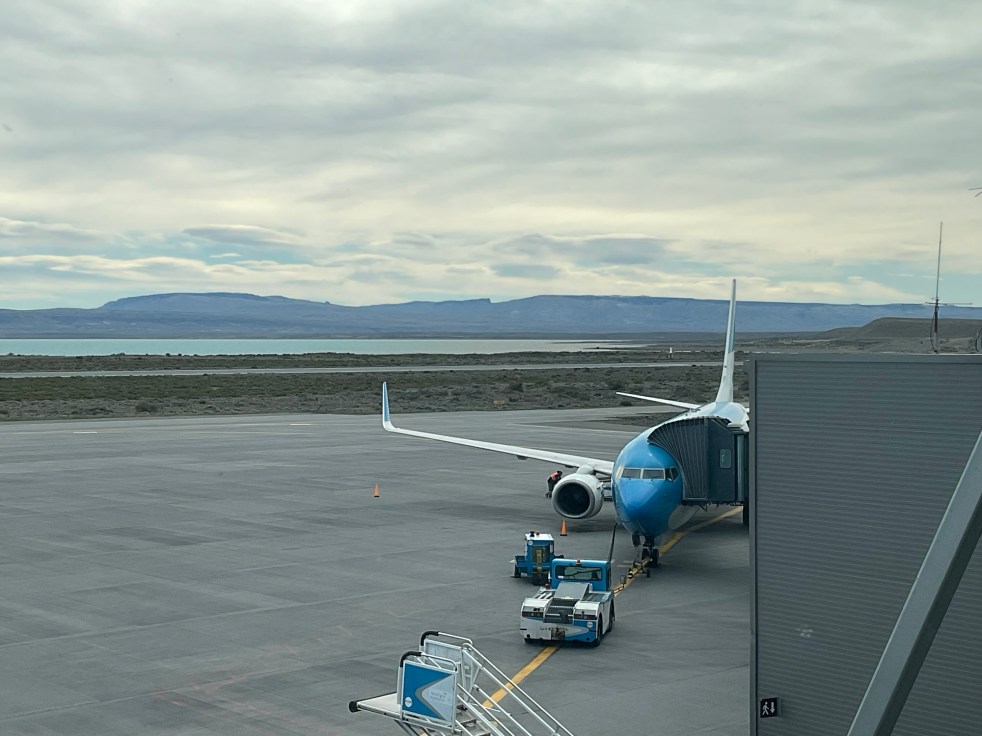
Our view while waiting to get our flight

Just a short one for today. It’s a travel day which is supposed to be non-eventful, right? Not so much.

I guess when you have 10 flights in 12 days you gotta expect it’s not all going to go right.

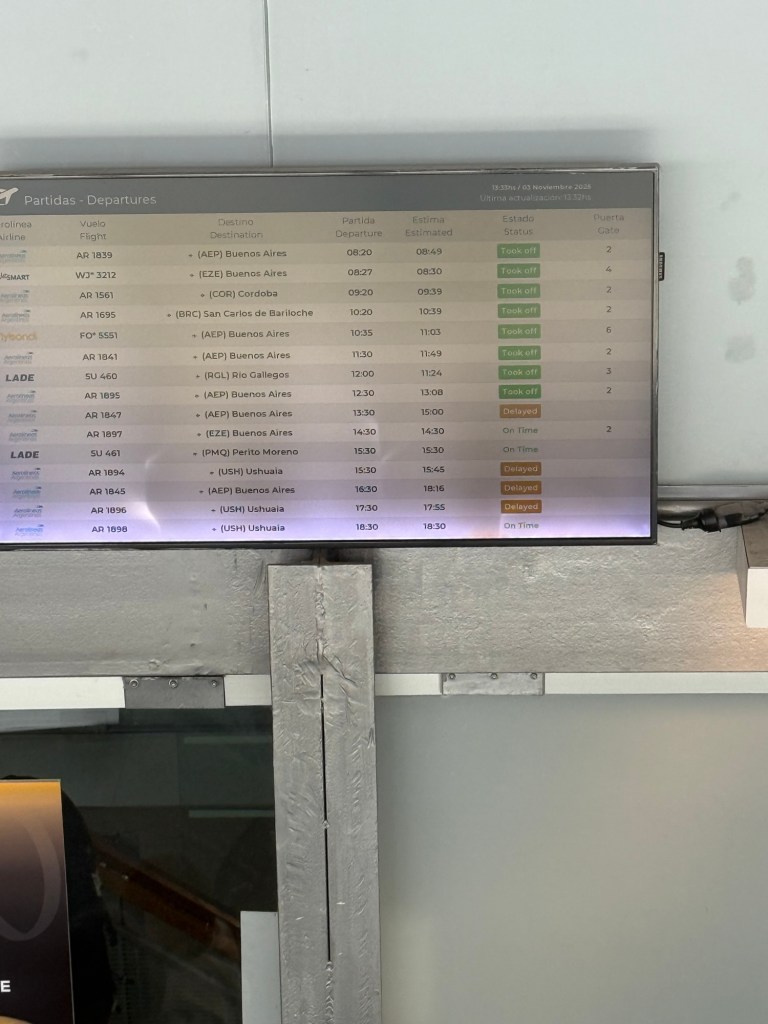
Despite assurances from the South American office for Wing Buddy that we would be on the same flight as the rest of the group even though our documents showed otherwise, Nanci and I ended up on a different flight from El Calafate to Buenos Aires and then Buenos Aires to Iguazu than the rest of our tour group today. And our flights were delayed. So we ended up spending 4 hours at the airport in El Calafate which has a grand total of one coffee shop after you’re through security. Thankfully it’s a nice one and we had a view looking over Lago Argentina from our comfortable chairs by the window. However, 4 hours is a long time. And there was chaos in the boarding area because the airline was having so many mechanical problems the flights were backing up. Really didn’t give one a bunch of confidence!

Finally we got off the ground and while in-flight Nanci had the great idea to get ourselves closer to the front of the plane for a fast get away upon landing and successfully talked the flight steward into it. He agreed to move us to the exit rows which were empty. But still we were literally running to catch our connection in Buenos Aires and if it weren’t for Nanci’s quick thinking and the kindness of a Spanish speaking passenger disembarking with us to help us navigate through the right security line to get to the gate for our flight I don’t think we would have made it. Thank you to that person and I have one huge kindness to pay forward for sure.

So instead of arriving at Iguazu at around 6 pm we got here at 9 pm. I’ve never been so glad to see my luggage come off the carousel in my life. The other group were delayed somewhat by the airline chaos as well, but arrived around 8 pm.

This would be the adventure part of travel.

The famous Iguazu Falls is tomorrow and apparently there is a high flow right now. Not sure if that’s good or bad.

Anyway, we’ll find out tomorrow.

2025 South America

A Ranch in Patagonia

Tulips are springing up!

Sunday, November 2nd

Almost a day off touring!  Well not quite.  

Today we had no scheduled activities during the day.  Some of the group are off for the whole day trekking across a glacier, a different one than the one we saw yesterday, and others are off on tours to see some caves with aboriginal writings. We decided to leave the day open to catch up on the past few days of intense touring. 

We didn’t set an alarm and had a leisurely start to the day, meeting up at 11:30 am to walk into town for lunch and to souvenir shop. It’s definitely spring here, with tulips and other summer flowers blooming. It’s a lovely sunny and clear day with some puffy clouds, 8 degrees C, and very windy.  Today will be our last day of cool weather and we’re bracing for the heat of Iguazu Falls and Rio.  

We did have one organized activity today as this evening we had booked to visit a ranch in our hotel’s neighbourhood. It’s set up to demonstrate what it was like on the ranches that settled this area, sharing some traditional food and for a show including local folk music and dancing.  

The early settlement of El Calafate was as a stop over point for wood traders on their slow journey, hauling their wool from the region at a speed of only 20 km per year! The government encouraged settlement by providing plots of land for those interested to establish ranches. Many from Uruguay took the government up on the offer and this is the style of ranch which we visited today. 

El Calafate was officially founded on December 7, 1927 by an Argentine Government Degree to continue to promote settlement and it was named after the calafate bush common in the area.  

It has just burst forth as a destination for tourists visiting the glacier and glacier park and now 99.9 of their industry is supporting the tourists in some way or another.

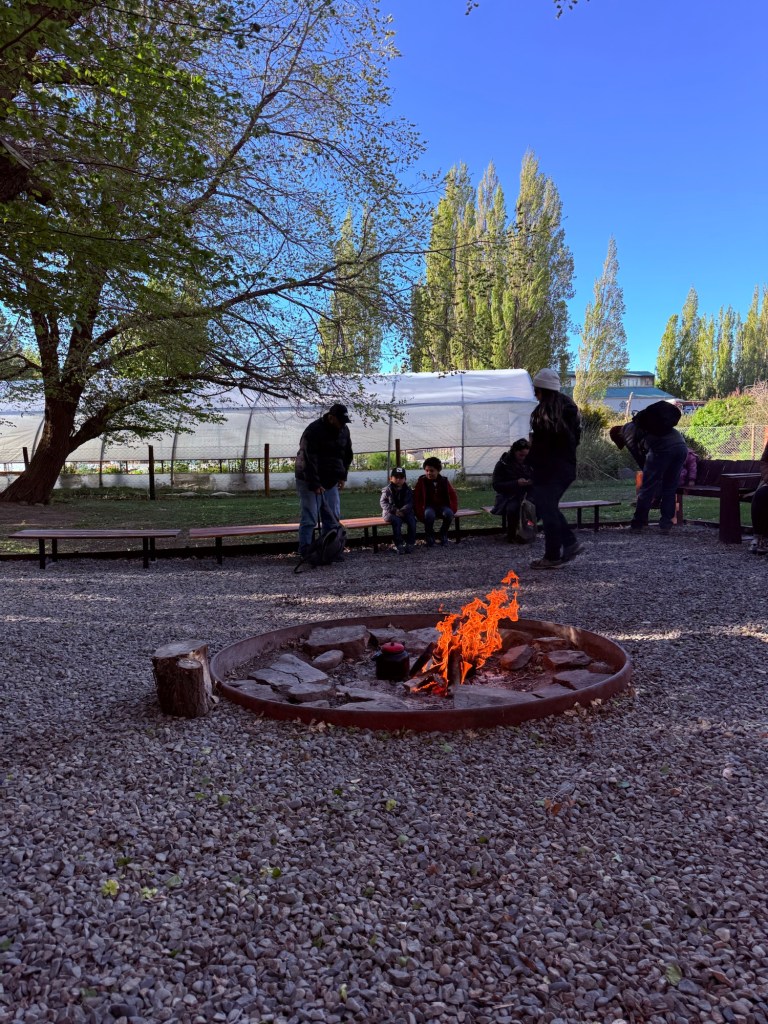
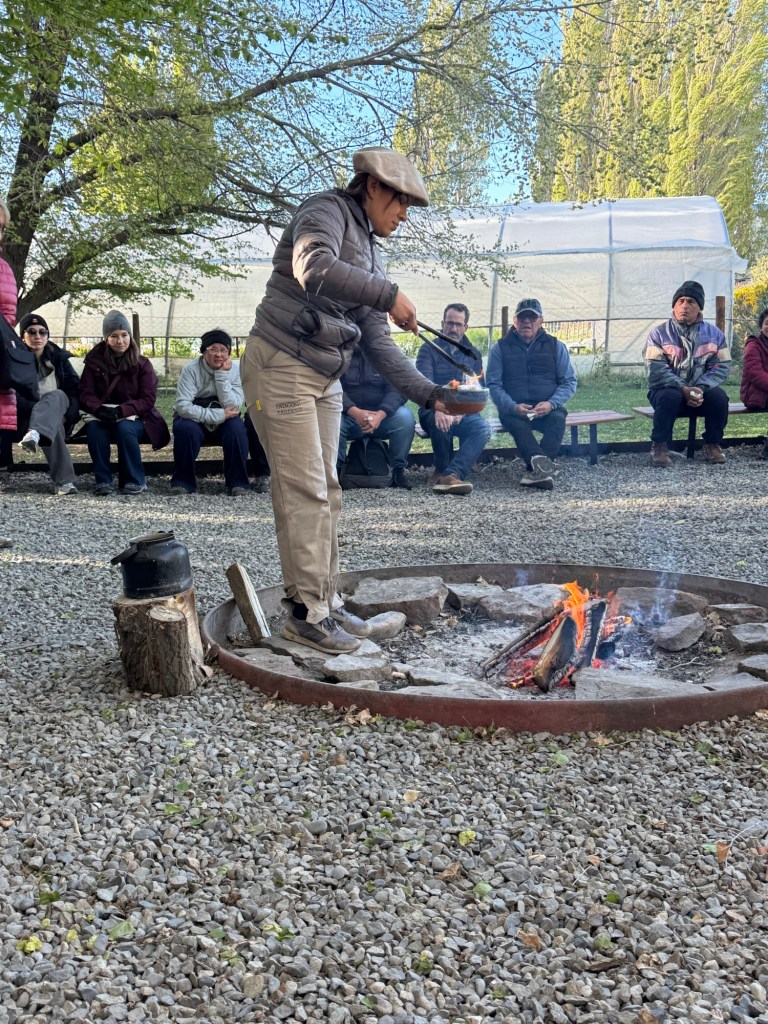
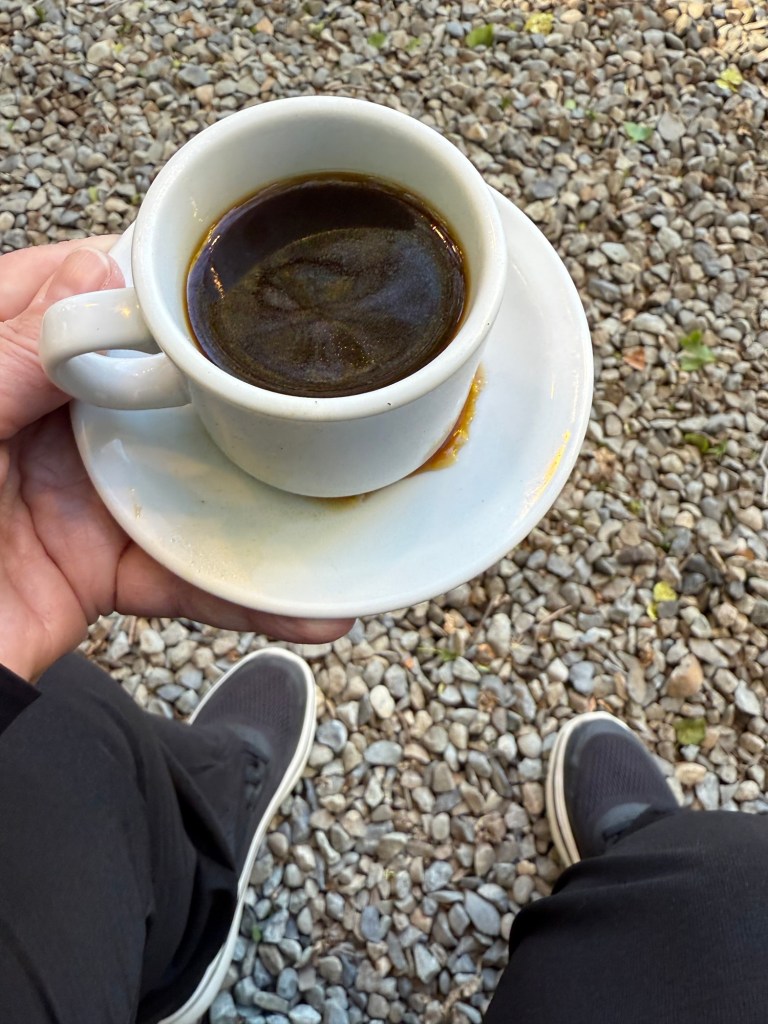
We spent the first 2 hours of our ranch visit outdoors, where it was cold and windy, but we were dressed for it and they did a great job of alternating having us outside for one demo and then inside for another for us to warm up. And the first activity was around a camp fire. They demonstrated a special and somewhat bizarre way that they made coffee on the ranch. They put a pot of water on the fire to start to get it hot, and then put in heaps of coffee grounds. Gingerly, with tongs they take brilliantly glowing red wood coal pieces from the fire and put them in a large bowl of sugar and turn the coal to coat it and then put the coal into the kettle. They did this several times until I thought the pot must be full of coals. Apparently the coal oxidizes the sugar which causes the coffee grounds to sink to the bottom of the pot so it can be served without the grounds, and it gave the coffee an only slightly sugary but smoky taste. 

Adding the coal to the bowl of sugar to be added to the kettle on the log behind her.

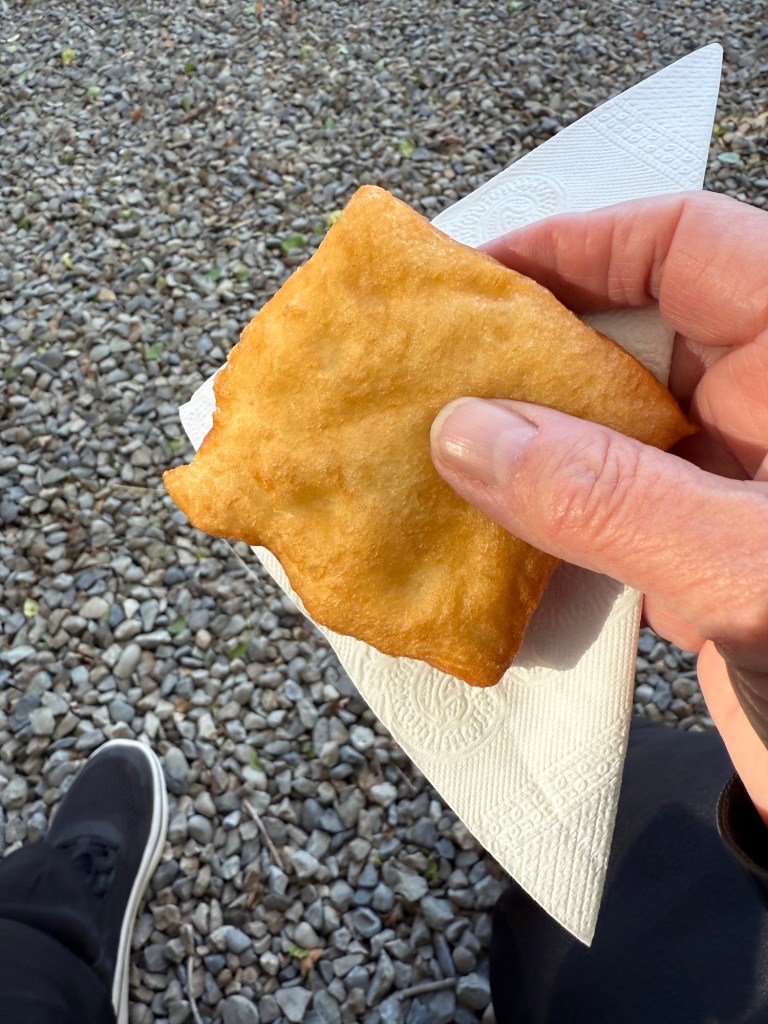
They also served a pasty that tasted kind of like a donut, but was square with no hole.  Apparently made from only three ingredients but I didn’t hear what they were. 

This ranch is 17,000 hectares and they primarily ranch sheep, although the tourism aspect of their ranch has produced a great crop for them as well. The property is very well maintained and the buildings used for the dinner, while rustic in design, had modern conveniences.  

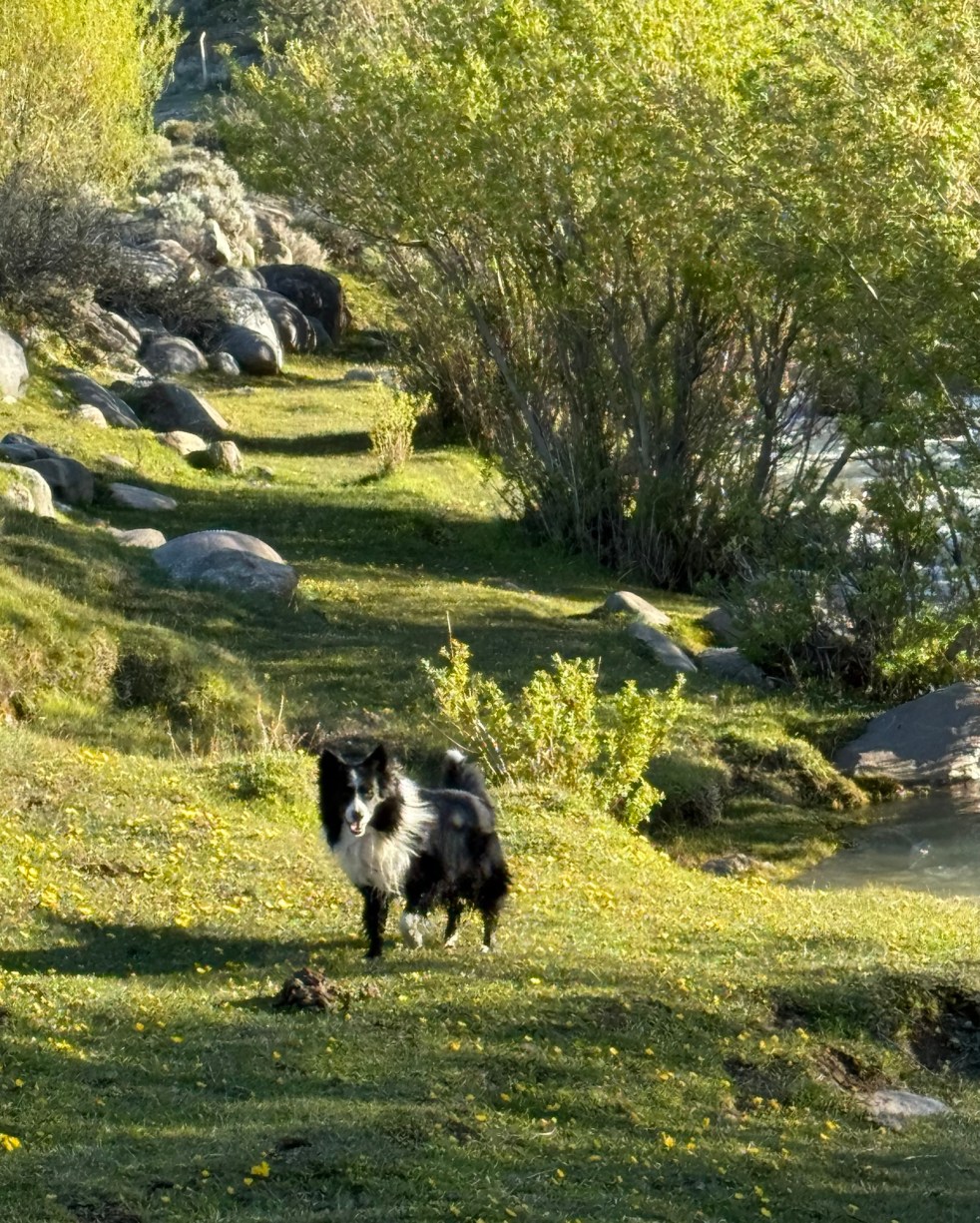
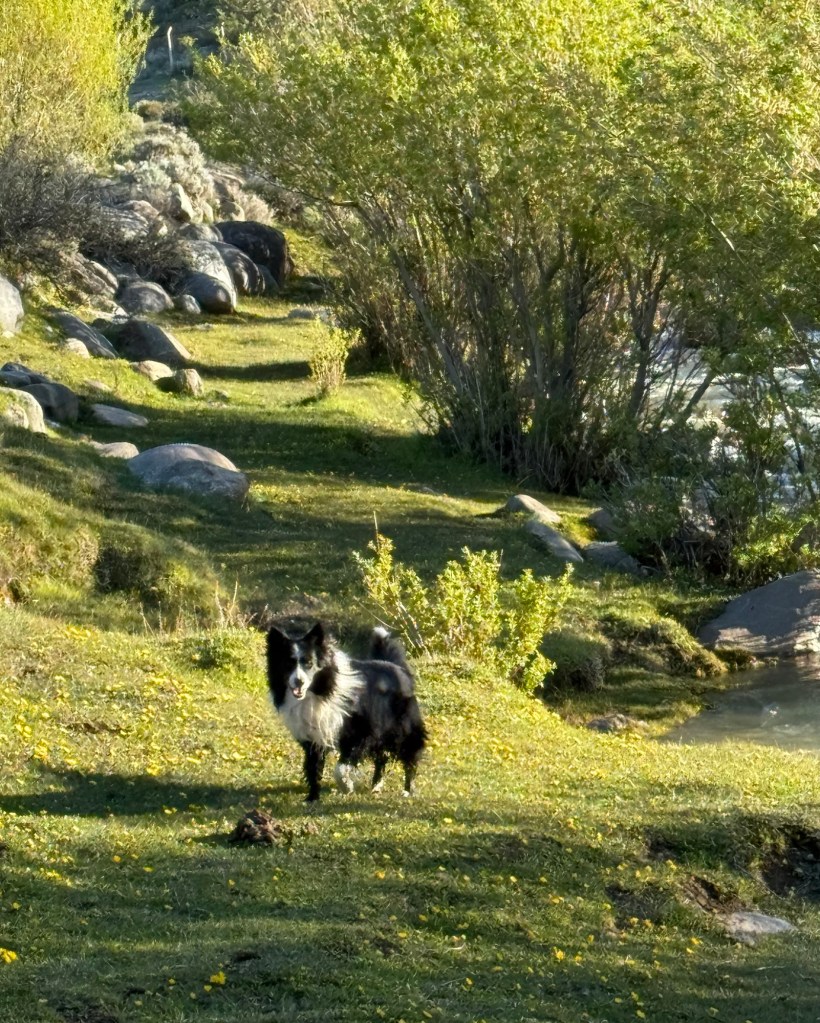
While at the camp fire we were treated to a demonstration of the great sheep herding skills of their amazing border collie. The working dog is the offspring of two other collies that have been retired and who followed us around the property looking for any handouts from the guests while the junior dog was doing the work.  

The sheep obeying.

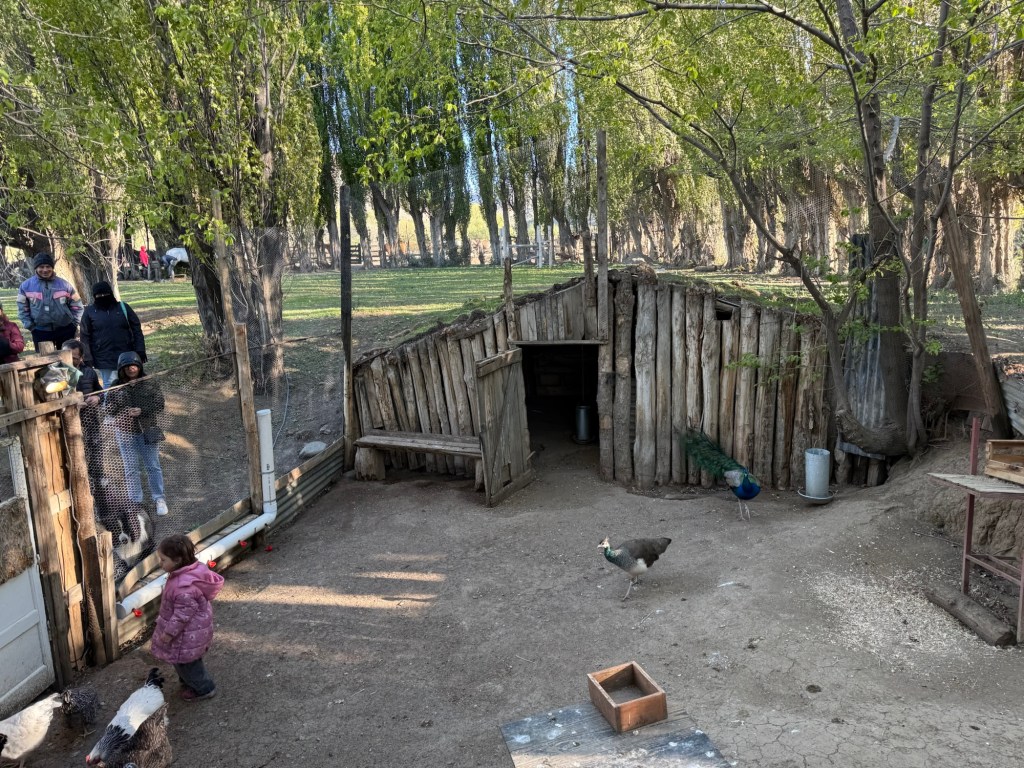
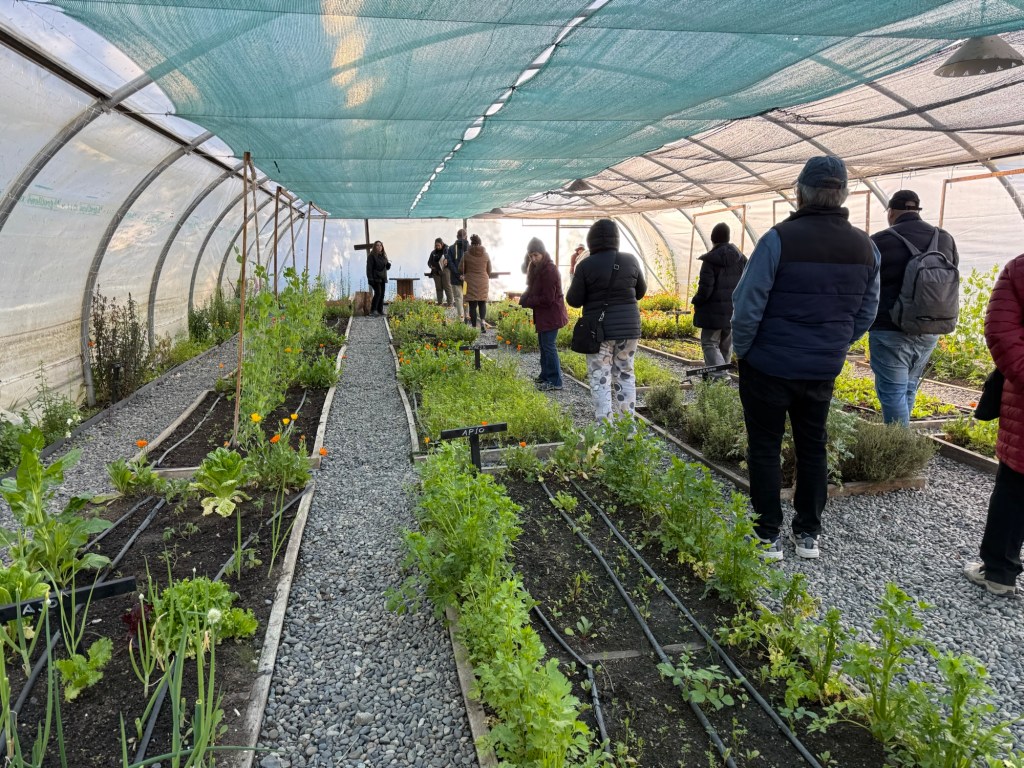
We stopped in at the hen house, which used to be the root cellar, and a greenhouse, which is not common in Patagonia, but the ranch here grows all it’s own veggies during the summer months.  

The hen and peacock (I have no idea why they have a peacock) house.

We walked along a lovely little creek running through the property, to the backdrop of hills all around for a bit. We ended up at a deck build by the creek where we could taste a warm mulled wine and some barbecued lamb and lentils on a biscuit. Nice little appies in such a unique setting.  

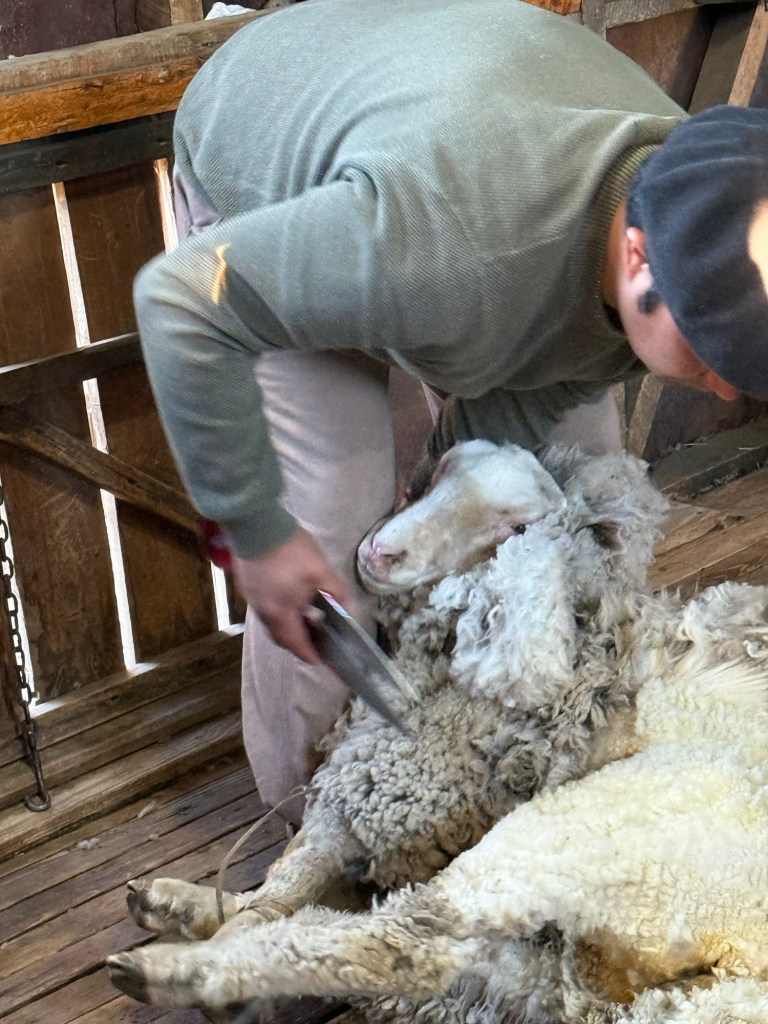
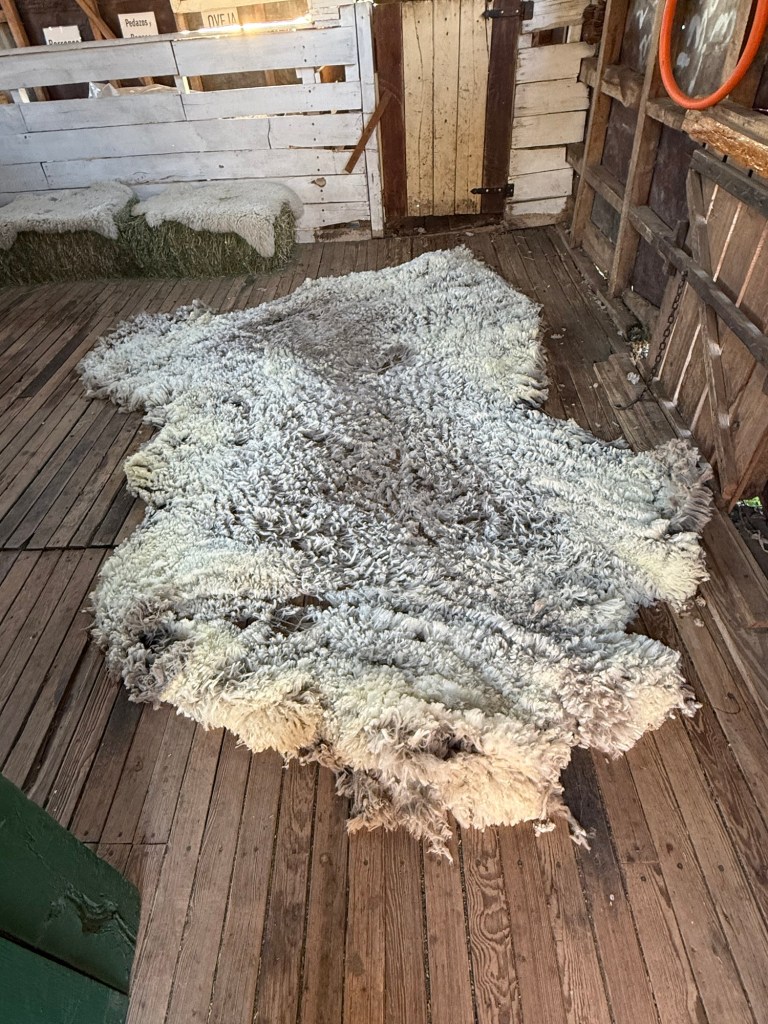
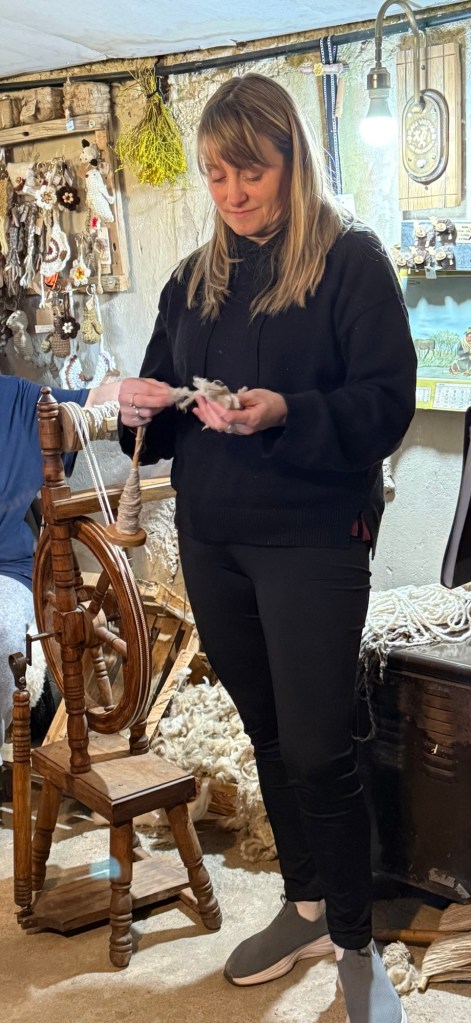
Next it was on to see the sheep raising part of the enterprise. They do have modern sleeping facilities, but they have left some of the historical buildings intact to use for their demonstrations. We saw how the sheep were separated for shearing, and then the shearing itself. This sheep shearer used the old fashioned huge scissors instead of the electric razor type. This was both to show us the original method but also because the sound of the electric ones scares the animals and it shears them too close and they get cold!  It was amazing to see that after just a few minutes a bald-ish sheep skipped out the shoot and the shearer laid out a complete one piece skin of wool. A group of volunteers keep up the traditions and showed us the pretty tedious way they spin the wool first into one strand, then many, and how it is dyed.

Shearing with scissors took only 15 minutes or so
One complete piece

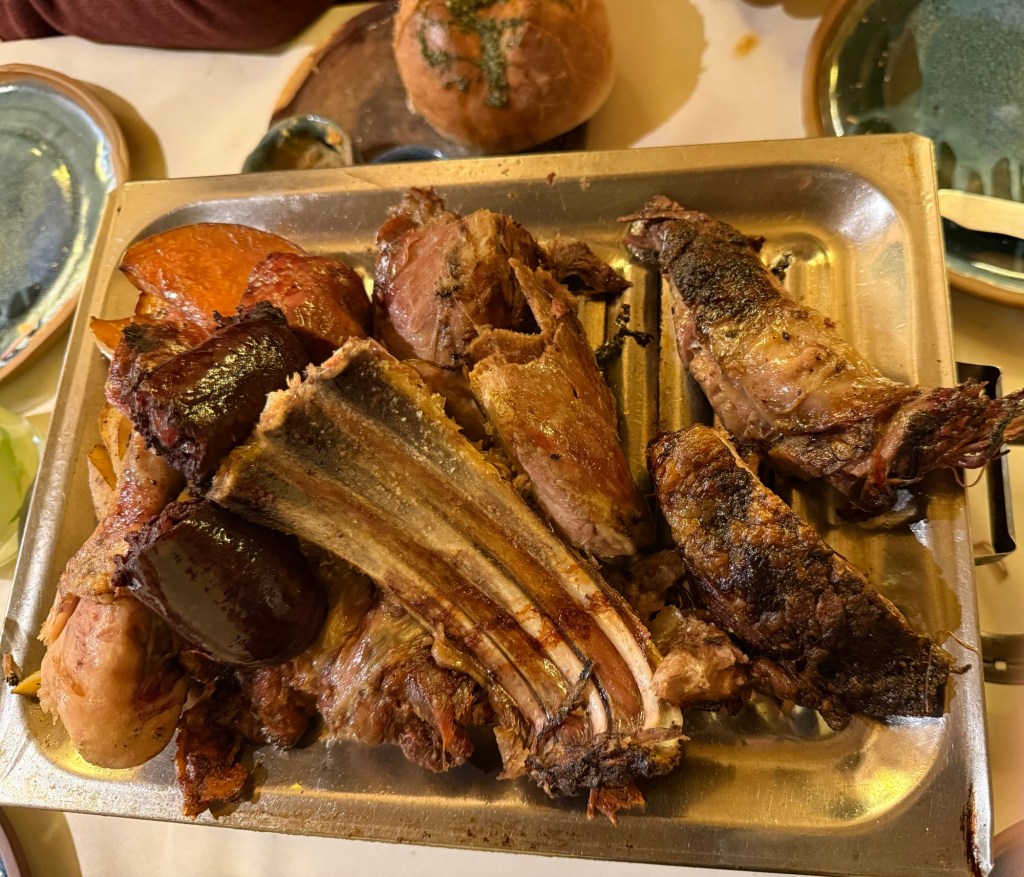
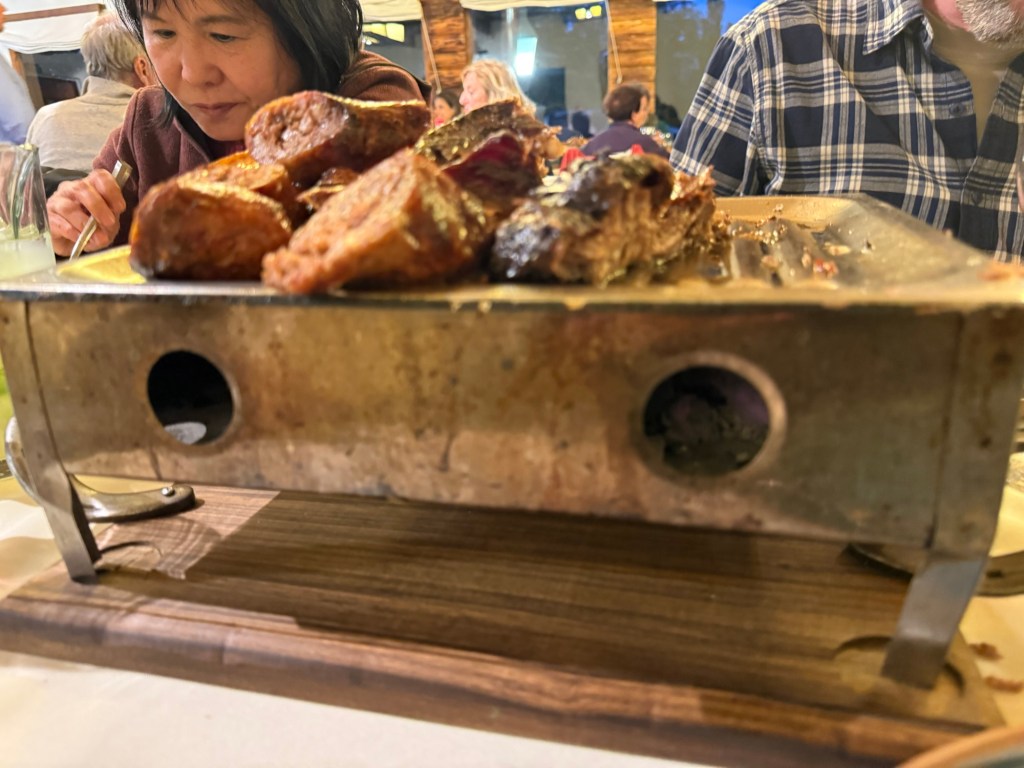
Finally it was time for us to head back to the dining hall for a fabulous dinner and some entertainment. After a starter of beef empanadas and salad, we were served family style with the meat and veggies that had been grilled and roasted being presented on a little grill for each table. They were piled high with beef, lamb, sausage, chicken, potatoes and we think butternut squash.

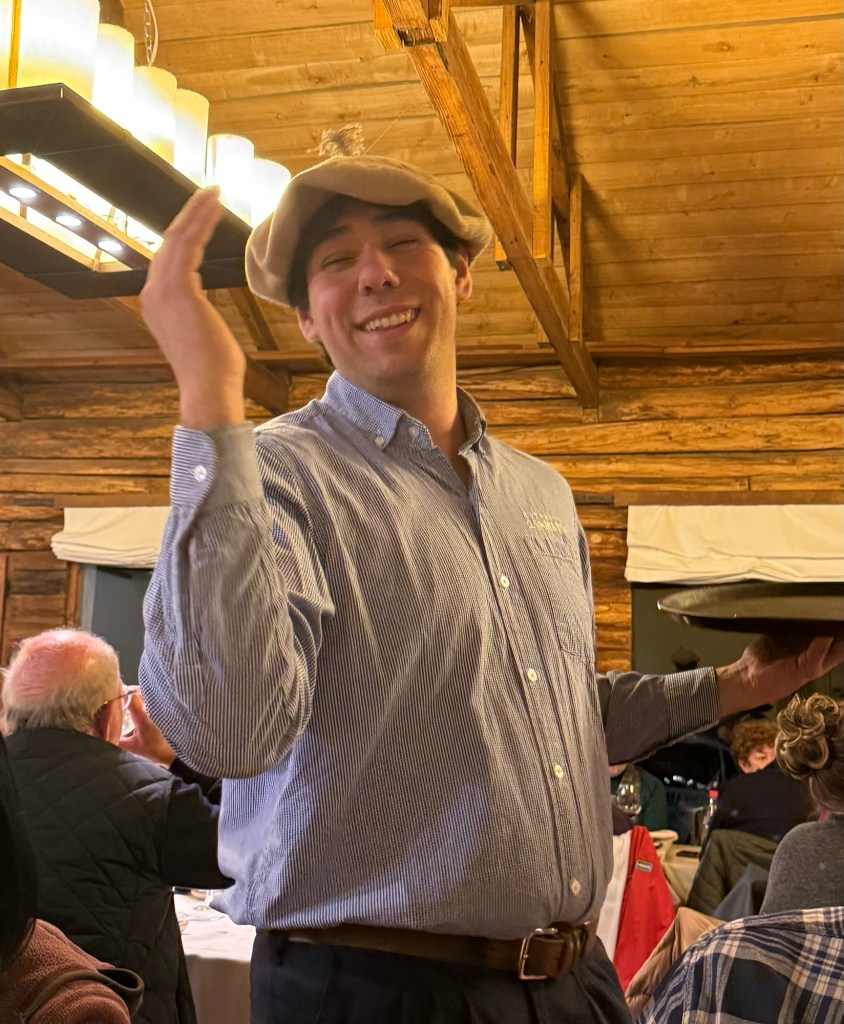
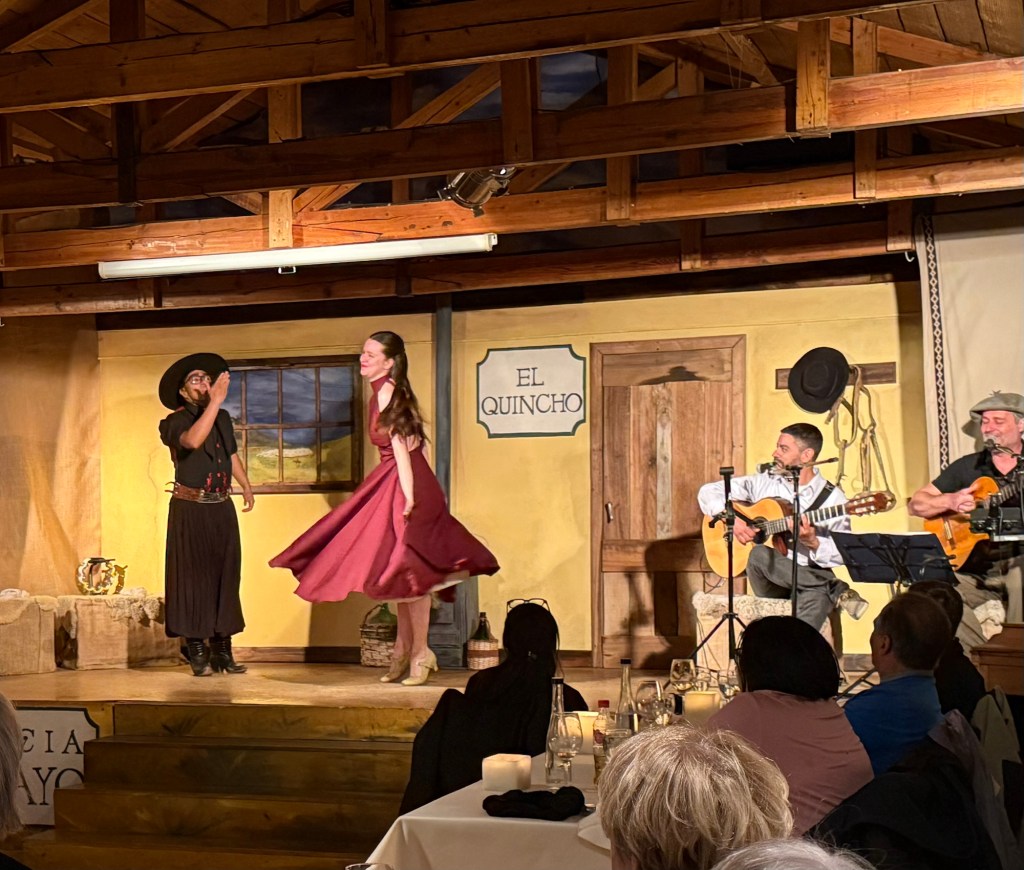
As dessert was being served the entertainment started, which was traditional dances and music from the Patagonia area. The guitar music was lovely and it was light hearted and interactive.

The traditional hat worn by the gauchos

It was an interesting, but late evening as we didn’t get back to our hotel til 1030 and then had to be up early the next day. But it was worth to learn a little more about the region and its people.  

2025 South America

The Glacier

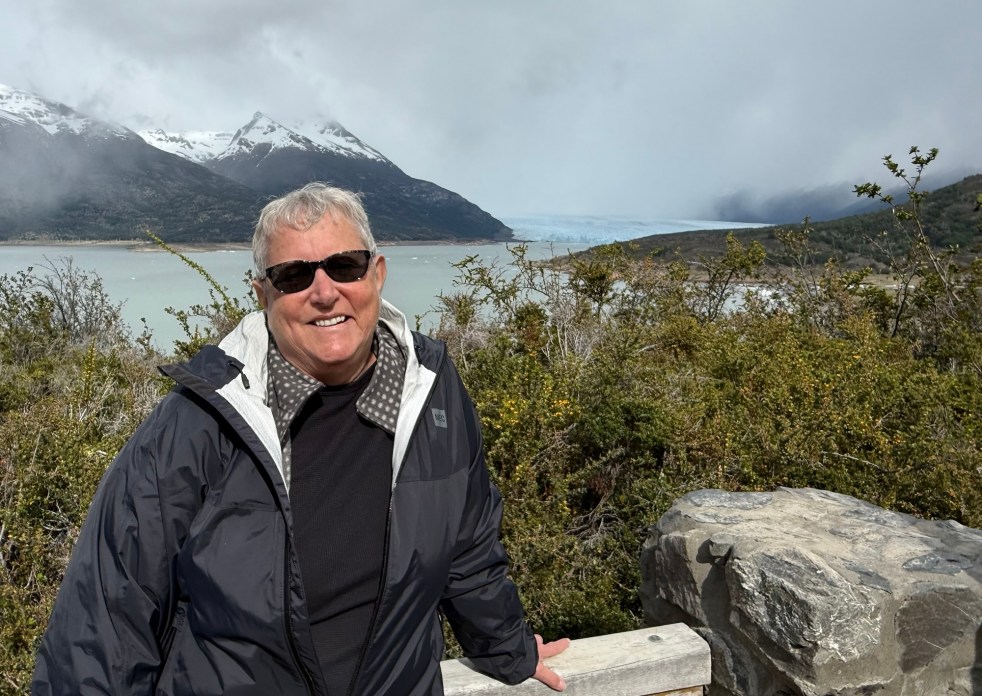
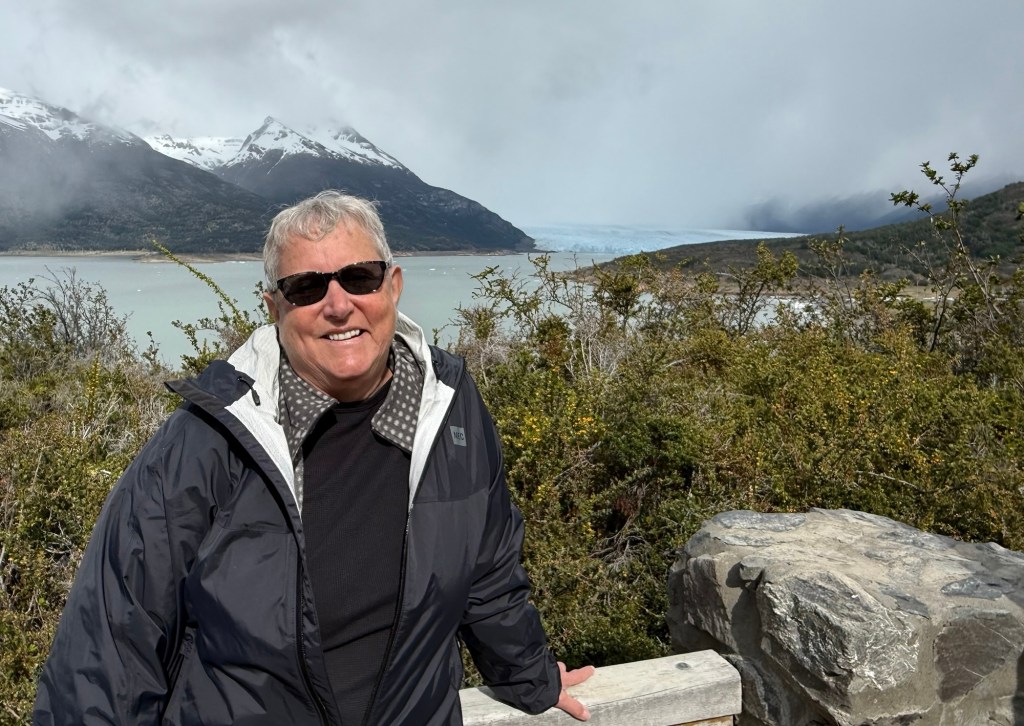
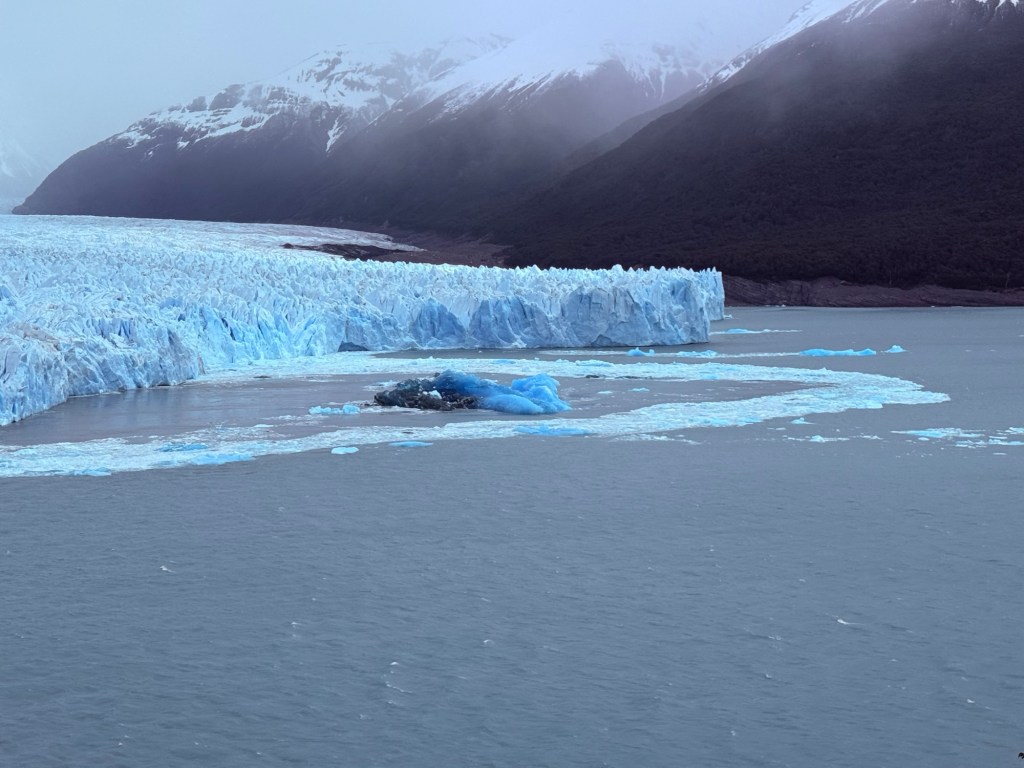
You can just see the snout of the glacier in the background. Our first glimpse of it.

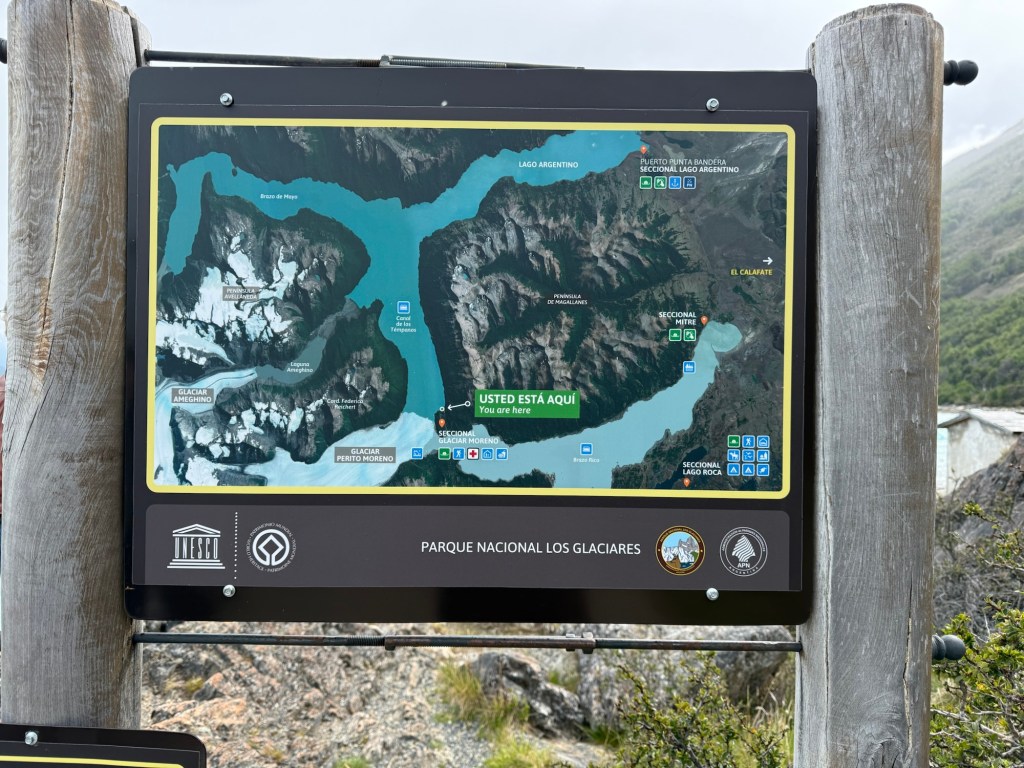
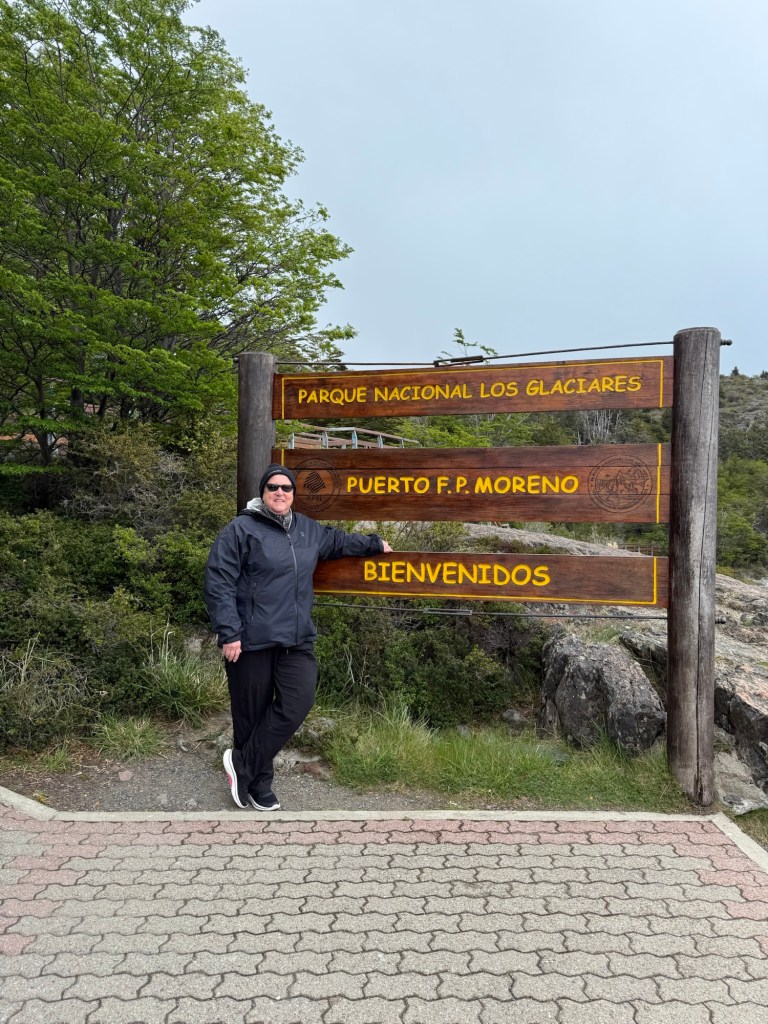
The excitement builds as today we will enter Los Glaciares National Park to see the Glaciar Perito Moreno. This National Park is the largest in the Argentinian park system and was created to preserve a significant portion of the souther Andes glaciers and forests. It was declared a UNESCO world heritage site in 1981. 

Viedma, Upsala, and Perito Moreno are the three largest of over 8600 glaciers in the Park. Viedma is the longest in South America, Upsala is one of the largest in the park with a significant area, and Perito Moreno is the most famous for its accessibility and dynamic ice calving. 

We were on the curb at 9 am ready to be picked up by the tour guide and driver and we started our journey to zig zag through Calafate picking up tourists staying at other hotels. There are only 8 of us who are English-speaking on the Wing Buddy tour so we have a regular English and Spanish speaking guide wherever we are travelling. We ended up with about 16 passengers once finally on our way to the Park. 

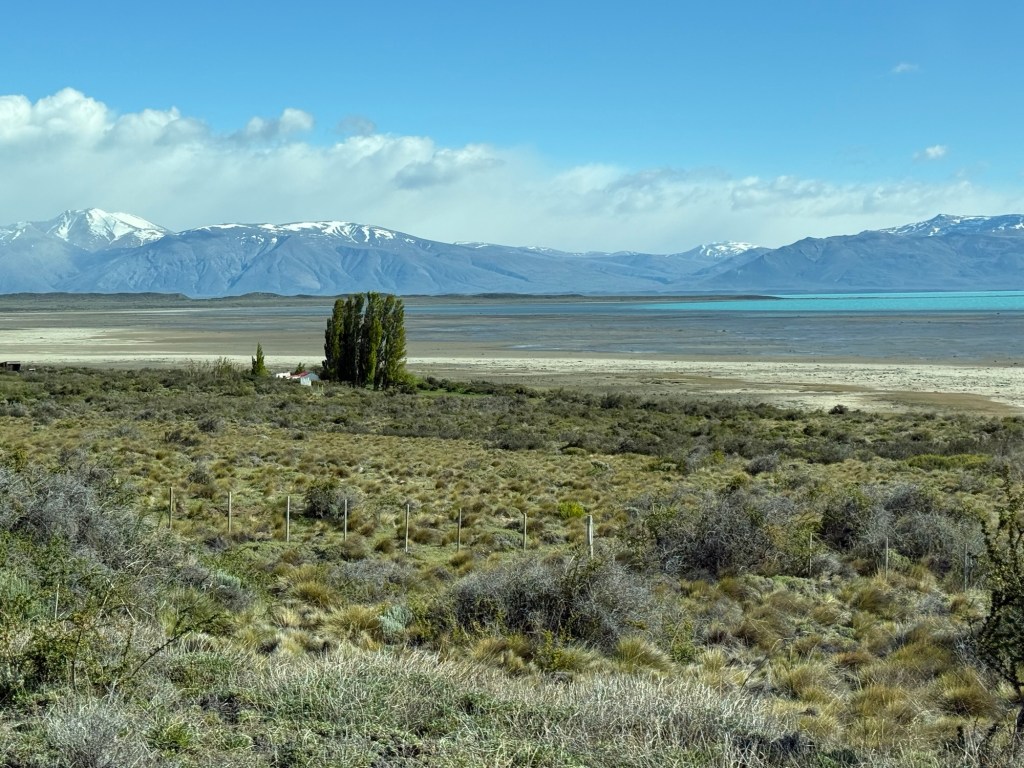
It was a drive of about one and a half hours, but the scenery was spectacular.  All along the route we traveled alongside Lago (lake) Argentina, a beautiful turquoise colour at times and brown or green at others depending the wind and where you are on the lake due to sediments. It’s been created by the Moreno Glacier runoff.  When the guide was telling us about the lake I noted that it was 700 m deep and then when looking at my notes to write the blog I thought I must have made an error.  However, I looked it up and its average depth is 155 m (509ft) and at its deepest it’s 719 m (2,359 ft). Despite the cold temperatures of the lake (2 – 5 degrees C), they do fish for trout and salmon which can reach up to 1.5 metres in length. 

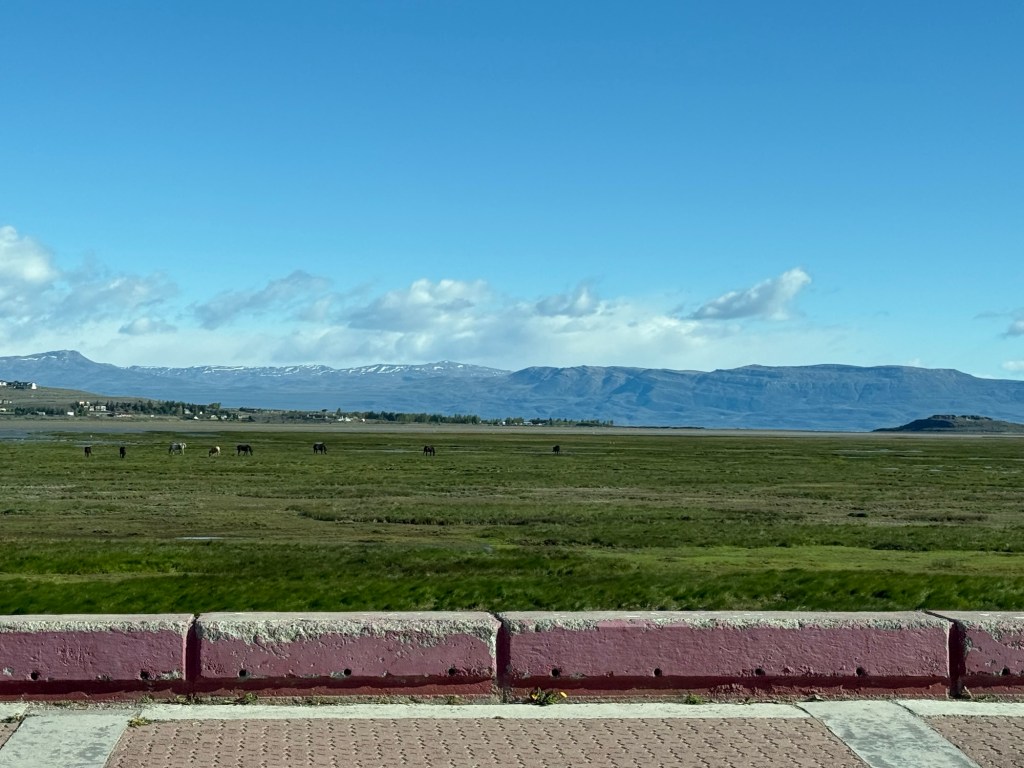
The whole Patagonia region is a desert and is famous for its almost constant winds (especially Sept- Mar) so the landscape if pretty devoid of trees except where they’ve been planted to protect ranches. Ranchers raise the famous Argentinian beef, and sheep and have a huge horse industry, breeding horses for polo, racing and general ranch work. 

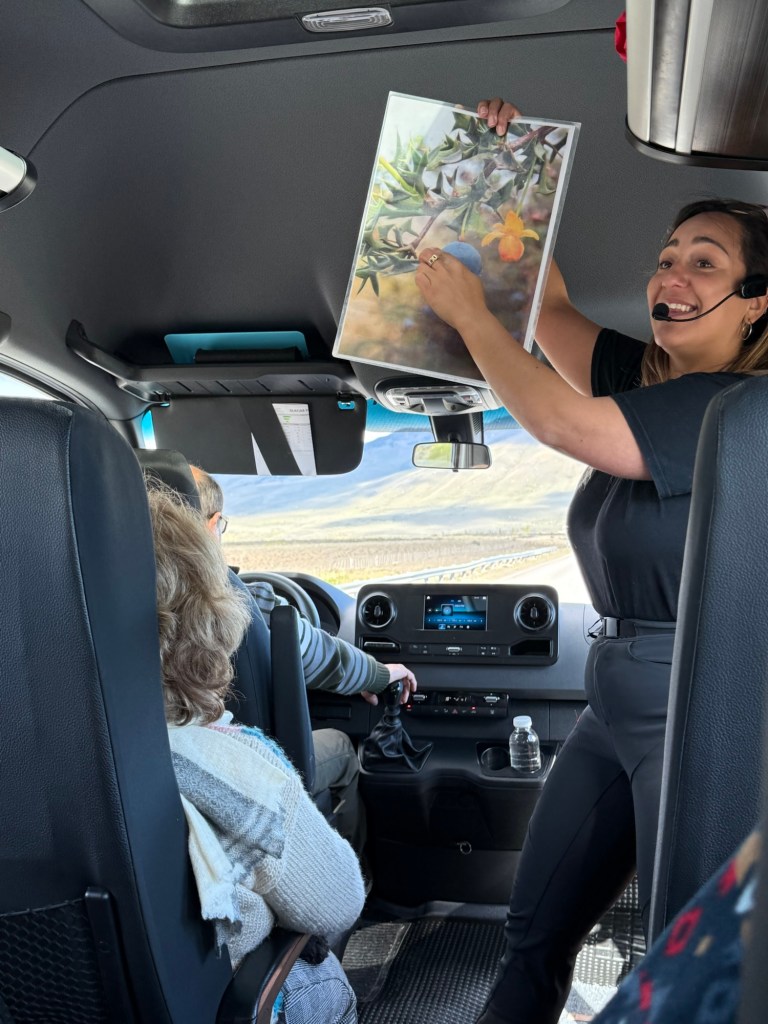
Along the route, our guide told us about the Calafate fruit, and showed us pictures, but we didn’t get to see one of the bushes. The fruit growing on the low bushes looks a lot like blueberries and is used in a similar way. The fruit is used in jams, ice cream, wine and beer. There are some myths around these berries, one which states that if you eat the berries of the Calafate plant you will return to the captivating Patagonian landscapes again. Our guide told us she ate so many Calafate berries when she first visited that she never left.  

Our guide showing us pictures of calafate fruit

The driver stopped the bus at one point and pointed out the 3 – 4 Andean Condors flying high above us. They are huge birds standing 3 – 4 feet tall and weighing up to 33 pounds with a wing span of up to 10.5 feet. The adult birds are black and white while the juniors are brown and they are 100% scavengers. 

Our guide, Daniella, was full of information and joy. She laughed and smiled and told us fun stories all day. One of the things she told us was that there is a culture of clapping among Argentinians. If a baby is born, you clap. If dessert looks amazing, you clap, you get the drift. So we clapped at pretty much everything all day. 

Daniella explained how and why the glaciers have been created along the west of Chile and Argentina. As the winds off the Pacific hit land and are forced to raise to get over the Andes, they drop the humidity as rain in the lower altitudes and drop the humidity as snow in the higher elevations. The snow layers compact forming the glacier and the layers move within the glacier so it is always moving. This Southern Patagonian Ice Field is the third largest after Antarctica and Greenland. 

Finally we were getting close to our first sight of the glacier, and Daniella put on some inspirational classical music and told us to close our eyes and she’d let us know when it was in full sight. It was quite the build up and while I have seen many glaciers in Canada, and Alaska, it really was quite the sight to see the snout (the front edge where it is melting and calving) of the glacier rising out of the lake and the glacier flowing through the valley as far as we could see.  

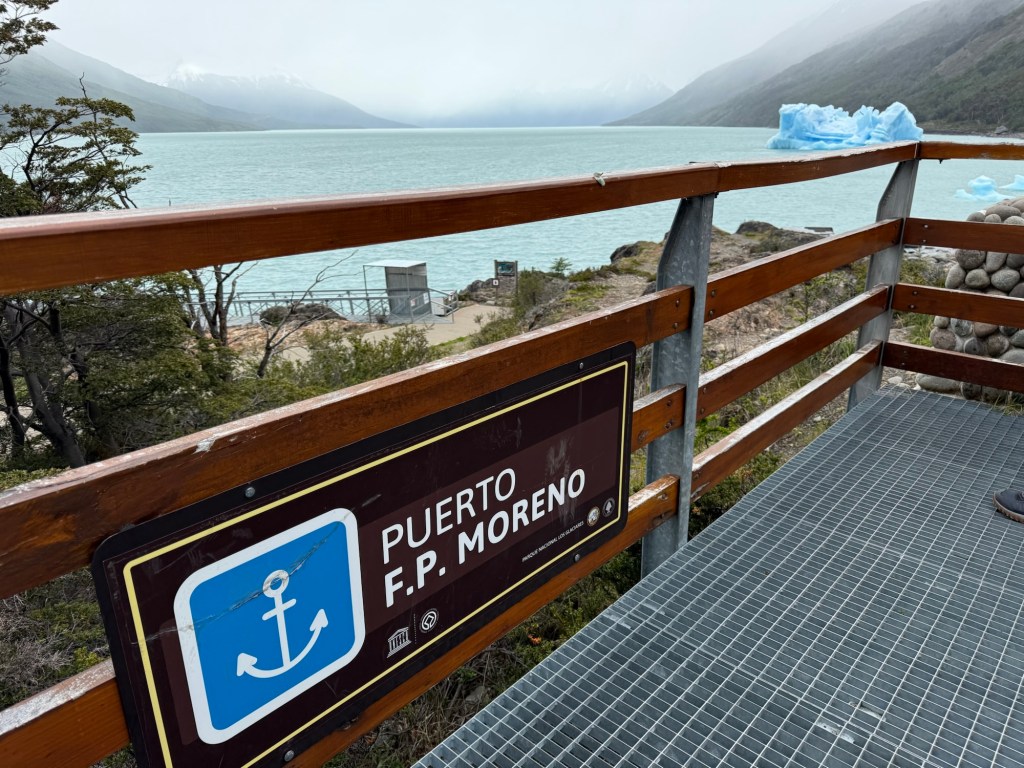
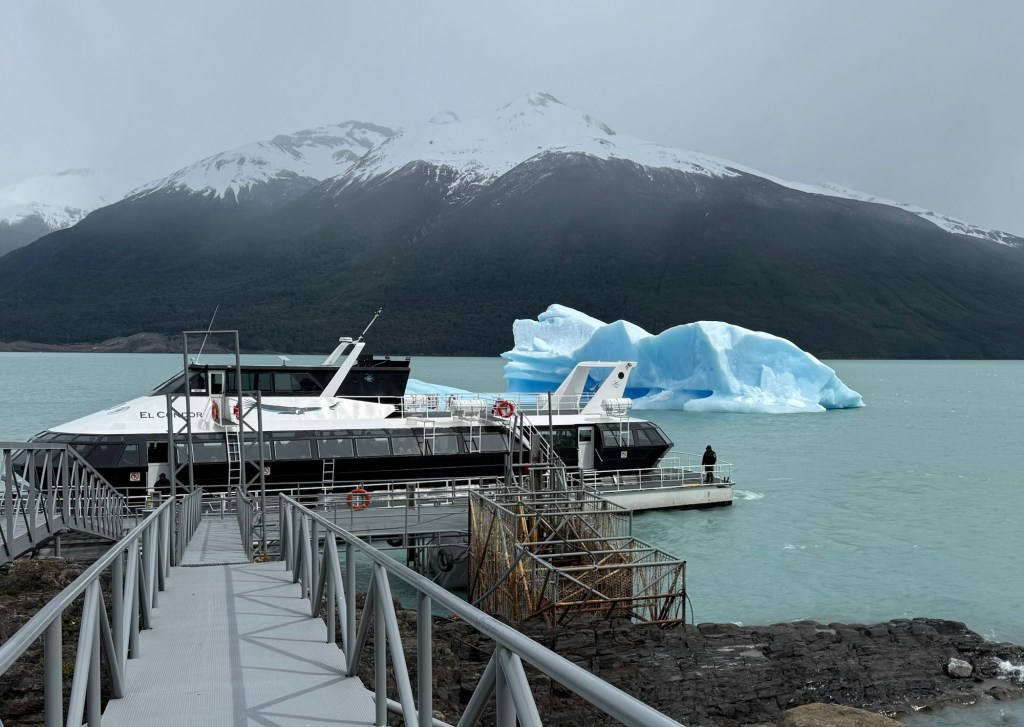
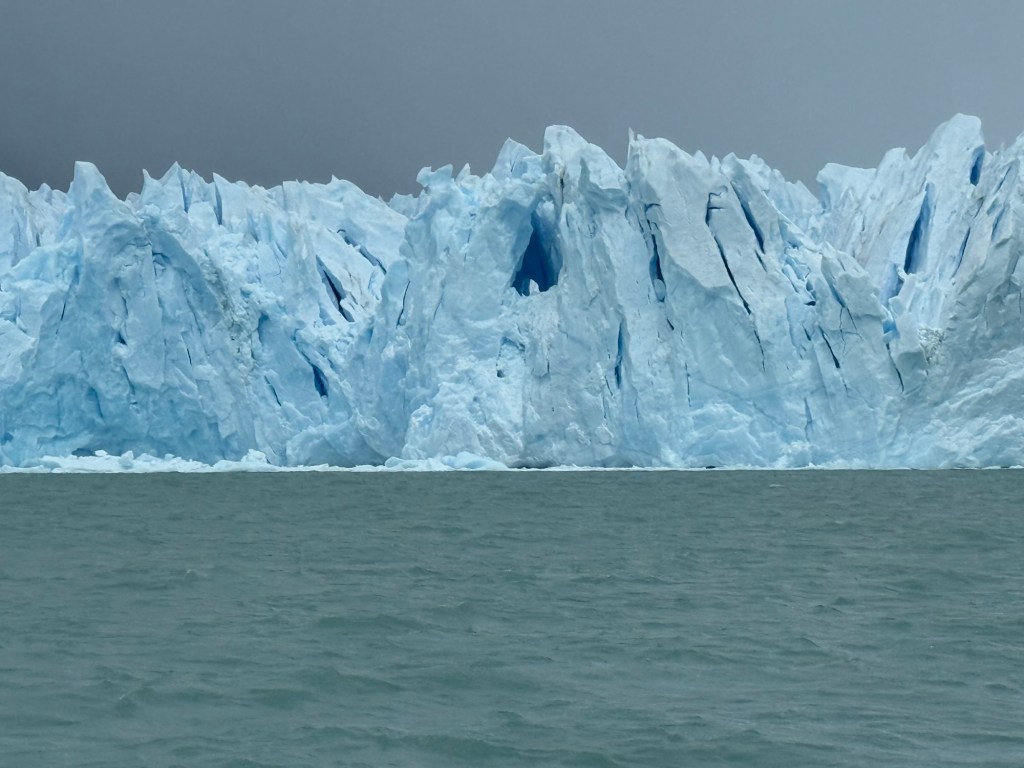
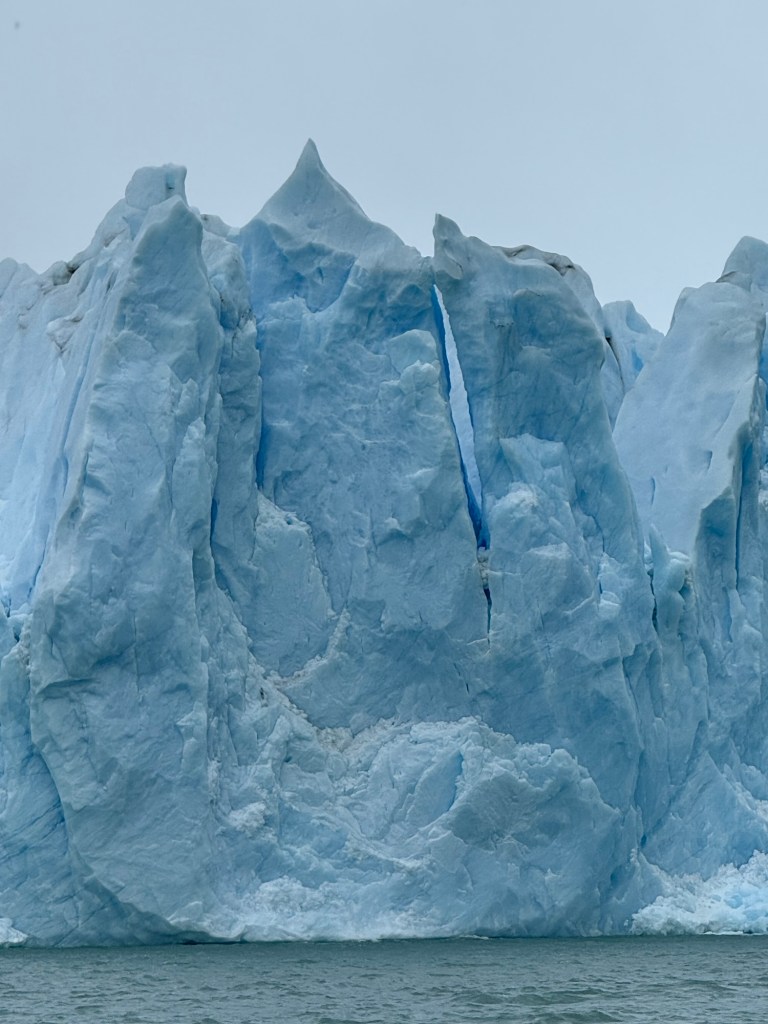
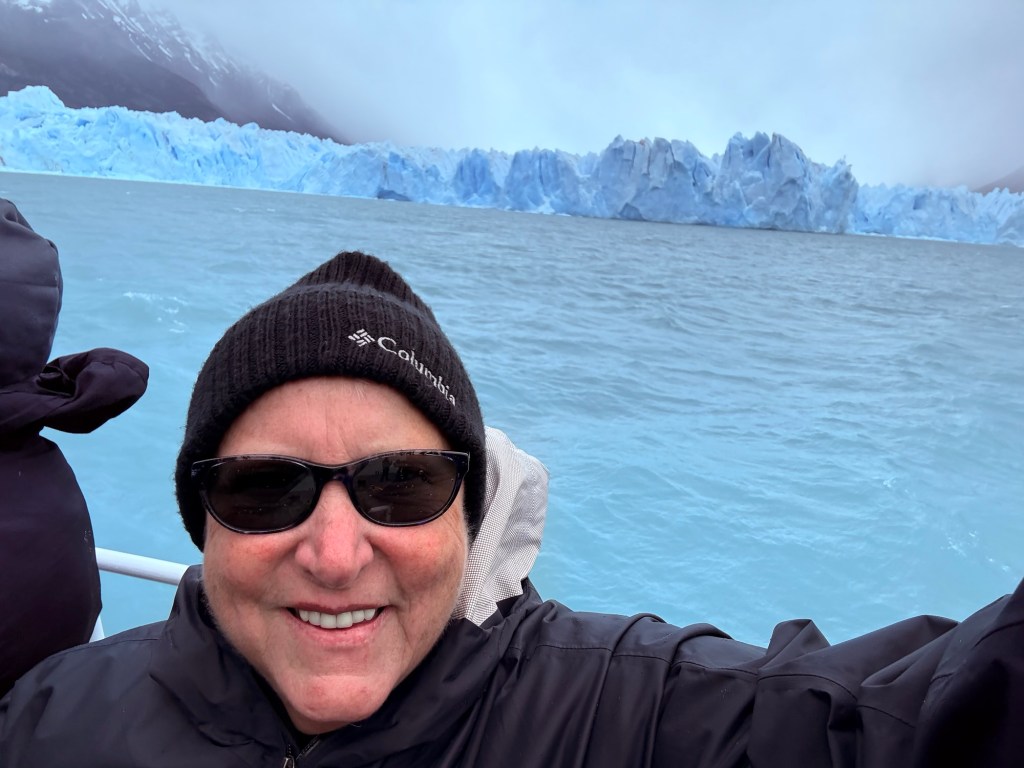
Our first stop once inside the park was to embark on a two-level tour boat on Lago Argentina to get as close as safe to the snout of the north side of the glacier which averaged 50 meters high.  It took us just a few minutes to get from the port to the glacier and although it was really cold, the wind was whipping and it was misty and even raining a little, we stood outside to be able to get the best views and pictures. It was fascinating; the rich and translucent appearing blues; and the cracks and crevices in the ice casting shadows. 

We were hoping to see a section of the wall calving but despite staring at the wall, no such luck. Finally we were shooed inside for the trip back to the port where we went into the visitors lodge which provided food and washrooms. From there, there were steel grated walkways all throughout the side of the hill over looking the glacier to get different views. Our guide had recommended we take a couple of specific ones to get the best views in the time allowed. 

We were going to grab some lunch because it was now 1 pm but the line was long so we decided to do one of the loops and come back later for lunch. Best decision we could have made. It meant that when we were on one of the best places to view the north edge of the glacier we heard the thunderous crack we’d been told to listen for, and stopped in our tracks to stare at the face. And OMG, a small avalanche of small pieces started and then a huge piece of the wall broke off and slide into and submerged into the water.  Almost immediately it popped back up again, like a beautiful turquoise whale breaching, to settle on the surface of the water. It was quite something. I got some of it on video but I was concentrating so much on what I was seeing that I missed moving the camera to catch some of it! Sorry about that! We watched for a long time as the berg grew higher in the water as the water ran off of it back into the lake. You could see sections of where the glacier had been in contact with the sediment so it looked dirty, and other areas that were clear but the most predominant was the beautiful turquoise blue.  

Again I apologize for the lapse in videography, but my eyes will remember what they saw.
Here’s the piece that calved once it had come to the surface completely.

We decided after that there wasn’t anything that could have been more spectacular so we didn’t finish the walkways and instead went back to get lunch. And there was no line up. Sometimes things just work out.  

Spectacular but desolate countryside.

It was back on the bus for the return trip getting back to our hotel by about 5 pm, tired but happy. After a rest and a change of clothes we walked downtown to a pasta restaurant that was highly rated by Trip Advisor (and we were in the mood for something different to eat). It had a great vibe and the food was fantastic, all made on site.  We ended up sitting next to a couple from Germany who we had seen on the boat trip in the afternoon and we conversed with them through much of the dinner talking everything from travel to politics. They are spending 3 months travelling through South America, and were very engaging so it was a delightful evening. 

2025 South America

As close to the South Pole as I’ve ever been

Today we left the capital of Argentina, Buenos Aires, and headed further south to the small community of El Calafate in the province of Santa Cruz. It is the major supply community for those travelling to Los Glaciares National Park.

Our domestic flight flew out of the municipal airport today. The airport was quite chaotic, but everything was on time and all went well. As we were approaching the town we could see the snow capped Andes in the not too far distance. We arrived into El Calafate by 12:30 pm and were bussed to our hotel which is a 20 minute or so walk to the centre of town. 

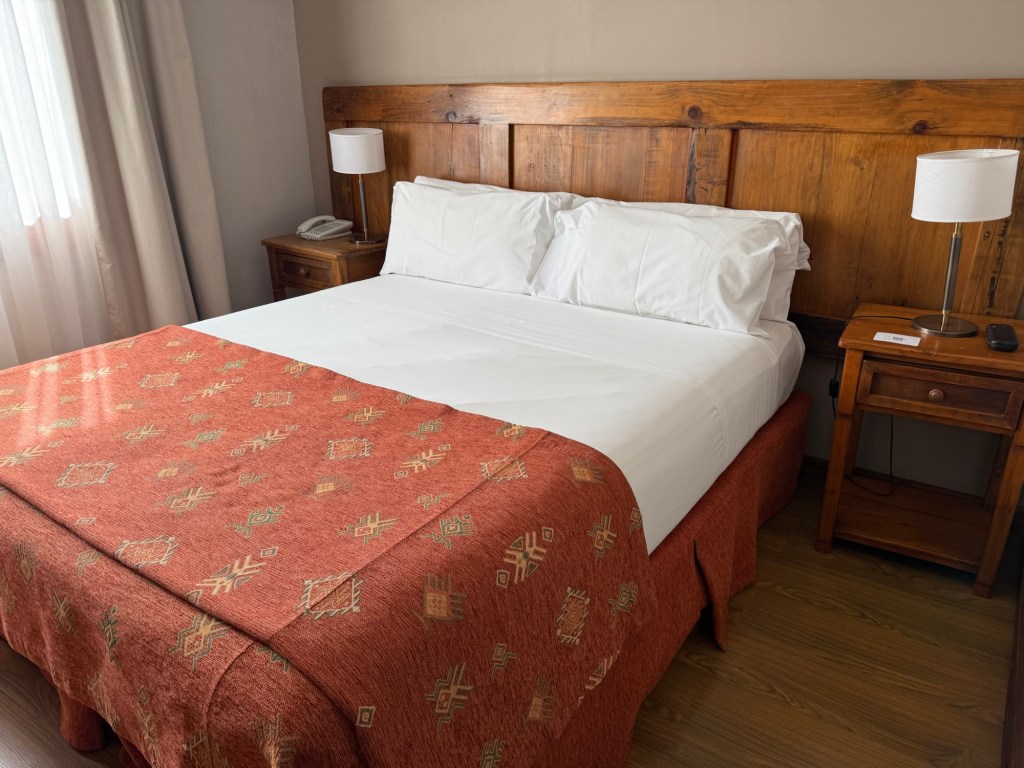
Our home away from home for 3 nights
As you can see our hotel leans into the lodge decor

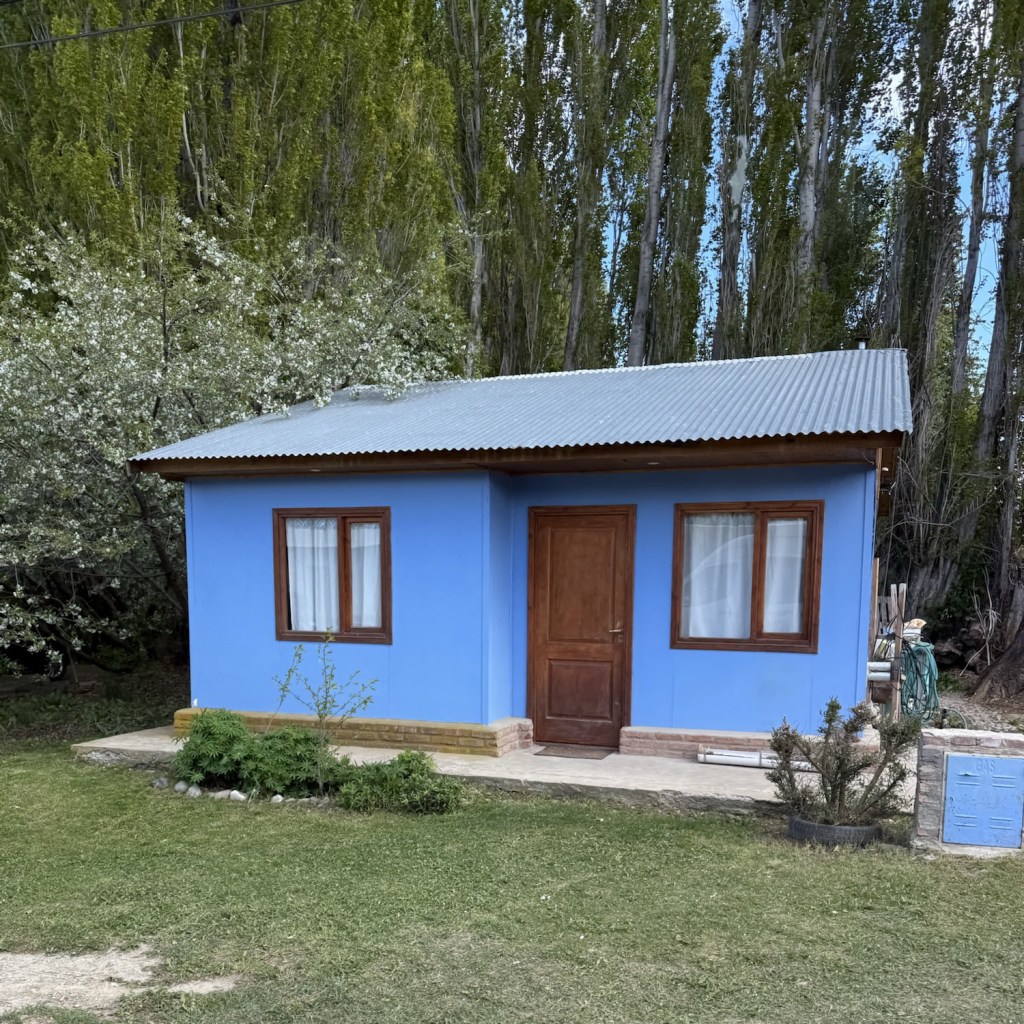
More than 30,000 people live in Calafate, all supported by tourism as its only industry. They run tours year round with the height of the season being their summer, December and January, when it warms to mid-20s C. In their summer, it is light in the day from 4:30 am – 11 pm and in winter it is only light from 10 am – 4:30 pm. When we arrived I said it felt like we were in Canada’s north, like White Horse and I suppose it is pretty similar distance from the equator. The architecture ranges widely from tiny ramshackle bungalows, to lodge or cottage style and a few high end brick homes.    

After dumping our bags we meandered into town to grab lunch and see what we could see.  The town is bigger than I expected with many restaurants and stores supplying equipment and guides for those hiking in the park. One can also book an excursion to do a full day hike on the glacier, but we’ve given that a pass.  

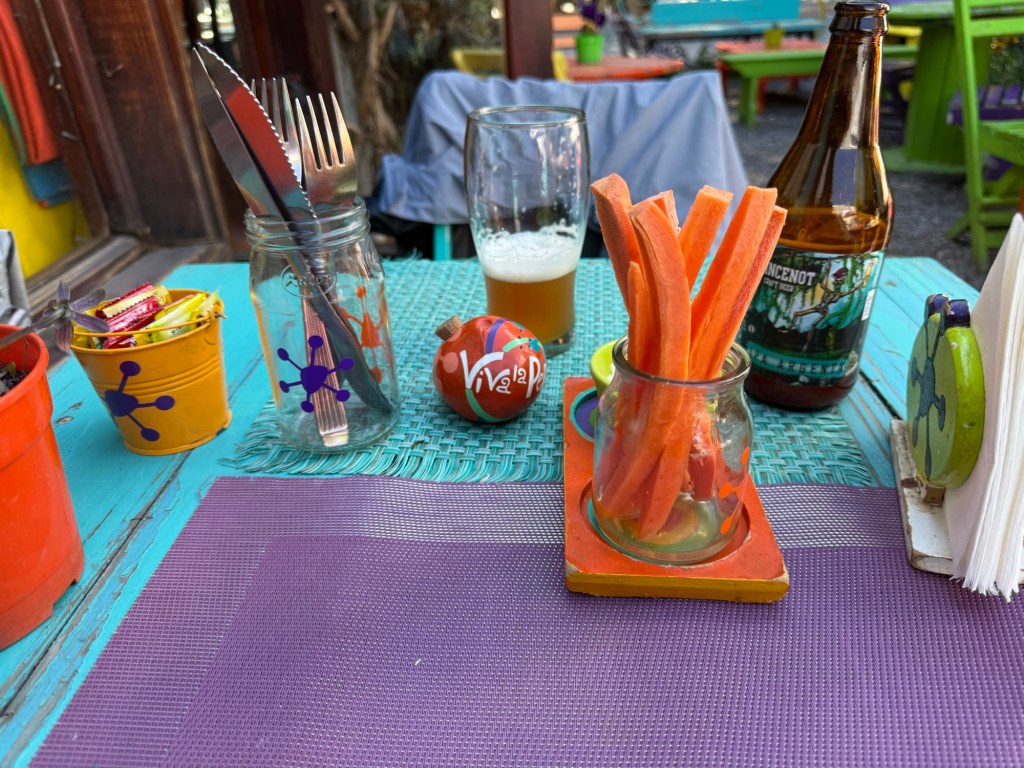
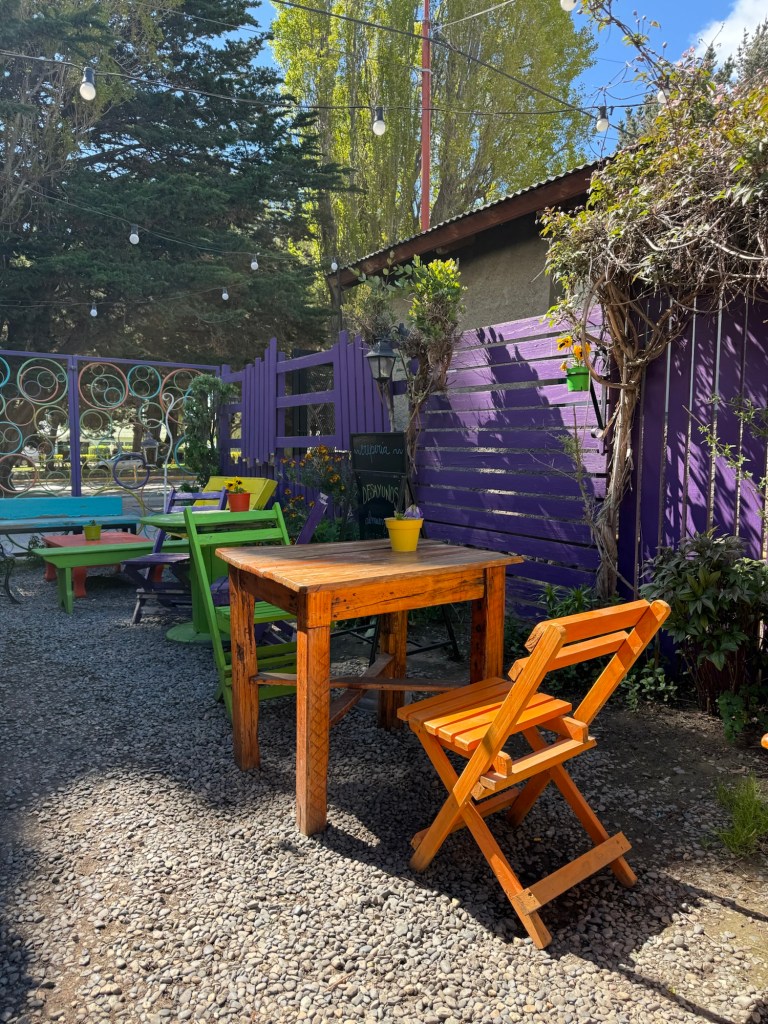
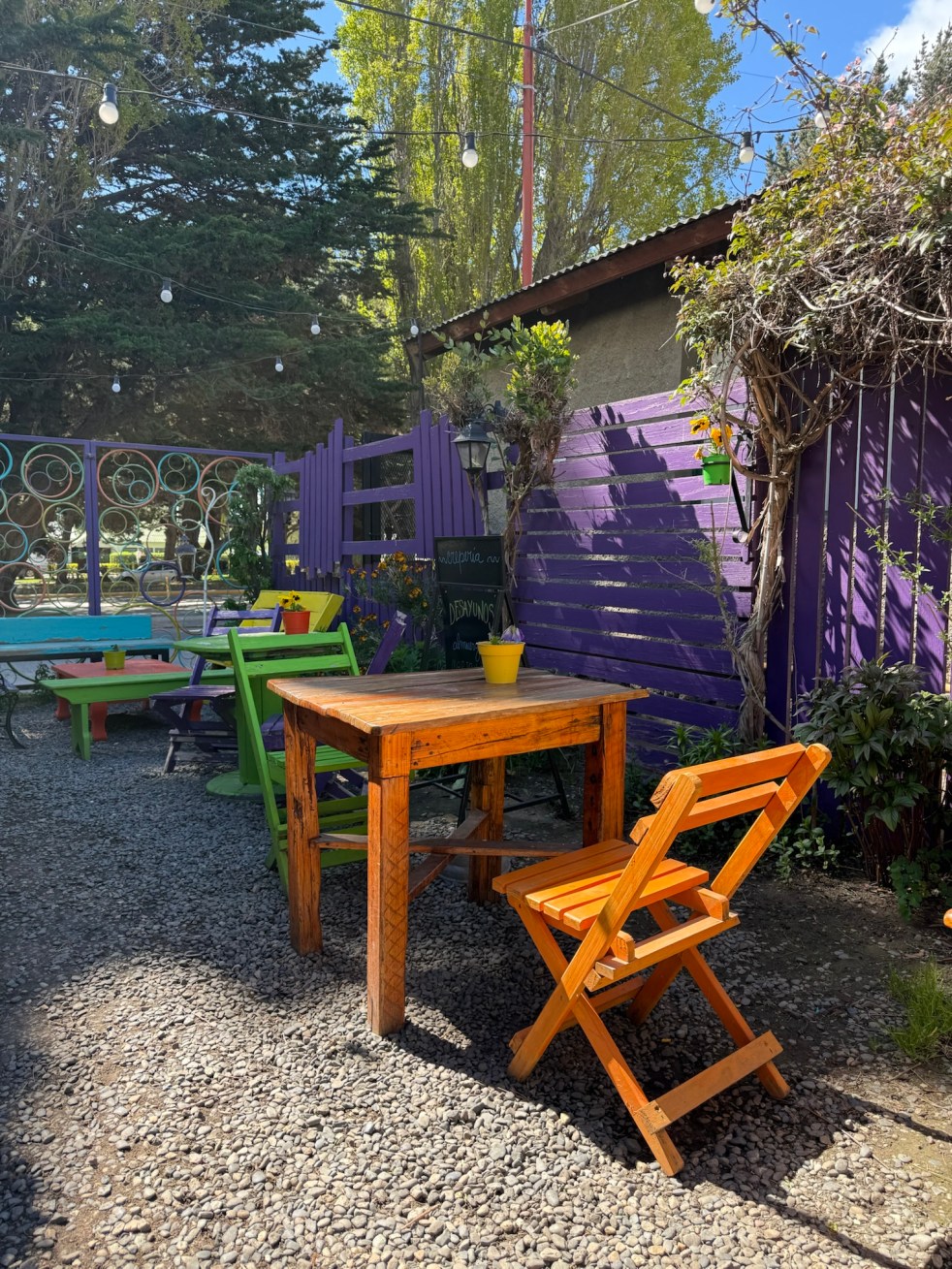
We found a really cute, brightly painted and adorned cafe with an outdoor patio, and it was warm enough in the sun and out of the wind to sit outside. 

Everything was brightly coloured and joyful

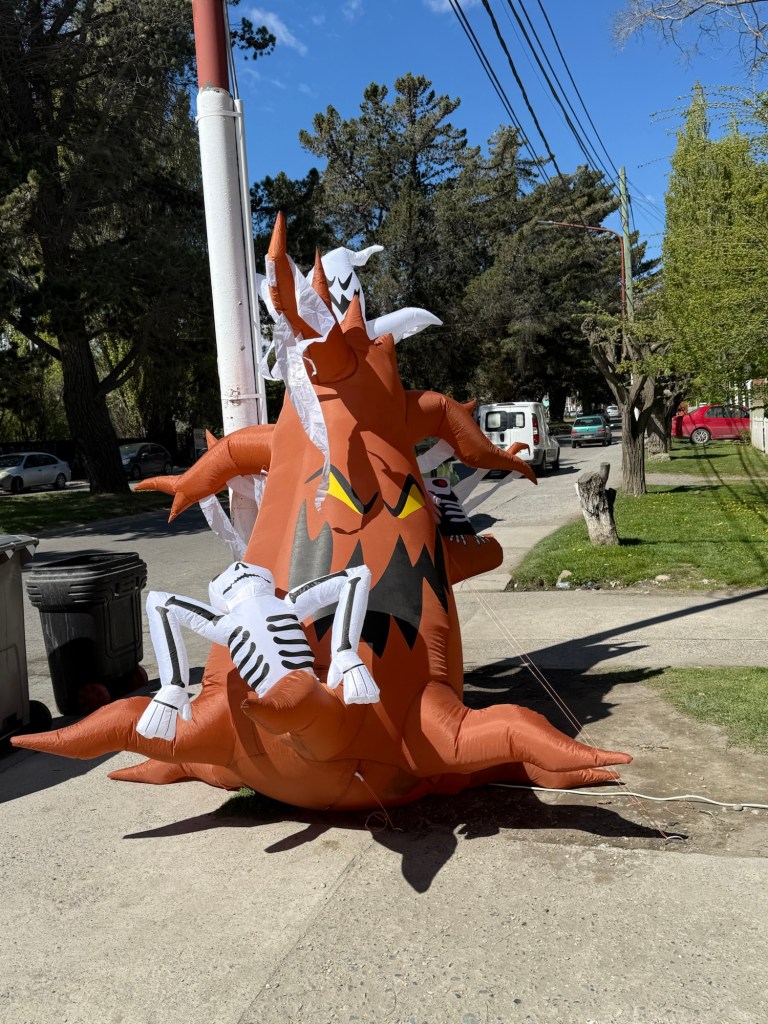
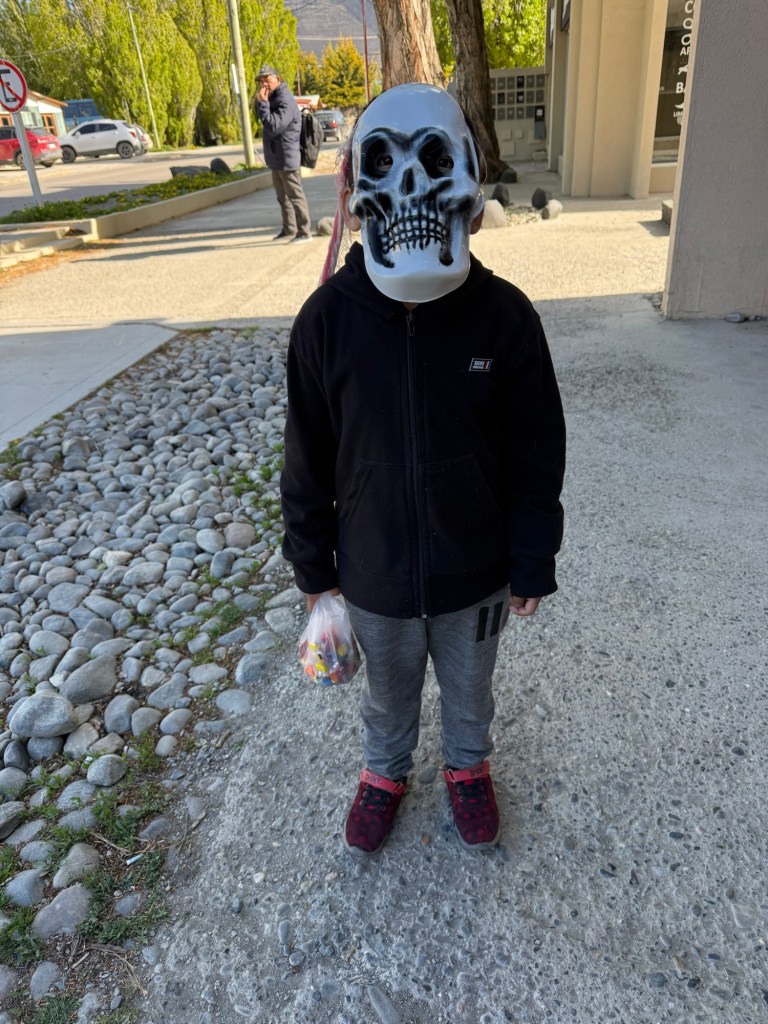
As we had our lunch at about 3 pm we started seeing little trick or treaters walking down the sidewalks and coming in to the restaurant to get treats.  Many were dressed as skeletons, and some as quite gory corpses.  But there some other inventive and cute costumes on the kids and on their parents accompanying them.  Made me a little homesick for my little humans in Ottawa but I know they had a hoot.  

We picked up some snacks and water from the grocery store on the main drag and headed back to our hotel, stopping at a bakery on our way home to pick up sandwiches for dinner. Our hotel is really nice and we’re well looked after, but they don’t have a restaurant.

2025 South America

The tale of two tours. Part II

A great meeting place

We tried to fit everything we could into our short time in Buenos Aires and so although we toured around the city earlier in the day, for this evening we booked a foodie tour through Viator/Sherpa.  I was excited for this tour and it exceeded my expectations.  

We Uber-ed to the meeting point in the Palermo neighbourhood about 30 minutes away in heavy traffic. Palermo is a large well-treed neighbourhood with many nice shops and restaurants and a really nice vibe. Our guide, Lu, (short for Lucillia) met us at our first stop on a tour of 3 restaurants and 2 stops for dessert. She was a fabulous guide with a passion for her job and the food and culture she was talking to us about. The culture around the serving and enjoying food is always interesting to learn about in the countries I’ve been. 

We had a great cross-section of people on the tour of 8 which made for lively conversation. There was a woman our age from London, England who was on a similar tour as ours (Exotica), a gentleman from North Carolina who was here with his nephew who was there for a week writing exams to try and get in to university in Buenos Aires (he was Colombian), and a retired couple with their young adult daughter who were independently travelling and were heading off in a rented car to travel around the country for a couple of weeks. 

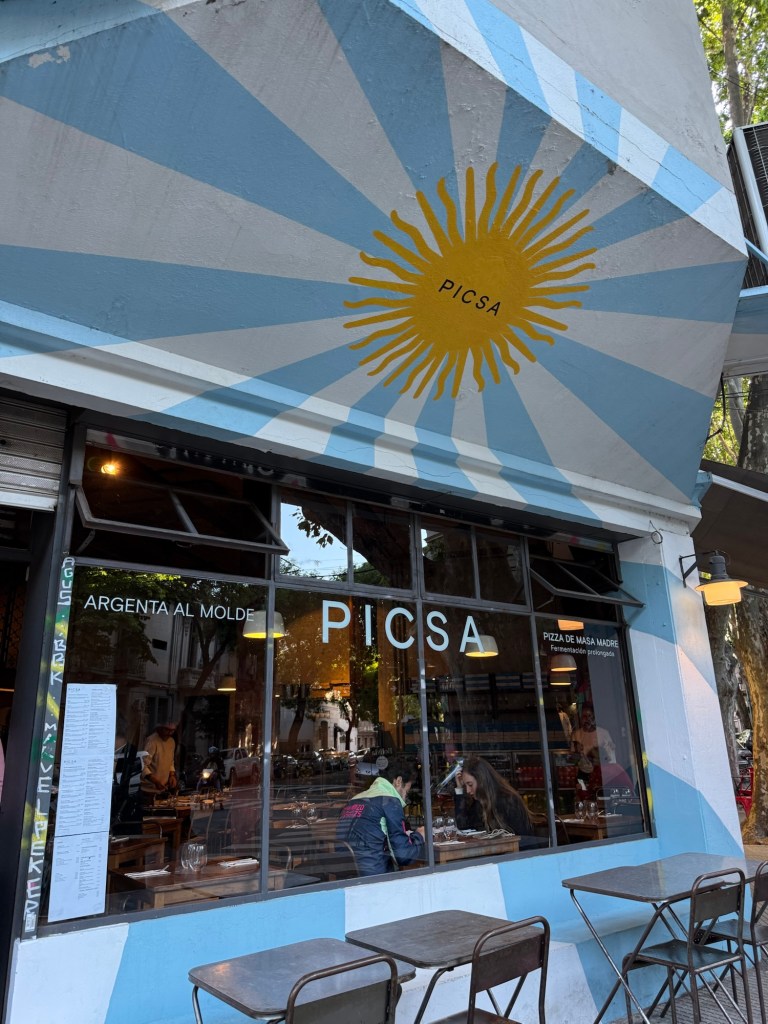
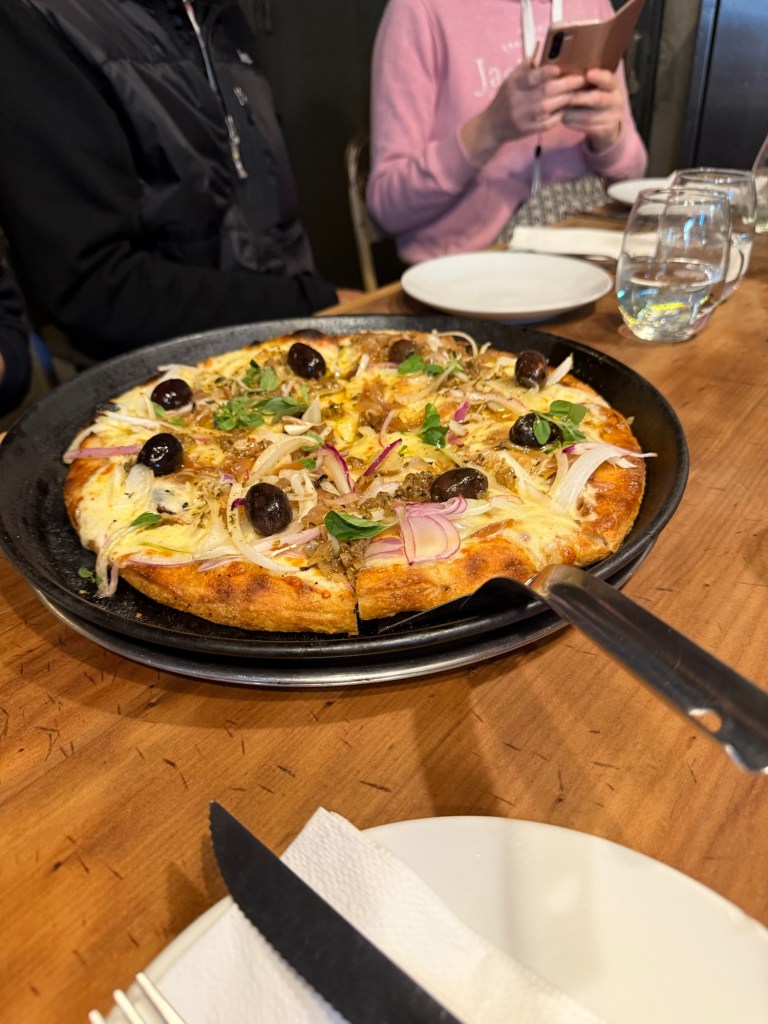
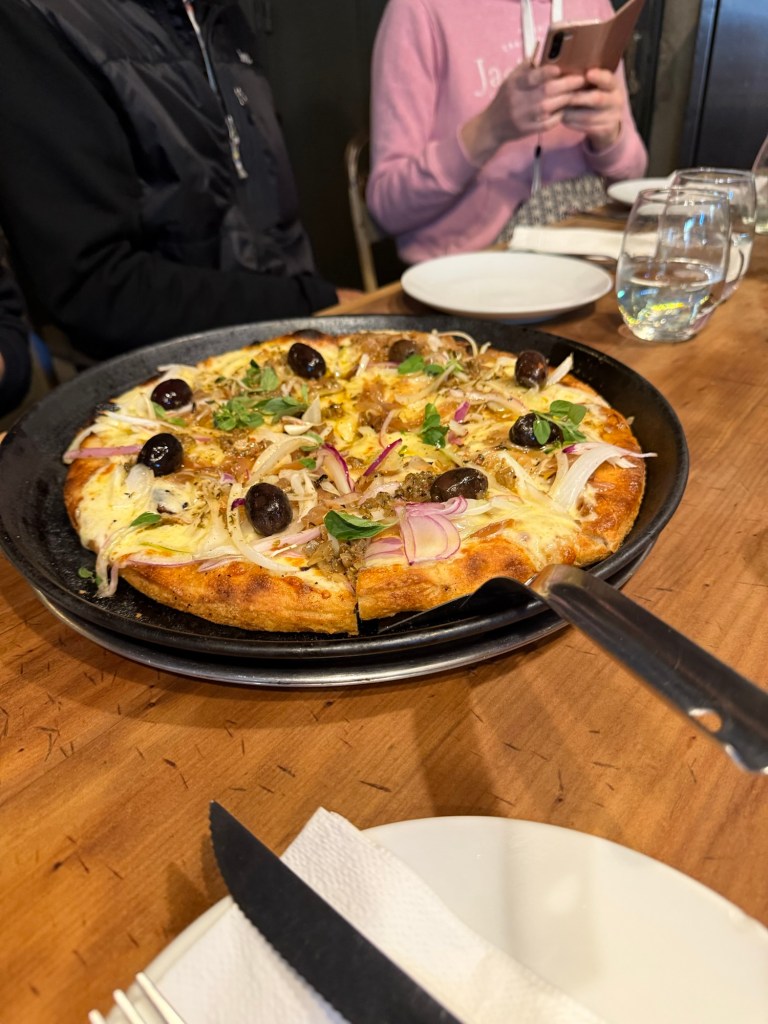
We started in a restaurant called Picsa, the Spanish word for pizza. I expected to be enjoying beef in our adventure and knew that there would be Argentinian wines on offer, but had no clue that pizza is something that the Argentinians have adopted and love. In addition to beef, Argentina produces huge quantities of cheese and it was used generously on the pizza we tried at Picsa. Lu had ordered one of the most popular local toppings for us which was onion, arugula, and olive. It was thick crust and had so much cheese!

Picsa

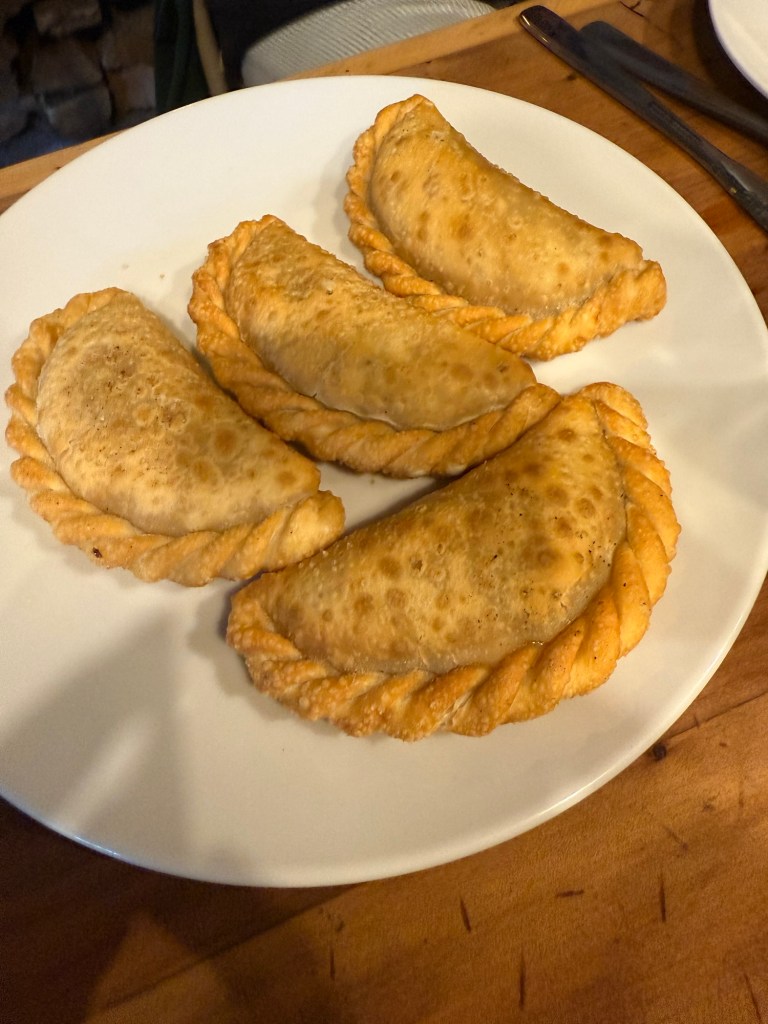
We also had a beef empanada that had such lovely light pastry and really expertly spiced beef, rather than ground. Lu said the best empanadas had a perfect 13 twists of the dough along the crescent shape, and had no air inside the pastry. By those standards these certainly fit the bill. Wine was served at all three places and not being a wine-drinker I didn’t really pay that much attention, but I believe they were all Malbec, which is a specialty of the Mendoza wine region of Argentina. Lu explained that Picsa and empanadas were foods that one enjoyed on the spur of the moment when gathering with friends or family for a casual evening. 

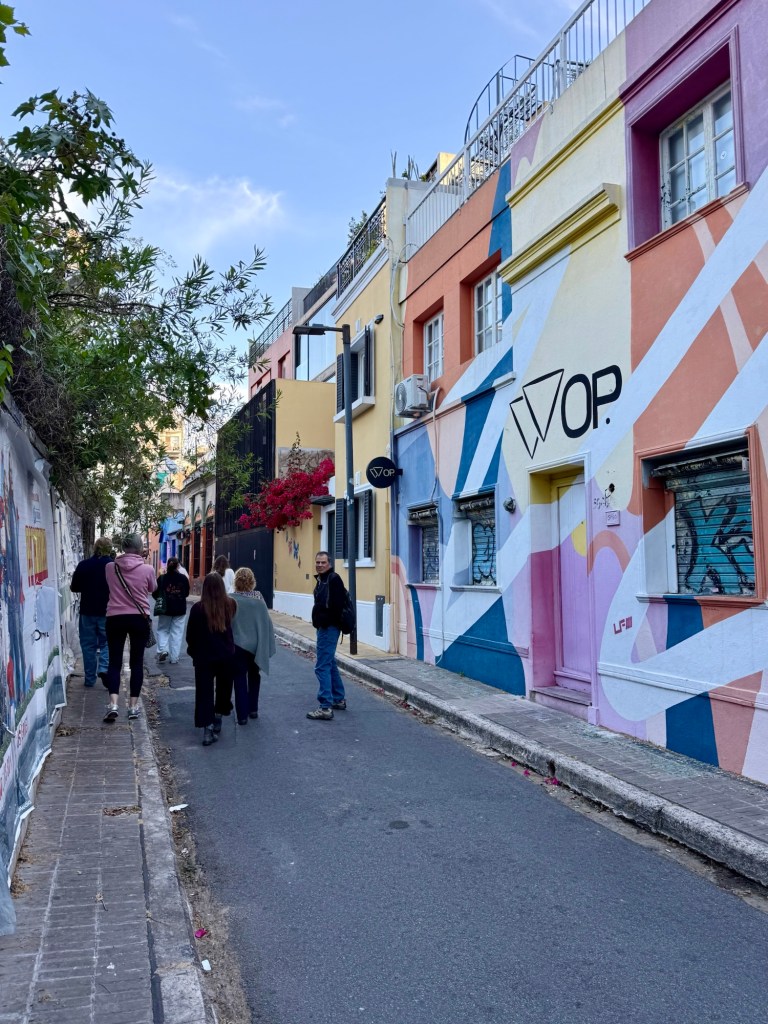
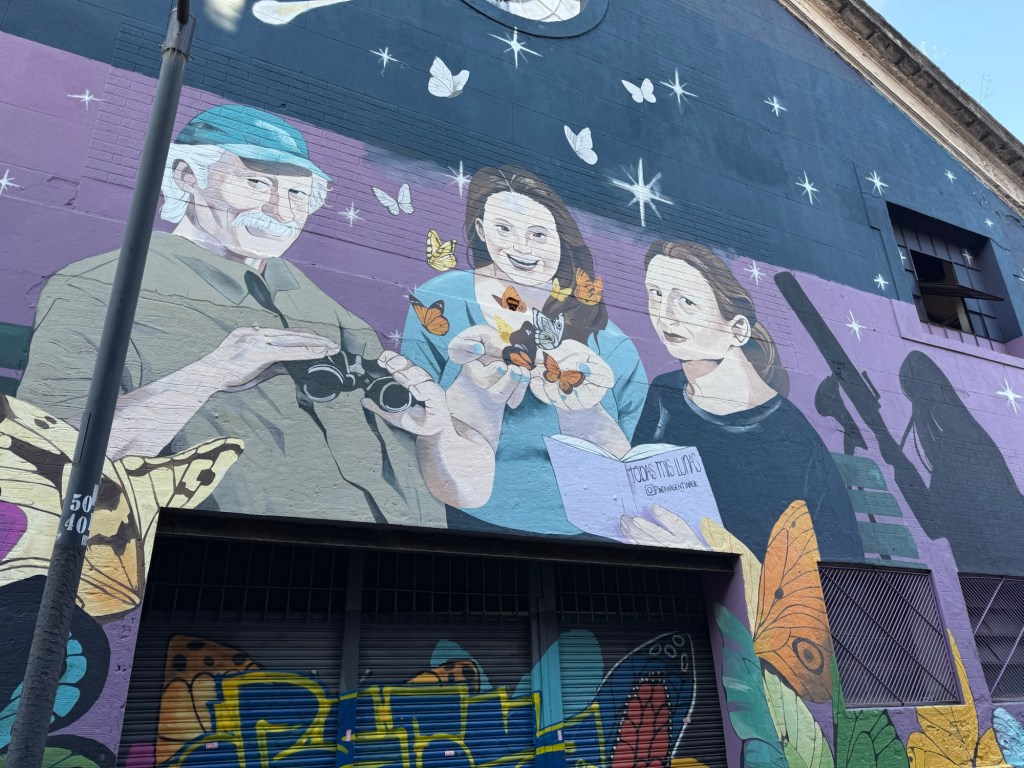
We walked only a few blocks to our next stop down some narrow alleys filled with wall art that reminded me of Cartagena.

Our next stop was a steak restaurant in a beautiful 100+ year old former home.

Lu telling us about this 100+ old house turned into one of the finest restaurants in the area.

Here we started with a cocktail of rose wine and a lemon/lime soda which was really refreshing. 

The clear spray bottle on the table is hand sanitizer, don’t put it on your steak!

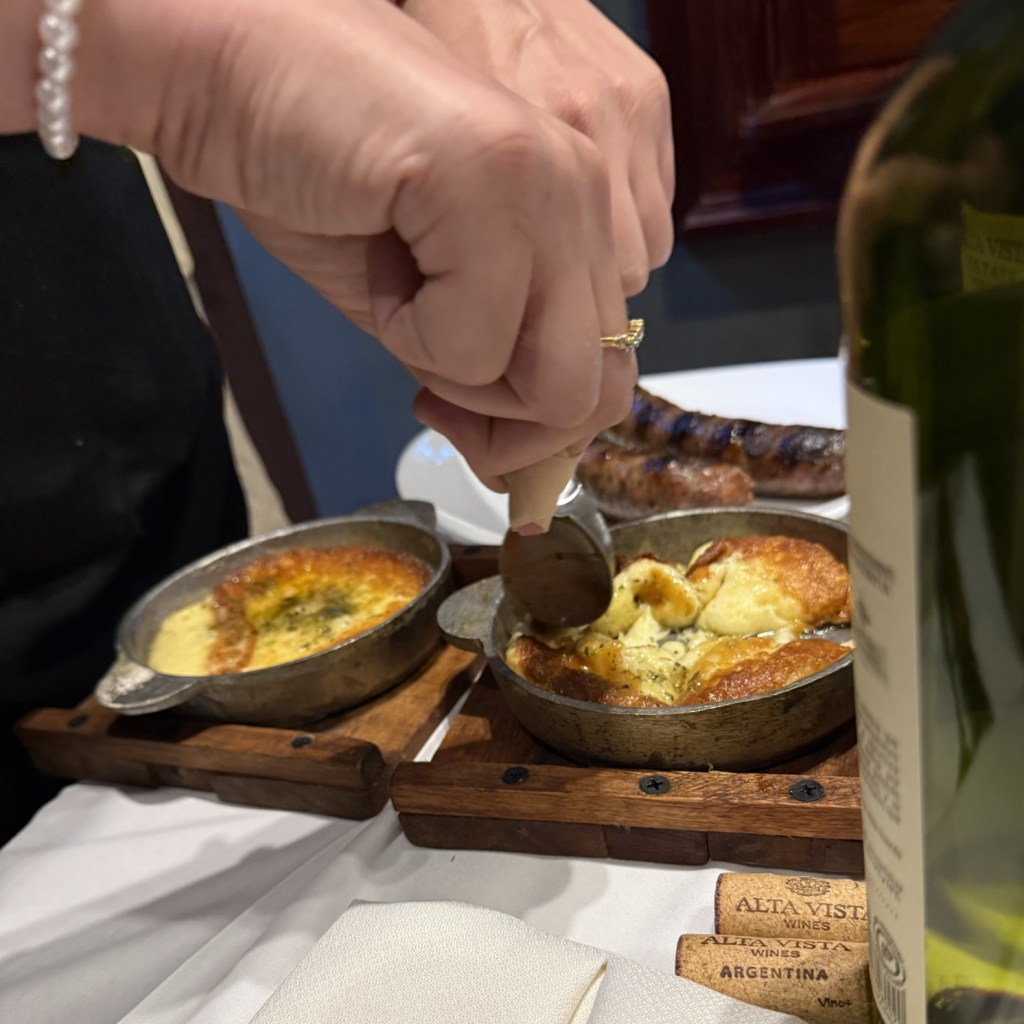
Our first food portion was cheese melted on the grill in small cast iron skillets which we tried as Lu told us that instead of cheers, Argentinians say cin cin (chin chin), and instead of cheese ( since the word queso would have them end with an o-shaped smile) but rather they say whiskey.

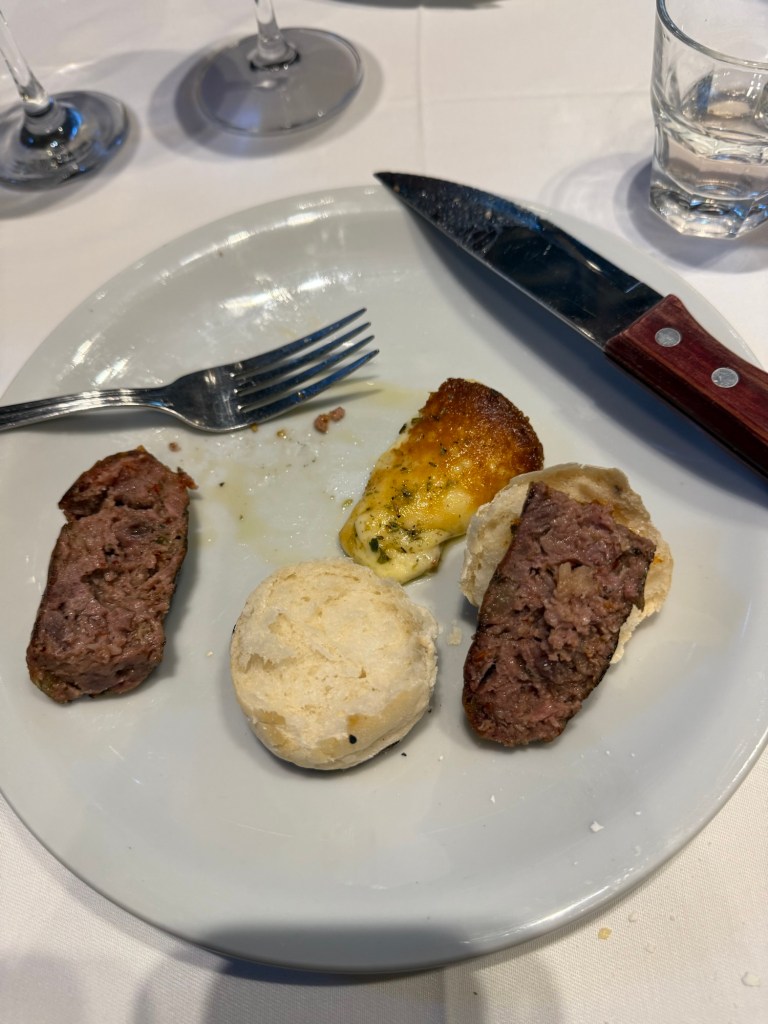
We then tried a mini-choripan sandwich, which I had eaten for lunch. We constructed the sandwiches ourselves, kind of like sliders, using fresh small buns. This one was considerably more flavourful and thankfully less garlicky. And then the star, grilled steak, served with three different kinds of sauce. I now realize I didn’t take a picture of the steak or the sauces. So anxious to try the delicacy. Lu explained that they don’t marinade their steaks but rather grill and then serve a sauce with it at the table. Tonight we had the option of a Chimichurri sauce or one made from peppers and onions and another green one that I can’t recall the name for or what was in it. (I wasn’t taking notes and rather enjoying the company) I didn’t eat all of my small portion as we by now we’d already eaten quite a lot!  

This isn’t a terribly appetizing picture, but is the chorizo sausage on half of the roll, and some of the melted cheese. Believe me it tasted better than this looks.

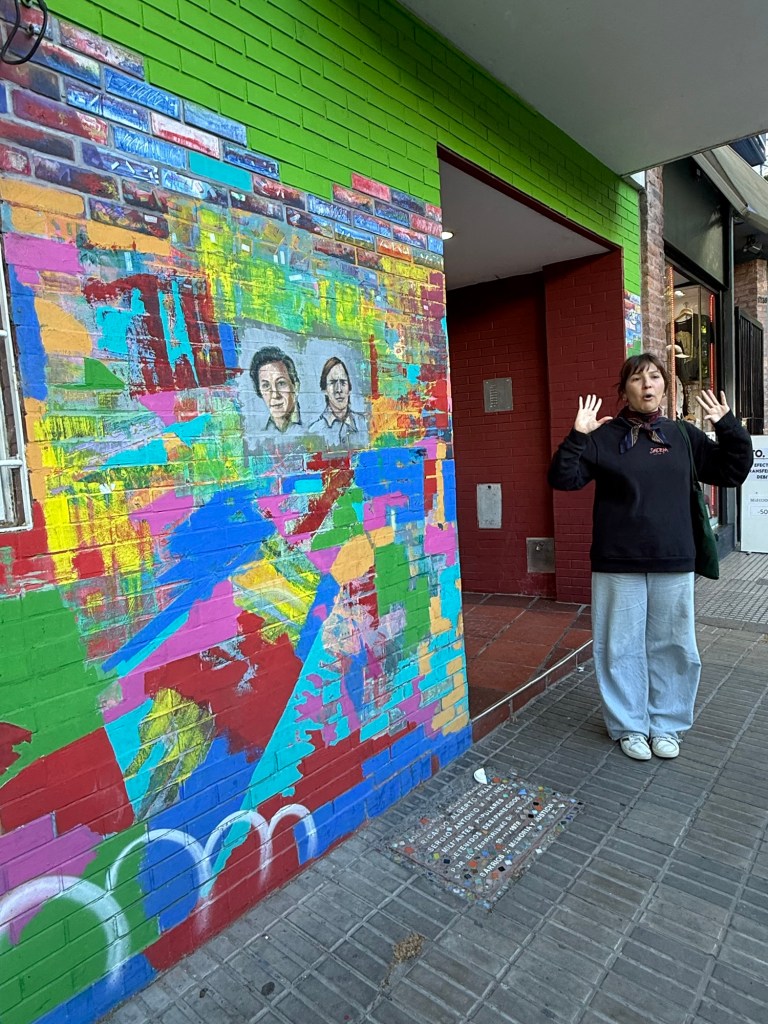
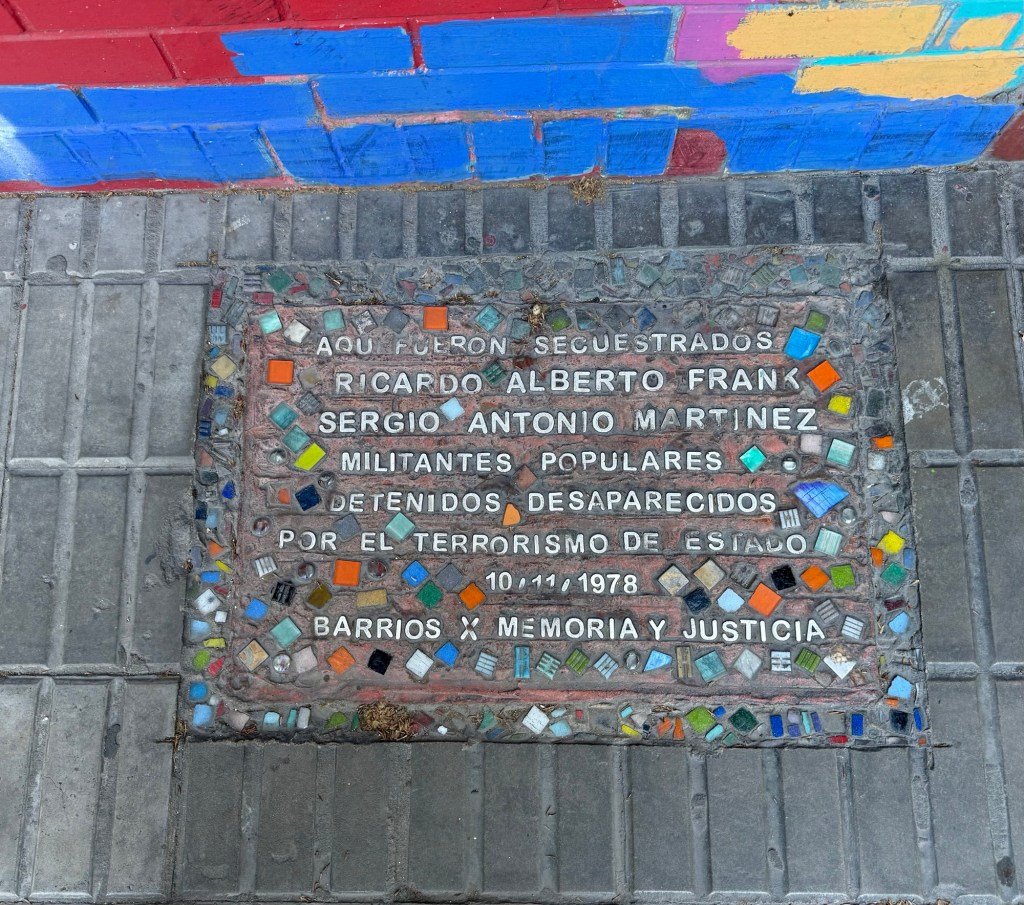
As we walked to our next stop Lu showed us a mural on one of the walls and explained the significance of the mural and squares in the sidewalk which we had noticed in other places in the city. They are memorials marking the spot where some of the approximately 30,000 or so people (referred to as desaparecidos) were each kidnapped and disappeared, and most killed, by the military during the years of the junta in the 1970s.  Wearing white scarves became a symbol for the mothers or grandmothers of those who went missing while they protested the actions of the military supported government of the time.  

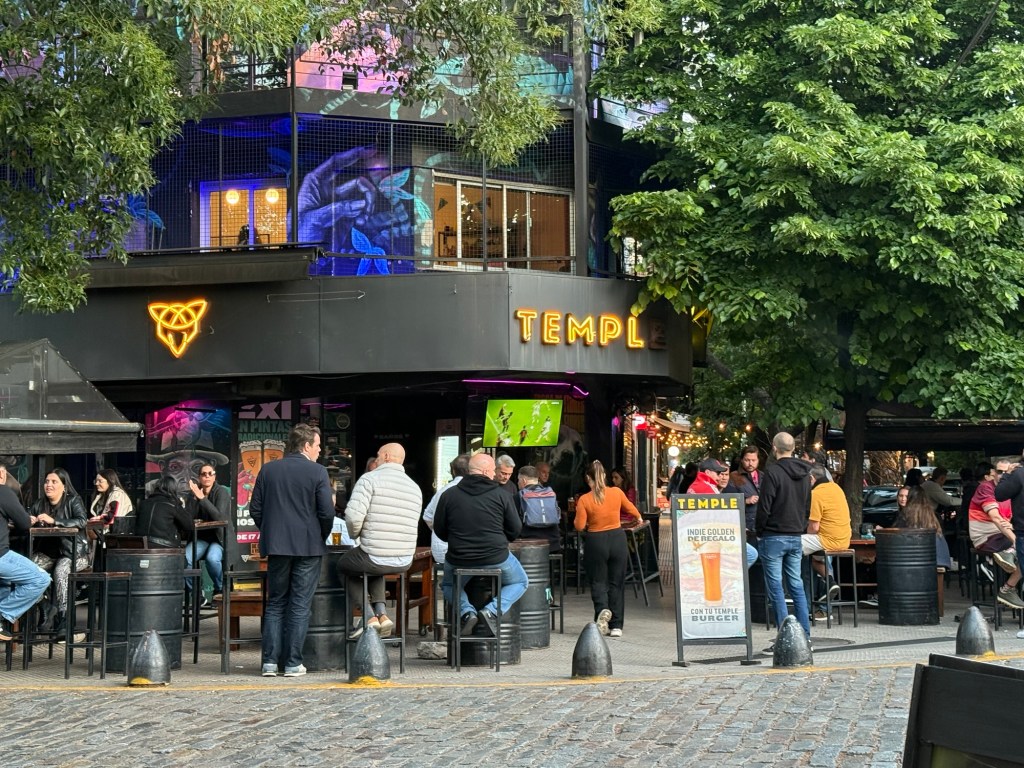
As we walked to our third restaurant, dusk was upon us and the neighbourhood came alive. Neon lights turned on, chairs and stools were pulled outside, and primarily young people were joining with friends and family at the various bars and restaurants covered by an umbrella of huge trees. The noise of the traffic died down and was replaced with the sound of the friends catching up.

The boulevard surrounding the Palermo sign in the middle of the neighbourhood is a favourite meeting spot for friends looking to meet up and decide where to grab dinner.

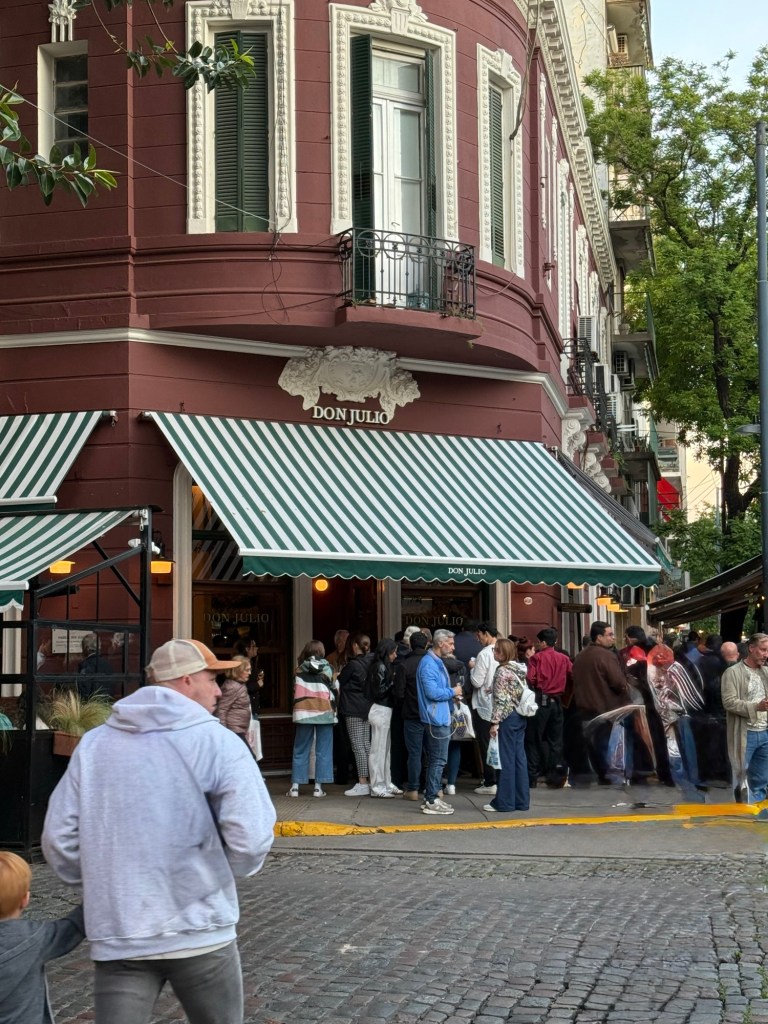
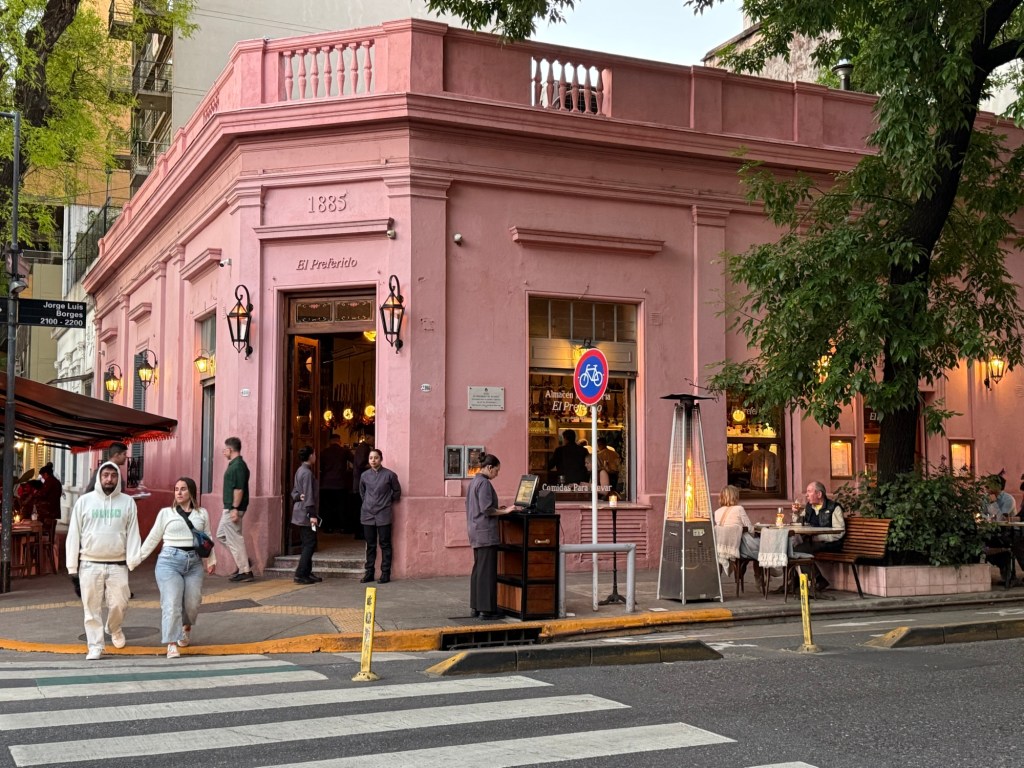
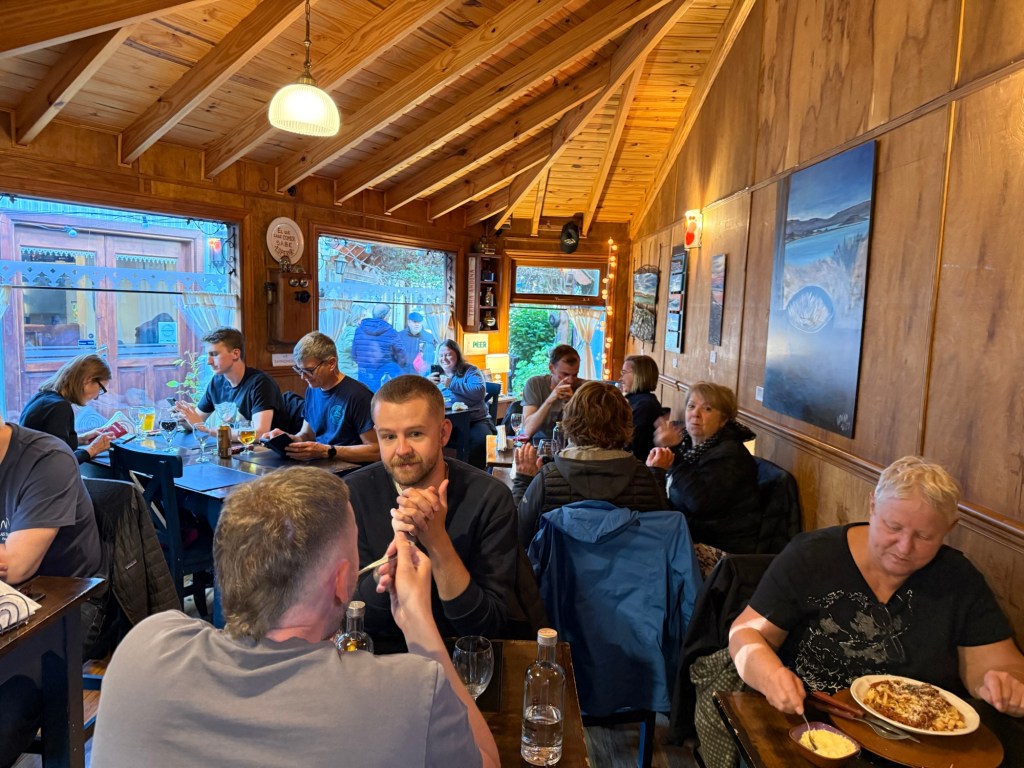
At our third restaurant, called El Preferido, we were seated next to the glass walled cooler that held hundreds of hanging sausages and cured hams. The eating area had high ceilings and although it was early by Argentinian standards for dinner, it was buzzing. The chef/owner of this restaurant also owns another restaurant called Don Julio, a couple of blocks away which has a Michelin star. Even with reservations there were lots of people hoovering around the entrance.

El Preferido is on the recommended list to receive a Michelin star and has a green star from Michelin for sustainable practices.  They have their own wine supplied by a winery in Mendoza that supplies El Preferido and Don Julio. 

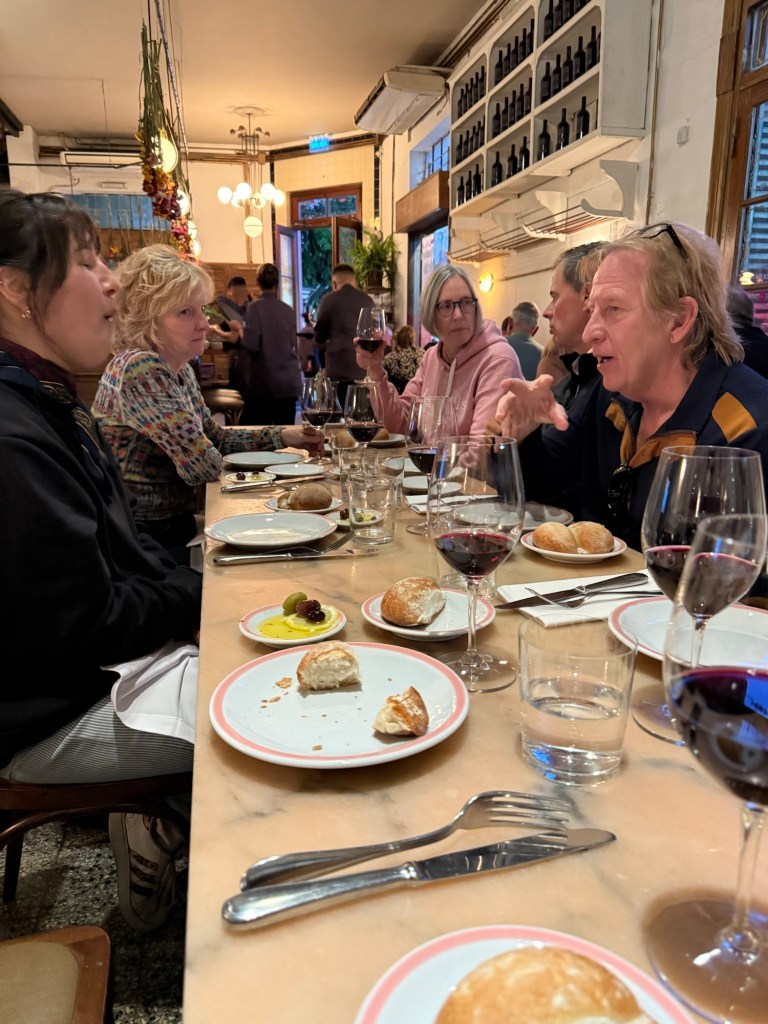
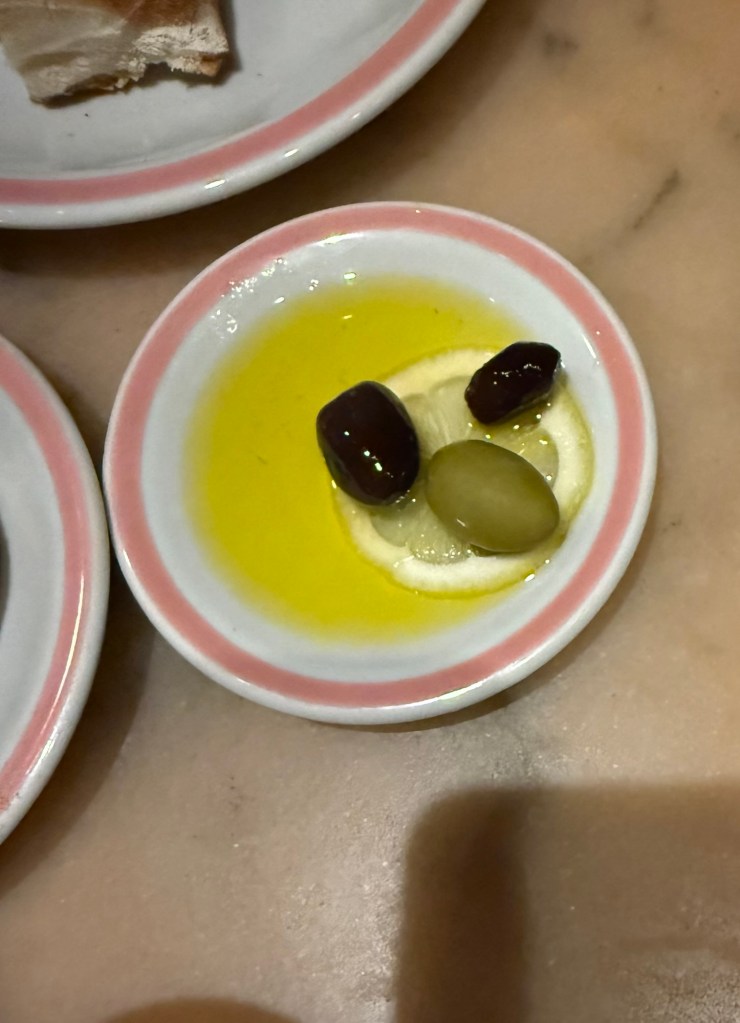
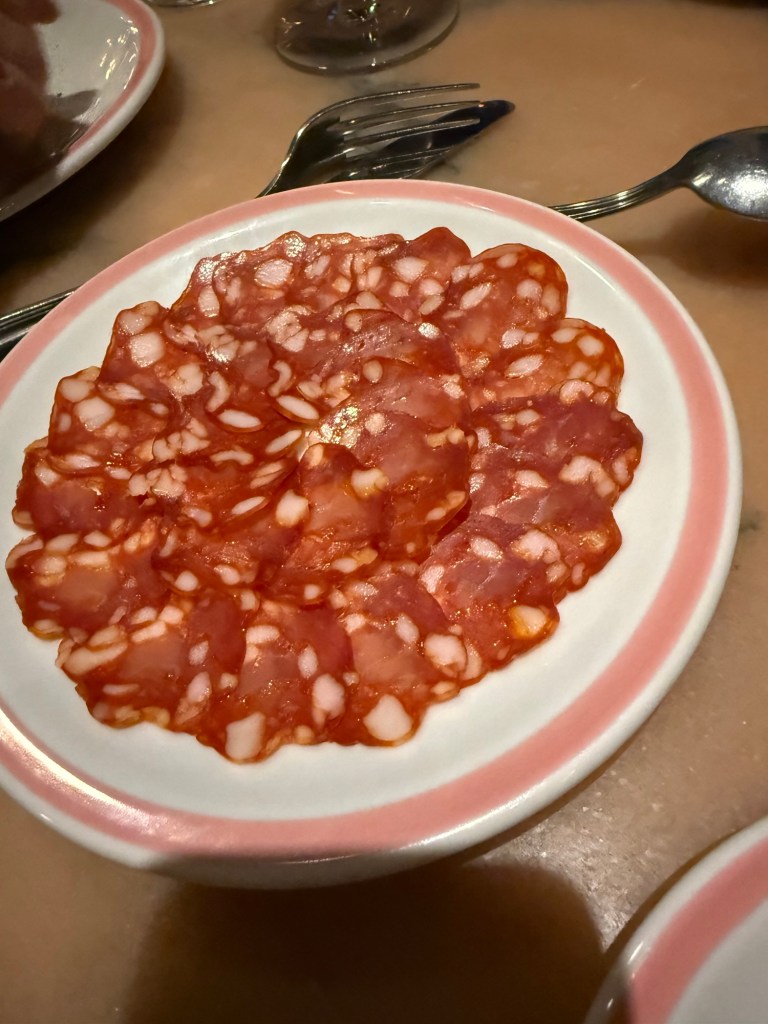
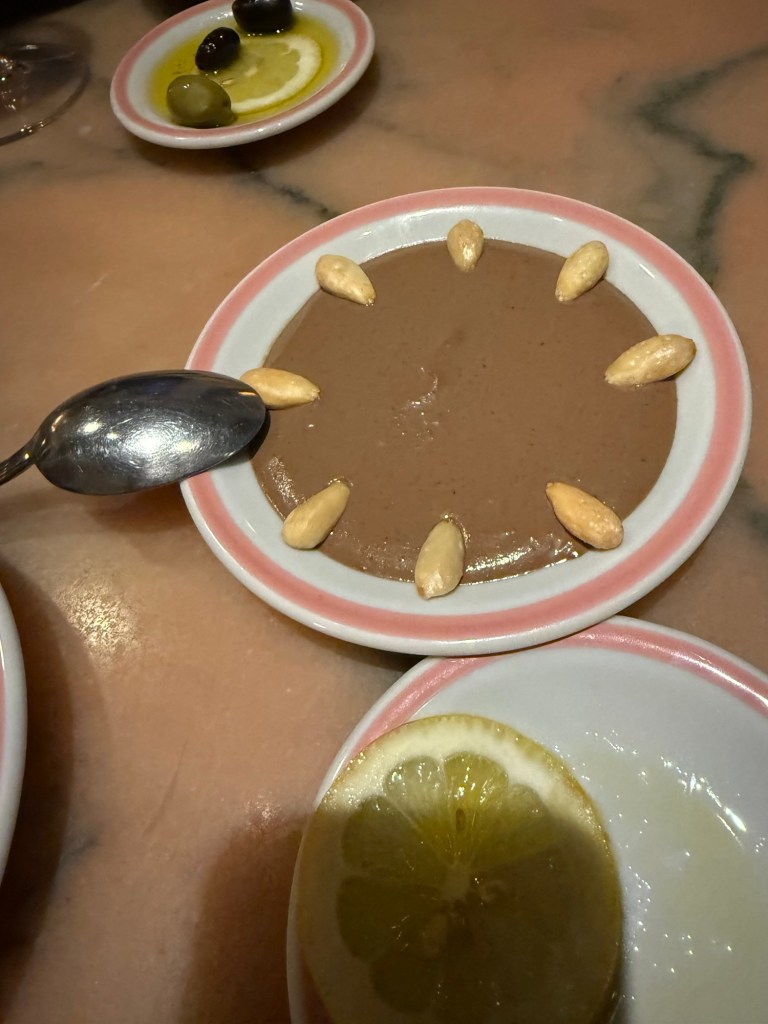
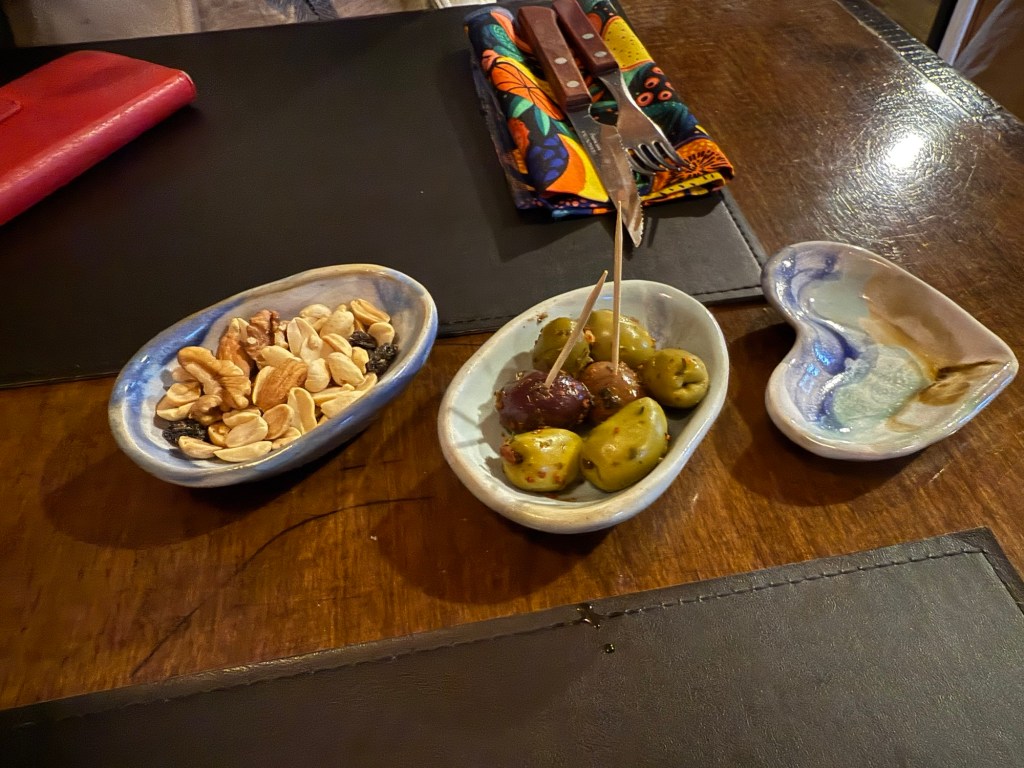
Here we tried several small dishes much like Spanish tapas. In fact, one dish was a Spanish Tortilla. Others included the most amazing rolls, (still warm from the oven), thinly sliced salami, a tasty tapenade with almonds, 3 kinds of olives in olive oil with lemon slice (from Patagonia), and a thin slice of bread made from chick pea flour (the only thing I didn’t like all evening). We lingered here chatting quite a while soaking up the great vibe.  

Lemon slice in the olive oil makes a nice dipping sauce
Thinly sliced salami with a bit of a bite of its own
This was an olive tapenade that was made into a paste rather than the chunkier one we’re used to, but it was as tasty and easy to smear on the fresh bread. Sigh.
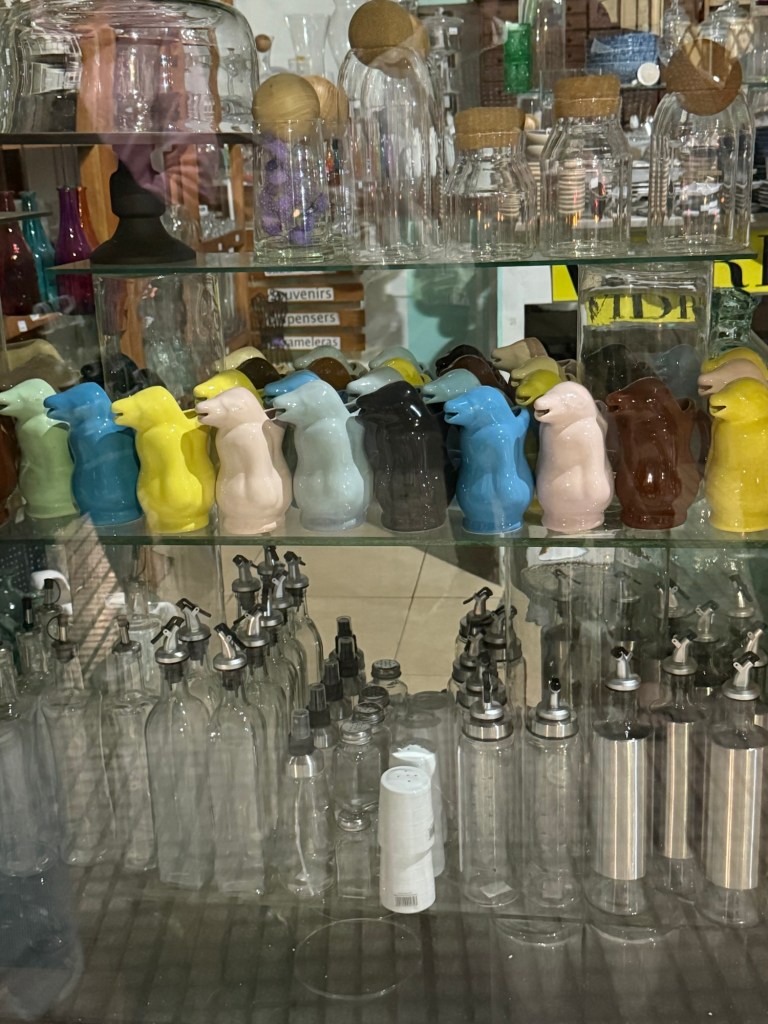
These coloured blobs are actually penguin wine pitchers for house wine which are quite trendy at the moment. It makes pouring house wine easier and hides what might not be the best coloured wine.

Lu finally moved us along toward the first stop of the evening for sweets, something that is near and dear to their hearts. We’ve seen more pastry shops in Buenos Aires per square mile than in any other country I’m sure. Lu picked up some foil wrapped treats in a candy shop that were absolutely possibly my favourite ever. They were chocolate-covered with a biscuit bottom, filled with caramel that was so good.  A stop at a gelato store capped off the evening. I felt like I could almost burst so didn’t take part in the gelato, but doubt I could have made up my mind because they all looked so good.  

Three and a half hours later we had sadly finished our wonderful evening and said our goodbyes to our new friends, including hugs from Lu. The neighbourhood, the food, the company were all fabulous, but Lu really made the experience.  Such a warm, engaging woman who clearly loves her job

2025 South America

The tale of two tours

Today was our regular city tour of Buenos Aires, led by the fastest talking guide known to man. He had both Spanish and English speaking guests so as the bus moved around the city, he gave his heavily accented talk in both languages, sometimes switching back and forth in the middle of sentences. To be honest I only got about 30% of what he was saying so forgive any inaccuracies. But he had a great sense of humour and I learned a few things along the way.  It wasn’t my favourite-ever tour, for sure.

I apologize for the derth and poor quality of the pictures, but we had only 3 stops in the 3 hour tour so it was impossible to get good shots. In an ideal world, after this overview tour we’d have several days to explore, however, we leave Buenos Aires tomorrow.   

We headed north from our hotel in one of the oldest neighbourhoods of San Telmo towards the Recolleta and Palermo Barrios. This was the route that many settlers in the city moved from San Telmo and La Boca in 1871 when a yellow fever outbreak forced them to look for cleaner and more open areas of the city.     

On our way, we passed through Retiro, which is the financial area, where the guide pointed out what used to be called the England Tower, but because of the war with England in the Falklands in 1982 it was renamed the Monumental Tower. (Sorry no picture) There were several 4 star hotels in this neighbourhood and we passed by the Train station, opened in 1930.  

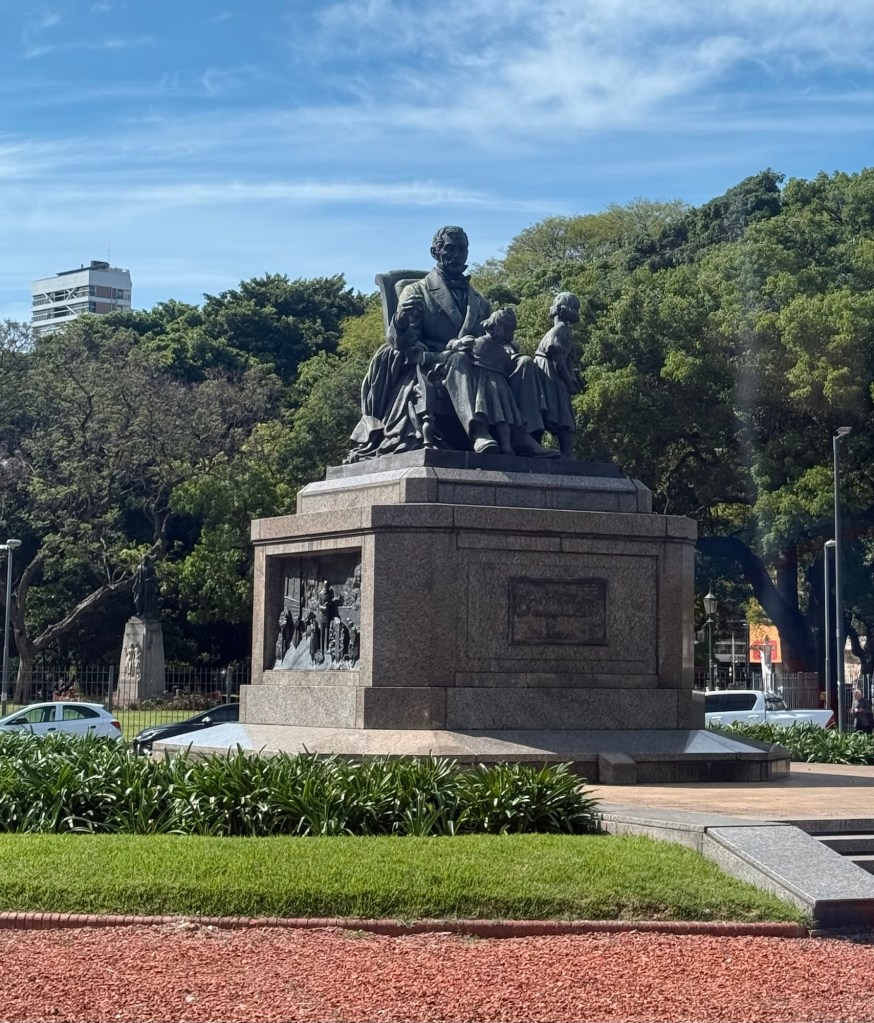
We zigzagged through the neighbourhood of Palermo and the guide pointed out many embassies that have taken over huge original single family homes. There is very little land associated with each of the properties which must be a security nightmare.  We passed a statue of General San Martin whose tomb we had seen in the Cathedral of Buenos Aires yesterday. He is nicknamed as the Liberator of Argentina, Chile and Peru, and was a central character in the struggle for Argentina’s independence.  The Order of the Liberator General San Martin, created in his honour, is the highest decoration conferred by the Argentine government. 

General San Martin

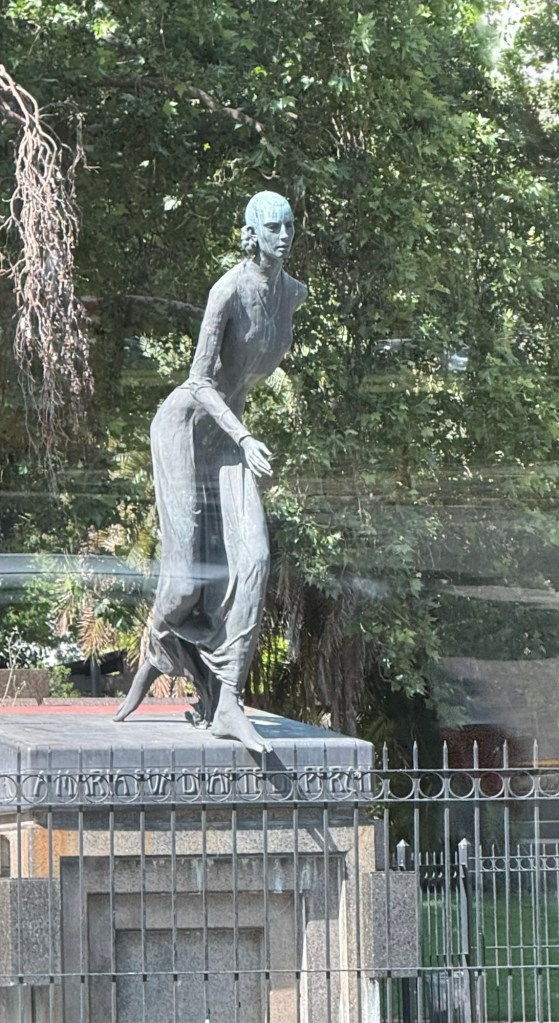
Next it was on to Recoleta Barrio and an avenue, Alvear Avenue, which is one of the most wealthy in BA and all of Argentina.  Along the way we saw a statue of Evita Peron in a beautiful park, but didn’t have a stop.  

Evita Peron statue

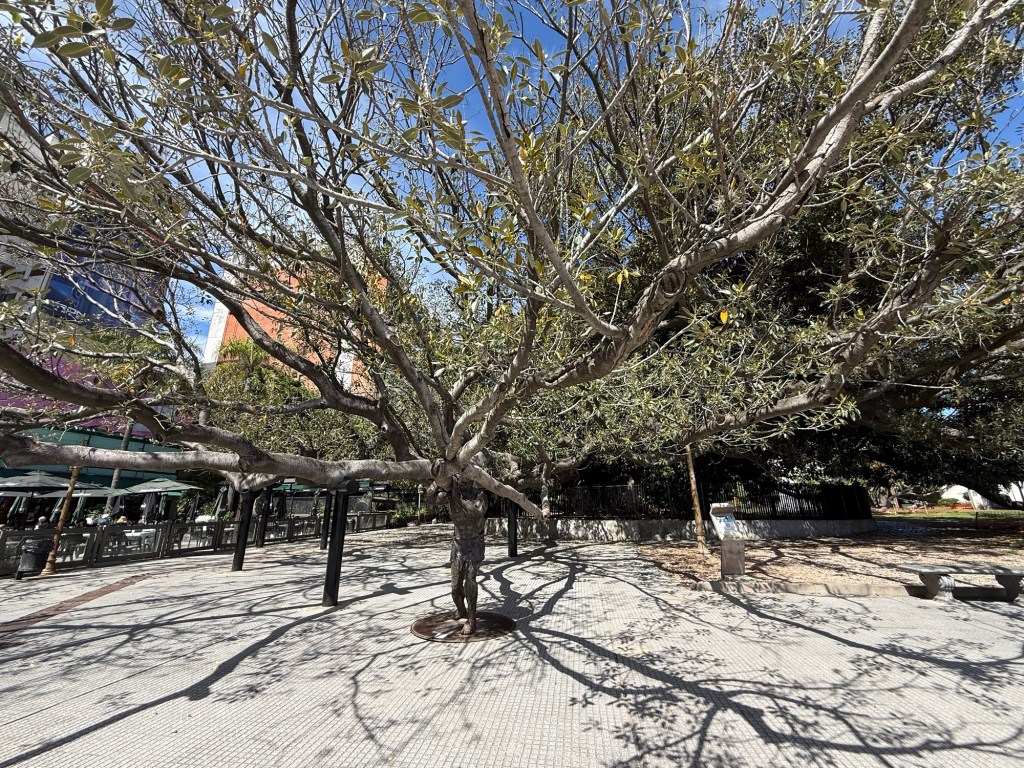
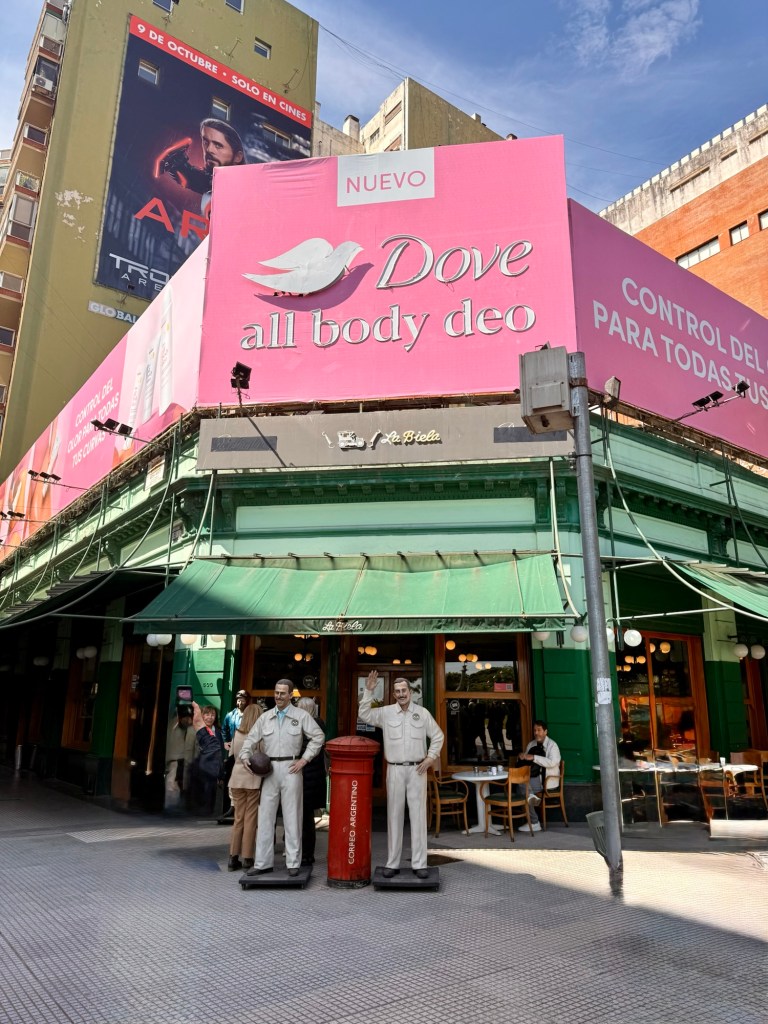
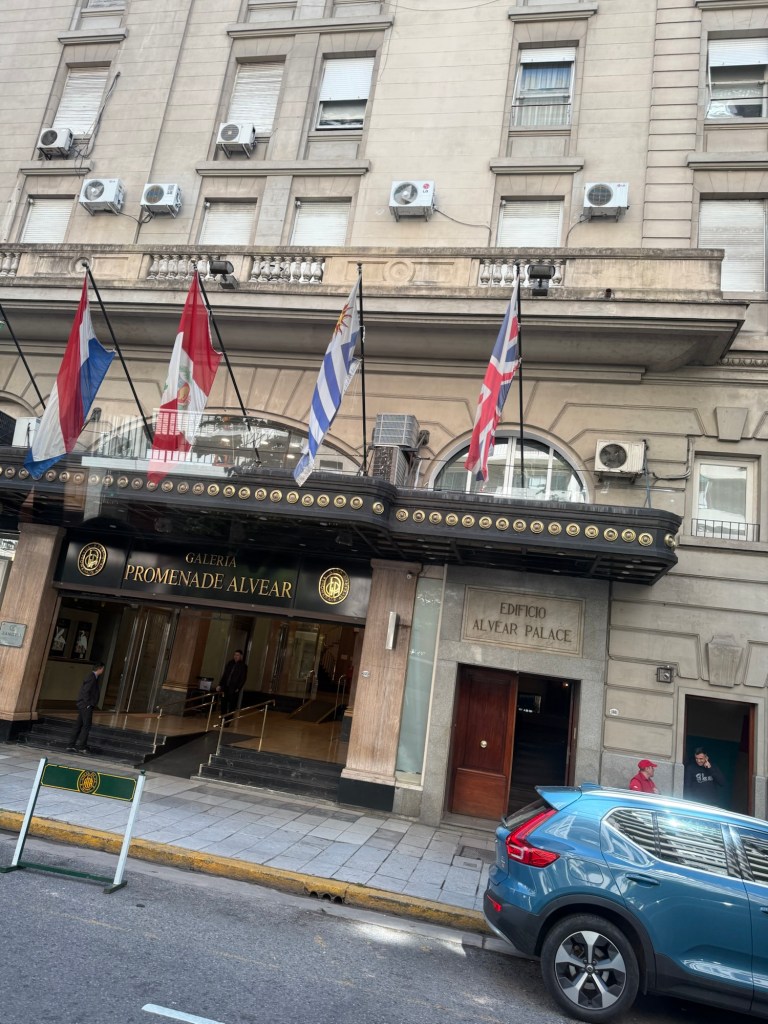
There are two 5 star hotels, and the 2nd oldest church (1732) the oldest bar in the city, La Biela, and a renown cemetery started in 1842. We had a short Kodak Moment here and unfortunately not enough time to see the cemetery which is apparently quite something.  

200 year old tree of unknown kind
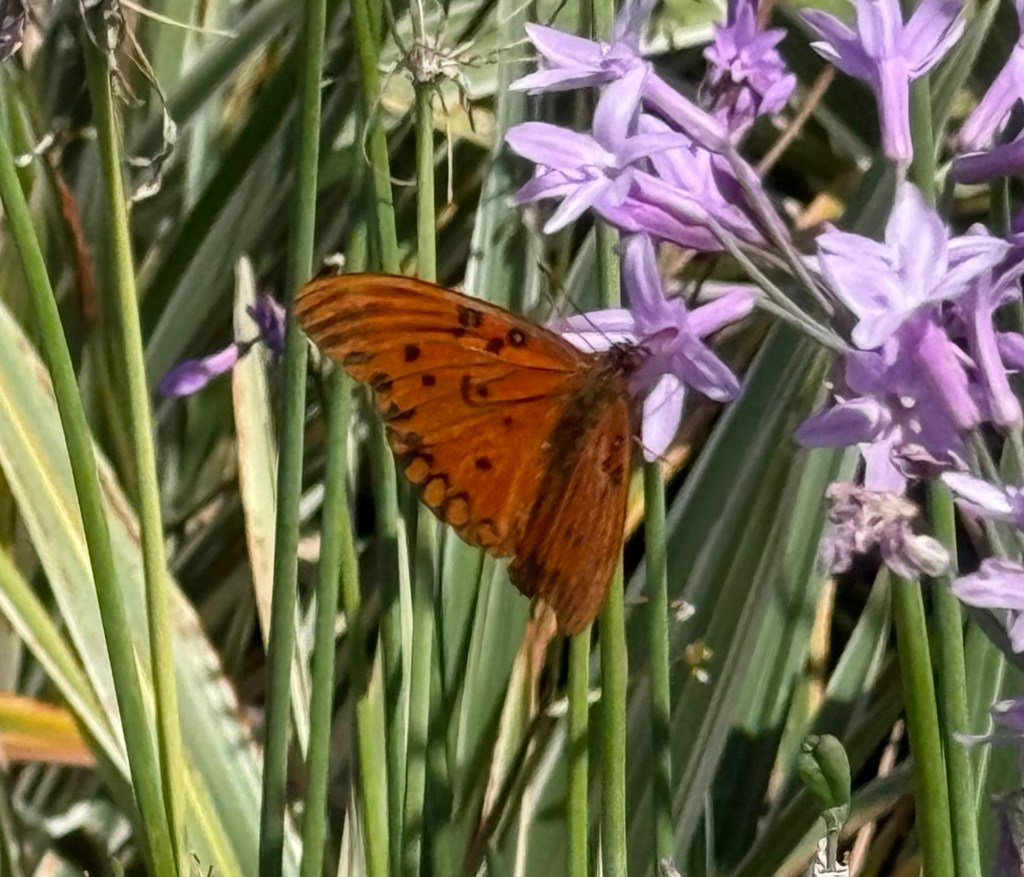
Plant and butterfly of unknown kinds
The oldest bar in Buenos Aires
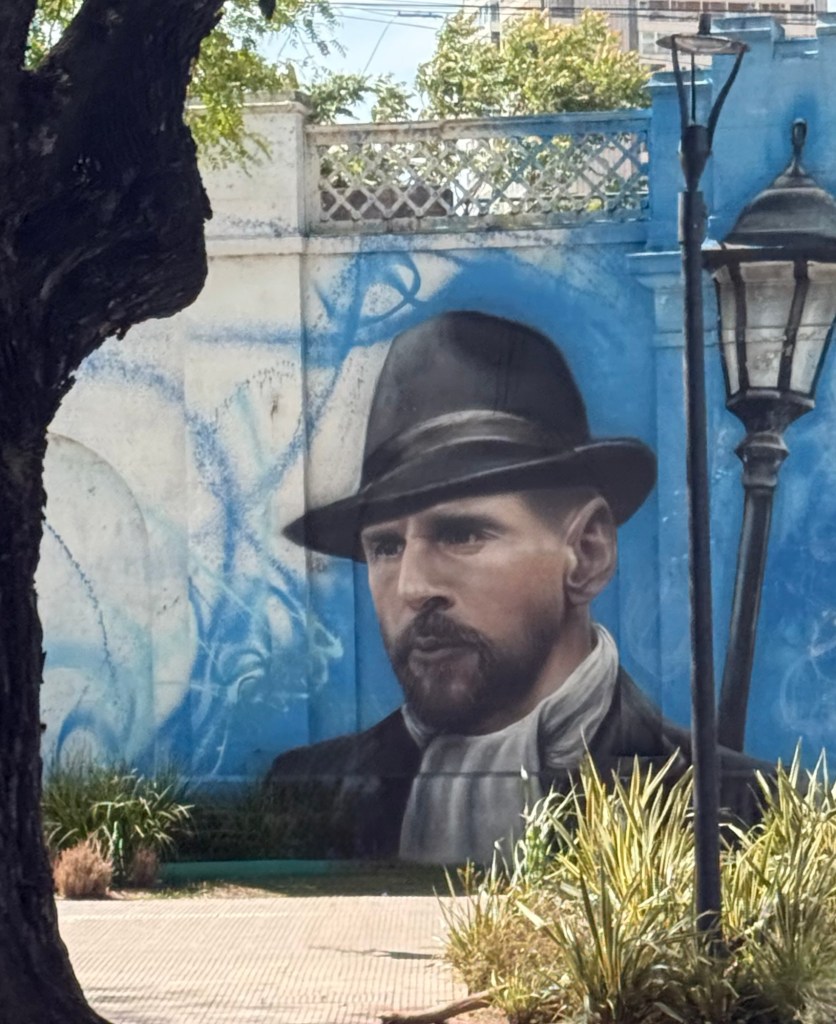
Look familiar?
Five Star hotel

Next we made our way to the Plaza de Mayo, for another short stop.  Since Nanci and I had explored this area over the last couple of days we enjoyed some chocolate samples and sat on a concrete bench, heated by the sun, in the Plaza.  

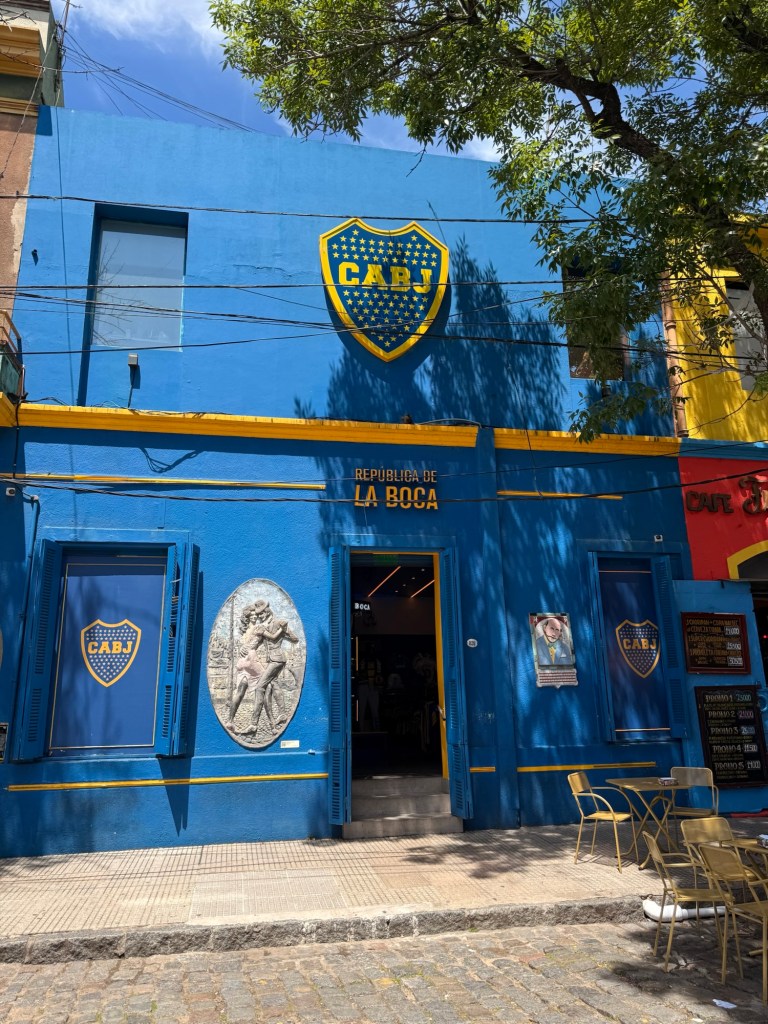
The final destination was the oldest area of the city, built up around the first port area from 1860 – 1950, called La Boca.There is another football stadium there, and the guide gave us some information about the history of football and the football clubs here in Buenos Aires, to which I honestly tuned out. But a Brit on the bus was particularly interested as his club had been defeated by the club here in La Boca at one time. (There was disagreement as to whether it was in the World Cup or another league play, to which I really tuned out).

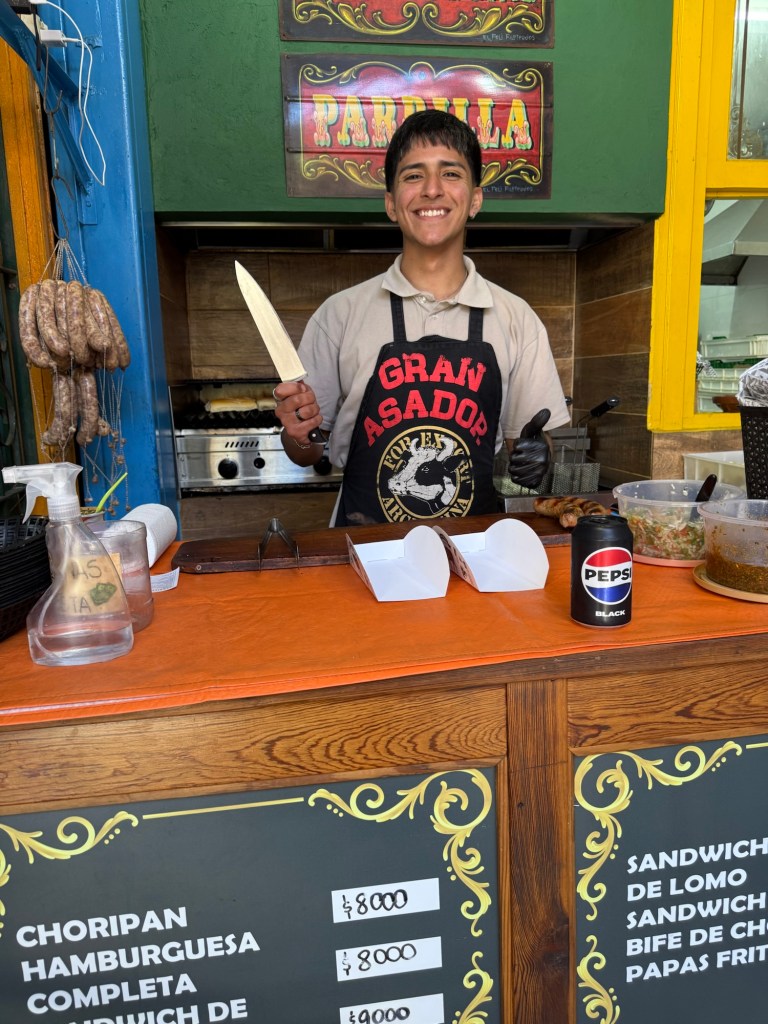
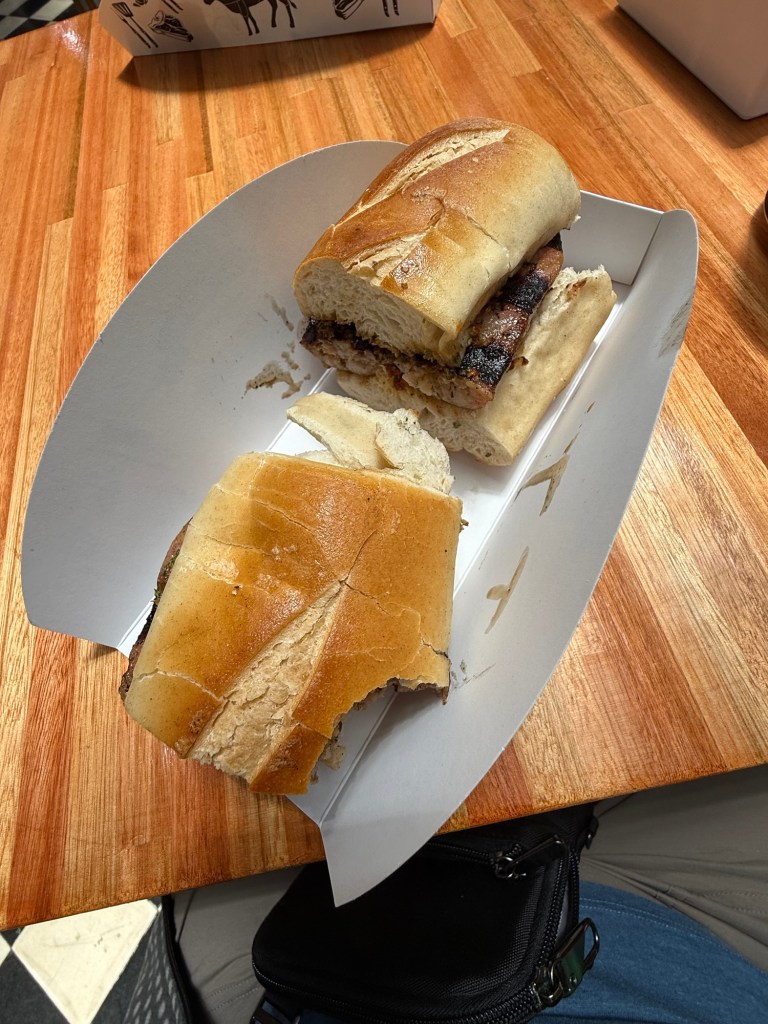
The area is old and made up of many tenements, and on some streets they have been brightly coloured and turned in to tourist traps and restaurants. We stopped in one of these to try a “famous local sandwich” called a choripan.  It was actually really tasty, a pork and beef sausage grilled and placed on a really fresh bun with Chimichurri sauce. I have to say I’ve been enjoying it all afternoon. 

The maker of my Choripan today.
My beef and pork sausage choripan

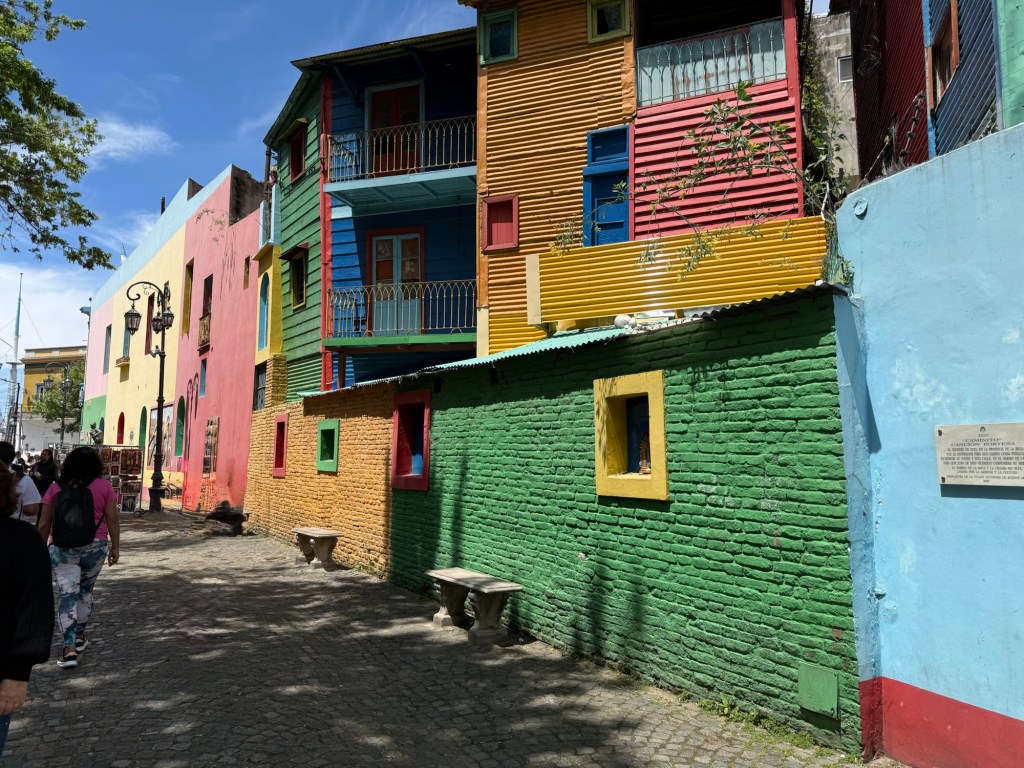
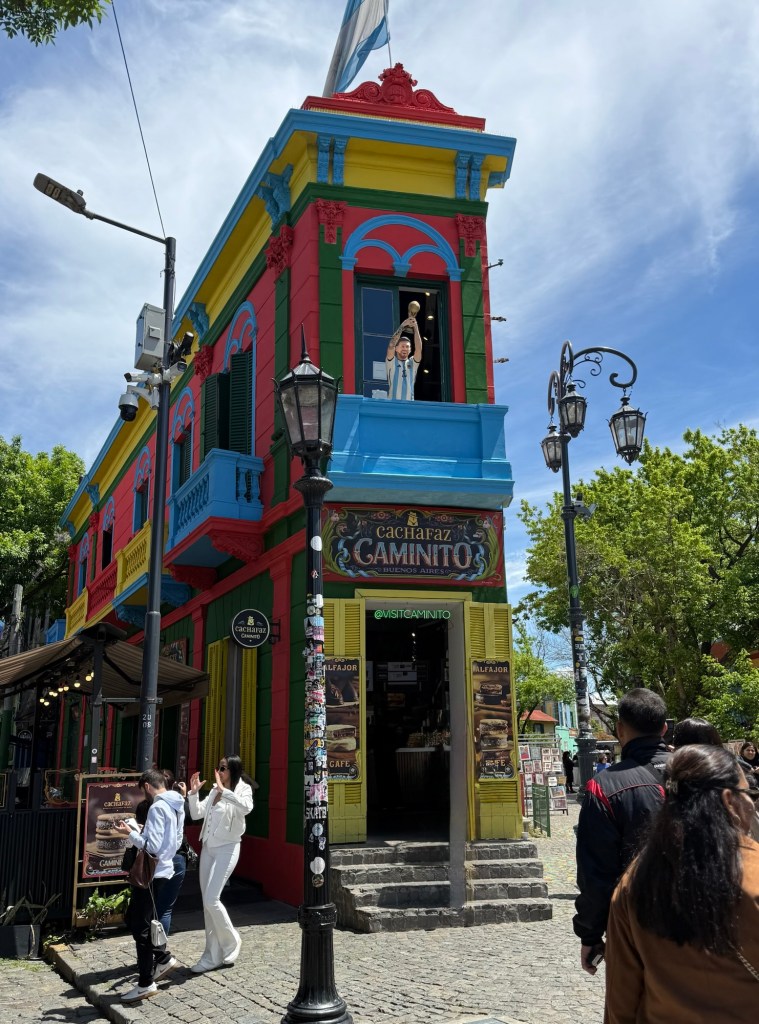
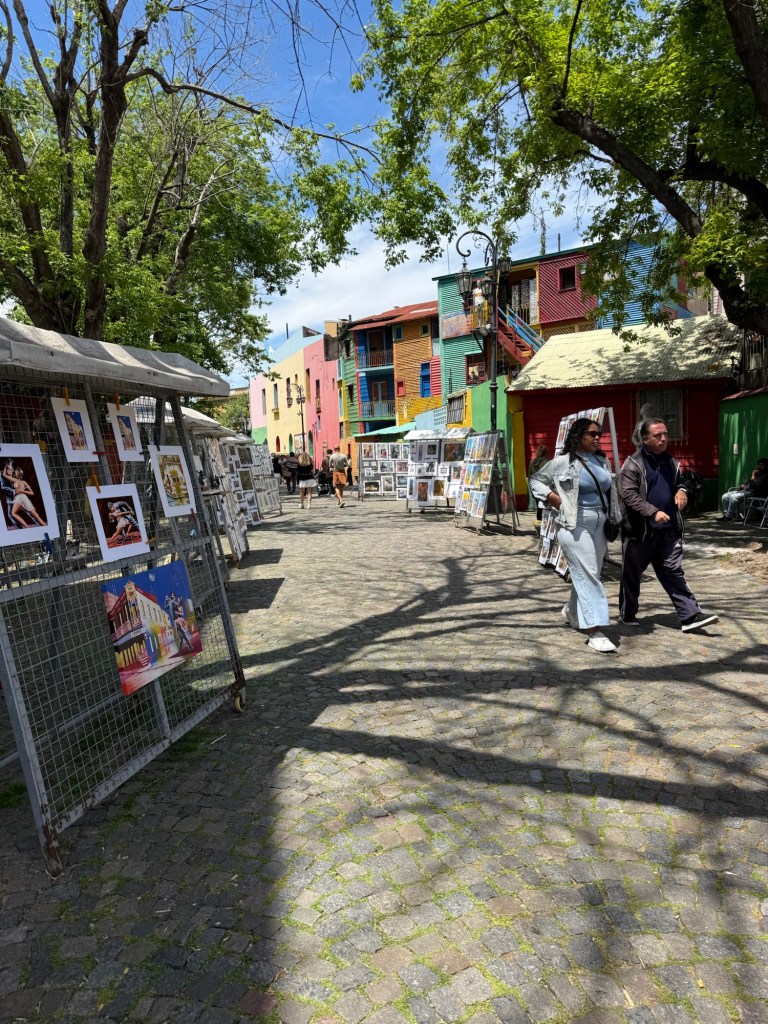
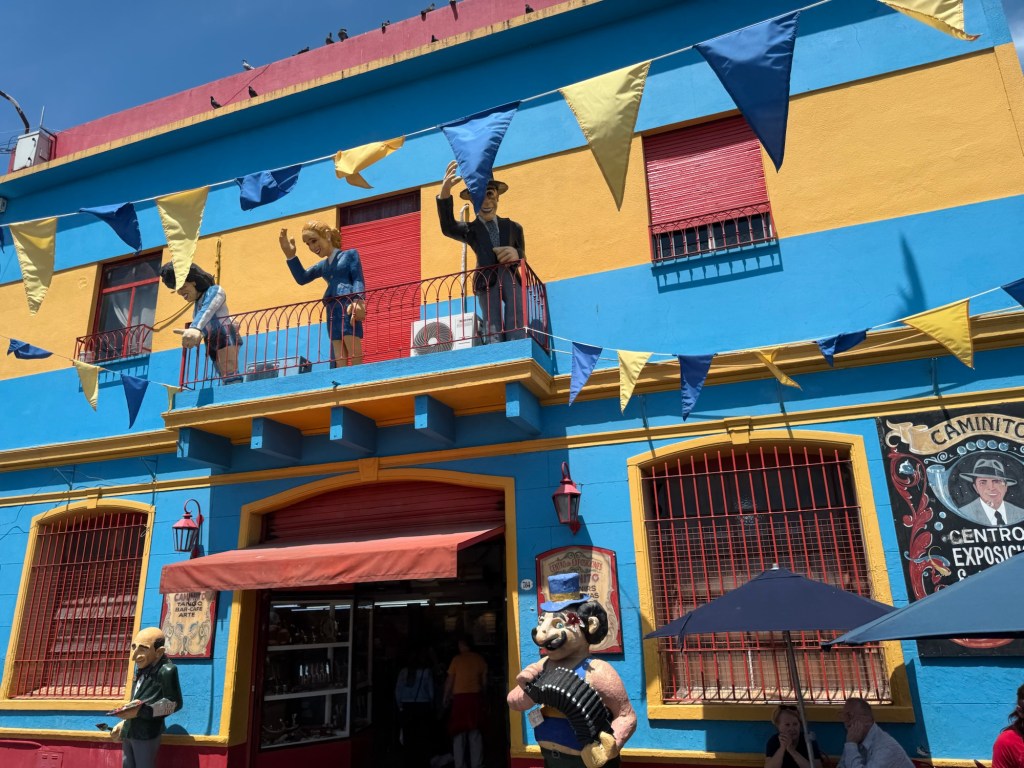
One street, called Caminito, has been turned in to an outdoor street museum. To me it looked like they had brightly painted the buildings along it to attract visitors so that local artisan could sell their wares.  But perhaps something got lost in translation. This street was the inspiration for a famous tango song of the same name.  

On the way out of the area and back to our hotel we travelled through a really poor area, and I’m reminded that we did see a huge area of “barrio pobre” or poor neighbourhoods yesterday too. The one yesterday was a huge area of 5 – 10 story small hovels build on top of and beside others in an unruly grid which looked so unsafe. Built next to the freeway, we got a good look at them from above and the electrical poles were masses of wires and there were no proper streets between them for first responders. There have been people on the streets begging, but honestly not as many as I see at home in Ottawa or other Canadian cities. 

Next it was back to the hotel for nap time and to get ready for our foodie tour this evening!  It was the exact opposite of our city tour this morning. It was fabulous, with an articulate, passionate woman as our excellent guide. I will do tour that as a separate post tomorrow sometime. Here’s a sneak preview…..
Our first stop was at “Picsa” (for Argentinian Pizza)

For now it’s off to bed as we have to be in the lobby by 6:30 am tomorrow for our flight to El Calafate in Patagonia. And yes I am going to be coming home exhausted… but happy.

2025 South America

Today we really did sing “Don’t Cry for Me Argentina”

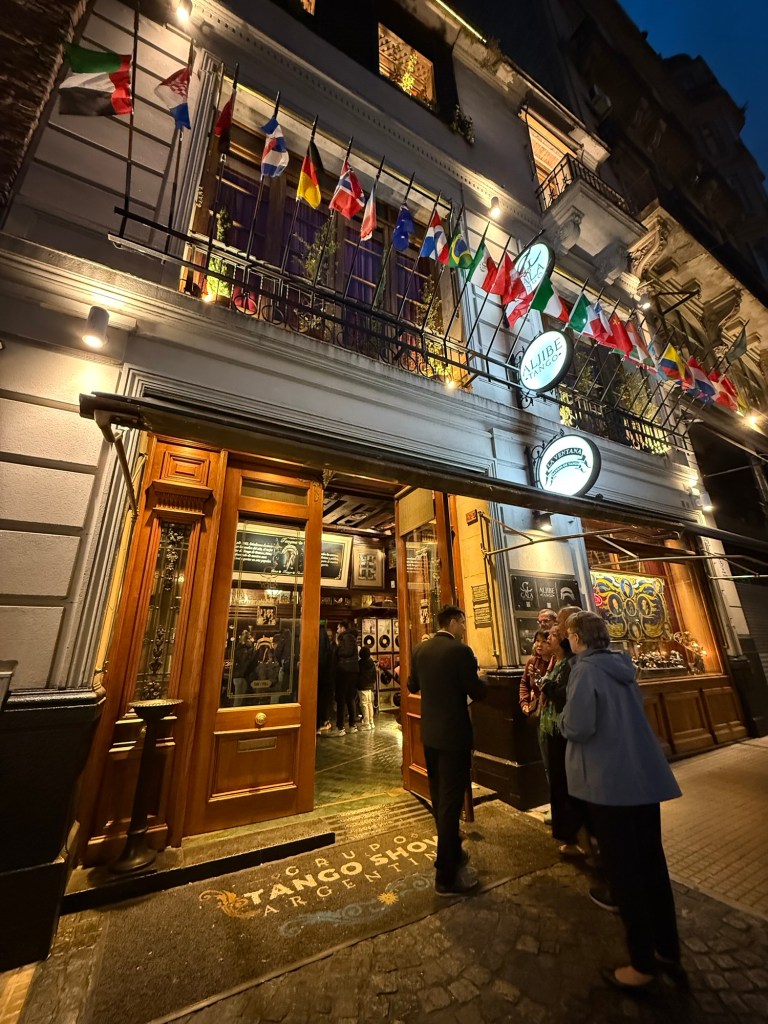
The La Ventura Tango Club

Nothing like a great sleep to allow you to leap from bed in anticipation of a great day ahead.  OK, well maybe slowly throw back the covers and gradually get out of bed at a snail’s pace allowing your muscles to start moving properly.  

At the appointed hour, I met Nanci in the breakfast room ready to go on our excursion for the day. The only reason I mention this pedestrian part of my day is that a nice gentleman joined us at our table part way through breakfast as it was quite crowded. After 20 minutes or so of Nanci and I chatting with each other, he leaned in and asked where we lived. We said Canada, and he asked what city.  Turns out he lives in Ottawa and works at a personal care home on Beechwood, a 10 minute walk from my condo and approximately half way between Nanci and I!  He is here visiting his father. Another small world example follows at the end of the day.  

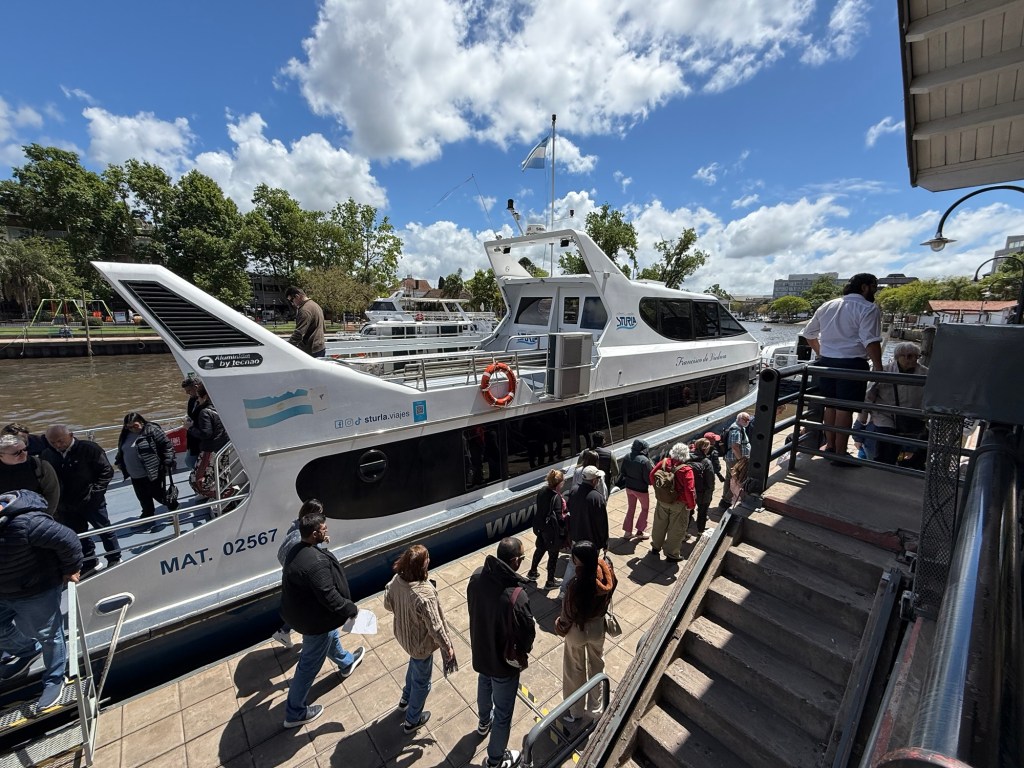
Our tour boat in Tigre today.

Our original excursion for today was cancelled just yesterday because the tour operator had cancelled. Viator quickly refunded the cost and offered a couple of other options. We opted for a plan B which was similar to the original tour but which was half as expensive. It didn’t include some parts of the original tour. Turns out that the original plan would have taken us out into the rain as we did get some showers while we were making our way out of the city by bus. So it all worked out for the best. 

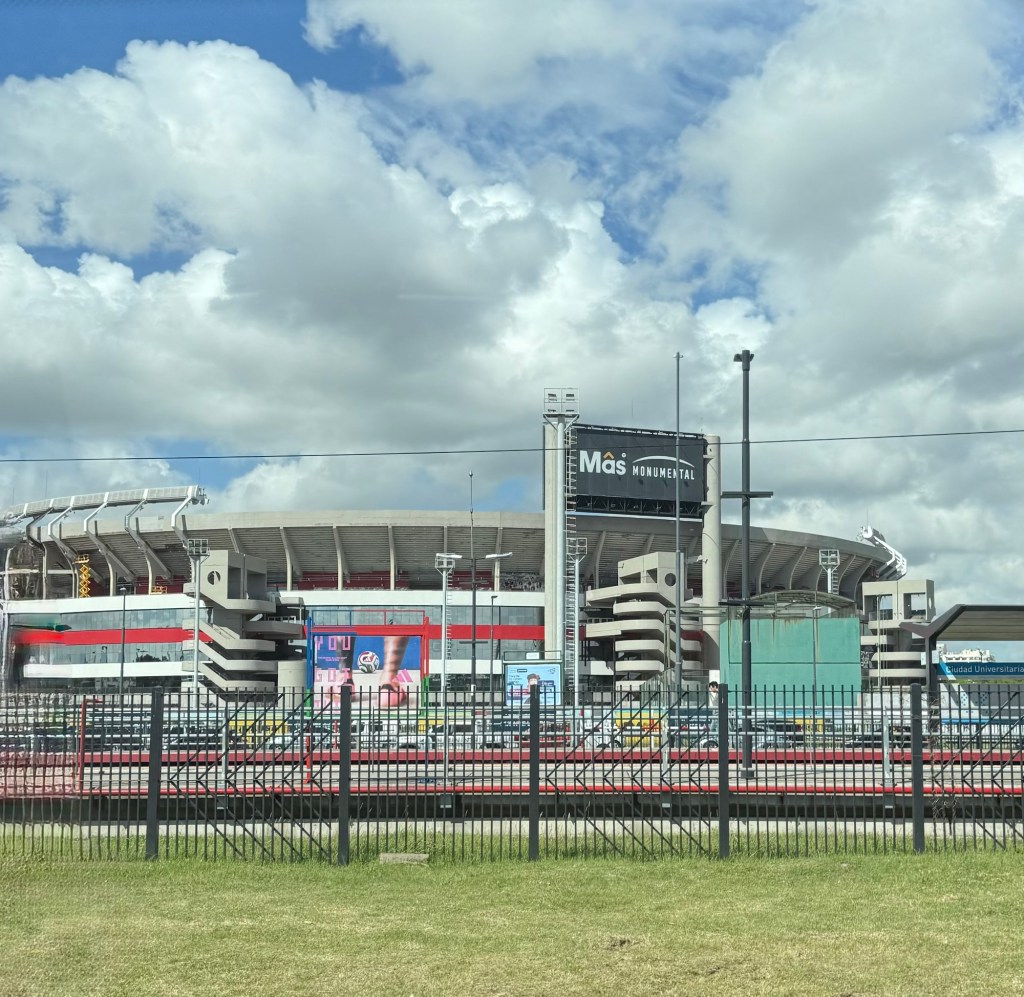
Estadio Mas Monumental

By the way, on our way out of the city we passed by the largest football stadium in all of Argentina and all of South America, Estadio Mas Monumental.  Its capacity is over 85,000 for football and it’s here where the Argentinian national team plays. In 1978 the FIFA World Cup was held in this stadium with the host team from Argentina defeating the Netherlands, by a score of 3 -1, our guide told us with great pride.  

The weather today went from grey and rainy to blue skies and sun to grey and windy to blue and warm in the sun, so we spent the day putting on layers and taking them off. But it really was a perfect day for touring.  

Buenos Aires city (population 3 million) is in Buenos Aires Province (17 million) and the total population of Argentina is approximately 45 million. So you can see that a substantial part of the population lives in the immediate vicinity of Buenos Aires. And it seems that all 17 million of those living in BA Province cram into the city during the day to work.  There are buses and trains, etc. but a lot of cars!  

We have already seen quite a lot of the main areas of the older downtown area of Buenos Aires by foot even in the short time we’ve been here, and we have a guided tour tomorrow with WingBuddy where we’ll hit the main spots.  So today we wanted to get out of the city.  

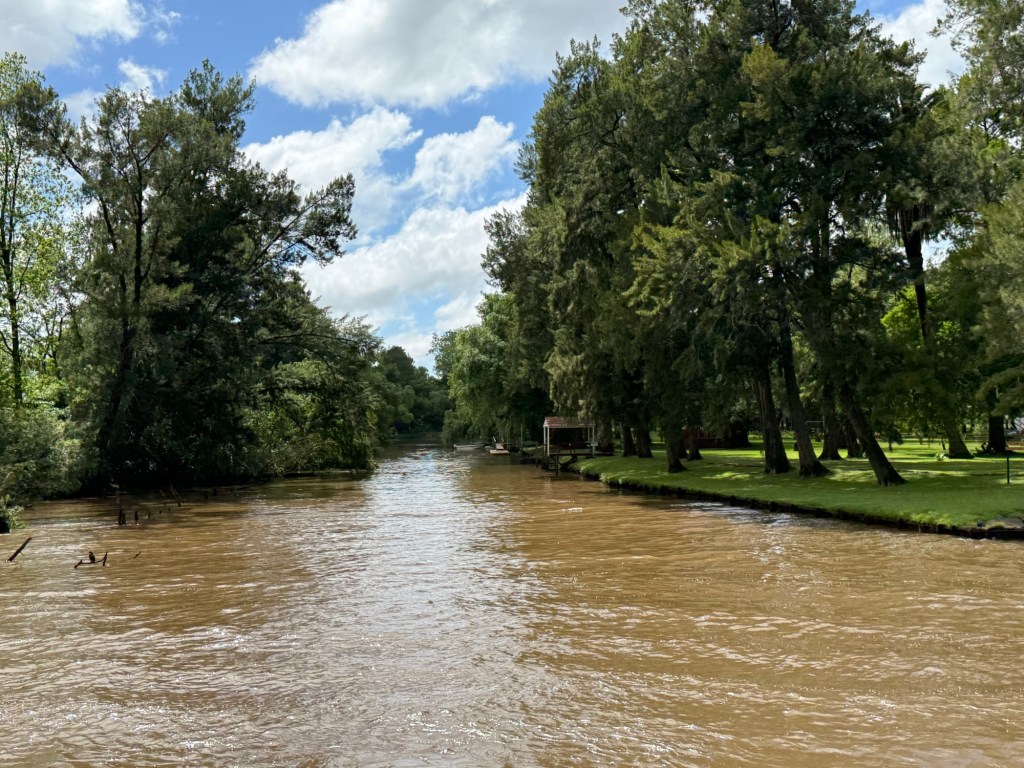
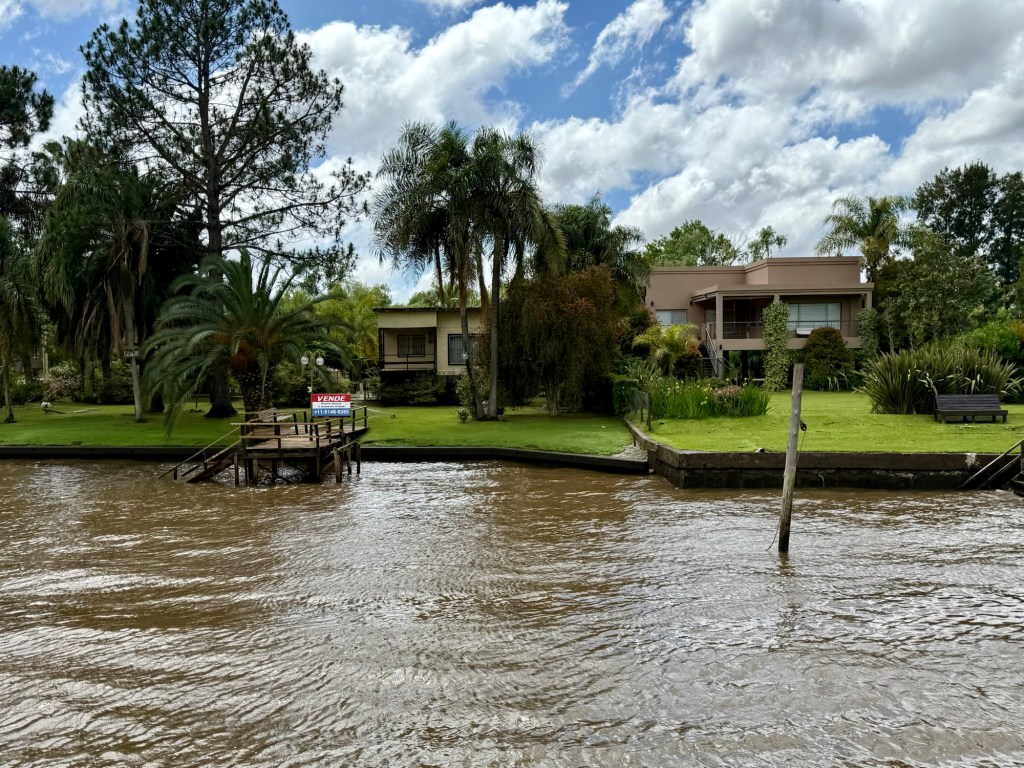
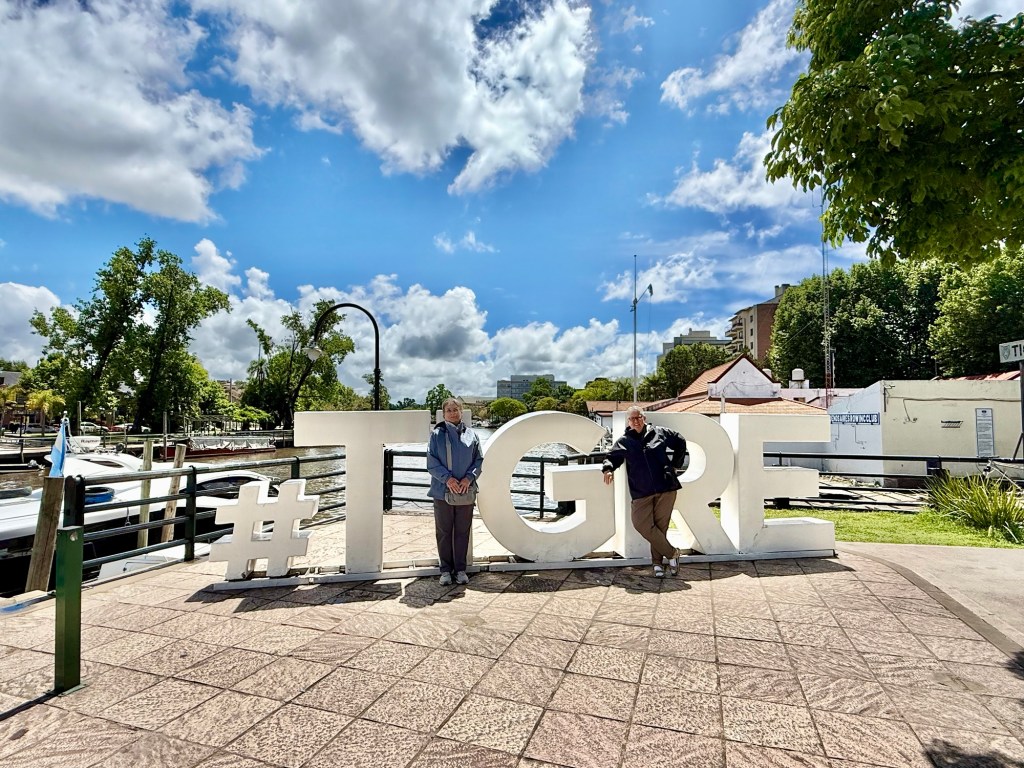
Our private bus and guide took us north of the city along part of the 17,000 km Pan American highway that stretches from Alaska to the tip of South America. Our destination was the municipality of Tigre, sometimes referred to as the Venice of Argentina or Venice of South America.  The land here is the delta of the Parana River, developed over time by silt being laid down as the river emptied into the South Atlantic Ocean.  The islands do not have bridges and so the people who built homes there must take private boats or river taxis to get to their properties much like they do in Venice. Tigre is one of the 135 districts (barrios in Spanish) of the province of Buenos Aires in the norther part of the metropolitan area. 

No, this is not a tiger, and no, there are no tigers in Argentina.

We wondered why a town in Argentina, where no tigers live, was named Tigre or tiger, in English, and why the symbol for the town was a cat face with spots not stripes. Apparently early Spanish settlers encountered and hunted jaguars, which they mistakenly called “tigres” or “tigres americanos”. Today jaguars are endangered with only 200 or so left in the north of Argentina. Also you’ll find out later that we were dropped off to shop at a Fruit Market that sells no fruit. Confused? Us too.  

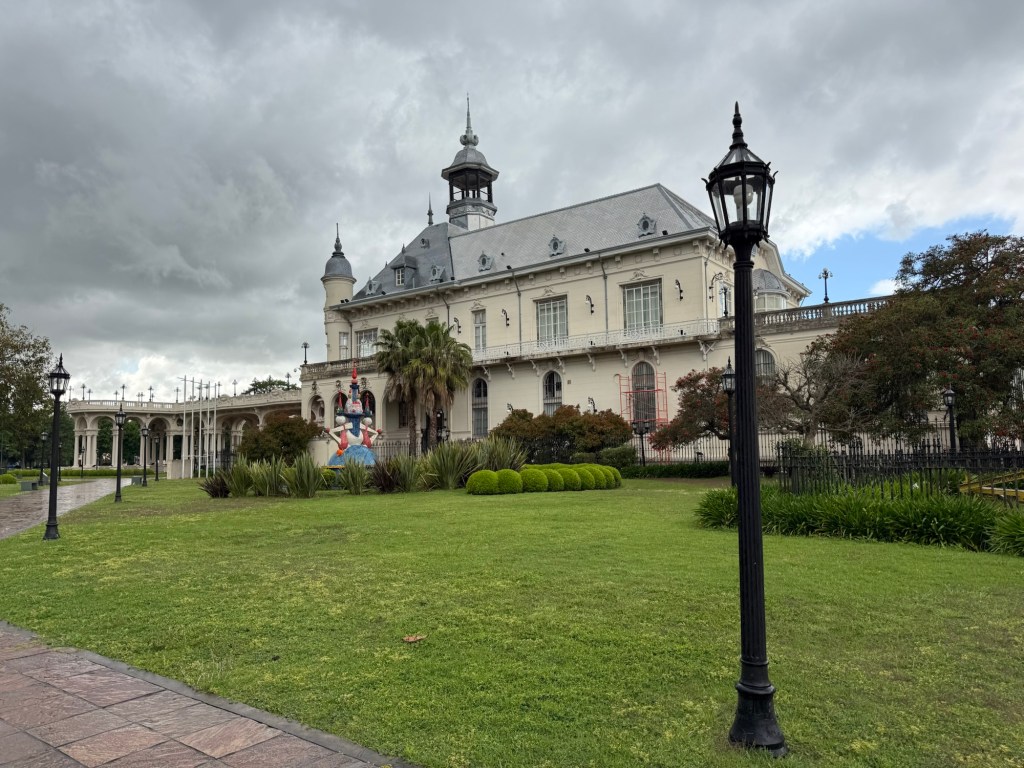
The Tigre Art Gallery
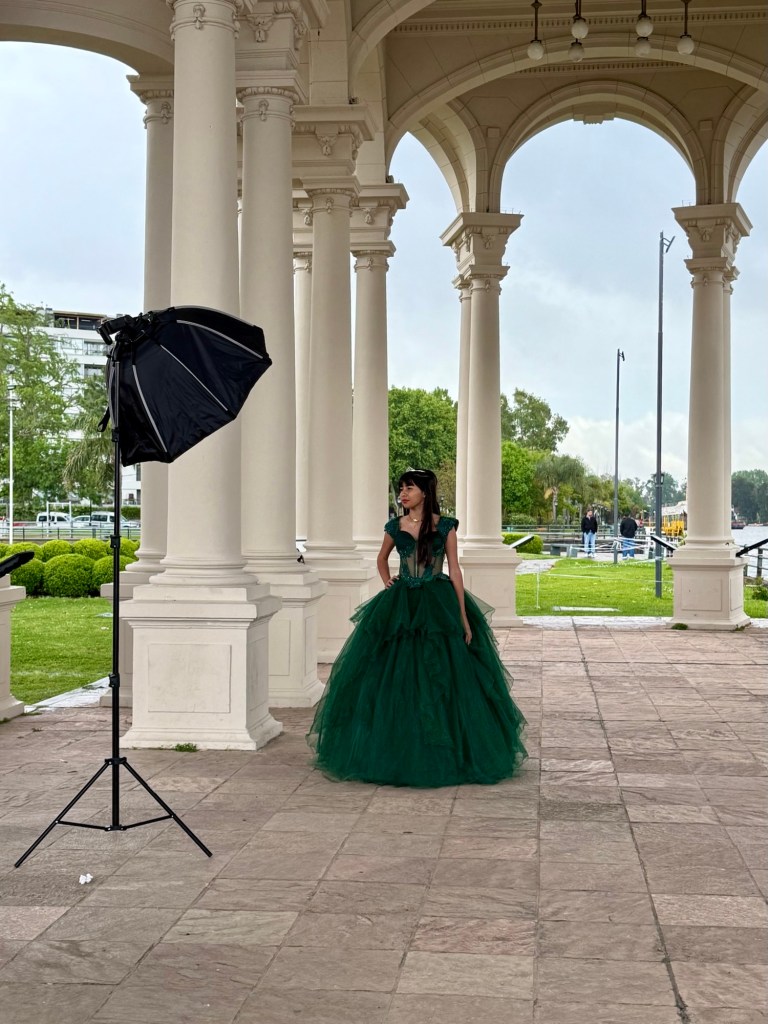
A photo shoot at the art museum

Tigre has a resort feel to it with both ramshackle and palatial properties along the canals we made a quick photo stop at an art museum on the Tigre River that has taken over a former private mansion that had been turned into a casino but has now been turned into an art museum. The building and grounds were beautiful although seemed a little grey since it was drizzling a little at that point. 

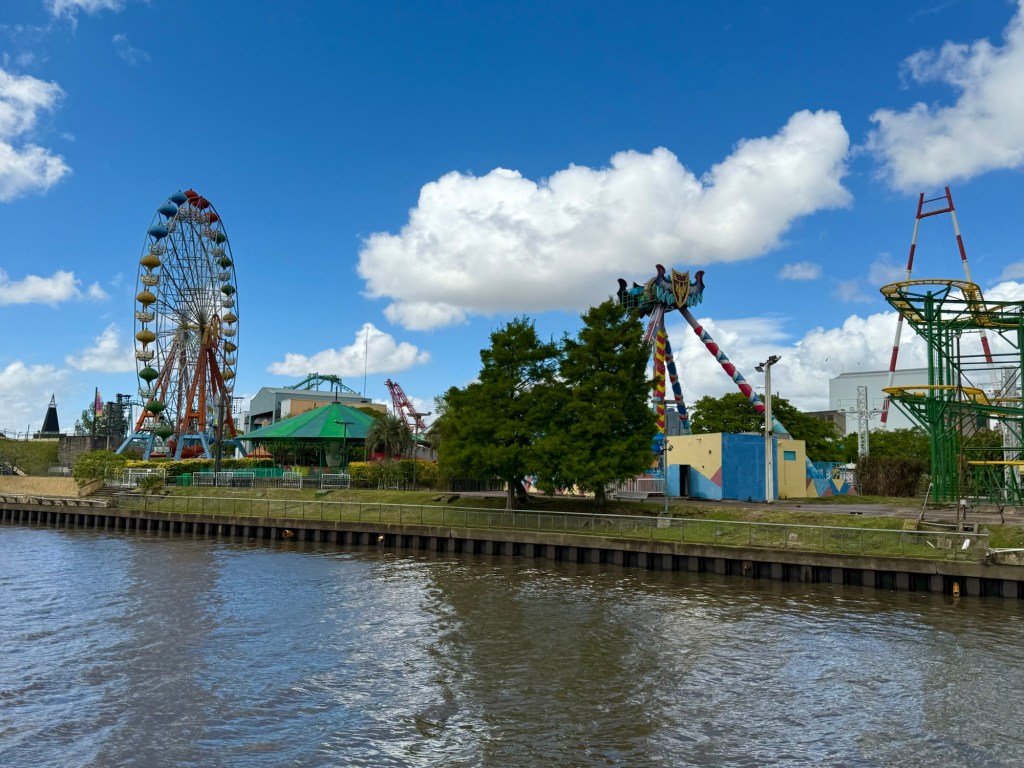
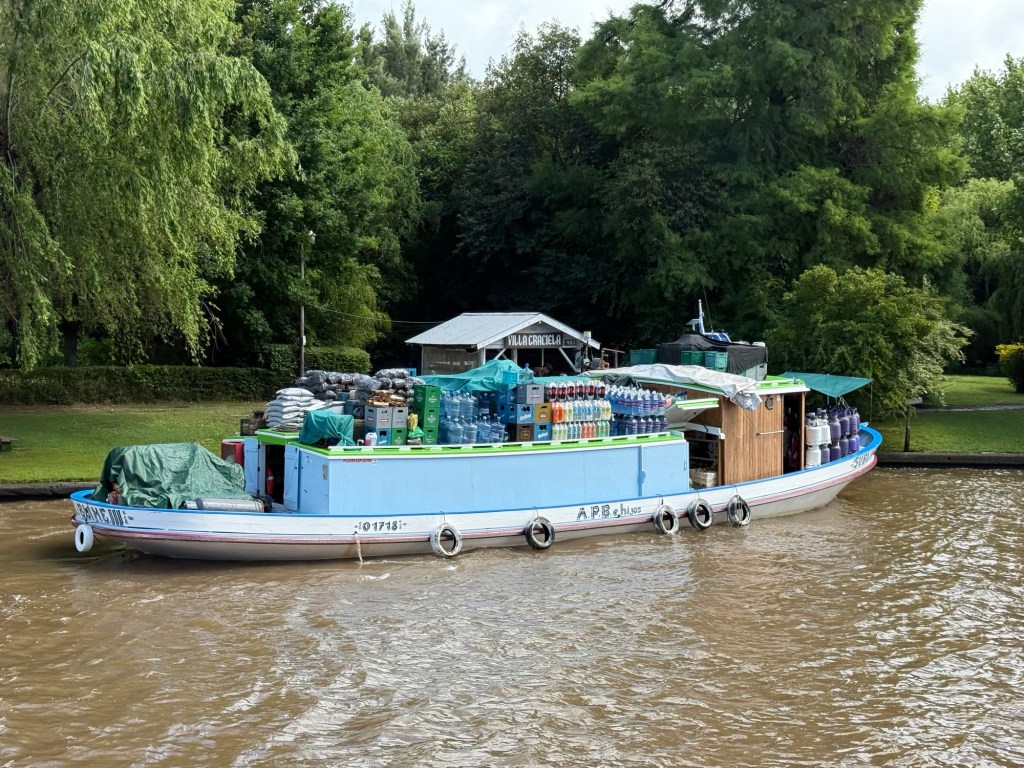
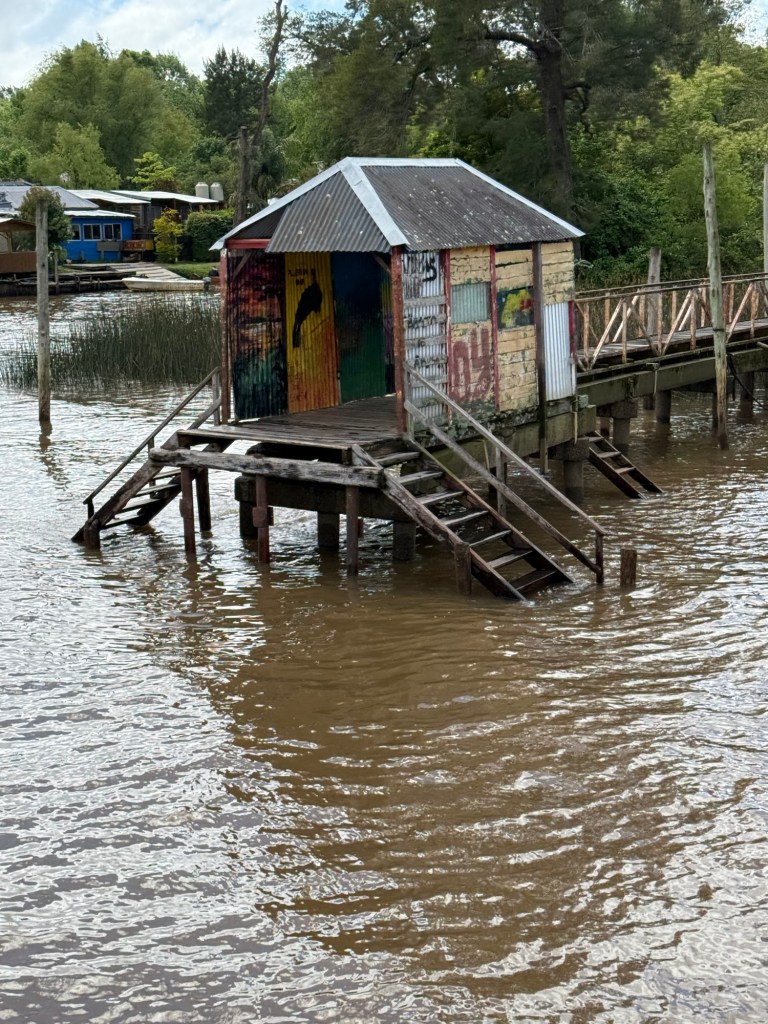
We piled back on the bus to drive over to the main canal and disembarked our bus at the terminal where water taxis and tourist boats load up and our small group joined some other tours on the Francisco de Viedma, part of the Sturla fleet of tourist boats. In no time we were making our way through the canals, and rivers of the delta enjoying the green shorelines and varied docks and houses along the shoreline as well as an amusement park and the Fruit Market.

An amusement park we passed by just as we were leaving the dock.
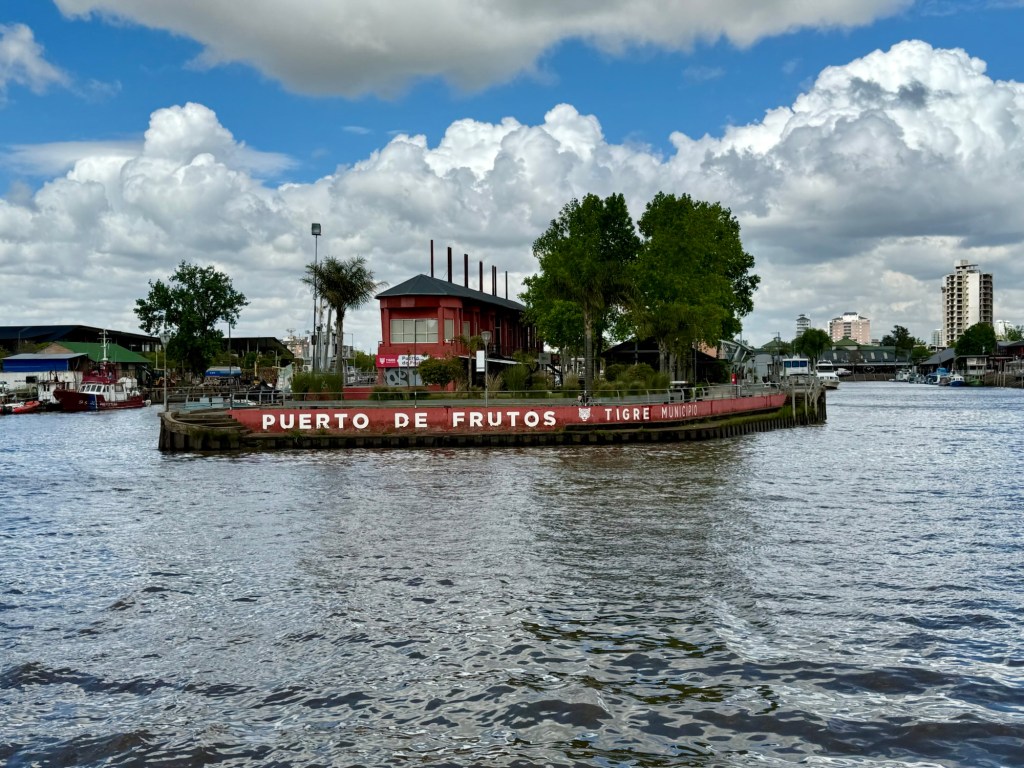
No fruit for sale here!

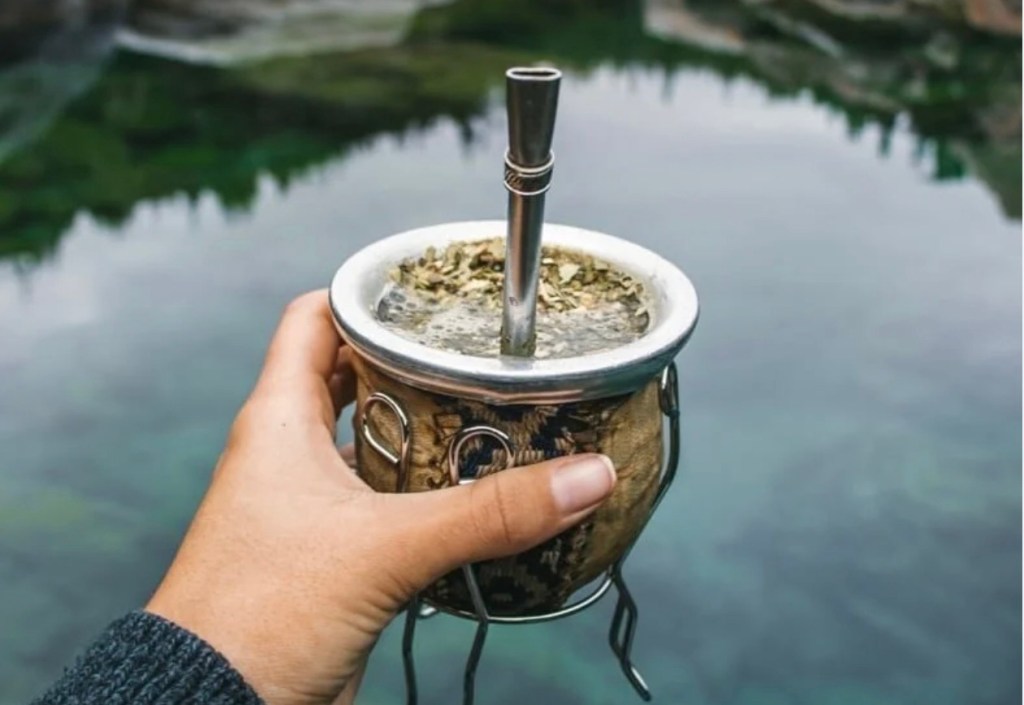
As an aside, along the way today we learned about Yerba Mate. We saw our guide pour something from a thermos into an unusual cup with what looked like the end of a pipe sticking out of it. Turns out it’s a tea many Argentinians enjoy instead of coffee. Yerba Mate is a plant that they use to make this apparently bitter, but heavily caffeinated, tea in this unusual cup. Our guide was adding more hot water to the leaves in the cup called a bombilla or bomba. The “straw” acts like a strainer to keep the leaves from coming up with each sip and the cup is traditionally made from nickel, silver, stainless steel or hollow-stemmed cane. Some are covered in hand sewn leather, and others ornately embellished with gem stones, or etched silver. 

The boat tour was approximately an hour from start to finish and it was great to be out on the water….. have I mentioned how much I enjoy every activity that involves getting out in or on the water in some way?  I suspect I have. 

One of the many canals through the delta
Here’s a small one you can buy.
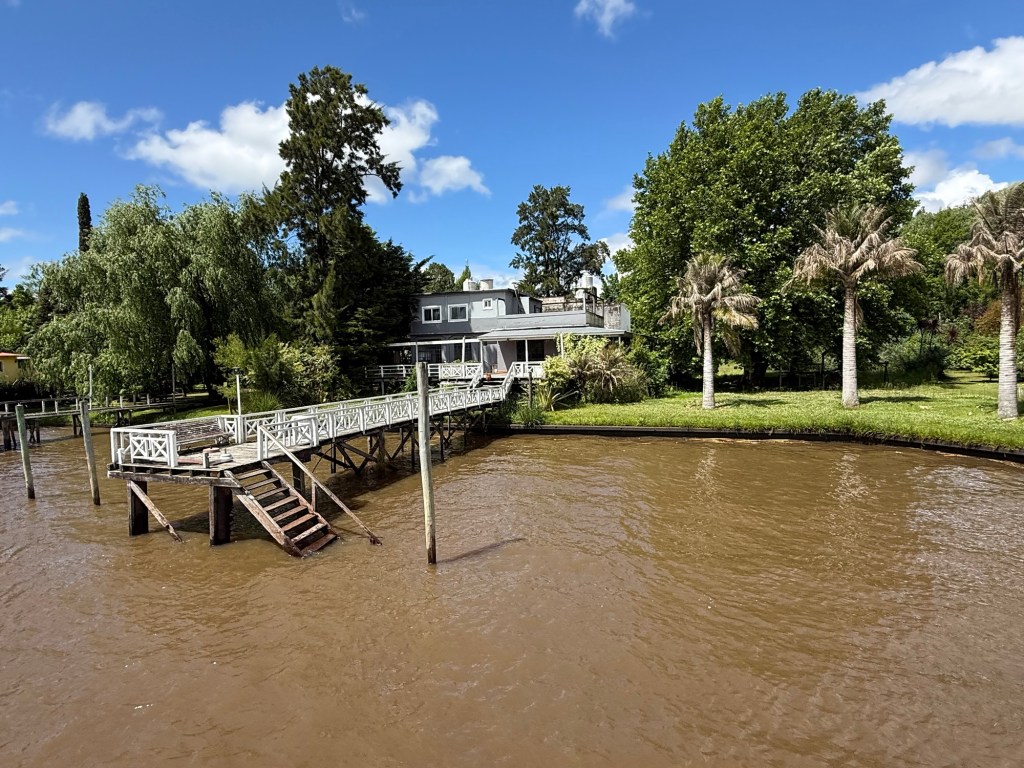
Some homes were palatial with matching docks, some rather funky.
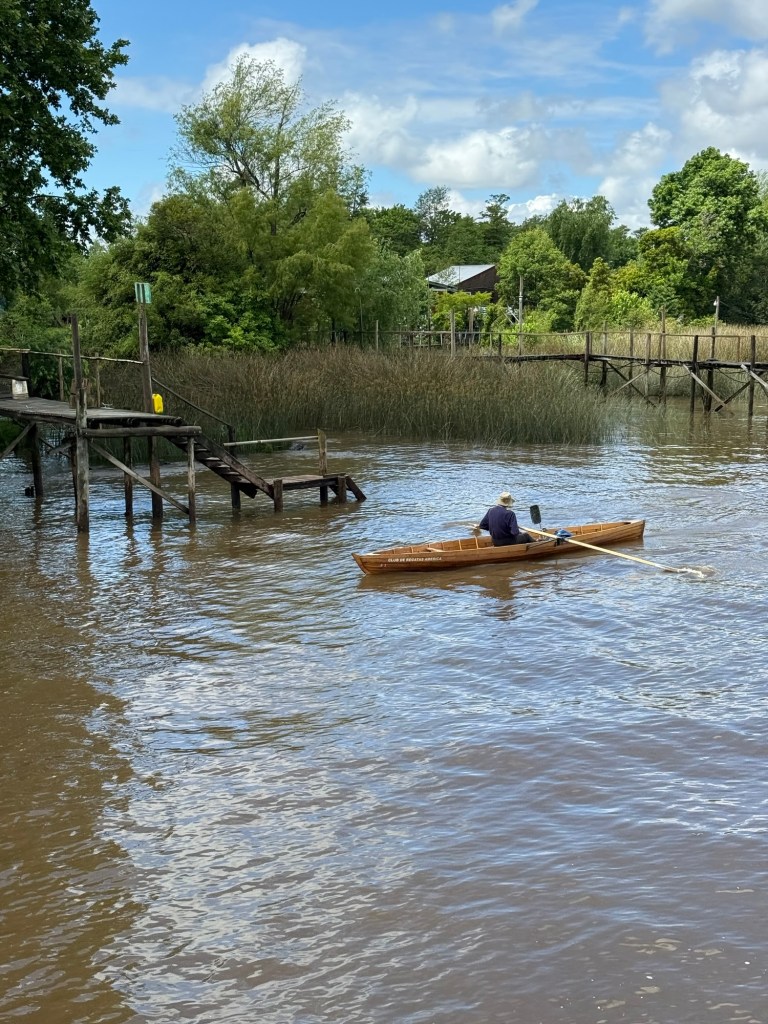
There were a couple of rowing clubs along the canals
This is how those living on the islands do their shopping! From a boat.
As you can see, it’s sunny with beautiful blue sky. And yes it was still a little cool.

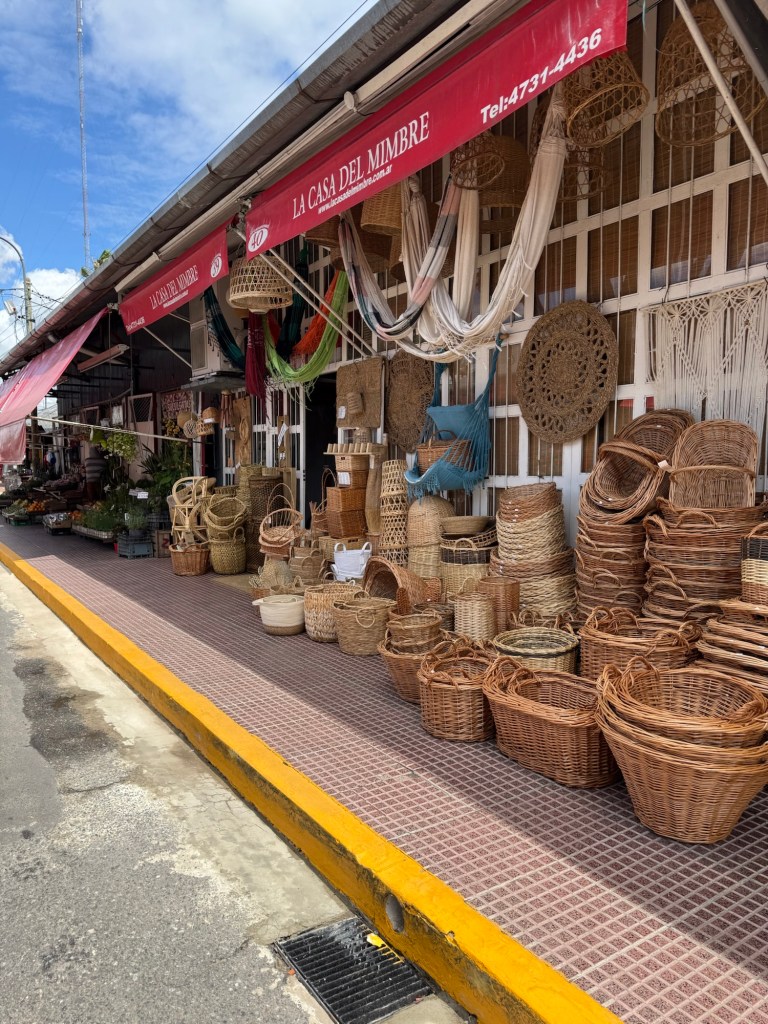
Then it was back toward the city to a place called the Peurto de Frutos, which of course used to be the fruit market but is now a huge market area full of small kiosks and shops selling primarily house hold furnishings and designer objects.  But food and jewelry and so much more. We had 40 minutes so wander but couldn’t cover even a small portion of the place.  

One of the dozens of shops at the Fruit Market.

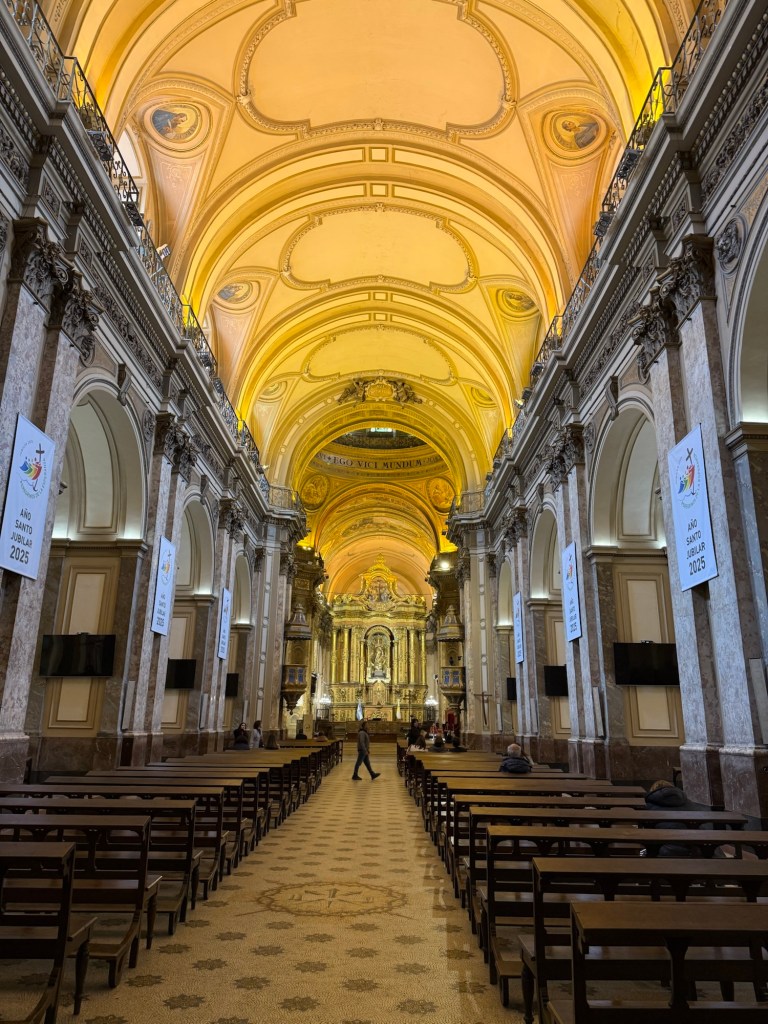
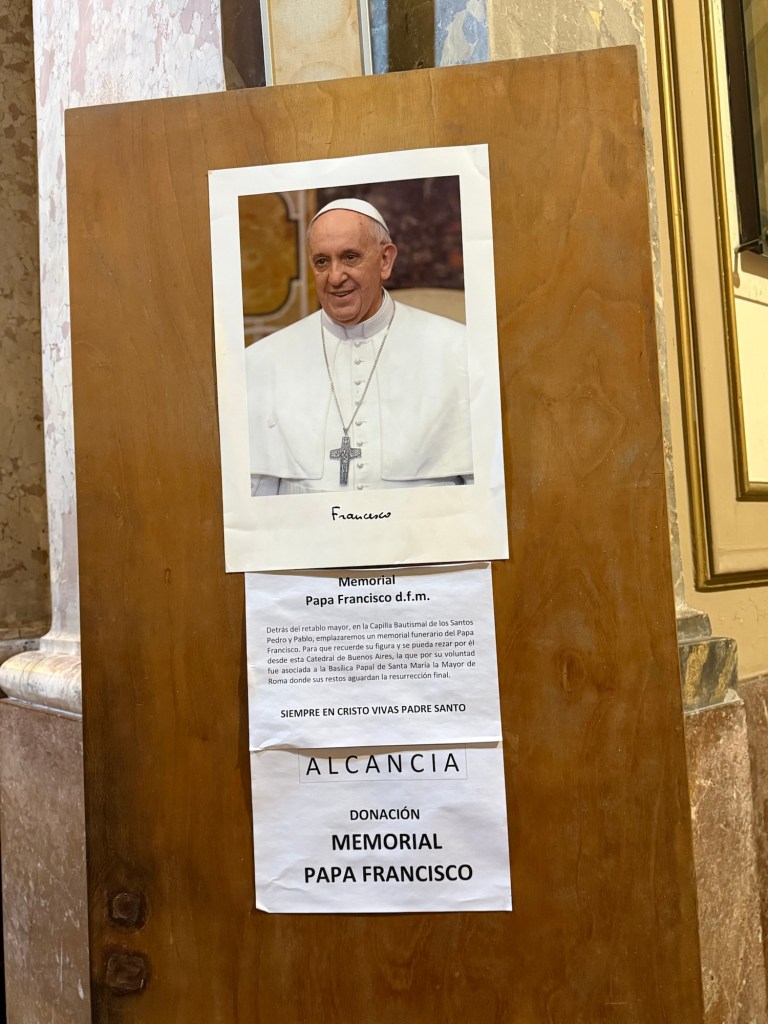
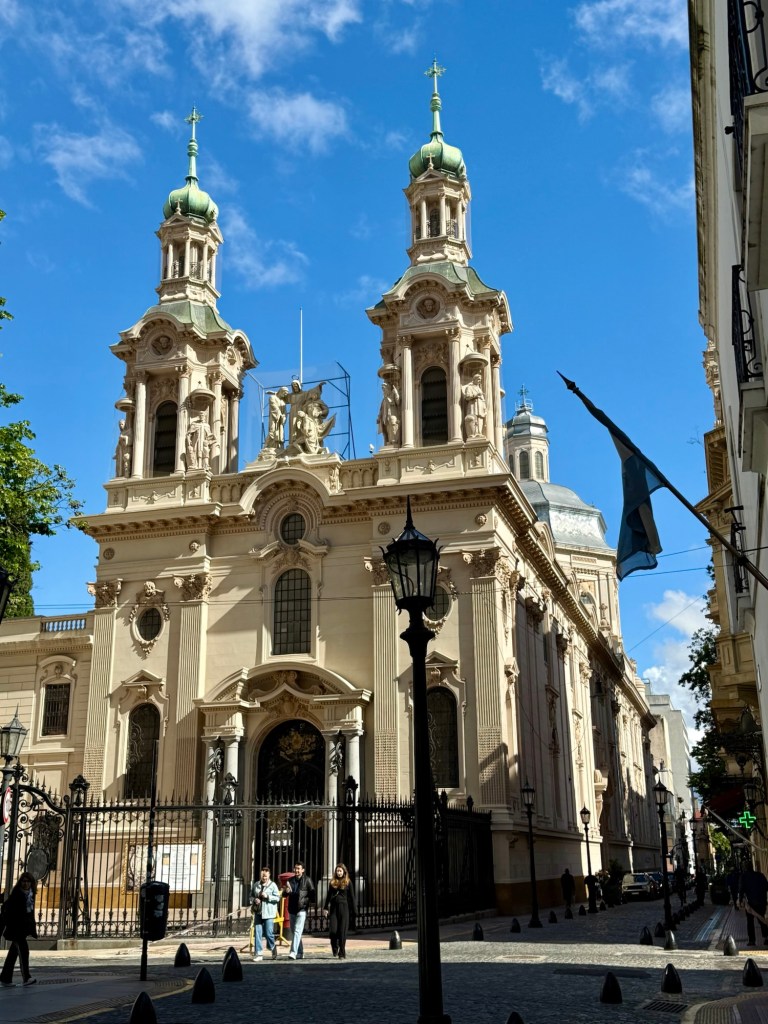
Our return trip was much faster with better traffic flow, and we were dropped back about a 30 minute walk from our hotel, in an area where we’d walked yesterday.  Along the way we stopped to have lunch and to visit the Cathedral of Buenos Aires which was the seat of Pope Francis, and dates back to the 17th century. The tomb of General Jose de San Martin is placed in the cathedral and guarded by ceremonial military, one of whom looked like he was going to pass out at any moment.  It was surprising to see inside the church today because from the outside the building it is really unassuming and from the sidewalk doesn’t even really look like a church.

The Cathedral of Buenos Aires on Plaza de Mayo

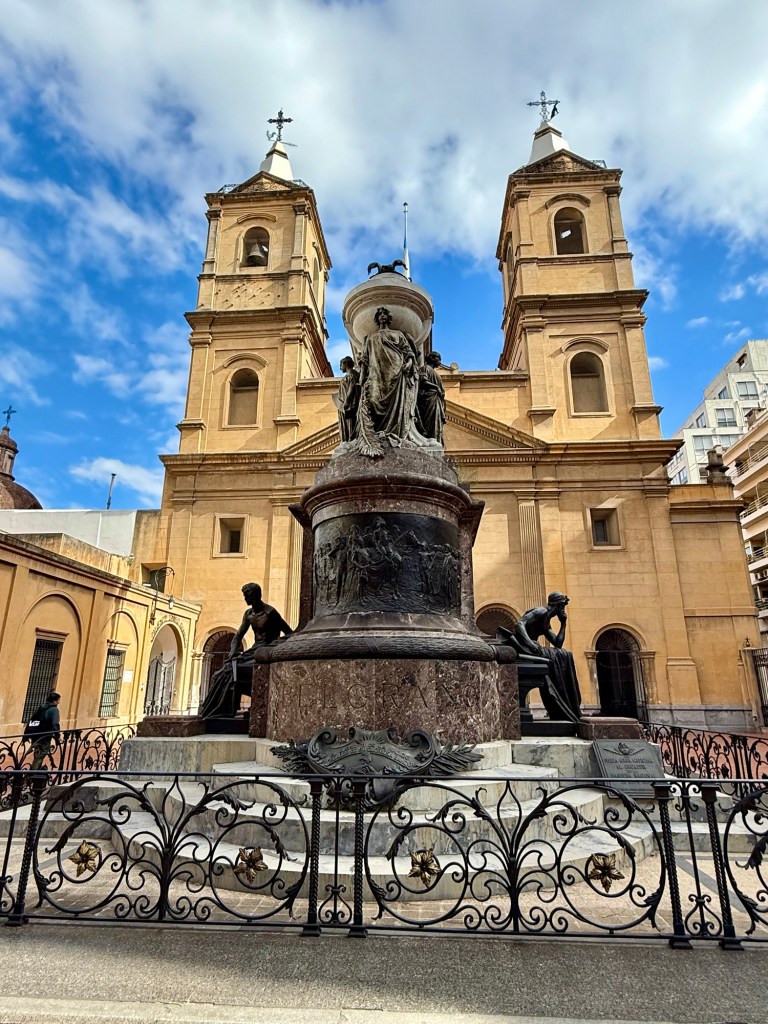
We stopped at a couple of other churches near our hotel to take a look and some pictures. By now our beds were calling so we headed back to nap knowing it was going to be a late night tonight.  

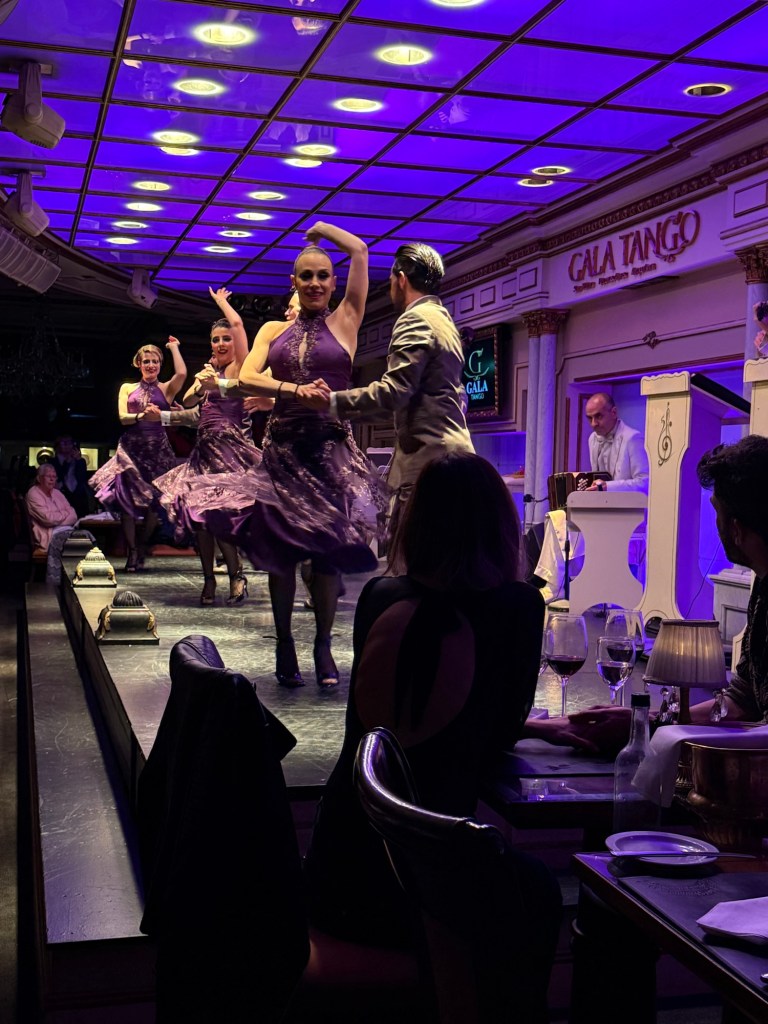
We walked just one block away to La Ventana, one of the oldest Tango shows in Buenos Aires.  It’s definitely one of the “must-dos” on the list for BA in my mind. (We went to a Flamingo show in Spain that was in the same category of when in Rome). Only some of our WindBuddy group did this optional activity and we sat with two couples, one from Markham and one from Vancouver. After chatting a bit we discovered that the woman from Vancouver was the pharmacist at the drugstore at Champlain Mall, which was our local shopping place for 30 or so years when I lived in Vancouver. Small World #2.  

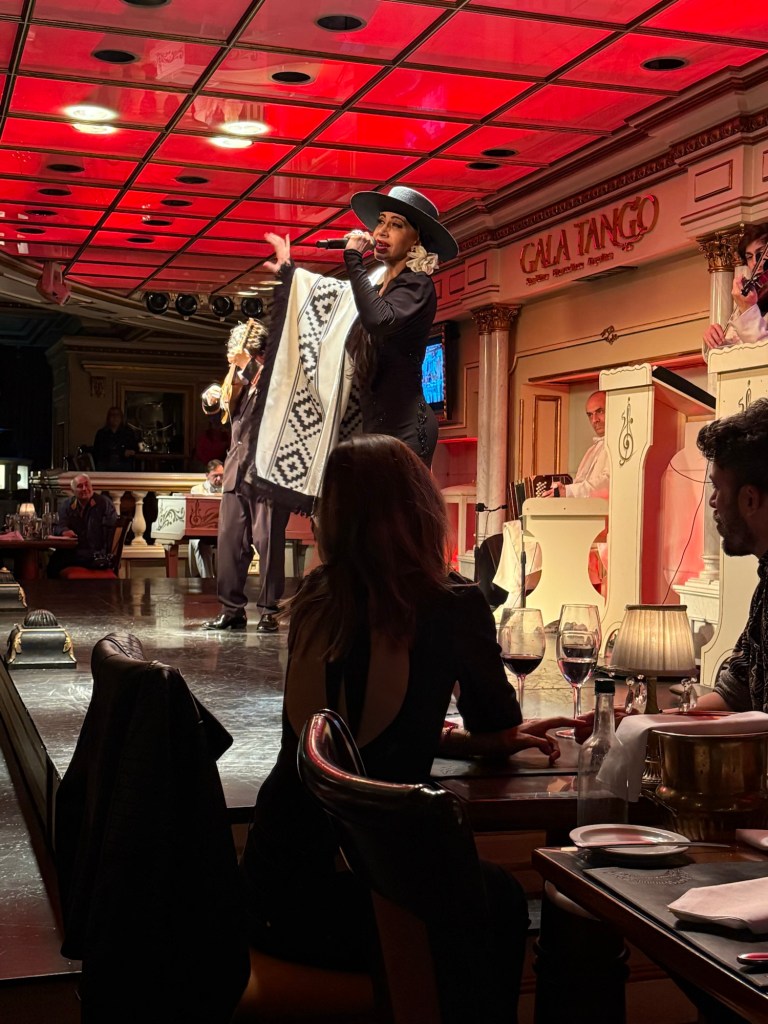
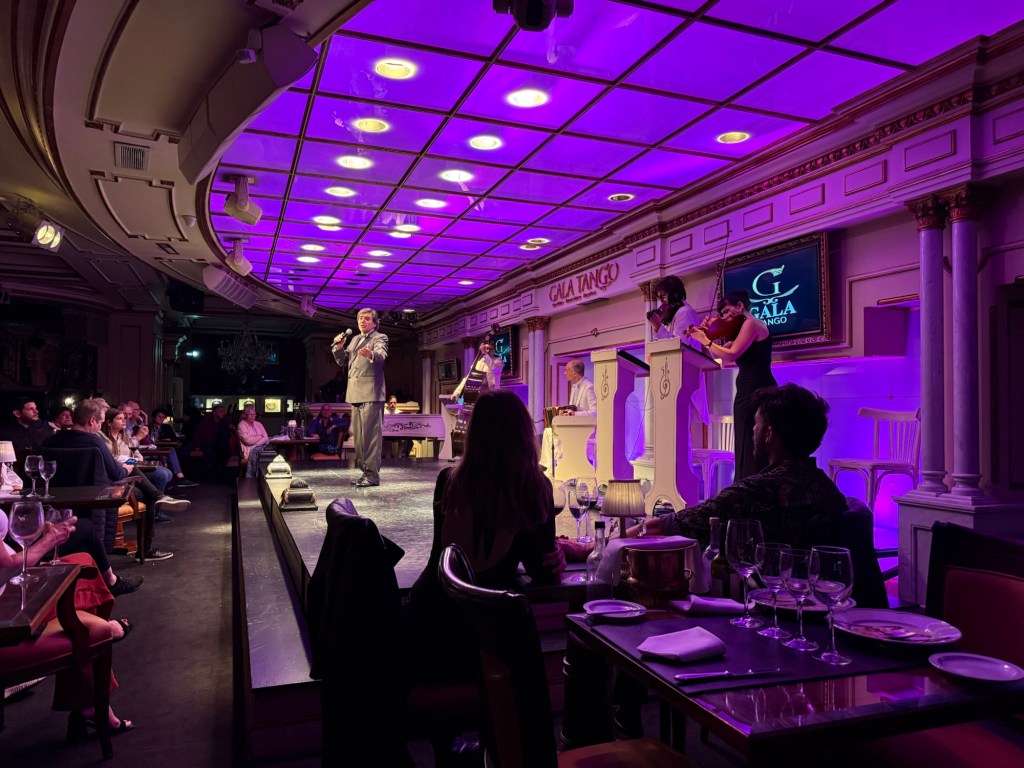
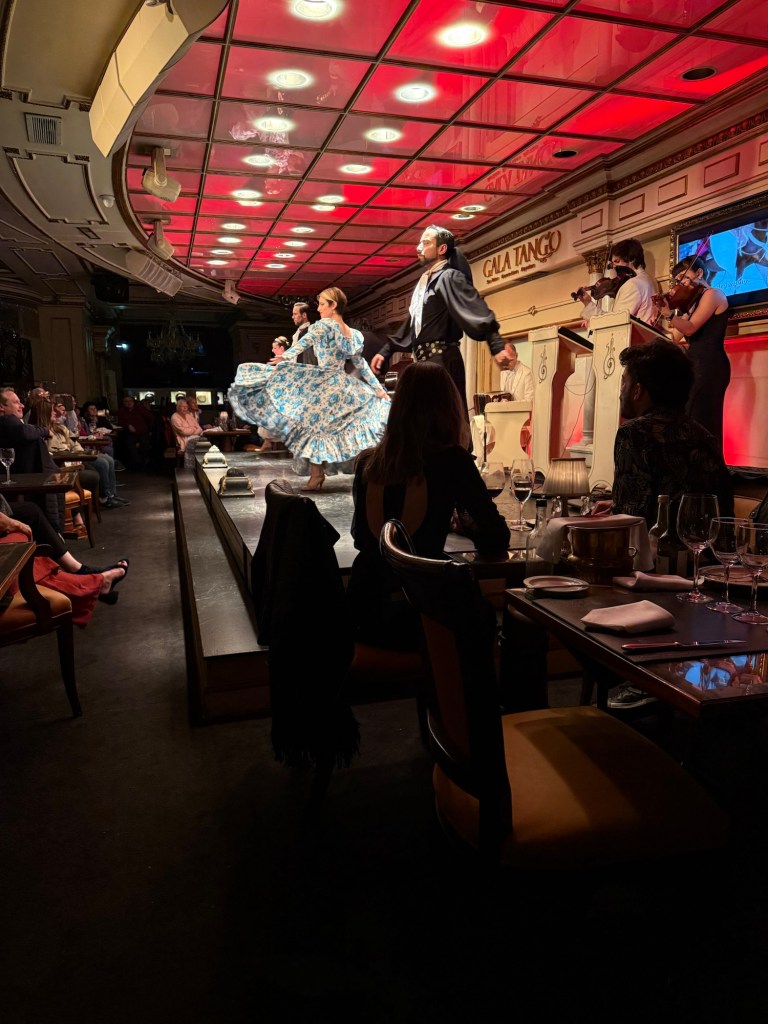
The dinner was fabulous.  I started with a Calabrese Salad, then decided that in Argentina, steak was probably a good bet.  And I was right. We had a couple of hours to eat and then the show started. There was a group of musicians (piano, base, violins x2 and accordion called a bandoneon) on stage for the whole show and 3 pairs of tango dancers that came and went through many tangos and costume changes, (including gaucho folk dress and dance) a female and male singer who sang separately and together, and a fellow playing what I think was a charango, a stringed instrument that sounded somewhat like a ukulele. 

The final act was, you guessed it, “Don’t Cry for Me Argentina”. A classic example of a song that rallies the patriotic spirit in its intended audience. The singers started softly, with the dancers on stage with them and built to a grand finale, ending with literal flag waving. For a little stage and not very many cast, it was a great show and well worth the price paid. 

It was a late night and I was glad of the short walk in the cool air to start to settle down for a great sleep. It was a long day with so many images flashing through my mind that it took a bit for me to fall asleep but once I did I stayed that way for the whole night.  

2025 South America

In the land of Eva Peron

Well, you will all recognize this picture as the beginning of another adventure. This time? I will revisit South America but on the eastern side of the continent this time, Argentina and Brazil.

We arrived in Buenos Aires early this morning, but our first activity with the Montreal tour operator WingDing’s semi-organized tour isn’t until tomorrow evening. We lost no time in venturing out to see what we could see from our hotel in the San Telmo district. It’s within walking distance of some of many of the sights of the downtown core.

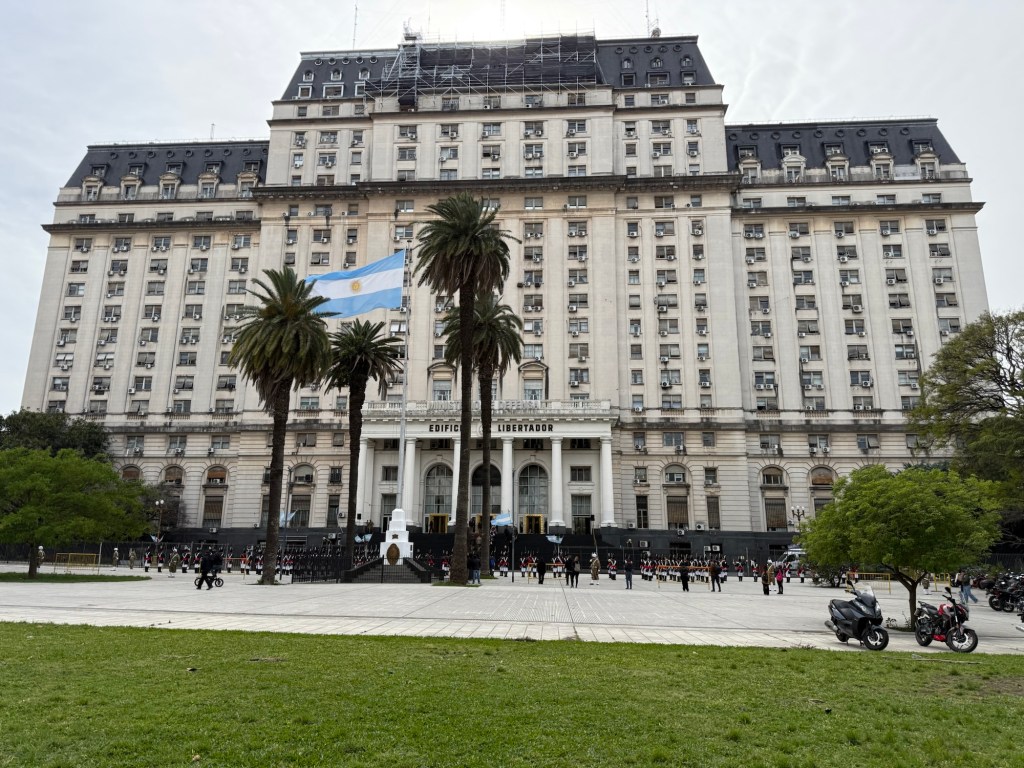
Plaza de las Armas Argentine Army

Within our first 5 minutes just down the street from our hotel we discovered the “Changing of the Guard” at the Plaza de las Armas Argentine Army in front of the Department of Defence Building. Not only was there pomp, circumstance and a band, they even sang as they departed.
Another 5 minutes brought us to the Plaza de Mayo, a huge plaza which is the oldest and most important plaza in Argentina and which has witnessed many protests. It was in this square that the May 25, 1810 revolution took place. The revolution marked the beginning of the Argentine struggle for independence. They also used to hold bull fights in Plaza de Mayo.

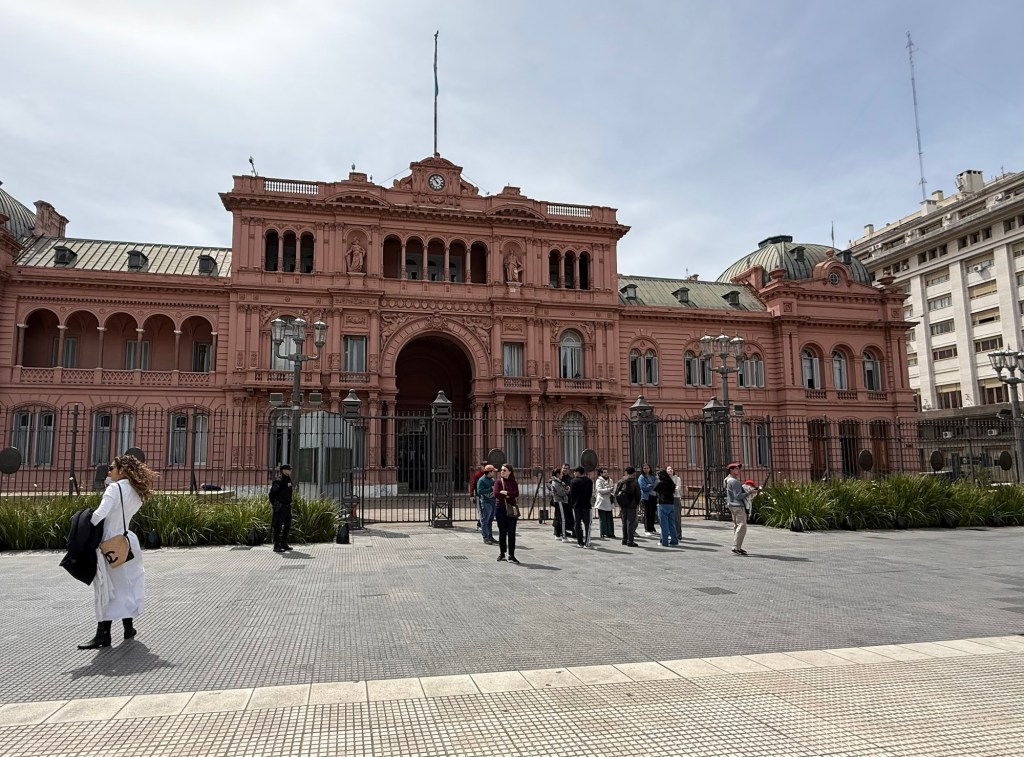
At one end of the plaza stands the Casa Rosada, Government House, or the seat of the National Government declared a Historical Monument in 1942. It’s a little older than our seat of government, having been built in 1580. The pink colour was apparently originally made by mixing lime with cow blood, to defend against the humidity.

Casa Rosada

Eva “Evita” Peron, considered by some as the spiritual leader of the country, and who with her husband struggled to bring labourers out of poverty, spoke many times to massive crowds from the balcony of the Casa Rosada including the most noteworthy one during a demonstration in 1945 to led to the release of her husband Juan Peron.

And no we didn’t stand in the square and sing Don’t Cry for Me Argentina, but it felt like we should!

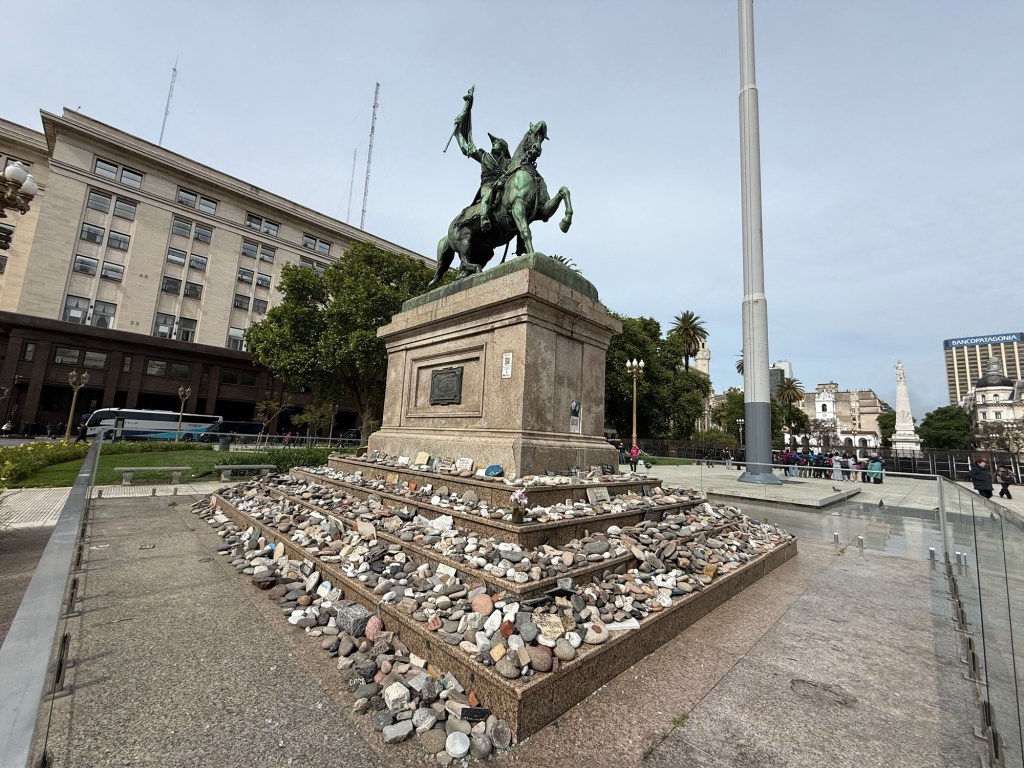
This equestrian monument in front of the Casa Rosada is a tribute to Manuel Belgrano, who was the creator of the Argentine flag, and leader in the country’s independence. We were wondering about the stones at the base of this statute and I was able to find that it started organically when the families and friends of victims of the COVID pandemic started placing stones with the names of their loved ones at the site. Kind of cool that it transformed the monument to one that memorializes an important historical figure as well as more recent victims of more recent tragedy.

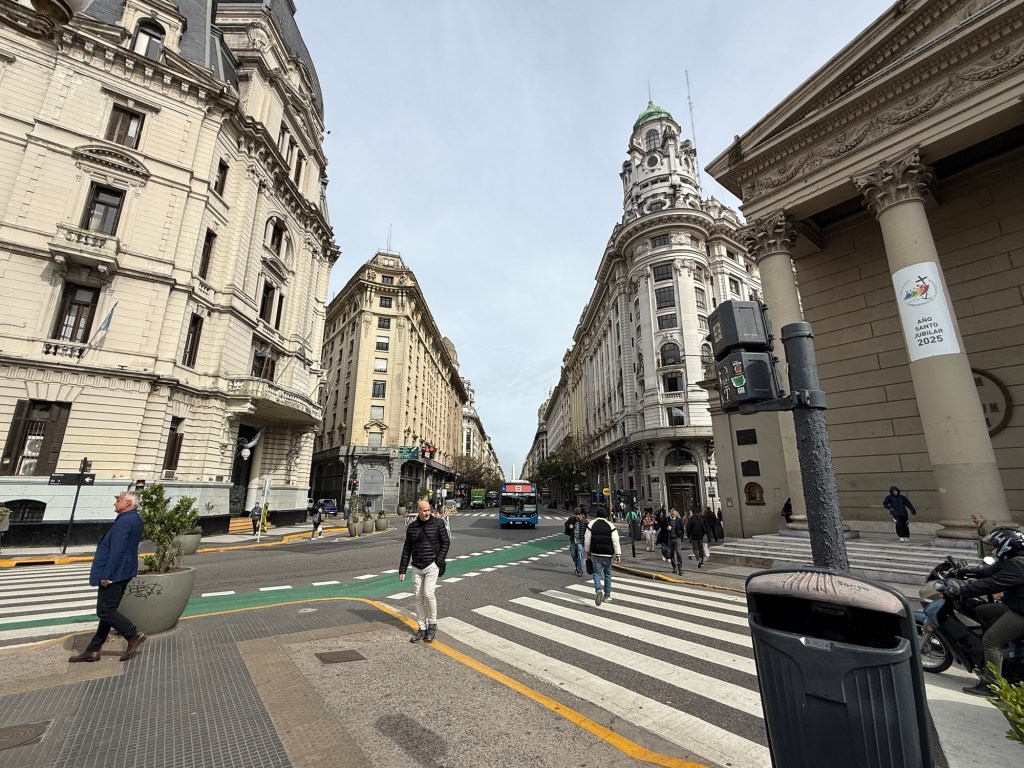
Although I’m no student of architecture, the architecture in view around the square and down the many impressive avenues leading off the plaza was amazing. We walked down many of them, including Calle Florida, which was the first pedestrian only shopping street in the city in the former cinema district. It has seen better days but still offers a wide range of shopping opportunities.
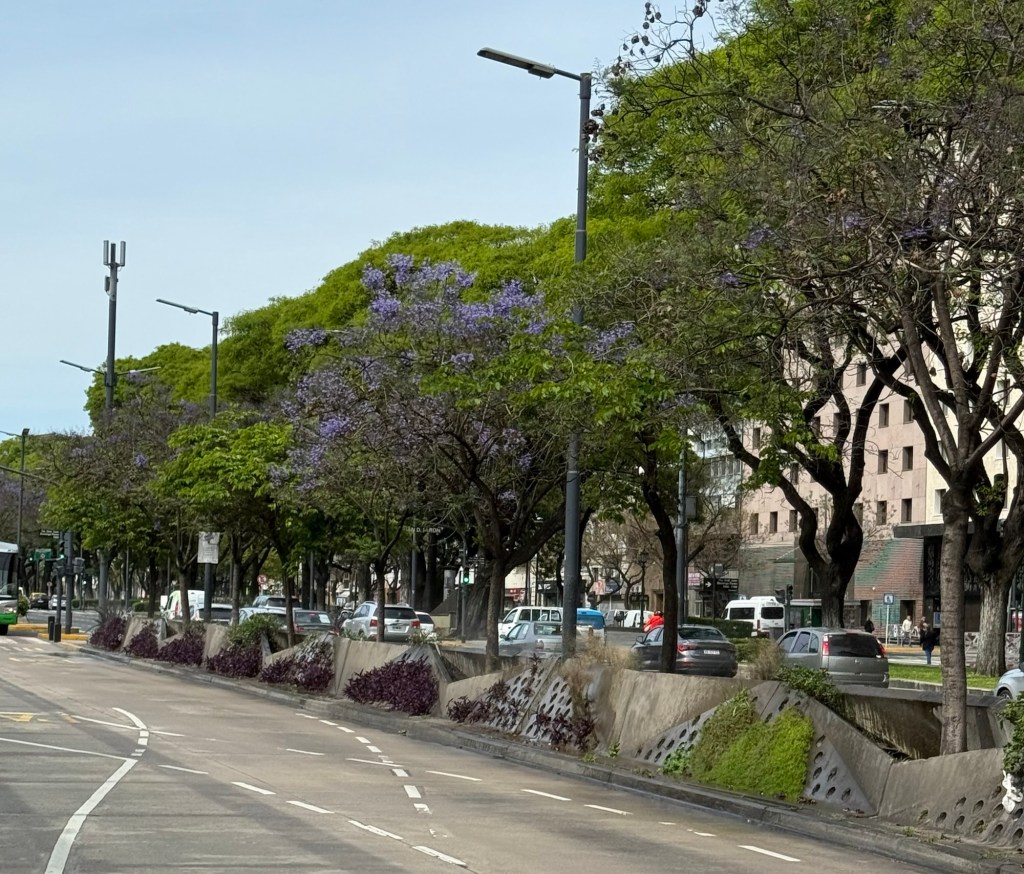
Jacaranda Trees in bloom along the bus corridor.

We walked for a while along a huge thoroughfare called Avenue 9 de Julio, named in honour of Argentina’s Independence Day. It has up to 7 lanes of traffic in each direction including a two-way, two-lane rapid bus corridor in between. It is claimed to be the widest avenue in the world, currently. The stretches of trees (including beautiful purple flowering jacarandas – my Millie would approve as purple is one of her most favourite colours) and grassy areas in between the lanes made it feel not so much like the 401.

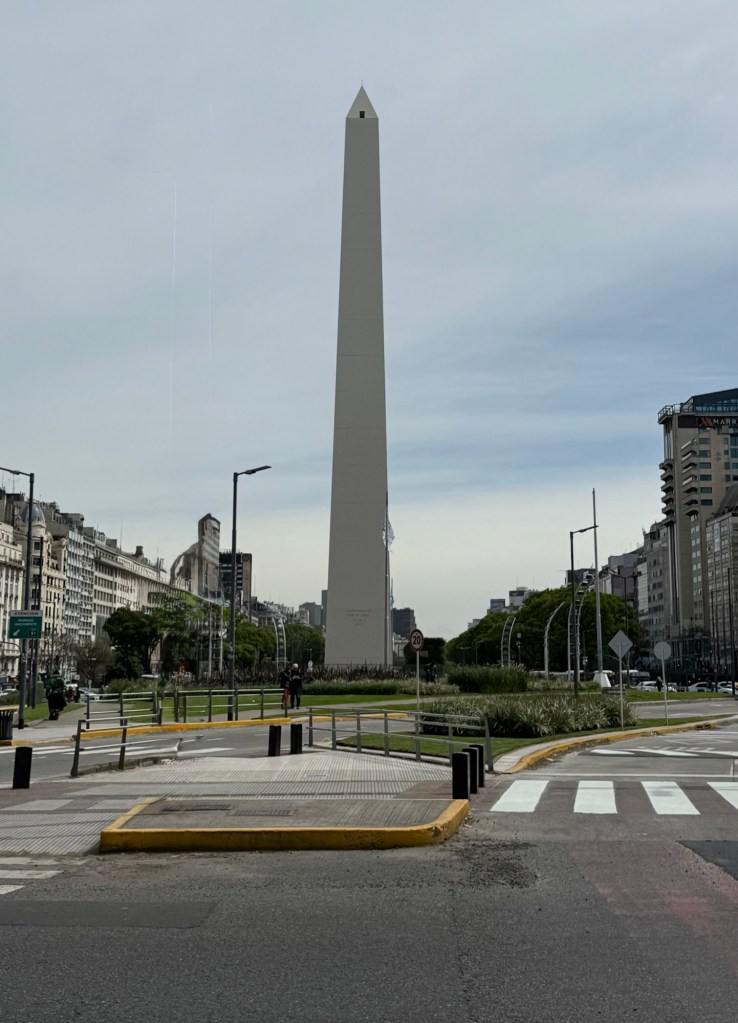
Obelisk of Buenos Aires

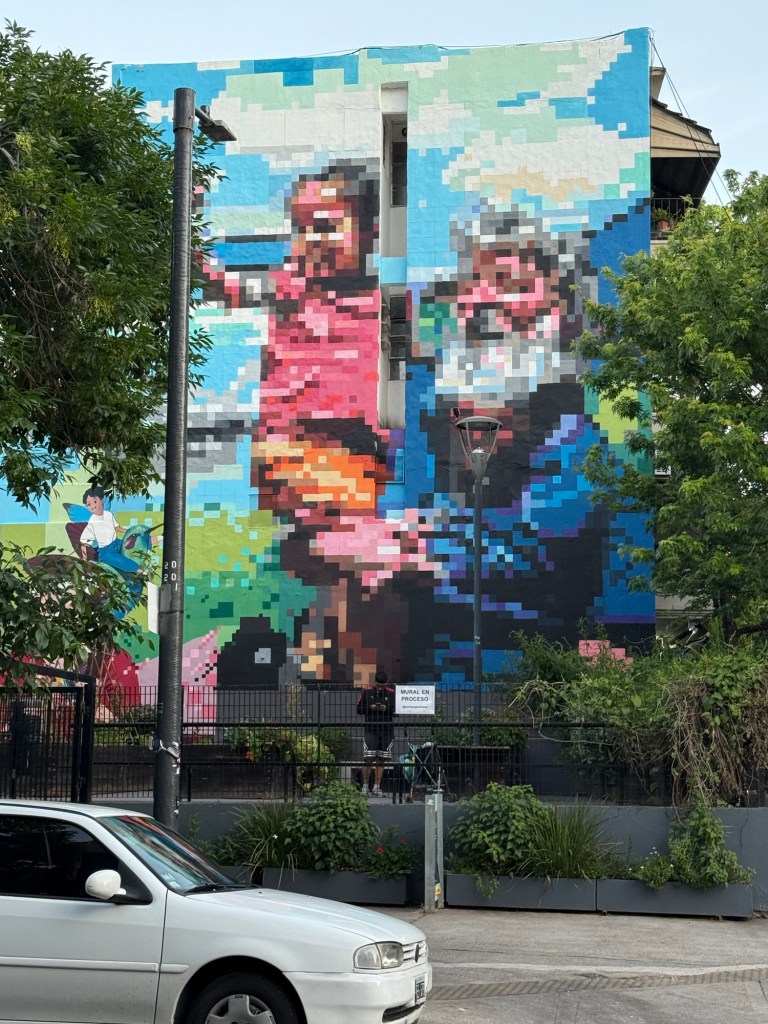
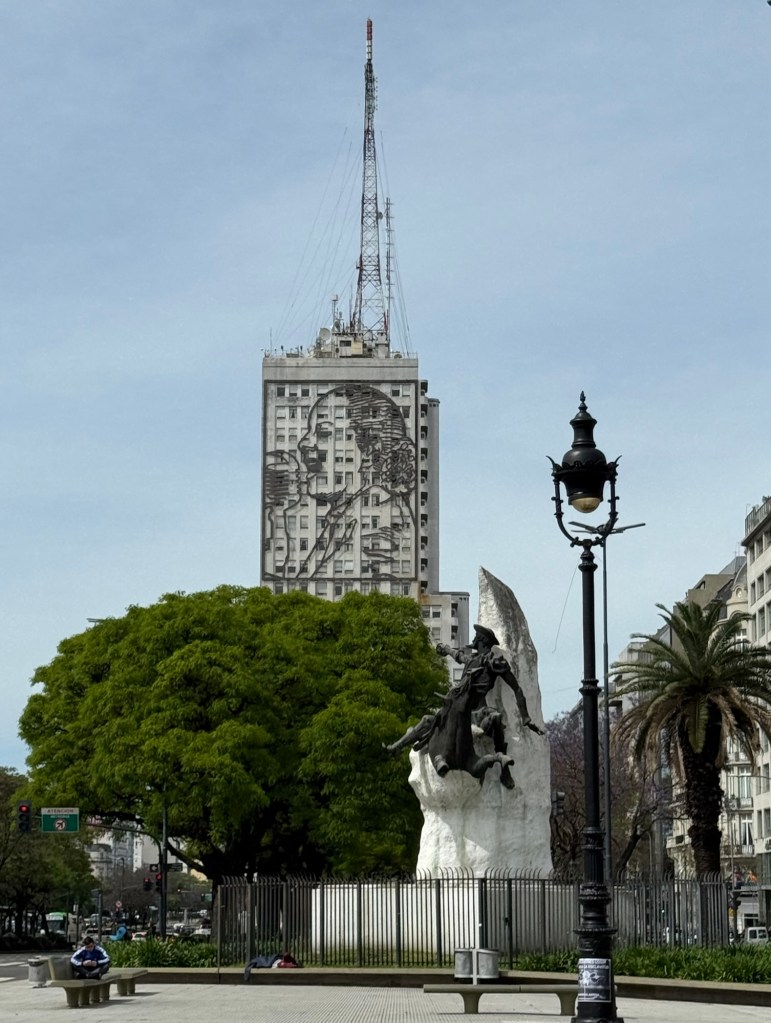
At one of the larger intersections, is Plaza de la Republica (Republic Square) where the Obelisk of Buenos Aires is rooted. It was built in 1936 from reinforced concrete to commemorate the quadricentennial of the first foundation of the city. At 68 meters you can see it a long way off. Along Avenida 9 de Julia we also saw the south facing side of the Ministry of Public Works Building where a mural of Eva Peron, made of steel 31 meters tall. by 24 meters wide. There is also another on the north facing side, towards the aristocratic area, where she is seen giving a speech to the people. They are illuminated at night, although we haven’t seen that yet. Perhaps tomorrow.

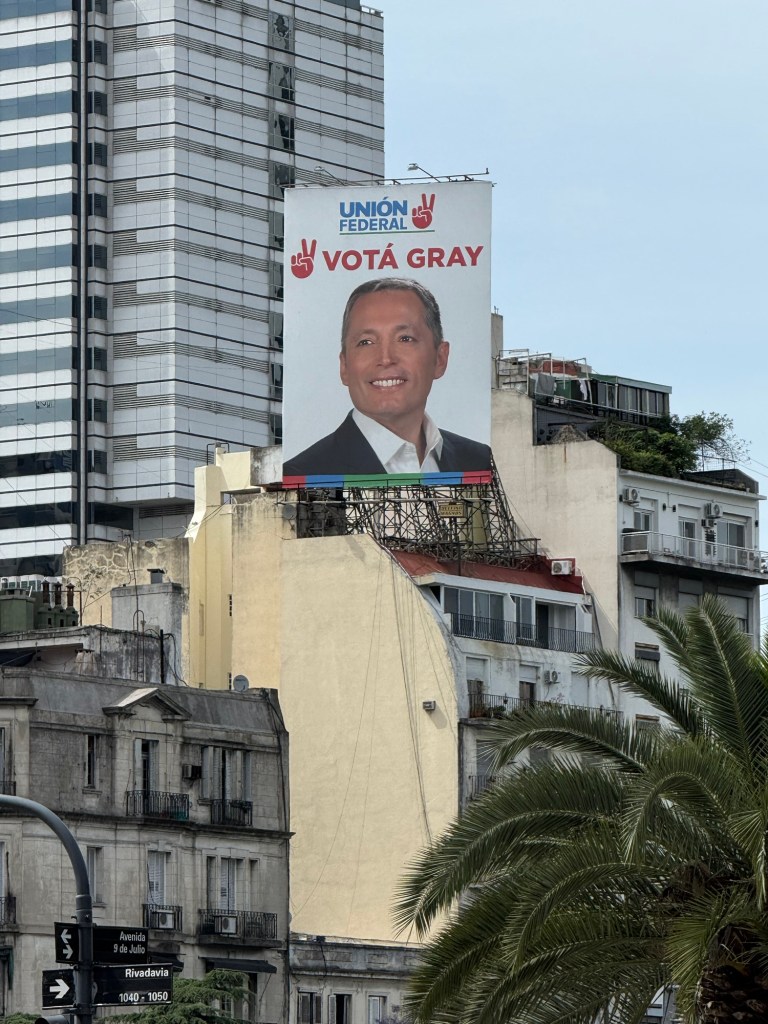
And of course my blog would not be complete without a reference to an election being held somewhere I’m travelling! The day before we arrived was the mid-term elections in Argentina where the existing government was re-elected but with a larger majority which will allow them to continue with their austerity plans. This is a sign from one of his opposition.

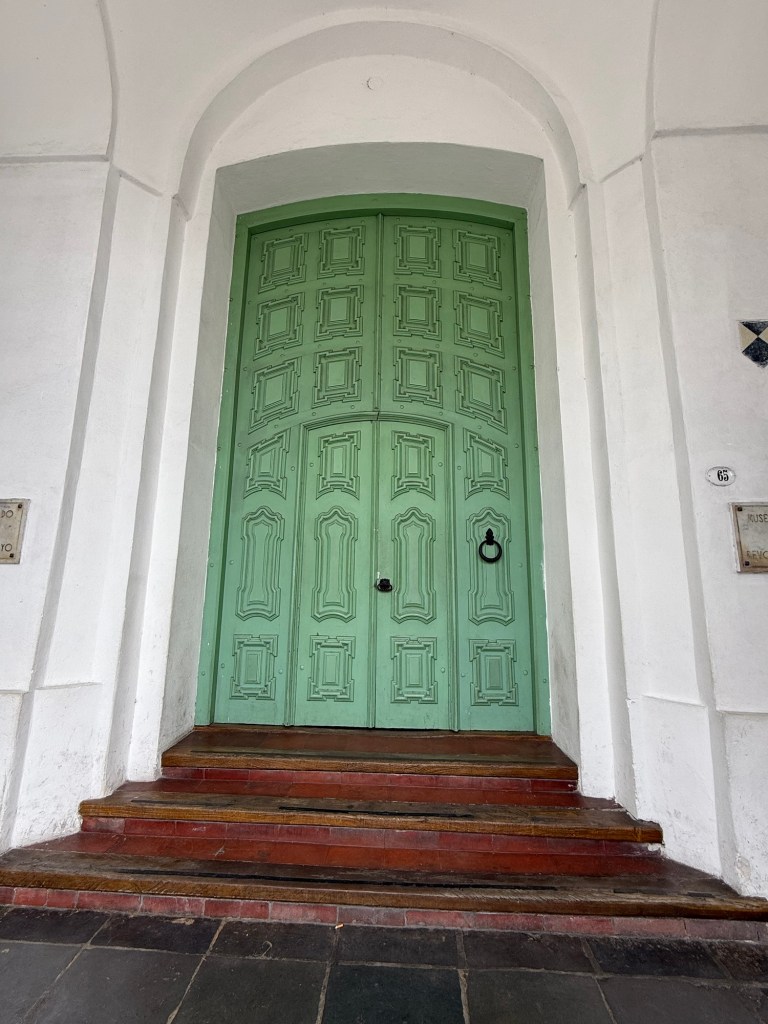
And who doesn’t love door pictures?!

After all our walking we definitely needed a cuppa and some sustenance and so we stopped at a not-very-Argentinian named cafe called London City for some tea and sandwich. The loose tea was put in boiling water in this heavy pot and I was told to wait until the grains of time ran out to pour!

Haha, I don’t look tired at all…..

Then it was back to the hotel to put up our feet, have an early supper in the hotel dining room and then hopefully we’ll have a good night sleep after too much time of being on the go to get here.

2025 Cruise

Beach Barbecue and Beginning of Goodbye

Today is our last full day of cruising and it was a really nice way to finish up this adventure. We had the Windstar’s very popular beach barbecue on the tiny island of Mayreau in St. Vincent and the Grenadines. There are 32 islands and cays in the Grenadines, nine of which are inhabited. Another of the islands in this country is Bequia, which I have visited on a previous trip and is one of my favourites in the Caribbean.  

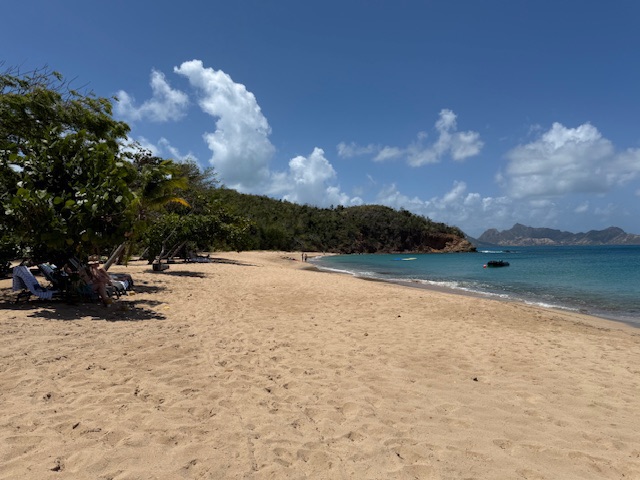
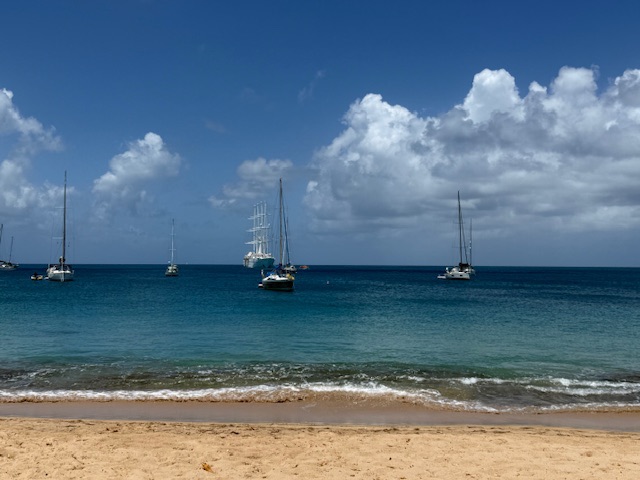
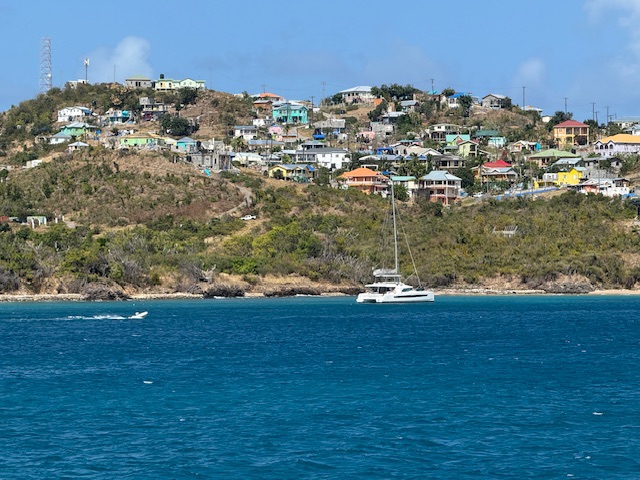
Mayreau is the smallest of the inhabited islands with a population of just under 300. The population is centred in an unnamed village located on a hilltop. Power to the residents is supplied to the residents by a central  generator located on the hillside of Saline Bay. The slave’s decedents who stayed on this island after slavery was abolished were given land to live on and they fished and farmed to make a living. In recent years, tourism and fishing has been the main source of income. There are a couple of seafood restaurants, a guesthouse and a small shop, as well as several vendors selling bright souvenirs on the walkway along the beach and near the pier where the tender dropped us off. There were a number of sail boats anchored in the bay, and the sailors were enjoying time along the beautiful white sand beach along with us. 
We visited this island last year as well, however the island got hit with Hurricane Beryl in July 2024 which apparently caused damage to 70% of the structures on the island. It was obvious even from a distance looking up the hill that there was lots of reconstruction going on – new looking roofs and evidence of new wood walls, etc. And some homes that were completely gutted. On the beach there were lots of trees partially or totally uprooted. 

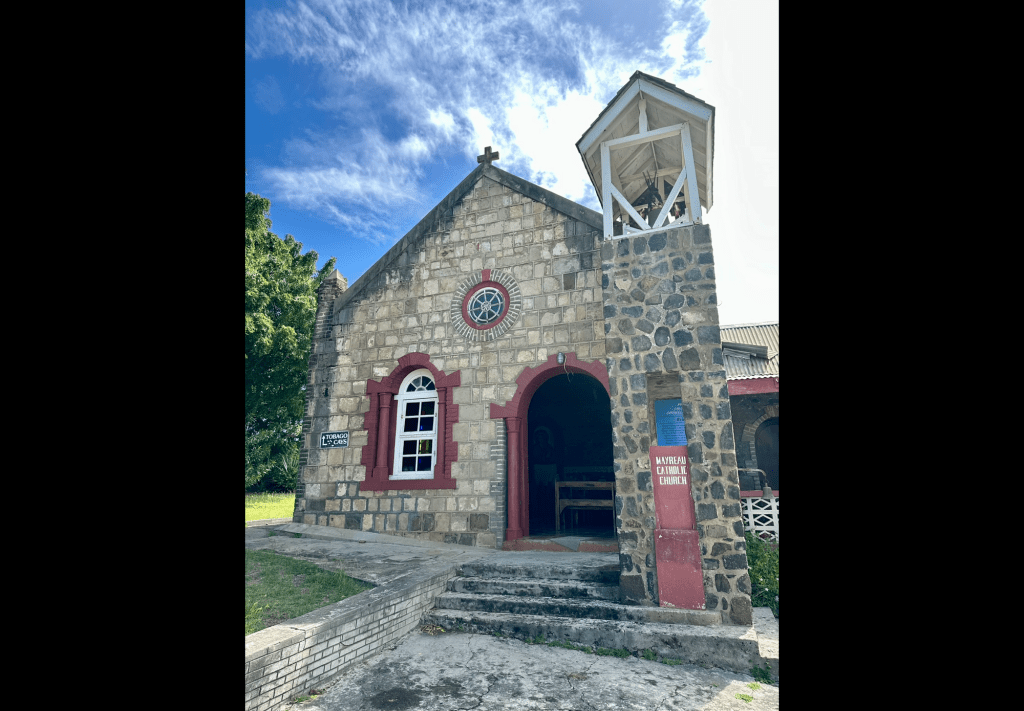
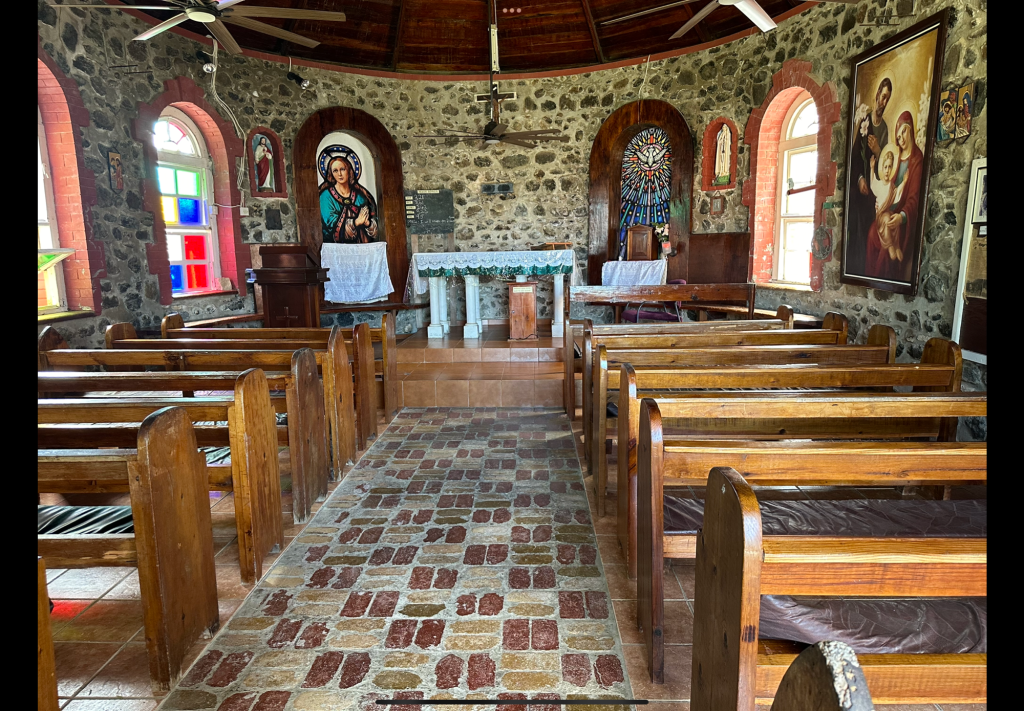
Last year when we visited this island, we walked up the hill to see the little (unnamed) town there and to see a little church at the top of the hill. It had a fabulous view of the island and our ship in the bay. The church was rustic but beautiful.  I’ve included a picture we took last year. Sadly the church was damaged in the hurricane and subsequently collapsed and is beyond repair. It hasn’t been rebuilt. This small community must have been devastated. We were very sad because it was a really pleasant memory for us. We didn’t walk up the hill today as we didn’t want to see the ruins of the church. 

January 2024 picture of church now destroyed

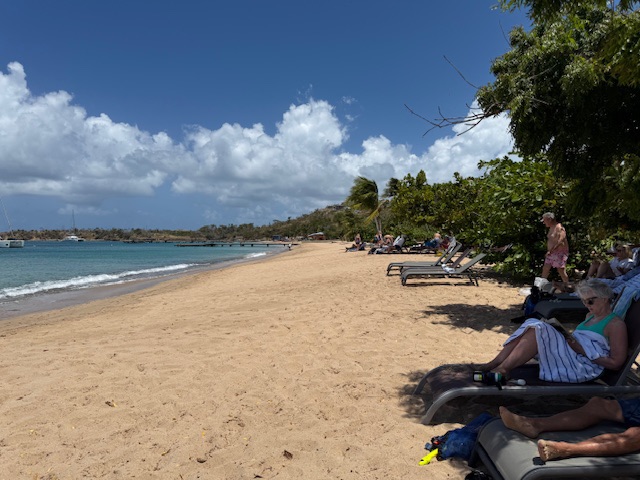
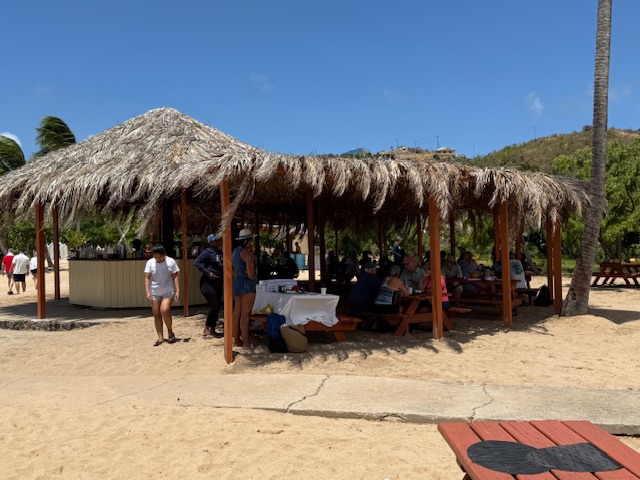
We did however, join the beach party and grab some lounge chairs under the shade of some trees along the ridge of the beach to enjoy the breeze and a view of the beautiful turquoise water. At noon our barbecue lunch was ready and we enjoyed a fabulous buffet of salads, veggies, burgers and dogs, jerk chicken and grilled fish. Oh yes, and dessert. An amazing amount of work goes in to these beach days. The chairs are stored on the island but stacked up and locked waiting for the next time a Windstar ship comes along. They have some permanent structures like a lovely clean washroom, bar area and solid wooden picnic tables but everything else is transported from the ship in the morning and taken back at the end of the day. They have a complete bar set up, and place settings for 120 passengers on the picnic tables including place mats and silverware along with solid white plastic plates. 

Adrienne did some snorkelling along rocks at the point of the bay and said she saw lots of fish, including Parrot Fish, and Blue Tang fish. Clair and I walked along the edge of the water enjoying the breeze and the view. And then it was then time to get back to the ship to clean up, cool off and take up our station on our favourite bar stools on the pool deck. 

This was one place where the transfer from the tender to the ship or vice versa was really challenging with the sporadic waves playing havoc with the process. The crew does an amazing job of keeping every safe. I was about to take a step on to the dock on our return when the edge of the tender dropped a couple of feet and the dock disappeared! My leg ended up hitting the edge of the dock as I was mid step. Thankfully, I was hanging on tight, the staff had a grip on me and the tender came back up to level with the dock very quickly and I was able to get all of me on the docking platform. I was no worse for wear, though, as my leg had hit sideways rather than right on. 

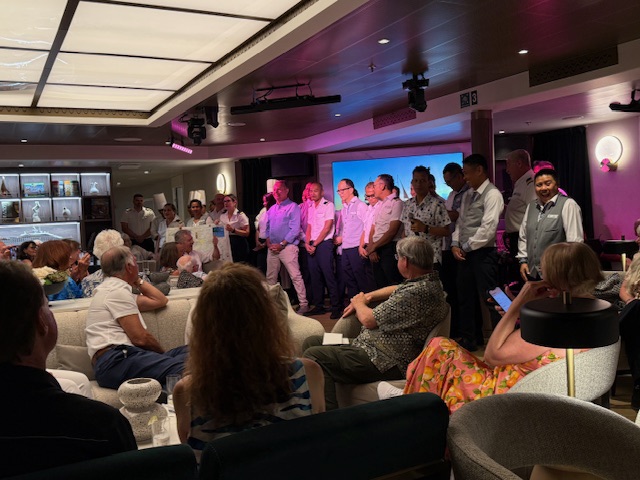
It was the Captain’s farewell in the lounge before dinner this evening when the Captain introduced the officers and rest of the crew who were available and they all joined in and sang the song “Sailing”. It’s a really nice moment. Later in the evening as we left the bay on Mayreau we had our final “Sail Away” to the sight of the sails filling, and the sound of Vangelis’ “Conquest of Paradise” and tonight an added extra song by Andrea Bocelli, “Time to Say Goodbye”. And tomorrow I will say goodbye to my fabulous travel companions Clair and Adrienne. So a surprisingly emotional evening. 
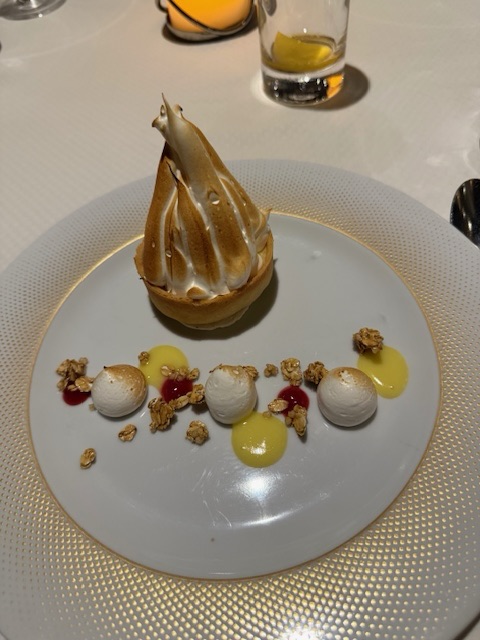
And then it was the “Last Supper” which included this amazing Mile High Lemon Meringue Tart .
I’ll be travelling all day Wednesday and won’t have much to say. Will try and do a recap in the next couple of days.

It’s been a great adventure and I’m sad that I’ll have to take a hiatus from travelling with Windstar, through no fault of the many employees who made our trip amazing.