Uncategorized

Windhoek, Namibia to Ghanzi, Botswana (Friday, Sept 1)

So, with our new crew in tow, off we left for our 3rd country of this trip this morning, Botswana.

Today’s drive tested our patience. Leaving Windhoek, the scenery started out interestingly, with hills and lots of vegetation. However it soon turned into flat land, with scrubby vegetation, with hardly any towns to look at. For the first time I actually nodded off as we drove along. Up until now, I have had FOMO (a new acronym for me-Fear of Missing Out).

We did have one spark of interest when we stopped for groceries in one of the bigger towns along the way. It was a busy service town, with stop lights and everything. And surprisingly it was an opportunity to see a lot of Herera women in their traditional outfits. We stopped into a Wimpy’s at a gas station and while standing in line, a couple of them came in to join the queue. I turned to look at the woman right behind me and looked up, and up and up. And her outfit was amazing. Some of the groups of them were open to having their pictures taken, but one group that one of our travellers tried to engage in conversation with, immediately said, “$100 for a picture.” Naturally they generate a lot of interest. I had assumed they only dressed up for the tourists in the area we had passed through the other day, but apparently not. This is their normal attire.

Lunch time wasn’t even a treat. Because we’ve been on the move almost everyday and in areas were there were absolutely no services, we have had picnics for lunch frequently. They’ve found nice locations, for the most part, but they have become a tad repetitive, with sandwiches made of cold cuts, lettuce, tomato, cucumber, cheese and avocado. Someone had asked to stop for a “bushy bushy” break and since it was close to lunch time, Innocent suggested we just stop at this same spot for lunch. However, there was unanimous consent that we didn’t want to stop here. It wasn’t even a picnic area, and there was toilet paper all over everywhere, from previous “bushy, bushy” stops. So we carried on to a picnic site and got set up only to discover there were some sort of sand fleas and added to the animal dung all over the site made for a less than desirable lunch. So we ate as quickly as possible and moved on, and on, and on and on. We had started at 7:30 am and didn’t roll into our night stop until almost sundown. We missed a planned bush walk activity because we’d arrived so late.

The evening was pretty magical though. We were hosted at a camp run by some San Bushman and supported by Intrepid Foundation. It is in the middle of a private game reserve far from any civilization. The rooms were pretty basic, but comfortable. We got to experience some of the things the locals get to live with, like the generator not kicking in until 6:30 pm and then going off at 10pm and not on again until the next night. Our head lamps are getting a workout.

The dinner they prepared and presented to us in an outdoor gazebo in the courtyard, was one of the nicest we’ve had. It was very western in our honour- comfort food-beef goulash, rice, sweet potato, cauliflower with cheese sauce and greek salad. After our delightful meal we were invited to camp chairs set up around a huge fire to experience an evening of traditional story telling, dance and song of the San. Several of the San women were sitting in behind the fire, chatting among themselves. They were dressed in traditional San attire as were the 5 men who would be the dancers. The leader started by explaining what the presentation would be. The song and dance were part of a healing ceremony and typically the “shaman”-type healer of the group used the song and dance (and some recreational marijuana) to get into a trance and the laying on of his hands to heal any ailments in the participants. Nanci and I figure Eli, our physiotherapist, should add this to his repertoire. Innocent had arranged for their leader to tell a couple of traditional stories, and for them to do 4 – 5 song and dances for us, but because it would have been rude to leave once the dancers had entered into a trance, they ended the demonstration before they got to that point. The healer was a frail-looking older gentleman, who we were worried would keel over and fall into the fire. It was great to see that the younger people were being schooled in the traditions though. It was all a little surreal, especially when some of the staff came to watch and were sitting looking at their iPhones. We were grateful to be able to learn more about the Bushmen and be invited to watch some of their rituals.

Uncategorized

Etosha to Windhoek, Namibia (Thursday, August 31)

Today we leave Etosha National Park and we’re on our way to Windhoek, the capital city of Namibia.

And yay, no gravel roads today. What a treat. It is mostly cattle country and not a lot to see on the way, and we’d passed by some of the route already on our way up to Etosha. We did see some baboons at the side of the road, but we didn’t stop to get pictures. They were following along in an area where the road crew had just mowed the shoulder, eating insects that had been turned up.

We stopped for provisions early in the day in a town where we’d stopped once before, feeling like regulars and not so weird being the only white folks in town. We had just one more stop, in a small town just north of Windhoek, for our standard picnic before proceeding on the busy 4 lane divided highway into Windhoek.

We were given an hour to explore the centre of Windhoek and I took the opportunity to find an optician to see about getting my sunglasses fixed. Sigh. On the game drive in Etosha, when we had a double seat to ourselves, I set my sunglasses on the seat beside me, along with my ball cap when we happened upon some elephants so that I could more easily take pictures. I should have known better. We all moved around the truck while we were stopped to get different photo angles, and one of my fellow travellers sat or kneeled on my glasses. One of the stems was broken off at the hinge, and the hinge was destroyed, but the stem and the lens portion were fine. So Nanci and I headed off, to the core of the downtown area, with warnings to be careful of our purses, in search of an optician. A 10 minute walk found us in a medium size mall that included not only an optician but a money exchange. The optician was able to take a hinge from another pair of glasses in 20 minutes and for only Cdn $10 and they are good as new. And we were able to get some money exchanged. So 2 missions accomplished.

We took a quick look at the main church and took pictures of a monument to the first President of Namibia, Dr. Sam Nujoma. We noted with interest that there were major streets named after Fidel Castro and Robert Mugabe. And then we were off to check in to our hotel. I didn’t take pictures of this hotel because it was in the process of having a new roof installed and so was a mess. Ironically it was called the Roof of Africa. We had some time to relax, swim or use the wickedly fast wifi. You can guess which I chose.

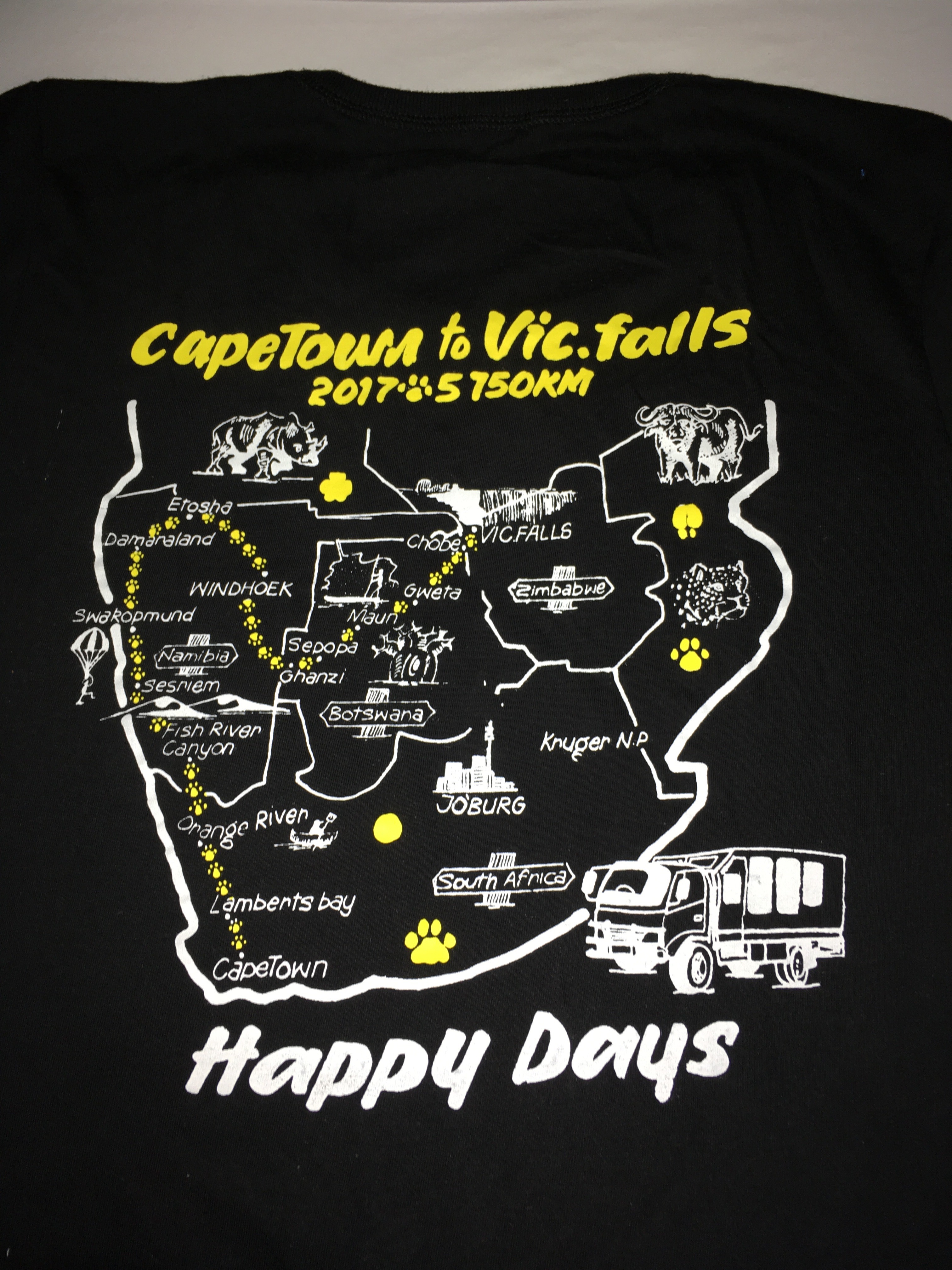
Our trip is made up of several components, and today is the completion of the first of two legs of the Cape Town to Victoria Falls Tour portion. Sadly this means that 6 of our travel companions will be leaving us here in Windhoek after 13 days on the road together. A couple and a single from Australia, two American friends travelling together, and a single woman from England all head on to other adventures or head for home. So tonight’s dinner is their farewell.

But happily we met our new companions at our orientation meeting this evening. They are all couples, one each from England, Australia and Ireland. They joined us for the farewell dinner so it was quite a large group. The restaurant was a quick 10 minute walk from the hotel, called Joe’s Beer House. It was huge and really hopping with activity and had a lovely ambiance. It was divided into various sections and most of them were open to the stars. Unfortunately the food, especially the lamb curry which many ordered, was not that great. We have been really lucky with our meals so I suppose one not-so-great one is to be expected.
I will miss the daily competitions between Dip and Charlie about who has more fitbit steps logged. We’ve travelled some pretty bad corrugated gravel roads and Fitbits register a step on some of the bumps. The highest number of steps in one day that I had was 24,000 and I’d been sitting on the bus all day. But I won’t miss poor Coral’s constant coughing. Colds have been going around since the early days and she picked up an ugly persistent cough that antibiotics weren’t going to budge. She is off for home in Australia so hopefully she can recover quickly there.

Tomorrow our new truckload of travellers heads east and crosses into a new country! This time it’s Botswana. The next week is going to fly by because we’re moving almost every day. Each day, Innocent lets us know what type of footwear is appropriate based on our activities for the following day so that if we need to wear closed toe shoes then we have then on hand. At our orientation meeting tonight Innocent let us know that any type of footwear was fine to wear for tomorrow, but that we should bring our other pair of shoes with us on the bus. We were a bit confused by that instruction until he explained that Botswana is cattle country and they have concern about cattle diseases carried on shoes and that we may have to walk through some sort of disinfectant and also dip our other pair of shoes in as well. If we don’t bring them with us on the bus, the inspectors may have all the luggage searched looking for shoes so we’re trying to avoid that.

Back at the hotel we stayed up late, despite our early start tomorrow, wanting to take advantage of the wifi, since it’s doubtful we’ll have good wifi for a few days.

Uncategorized

Etosha National Park, Namibia

Etosha National Park in northern Namibia was established by the Namibian Government in 1907 and is now 24,000 square km after having been reduced in size over time with the demand for land. More than 15% of the country has been set aside as parkland by the government. Here at Etosha, there are at least 2 camp sites, which have significant fences around them, as well as toilet areas that are all fenced in. Aside from those designated areas and one at the overlook of the Salt Pan, no one is allowed to get out of their vehicles. As our driver said, I only want to see your cameras out of the windows, no body parts. It’s easy to forget that these are wild animals and there are dangers here.

At dinner last night, four of the group decided then didn’t want to do an all day game drive in our truck and so they booked a shorter one with the National Park Service for today. The rest of the 8 of us loved that we each had a double seat, and therefor a window seat to ourselves. We started off at 6:30 and not a peep of complaint as we were all keen to experience today, and once the gate opened at 6:45 we were off and running.

When we arrived at the first waterhole where we’d seen so many animals the day before, there was not a living thing to be seen. Not even a bird. We wondered if we were going to have an unlucky day! The pressure was on our guides as one group that we encountered at dinner the night before had seen 5 lions on their game day. Our guides know the park well, and know the habitat of each of the target animals and each time we passed a vehicle there was a short conversation about what the other had seen and where. We got a lead that there were 3 lions spotted within the last hour at a certain water hole, not too far away and so off we were. Alas, no evidence of them when we arrived.

Innocent told us to watch the animals behaviour because it can tell us much about what might be nearby. When we arrived at one water hole we noticed there were lots of zebra and springbok nearby but not at the water hole. And they were all spread out standing looking in the same direction. Sure enough, minutes later the zebras all ran into a bunch all facing the same way with the springboks behind them doing the same thing. Innocent said it was a defensive position as if to tell any predictors that they had been seen and and they couldn’t be surprised by an attack. Minutes later, 2 lionesses with a cub poked their heads above the horizon and wandered nearby. We watched in anticipation. The lions didn’t spend much time there, as they knew they had been spotted and wouldn’t have success hunting.

We drove from water hole to water hole, through areas where smaller cats like leopards are known to rest. Every once in a while, 4 or 6 giraffe heads would stick out of the tree line and we’d stop to watch them eat or cross the road. Zebras were everywhere, and we didn’t even stop to take pics after a while.

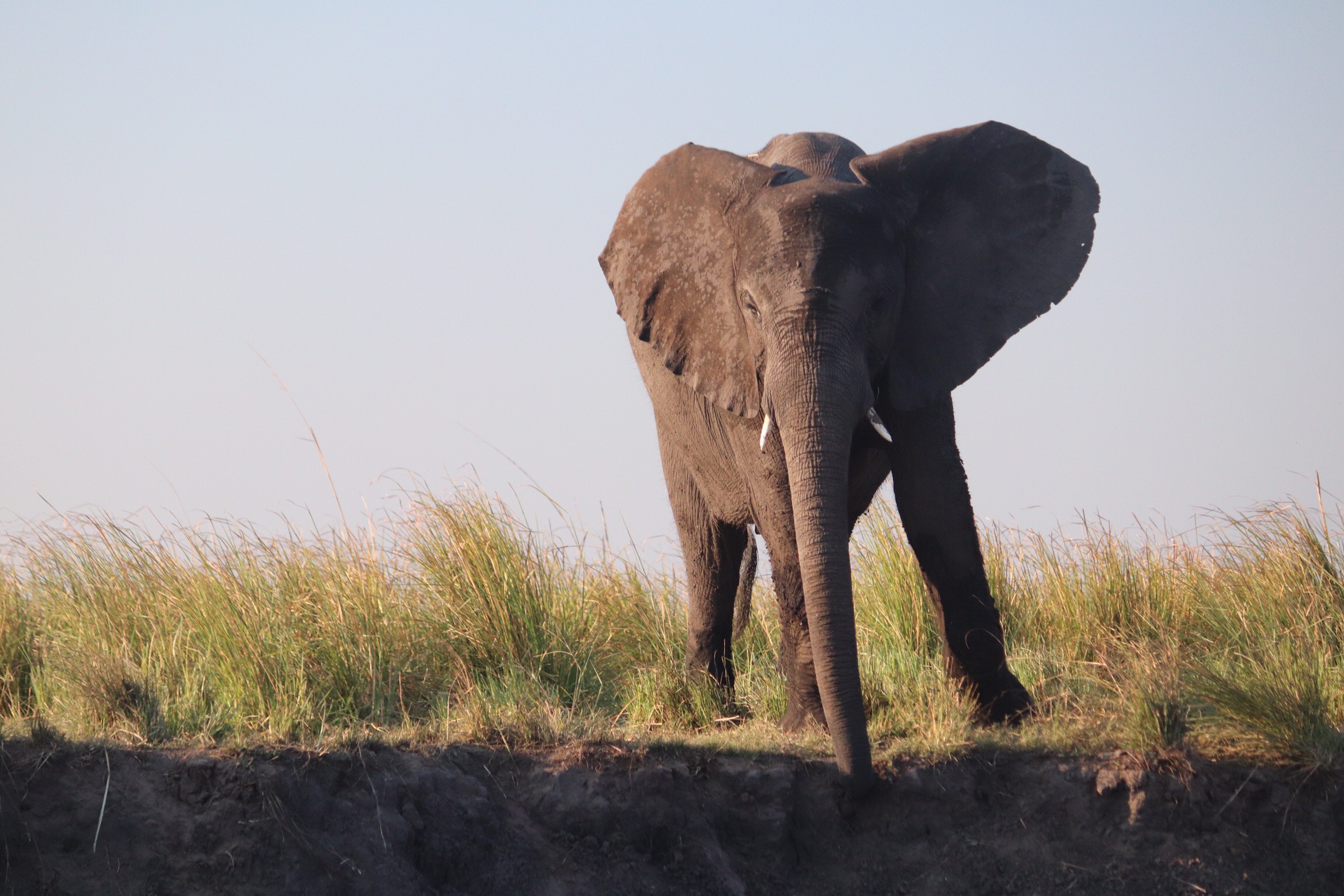
We came across a “breeding group” of mothers and their baby elephants eating right beside the road and were able to watch them for a while. Oh, and maybe take a few photos. We came across another couple of lions, one of which was trotting along just 10 feet from the side of the road while the other laid in the shade.

We had worked our way to toward the salt pan at one side of the park, and so we stopped at an overlook where we were able to get out to stretch our legs and take a look at absolutely nothing, as far as the eye could see. Flat, white and devoid of any sign of life. It is 120 km by 60 km in size.

We made our way to the second of the 2 camps and had a buffet lunch in the shade at a restaurant in the camp. After lunch while we waited for Innocent to conduct some business we headed to this camp’s water hole in the hope that it would produce the same results as the previous day. We had a bit of a walk, and then came upon a seating area overlooking the water hole with quite a few people sitting perfectly still, and quiet, looking at absolutely nothing. There was nothing at the water hole but they were waiting in silence just in case something showed up. We left to join our group and were off to wander the park in our truck, heading slowly back to leave the park.

As we neared Anderson Gate Innocent, who was driving at the time, asked Sandile to check out what he thought might be a rhino in the very far distance with the binoculars. I couldn’t see what he was looking at with my naked eye but I took a picture with my zoom lens and then looked at the picture blown up. There it was. How on earth Innocent could have seen it is beyond me. And then even closer to the gate still was another white rhino quite near the road but with it’s back to us. At first I thought it was a huge boulder, but then it moved and I realized it was indeed a rhino.

To that’s 3 of the available Big 4 in Etosha. Figures crossed we’ll see the leopard and water buffalo elsewhere in our travels. It was an amazing thing to be able to see these animals so close up and in their natural environment.

Uncategorized

Damaraland, Namibia to Etosha National Park, Namibia

The excitement of heading north to Etosha National Park and our first game drive helped to ease our sadness at leaving our oasis at Damaraland Mopane Lodge.

The drive north was a pretty easy one, with a first stop by the side of the road while Sandile explained the growing number of large mounds we’d seen scattered in the landscape. Termites build these using secretions to bind the soil together into these upside-down cone shaped mounds. The mounds generally lean toward the west somewhat and the Bushmen use that as a direction indicator. Some of them encapsulate trees and eventually kill the tree. There are tunnels and compartments for various uses within the nest

Each mound has one Queen, who can live to be 50 years old and can lay up to 30,000 eggs a day when necessary. There are different kinds of ants, some of which are builders, some that defend the mound, etc. Chemicals they emit when they die let’s the Queen know when she must lay more eggs to replace those that have died. Their predictors are aardvarks who use their long snout to forage in the nest.

We stopped for 45 minutes or so in a town named Outjo, to stock up on provisions for lunches for a couple of days and then headed on to our lodge just outside Etosha National Park, Anderson Gate. It was too early to check in but Sandile and Innocent dumped the bags to be put into the rooms when they were ready and off we went into Etosha and our first game drive.

After registering at the park offices we went into a campsite to have lunch. It was a really well furnished campground, and made me homesick for my little trailer. While lunch was being prepared by Sandile and Innocent, they pointed us in the direction of the water hole to check out what was there. My heart leaped with joy as we rounded the bend to gaze upon the back end of a couple of real live and free elephants just meters away! Well, to say our experience started off well, was a major understatement. One of the four of the Big 5 (Elephants, lions, rhinos, leopard, and water buffalo) that live in the Park, ticked off our list already! Water Buffalo are not found here, so hopefully we’ll see them somewhere else in our travels. We watched while 6 elephants came and went, stopped for a drink, or a bath. There were a couple of giraffe in the far distance, springbok, and all sorts of birds flying in formation. A feast for the eyes. Needless to say, none of us was interested in lunch and Sandile had to come and practically drag us off.

After a quick lunch and wash up we were back on the bus, this time with all the windows down and seat belts off as we started out on our first game drive. We selected this time of year to come to southern Africa because it’s nearing the end of dry season which means that the wildlife are more concentrated around the water holes and you don’t need to go looking for them as much. Well the first watering hole after the camp area was packed with so many different types of wildlife it was hard to decide where to look. Zebras were the first favourite and there were even some cute juveniles and Springboks were plentiful. We watched and took pictures for a while and then were off to check out some other areas and water holes, stopping wherever someone wanted to in order to get a picture.

We had to be out of the park by sunset or receive a huge fine, so after putting in as much time as we could, Innocent headed for the gate and back just a few minutes to our lodge. We then set off in search of our individual rooms with the map, room key and whistle provided anxious for a shower to get off the dust of the day. It was a bit of a hike and we were glad they had put our bags in our rooms for us.

In anticipation of taking a lot of pictures in the park, I had switched memory cards so I’d have an empty one and I was anxious to look at their pictures from the day. I had taken almost 500. I haven’t even downloaded them all yet, and just selected a few of what I thought would be the best to post. I’ll have a big job when I get home to go through and pick the best and purge the rest.

Dinner was lovely, served in a rondovel with a partially open to the stars, partially thatched roof, and there was much chatter about the animals we’d seen, pictures we’d managed to get, etc. But it was early to bed because we had a whole day game drive in the park the next day.

Uncategorized

Damaraland, Namibia

We have a rare 2 nights in one place here in Damaraland at this lovely “neighbourhood” lodge. Today we’ll explore the region a little bit.

We started at the second of two UNESCO World Heritage Sites we’ve visited in Namibia. The first was Sossusveil, where we climbed Dune 45. This one is called Twyfelfontain which means a place where there is sometimes water and sometimes not. An early settler tried, with his large family, to eek out an existence in this unforgiving area, but he was unsuccessful because of the uncertainty of the water supply and the site was abandoned.

Then in 1921, rock drawings were found in this area that are 2000-6000 years old. They were etched in the iron rich sandstone, and acted like early Google Maps, to depict areas where animals and water could be found in the region. They were pretty amazing, although rudimentary etchings, and one even indicated a giraffe with its neck in 3 different positions to indicate it leaning over to drink. Water holes were indicated by a circle and those that were permanent had a dot in the middle of the circle. We saw just a few of the over 2500 drawings found in the area.

Our guide was a descendant of the original Dama people who were Bushmen similar to the San and in his native language they use the same clicking sounds as the San. He demonstrated the 4 different clicks they use and laughed at us trying to recreate the sound.

We had to hike a short bit from the visitors centre out to the site and then scramble over some rocks to be able to view the various pieces of sandstone, now resting on the valley floor or among other rocks. They also had built some metal viewing platforms. Along the way a couple of our travel companions fell, one of top of the other. Everyone scrambled to help, especially our guide as it appeared the one on the bottom might have hit her head on the rocks. Finally this very practical Aussie spry grandmother said, “OK then, who should get up first?” Everyone started breathing again, and after their limbs were untangled their injuries were assessed. Some scrapes and bruises but thankfully, no broken bones. The episode proved to remind us how far from any services we were. Our guide said later he was already thinking quickly about how we’d evacuate anyone with any broken bones, etc. He has already had to rescue a passport left in a safe back in southern Namibia, and arranged to have it brought up to meet us in Windhoek. I’m sure he was relieved not to have to challenge his logistics skills once again.

Next we were off to visit the Petrified Forest National Park. As the Ice Age receded, huge trees (which I think our guide said they figure had stood for 1000 years), from central Africa were deposited in this area, and they were compressed under tonnes of debris and the wood became Petrified. There were pieces of the wood spread over the surface of desert and in some places there were larger trunks of trees, even with some bark still left on the tree. The guide also pointed out a plant surrounded by a circle of the wood, the Welwitschia that was the national plant of Namibia.

Then we were off back to our lovely lodge to enjoy a swim before heading up to the Sundowner deck to enjoy the sunset, drink in hand, before dinner. Well, that plan came off the rails as a rattling noise coming from the undercarriage of the truck that was assessed several times, got worse and worse. Turns out the bracket holding the water tank on the bottom of the truck had broken and although a fast fix was done with wire holding it up, that didn’t last long and something was rubbing on the drive shaft. Luckily it held until we hit the “bitumen” road (we’d call it “sealed” road) and limped into a town just a short distance. And more luck, there was a welding shop that was still open for the day. So we all headed off back to a gas station in town for ice cream treat and sat on a curb in the shade and chatted while the welding job was done and we were on our way again. TIA – This is Africa, and so travellers need to remain flexible, and we all took it in stride.

But it meant that our swim got scratched off the itinerary and we had to hustle up the hill to the sundowner deck to get there in time to grab a drink (and sadly they were out of my Savanna at the mobile bar) and watch the sun go down. We met a lovely German couple travelling with their grandson, who were taking somewhat the same route we were on their own. Canada of course came up and yes, they’d been to the west coast and up through the Rockies to Banff and Jasper, and into Yukon Territory and Alaska. People, one of the best parts of travelling.

Uncategorized

Swapkomund, Namibia to Damaraland, Namibia

Today we left Swapkomund and headed north along the Skeleton Coast along what is referred to as a “salt road”. It’s apparently made from salt and as such can’t be painted so it has no centre line or edge lines. Glad I wasn’t driving.

On our way out of town, our guide pointed out the new neighbourhoods of homes that the Namibian government has undertaken to build for its citizens. The homes are small, but include a small fenced piece of land and all the infrastructure is in place for the new inhabitants, who can rent-to-own at reasonable prices.

The Skeleton Coast is called this because of the number of ships that have been wrecked along this rough Atlantic coast line from the early Portuguese explorers right up until 2008 when a Russian fishing vessel wrecked just south of Henties Bay. We stopped for a Kodak moment and to be inundated by entrepreneurs selling rocks to us and other tourist bus loads. This area is rich with a great variety of stones and it seemed there was one for every taste however they were just rough stones and the real cost would be having it cut and set so no one took them up on the great deals.

We turned inland from the coast at Henties Bay (where parts of the Mad Max movie were filmed) and headed east and north past a small range of mountains including the highest peak in Namibia, Brandberg Mountain at about 2600 meters. And on into Damaraland.

When the German missionaries came to this region, they had some of the local Herero women work for them in their households but the story goes that the missionary’s wives were not comfortable with the women working in their traditional attire and so the wives encouraged the Herero to wear bright Victoria costumes, complete with crinolines, which were much more modest. They also augmented their dresses with broad head pieces that look like horns.

A subset of the Herero people went in the opposite direction. The Himba are cattle ranching people in the north near the Angola border, but the woman have come down to the tourist route to help augment the family income. The women have maintained their traditional costumes which includes elaborate hair and jewelry adornment, loin cloth and little else. The adornment and style of their hair tells the story of who they are, ie. if they are married, if they have children etc. They don’t ever wash their bodies or their hair and they use a concoction of ochre clay, with herbs and butter and smear it over their bodies to protect them from the sun, and they use it in their hair to cover their long braids. The young girls wear two plaits coming forward and the boys wear their’s long in the back. When the girls are about 15 they remove their front teeth because they believe they are more beautiful without them.

We stopped along the way at a couple of very interesting “markets” put up by each of these groups, ramshackle booths made from whatever they could scrounge and set by the side of the highway. The first was a handicraft market set up by the Himba people. It included lots of beaded work, copper bracelets, etc. They were keen for us to buy their trinkets, quite aggressive actually, and in exchange for a purchase we were free to take a picture of them. But don’t try taking one of any that you hadn’t bought from! If looks could kill. They didn’t speak much English but knew enough words to make the trade negotiations work. We discussed with our guide whether participating in trade with these people was the right thing to do. It seemed like exploitation but it helped them make money. A difficult decision one for sure. One of our group brought some candy for the children, and kids came out of the wood work when she arrived. I bought a couple of bangles and took some pictures but I was a little uncomfortable for sure.

Next it was on to the Hereras Market. They were much less aggressive, and happier lot. They cheerfully posed for all our pictures without expecting payment, and they were selling little dolls made up in dresses like themselves.I got chatting with one of the young Herera women dressed in traditional bright dress and headgear to discover that she spoke perfect English and was home visiting her family on break from university in Windhoek. She’s in first year studying for a degree in logistics and transportation. Another was on crutches and showed us her leg had been amputated just below the knee, and we were told that she had been bitten by a puff adder snake and had to have the leg removed. It was a colourful and interesting afternoon.

We arrived at our lodge in Damaraland and pretty promptly decided we didn’t want to leave. It was set up with little “houses” in concentric circles around a huge centre common garden and pool area, surrounded with short little fences, complete with gates. Each yard was planted with various lovely vegetables. (Corn, carrots, egg plant, peppers, cucumbers, etc). I was afraid we might have to hoe a row before dinner, but the tending of the gardens is left to staff, and the kitchen makes use of the abundant fresh veggies in their cooking.

Dinner was served in an open-air courtyard, that was transformed by lights after dark, into a magical garden. Quite delightful. I’m only sorry we ended up being there such a short time and didn’t get to take advantage of their lovely facilities.

Uncategorized

Swakopmund,Namibia

It was a nice change to not be getting up to the alarm and piling back on the bus today. It has been non-stop action since we arrived in Cape Town almost 2 weeks ago.

As I mentioned yesterday, Swakopmund is a beach town along the “Skeleton coast” of Namibia, so-called because of all the ship wrecks that can be found here. The coastline is unprotected from the Atlantic and its storms and the water is cold the whole year. It is now winter and cool, so the town is quite quiet, but it looks like it would be hopping with beach goers in their summer months.

Our hotel is near the southern end of the main beach road within easy walking distance of downtown, the market, etc. It’s also one of the most modern we’ve experienced and thankfully had great wifi in the lobby area. Wet rooms seem to be the big thing in hotel rooms these days where all the bathroom facilities are in one open room.

Once we had cleaned up, dropped off our laundry, and had breakfast we walked along the beach road to the main drag named after Namibia independence hero Sam Nujoma. We stopped in at the pharmacy, Pick and Pay, a grocery store chain, and tried, unsuccessfully, to take out some money. My bank card is not working in Namibia for some reason and so Nanci has loaned me some money for this leg of the trip. I have some US cash which I’ll be able to exchange in Windhoek if I still can’t access my accounts, and I’ll put as much on my cards as I can. We’ve had a bit of bad luck in that regard as Nanci’s credit card is not working here either.

We wandered the Main Street and looked in a few of the many shops hoping for some of our tourist dollars. They did librate a few of my Namibian dollars for an Africa print runner for my dining table. We discovered that it’s a national holiday called Hero’s Day. It to celebrate the heros that worked toward Namibia’s independence, most recently from the South Africans who had been given control of Namibia after the Second World War. This meant that many of the shops were either closed or closing early, but we got what we needed before that happened.

We headed toward the market area to see what they had for sale there, and midway there we encountered the guinea hens that we’d seen yesterday on our way in. It was quite funny yesterday to see them scurrying across the road, obediently in a pedestrian walkway. Today they were busy scratching at the earth looking for their dinner and didn’t take any notice of us.

From here we walked toward the lighthouse, because of course I needed to have a picture of it! But it wasn’t that interesting and so a quick snap had us off the the market.

The products for sale in the market were pretty much the same as we’ve seen elsewhere, and so we quickly made our way out to the beach walk, to avoid the ongoing interest of the venders. We wandered along the water and went for a stroll out onto a pier with a restaurant at the end and fishermen along one side. I felt somewhat like I was back in Southern California.

We went back to our hotel where we basically crashed for the rest of the day, although we headed out for lunch to a beach restaurant that looked to be a happening place in the summer. Today it had a few hardy customers seated next to the fireplace.

We did joint up with some of the rest of the group for a dinner of Indian food, after our attempt at eating local was dashed because the restaurant one of the group had researched had closed a couple of years ago. So had a second choice. It had a standard offering of Indian dishes and the food was excellent and so was the service.

Then it was home to bed but thankfully no early start for tomorrow. A very respectable departure time of 9 pm since we didn’t have far to go.

Uncategorized

Sesriem, Namibia to Swakopmund, Namibia

Today was once again a travel day, across some amazing landscape of the Namib Desert, across the Tropic of Capricorn, through the Kuiseb Canyon and out once again to the Atlantic Ocean at Walris Bay.

Early on in the day, 3 giraffe were spotted in the desert! It wasn’t expected that we’d see them in this area. It was actually hilarious since everyone was trying to scramble to get out cameras, get windows on the truck down, and give advice to Sandile as to where to stop the truck. And the giraffe weren’t in a hurry to go anywhere. In fact they moved in to a crossed neck position, a very common giraffe pose, for us.

Sandile pulled over for us at one point to have a closer look at this huge “growth” in one of the Acacia Trees. This is one of the largest Social Weaver’s nest we’ve seen. These little Sparrow-like birds build their nests collectively from grasses and it builds and builds. This one is likely 15 – 20 years old. Underneath you see the individual entrances.

Part of the way from Sesriem to our destination was a remote little town, appropriately called Solitare. A fellow, Mr. McGregor, now deceased, recognized there was an opportunity because there weren’t any services between these two spots. We stopped for gas, toilet break and to try our second version of Apple Cake. The consensus was that this one had a better filling, but the crumble wasn’t as good as the original and the overall winner was the first. We also discussed how weird it was that we were actually in Namibia comparing apple cakes!

Somewhat further along we crossed the Tropic of Capricorn which was not at all exciting for the Australians but was for those of us from the northern hemisphere. Out in front of the group picture is our guide Innocent. One of the nicest people you’ll ever meet. Kind, gentle but firm. “Happy Days” is his favourite expression.

We travelled through the Gamsberg Pass, and stopped at the top for this lookout into the Kuiseb Canyon which was not very visually pretty but really interesting from a geological perspective. The Kuiseb River is nothing more than a dry, sandy river bed most of the time, but it does get filled up for a couple of weeks during the rainy season and flows from the capital city of Windhoek out to the ocean at Walris Bay.

It was so great to get back to the Atlantic, but a bit of a shock to the system since the temperatures were quite a lot lower and it was foggy and overcast. Just outside the industrial city of Walris Bay, we passed by the site of what will be the largest uranium mine in the world when it’s completed. In Walris Bay we did some shopping and stopped at a park by the ocean for our picnic lunch of barbecue chicken and salad. There were flamingos in the bay, but they were different than the ones I’d seen in Florida and other places. They weren’t as pink except under their wings.

Then it was on to the beach and activity capital of Namibia, Swakopmund. We stopped in at an activity centre that offered various things to do from desert tours to skydiving. Most of the group decided to go ATVing in the sand dunes. Meron did the desert tour and Nanci and I opted to do nothing, I should mention at this point that at least half of the people on the bus have succumbed to a cold. And one has had stomach flu. Nanci got the cold before me but I followed shortly thereafter. It started in my head, but has progressed to my lungs. Seems everyone’s progression is a little bit different. I’m not suffering as much as many are and I was healthy for the part of the tour requiring a lot exertion. I have slept as well as I usually do, which always helps. So hope by tomorrow I’m back to normal.

Uncategorized

Sesriem, Namibia

The first few nights of our tour have been just one-night stays and it has been hard to leave some of them without having had the opportunity to really appreciate their facilities. But we stayed two nights in Sesriem so that we could visit Namib-Naukluft National Park in the Sossusvlei area, (roughly translated to dead-end marsh) sight of these amazing huge, and old sand dunes. Our guide wanted to be in line when the park opened at 6:45 am so that we could get out onto the dunes before it became too hot and crowded, which meant a 4 am wake-up call. Ugh. But believe me by afternoon, we were grateful for the early start.

We drove into the park for about an hour after the gates opened, our destination Dune 45. It’s named 45 because it’s 45 km from the park entrance, but other larger but overwhelming huge dunes were named Big Daddy (the tallest at 1000 + ft) and Big Mamma. These dunes are some of the highest in the world and were created by sand being washed down the Orange River and washed out to sea, only to be picked up by the winds and blown back into land here. The sand is a bright orange, with a lot of iron in it. Innocent put a tissue over a magnet, and rubbed it in the sand. The tissue came out covered in iron powder.

In the picture of Big Daddy below if you look carefully you can see tiny specs along the rim which are people that have started at ground level, and are walking across from left to right over the first hump, to the valley on the left, and then across and up to the crest in the middle. We were very glad not to be attempting that but rather trying to tackle Dune 45.

Our guide gave us some great advice about going without shoes to do our climb and to follow in someone else’s foot steps as we climbed. The sand was silky smooth and at this early hour, still cool to the touch. Imagine how difficult it is to walk on loose sand, and then add a high incline! And we’re talking 560 ft. And walking in the footsteps of someone else really did help. The first part of the trail was quite broad, but as we climbed the path became narrower and passing people coming down was a little challenging. You didn’t want to get off the path because the sand was loose there, and the slope was pretty significant. It wouldn’t have taken much to tumble all the way down to the valley floor. I didn’t climb all the way to the top. I knew that I had more walking through sand to do and didn’t want to completely ruin my SI Joint. Several of us rested on a bit of a plateau, took pics and then headed back down. Two of our group made it to the top and get top honours. When we returned, our guides had tea prepared for us. They’re taking such good care of us.

We then headed further into the Park toward the Sossus Vlei area. Once in the vicinity we waited for a lift by 4X4. In ancient times, the Sossus River flowed through this area of the dunes and trees grew in the valley. But when the river dried up, the trees died leaving this unique area of dried and bleached clay and skeletons of trees called Dead Vlei. It has to be one of the most iconic Kodak moments in Namibia.

Our very resourceful guide managed to secure our return to the parking lot with a drive-by some other areas without having to wait for another lift. We left the park to have lunch just outside the gate and then re-entered to head to the 3 million year old Sesriem Gorge. Sesriem means “six belts” in Afrikaans and the gorge was named Sesriem because it took 6 knotted belts to reach down to the bottom of the gorge to get water from the river bed. We were able to get down into the gorge over some pretty rough steps, with the able assistance of Innocent, to walk along the floor of the gorge. The gorge only floods every 8 – 10 years and it’s overdue so we were hopeful that it wasn’t our misfortune to be there for the next instance. But it was shaded and a much-appreciated cooler temperature, and a very enjoyable walk. The erosion of the sides of the canyon over the years, showed layer after layer of flooding and placement of rocks.

Then it was back to our hotel for a sundowner, and another fabulous buffet. Tonight we were entertained in the dining room by the staff of the hotel. Was great fun.

Uncategorized

Fish River Canyon, Namibia to Seiriem, Namibia

Today, is a pretty much just a travel day, mostly on gravel roads, although not as corrugated as yesterday. When we did come across a paved portion of highway applause broke out!

Just after we started out early this morning we spotted 3 ostriches, a couple of Kuda, and several springboks. Not much further along, someone spotted a more rare Mountain Zebra. They are smaller, with thinner stripes and the light portion of the stripe is slightly golden rather than pure white. There were two of them just standing looking at us. Not great pics because I didn’t yet have my long zoom lens on my camera.

We stopped in a town called Bethanie for gas, and a bum break. This town was founded by the German Lutherans and has more churches per person than any other town in Namibia. The people here are San Bushmen and their descendants. They are very distinctive looking with high cheek bones, and a much lighter, and more yellow colour skin. Their ancestors were generally smaller than other tribes and that carries through to today. Here is a picture of a springbok which I took while we stopped for lunch. These guys are all over everywhere (much like our deer but with nicer colouring), springing along. It’s not great, but I thought it was ironic because it’s behind a fence, but it’s us that are in the enclosure and it was in the open field.

Namibia was a German colony from 1884 when it was called Germany South West Africa. One of the things that the Germans brought to this region was some of their food and we experienced it first hand at our stop in Bethanie. We had the most amazing Apple Cake/Crumble as an augment to our picnic lunch!

The landscape constantly changed as we travelled along through the Namib Desert, one of the world’s oldest deserts. I am sometimes reminded of Utah, and the SW USA. After a long and dusty day we arrived at our destination, a “guest house” near Sesriem, called Hammerstein Lodge. This was to be our home for two nights. It was quite a large compound with blocks of rooms. The facilities were great, with a large patio for enjoying sundowners, or a quick dip although the pool wasn’t heated. Because we know it’s going to cook right down at night, I haven’t felt the need to partake of the pool yet even though the days are hot in the afternoons. Nanci is being challenged to go swimming at every opportunity to one of our English travelling companions but so far she has resisted.

After a beautiful buffet dinner, of kudu and zebra (yes, once again, sorry vegetarians) it was time for an early night because we had a wake-up time of 4 am tomorrow morning! Big day tomorrow……climbing Dune 45. Named as such because it is 45 km from the park entrance.