Uncategorized

Can we really be returning to Quito today?

Today is the last day of the Ecuador portion of our adventure.

We are headed back to Quito, but not without a final exciting stop at the Cotopaxi National Park to see the dramatic Cotopaxi Volcano. At least we’re hoping to see it as the top is usually veiled in clouds which often extend down into the valleys around the volcano.

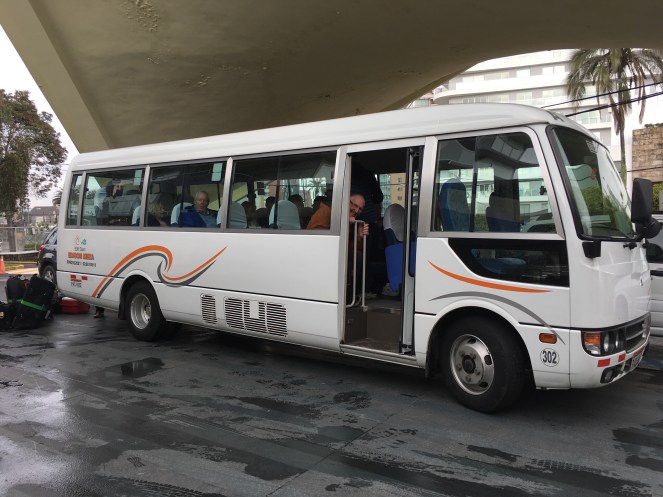
We had another wonderful day traveling by bus with our fabulous driver Victor through the absolutely stunning countryside, and through interesting little towns. Many things looked familiar to us, but there are definitely some things we don’t see in North America. Like guinea pigs ready for the roasting. Hard to imagine our furry little friends that so many of us had as pets when we were kids being roasted for dinner. Yet, here at the side of the road in one town there was a whole rack of them at the ready. They are apparently more commonly eaten in Peru but they are eaten here as a delicacy and special occasion treat. I haven’t tried it yet, but imagine I’ll get to do so in Peru.

Pelileo is a small town along the way which is a little like our outlet malls. All up and down the main streets along the highway are stores selling blue jeans and other denim wear as well as other clothing. People for Quito often plan a stop in Pelileo on their way to or from a weekend vacation in Banos to pick up some bargains.

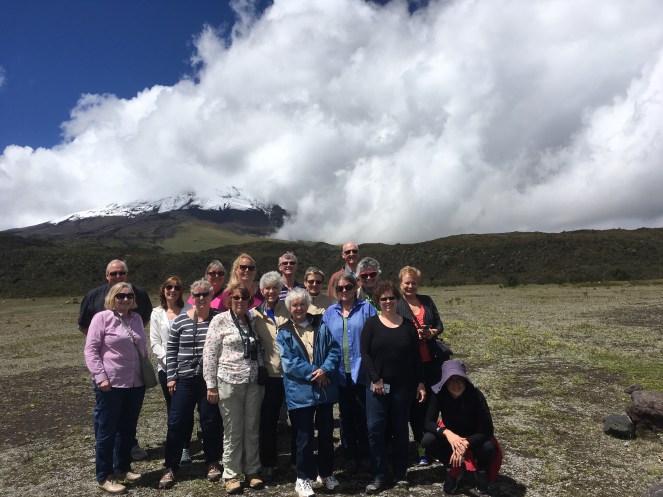
Before lunch we were at the entrance to Cotopaxi National Park and the weather was promising for a volcano sighting. Snow capped Cotopaxi Volcano is the second highest summit in Ecuador, at 19,347 ft, and is among the highest active volcanos in the world, last erupting violently in 1904. In 1970 there was a major lava flow when the material from the summit flowed at 35 – 40 km per hour. There was some rumbling in 2015, 2016 and 2017 which closed the park to climbing for a few months, but so far this year it’s been inactive. I have to say the evaluation route signs all over and the fact that there is an alarm system giving visitors approximately 1 hour to get out of the park were not at all comforting.

We stopped briefly at the park entrance to use the facilities, have some snacks or cocoa leave tea (which is supposed to help with altitude) and to pick up a park guide which is required for any group over 6 people. He gave us some information about the park and the volcano. Cotopaxi means Moon Neck since some of the sightings of the summit have occurred during full moons when it looked like the moon was sitting atop the volcano. Along the road up to the volcano and before the park boundaries begin, there is some planting and harvesting of pine trees imported from Canada and California. The park was established in 1975 and is 3392 hectares in size. There are hiking trails throughout the park, but the altitude is a challenge for almost everyone.

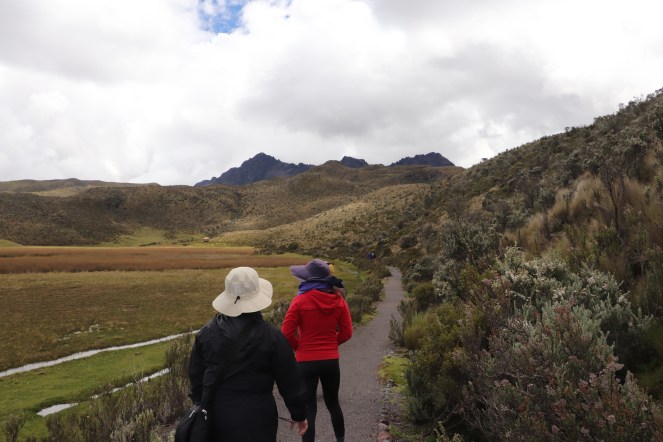
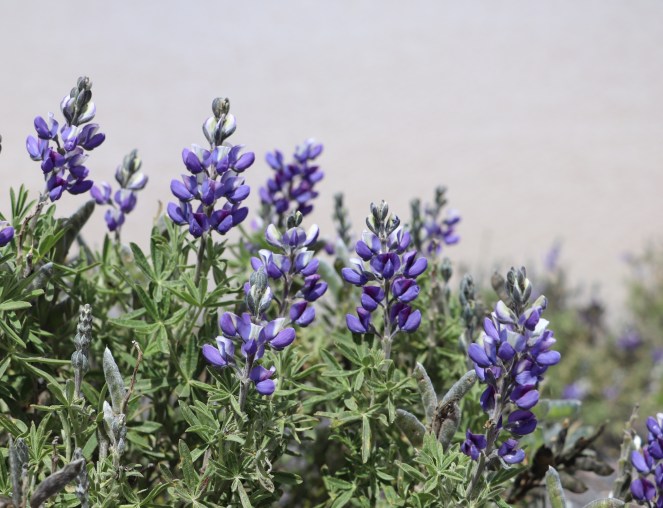
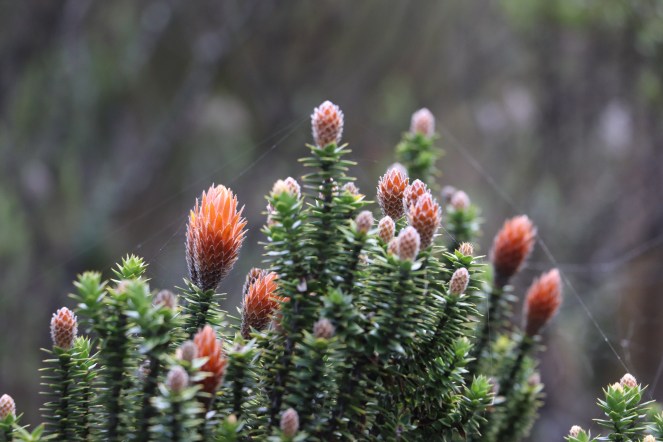
There are some animals living in the park such as White Tail Deer, skunks, weasels, wolves, pumas, Andean Lizards and the Andean Condor. There is also a herd of wild horses which we saw near the parking lot. After some quick stops for photo ops (including a group one) we parked and headed on a nature walk around a small, shallow lake, at a snails pace. We were at 13,000 feet and were definitely feeling the altitude. It was fine if you walked slowly, and thankfully the path was “Equador flat” which is Maria Sol’s term for a path that can have some inclines but is somewhat flat since most trails are ridiculously up and down. All along the way there were beautiful delicate little flowers like we’d find in alpine meadows.

When we got back into the bus after our walk, I experienced one of the other signs of altitude, tingling in my finger tips. It was as if the tips of all my fingers had been “asleep” and were just walking up – that pins and needles feel. Very odd. It only lasted 20 minutes or so and then back to normal.

On our way out we stopped at another park building to get a special stamp in our passports.

By this time we were starving and figured that a 1 km walk, even at a snail’s pace at 13,000 feet ought to be rewarded with a great lunch. We stopped at a restaurant that Maria Sol knew would be fast and tasty and had some chicken soup, by now a staple of our diet. This one came with half a chicken on the bone in it!

Then it was back through rush hour traffic to Quito to check in at our original hotel for our last night on the Ecuador portion of our tour. We had a couple of hours to chill out, and recover from our high-altitude adventure and then met in the lobby for our farewell dinner since only 9 of us will be carrying on to the Peru portion of the tour. On our way to the restaurant, Maria Sol went over on her ankle on a section of the sidewalk that was broken up and really sprained it badly. She hobbled on, not allowing much assistance to get us to the restaurant. She was really shaken up and I think somewhat in shock and we all wanted to just put her in a taxi and send her home but she insisted on continuing.

She took us to a really cool restaurant in an up and coming neighbourhood where the food was very modern and delicious. It reminded me a bit of Kits in Vancouver.

Maria Sol recovered nicely with a cup of hot chocolate but we sent her home in a cab and followed our other tour director, Google Maps, to find our way home with no further incident. And there was Maria Sol waiting to make sure we all got back OK. A consummate professional. We will miss her as we carry on with our adventure.

I’ll try and post some general comments about the Ecuador portion of our trip in the next couple of days as I’ll have some travel waiting time to kill.

Uncategorized

A day in the adrenaline capital of Ecuador – Baños

In the 60s and 70s when the oil industry was opening up the Ecuadorian Amazon Basin jungle, Banos became a leaping off point and service centre. With the increased activity, the thermal hot springs were discovered and became an attraction for the locals and domestic tourism. With that increase in tourism came the development of the adrenaline sports activities in the region – thus the title adrenaline capital. And when the oil prices declined and Ecuador’s economy suffered, the government made huge investments in infrastructure to promote tourism. Banos became a natural stop on the tourist’s agenda.

On our way into Banos, Maria Sol outlined the various activities available for the day we had in Banos. In keeping with the adrenaline sports theme were things like white water rafting, paragliding, canyoneering, zip lining, a huge swing at the top of one of the foot hills, and bungee jumping. Other activities included horseback riding, hiking to vistas of the nearby volcano, and to the top of some of the foot hills, etc. And of course, there is the hot springs. These hot springs were not charming like the ones we visited right outside our door at our hotel in Papallacta. But rather these are big public pools of mostly locals and folks from Quito and the coast of Ecuador. In Maria Sol’s description the phrase “its so crowded you’ll feel other people’s arms and legs” which didn’t sound very appealing. Turned out that it wasn’t that crowded and a couple of our group went and said it was just OK.

Since I’ve participated in many of the adrenaline sports and really didn’t want to think about doing the rest, I opted for a very tame spa visit, and booked a back massage for the afternoon. Two of the other women of the group wanted to go as well so we booked at the same time to share a taxi.

Since this was a rare day when we didn’t have to get up at the crack of dawn to get on the bus I slept in a little, and had a leisurely breakfast. People were making plans as to what to do with this day, and I was surprised but delighted to hear that 3 of the most senior of our group, two sisters from Fort Worth and their friend from St Louis, Missouri, had decided to go zip lining on the 1 km superman zipline. I have new role models as these ladies are still living such a great life of challenges and adventures for their minds and bodies.

Again, we lucked out and had a lovely day for our various activities. I wandered over to the town square which we visited last night, and entered the cathedral since there was a rare window when there wasn’t a mass going on. It is the Church of Our Lady of Holy Water and it has huge paintings depicting miracles attributed to the Virgin Mary. I sat and enjoyed the coming and going of the locals in the square for a while and then headed over to pick up my laundry which we had dropped off the night before. At only $4.50 for a huge bag of clothes I felt a little guilty that someone had stayed up all night getting our things laundered for us for so little compensation.

There are vendors all over town making and selling cane sugar candies. I’ve managed to resist buying any but they did have a jar of them on the hotel desk counter and have to admit that I may have had a few.

Those interested in trying some local food stalls met up with Maria Sol in the lobby at 12. There were about 10 of us in the group and we went through the marketplace, not unlike a food court, where locals were eating their lunch. Most of the tourists ate in one of the many, many restaurants around town offering local food but also any kind of international cuisine. Maria Sol explained what each stall was selling and what to look for and what to avoid (i.e. salad is not great for our foreign tummies). Some of the group opted to head to a restaurant after this brief introduction but 6 of us braved the local food and really enjoyed it. I had rice, beef, and avocado slices, and it was really good. Others had the delicious smelling soups or ubiquitous chicken dinners. We were served by this delightful older woman who was so much fun although we could barely understand each other since she spoke no English and only one of our group could speak other than a few words of Spanish. She was so cute, when one of our group started coughing, she came over and patted her on the back making soothing sounds. On our way out we stopped and got a local dessert of pastry wrapped around fresh cheese, and deep fried. It was really tasty, of course because it was deep fried!

Then it was back to the hotel for some blog time at the pool before our massage at 3:30. The hotel pool was really lovely with a view of the high waterfall just outside the hotel entrance.

The three of us headed off in a cab for our massage with verbal and written instructions from Maria Sol and in just a few short minutes we arrived at a lovely spa and boutique hotel just on the outskirts of town that had a really lovely garden. Somehow we muddled through figuring out what we were meant to do, answered questions about our service and were led into the back rooms of the spa to prepare for our massage. They led us into a large room with 4 massage tables all set up and ready to go. So it appeared we were to have a group massage. So we went with the flow and agreed that we’d likely never see each other again after this trip and so what the heck. We all striped down and jumped up on our assigned table in a lovely serene environment with the now familiar rose displays all over, wonderful smells and zen music. Three masseuses arrived and we spent the next 60 minutes in silence and bliss. Although I’m used to therapeutic massages performed by a Registered Massage Therapist, this relaxation massage was lovely nonetheless, except for the ear massage part which I just found annoying. At the end they rubbed us with warm lava rocks and then left them on our back and limbs and left us for some time. I was beginning to wonder if they were going to come get us, when in fact they did to tell us the massage was complete. After dressing we were directed to a lounge area, with seating, and a mud mask was applied to our faces and let dry while we feasted on lovely local pineapple and some kind of tea. We managed to jump into a taxi for our return trip to the hotel just before the clouds burst forth with the usual afternoon rain.

Back at the hotel, it was definitely nap time before dinner after such a soothing afternoon. At the usual time of 6:30 we gathered in the lobby to head out for dinner. The restaurant was just steps from the hotel this time and offered local food but lots of Mexican and Asian food as well. It had a very relaxed atmosphere and they spoke some English so Maria Sol didn’t have to translate everything for us. I ended up having Pad Thai just for something different. It wasn’t what I normally expect from a Pad Thai, but it was tasty and really fresh just the same. I also opted for a chocolate fudge brownie for dessert. I hadn’t indulged yet, and with chocolate being such a part of Ecuador’s offering I thought I really ought to try it. All in the name of research of course. Their chocolate is very high in dark delicious cocoa and very low in sugar and so it wasn’t overly sweet, but it was delicious. While we were eating, a Peruvian band came in and played for the guests at the restaurant, in exchange for passing a hat, of course. They were very good and added to the festive atmosphere as music always does.

Another day of experiences under our belts.

Uncategorized

A wet start – Tena to Baños

Yesterday morning (actually Wednesday – I’m a little behind) we awoke to realize how lucky we were with the lovely weather the day before as it is pouring rain this morning for our departure from the jungle lodge back into relative civilization. This makes the whole boat transfer of people and luggage very challenging. So we tried waiting it out, but finally had to go in order to stay on schedule.

So we all donned our rain attire, put our back pack rain covers on, added an extra layer of disposable ponchos on over our life jackets and back packs and headed out. The rain had started to subside somewhat but continued the whole way from the lodge to the bus and in the process almost everything got soaked. Victor, our trusty driver, had to put on the air conditioning to get the moisture out of the air on the bus so he could see out of the windows. Luckily we had only one stop planned for today enroute to Banos, and the rain stopped before we arrived at that stop.

While enroute, Maria Sol talked a little more about the indigenous people. There are a couple of groups deep in the Amazon jungle who have not had a lot of communication with the outside world nor do they want it. One tribe has threatened to kill anyone coming on to their lands and not too long ago, some journalists were killed when they entered their territory uninvited and unwanted. For the most part though the 10 other indigenous groups have kept their way of life while integrating new realities into that life.

After a while we arrived at a small town where we would be having lunch and also visiting the Omaere Ethnobotanical Park. Ethnobotanism is the study of the relationship between cultures and the plants around them. It was a bit of a weird visit. The guide for our tour was a former Californian who married an Indigenous woman and together they started this amazing jungle forest full of special plants important for their medicinal and healing properties. He was a little hard to take, with his holier-than-thou attitude and I have to admit this was not my favourite activity. While I agreed with much that he said about the environment and waste, it was the way he said it that had my back up. And after condemning modern society for its use of everything other than natural materials, he hauled out his cell phone when it rang to let him know another group was at the gate. Guess he wasn’t aware as to what went in to it. OK, sorry, rant over.

It had stopped raining but was still really wet and the pathways in the jungle were lined with smooth stones. Can’t imagine who would think that was a good idea. So we slipped, and slided away up and down the pathways being told about all the great uses for the plants planted in this area. It is pretty amazing the work they have done, since it started out as a plot of land being used for agriculture just under 20 years ago, but now looks almost like a native jungle. It is also pretty amazing how the plants have historically been used by the indigenous peoples and how many present day medicines have come from the Amazon jungle environment.

This is one of the most interesting plants that was first pointed out to us at the jungle lodge and was thriving in this place as well. It’s called a “Walking Tree” because it sends out new roots in the direction of the sun and as the new roots form, the old ones die and the whole tree moves closer to the sun. These trees can “walk” up to 2 metres in their life time.

The orange sap coming out of this tree can be used to make dyes.

The vine growing on this trunk is the vanilla orchid from which we get vanilla.

After our walk through the Park we walked down the river walk just a short distance to a lovely patio of a restaurant for lunch. Our lunches have often been pre-ordered by Maria Sol so that we could be in and out quickly. At lots of places we would go with the local soup, either potato or chicken but at this one she recommended the shrimp and most of us ordered either grilled shrimp or shrimp in garlic and other herbs. It was absolutely fabulous. She hasn’t steered us wrong yet.

Then after the short walk back to the bus we headed on to the adrenaline capital of Ecuador, Banos. The drive was absolutely gorgeous. Banos is located in the foothills of a 13,000 foot high active volcano but it’s been quiet for some time. There have been some rumblings when the townspeople are required to evacuate but nothing has come of it. Unfortunately the townspeople’s property was not well protected during one evacuation and they came back to some ransacking so now even when there are concerns about potential eruptions they won’t leave their property.

We arrived at our hotel in the late afternoon, still in a bit of a drizzle. The hotel is ideally located across the street from the famous hot springs and there us a waterfall just outside the front door. Many of the buildings in town, including one of the walls of my room are made of volcanic rock.

After checking in, and a short rest, Maria Sol took us on an orientation walking tour of the town, including a stop for us to drop off any laundry for cleaning.

Like is so many of the towns we went through, there is a lovely town square with a Catholic Church on the square. In Ecuador, 95% of the population is Roman Catholic so you can imagine how many churches there are like the one in Banos. Beautiful.

Further on in our tour, Maria Sol took us to this shop where we saw a unique craftsman at work. He uses the seeds of one of the palm trees which hardens like rock and then using a lathe and other tools to form all sorts of ornaments like the ones he is holding the picture below. These pieces will be coming home with me.

We finished the walk at a really nice restaurant with typical local food. We have two nights here in Banos, and there is so much to do it’s a little overwhelming. More on all that with tomorrow’s post.

Uncategorized

A day up and down the Arajuno River

Tuesday was a full day here on the Arajuno River, and we spent a good chunk of it taking the power canoes up and down the river expertly piloted by the local indigenous community members. We were extremely lucky with the weather as we had some clouds in the morning, but brilliant sunshine in the afternoon and into the evening. As you can imagine, that made it feel somewhat like a wet sauna but made getting around easier. The feel of the air in the jungle is beautiful. The only other place I can think of that feels as great is the old growth forests of BC or the Redwood forests of California.

Never did I think I’d get up at 6 am to scramble into a wet boat, clamber through mud up the side of a river bank, and then stand for 15 minutes precariously perched on the side of a muddy slope with nothing but netting (to camouflage the humans) between me and a ravine just to see some damn parakeets. Haha, it was actually fun, and the parakeets were beautiful a fluorescent green colour with grey heads. The birds need to clean their innards every few days to wash out all the seeds they’ve ingested and they came to a cliff where some clay was exposed to eat it. It was fascinating to watch the flock of them gradually move towards the clay lick (Saladero). We waited in the boats by the river bank as they gathered in the trees across the river from the clay lick. A few birds at at time would fly to trees nearer and nearer. The guide knew when it was time for us to leave the boat and climb up the bank so that we didn’t have to stay on the slope too long waiting for them. We all got our spots along the ridge and within a few minutes the first few birds started to land on the clay and start the process. Then more and more joined them. Seems like such a silly thing to do when I read this, but it really was interesting.

Some guests showed up at breakfast to join us. A stick insect (on Maria Sol’s shoulder) and a leaf insect (on her phone). She was constantly showing up with something interesting to show us.

We barely had time to get back to the lodge for breakfast and it was time to head out for what turned out to be an incredibly interesting experience and one I suspect will be one of my favourites. We went 20 minutes or so down the river to the Kichwa village where many of the people working at the lodge live including our guide for all activities at the lodge.

The women of the Kichwa village are the farmers and our first stop was so that one of our guides young daughters could show us how they farm yuca and bananas and plantains. Yuca is a root vegetable that looks like a potato but comes from a tall and fast growing tall bush and it is a staple in their diet. The plants can be re-grown using stalks from the bush and they are ready to harvest in 4 – 6 months. The tool of choice is a machete and the young girl that is maybe 12 was very adept at using it like she meant it. To harvest, once the branches of the bush are cut and the pieces for re-planting are secured, the root is pulled up to harvest the various bulbs of root. A couple of our group got to try both the planting and the harvesting, with Aussie Jeff taking the lead, but Elizabeth from Gatineau swung a mean machete.

We moved to another area where there was a bunch of plantains ready to be harvested. It seems the whole top of the tree gets loped off but you have to cut only part way through the stock with one swipe of the machete so that the weight of the bunch doesn’t bring the whole thing crashing down and bruise the fruit. Nancy from Colorado did the honours and did a great job of getting a huge bunch of plantains down without bruising them. Plantains are in the banana family and have to be cooked to eat, but they are a staple of the diet here and are delicious sliced and just fried up.

Next it was back to the boats and down river just a bit farther to a level sand/rock bar at the side of the river for our guide to demonstrate one of the ways the Kichwa fish the river. This demonstration was using a net and throwing it into the river and then pulling it up, hopefully with fish caught in the net. They also will put a net completely across the river when the height of the river is right and catch everything going by or another method is to catch them using a line. This time I was one of the brave guinea pigs and I failed miserably. When the guide threw out the circular net, the weight of the rocks along the bottom of the net landed in a perfect circle in the water. The guide hung the net over one shoulder and showed me how to swing and turn to throw it. I couldn’t believe how heavy it was and how easy he made it look. My throw resulted in the net in a pile about 2 feet from me barely in the water. A couple of the guys tried it and they did a little better but not much. Clearly an acquired talent. There was one tiny little fish in the net at the end of our attempts which I’m sure I caught, but the guys seemed to want to claim it.

Then back to the boats and over to the village to learn more about their way of life. There are 135 or so people in this village, made up of of 20 families. (Our guide contributed 12 children to that number). We gathered at a community area, near a building that had been built communally by the whole village with the help of Volunteer organization. The families sometimes work together but they have their own land and make their own way. They elect a President, Vice President, Secretary and Treasurer every 2 years, and there are also Committee Captains, like Sports and Chicha Captains.

Chicha is a drink which the Kichwa make using yuca. They drink it starting on day 1 but also let it ferment for up to 10 days when it’s very strong. We got to taste Day 1 which tasted like a green tea and Day 3 which was now milky looking and already had a kick to it. So when the families are gathering to work on a cooperative project the Chicha Chair is responsible for keeping track of how much Chicha each family brings and reprimanding them if they don’t bring enough and telling them how much they have to bring next time.

Each village has a Shaman who looks after the well-being of the community and one of our crew volunteered to have her energy restored with smoke and waves of a palm limb of some kind by the Shaman.

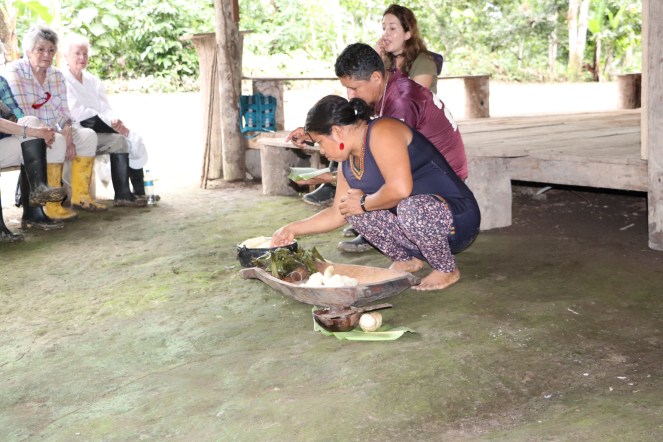
The women had prepared some of their food for us to taste and showing us their cooking methods. They use the broad leaves of one of the plants to wrap the food and put it right into the fire. It cooks the food in its own juice and kills off any germs. We tried fish, chicken, larva, potato patties, and fruit with chocolate dipping sauce. It was amazing.

I’m not sure about the Kichwa, but some of the Indigenous people still use blow guns to hunt and can hit targets 40-50 meters away using blow guns that are 6 feet long and really heavy. They also practise fishing using the poison curare where they throw it in the river which doesn’t kill, but stuns the fish so they can’t swim and they float to the surface and then they scramble to net them before the water flowing over the fish cleans away the toxin so they are able to fish again.

The community had set up a stand to sell their handicrafts, and of course I helped their economy purchasing a little dish made of clay and painted in three colours.

Then it was time to say goodbye and back up the river to the lodge for another great lunch before our afternoon activity, a visit to an animal rescue centre called AmaZOOnico. By after lunch the day had turned sunny and really warm and with the humidity just standing still had the sweat dripping off of us. So we really enjoyed the 30 min boat ride to and from the rescue centre. The rescue centre is doing amazing work, mostly with volunteers, in returning lots of injured animals to the wild after patching them up. But they also have a lot of animals that they can never release because they’ve become too used to humans or they can’t teach them the skills for them to manage in the wild. Lots of them are Amazon parrots, but there are toucans, snakes, small cats, etc. It was tough work walking through the centre because nothing is on the flat here. We were up and down steps for over an hour in the heat so we were glad to be back on the boat on our way back to the lodge for our evening.

Dinner was once again fantastic, and I opted not to go on the Night walk. I saw the pics people had of the things they saw from the walk the night before and decided I had tromped up and down hills, over tree limbs and through the mud enough for one day.

I’m sure today will end up being at the top of my list of favourite experiences of this trip with the diversity of nature and culture, and the sheer beauty of the area.

Uncategorized

From the cloud forest to the Amazon basin jungle

Writer’s note: It’s now May 9th and I’m back in wifi range so here is one post that I wasn’t able to send from the jungle lodge.

************************

Well, the morning started off raining and ended that way. But in between, when it counted it stopped. We spent the day in a Cloud Forest and the Amazon Basin Jungle, so really what were we expecting.

On a trip like this where you’re doing well to just see the highlights, there are many places where we would have liked to stay longer. Papallacta, and the Termas Papallacata Hot Springs, in particular, was one of those places. However, the tour must go on.

As I mentioned yesterday, our journey today went from 3300 metres to 600, so as you can imagine we spent most of the time heading down hill. The roads are not that bad, but there were a few places where recent washouts caused small landslides and in one instance the guard rail was gone and the valley was a long way down. The views were spectacular, with green hills and waterfalls all over. Yes, they get a lot of rain. The roads were really windy, and so as you can imagine we couldn’t stop to take pictures.

Our first stop of the day was at the Guango Private Reserve. Ecuador is one of the top countries in the world for the diversity of species of hummingbirds, with 50 different varieties from the size of a bumblebee to that of a pigeon and 15 of them are found at the Guango Reserve. The number of them was overwhelming and some of them were really pretty and of course different than the ones we see in Canada. But I have to say that I was somewhat disappointed in the muted colours. It might have been that it was overcast and we weren’t seeing the true colours. You can see by the picture below what’s required to get a good picture of a hummingbird: huge lenses; lighting; tripods; etc.

But one very exciting discovery was “Slo-mo” on iPhone. I took some slow motion pictures and if nothing else it will give you a sense of how many birds were flying around. We often heard the buzz of them as they went by our heads flapping their little wings at an average of 80 times per second. Something I didn’t know was that the hummingbirds go into an almost dormant state overnight called a torpor state of temporary hibernation when their heart and respiration slow right down. I figure that’s the only way they can keep up their wing flapping during the day.

After our fill of picture-taking we were off for a nature walk, and because it had been raining for a few days we were issued rubber boots for the walk. Our CEO again amazed us with her knowledge of the flora and fauna of the area. We saw a duck that is apparently one of the most prized finds on birders’ “life lists” (who knew birders had life lists!). It was called a Torrent Duck and was sitting just off shore on a rock in the torrent of the river. There were lots of species of birds including a couple of different varieties of Tanagers, and a really beautiful bird called a Blue Trojan which has a bright red belly with an iridescent green back and blue head.

There were all sorts of beautiful wild flowers, orchids and special mushroom varieties. Ecuador exports Hearts of Palm and since I normally see them coming out of a small can, I assume they were small plants, like asparagus or something. Not so. They come from medium size palm trees and the pieces are cut from the inside of the trunk of the palm. And we even managed to see the back end of a kind of rodent the size of a rabbit disappearing into the undergrowth.

After about 45 minutes we looped back and handed in our rubber boots.

On the bus once again, surprisingly, it was already time to eat again and we stopped a short distance away, to a pre-arranged set lunch at a restaurant/bar overlooking the most beautiful valley. It was a little surreal as they were playing North American county western music. Turns out the proprietor was an Ecuadorian who had lived in New Jersey for a few years and loved country music. The first course of our lunch was tomato soup, served with a side of popcorn. Yup popcorn. Marie Sol explained that instead of putting crackers or croutons in soup, they use the ubiquitous corn, this time popped, to add some interesting crunch to the soup. It was actually very good. The restaurant/bar owner had a beautiful garden in back of the restaurant and he took us on a tour before we headed off for our afternoon of adventure.

Before long at all, we came to a spot where in front of us was a bridge that obviously the bus was not going to be able to go over. It was for cars and pedestrians and we became some of the pedestrians on our way to the small town of Misahualli were we hoped to see some monkeys indigenous to Ecuador, Capuchin monkeys. We had in mind that we’d have to truck through another jungle to see them but in fact they were hanging out in trees of the main town square. The shop owners around the square have a feeding post set up and the monkeys come in from the jungle to feast then move on. There were 5 or 6 of them playing in the trees and stopping in to nibble. Our guide told us that the monkeys normally behave for the shop owners and don’t try and eat the things in their stores, but they have been known to create havoc with the tourists who come to visit.

A little while longer down the road, at a town called Tena, we came across another river, and another bridge that the bus couldn’t cross. This time instead of becoming pedestrians we climbed down stairs to the side of the river and became passengers in “motorized canoes” that would take us to our resort for the next two nights. You’ll notice I didn’t say down to the “dock”. There were some cement steps most of the way down but only mud at the bottom of the stairs. The logistics of climbing in for the first time was hilarious, but we figured it out and no one fell in or got their fingers crushed between the two boats. Score one for the tourists.

It was only a 10 – 15 minute ride in the power canoes down the Arajuno River through the mist and clouds to home for the next 2 nights, the Itamandi Lodge. We weren’t sure what to expect, but none of us expected to find such a fine establishment so remote in the Ecuadorian Amazon region. The lodge has only 23 rooms, with only our group of 16 and one other group of 16 (from Germany primarily) staying here. I’m writing this after having been here for two nights and the food has just been fantastic. Not huge portions, but really nicely seasoned, obviously fresh and interesting. The dining room is outdoors, with a high roof over because of the frequent rains, with the sound of the river to enjoy with our meals, and with a bar and swimming pool adjacent. The picture of the plugs below is a station in the dining room where we could plug in our cameras and other electronics for recharging since there weren’t plugs in the rooms.

My room is one of the furthest from the main area, and the walls facing the river are all just screens, not walls. It’s delightful to get the occasional breeze through, and it’s really quiet except for the cacophony of sound from the insects, frogs and other jungle life. My white noise is the sound of the river as it makes it way to the Napo River, and then after that to the Amazon.

The Lodge owners are very supportive of the local indigenous community, ecologically sensitive, and concerned with using sustainable technologies. The whole lodge is run on solar panels, they recycle, even though that means sending it out on the power canoes, and they even supply special biodegradable soap for our use here. One of their codes of conduct is to use canoes that are rowed, but thankfully we didn’t have to use those since the distances we covered on the river were pretty vast. (But now I’m getting ahead of myself since I’m writing this the day after.) And they hire all of their staff from the local community.

After dinner tonight the first group of 8 went on a night walk and I am with the group that goes tomorrow. Tomorrow promises to be busy and interesting. Not expecting anyone will have time to use that lovely pool.

Uncategorized

Still higher!

Tonight I’m sleeping at the highest elevation on my tour of Ecuador. And to get here, we went through a pass at over 13,120 feet (4,000 m). We travelled from near Otavalo, north east of Quito to Papallacta to the south east of Quito on our way ultimately to the Amazon Basin. Papallacta is at 10,827 feet (3300 m) above sea level and is reportedly one of the highest towns accessible by car in the world.

But let me go back to this morning. We didn’t have to leave our lovely hacienda until 12:30 pm because we couldn’t check in at the Hot Springs Lodge at Papallacta until 3:30. So we had several options for things to do this morning. Some people opted to just sleep in, and wander the property, and there was the opportunity to go horse back riding if you weren’t allergic to horses. But our CEO offered a morning of activities, and that’s what I signed up for – the FOMO Tour. That’s the Fear of Missing Out Tour.

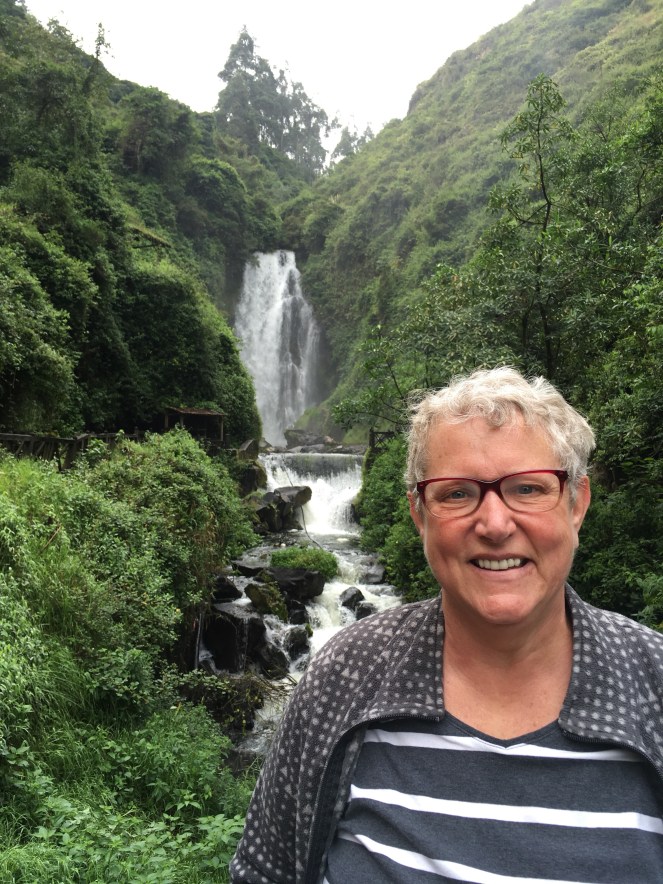
We unfortunately had to start out at 8 am but the early morning was well worth it and we got a jump on the other tourists in the area. We started with just a short drive back through Otavalo to the Cascada de Peguche. It was overcast with a bit of a mist, but it just seemed to enhance the experience, not take away from it. An easy 20 minute walk through a eucalyptus forest had us arriving at a viewing platform at the base of the Peguche Waterfalls. Waterfalls have special significance to the indigenous peoples as they believe they bring renewal and cleansing. In the spring of each year there is a ritual bathing by the men only where they stand on the bridge you’ll see in the pictures, facing the waterfall they wash themselves in the waterfall to cleanse themselves for the coming year. We didn’t get in the waterfall.

Some of the water gets diverted for irrigation purposes.

This is a 100 year old eucalyptus tree beside the pathway on the way to the falls.

This is a pic of fellow traveller Jeff from Australia, who is hilarious despite his serious job. He is a pilot in the Outback for the Royal Flying Doctors organization.

On our way back from the falls to the parking lot we were met by travellers with one of the huge coach tour companies so we were glad that we’d been able to have our time at the waterfall with just our little group.

Although the weather wasn’t ideal for going to see the nearby crater lake, we decided to go anyway and see what we could see, and at least we’d get a great walk out of it.

This eco-reserve is called Cotacachi Cayapas and it surrounds a lake that formed in the crater of a now extinct Cotacachi Volcano. We went to a lower viewing place thinking we might see more through the clouds and mist from there. But no such luck. So off we went to a trail higher up where, although we couldn’t see the lake at all, we did have a lovely walk. It was serene, and enlightening. Our CEO Maria Sol, is an expert at botany and she must have told us the use for 30 different plants along the way. At one point someone asked what a particular flower would be good for, and Maria Sol answered that its job was just to be beautiful.

When we finished our walk we descended to the other lookout to see if the fog had lifted at all and it had a little and I was able to get this pano shot. Not really impressive in the picture but it was beautiful.

Our next activity was a stop at a local Sunday market in the town square of a nearby town. The 6 of us walked through the market, with Maria Sol explaining the various foods that we didn’t recognize. I’m sure no one noticed we weren’t from around there.

Potatoes are a staple in Ecuador, and there are over 300 species grown. This vendor had just a few varieties.

Yes, this is a whole roasted pig in the “food court” where market goers could chose from a variety of weird and wonderful looking things.

Then it was back to the hacienda to pick up the rest of our group for the long windy trip to Papallacta. We stopped for some fabulous sandwiches that Maria Sol had pre-ordered in Otavalo and ate on the way. BTW, the bread is wonderful here. I may not come home.

The views along the way were absolutely stunning, especially when the clouds parted for a bit and we were able to see more of the mountains in the distance. You could see the vegetation change as we went further and further up towards our destination.

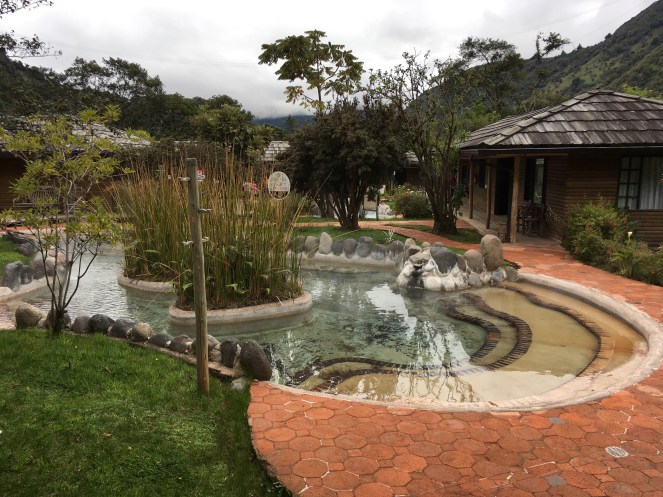
This lodge is wonderful in every way. Our group occupied rooms which circled 3 different hot spring pools and one cold spring pool. So all we had to do was go out the door of our unit and walk into the steaming hot water. Not to worry, it wasn’t boiling water, but the air temperature was just much lower than the water temp. The rooms are incredibly well appointed with thermally heated tile floors and a dispenser for safe drinking water in every room.

I soaked and chatted with my fellow travellers for at least an hour and it was heavenly. I could barely drag my sorry butt out of the water to go and get cleaned up for dinner. Several of us didn’t join the group for dinner tonight but rather chose to stay at the hotel to just have something light. I’m finding my digestive system has slowed down to a snails pace and I’m always feeling full. Hard to believe! They say to avoid protein which for some reason is hard for the body to metabolize at altitude and to eat more carbs. So hey, pass the rolls!

Tomorrow is an action packed day as we descend from 3300 metres down to 600 metres in the Amazon Basin with lots of activities along the way.

Uncategorized

Today was mostly about shopping…. Quito to Ovatalo

My brain is almost as packed with facts learned today as all the bags I brought with me are packed with wall hangings and other artisan products.

After a great night’s sleep I was up even before my alarm to jump on the bus to head out of town today. Our destination was 1.5 hours north of Quito in the Andes to Otavalo. It is the site of the largest artisan and produce market in South America.

We drove through beautiful green rolling hills with the occasional peak of a dormant volcano thrown in. I was surprised to learn there are Acacia Trees here, like we saw in Africa only without the giraffes. OK, I stole that joke from our CEO. The highway we drove along is part of the 48,000 km Panamerican Highway and approximately 4 hours further north is the Colombia border.

As we drove along our CEO regaled us with factoids about Ecuador. Each of the provinces of Ecuador is named after either a volcano or a river and since there are 84 volcanos on the mainland, there are lots of names from which to chose. Fortunately only 9 are active. There are 4 regions and I will visit 3 of them on my trip. Quito and Otavalo are in the Highlands – the Andes. We will reach the Amazon region day after tomorrow and after the Peru portion of my trip I will return to Ecuador to visit the 3th region, Galapagos. The other region which I won’t visit is the coastal region. Not widely known for its beaches, Ecuador has some nice ones nonetheless.

One of the current political issues here is that there are a lot of Venezuelan refugees coming into all countries surrounding it and Ecuador is taking its share. Ecuador is a Democratic Republic and they elect their President every 4 years. The current President is Lenin Moreno and he leans towards the left politically.

I won’t go into too much history here, but the indigenous people were first conquered by the Incas, who were only in this region for less than 100 years before the Spaniards ran them out and took over. Ecuador gained its Independence from Spain in 1822. Simon Bolivar factors prominently in Ecuador’s history as he does in Bolivia and Venezuela.

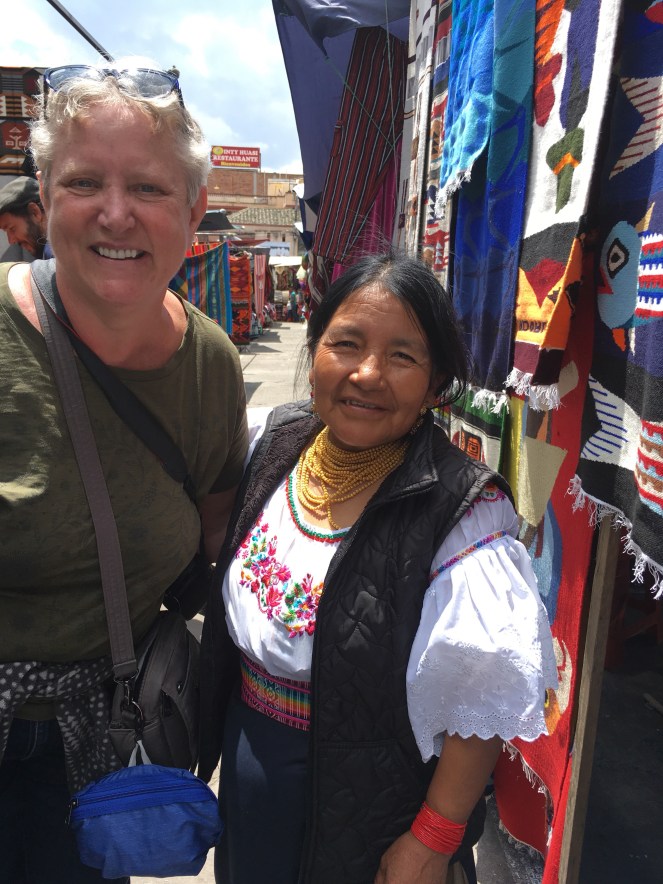
The Otavalo Market was really something. Once again, I got so caught up in the moment that I didn’t take any pictures other than the one above of me with the lovely lady who negotiated hard with me on the purchase of a hanging. There were artisans with lots of textiles, silver, musical instruments, as well as food. A pile of chickens was sitting on one table, with chickens feet on another. And the ubiquitous corn in a million varieties, along with lots of different kinds of beans and grains. The people were keen to sell their wares, but not overly aggressive and they expected you to bargain. Now I’m the worlds worst bargainer. I just want to pay the price and be done with it, but one of my fellow travellers helped me get into the spirit of it and it ended up being fun. Maybe because the people are so warm.

It was getting to be lunch time and we were expected at a community educational centre, both for lunch and for a demonstration of some of the local culture. Jose, seen in the picture below explained all the symbols in this huge wall art to us, and I ended up buying a much small version of this in a woven wall hanging.

Corn is a hugely important part of the Indigenous people’s diet. Hmm, where have I heard that before. Almost everywhere.

Jose showed us how to use this Spanish style loom, which they use to make the most gorgeous work. Table runners, hangings, scarves, blankets, etc. Most with some alpaca in it mixed with sheep’s wool.

You can see some of the gorgeous hangings on the wall behind our group. The colours were amazing and there is such symbolism in the art. Everything seems to have a meaning.

After learning an incredible amount we moved into the dining area for an amazing lunch, which is the largest meal of the day for Ecuadorians. We started with two kinds of soup, with all sorts of things to add according to our taste; cheese, grilled corn, avocado, beans and more. Then potatoes (they grow 300 varieties of potatoes in Ecuador!) corn on the cob and the most fabulous chicken cooked in an oven that looks a little like a pizza oven. It was so tasty. Desert was this unusual fruit shown below – a tree tomato. It grows on trees much like a pear, but has pulp and seeds inside that are just like a tomato. They prepare this desert by putting the fruit in a syrup and it was an interesting texture but delicious.

Next it was off to learn about a more primitive loom, the Backstrap loom. As you can see, the fellow below has a backstrap, made from reeds in this case, but also sometimes made of leather, which holds the loom in place. This is painstaking work and the product is so refined looking.

Here he is working on a larger piece. The wooden paddles that he uses to make the pattern are not light and my back hurt just watching him.

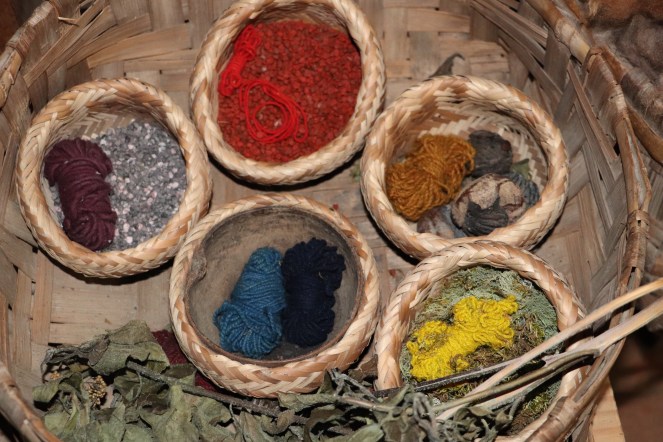
We learned all about how the wool is cleaned, carded, spun in to skeins and died.

And here are some of the products…..oh, and I might have left some $$ behind here as well.

We managed to time it right so that we missed most of the rain this afternoon, it’s rainy season so we will expect rain every day at about 3 pm.We drove the short distance to a lovely historic hacienda where we’re staying tonight. It started as a 7000 hectare cattle range but now only 16 acres are still held by the 7th generation of the same family. The current owner’s father, who passed away just last year, was a horseman, and won many trophy’s and international jumping competitions. There are still horses on the property and we had the option of going horse back riding tomorrow. Yeah, not going to happen as horses are one of the two things to which I’m allergic.

After a bit of a rest and downloading my pics from today I wandered some of the property and the main house. It was converted into a hotel 22 years ago, but is now a little tired. But it still maintains its charm in a huge way.

After a meeting with our CEO is this beautiful bar area (sorry for the tiny pictures. Wifi issues) we were offered cinnamon tea and a welcoming shot of something. I’m not entirely sure what it was. An Andean Band entertained us with pan pipes and flutes, and their beautiful voices. It will be one of the memories I cherish about this trip. Then it was on to the dining room for some potato soup, a Ecuador specialty. It’s served with cheese and avocado. That and a bun was all that was needed as our lunch was so huge.

We’re up high and with the dampness it was cool this evening, but I came back to my room to find a hot water bottle between my sheets. Ah. Nighty night.

Uncategorized

Mitad del Mundo or Middle of the World

As I noted yesterday, while in Ecuador, one of the must do’s in my book is to take the chance to straddle the equator. So that was today’s mission.

As agreed, Hector picked me up at the hotel at 9:00 am this morning to try and take advantage of all we could in one day. We headed for Mitad del Mundo, but went slightly beyond it to stop at the now dormant volcano Pululahua GeoBotanical Reserve. Sounds like a Hawaiian adventure, doesn’t it. This volcano crater is one of two in the world that are inhabited. There are 14 families that call Pululahua home, and they farm the land at the bottom of the crater very successfully and without the use of chemicals to enhance the land because the volcanic ash provides the necessary elements for great crops. Just outside the crater is one of Ecuador’s Cloud Forests and while we were there we watched the clouds come into the crater and then back out several times teasing us.

Next it was a short distance back down the road to the Intinan Museum which is now known , using GPS technology, to be the REAL middle of the earth or equator. The monument you’ll see further down this page a bit was built between 1979 and 1982 to highlight what was then though to be the exact location of the equator and commemorate a French scientific expedition from the 1800’s. In the reading I did, some people were complaining and calling it fake news since it wasn’t the real location. However, my thoughts were, really, in the 1800’s they got the location that close!

But I digress. At the Intinan Museum, they took advantage of the draw of the real equator to educate tourists about the life of early Ecuadorians. It was a little kitschy, but got the point across.

This woman is spinning alpaca wool to be used in weaving and other artisan products.

Mom and Dad slept with the kids in one set of hammocks until the kids were 12 and then they sleep on the floor. But don’t feel bad, they were married off at the age of 14 or 15 and then they got their own set of hammocks.

This is a gravesite, I think he called a “sink”. The Ecuadorians believe in the afterlife so all of their possessions that they would need there were buried with them. In the higher ranking families, it is assumed the wife would not want to leave her husband and so she was buried alive with him.

Like in many other countries, these cute little guinea pigs that we have as pets regularly appear on Ecuadorian menus.

They also demonstrated the process of making chocolate from cacao fruit. Ecuador has won many awards for its chocolate and in fact one year in an international competition took all three awards, Gold, Silver and Bronze. We were told that while Toblerone is made in Switzerland, the cocoa to make it comes from Ecuador. We were able to taste the product all the way along through the process and I know I’ll be picking some up at the airport on the way home.

They of course had a few demonstrations about how things are special at the equator, such as being able to balance an egg on the head of a nail, how the water in the same vessel drains clock wise on the south side of the line and counter-clockwise on the north side. (I’m not convince about that one yet but can’t for the life of me figure out how they did it).

This picture is of my guide Hector (to the right) successfully balancing the egg.

And of course there were the compulsory photo opportunities.

Next it was down the road to the Monument at the site originally thought to be the equator. Again the required photo ops. Why do some people think that at the most visited tourist site in Ecuador that they’re going to be able to get a picture of themselves in front of the moment with no one else in it?

The boulevard leading up to the monument lined with busts of previous Presidents.

And these hummingbirds which also line the boulevard were all painted in different colours. I’m told there are 50 varieties of hummingbirds in Ecuador!

And we were able to climb to the top of the monument to look at the imaginary line of the equator and the surrounding countryside from the top. On each landing of the stairs to the top they had a display about one of the 38 different traditional groups in Ecuador, their costumes, tools, instruments, etc. I’m convince it was just done as an excuse to allow us to rest at each landing before proceeding to the next stair case but I was more than OK with that. Sorry Nanci, I didn’t count the stairs.

There were museums and little shops selling all sorts of artisan products, but given that I’m at the beginning of the trip I decided I best not stop at any of them yet.

Then it was back to the city, and to Old Town where we managed to squeak a half hour walk in just to give me an orientation for the next time I stop in Quito (I’m here 3 more times on my way to and fro) when I will have a chance to explore more. Going back to where Hector parked his Jeep I almost died. It was very steep up hill, we’d been on the go all day and with the altitude and my general lack of breathing capacity, I had to stop often on the way. Hector was very gracious and found fun things to tell me about the city along the way. None of which I can now remember unfortunately.

Just a taste of what’s to come when I do get back to Old Town. This is one of 7 churches on one street. This is the Basilica, with it’s Galapagos native iguanas as gargoyles.

We got back to the hotel, just in time for me to attend the meeting of the tour group with our CEO (guide). Only 11 of the 16 people were there but that will make it easier to try and remember names. Some of the group will return home or head to the Galagos after our 7 days in Ecuador, others will carry on to Peru with me. The CEO, Maria Sol (both are given names that she goes by because there are so many Maria’s in this predominantly Catholic country). I know so far that there are 5 Canadians, 5 Americans, and one Aussie.

Although Maria Sol had a plethora of recommendations for us to check out for dinner tonight, Deborah (from Whitby who I met at breakfast yesterday) and I opted for a quick dinner in the hotel dining room. Her room mate from Courtenay, BC arrived and joined us for a drink.

The first day of our great adventure starts tomorrow with only a 1.5 hour bus ride to Otavalo which hosts the largest outdoor artisan and food market in all of South America. I might be dropping some cash tomorrow, storage space be damned.

Uncategorized

If you don’t like the weather wait 30 minutes

After arriving in Quito to fog and cool temps at 2:30 am this morning, I woke up at about 7:30 am because of the bright sunshine sneaking in around the edges of the curtains in my room which faces east. I was thrilled when I opened the drapes to see the most gorgeous views that I hadn’t been able to detect last night.

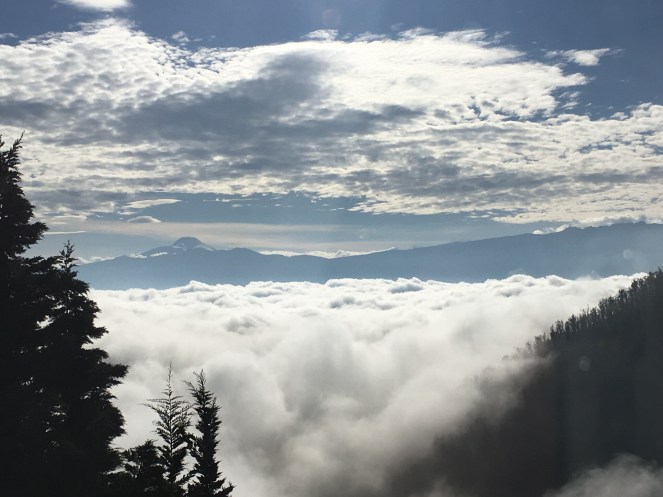
The above picture shows the profile of the Andes all around Quito with a layer of fog in the valley to the east. I’ll post below a series of pics taken from pretty much the same location throughout the day at about 10, noon and 3 pm.

It started out quite warm as early as 10 am this morning when the fog had rolled out and the sun was out in full. And it’s not that cold this evening, about 12 degrees, but feels much cooler because of the fog that is now all encompassing as it was when I arrived last night.

Breakfast this morning was buffet at the restaurant on the 7th (top) floor of the hotel, which turns out to be one of the best known hotels and iconic restaurants. I can vouch for the fact that the view is certainly spectacular. The two pics below were taken from my table at breakfast but as usual they don’t do the actual view justice. You can check it out at the following website.

En.hotelquito.com

After a lovely breakfast, I wandered around the property and spent some time sitting in the shade by the pool. I was afraid to go swimming because apparently the best way to get over the first couple of days of altitude sickness or avoid it all together is to take it easy and not exert yourself too much. So far I’ve experience no headaches, but I do feel out of sorts, and after walking up one set of stairs I feel like I might have done the Grouse Grind (no of course I’ve never done the Grouse Grind, but you get my point). And a little light headed. It’s been a tough day because my brain is saying get out there and explore and my body is saying, oh no you don’t.

Below are some pics of the hotel and environs. Haha, when I arrived last night I had no idea it was painted to match my toes!

I spent some time this afternoon in the 7th floor bar, drinking only water I hasten to add, and reading and thought to myself, oh.my.goodness, I’m sitting here in Quito, Ecuador.

I have organized a private tour guide for tomorrow to take me on a city tour and out to Mitad del Mundo (middle of the world). I figured visiting a monument on the equator would best be done in the country named after it!

Then tomorrow evening I will meet up with my Tour group and our CEO (Chief Experience Officer) will give us the important details of the next 15 days. Can’t wait!

Uncategorized

From one capital to another

I will apologize in advance for the length of this blog post, but you gotta understand I’ve been on 9 hours of flights and 4 hours of layovers today.

Today I begin my first real South American adventure and as you can see I have sported purple for this particular trip. These toes likely won’t see daylight again until the last part of my trip but one always needs to be prepared.

I did stop briefly years ago in Caracas, Venezuela, when the cruise lines were still stopping there. It was a much less volatile time, but even then we boarded the tour bus in a compound surrounded by barbed wire, had a police escort, entered a hotel through a secure loading dock for our luncheon, and the tourist areas we visited were blocked off to locals. We visited a Murano Glass factory out in the countryside that was amazing.

On this trip I will visit only two countries, Ecuador and Peru, over the next 28 days on small group tours with my favourite tour company, G Adventures. I have previously travelled with them to Costa Rica, Turkey, and The Balkans and I already have a trip booked with them for next year to Israel and Jordan.

The past few weeks have just flown by and I can hardly believe that this trip is here. I’m embarrassed to admit that aside from the detailed itinerary provided by G Adventures I hadn’t read anything about the places I’m going but I have downloaded a couple of guide books and got a start reading them on the flights today. Looks like I’m in for some unique experiences. And on a day when we sadly learn of the sudden death of Gord Brown, MP, at a too young age of 57, life is all about experiences and carpe diem.

Living at Lansdowne in Ottawa has been a delight, but sometimes it creates some interesting challenges. Most of you will know that the Red Blacks CFL team (and league champions year before last) plays at the TD Place Stadium here. When there is a home game the area is full of fun and chaos. Unless you’re trying to get in or out of the parking garage and then it is just chaos. However, there is also a soccer team, the Ottawa Fury FC of the United Soccer League who are at the beginning of their season. It never occurred to me to check the schedule mid-week, mid-day, but alas, today was a specially scheduled game to allow 10,000 students from across the area to arrive, you got it, just as I was about to grab an Uber. Fortunately, in my normal Mrs Fines mode (for those of you who don’t know, my Mom, Mrs Fines, was always copiously early for everything) I was early. So I walked south on Bank Street to grab an Uber on the other side of the canal. Fortunately that was the only hiccup with getting out of town.

The first of 3 flights, this one to Toronto, was on time, with just a little bit of turbulence to assist in my nap. Once in Toronto, I had to change from D gates to E gates, for my next flight to Bogotá, Colombia. My goodness, the hallways went on and on. I had no trouble getting my steps in today, even with the aid of moving walkways.

My first Air Canada Rouge flight from Toronto to Bogotá, Colombia was next and this 6ish hour flight actually ran a bit early. I didn’t notice that the seats were very much closer together on this down-scale version of Air Canada’s offering but when you’re only 5’3” that’s not all that critical. A rare benefit to being short. There was a complimentary meal service that was relatively tasty, although as you can see from the pic, it was the teeniest meal I think I’ve ever seen. Alcohol is available but you have to pay for it. A hint if you’re flying Rouge for the first time, there is no on-board entertainment so download their App before flying to use your tablet or phone to show movies enroute.

My final flight was on Air Canada Partner Avianca From Bogotá to Quito. It was less than 2 hours, but this late into the day seemed to take forever. It’s a really nice airline though, and the flight attendants (all female) wore striking red capes and hats as they traveled through the airport. They fed us a snack that appeared to be a cheese wrap. And I’ve already made an amazing discovery, parsnip chips taste just like potato chips.

This flight was a little late getting in, but the special service I got going through customs made up for it. Must be the blue eyes or maybe the confused look, but I was directed to a kiosk with no line up and after a very simple and friendly interview by the customs agent I was on my way.

The capital city of Ecuador, Quito, is at 9350 feet above sea level which makes it the second highest national capital in the world, second only to La Paz, Bolivia. This of course means that altitude sickness is a real possibility with its symptoms of head ache, difficulty sleeping, feeling like you can’t catch your breath, vomiting, dizziness, etc. Sounds like a pharmaceutical ad, doesn’t it?

I have to admit that I’ve fretted a little about this, OK a lot, but I have taken some precautions to mitigate the effects of going from just 300 feet above sea level to 9350 feet in one day. I’ve come 2 full days ahead of the start of my tour to give myself a chance to acclimate to the altitude before starting out. I’m going to try and stay hydrated, avoid alcohol, and I’ve started taking medication that is supposed to help. So far, I’m feeling a little light headed and I take an involuntary deep breath every once in a while, but no issue with walking up stairs or briskly with the porter. We’ll see how tonight goes as the effects don’t really hit for 24 hours or so.

I was picked up outside of the baggage area by a delightful young man named Hector. (arranged by G Adventures, I didn’t just go with the first good looking guy that came along). He is very knowledgable about languages and we had an interesting discussion in the 45 minutes from the airport. He studied journalism in University and has a plethora of jobs.

So I’m stowed at the hotel for the night and I likely won’t do anything terribly adventurous tomorrow. Thanks for coming along on another adventure.