Uncategorized

Floreana Island – possibly best day of trip so far

Wednesday, May 23

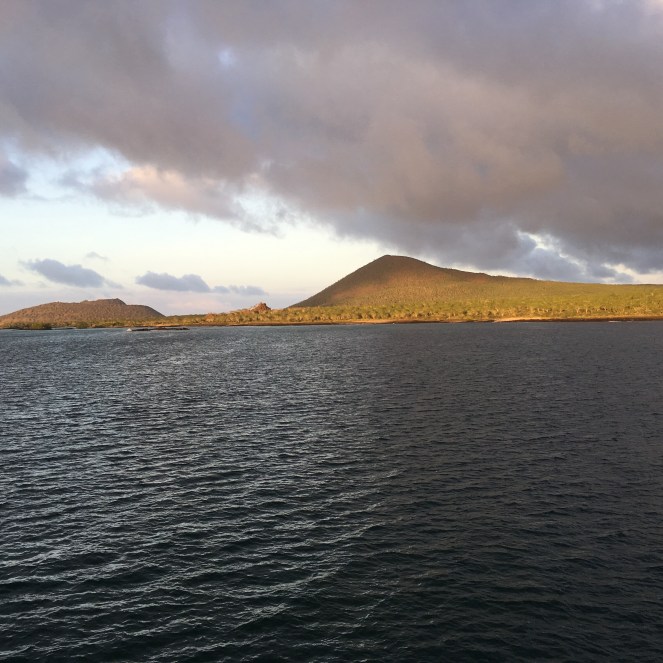
Our weather in the Galapagos has been mostly sunny with some cloud cover off and on, and usually the cloud cover is appreciated to keep the air temperature down and keep from sun burning. Today, however we are farther south and in some cooler weather and it’s overcast. It didn’t keep us from doing anything though as the temperatures are still really comfortable.

After breakfast we headed off in the pangas for a wet landing at Punta Cormorant on Floreana Island to go for a 1.5 hour walk to hunt for flamingos and another surprise. We landed on one side of the island and walked over to a lagoon where we hoped there would be some flamingos. The guides warn us on a regular basis that these islands are not a zoo and the wildlife is in fact wild and so they can not promise to always find certain things in their normal locations. But lo and behold, although they were far away at the other end of the lagoon, there were perhaps 30 flamingos standing feeding. Milton seems to be able to replicate any bird or animal sound and soon had the flamingos responding to his call. We stayed for a bit hoping they’d come closer and they did, but still well out of camera range. A group of them did fly past which was an amazing sight. They are much more orange than the ones I’ve seen in other places and brilliant coloured due to their food source.

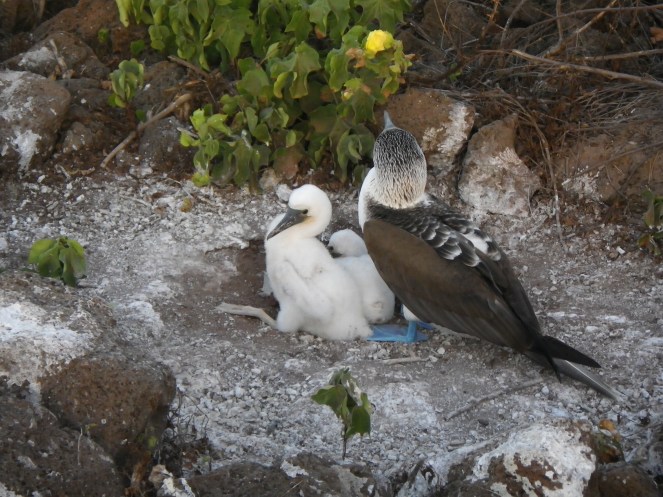
BTW, speaking of food sources, I don’t think I’ve mentioned that the darkness of the blue in the feet of the blue footed boobies is because of their food source (sardines) as well. The deeper the blue, the better fed they are, so when the female boobies are choosing a male to mate with they look for the bluest of feet.

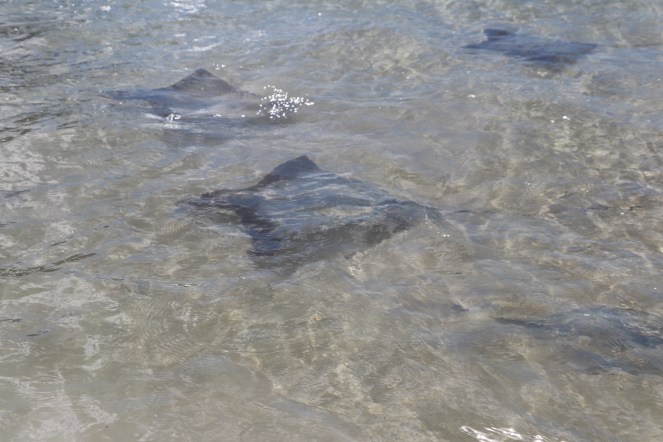
We continued our walk to the other side of the island and to a beach that is a breeding ground for green and Black Sea turtles but it is not the right season. Here is where the guides hoped we’d see stingrays because it was an eating area for them, and did we. We shuffled into the water, I remember them calling it the “stingray shuffle” in the Grand Caymans, without lifting our feet, because there could be rays sitting on the bottom covered by sand and we don’t want to step on them or more importantly for us, their stinger. We waded in knee deep and it took no time at all and we had a parade of them coming by. Most were platter sized greyish or sandy coloured ones and they tickled as they were washed up against your feet or hovered over them looking for food. We also saw 3 larger dark ones, Eagle Rays, which had beautiful markings. The edges of their “wings” sometimes flipped out of the water as they swam along. They were more wary and stayed a couple of feet away from us. It was a hard to get pictures, but one of our group got a picture of me with them in front of me, so hope I can get it from him.

We headed back to the ship to get ready for a deep water snorkel around Champion Islet off the panga. We went through the usual drill to get ready, putting on flippers, putting “sea lion spit” (really shampoo) on our masks to cut down on fogging, and once ready I slid into the water. I looked around to get oriented and couldn’t believe what I was seeing. Thousands and thousands of fish! All around us. All different kinds. All different depths. Huge schools of King Angelfish, with their bright colours of blue with a white strip and yellow tail and fins that almost fluoresced they were so bright. Parrot fish whose colours seem to be iridescent, and lots of surgeon fish with their yellow tails glistening in the sunlight that filtered down into the water. And every other kind we’d identified before and some we hadn’t. I didn’t know where to look. I just floated and my eyes darted all over taking it all in. We didn’t want to move on because we wanted to take it all in. And of course we were accompanied by the usual playful sea lions darting about as we swam along with them. We slowly made our way around the end of the islet and let the current float us along between the islet and the beach. The current was strong and the water a bit choppy so the less adventurous snorkelers were dropped in closer to the beach and Milton stayed with them with a life preserver to allow them to rest there when necessary. More than one of us commented on the fact that it felt like swimming in an aquarium. We followed the rocks along for quite a long time, soaking it all in. Along the way we also saw some White-tipped Reef Sharks who mind their own business and aren’t that large, but the shape and the way they swim still gets the heart racing.

I laughed out loud at one point (and was rewarded with a mouth full of very salty sea water) because a bunch of us were all floating looking at something and pointing down and I looked over to my left because I sensed there was someone close and I didn’t want to accidentally run into them. It was a sea lion and he was tail in the air, looking down with his head at the same angle as ours, as if he too was looking at what we were pointing to. When I looked at him he looked at me and them back down. It was priceless. It was a tad chilly because of the deep water and currents, but no one wanted to give in and go back to the panga and the guides practically had to drag us back in to go back to the ship.

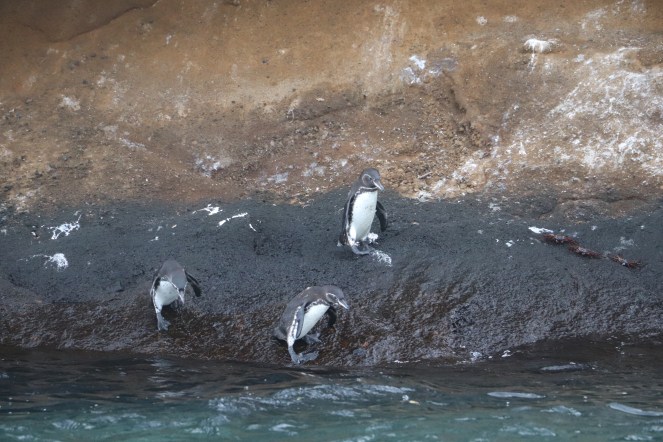
Then on the way back to the boat, when no one was even looking for them, Milton spotted 3 penguins on the rocks near the water. He was so excited for us and he got on the radio to Adrian hoping the other panga would be able to get there before they disappeared. They all jumped into the water right away but I was lucky enough to get a picture before they did. They are smaller here than that ones I’ve seen in South African and certainly much smaller than on the ones we’re used to seeing on TV about Antarctica. We watched them in the water for a short time before they disappeared down the coastline. The theory is that at some point they came on the Humbolt Currents from Antarctica and over the generations they shed the size and weight which wasn’t needed here in the warmer waters.

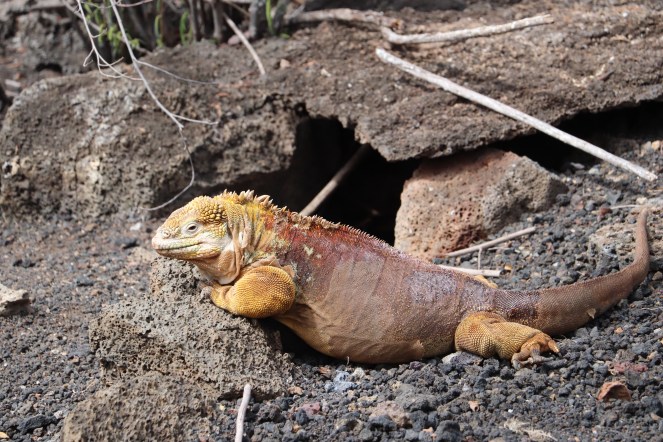
This is what makes this place so special. The adaptations of the wildlife make it so interesting to see them on the different islands because they’re all so different. Lava Lizards (like geckos) are a classic example. They are differently coloured depending on what island they are from because of their food source. Some are black with the top half of the body red, some are dark with a red stripe down the middle and others are almost a yellow colour.

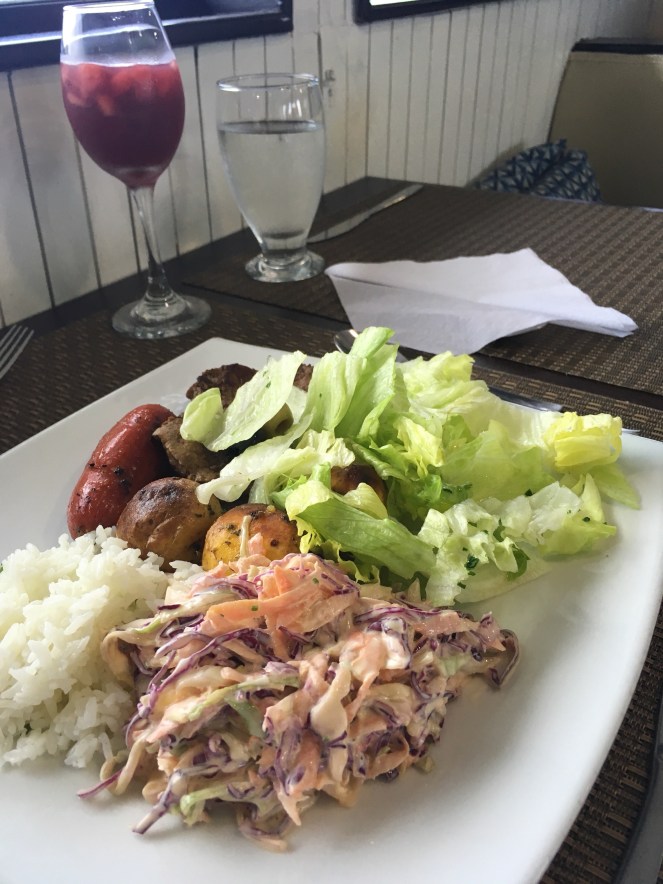
We had a special treat of sangria at lunch today perhaps because it was the last day for some of our fellow travellers to be on board. And then the usual siesta time which we’ve all come to love.

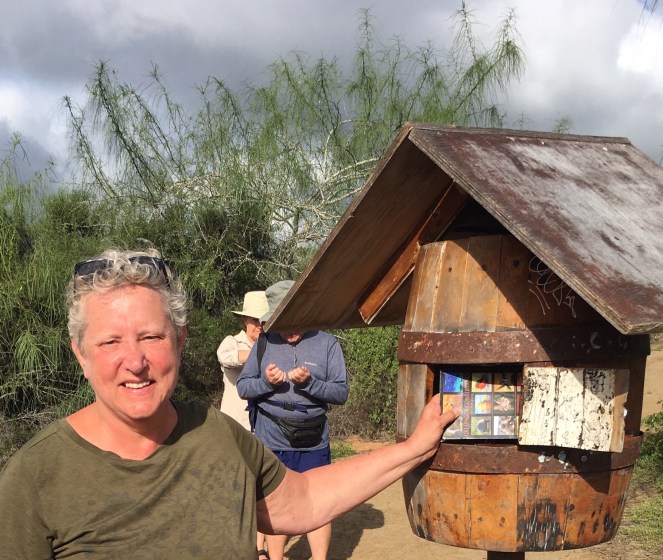
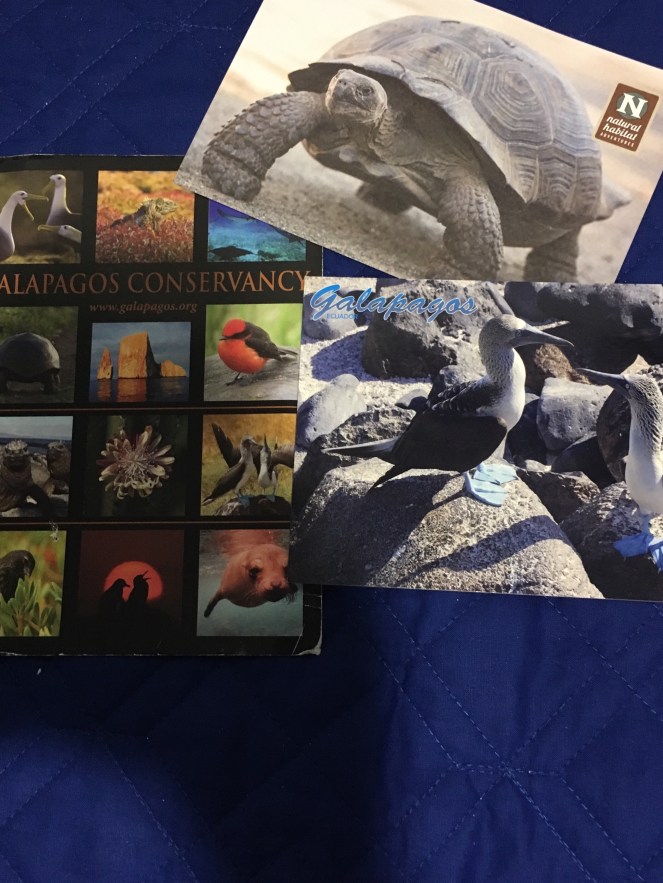
In the afternoon, we had an excursion to visit Post Office Bay where we would find the Post Office. The post office was started in 1793 by the English whaling vessels to allow for news to be passed on to the sailors loved ones. A barrel was placed on shore, not far from the beach and sailors put letters in it with the hope that the letters would be taken back home by sailors passing in the other direction. It has continued as a tradition and we sorted through the post cards to see if there were any from our home towns which we could deliver. I took three, one for Gloucester and one for Elgin, ( both just outside of Ottawa) one in Kingston. I’ll make a trip down to Kingston in the next couple of weeks to deliver it. I left 5 post cards there so you never know when you might get a knock on your door with the delivery of an unstamped post card.

This was the first stop where the bugs were annoying. There weren’t any mosquitos but there were horse flies and other small ones that buzzed around our ears. So we were happy to don our wet suits and do a beach entry snorkel into Post Office Bay. The sand there was lovely and white and soft although there were some rocks to navigate over about knee deep. Once out in the protected bay we wandered around checking out the rocks for fish. I could hear a couple of my fellow travellers ahead of me all excited so I headed for them at top speed. There, feeding on the bottom, were the most gigantic sea turtles. I’m not exaggerating to say their shells were 6-7 feet across. There were some strong currents and we had to work at keeping from being pushed into them. They didn’t even look up from their munching at us despite the fact they were quickly surrounded by 6 or 8 of us. Every once in a while they’d surface and I found one’s head pop up within 2 feet of me at one point. We’re not supposed to go within 2 metres of them, but again, someone forgot to tell the wildlife not to come close to us. It was amazing! What a day of snorkelling.

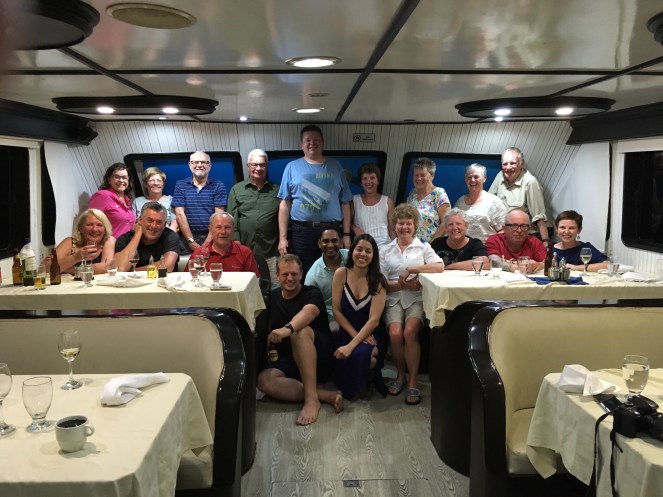
This evening was our last dinner with 9 of our fellow travellers who will be leaving the boat tomorrow, and heading home or on to other adventures. At our usual 6:30 briefing the crew all joined us in their white uniforms and the people leaving had a chance to say their thanks to them for everything. And we raised a toast in a traditional way which I’m not sure the origins of, but it was a really nice send off. Selfishly I was glad I wasn’t among those leaving. I’m am just not ready to leave yet.

Uncategorized

Snorkeling twice today-no words to describe how amazing it was

Tuesday, May 22 – Espanola Island

Tuesday, May 22

This morning my view was that of Gardner Bay on Espanola Island and of the G Adventures ship Yolita which has some of the same stops that we have it seems.

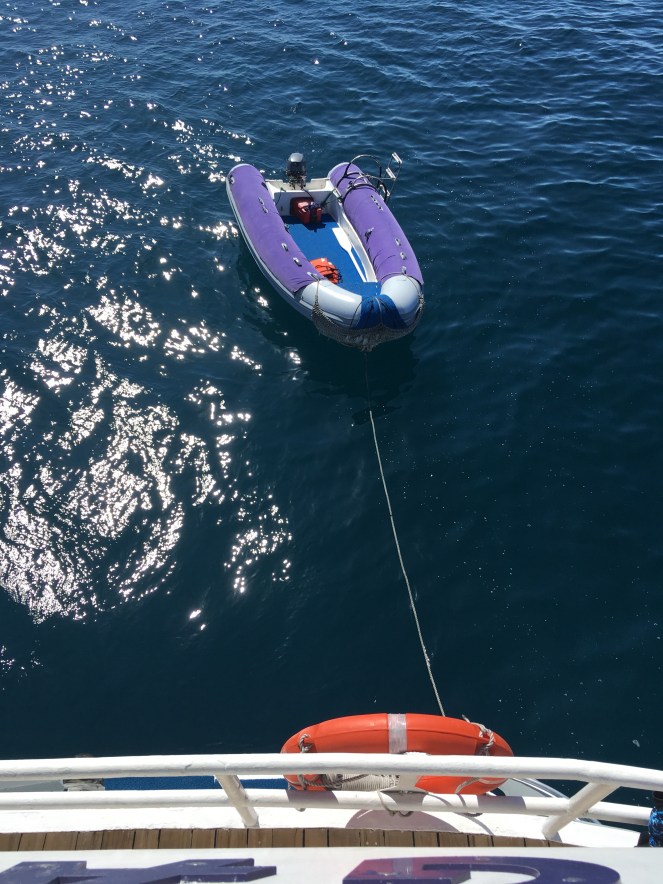
After our 7 o’clock breakfast call we grabbed our snorkelling gear and headed for the pangas for a wet landing on Gardner Bay Beach. A wet landing, not too surprisingly, means that we jump off the panga in the water up to our knees or thighs and wade up on to the beach. (A dry landing means it’s from the panga to a dock or stairway.)

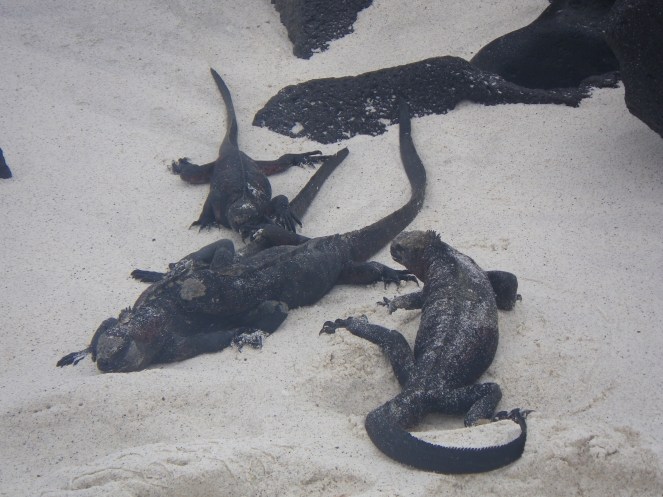
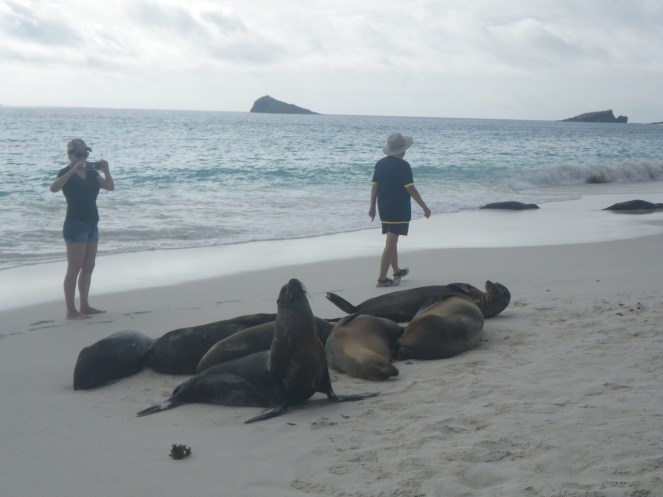
We walked along another stunning white sand beach stopping to check out the wildlife. There were the usual sea lions, this time some of them body surfing in the waves as I had done yesterday. Thankfully no one made a connection. And we saw a few Marine Iguanas on the beach and on the black volcanic rock along the beach. They sit on the rocks to warm themselves up after the cool nights. There were a couple of small lava lizards as well.

We had been warned about Mockingbirds and today experienced them first hand. Up until the government set aside the land in the Galapagos in a National Park, there weren’t any rules and regulations about interacting with the wildlife. There isn’t a lot of fresh water on some of the islands and these intelligent birds had discovered that people coming to the islands carried water in bottles in their backpacks and they were successful in getting water from them. So even though we’re not allowed to give them water they still try and get at our water bottles if they are outside of our day packs. They’re really quite pesky.

Then it was time to put on our wetsuits and snorkel gear and head out to and around a small island just off shore to check out the potential wildlife there. The group has broken into two groups with those of us who have some experience snorkelling and are comfortable with it in one group (called the Rambo snorkelers) and the other group of newbies. I’m happy to report that I’m in the Rambo group. It split up pretty much half and half with some folks brand new to snorkelling. Milton, one of our Guides, is great with those not yet comfortable with it all. He took them into a shallow area yesterday to get used to the equipment and then today for the deep water snorkel he got in the water with the group and took along one of the life preserver rings from the boat and let them hold on to it to get their gear on and even hold on to it as they moved along the rock formation. They really appreciated the slow and patient approach and are all up to try really deep water snorkelling tomorrow. I figure once it’s over my head (and let’s be real, that doesn’t take much depth) it really doesn’t matter how deep it is. I love not having to use a life jacket because the wet suits create some buoyancy as well as keep us warmer and from getting sunburned.

So, I grabbed my underwater camera and away I went off the beach and on my way out to the small island. I’ve had no problems at all with this camera until today. I guess maybe the seals are not holding or some salt water got into it somehow, so I only got a few not-very-good pictures and not it doesn’t seem to be working at all. I’m so disappointed because there was so much to see and I feel like I let you down, Rae. Sorry about that. Next on my toy list is a Go Pro. But after Galapagos I can’t imagine I’l ever see the diversity of sea life we’ve already seen in 2.5 days.

There were schools of different kinds of fish such as Parrot Fish, King Angel Fish and Surgeonfish and individual ones like Flounder and almost transparent Cornetfish. I swam alongside a Green Sea Turtle for quite a long time until he went off in another direction. I saw some small sting rays, but missed seeing a 2 sharks that a couple of the others had seen. You had to dive down to see them and I haven’t yet mastered that technique. I float like a cork and getting my butt down is a problem for me. I also seem to always end up with water in my tube and not able to clear it without surfacing and taking it out or my mouth and cleaning it out. Hopefully by the end of this week I’ll have mastered that. One of our travellers from New Zealand, Andrew, is like one with the sea lions. He can stay down for a long time and zips and spins around like they do. But I’m getting ahead of myself.

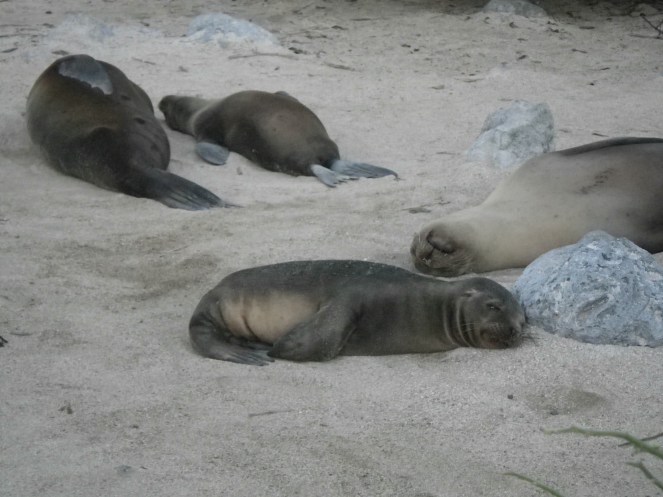
The advanced group headed back to the boat to get rid of the rest of our gear from our walk and to go for another one hour snorkel in deep water off the side of another small island. This was a more technical snorkel with currents and rock walls to avoid, caves to carefully explore, and a lot cooler water. But my goodness the fun we had with the sea lions. So first of all, although they are sea lions, they are a much smaller variety. They look more like seals to me, so they’re not like the big hulking ones that line the docks on the west coast.

Between our guide and Andrew going down and playing with them, the sea lions, 10 – 12 of them at one point were having great fun swimming among us. They frequently brushed up against us, and jumped over our heads more like dolphins. They genuinely seem to like to play with their human guests like puppies. I just floated and enjoyed the hijinks. One of my most treasured moments of the trip for sure. But we were getting cold so it was time to get out.

Did I mention that they have snacks and juice or ice tea waiting for us when we come back from each of our activities? Fried plantain, or yuca fries or little sandwiches, or chips and hot sauce or cookies….. you get the idea. They’re always really appreciated because we’re working for them. This last snorkel we burned a pile of calories just keeping warm. After some snacks and iced tea I headed to the shower to get warmed up.

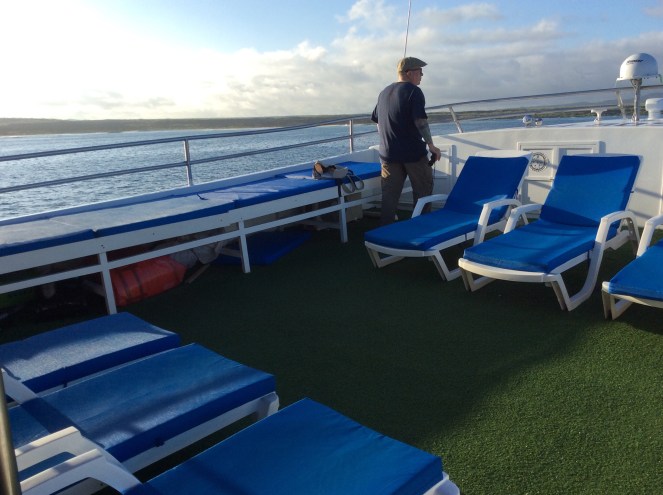
Our days seem to be following the same pattern where we have free time after lunch and til 2:30 or 3:00 and I think it’s the time that most of us really appreciate. Gives us a chance to soak in all that we’ve seen and done, talk about our experiences, or just have a nap on one of the lounge chairs on the top deck.

This afternoon’s activity was a 2.5 hour walk over lava beds, so as you can imagine if we were cold from our morning snorkel, we warmed up pretty fast with the afternoon sun, at the equator, on a black background. It was a hard walk, having to watch where you put every step over sometimes smooth and sometimes jagged rocks. But we saw so many interesting things.

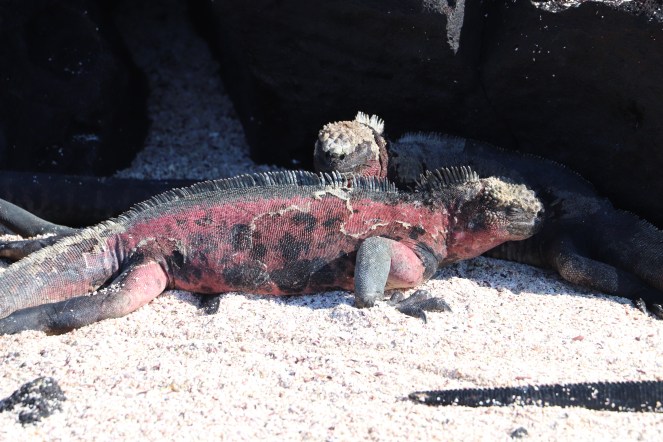
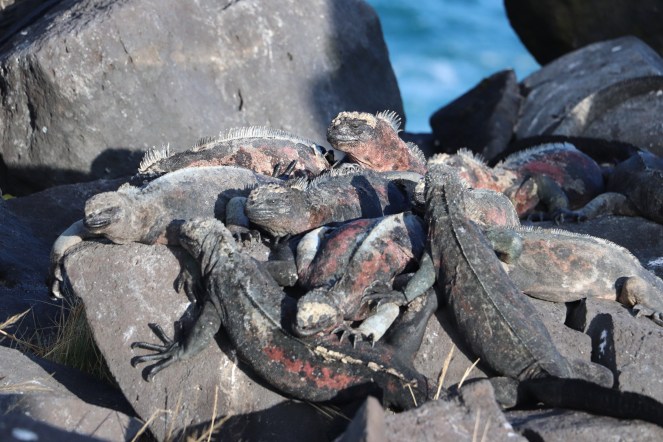
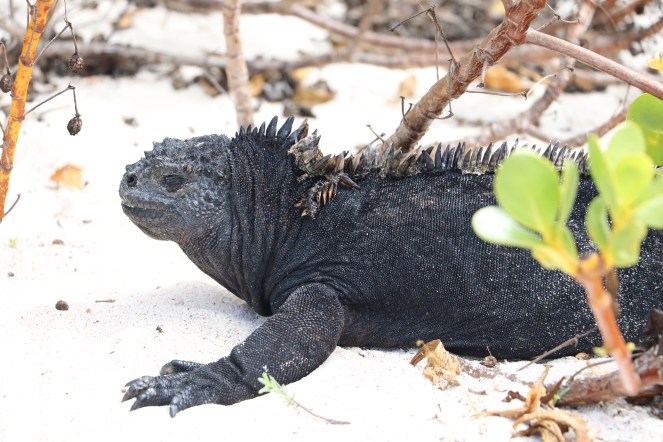
There were marine iguanas everywhere. The Galapagos is the only place in the world where iguanas have adapted to be able to swim and feed in the ocean. They are not cute and cuddly like sea lions so I’m glad we haven’t run into them in the water. They tend to congregate together on the black rocks to keep each other warm and you see piles of them. While they are feeding in the water, they take in a lot of salt water along with their food and to eliminate the salt, there is a process whereby the salt is expelled from their noses, and it looks like they’re spitting. Also not terribly attractive. The ones on Espinosa Island are black with green and red markings that are quite subdued during most of the year, but in the fall, during mating season they apparently turn very vibrant and they call them Christmas Tree Iquanas.

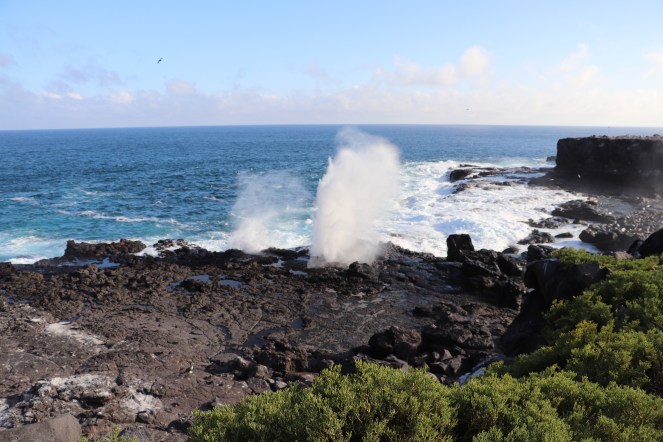
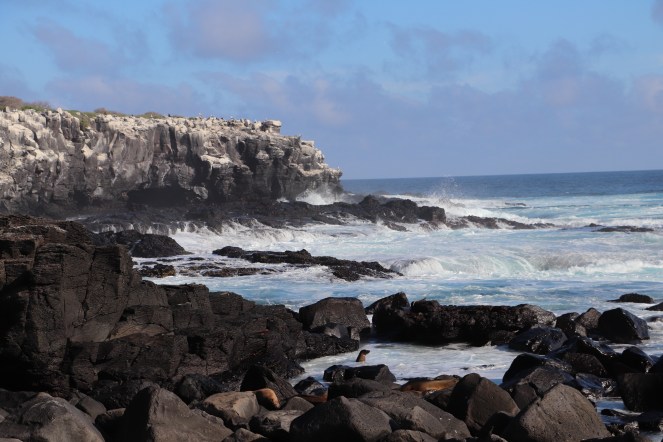
The cliffs made for some great scenery and there was even a blow hole along the way.

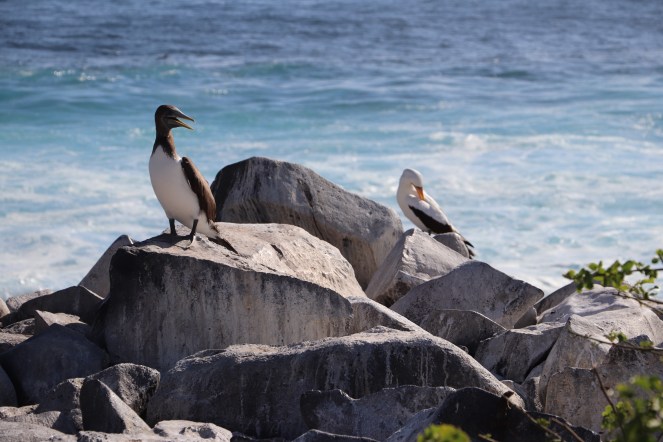
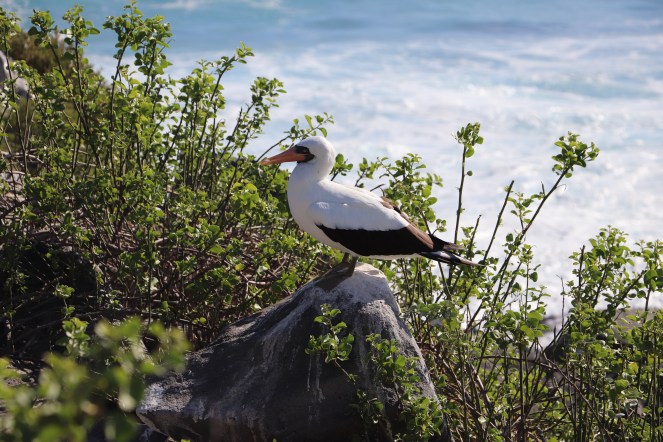
There were a couple of new breeds of birds to discover here as well. You met the Blue Footed Boobies the other day, but on Espinosa there are Nasca Boobies, which are larger and much more aggressive. Although we did have a visit from a Blue Footed Boobie as well and guide Milton became photographer Milton.

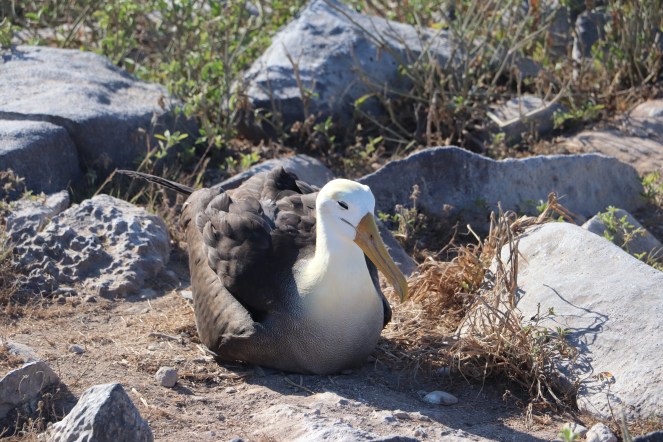
Another of the different species of birds is the Waved Albatross.They are the most awkward looking birds on the ground with their big feet and funny legs. But in the air they are excellent flyers and we watched them soaring off a cliff on the back side of the island. They are nesting at the moment and there were dozens of them sitting on an egg each, that are huge. And like the other wildlife here, they let us walk right beside them without any fear. There are 18,000 couples in the Galapagos and they mate for life.

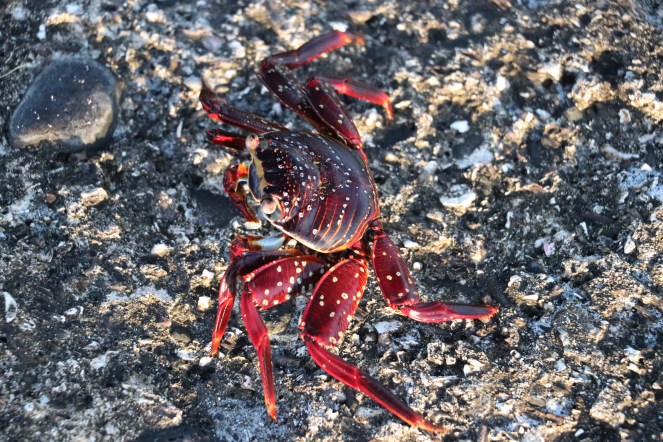
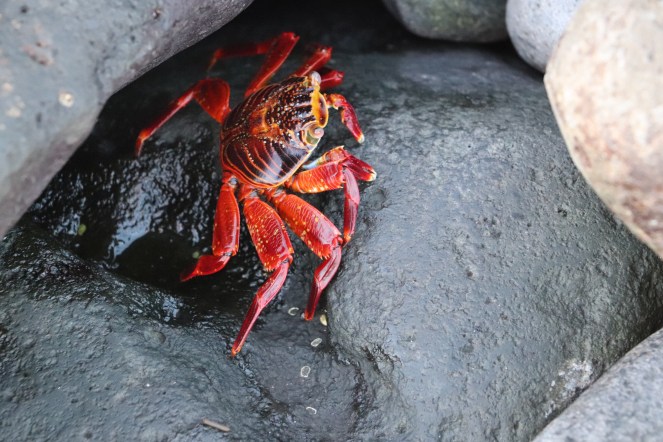
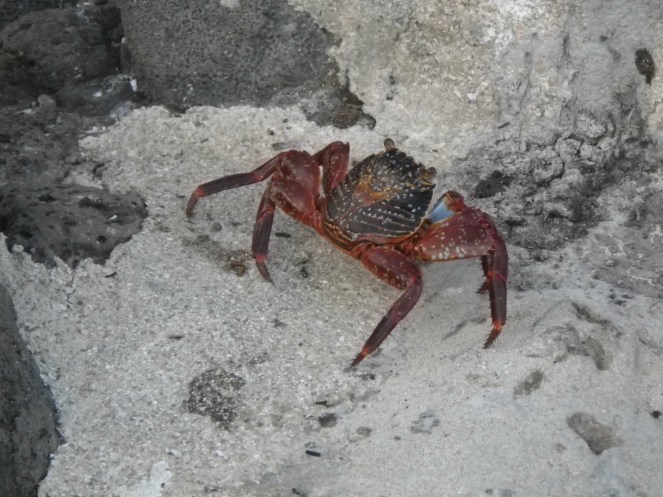
We gradually made our way back to our starting point carefully picking our way over the rocks and praying to not turn an ankle. While waiting for the rest of the group and the pangas to arrive I went Sally Lightfoot Crab hunting. Photo hunting that is.

I had time for a quick nap when we got back before our briefing for tomorrow at 6:30. We’re headed off to Floreana Island tomorrow and will do a nature walk first thing, and a panga entry snorkel and then in the afternoon we’re going penguin hunting, although I’m not terribly confident we’ll see any given that there are only 14 – 16 of them on the island. We’ll have a chance then to snorkel off the beach, and visit a post office that has been in operation since 1793. More on that tomorrow.

Uncategorized

Another special day in a very special place-San Cristobal Island

Monday, May 21, San Cristobal Island

Today (Monday) was amazing. We spent it at various locations on San Cristobal, the largest and one of the oldest of the volcanic islands of this archipelago. Tonight I might not get this posted but its after dinner and I’m sitting on the top deck of the ship in the dark with the lights of town and the other ships anchored here all around me. Another one of my happy places that I’ll come back to in the middle of next winter, at least in my mind. The only noises are the distant sounds of the sea lions on shore.

Last night we moved from the harbour in Peurto Baquerizo Moreno and travelled to the north coast of San Cristobal. What fun to open up the curtain after my alarm went off to see what I could see. And it was a gorgeous view.

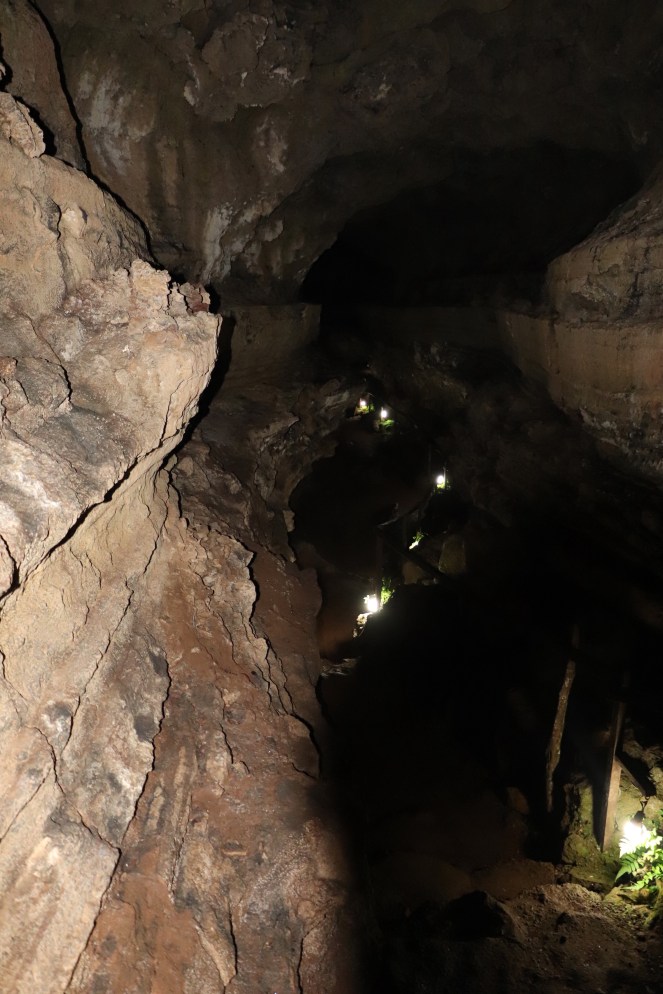
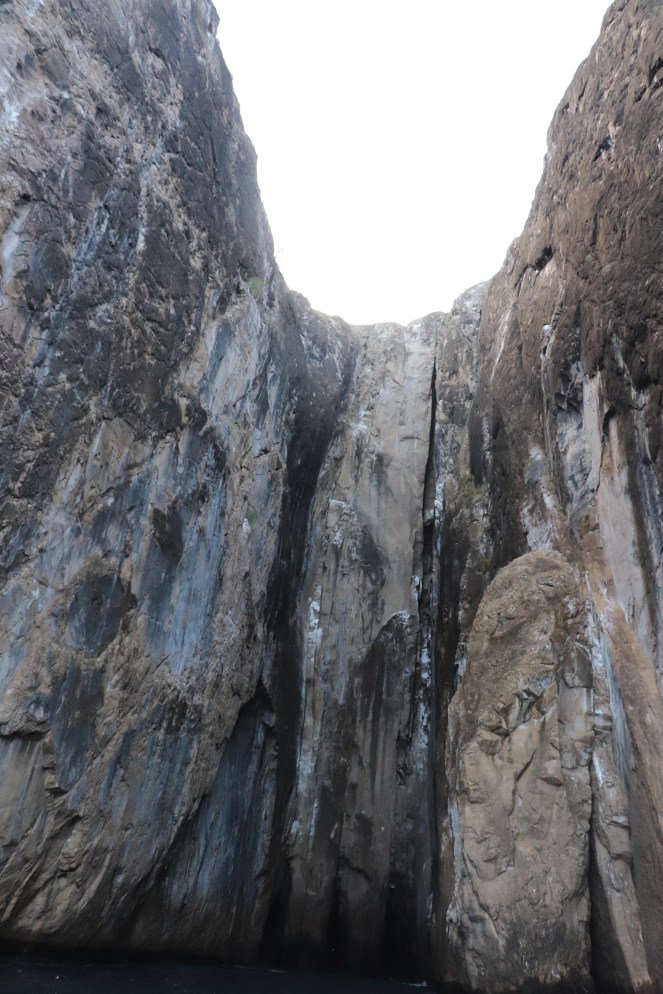
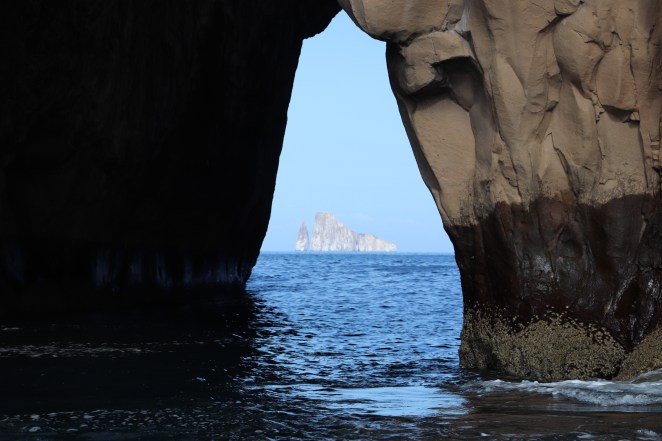
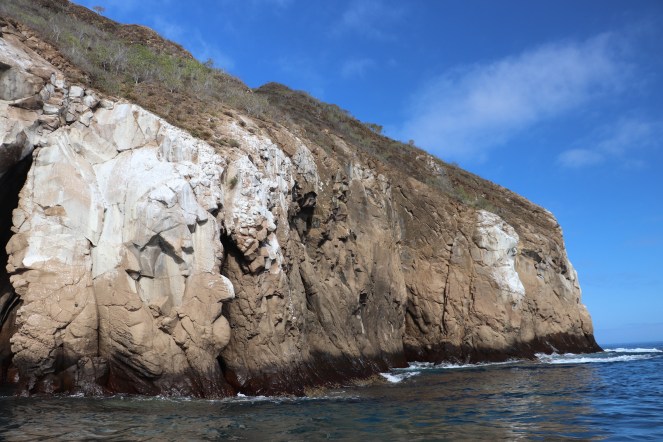
We started off the day with a panga trip around one of the nearby small volcanic islands that had been eroded in the last 1000 years. We popped into a cutout called the “cathedral” because of it’s impressive high walls around a cave and it was as inspiring as some real cathedrals I’ve been in. We took a narrow channel in the dark rock through to the other side of the island that was pretty hair raising because of the large swells. The walls seemed close enough to touch except they kept going up and down. Our 2nd mate, Richardo, did a great job of navigating it for us.

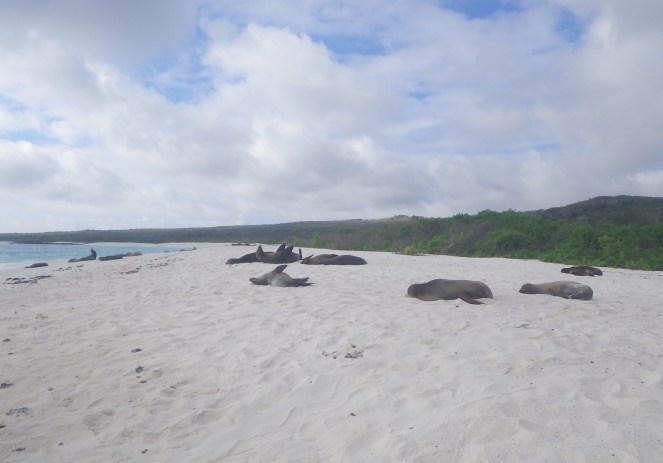
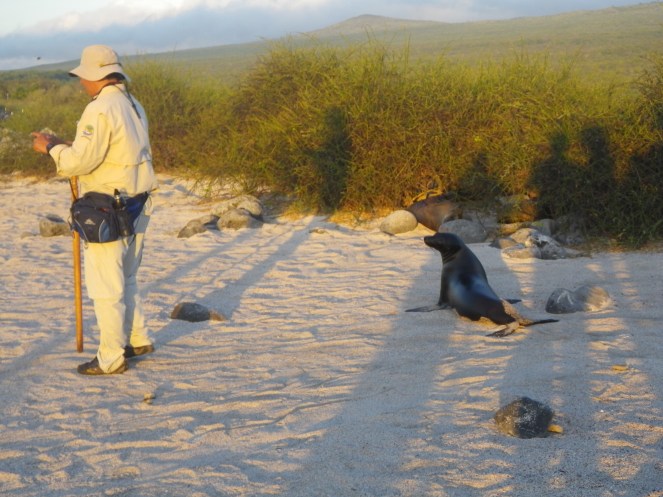
Our landing spot at Cerritos Bruno was picture post card beautiful and amazing. Soft white sand along a crescent shaped beach with no one to share it with but the sea lions ad iguanas! As we all wandered past the sea lions, being led by our guide, they rarely even looked up or took any notice of us. That is one of the overwhelming sensations about all the wildlife here. They aren’t afraid of people and so you can get really close without annoying them or scaring them off. The rule is 2 meters and when swimming with the sea lions yesterday I asked who policed them because while we were staying our distance they kept coming inside of the 2 meter zone.

We took our time, stopping at whatever was of interest to us and walked all along the beach and back for over an hour. It was amazing to watch the boobies and pelicans fishing by diving at top speed directly at the water. I think we each spent some time chasing the Sally Lightfoot crabs to get a better picture and watching them cling to the rocks and being hit by waves that you’d think would have knocked them flying. And we even got to checking out a marine iguana.

Then we had time to either snorkel off the beach or swim or just sit and enjoy the most magnificent views. I opted to swim because it wasn’t a particularly great snorkel spot, and I had a great time body surfing. The water was nice and warm and the waves were just the right kind. I did at one point thinK I was going to do a face plant on the beach but managed to get control before getting to that point. It was interesting that as soon as anyone started to go into the water the panga came out from the ship and hoovered nearby in case anyone needed assistance. They are incredibly safety conscious.

Once we’d had our fill of swimming/snorkeling/picture-taking we headed back to the ship. It was 11ish and besides lunch at noon, we didn’t have anything scheduled til 2:30. It was kind of weird. We all looked at each other not sure what to do with free time. Most of us headed for the top deck of the boat to read or nap or work on their blogs. I think it’s the first quality down time I’ve had on the trip and the location couldn’t have been better.

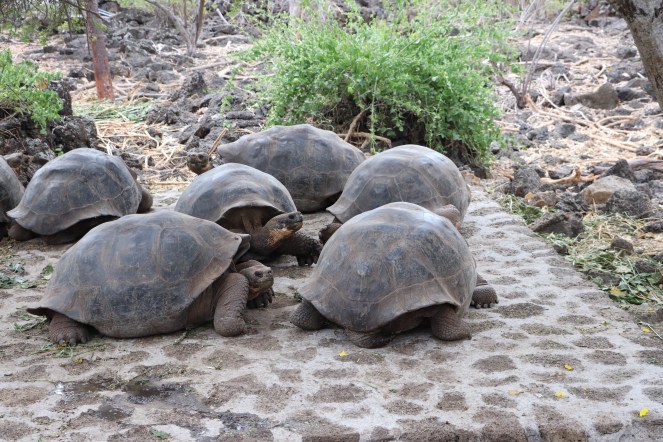
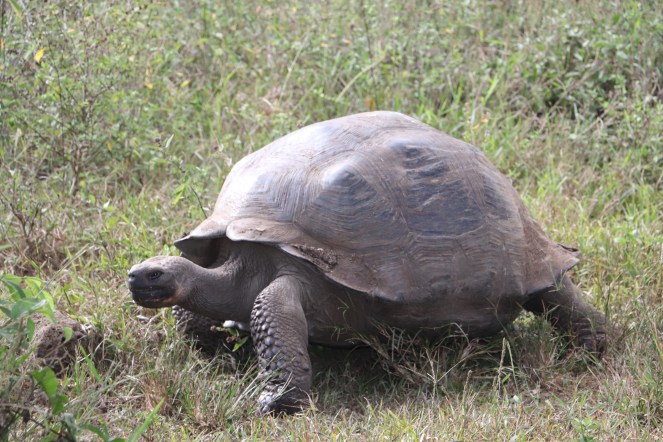
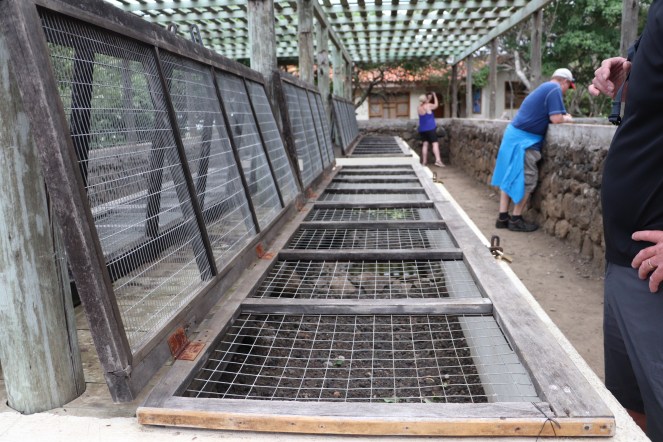
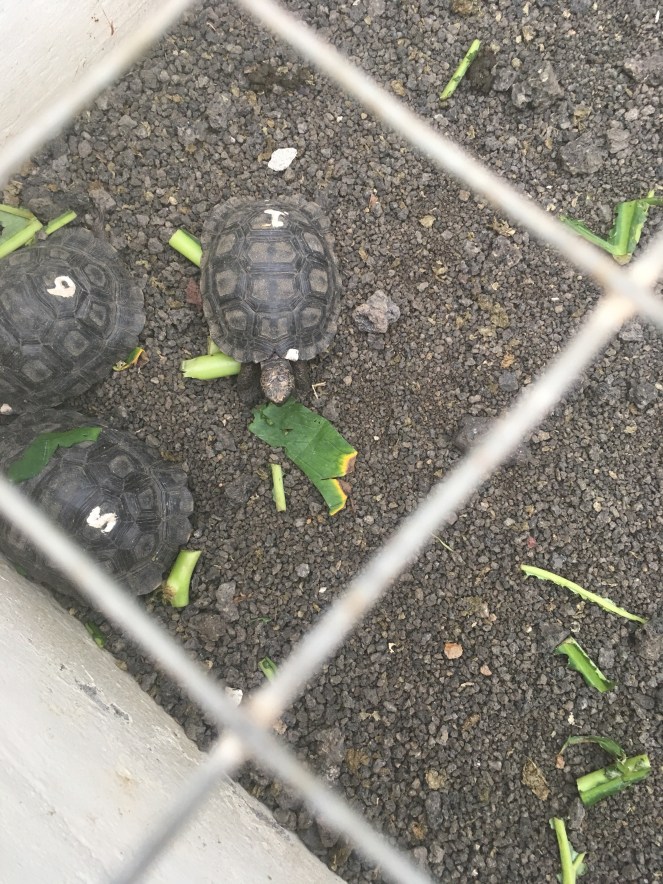
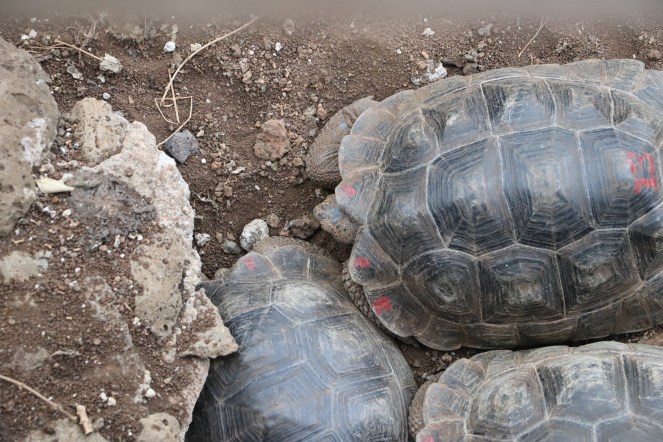
Another fabulous lunch was served and off we went in the pangas to the harbour to board a bus to take us to the Giant turtle breeding centre up in the “highlands” (definitely not the Ecuador mainland highlands), called Jacinto Gordillo Breeding Centre. As with many other species throughout the world, the giant land turtles here are in need of some tender loving care to keep them from becoming endangered. The turtles bred here have a 65% chance of surviving vs only 3-5% in the wild. The centre has a huge acreage where the turtles are corralled after a month in the darkened hatching centre. The corrals for the young ones are double fenced, one to keep humans out and one to keep rats out! Who knew. After 2 years in the small corrals when their shells are hard and the chance of them being someone’s lunch are less, the turtles are moved into a larger corral and stay there until 4-5 years of age when they are released into the wild. They can live for up to 100 years and are mature to breed at the age of 35 or so. There are some that we saw that are close to 50, and they are huge.

Surprisingly these huge turtles can move up to 4000-6000 meters a day and one that was 5 years of age or so did cover a lot of ground while we watched. Their sex is determined by the temperature that their eggs are incubated at rather than their DNA so the centre is able to breed more females to be able to produce more hatchlings.

On the property we learned about some of the indigenous plants. There is one tree that produces fruit, that looks and smells somewhat like crab apples but is poisonous to human. The turtles however can feed off the fruit. There are 16 species of sunflowers in Galapagos, none of which look like the ones we grow in Canada.

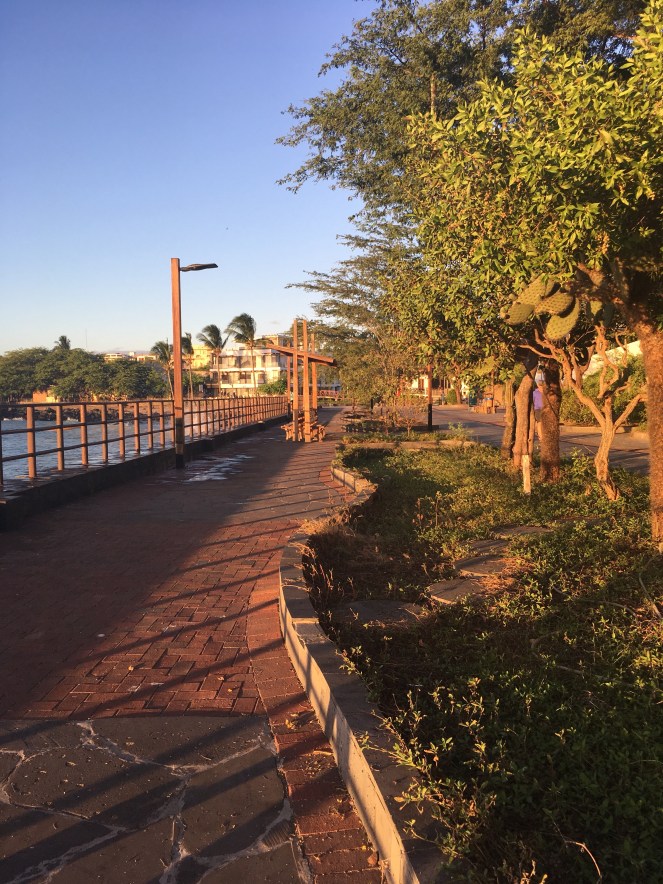
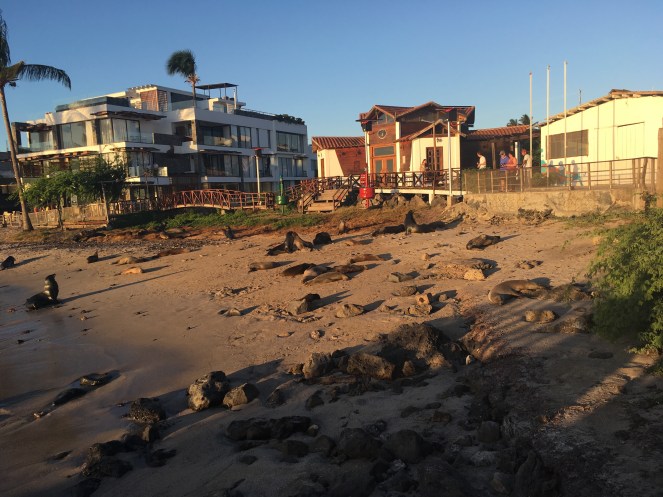
On our way back to the ship we had a chance to wander in town and I took the chance to wander the main street along the harbour (named Darwin Street naturally). A huge sea lion had parked itself on a small bridge on the boardwalk and was not allowing anyone to pass without being barked at. A shop keeper finally came out and shooed it away.

Back on the ship, dinner couldn’t come soon enough as we were ravenous. As I suspected the meals have been fabulous. Varied and fresh and well prepared. Our server and bartender Eduardo has taken great care of us as has Chef Boliver who we rarely see because he’s slaving away in the kitchen.

After dinner I wrote this blog and then headed for bed by 9:30 pm or so. I would never sleep so much at home but all the activity during the day spent outside and the gentle (or not so gentle!) rocking of the ship makes sleep easy. After I had turned out my light I heard the engines start up and the boat start to move on our way to Bahia Gardiner on Espanola Island.

Uncategorized

In the land of the term “natural selection”

Wow, it’s going to take a lot to top our first day in Galapagos.

Once again I found myself at an airport early in the morning, this time to fly from Quito to Quayaquill where we refueled and picked up some new passengers and then on to the island of San Cristobal to one of the two airports in this amazing archipelago.

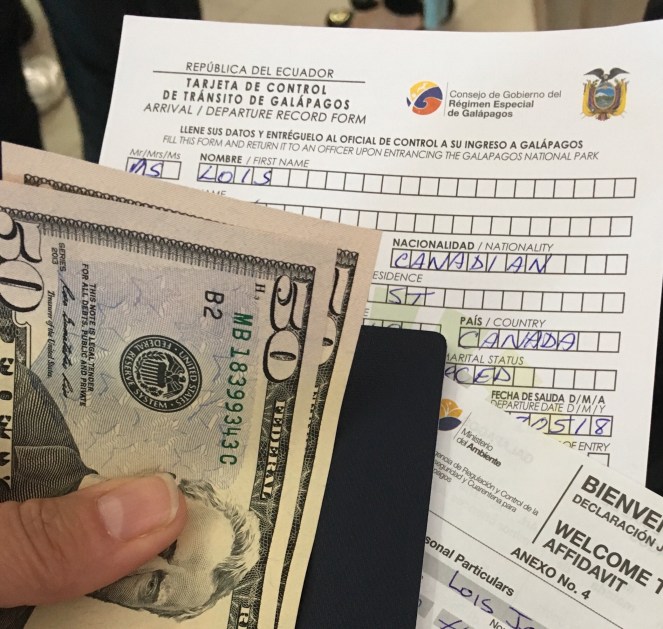
Since 97% of the land mass of the islands has been saved as a national park, and the Ecuadorian government is taking some measures to preserve the fragile ecosystems here, the paperwork, fees, processes and rules involved in coming here are a bit staggering. We were glad to be with a tour company to walk us through all the rigamarole. I don’t begrudge any of it though since it’s such a significant place.

We were bussed through the capital of the Galapagos province, Puerto Baquerizo Moreno and down to the docks where our pangas (we call them zodiacs) and a whole pile of sea lions were waiting to greet us. There were also some Sally Lightfoot crabs among the rocks, our first introduction to them.

We waited our turn on the dock, while another tour group of roughly the same size got into their awaiting pangas. As they did, we assessed what might be the most graceful of the ways to get in and determined there weren’t any and so just did our best with the help of the crew.

Our ship, the Monserrat, is nicely appointed, and has been maintained very well. There are large common areas with my favourite being the sundeck on the top, with both covered and open areas. I’m glad I paid the single supplement to have the twin cabin to myself as it’s pretty tight for two, but for one it’s great.

We had a safety briefing right away once on board, and then a few minutes to check our our cabins and get organized before the bell rung to let us know it was lunch time. I have a feeling that although I don’t think I’ve gained weight so far on this trip I might this week on the boat.

After lunch they talked to us about our week ahead, and specifically logistics for the rest of this day. It’s a little confusing about what we should be taking with us when, but we’ll figure it out. We had our fitting for our snorkel equipment and wet suits. What a hilarious adventure that was. I’ve never worn one before and it’s not easy getting in and out of them, especially when you’re my size.

Then it was time to try all the equipment out. One parga went off with those who had never snorkelled before to a beach around the bay. That would give them an opportunity to get used to the equipment, etc while only hip deep in water. Our parga went to another bay where it was deep water and in we went. Within minutes we’d seen 3 decent size turtles and came upon some Sea Lions playing with an old water bottle float for an anchor. As soon as we arrived they started darting all around us, sometimes nudging us as they sped by. They are a small variety, that almost look like seals, but we’re assured they are sea lions because there are no seals here. I didn’t take along my camera on this trip because I hadn’t snorkeled for a awhile and with my cold, I wasn’t sure how that was going to work out so I didn’t want to have to deal with the camera as well.

Then it was back to the boat for a quick wash off and then back on the pangas for the short trip back to the island for a nature walk. And within seconds we’d seen the red throated frigate birds, Blue Footed Boobies, lizards and lots of sea lions sunning themselves. We hiked for about an hour and then headed back to the ship where there was time for only a short nap before dinner.

The crew were introduced to us, with a welcoming cocktail and by 9 pm I was in bed asleep. I woke up at one point in the night and boy it was rocking and rolling, but it didn’t bother me and I went right back to sleep.

Uncategorized

Sadly I said goodbye to Peru today but on to a new adventure in the Galapagos tomorrow

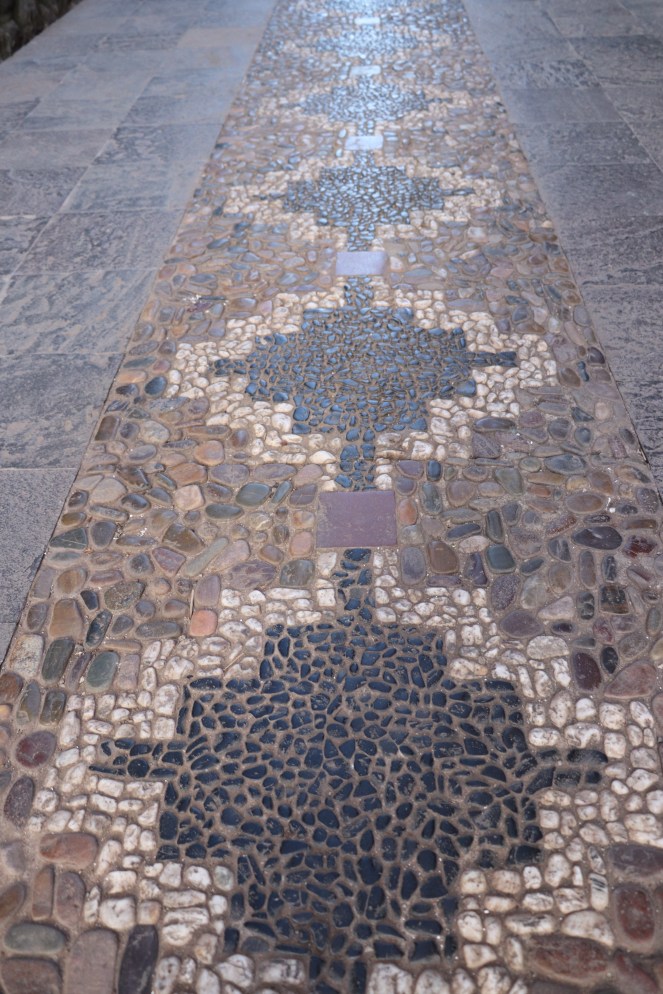
Today is Saturday and yesterday was our last opportunity to soak up the amazing architecture, culture and history of the lovely city of Cusco. Daughter Gill knew I would love it there and she was absolutely right. (She usually is but don’t tell her I said that). Early in the morning I wandered over from our hotel down the narrow streets that were originally set out by the Incas generations ago and sat in the Plaza Major in Cusco on the stone steps where millions of footsteps over time have smoothed out the granite, sipping on my Starbucks tea. My only irritation was the frequent visits by sellers of everything from ice cream to alpaca scarves, to paintings. Seems like I stood out as a tourist. Damn blue eyes and pale skin.

Yes, for the first time in South America I broke down and visited a North American franchise. I’ve been really adventurous in trying the delicious local food and food preparations. This is the only Starbucks I have seen, and it was very discreetly tucked away in the courtyard in the corner of the square. Once inside I could have been in a Starbucks in any of the stores in North America. I was looking for a decent cup of tea but alas I’ve discovered it’s the taste of the leche (milk) that I’m not crazy about, not so much the tea. The only noticeable North American franchise in much of my travels here has been KFC who were also prominent in Africa. Not sure how they manage that. There was a MacDonald’s on the square as well, but it was equally as discreet, thankfully, and not busy at all.

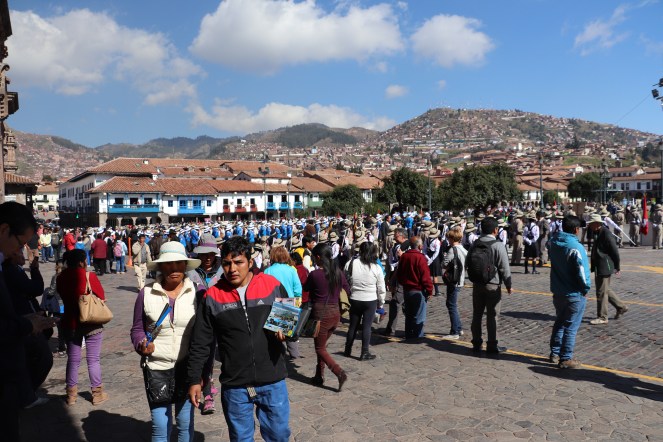
The school children, somewhat older yesterday than the day before, were there again, with a military marching band, doing some sort of drill while their proud parents watched on. At one point, the whole square was standing almost at attention and singing what I think might have been the national anthem as the Peruvian flag was raised on the square along side the Cusco flag. It was pretty moving, whatever song it was. I lallygagged around, rather thrilled to have some downtime on my own before our 11 am departure from our hotel in Cusco. I wanted to savour a few more moments of the history and culture of this great city built by the Incas and literally built on by the Spanish before Peru’s independence in 1821.

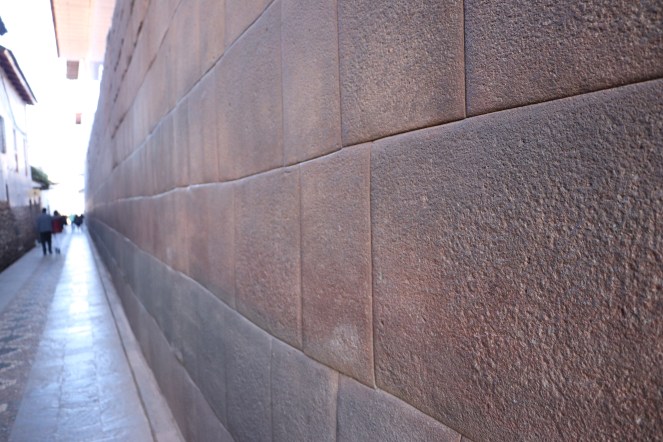
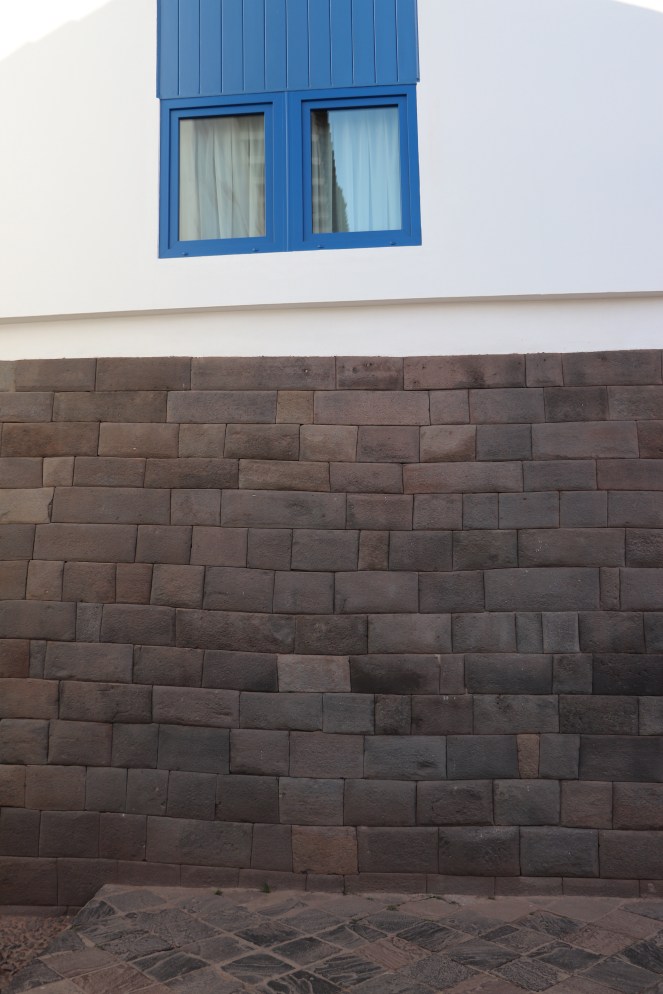
The wall in the picture below is right around the corner from our hotel and is considered one of the best examples of Incan building techniques. No lasers for measuring and cutting back then.

I wandered back through the historic part of the city to our hotel just as it was time to grab our suitcases and head down our narrow little street on to a major thoroughfare to wait for our private bus that would take us to the airport. We cleared through the traffic, check in and security process in good time and the flight was on time.

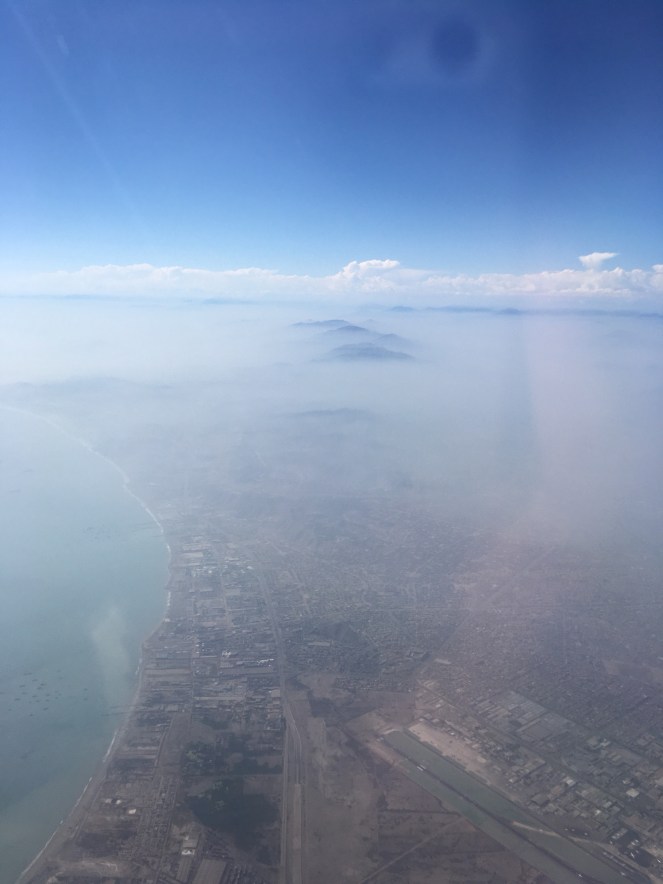
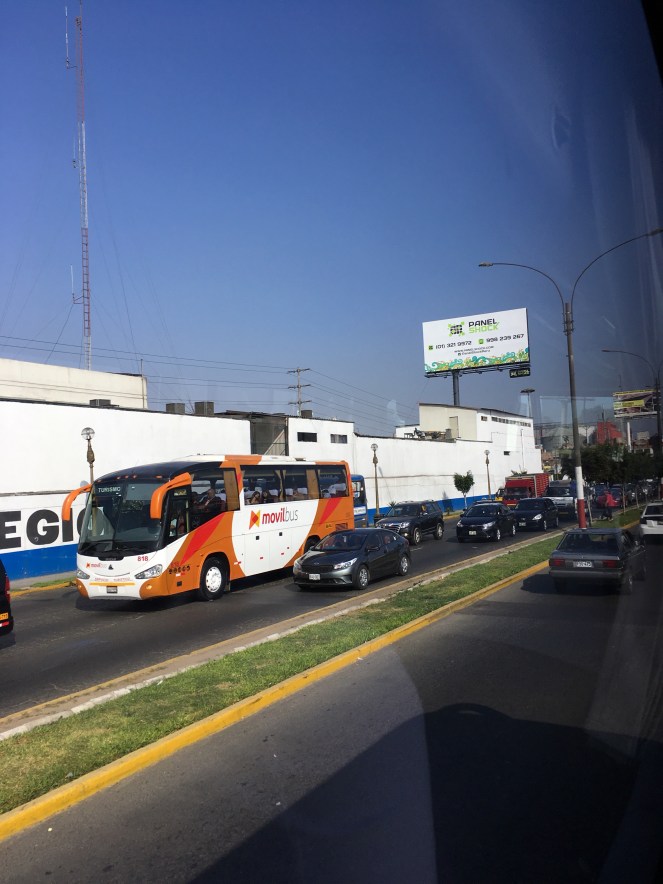
We arrived into Lima just as rush hour was on. Oh.my.goodness. I don’t think I could drive here. The drivers are crazy, driving with equal pressure on the gas pedal and horn. Traffics signals, lights and lanes seem to be merely suggestions. And as pedestrians, you just have to go for it and hope for the best.

We arrived safely at our hotel, my least favourite one on the tour, in the Miraflores district of Lima, about 30 – 45 minutes from the airport. We last stayed over night in this hotel on our way through to Cusco and you may recall that we didn’t arrive until very late and then had to be up at some ungodly hour to catch our flight that was subsequently delayed 2 hours. This time the hotel didn’t seem as dour as the previous time, but it’s definitely tired and in need of a re-do. But the neighbourhood it is in, Miraflores, is spectacular. Our guide said it was one of the most affluent in Lima and you can tell. I am so sorry I didn’t have even one day there to wander. It’s alive with people walking and jogging, playing and eating on patios along the pedestrian walkway in the middle of the main avenue with lots of restaurants and shops, music and entertainment. The avenue makes it’s way down to the Pacific and the beaches there within a 20 minute walk or so. Next time.

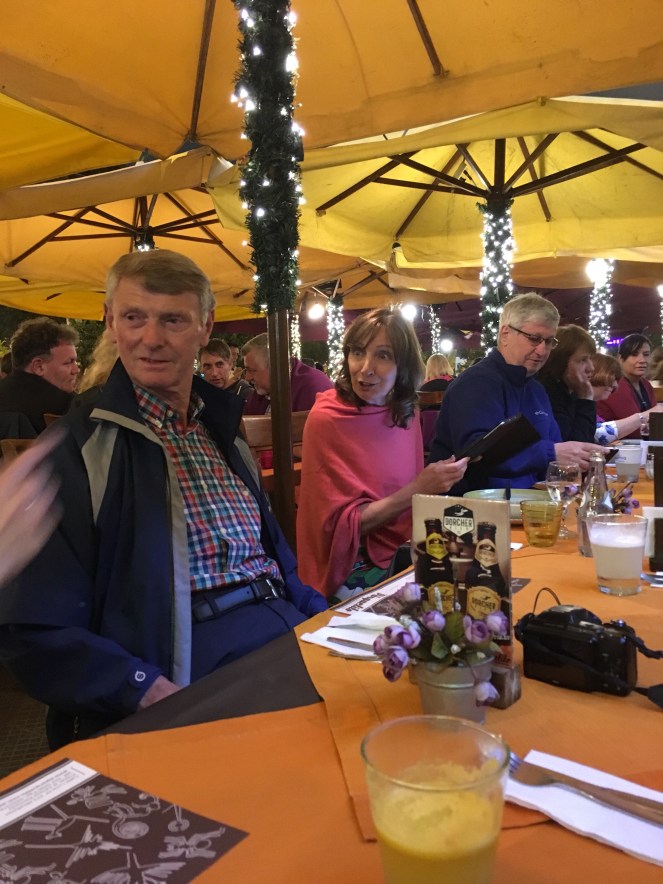
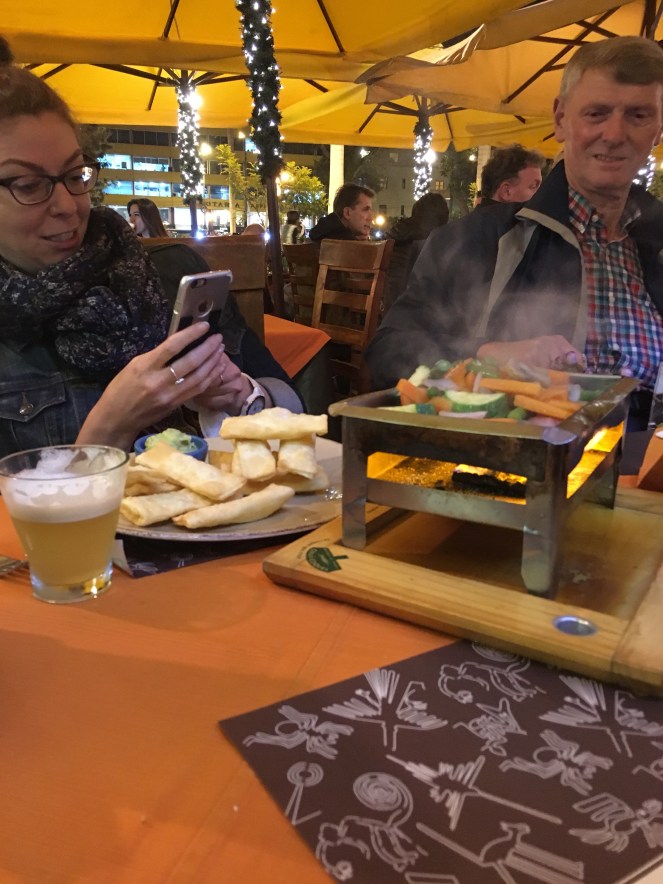
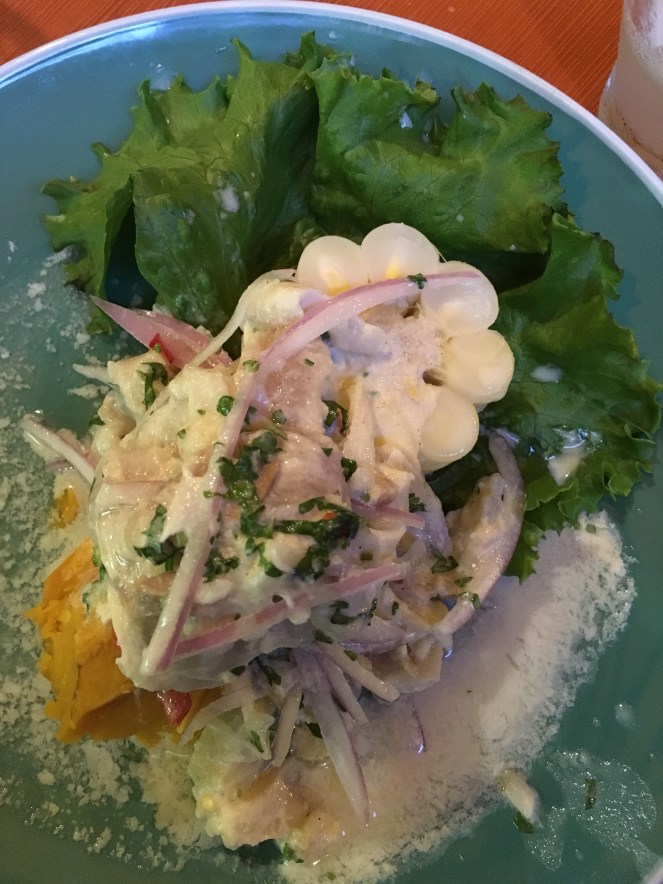
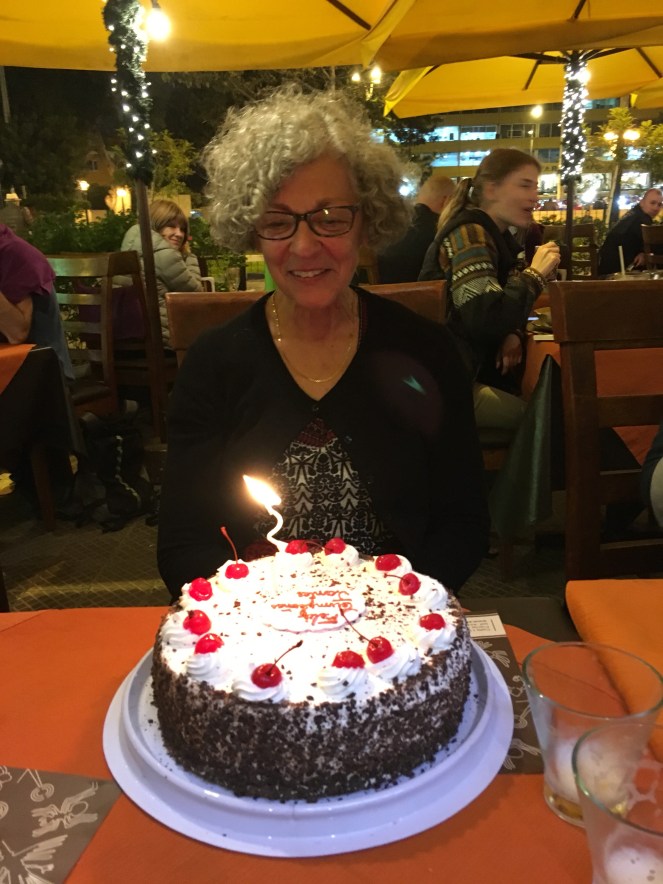
Our last dinner together as a group was last night and our CEO, Katy, chose a fabulous restaurant with an outdoor patio right in the heart of the action for us to enjoy. Its specialty is ceviche and although we’d mostly been warned by our travel docs not to eat ceviche, many of us threw caution to the wind and ordered it last night. We also had the drink specialty, you got it, Pisco Sours. They were potent but (or possibly because) we really enjoyed them. Hopefully the alcohol killed any potential bugs. The Mom and daughter from Calgary, Janice and Erin, were travelling together to celebrate Janice’s birthday and Katy organized a Black Forest Birthday Cake for Janice which she shared with all of us. It was a lovely way to end the tour. Some of us had been together for the Ecuador and Peru tours (14 days) and others for just for the Peru portion (8 days).

On our walk back to the hotel last night we were able to enjoy the nightlife (if you can call 8:30 pm night life) including some dancing in nearby JFK Park (yes, The JFK)

Our senses were alive with the sounds, smells and sounds of Peruvians at play. Once back in the lobby of the hotel, it was hugs all around as we said goodbye to the group of people with whom we had enjoyed our shared experiences over the past couple of weeks. Like any trip when the itinerary is as packed as this one was, it seemed like we’d been together for months. It’s always an interesting study in human nature to be in a group travelling together. Like-minded people tend to migrate towards each other, but this group stayed pretty cohesive throughout our travels, looking out for each other and sharing knowledge, experience and the odd sip or taste of each other’s meal choices. I spent a lot of my time with Cara, from Salem, Oregon as we shared similar interests and somewhat the same west coast life experiences. But I enjoyed the company of many of our fellow travellers.

Peru was a wonderful experience, right up there near the top of my favourites list, although I think because of the diversity of our tour in Ecuador I would put it higher on the list. No maybe Machu Picchu trumped diversity. Hard to say. Of course, each had their strengths and special moments.

I’m currently on my flight from Lima to Quito after a hair raising taxi ride to the airport, which included the crunching of my driver’s rear right bumper by another taxi behind as he tried to sneak into another lane. My driver jumped out to check the damage but the other taxi was long gone. Check in, customs, security and boarding went without a hitch other than the usual 3 gate changes that seem to be a compulsory part of air travel in Peru.

Tonight I’ll meet up with the group for my next adventure, the Galapagos. I’m staying at a different hotel in Quito than previously, and this one is closer to the Old Town and Artisan market, so I may get out and about some this afternoon. Unfortunately I’ve picked up a cold, and Janice if you’re reading this, I’m not blaming you. With the rigorous schedule we’ve been keeping, along with the lack of sleep and dealing with altitude, it was almost inevitable that I would pick up a bug. I just hope it doesn’t play havoc with my ability to enjoy the snorkelling that is to come in this next phase of my trip.

My postings will be rather erratic in the next 10 days as we move in and out of wifi range. I’ll try and keep up my posts though so when we hit an area with wifi that I can fire them off.

With that, I’ve timed it rather nicely, our flight is in final descent so off I go to get ready for the next transfer from airport to hotel.

Uncategorized

One day in Cusco is not even close to being enough

I’d like to thank whoever is praying to the sun gods for us because we’ve been so lucky with our weather. Today in Cusco was another great day for visiting this beautiful and interesting city. The culture and the history are so evident in the old section of the city where we are fortunate enough to be staying.

We had a free day today and our guide, Caty, graciously offered to do an orientation walk around the city she calls home. She obviously has a passion for the city and for the culture and history of “her people”.

Cusco is a city of approximately 500,000 built among the valleys and slopes of the nearby hills. It was the centre of the Incan empire until the Spanish conquered it in the 15th century. When the Spanish took over the city, they built on top of the existing Incan buildings and there is evidence of that throughout the historical part of the city. The Spanish made a point of building their churches on the sites of places that were important to the Incans.

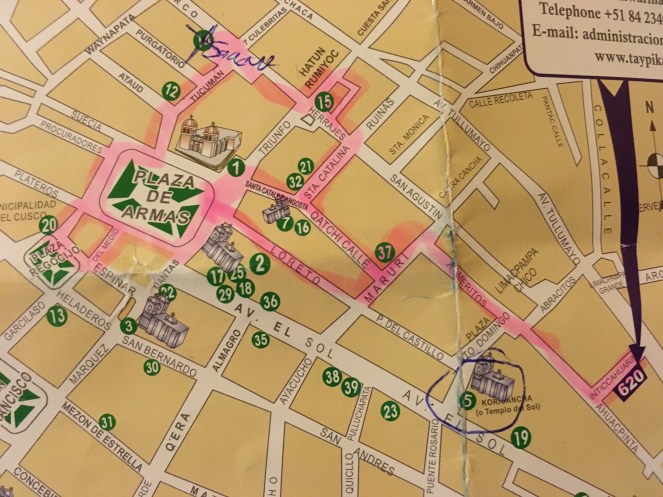
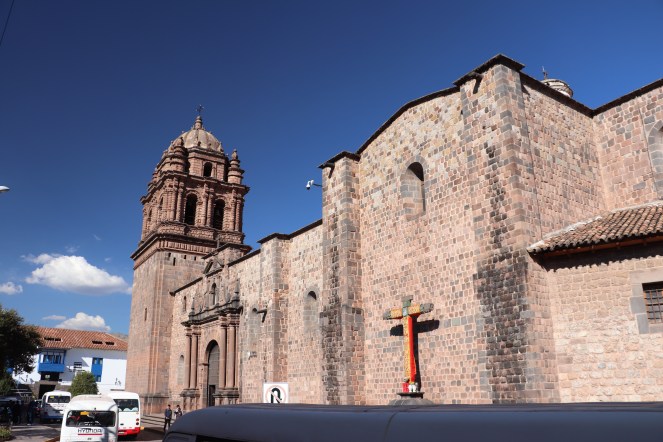
We walked past one of these sites, right around the corner from our hotel, the Temple of the Sun, which became the Santa Dominigo Church. We would come back later in the day to visit it. We walked along many streets and saw the foundation layers were the very obvious expert work of the Inca, with colonial buildings on top. Scotiabank is actually in a nearby colonial building that demonstrated it well and they have various cultural displays throughout the building as well. We zigzagged through narrow streets and Caty pointed out where we could find things we might be interest in buying or seeing.

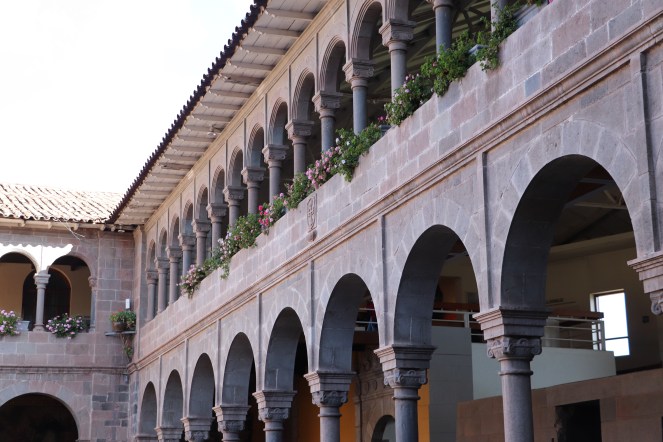
The below picture is an example of the colonialists building on top of the strong foundations built by the Incas.

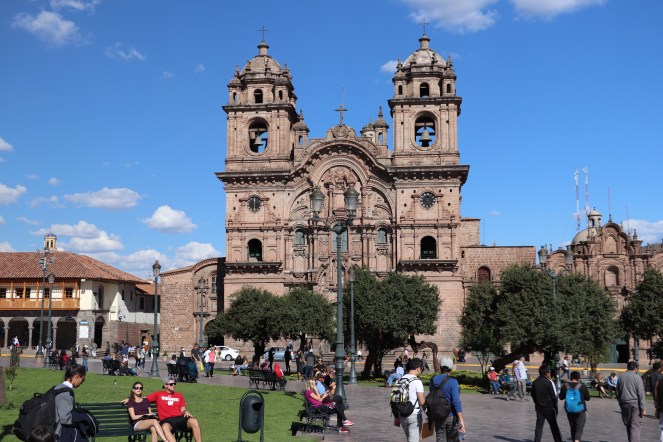
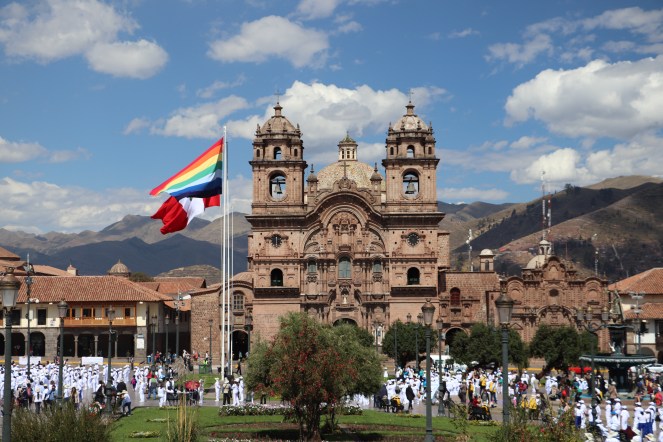
Eventually we came to the Plaza de Armas, the main square of the city, where Caty ended her orientation walk. It was particularly chaotic today as there were school children there marching around the square to bands or drums. No one was sure what it was about but it certainly added some colour and the ice cream vendors were doing a great business. In the middle of the square is the 9th King of the Kingdom of Cusco who is reputed to be the best of all of the Kings and is credited with expanding the Empire. There is speculation that Machu Picchu was built as an estate for this King named Pachacuti Inca Yupanqui.

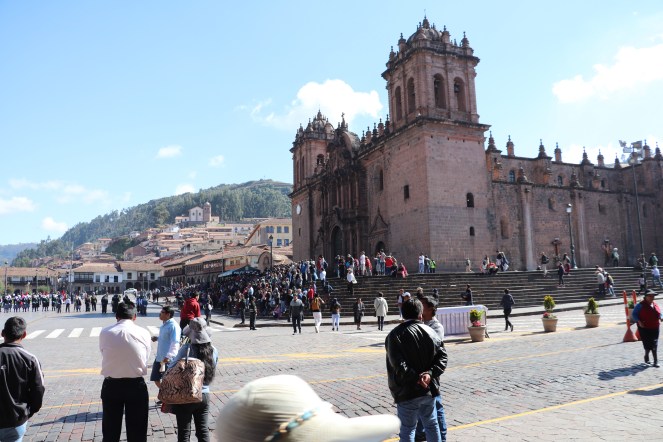
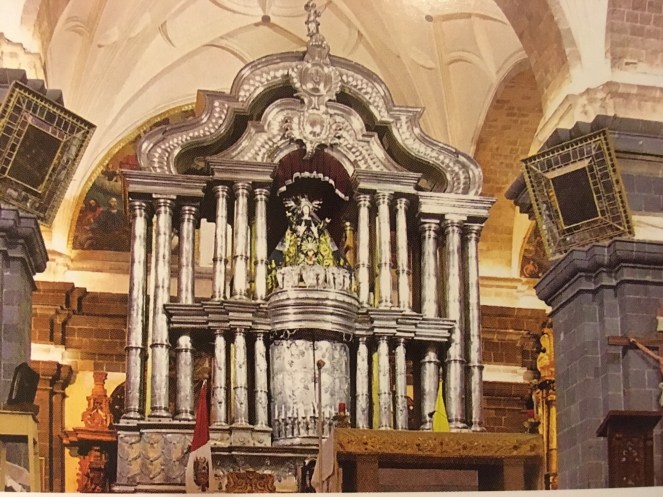
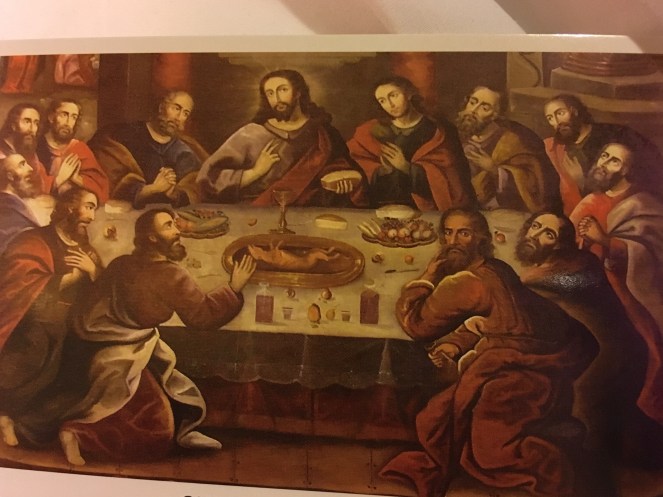
Cara and I did a little shopping and then sat in the square a spell to just soak up the ambiance and then headed for one of the recommended visits, the Cathedral Basilica of the Assumption of the Virgin, also known as the Cusco Cathedral right on the main square. It was completed in 1654 and is made up of 3 churches inside and in the main church has an unusual silver alter as well as a room with some stunning silver on display. Of course we found it quite hilarious that there is a picture of the Last Supper that actually looks to show a guinea pig as the supper. Apparently there is an inscription in the cathedral that claims it not to be guinea pig but we don’t believe it. We were not allowed to take pictures inside the cathedral but I bought a couple of postcards and took pictures of them to show you when I can upload pics more easily.

Next it was on to lunch. All around the main square there are shops on the main level and restaurants on the second level, most with small balconies and we chose one of these at the end of the square looking across the square. We had rather tame dishes today, both kind of like stir fries. That rainbow flag has nothing to do with gay pride, but is the flag of Cusco, and the red and white one with an emblem in the middle (which you can’t see) is the flag of Peru.

We then made our way up the hill (hills are still heart-pounding and gasp inducing) to the Inca Museum. There is apparently a better one in Lima, but I won’t have time to visit it since I’m heading straight back up north for my last adventure in the Galapagos Sunday morning. It was really interesting with artifacts laid out nicely and some with English translations. Not knowing exactly what things were didn’t detract from our enjoyment of the items though. Pretty amazing to see the size and decoration of some of the vessels in particular.

We headed back in the direction of our hotel to stop at the Sun Temple. Many sections of it did not allow for photography either so not a lot to show. They seemed to be setting up for some sort of production with lights and sound systems etc. They have unearthed the Incan architecture and show various building techniques such as how they used various notches in the rocks to direct the water through an aqueduct system and how they secured doorways.

We made our way back to the hotel and I even had time for a short nap before we headed out at 5:30 for our only planned activity of the day at the Cusco Planetarium. I’m not a big star gazer, but it was an interesting presentation using a dome to show the various constellations in the northern and Southern Hemispheres and what we know about the heavens today and what the Incas knew about it in their time which was pretty remarkable. Then we went outside where they had two telescopes and some telescoping binoculars aimed at some things in the skies that you can’t see with the naked eye. It was great to get to see some of the rest of the city on the way to and from the planetarium.

Tomorrow we’re back to Lima and the tour ends with our farewell dinner tomorrow night. Then on Saturday I’m back up to Quito to head over to the Galapagos on Sunday. So the adventure just keeps on coming.

Uncategorized

The reason that we, and 95% of all tourists to Peru, are here – Machu Picchu

Sorry this is a long post because it covers a couple of stellar days. And it was written over a few days so hope the time references make sense. Also, the wifi here is not great so I can’t get pictures to upload using Word Press. So I’ll add them when I can, and post the pics to Facebook which loads OK.

So, first some back ground on Machu Picchu. I am writing this from memory and brief notes written on the fly so I apologize for any errors which are of course the tour guide’s… ….no, they’re mine alone.

In the early 1900s Hiram Bingham, a Yale University professor and archeologist was travelling in Peru looking for “the lost city of the Incas”, a secret mountain stronghold used during the 16th century rebellion against Spanish rule, but instead on July 24 1911 he discovered the Inca settlement which is known by the Quechua name Machu Picchu, or Old Mountain. He supposedly paid 1 soles for the rights to the site which today doesn’t even buy you the entrance to the public washroom on the World UNESCO Site.

Most of the site was covered in jungle and he went back in the following year with a group of his sponsors, including National Geographic. The pictures taken during that exploration were on the front cover of National Geographic in April 1913.

When it was built In the 14th century, life for the Inca people centred around Cusco which means Centre, but Machu Picchu was important as the entrance to the jungle to the east and as a spiritual place. It was continuously worked on for 100 years mostly likely by up to 20,000 people but it was meant to be home to only approx 500-1000 of the Cusco elite.

The site’s location was important, as the location on a mountain top and Urubamba River provided natural protection, a source of building materials (granite) and most importantly water. And spiritually it was a good spot because it was near the Sun and the moon and the earth, elements important to the Incan culture.

The best architectural and masonry skills were used for the most important structures of the city, such as the Temple of the Sun and priest’s quarters.

You can see from the pictures the workmanship of the round building, which was the Temple of the Sun. They didn’t use mortar and the granite pieces fit so tight that a piece of paper couldn’t be slipped between them. To make the pieces fit, they looked for natural fault lines in the rock and then drilled into the rock using natural iron tools, and then pounded wooden pegs into the holes and wet them. As the pegs expanded from the moisture the rock broke along the fault line.

The Incas, much like the Mayans on the Yucatan in Mexico were smart mathematicians and paid a great deal of attention to the cycles of the sun and the starts. there are examples of this throughout the site. The Temple of the Sun has one window that is perfectly aligned so that on the spring solstice the light comes through a V in the mountain ridges casting a light through that window. Likewise the fall solstice, and another V in the mountains. One of them is the famous Sun Gate on the Inca Trail which goes through the Sacred Valley between Cusco and Machu Picchu. I remember Gill telling me how moving it was to come throug h the Sun Gate to see the sun rise on Machu Picchu before tourist buses had started to arrive. Two of the people from our group did the last 11 km of the Inca Trail and had the experience of coming throught the Sun Gate, although not at sunrise. You may say, hey, 11 km, that’s not far, but at the altitude of the pass they had to go through it was tough slogging which took them approximately 7 hours. There was a “sun dial” of sorts in a prominent location of the city that showed not the hours or the day but rather the seasons which is how they structured their lives. Preparing the terraces, planting, harvesting and celebrating the harvest.

One of the areas that has required no restoration work at all is called the Royal Tomb, although they’re not sure if it was since a tomb since no mummies were found in the cave.

The construction of the walls was hierarchical in that the high ranking leaders and priests had very precisely placed stones, with no mortar,, and the “middle class” had rooms made with smaller mostly rectangular stones, that required mortar, and the the lower classs had walls made from irregular stones and mortar.

It was a simple life, with only three real rules of living: Don’t lie, Don’t be lazy and don’t steal.

So now more about my time at this magical place high in the cloud forest of Peru.

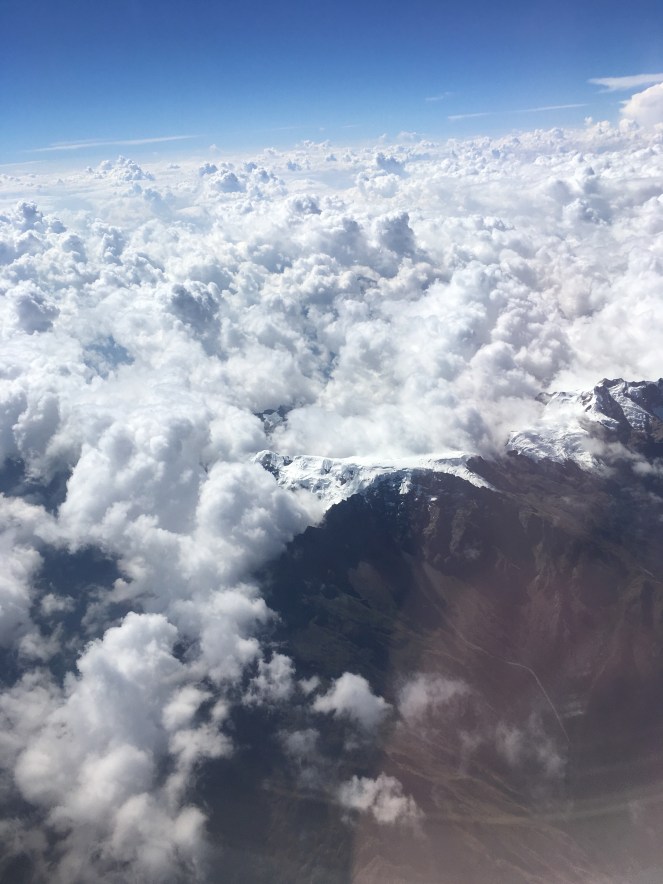
We spent the night before last at the same hotel in Urubamba but in the morning we packed up all but a small overnight bag and after breakfast left our other belongings in safe keeping at the hotel and headed by bus to Ollantaytambo. It is here that we caught the train to Aguas Calientes, the only way in or out. It was a lovely 1 hour and 40 minute ride in a very comfortable coach with a snack and coffee service part way through. The tracks followed the Urubamba river through the mountains and we caught glimpses of snow capped mountains and smaller Inca ruins along the route. We were all very chatty in anticipation of the primary reason we had all come to Peru, like 95 % of all tourists, Machu Picchu.

We dropped off our two hikers at mile 93 of the Inca Trail, along with what seemed like 100s of others. They got a rousing send off, looking a little overwhelmed and nervous. We then carried on to the train station in Aquas Calientas and were in to town by 9:30 am or so. We had an orientation walk around town while waiting for our hotel rooms to be ready. It’s an odd little town that has grown exponentially in the past 10 years, and really hasn’t been able to keep up the infrastructure. Ten years ago 3000 people visited MP a day in the high season. Now over 7000 a day in peak season of August, Sep and Oct make the winding bus trip up Machu Picchu Mountain. The train track runs right down the middle of town and the slope from the river is really steep with hotels and shopping areas a challenging walk uphill.

After checking in to the hotel, 6 of us opted to make an additional trip to go up to Machu Picchu that afternoon. The next day we would have an included guided tour of the lower section of more urban buildings but today, we could take our time and see which ever parts of the site we wanted without the restrictions of the group or the guide. All visitors must take a bus up to the site, and I was more than happy to leave the driving up this crazy road full of switch backs up the side of the mountain.

Our guide had suggested that since we would be visiting the lower portion of the site the next day that we hike up (“up” being the operative word) to the top section, where the iconic pictures of Machu Picchu are taken. So up we went. Although Machu Picchu is at a lower altitude than the Sacred Valley or Aquas Calentes, we still felt the altitude and had to stop to let our hearts and lungs settle down after every 15 -20 steps or so. And although the Incas were supposed to have been pretty short, you couldn’t tell by the height of some of the stairs that we had to manage.

But that first glimpse of the iconic view made it all worth while. And, yes, of course I teared up. It felt somewhat like I’d been photoshopped into a scene because of all the times I’d seen this view in pictures. There were various routes to take to get different views and we spent quite a lot of time getting shots of each other from various angles. We walked part way to the Inca Bridge, past a check point where we had to sign in so they could keep track of everyone. This section was mercifully flat. We had split up from the Mom and Daughter on our tour and found out later that Erin, the daughter, hiked up to the Sun Gate which is where the Inca Trail trekkers arrive into Machu Picchu. We tried heading in that direction, but knowing it was a 2 hour round trip and the first half up a really steep track, we opted not to go. Eddie, wanted to hike part way up at least, and so we sat on a rock by the side of the trail and soaked up the atmostphere and rested. In order to make our way out we had to go down a long stairway, (150 stairs or so) with no railing and a wall only part of the way down to keep a hold on. My poor knees toook a lot of abuse.

Done for the day we got a stamp for our passports and queued up for the wild bus ride down. I caught air a couple of times. We didn’t want to walk up to our hotel twice more in the evening so Cara and I decided to have dinner in one of the many restaurants looking over the town square on the second floor, where the people watching was great. We split a set menu and add a delicacy to our meal, the ubiquitous cuy, or guinea pig. It was delicious. It tasted and had the texture of dark turkey meat. Many of our group were appalled we’d either a) eaten a pet or b) eaten a rodent. But hey, when in Rome.

We had a group meeting at 6:30 to talk about logistics for today and after that I headed for my room, and by 8pm I had turned out my light for a well deserved rest. I was bagged.

This morning we were on our way to the bus station by 6:45 to try and beat some of the crowds and we did as we could see it getting busier and busier after we got to the site. The weather was glorious, even better than the today before. We visited the lower areas of the site for 2 hours with an excellent guide, José. It was incredibly interesting and great to now have some context into what we were seeing. We had some time left over to explore the site on our own, but by then it was so crowded and the sun was so hot that Cara and I decided we’d had enough, so we jumped on the bus and headed back into town. I’m so glad we made the decision to go in on the extra trip yesterday because first of all, our first impression was from the Guard House which is the iconic view and tear inducing. Secondly, it allowed us to break up our visit over two days which was less wear and tear on our bodies.

We all met for lunch at a great restaurant, right on the Main Street, with the trains coming and going. One VIP train that went by was obviously well appointed, with little lamps on each table and beautiful seats. We were told that the cost of a two way trip on it was $600 US vs the $140 US of our train, which was very comfortable. At lunch, in keeping with the “when in Rome” theme, I had Alpaca. It was really nicely prepared medium-rare and was really tender, with a red wine sauce. Have I mentioned that the main daily meal here is at lunch time? We frequently have had big lunch meals and then just soup or something else light for dinner.

The day was long having tramped all over Machu Picchu in the morning, then taken the bus down, jumped on the train, and then transferred to a bus for the 2 hour drive to Cusco. Thankfully we had a big bus for that portion and so we could spread out with each of us having our own seat.

I was afraid that I was going to be disappointed with Machu Picchu since I had such high expectations going in, but that couldn’t have been further from the truth. Now I know why we got that call from Gill all those years ago, and I didn’t even hike the Inca Trail with Machu Picchu as the reward along with the huge sense of accomplishment.
Uncategorized

Urubamba, Sacred Valley, Peru

Sitting in the bar at our hotel drinking a Picso Sour (my new favourite), listening to live pan flutes, reviewing my pictures of the day and tearing up. Oh my goodness, what a day. What an amazing place, and I haven’t even gotten to Machu Picchu or Cusco. Can’t put into words why it’s so emotional. Perhaps because I’m re-living it with daughter, Gillian, who we forced into coming here with her class in high school. I’ll never forget the phone call we got from her, and of course the immediate reaction was “What’s wrong”. But no, she was calling to thank us for “making me come here”. She was obviously moved by the experience as well. Maybe some day she and Phil will send their offspring here as well. A writ of passage.

Today we packed a lot into the day, but hey when you’re this far, you have to do as much as you can. What seemed like a rather uninteresting activity actually was really interesting and a chance to interact with a community not often visited by tourists. It is part of the National Geographic Journeys portion of this trip. Our special guide, the professor, was with us again today and he told us we need to be the messengers that there are things bigger than us going on in the world and to tell our friends about the Parque de la Papa. So here goes.

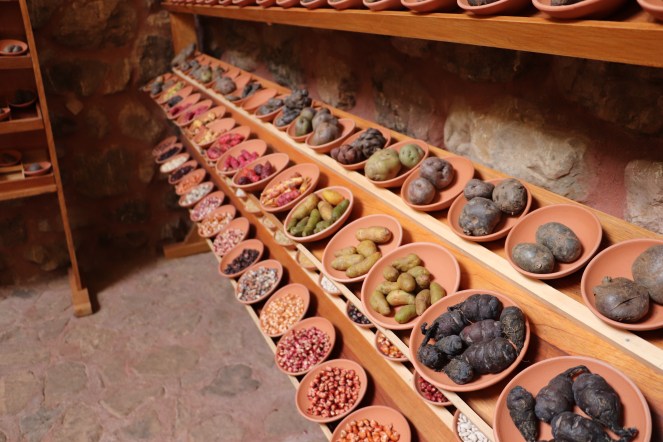
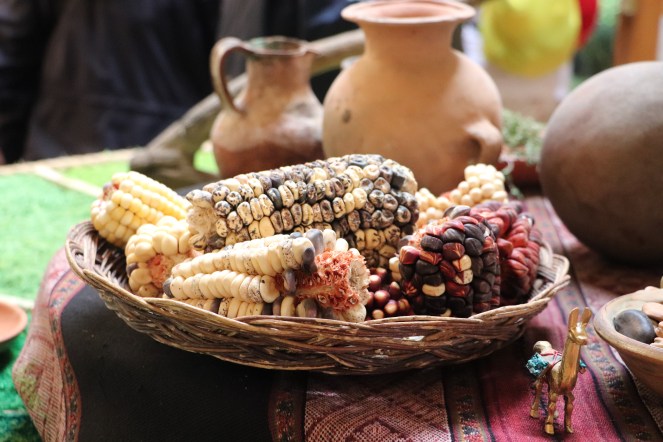
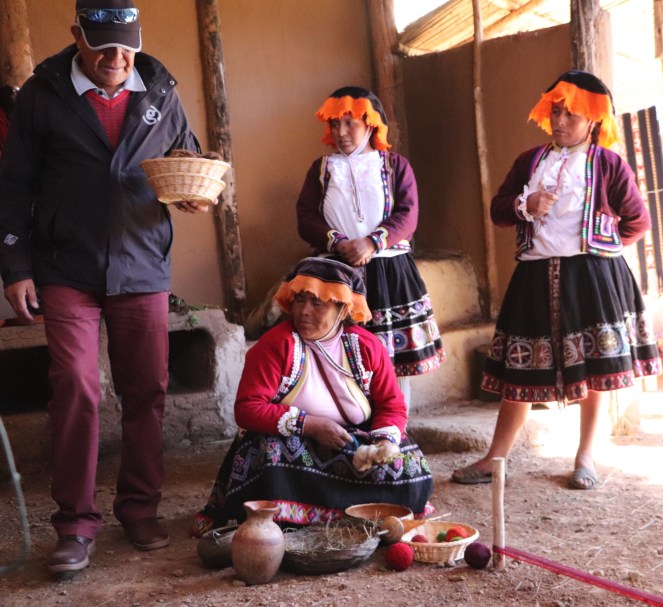
This Potato Park is a joint venture of 6 communities high up from the Sacred Valley (4000 m I think) in the Andes aided by the G Adventures Foundation. There are 6000 or so indigenous inhabitants here, all working together to preserve over 700 species of potatos, and teach about their cultivation. Who knew, but there is a seed vault of potatoes in Norway that holds seed potatoes in case there is some sort of catastrophic event. Once a year they travel here to secure new seeds for storage in their bank. We also learned about the cultivation cycles, producing alpaca yarns, dying them and weaving them. The women there work hard for long hours while the men are working in the fields to sustain them. It’s a simple life but they seemed happy enough.
Next it was back further down into the valley to Pisac Ruins and our guides were smart to have us head up to the Potato Park first, because the dozens of our buses at the Ruins were mostly leaving as we got there so we had less other tourists to deal with. It seems incomprehensible that the Incas built this amazing place, with acres of terraces following the natural contours of the land. With the sweeping green vistas and surrounding Andes, it was quite an eye full. Across the gorge from the building site there was also one of the largest burial sites of the Incas – some 3000 or more sites- where the Incas were buried in the fetal position with their treasured possessions around them to be used in the afterlife.

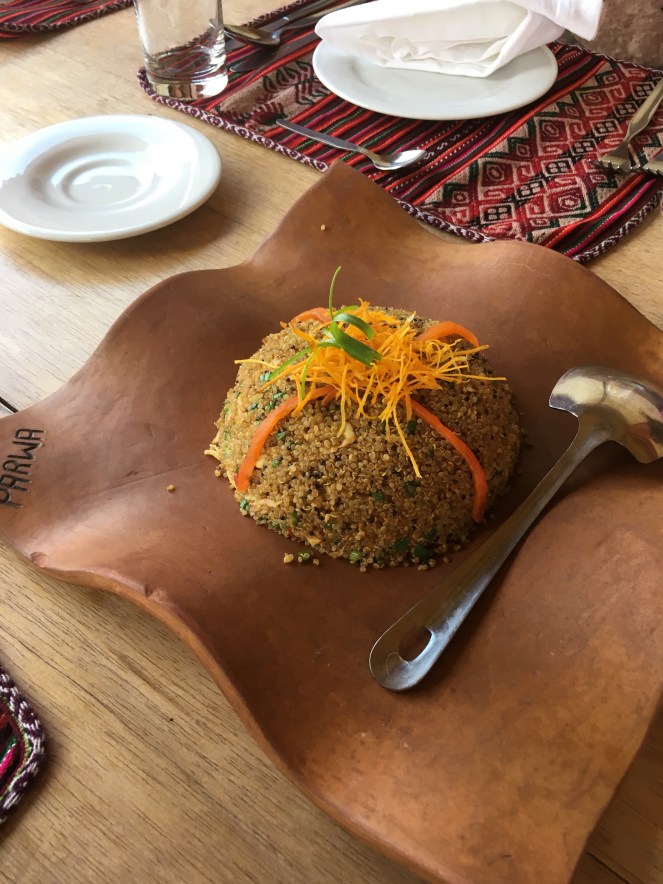
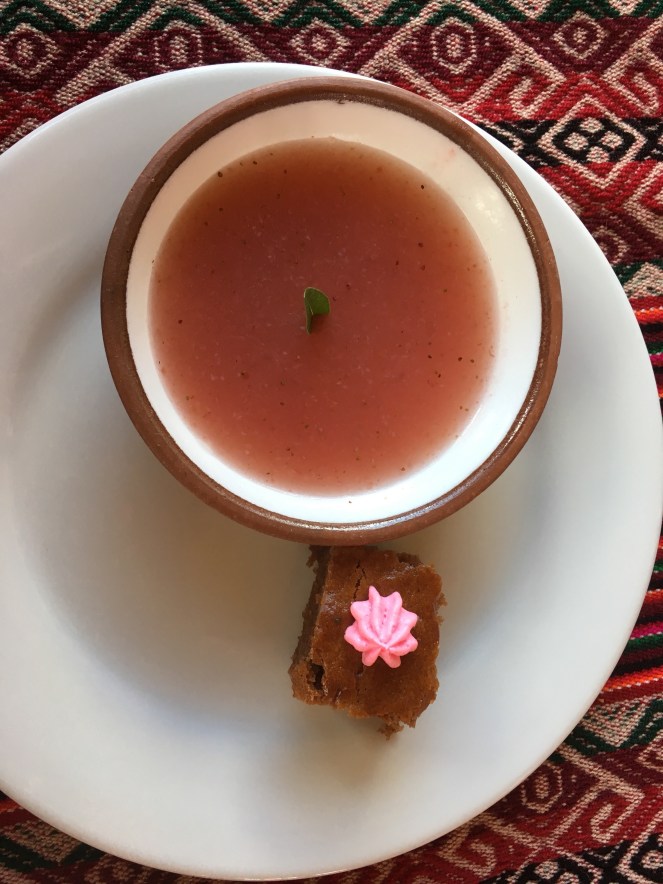
Thankfully lunch was next on the itinerary, and again we had a unique experience thanks to G Foundation. We travelled just a short distance back in the direction of our hotel and turned off the main road for just a kilometer or so to arrive at the G Adventures Foundation supported Sacred Valley Karma Community Kitchen. The foundation has helped set up a modern commercial kitchen, garden and dining facilities where each of it’s tour groups are treated to a fabulous local meal. I have to say it was right up there with some of the best meals of the trip. In the Andes region of Peru there are over 3000 varieties of quinoa and so our main dish was quinoa. But we had delicious salad from their garden, a couple of appies that tasted great, although I have no idea what they were. And dessert was strawberry jello, made from real strawberries and a little piece of chocolate cake. This meal was one of the components of the necessary life sustenance that we were going to need for this afternoon’s adventure to visit the Ollantaytambo ruins. The other was a nap on the bus on the way to the ruins.
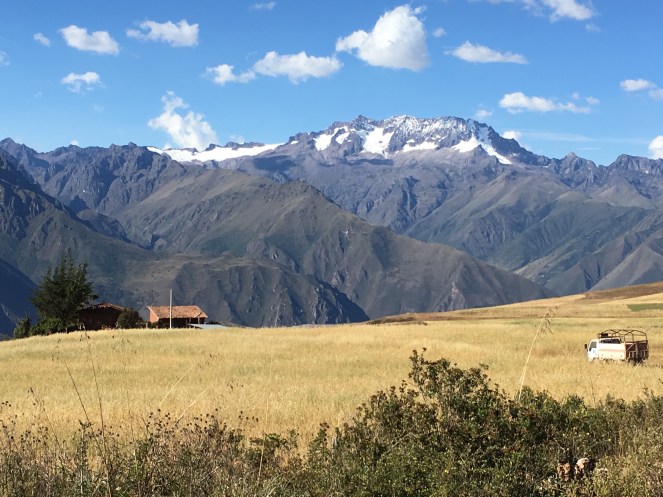
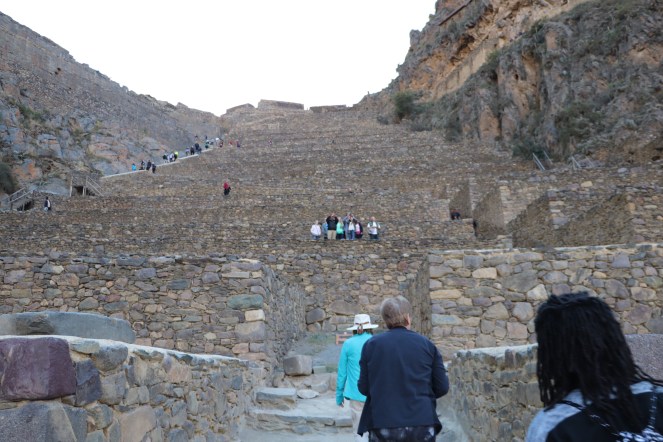
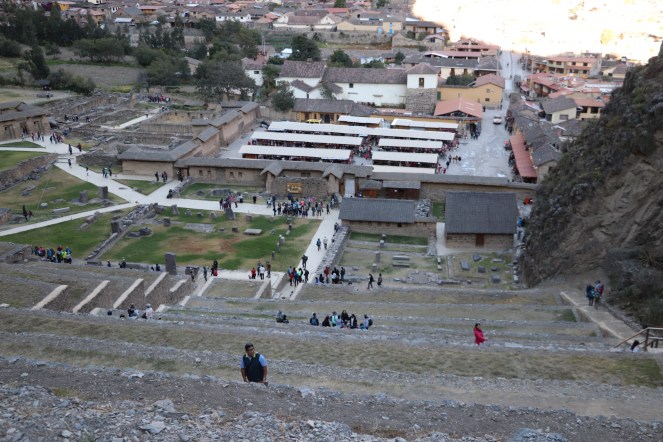
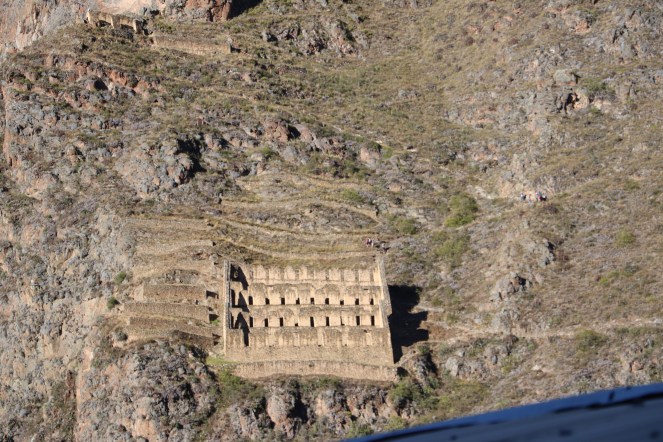
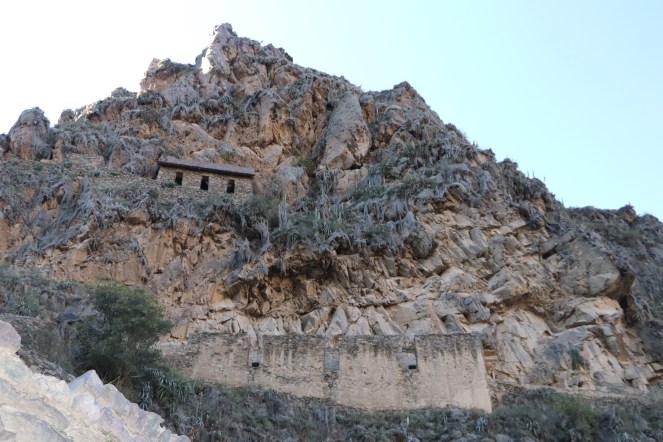
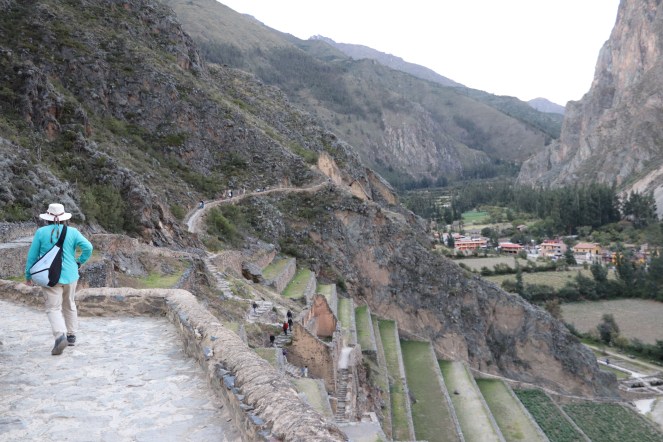
There was no getting away from uphill in order to see the Ollantaytambo ruins and only 9 or 10 of us managed to make it to the top and down safely. The others were safe, they just chose to bail at various points. These ruins were the site of the last battle between the Incas and the Spaniards, and because of the invasion by the Spaniards, Ollantaytambo was not completed. There are huge boulders ready to be installed all over the site.

We all took it really slow and were suddenly really interested in the bits of information that our guide was providing…. so that we could stop and catch our breath if nothing else. No really he provided so much information my brain is in overload. Incas were supposed to be rather short people so I can’t figure out why some of the steps were so high. One of the most interesting parts of the ruins for me was the amazing skill in building the Incas had. They didn’t use mortar and yet the huge boulders, which were cut and chiseled smooth in the quarry before being hauled up the side of the mountain, fit so tight that you couldn’t slide a piece of paper between them. You’ll note from some of the pictures that the architects of the time knew to use trapezoids instead of arches because of the risk of earthquakes and after all these years, they are still standing where many of the structures built by the Spanish after they conquered the Incas have been sent to the ground by various tremors. As our guide said, the Inca’s architecture and building can be summed up by three words: Simple, symmetrical, and solid.

Some factoids about Peru given to us by our guide, who is a professor at the University of Cusco, so I’m going to accept them unless proven otherwise:

  • Peru’s Number 1 export is copper, but they also mine gold and silver (Peru claims to be the largest exporter of silver in the world)
  • Peru’s second largest industry is tourism
  • Peru’s third largest industry is farming for export with the number 1 agriculture export being asparagus and second is avocados
  • Guinea Pigs which are eaten for celebratory dinners have recently been discovered to contain a huge amount of cancer-fighting antioxidants.
  • Peru exports guinea pigs, primarily to China
  • Sacred Valley grows wheat, corn, cauliflower, squash, tomatoes, apples, peaches, strawberries and avocados and lots more I didn’t get written down!
  • Lois likes Pisco Sours

One of the things our guide noted was that the Potato Park is one of the few areas that has remained relatively unchanged by the increase in tourism. He sadly notes that even the way houses are being built is slowly changing with the new ones being made from cement rather than brick. And the Urubamba River which flows through the Sacred Valley and ends up in the Amazon no longer supports any real fish habitat because of its pollution. We did our small bit with our guide buying drinking water in huge boxes (like boxed wine but bigger), and we just refill our water bottles from there instead of using the small water bottles.

Tomorrow we take the train up to Aquas Calientas for our assault on Machu Picchu the following day. Fingers crossed for good weather Wednesday.

Uncategorized

Peru did not start well

So, yesterday afternoon, we were picked up at the hotel at 2:30 pm by our usual driver, Victor, and so we were at the airport by 3:15ish for our 6 something flight. It took us a long time to get through check in and after Cara checking in our whole group individually, (well I helped with 3 of us), they started from scratch at the airport and issued us new boarding passes and luggage tags. We already knew our flight was delayed by 30 minutes as it had shown up that was the case the previous night. However, in the course of 2 hours, the time and gate changed 4 times keeping us on our toes and shuffling back and forth from gate to gate. Finally we were in the air and on our way.

After an uneventful flight, (those are the best kind) we were picked up by the G Adventures driver in Lima for our “40 minute” transfer to the hotel, arriving an hour later, or at 11:30 pmish. Needless to say it was a long day. And the hotel was not one of the best. 3 Star would be pushing it. We knew our flight to Cusco this morning was going to be early, but we received a note upon check in from our Peru CEO, Caty, that we would be picked up at 5:00 am so my alarm was set for 4:30. Breakfast was toast and tea or coffee, and we were on our way at 5 am. We met our CEO and the rest of the adventurers with rather muted enthusiasm, only because of the sleep deprivation. Once at the airport we discovered our flight to Cusco had been cancelled and we were re-booked on one leaving at 10:30 putting us 2 hours behind on our itinerary for the day. So the early start for nothing.

But things went up hill from there. We were able to have a leisurely breakfast at the airport at a restaurant that is apparently owned by the chef of one of the best restaurants in Lima. Our check in and security check was pain free and leisurely and the flight was on time leaving.

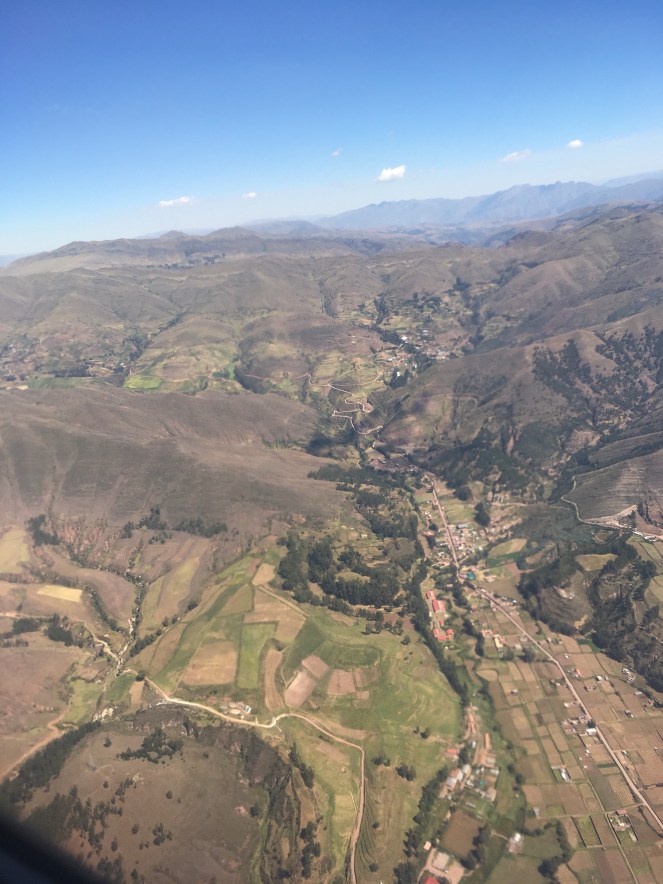
So we arrived in Cusco and in no time were on our way to the first of three stops today. Right from the get go, the scenery was amazing. Coming through Cusco we saw glimpses of what we have to look forward to later in the week when we return for two nights. Stunning architecture and a vibrant city. The plan is to spend the first few days in the Sacred Valley and Machu Picchu, which are lower than Cusco, for the travellers who just joined us to get acclimated to the higher altitudes. We got as high as 4000 metres today but didn’t have to exert ourselves at that altitude.

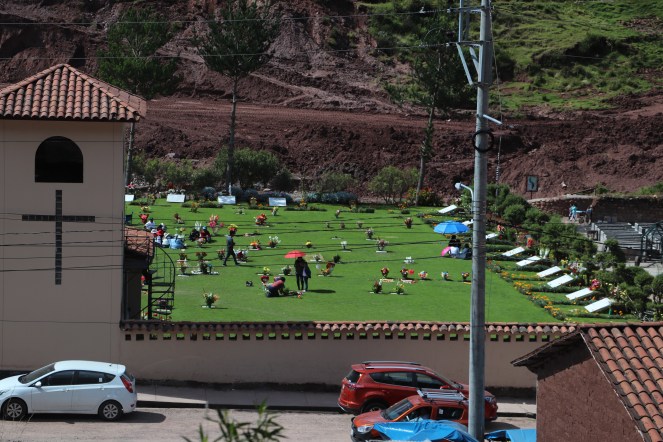
As we were leaving Cusco the traffic was snarled near two cemeteries as people were celebrating Mother’s Day here by visiting the grave sites of their loved ones. People were in a festive mood, setting up with big umbrellas and picnic gear all around the cemetery. Not a bad practise I’d say.

Next we went through Poroy, which is a favourite place for people from Cusco to celebrate graduations and birthdays etc. And they almost always celebrate by serving Guinea Pig. I had yet to try it but will given the opportunity.

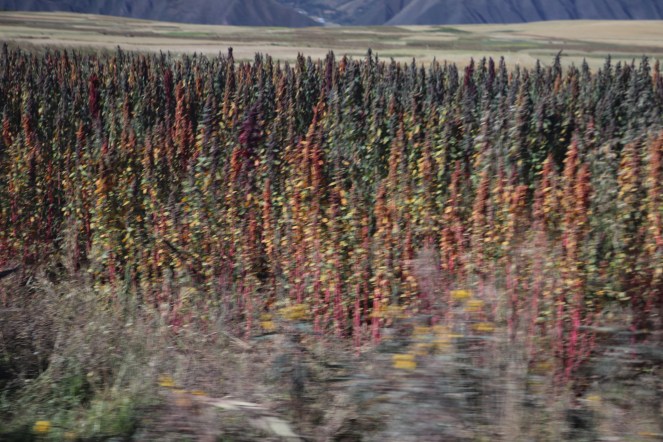
The area around Cusco and the Sacred Valley is still agricultural as it was when the Inca’s walked the land. The primary crops are potatoes, quinoa (all sorts of colours), wheat, and barley. The crops are 98% organic. Eucalyptus trees dot the countryside to help stop erosion. Hydro to all families and communities in the Cusco area is supplied from a hydro plant in Machu Picchu and it also supplies 37% of the power to all of Peru.

We passed a couple of lakes where speckled trout, whose ancestors were imported from Canada, are raised.

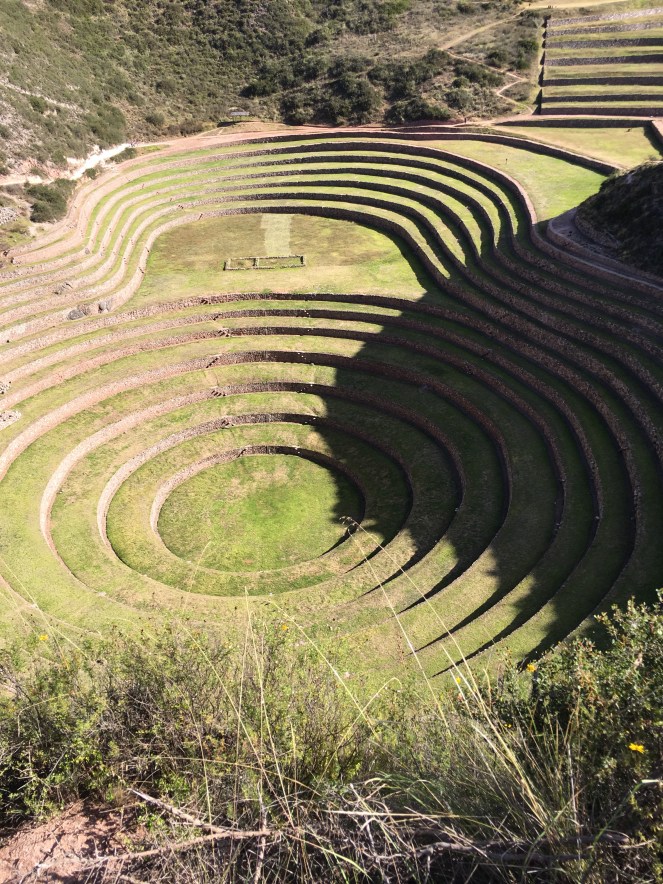
Our first stop was just off the main road and it was at the Moray Ruins. It looks like the ruins of a Roman amphitheatre with tiered seating, but archeologists believe it is an “Open Experimental Centre” built by the Incas in the mid-1400’s. Here all different climates in the region were replicated and various plant varieties were tested. It’s beautiful and pretty darn smart of the Incas. Most of the area has been restored (only 25 % of the area hasn’t been). The temperatures from top to bottom of the ruins apparently shift as much as 15 degrees. Thankfully our guide was really thoughtful and only had us do some walking down hill and directed our route so that the bus could pick us up and not have to walk back up hill again. We were all OK with that suggestion.

By the way, our CEO, Katy, has a degree in Tourism from the University of Cusco, and one of her professors was also with us today and guided us through the sites we visited.

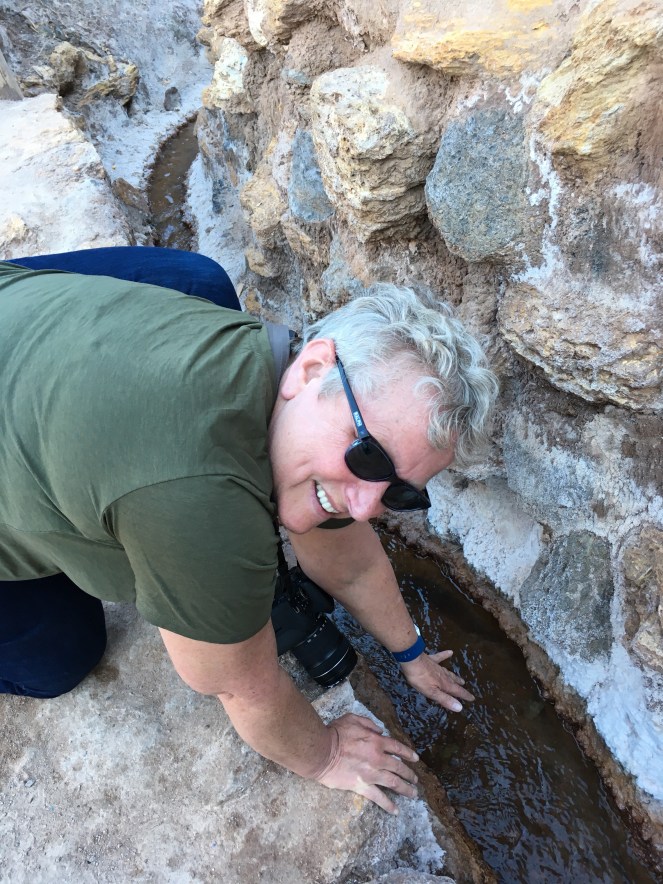
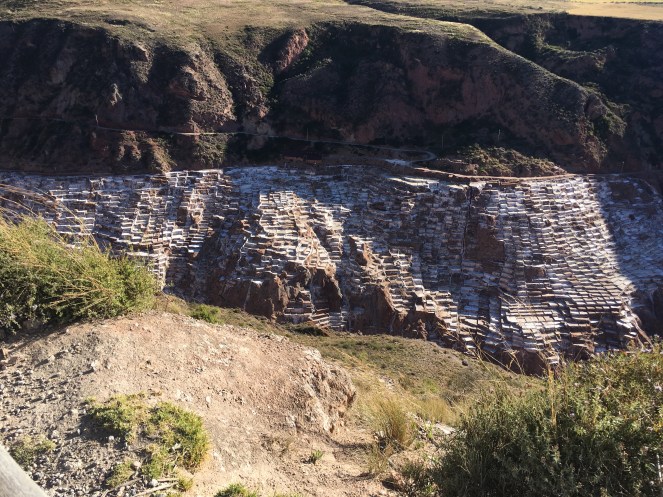
The second stop was at a “Salt Mine”, Las Salineras Pre-Incan Salt Pans, only it’s not really a mine. The water comes into the area and over 1000 terraced ponds, still worked by the community are producing a very special kind of pink salt, found in only 4 other places in the world. (Virgin Islands, Italy, Australian and one more I can’t recall). And yes, there was the opportunity to grab some of the famous pink salt at stands throughout the complex.

We wandered around the site, and had a chance to give the incoming water a feel and a taste. I was surprised to find out that it was quite warm water and not surprisingly it was really salty. It’s something like 3.5 times more salty than the Dead Sea. Their pink salt is shipped to Chefs around the world because of it’s unique composition of minerals.

Next it was on to what was supposed to be lunch but which turned out to be an early dinner. It was a dinner cooked in a 1000 year old traditional way called Pachamanca, They served the largest plate of food you can imagine. The meat (in this case, chicken, beef and lamb) and vegetables are cooked in an oven created by hot stones covered in the earth. It was delicious, but way too much food. I felt guilty leaving so much, especially since it was so tasty.

We made our way back across Urubamba to our lodge for the next two nights (Yay) and it looks really nice, but it was dark when we arrived so we’ll check it out tomorrow. As we came through town we drove past a festival of townspeople celebrating. Katy said there was a very popular folk singer scheduled to sing there tonight. There was dancing and music and even bounces castles for the kids. Might have been fun to join in, but we were all so tired we just wanted to get to our beds.

I’m not sure what I was expecting here, but whatever the expectations I had were blown out of the water. The views are absolutely breathtaking.

Tomorrow will be spent exploring more of the Sacred Valley.

Uncategorized

Final thoughts on Ecuador as we start our Peru adventure

Today is transition day, from the Ecuador to the Peru portion of the current tour. Nine of the 16 of us on the Ecuador trip are carrying on to Peru and 7 new people will be joining us in Lima. Our flight from Quito to Lima wasn’t scheduled until evening so it was a bit of a wasted day, although I was glad to sit still for a bit to catch up from the busy itinerary over the past week. And from the look of things, the next week doesn’t look any less busy.

Our driver Victor came to pick us up at the hotel today, and it was like meeting an old friend. He got us to the airport in great time using small winding roads instead of the usual route demonstrating once again his amazing driving skills. The flight leaving Quito changed gates and even departure times 4 times within 2 hours, and so we were on our toes making sure to be at the right place at the right time. It will be a late night tonight and an early morning tomorrow as we fly on to Cusco on an “early flight”. We’ll find out when we arrive in Lima what time that will be.

So, thinking back over our Ecuador trip, I loved every bit of it, well except Chris at the Envirowhatever park. I’ve sprinkled some of my favourite pics of Ecuador throughout this posting.

Our journey by bus every day (well we had a couple of 2 day layovers) was a delight. The scenery is spectacular with more interesting and beautiful things to see around every corner. From the highlands to the cloud forests and down in to the jungle, the rains and mists create a green paradise. Plants that we think of as houseplants that are difficult to keep alive in our climate grow with wild abandon in Ecuador.

Maria Sol jokes that some of our walks are “Ecuador flat” which means they can still be very hilly because it seems no where in Ecuador is it flat. Of course, throughout we have been surrounded by the Andes and volcanoes with their rugged peaks which are most often shrouded in clouds. And yes, there were some black humour jokes about eating the youngest and most tender first.

The Ecuadorian people are delightful for the most part, well except for that one woman that almost ran us down last night while smoking a cigarette, talking with the phone under her chin and driving without her headlights. We saw many poor villages where the existence was possible only because of the hospitable climate but the kids played and the adults seemed happy for the most part. Whether it be staff at the hotels, or restaurants they seemed eager to please. Perhaps it’s because tourism is a relative new phenomenon for them and they’r not yet jaded and tired of being on display. We did see a little of that, but the people in the community we visited in the jungle seemed somewhat shy and reserved rather than disinterested as they first appeared. Our tour guide Maria Sol, and Hector, the guide I hired in Quito when I first arrived, each have a passion for their country and were proud and excited to show off their country and its people.

Experiencing the food has been fabulous, thanks in great part to Maria Sol. She went above and beyond the call of duty to introduce us to the typical Ecuadorian foods and find places to try them out. Potatoes and corn are a huge part of the diet, as is rice. Chicken and pork are the prominent proteins although the indigenous people eat larva as well. Flavours are generally gentle, and even the “hot sauce” is not as hot as one would expect. But the food is fresh and full of beautiful herbs grown in gardens wherever food is cooked. There are about a million varieties of fruit, some of which are alien to us, but we dutifully tried some of them. Even the things that are familiar to us such as watermelon, and pineapple tasted so much better. Fruit juice is a staple and market stands offered up whatever was currently available.

Putting 16 people in a small bus and keep them running 12 hours a day, depriving them of sleep, adding altitude and heat and humidity and cold and damp and tropical rain and the consequences could be disastrous, but the theme of this group throughout our 8 days together was “it takes a community ” or “village”. We watched out for each other, helped each other up and down the slippery slopes and uneven pavement, shouted out a warning to watch fingers on the power canoes, pointed out forgotten items, reminded each other to bring the necessary items (do we need our boots for this activity?), helped each other through the transfer process today, etc. When Maria Sol fell last night, she had many concerned “villagers” each with advice and literally a hand up and shoulder to lean on as we made our way to the restaurant. I’m sure every day I heard the phrase, “it takes a community” as someone was helped along the way. I will miss those that have left the group to return home or carry on to other adventures, but look forward to meeting new people.

Would I recommend Ecuador to people looking for an interesting place to visit? In a heart beat. It reminds me of what Costa Rica probably was like 20 years ago. Cheap and cheerful and full of diversity. The altitude that had me worried going into this trip is not a problem but you should have prepared to deal with the symptoms.

I am sad to have left Ecuador behind but look forward with anticipation to our adventures in Peru and then on to Galapagos. As always, thanks for coming along for the adventure.