2025 Cruise

Beach Barbecue and Beginning of Goodbye

Today is our last full day of cruising and it was a really nice way to finish up this adventure. We had the Windstar’s very popular beach barbecue on the tiny island of Mayreau in St. Vincent and the Grenadines. There are 32 islands and cays in the Grenadines, nine of which are inhabited. Another of the islands in this country is Bequia, which I have visited on a previous trip and is one of my favourites in the Caribbean.  

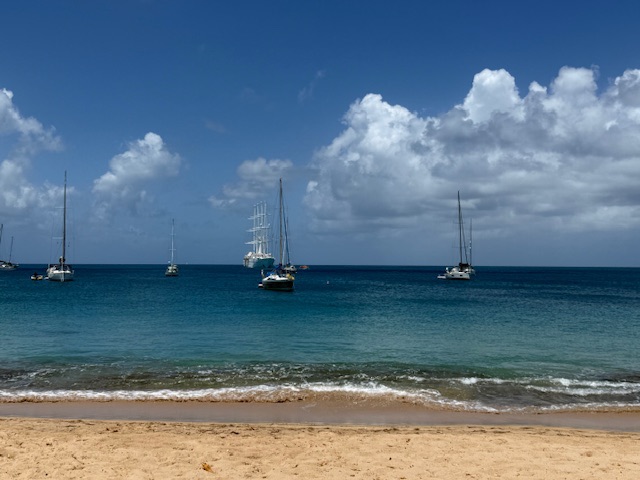
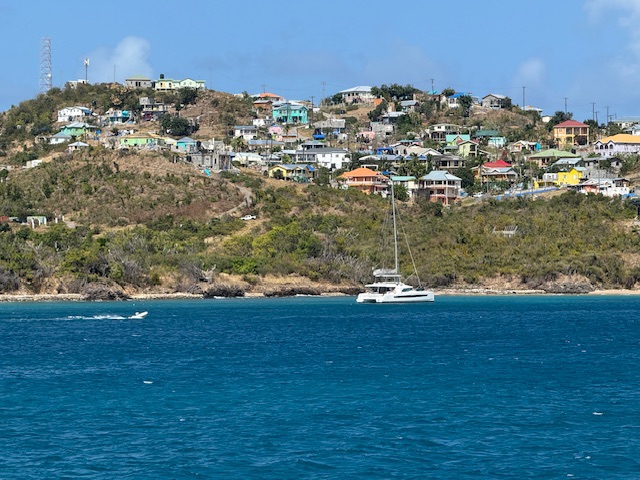
Mayreau is the smallest of the inhabited islands with a population of just under 300. The population is centred in an unnamed village located on a hilltop. Power to the residents is supplied to the residents by a central  generator located on the hillside of Saline Bay. The slave’s decedents who stayed on this island after slavery was abolished were given land to live on and they fished and farmed to make a living. In recent years, tourism and fishing has been the main source of income. There are a couple of seafood restaurants, a guesthouse and a small shop, as well as several vendors selling bright souvenirs on the walkway along the beach and near the pier where the tender dropped us off. There were a number of sail boats anchored in the bay, and the sailors were enjoying time along the beautiful white sand beach along with us. 
We visited this island last year as well, however the island got hit with Hurricane Beryl in July 2024 which apparently caused damage to 70% of the structures on the island. It was obvious even from a distance looking up the hill that there was lots of reconstruction going on – new looking roofs and evidence of new wood walls, etc. And some homes that were completely gutted. On the beach there were lots of trees partially or totally uprooted. 
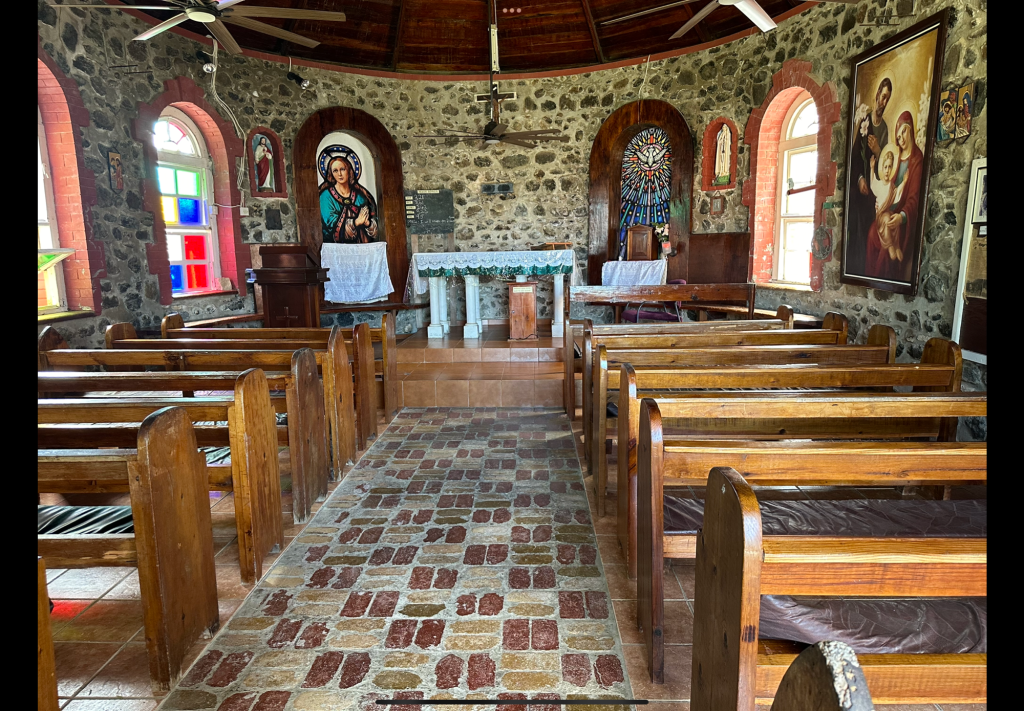
Last year when we visited this island, we walked up the hill to see the little (unnamed) town there and to see a little church at the top of the hill. It had a fabulous view of the island and our ship in the bay. The church was rustic but beautiful.  I’ve included a picture we took last year. Sadly the church was damaged in the hurricane and subsequently collapsed and is beyond repair. It hasn’t been rebuilt. This small community must have been devastated. We were very sad because it was a really pleasant memory for us. We didn’t walk up the hill today as we didn’t want to see the ruins of the church. 
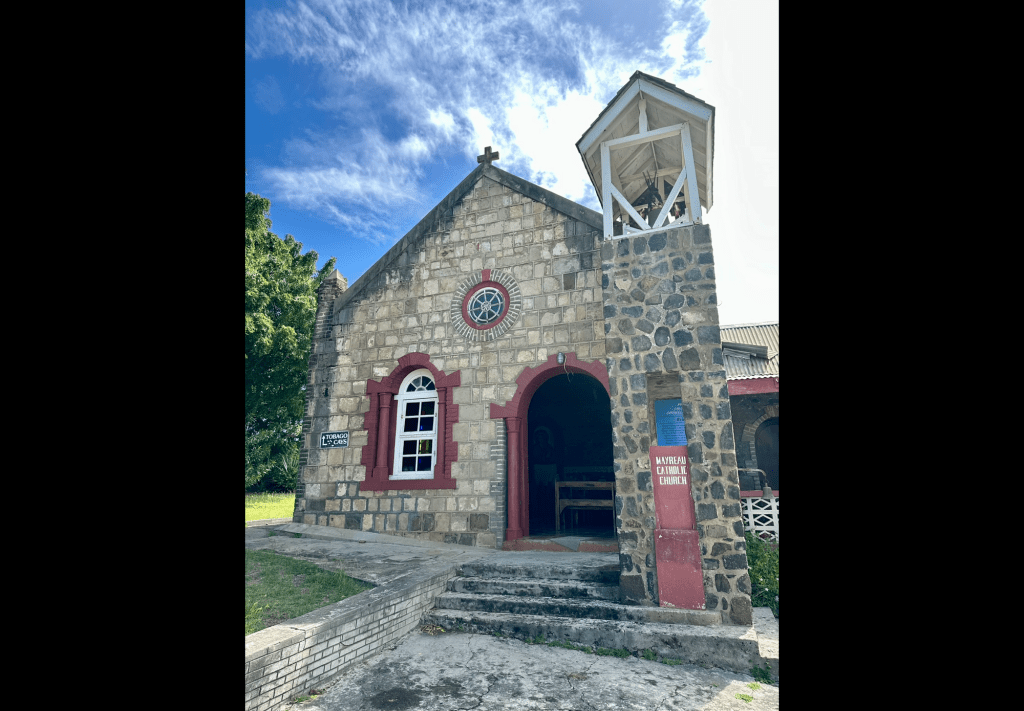
January 2024 picture of church now destroyed

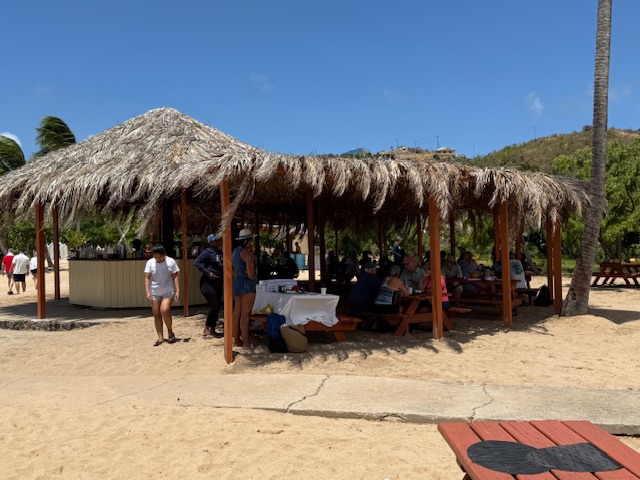
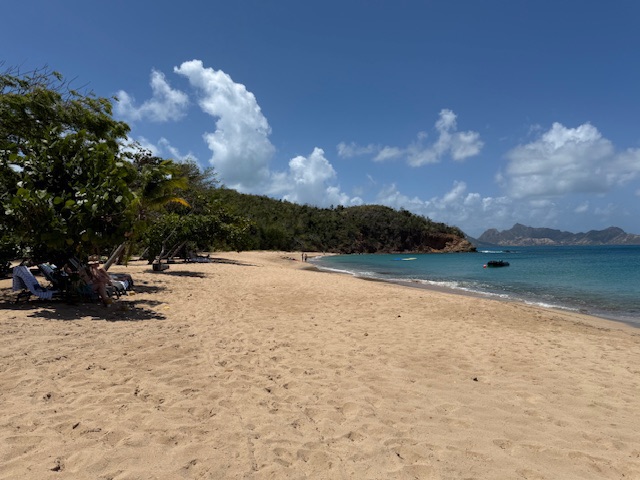
We did however, join the beach party and grab some lounge chairs under the shade of some trees along the ridge of the beach to enjoy the breeze and a view of the beautiful turquoise water. At noon our barbecue lunch was ready and we enjoyed a fabulous buffet of salads, veggies, burgers and dogs, jerk chicken and grilled fish. Oh yes, and dessert. An amazing amount of work goes in to these beach days. The chairs are stored on the island but stacked up and locked waiting for the next time a Windstar ship comes along. They have some permanent structures like a lovely clean washroom, bar area and solid wooden picnic tables but everything else is transported from the ship in the morning and taken back at the end of the day. They have a complete bar set up, and place settings for 120 passengers on the picnic tables including place mats and silverware along with solid white plastic plates. 
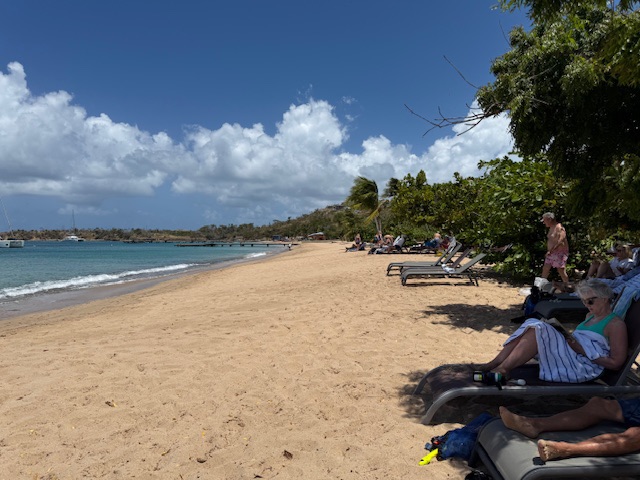
Adrienne did some snorkelling along rocks at the point of the bay and said she saw lots of fish, including Parrot Fish, and Blue Tang fish. Clair and I walked along the edge of the water enjoying the breeze and the view. And then it was then time to get back to the ship to clean up, cool off and take up our station on our favourite bar stools on the pool deck. 
This was one place where the transfer from the tender to the ship or vice versa was really challenging with the sporadic waves playing havoc with the process. The crew does an amazing job of keeping every safe. I was about to take a step on to the dock on our return when the edge of the tender dropped a couple of feet and the dock disappeared! My leg ended up hitting the edge of the dock as I was mid step. Thankfully, I was hanging on tight, the staff had a grip on me and the tender came back up to level with the dock very quickly and I was able to get all of me on the docking platform. I was no worse for wear, though, as my leg had hit sideways rather than right on. 

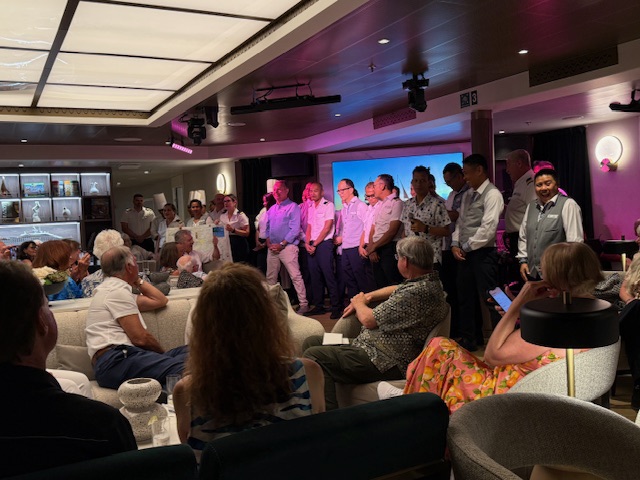
It was the Captain’s farewell in the lounge before dinner this evening when the Captain introduced the officers and rest of the crew who were available and they all joined in and sang the song “Sailing”. It’s a really nice moment. Later in the evening as we left the bay on Mayreau we had our final “Sail Away” to the sight of the sails filling, and the sound of Vangelis’ “Conquest of Paradise” and tonight an added extra song by Andrea Bocelli, “Time to Say Goodbye”. And tomorrow I will say goodbye to my fabulous travel companions Clair and Adrienne. So a surprisingly emotional evening. 
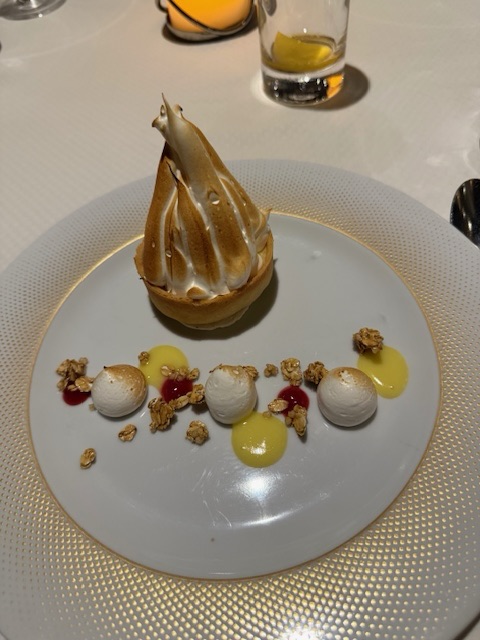
And then it was the “Last Supper” which included this amazing Mile High Lemon Meringue Tart .
I’ll be travelling all day Wednesday and won’t have much to say. Will try and do a recap in the next couple of days.

It’s been a great adventure and I’m sad that I’ll have to take a hiatus from travelling with Windstar, through no fault of the many employees who made our trip amazing.
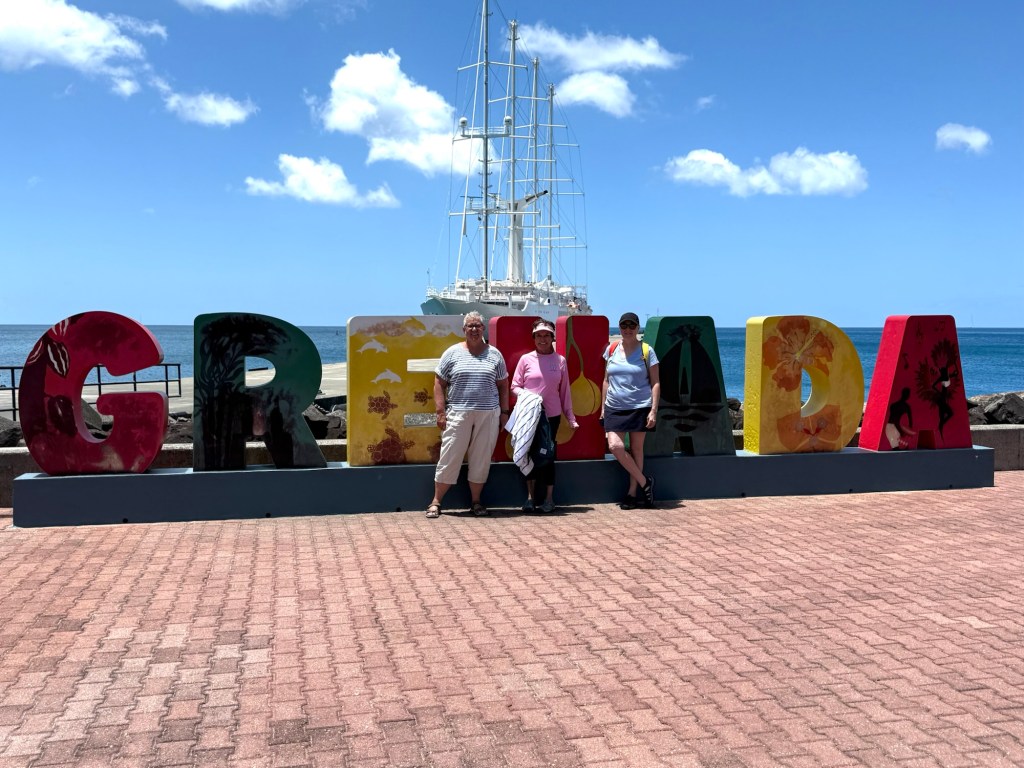
2025 Cruise

Up A River Without a Paddle

The first stop on my cruise two years ago was Grenada, and today we visited it again. Last time I did a snorkeling excursion to see underwater statues but I decided to do something a little different this time. More on that later. 

First of all, let me remind you of some history.  

Historically, the French and the English fought over the islands with the English eventually winning out. They brought slaves to the island from Africa to work the land and grow spices and indigo until they were emancipated in 1833. Now the majority of spices are grown in small independently owned plots on substantially sloped hills throughout the island. The islands eventually became part of the British commonwealth gaining their independence in 1974.

Now is possibly time for a reminder that my information is sourced in various ways, and can not at all be considered totally accurate. I try and find legitimate sources but some of the stories told by guides are so much more fun and interesting that I can’t help but include them. There is no question some are exaggerated.

Cuba got quite involved in the island during one particular socialist government and they even built a huge General Hospital for the people of Grenada. According to Wikipedia, there was a military coup in 1983 and the US came in to help re-establish democracy which led to the house arrest and execution of the previous leader and Prime Minister of Grenada. General elections were held in December of 1984.

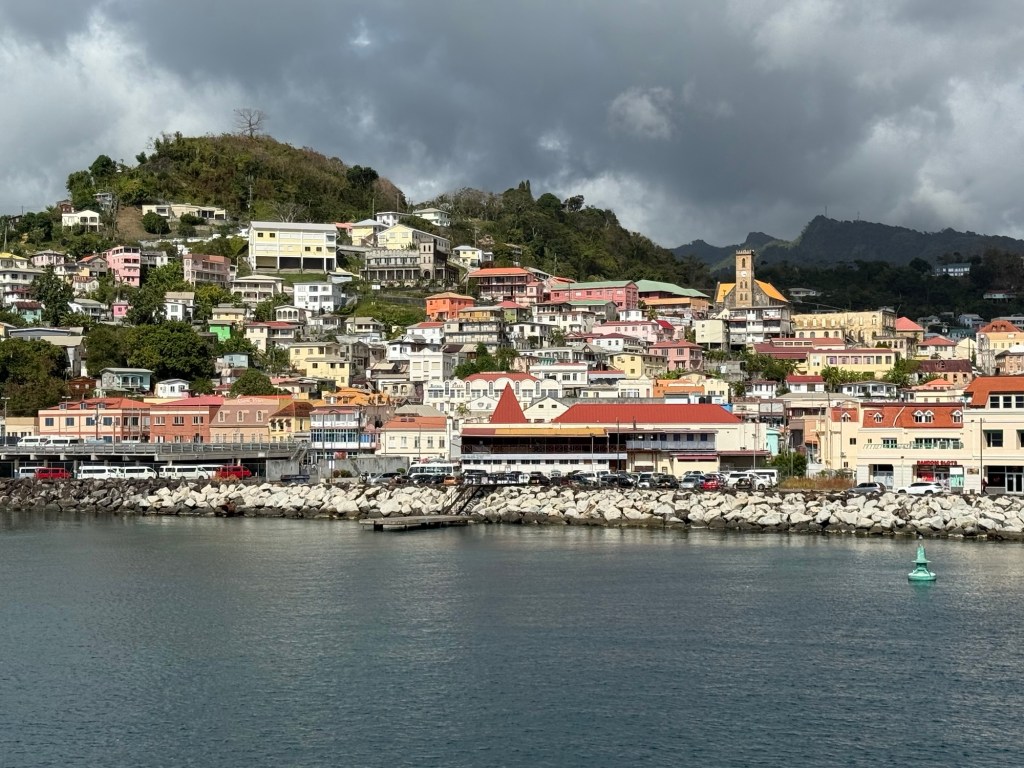
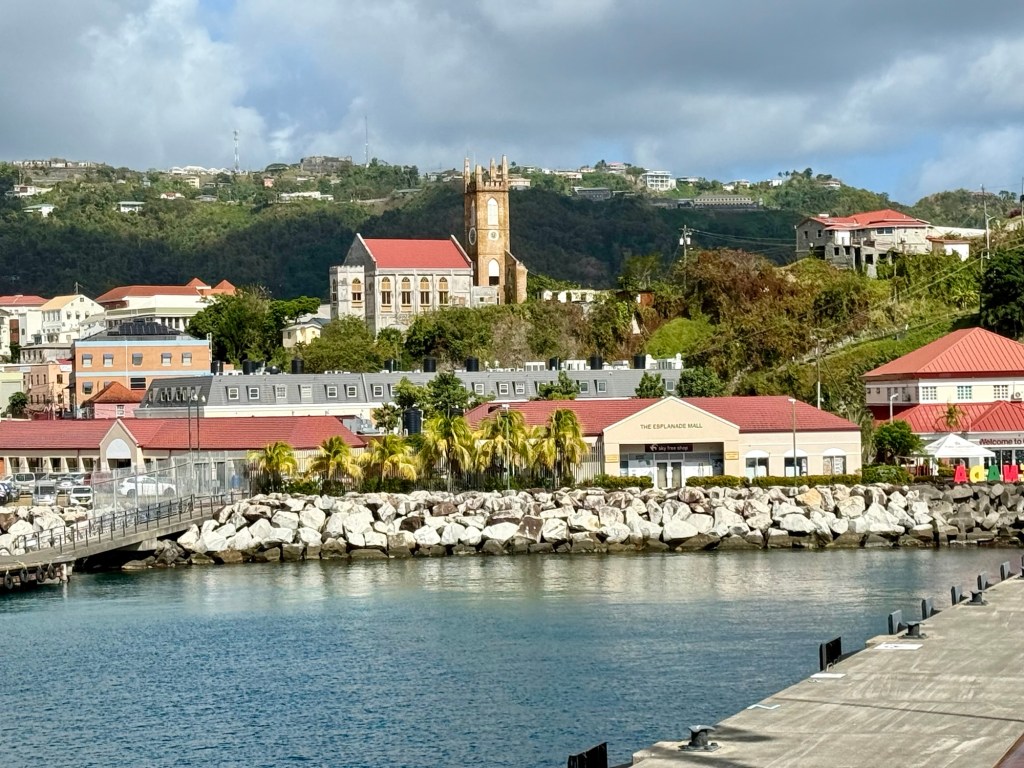
Grenada is nicknamed the Spice Island because of all the spices found and grown commercially here. The spice market is a treat for the senses with the colourful dress and aromas of spices hanging in the air. It’s also somewhat chaotic in the “downtown” St. George’s area. Lots of traffic, no where to park, and poor traffic police trying to make sense of it all. St George’s is on the south west coast of the island at the entrance to a great natural harbour.

The spice Grenada is most famous for is nutmeg, but others found here include turmeric, cinnamon, all spice, ginger, cloves, and bay leaves. There are also all 3 types of the cocoa found in the world on this one island. 

Its primary industries are agriculture and tourism, and fishing is becoming more significant. There are many larger fishing boats tied up along side the sidewalk along the Main Street on the natural harbour side in St George’s.

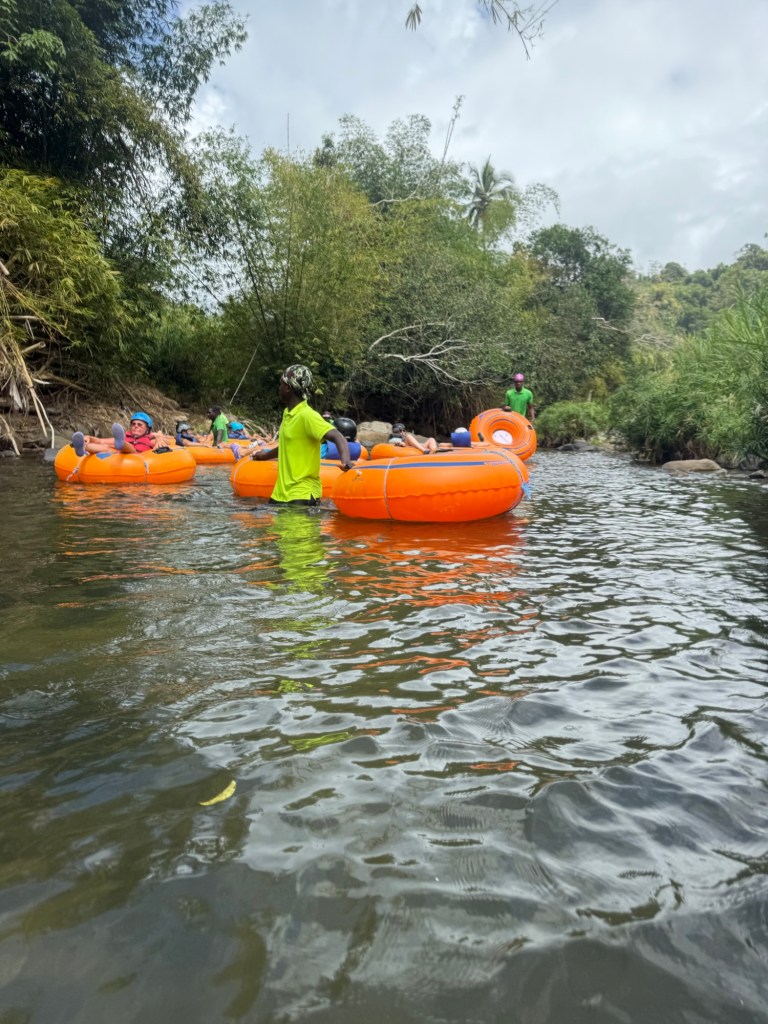
Our adventure for today, was river tubing on the Balthazar River! The starting point was high in the hills in the centre of the island. I had walked through the downtown area of St George’s last visit but it was great to see some of the rest of the island as we travelled by van to get to the launching spot for our adventure.

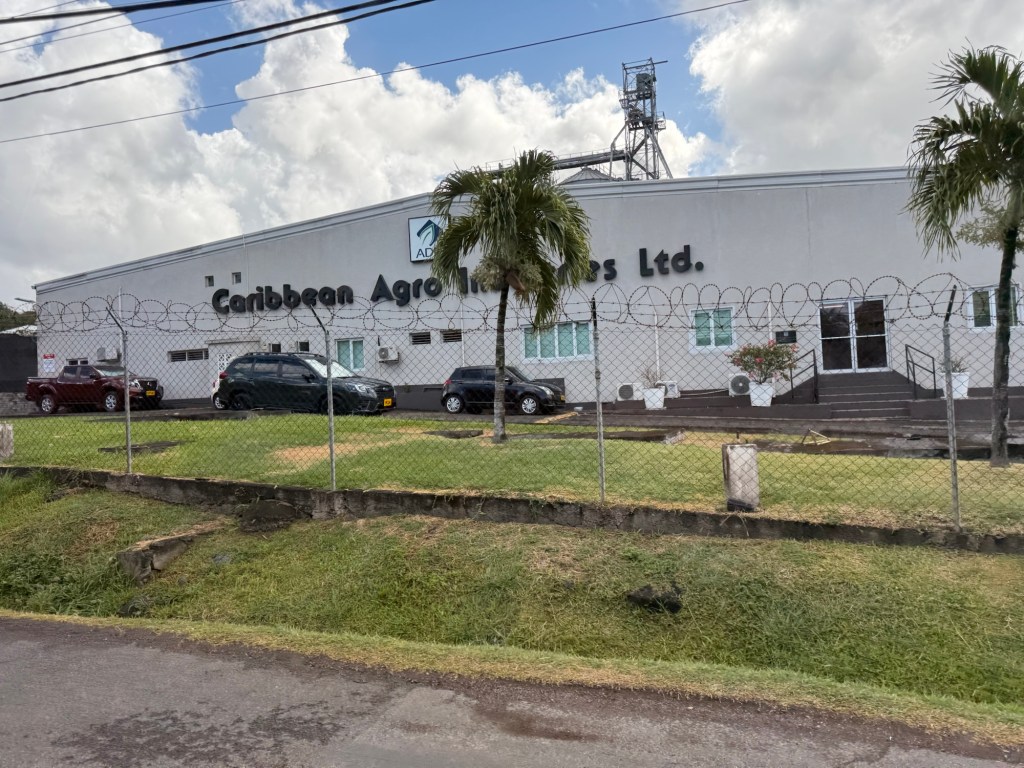
This company buys wheat from Canada and makes it into flour here on the island.

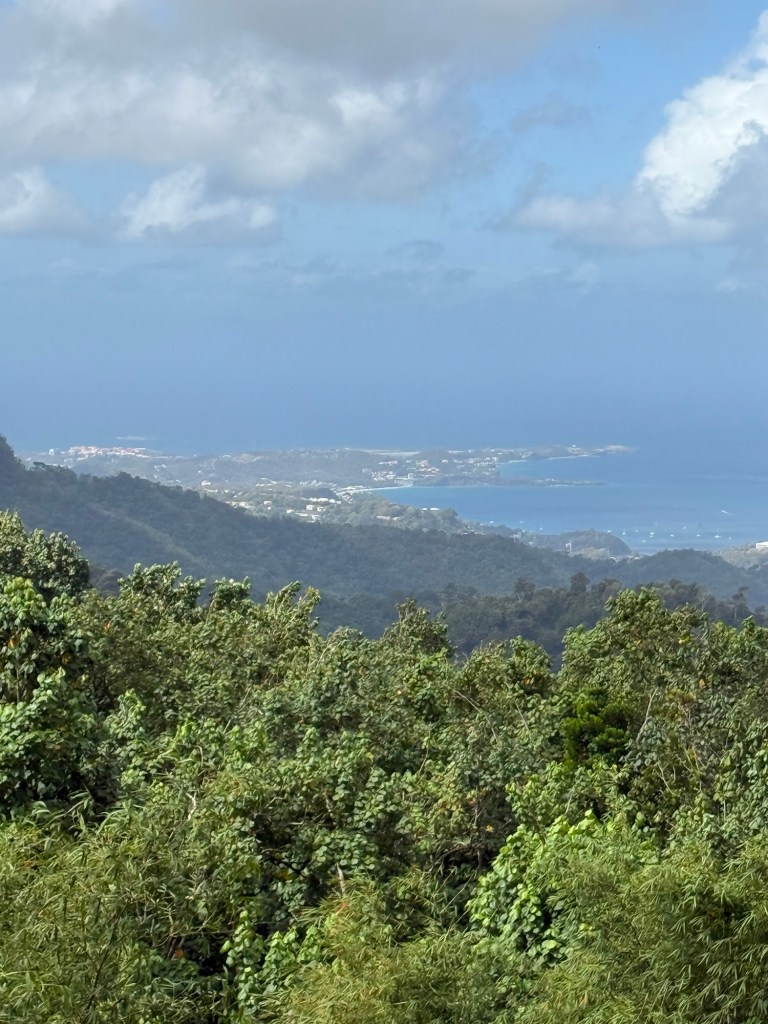
The expert van driver took us up, up winding, narrow roads, honking as he passed each vehicle which as he explained is just saying hello to the other drivers who he knows. We stopped at a lookout to get a sense of how high we’d come and had a great view back to the downtown and port area. He pointed out many of the trees bearing the spices for which the island is famous. We entered the Grand Etang National Park and through the centre of the island to get to the headquarters of the river tubing company. 

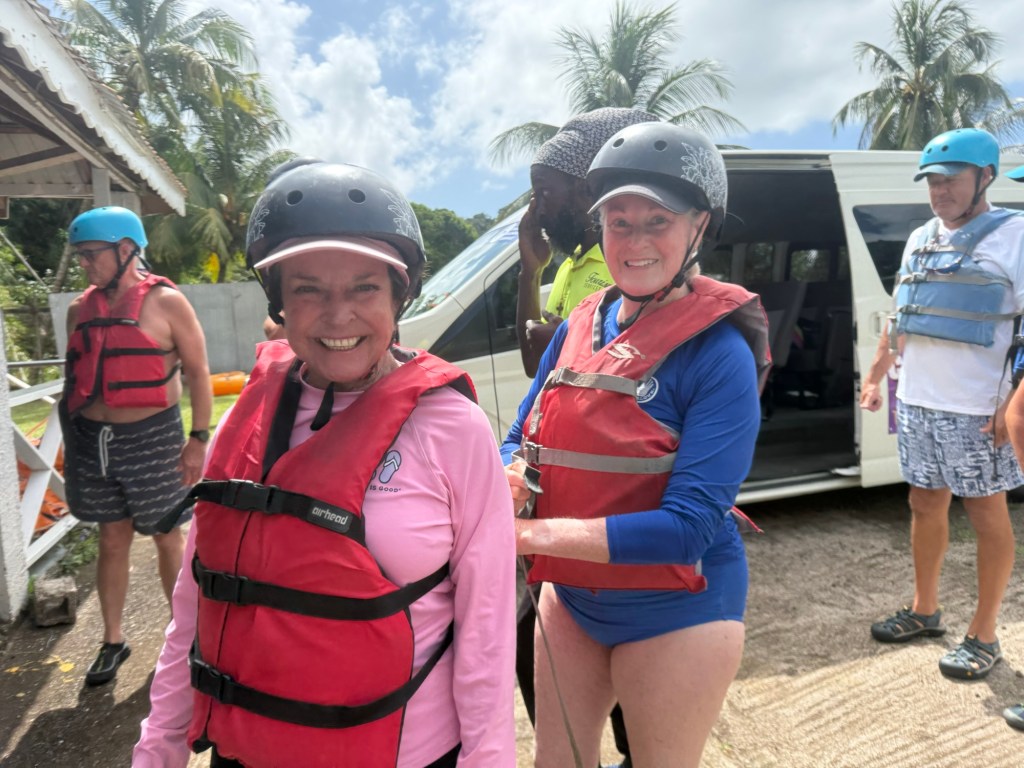
After being given helmets and life jackets and a briefing on how to sit in the tube and where to put your feet, etc, we were ready to go. There were about 20 cruise ship passengers on the adventure and 7 or 8 strong lads to help. At the bottom of some steps leading down to the river, we each eased into the tube, some more graceful than others (I’ll leave it to your imagination to determine which camp I was in) and were sent on our way down stream.

The river level was low because of not much rain, so conditions were not ideal, but we managed to have lots of fun anyway. The strong lads spread out along the group and kept everyone on track. At times we bogged down on rocks or spun into areas where the current kept us from entering the next rapids, and they came along and pulled or pushed us into the right position. We also got better at using our legs to lift up our butts, pushing off rocks with our feet or hands or jiggling ourselves free to get over the shallow areas. As the leader said we would, we got our six pack exercise today for sure. 

There were lots of spots where the water was higher, there was a narrow channel and we got spinning around going through that section at a good speed giving us quite the thrill. I was laughing out loud much of the way. I took my phone with me, but was only brave enough to take my hands off the handles a couple of times to take pictures. The guys did their best to entertain us and make sure we had a good time, but I sure felt sorry for them having to haul my sorry ass across rocks a couple of times. Overall, it was a fun experience and one of the times I’m glad that I work out and could manage the physicality of the adventure. 

We came back to the ship and got cleaned up and had some lunch. One mustn’t miss a meal, after all.  Then we headed out to walk around town a little. We ventured in to the port area, getting to it through a narrow one-way car and two way pedestrian tunnel that cuts under one of the hills on the edge of downtown. The near side of the port was very commercial, with lots of fishing boats tied up by this point in the day.  So our walk was short lived. 

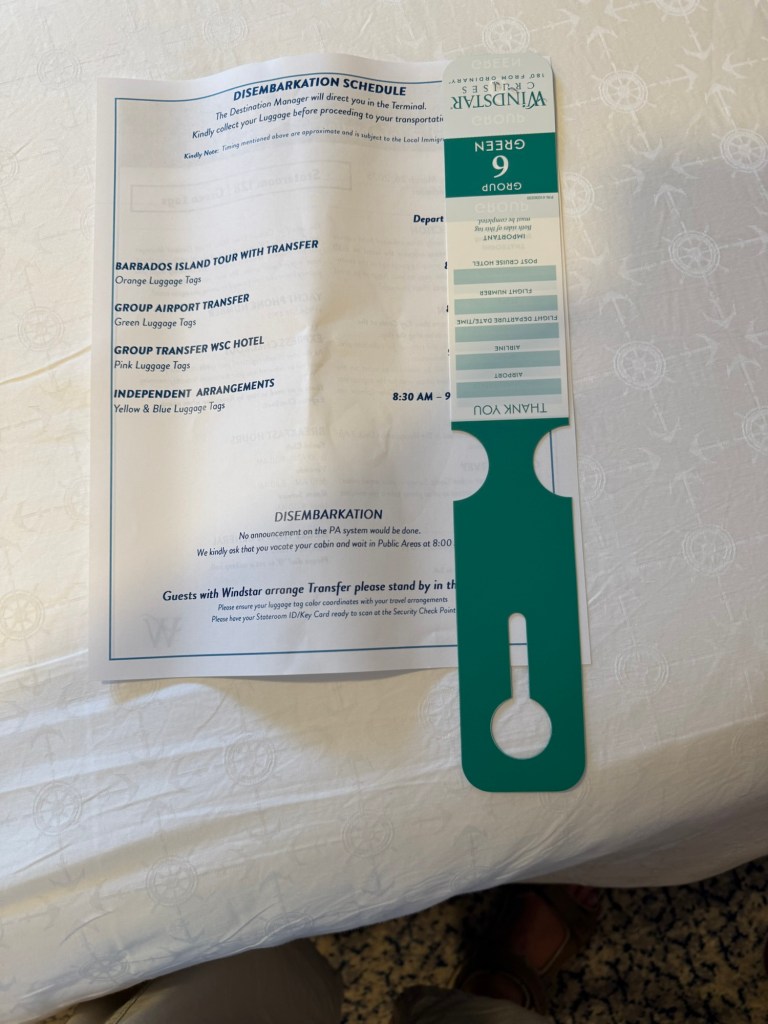
While we were at dinner, the information and luggage tags for disembarkation were delivered to our cabins. Always a sad sign but starts the mental process for re-entry. One more day and two nights on the ship and vacation 2025 will be done. 

2025 Cruise

It’s election time! Well in Curaçao.

The Main Street along the harbour taken on the Queen Emma Bridge.

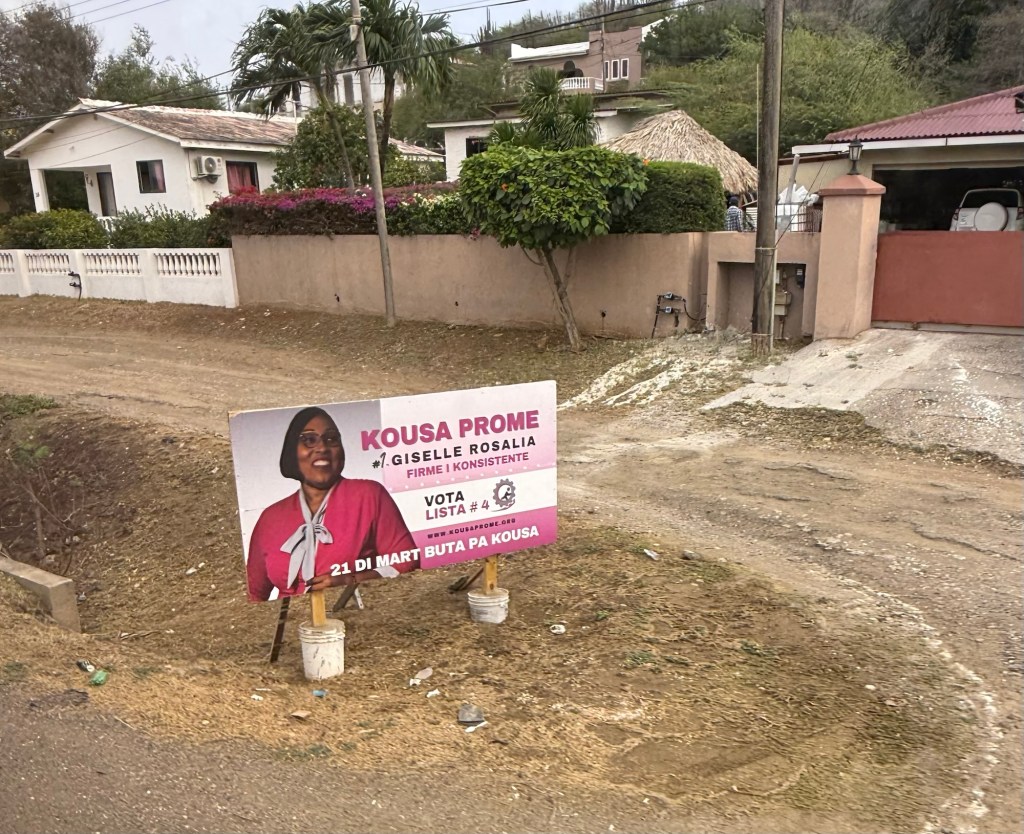
Today, our visit to Curaçao coincided with a national election day! Schools are out and businesses are only open 4 hours to allow citizens to participate in the democratic process.  As we travelled around Curacao we saw evidence of electioneering. Signs, both large and small, flags posted to telephone poles, and caravans of buses and cars travelling around were all seen along our way. 

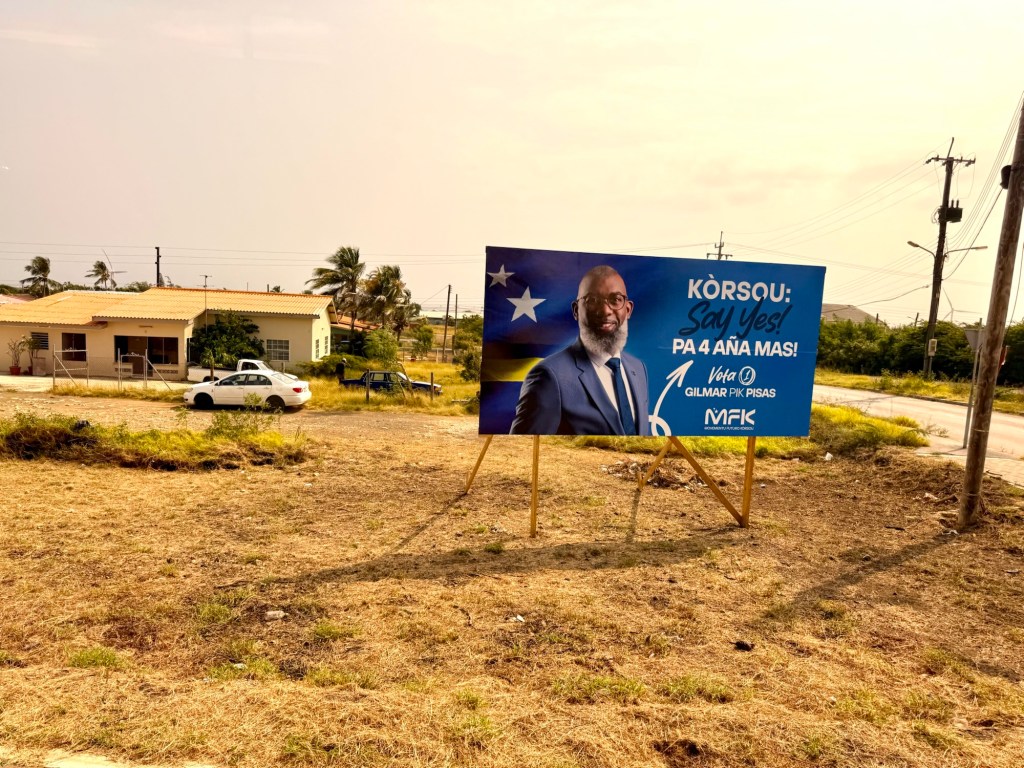
We each guessed who was going to win the election based on the number of signs around and turns out we were right. The MFK Party, a centre right party, won with 52.8% of the votes and the next closest was in the 20% range. The MFK Party has 9 of the 21 seats with the remaining seats being held by 5 other parties.  But enough of electioneering, we’re here on vacation! There will be enough election news in Canada in the coming weeks from the sound of things. 

This was the winning party.

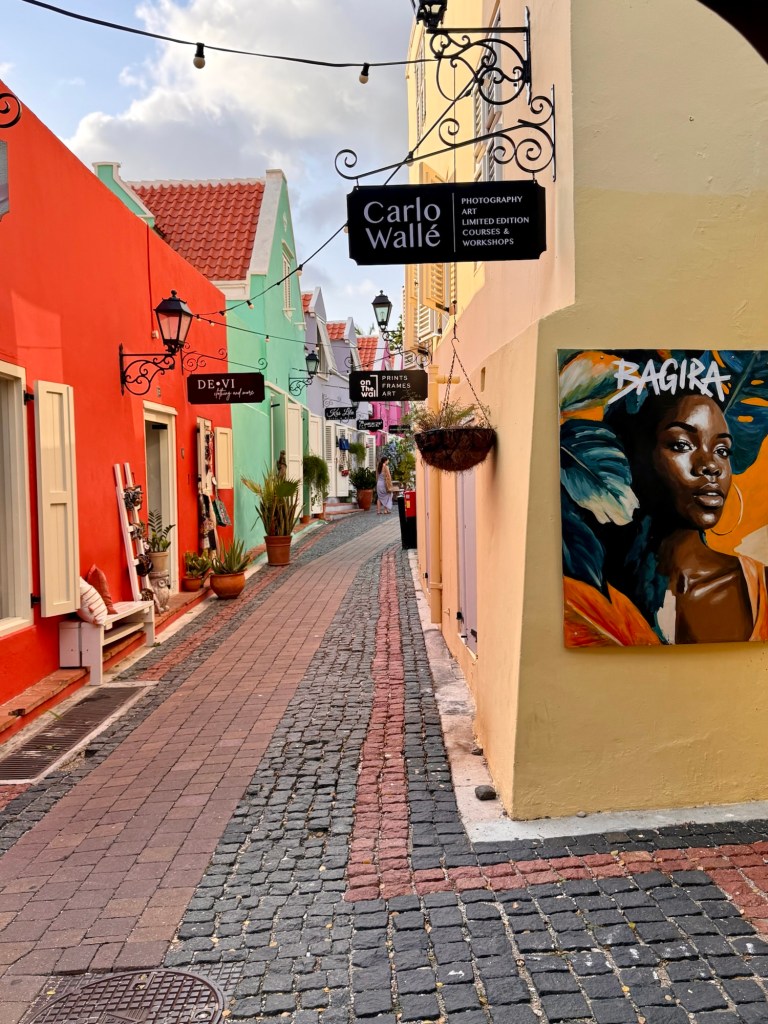
This is my second trip to Curaçao in as many years and I loved it as much this time as last. Last time we did a historical walking tour of the main harbour area, and through the old part of the city which has been revitalized. This year we did a bus tour around the island, that included three stops and gave us a great idea of the whole island. 

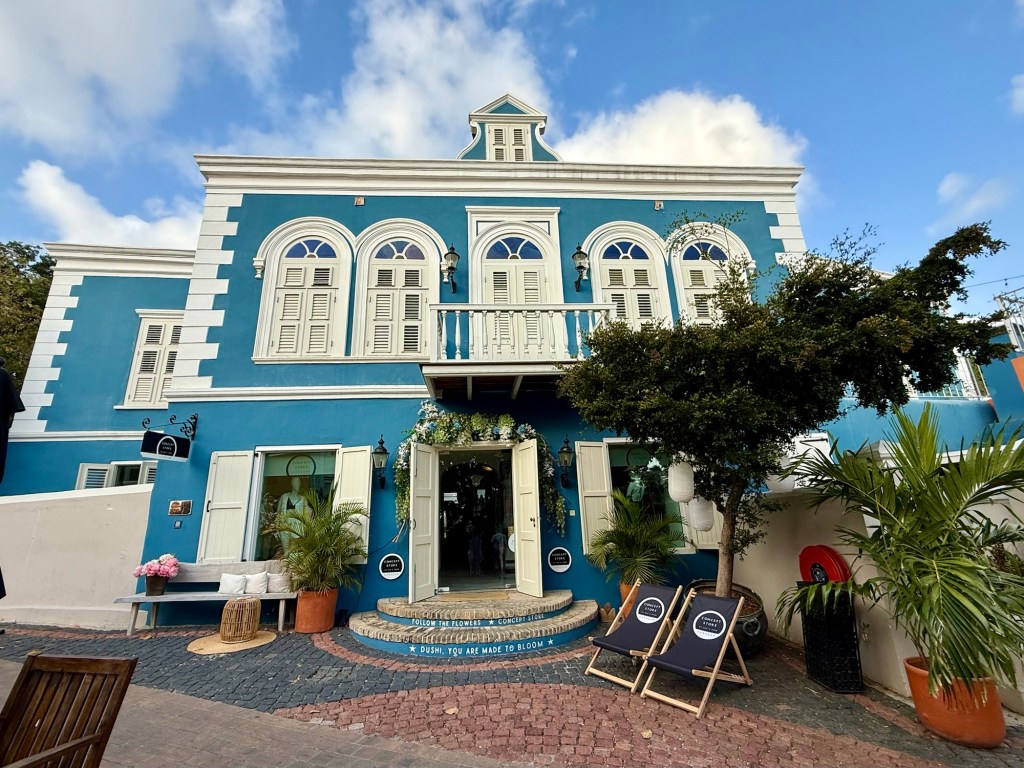
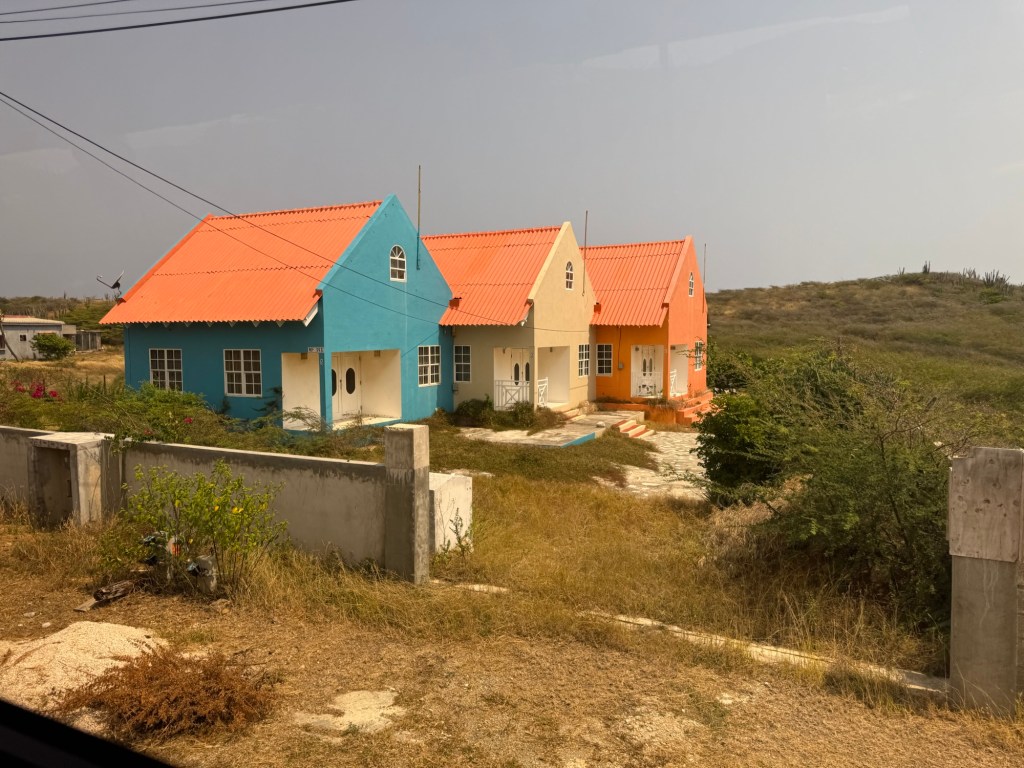
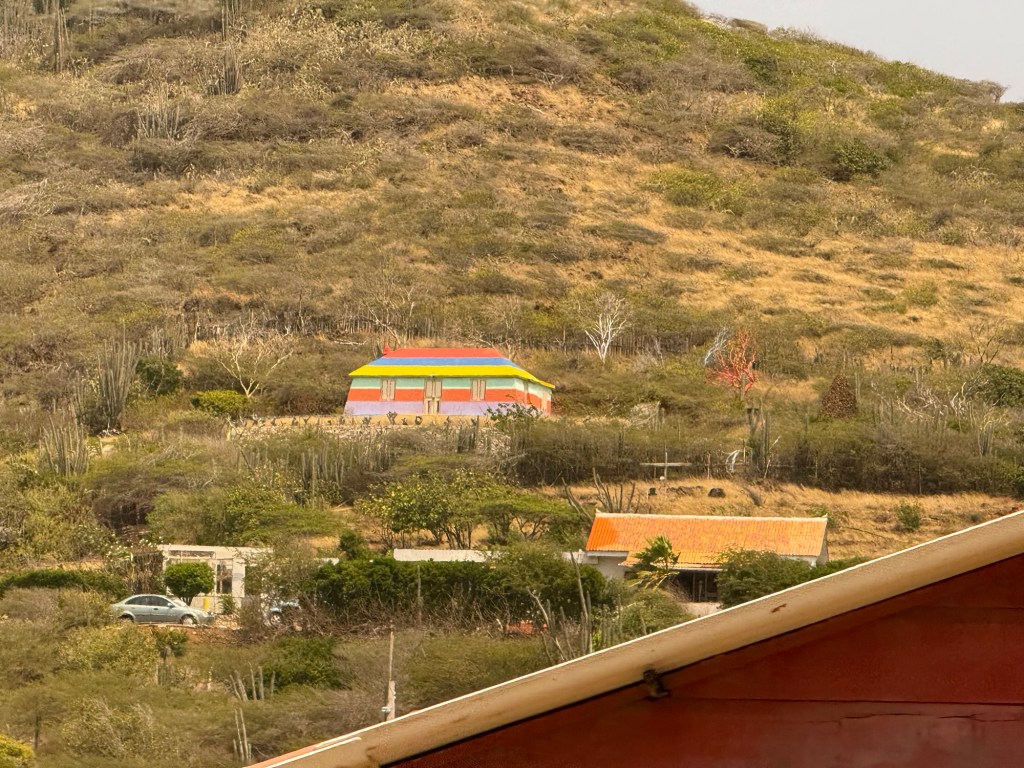
What is immediately apparent upon coming in to Curaçao is that the paint companies do a great business here. Buildings, including residential and commercial ones as well as government buildings are brightly coloured. I’m remembering that we were told last year that at some point in the history of the island, the ruling parties insisted that all buildings were white, but once they were overthrown the citizens showed their independence by painting their buildings every colour of the rainbow. 

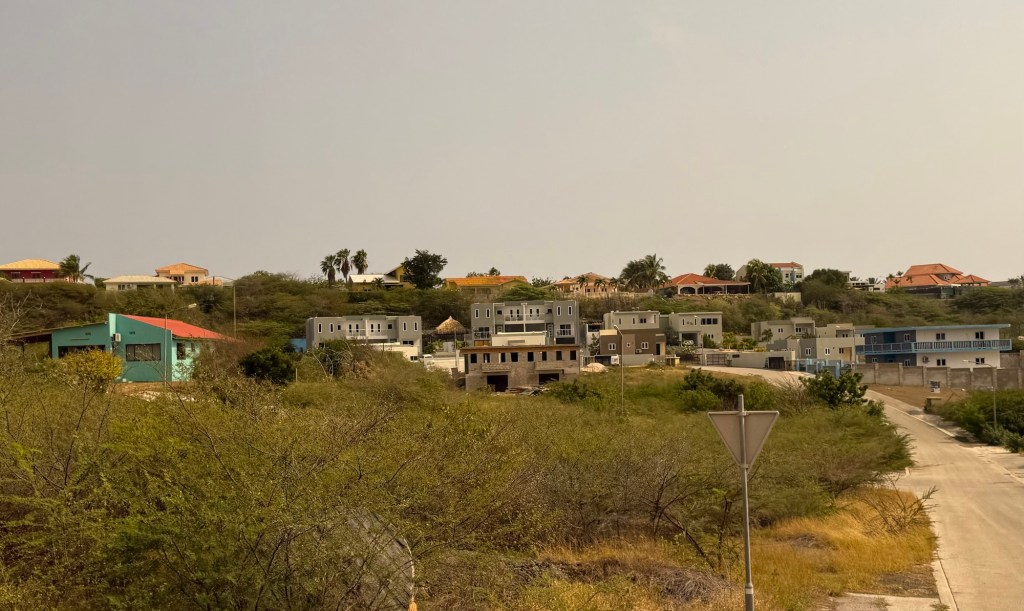
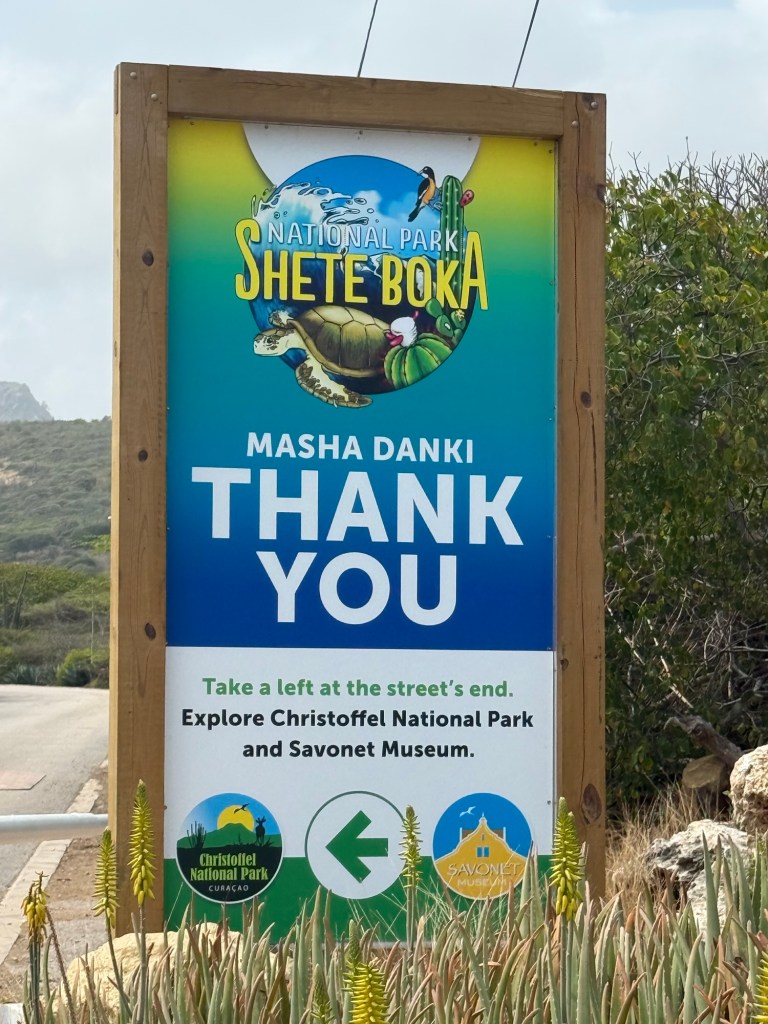
The island of Curaçao is 61 km long and varies in width from 5 – 14 km wide. We travelled with a guide in a lovely air conditioned bus from the port and capital of Willemstad to the north of the island to Shete Boka National Park. Along the way we saw lots of little towns, small older homes, and some newer areas being developed. 

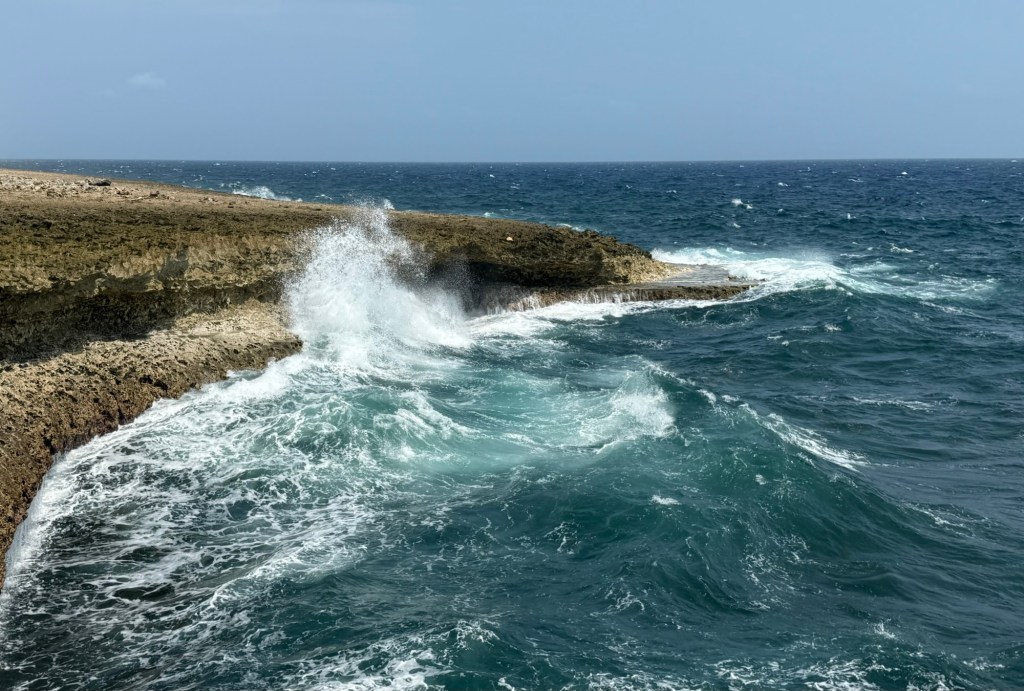
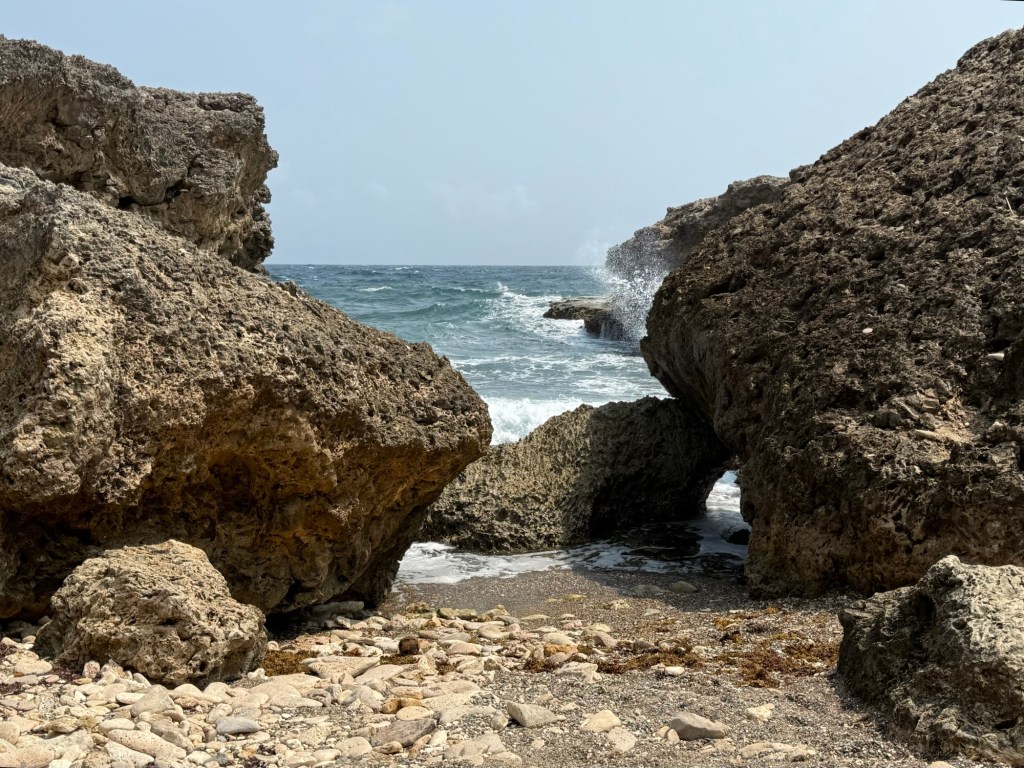
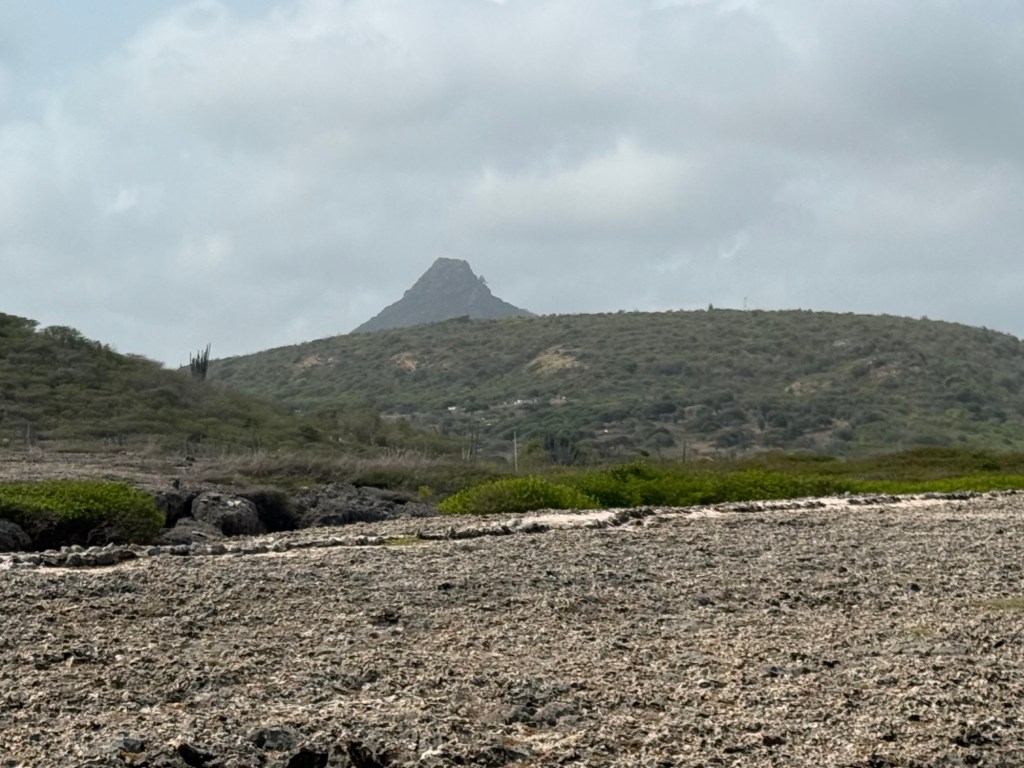
The north side of the island has high cliffs of limestone and coral rock formations below which makes for great viewing the pounding waves into the bays below. There were also some caves cut into the rocks by the wave action but we couldn’t go inside as the high water had made the platforms too slick to be safe. The pictures don’t really demonstrate the force of nature between the waves and the wind that we experienced in our short time there. We also got a peek at the highest mountain peak on the island, Mount Christoffel (at a height of 375 meters). 

Mount Christoffel in the distance

Back on the bus, we followed the north shore for a while, heading west, where the guide pointed out some interesting locations where AirBnBs are available for rent that have access to beautiful beaches although there are steps involved in getting to them. We then headed south to our next stop. 

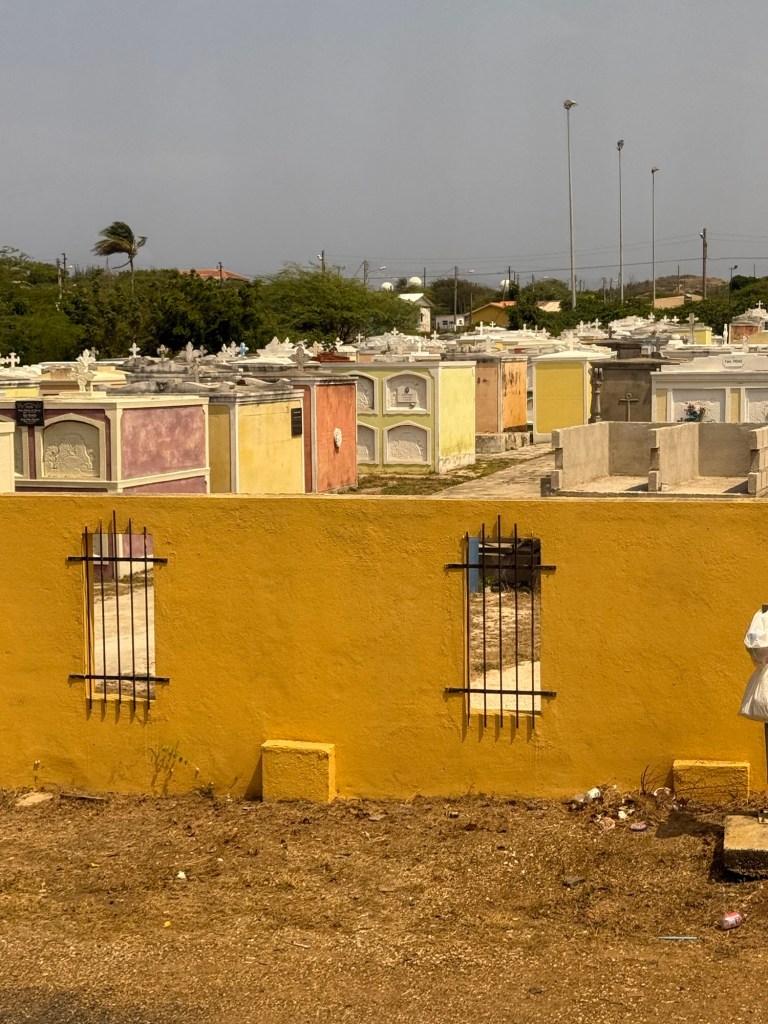
There are multiple Catholic Churches on the island, (80% of the population is Catholic) which are painted yellow and their doors all face west in the direction of sundown. (No, sorry I don’t know why). As we passed one, our guide pointed out the “triangle of life” that is demonstrated in the placement of the church, the school and the graveyard all together in their communities.  

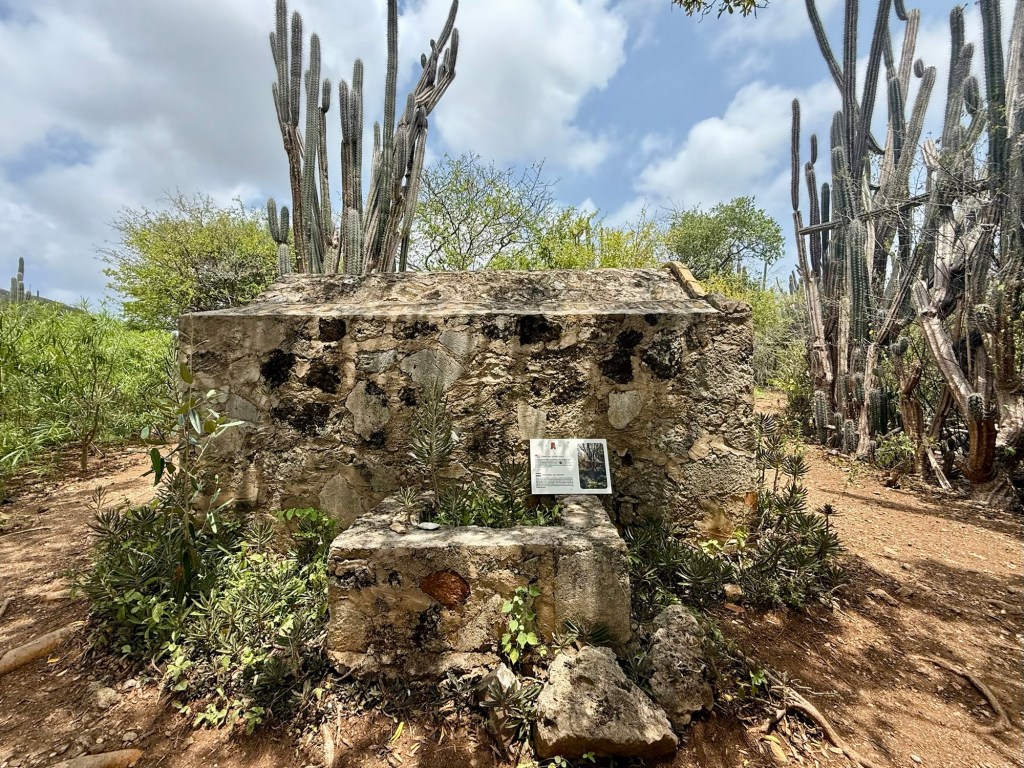
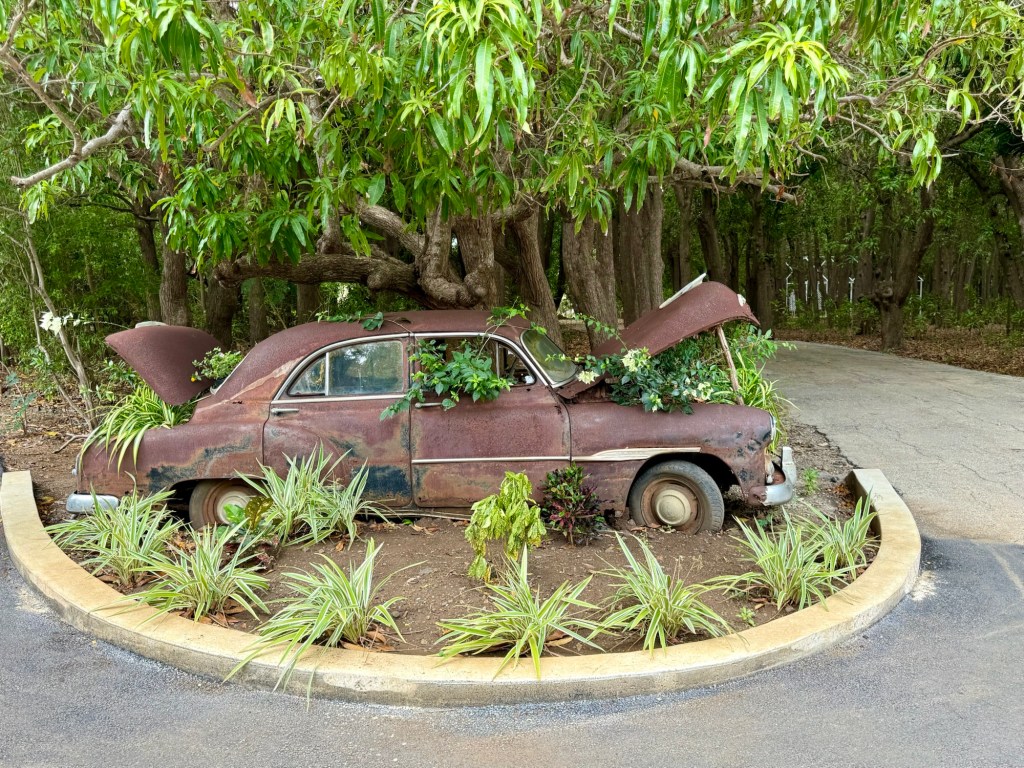
Historically, Curaçao was covered in plantations, using slave labour to grow various crops. Once slavery was outlawed, the plantations were not able to operate financially and they have become living monuments to that sad history. Since the plantations can are not allowed to be torn down they have been turned in to various enterprises, homes, vacation spots, etc. Our next stop was one such former mango plantation, Hofi Mango, formerly owned by Willem van Ulytrecht. 

Van Ulytrecht was an interesting fellow, having many children, both in and out of wedlock. He is one of the few plantation owners who insisted that upon his death, all of his children would receive the same size plot of land regardless of whether they were legitamet or not.  

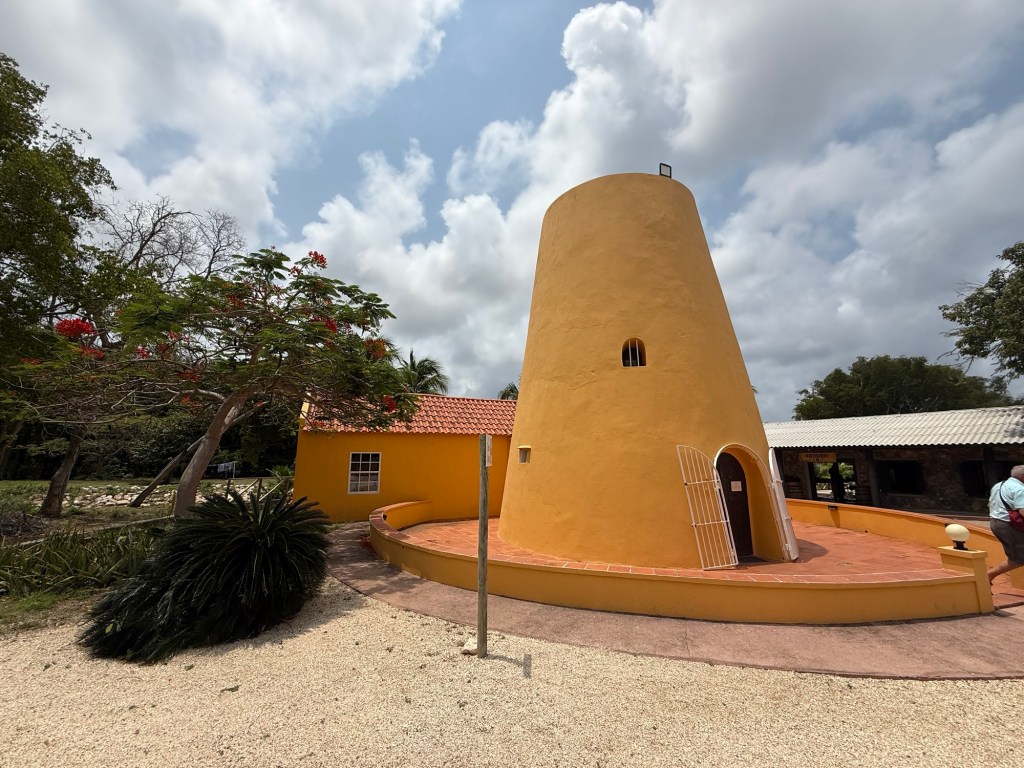
Hofi Mango has the only standing Dutch sugar mill in the former Dutch kingdom. The mill has been somewhat restored and is now protected. It still needs to have the inside restored and the roof, along with the blades of the windmill, will be installed once that is complete.  

Sugar Mill

Our guide took us on a tour through part of the forest of hundreds of years-old mangos and explained some of the plants including one called “beard of young man” in Dutch. The seed pods which hang from the branches are transparent and you can see the seeds through the fibre of the pods like the patches of the beard of a young man. 

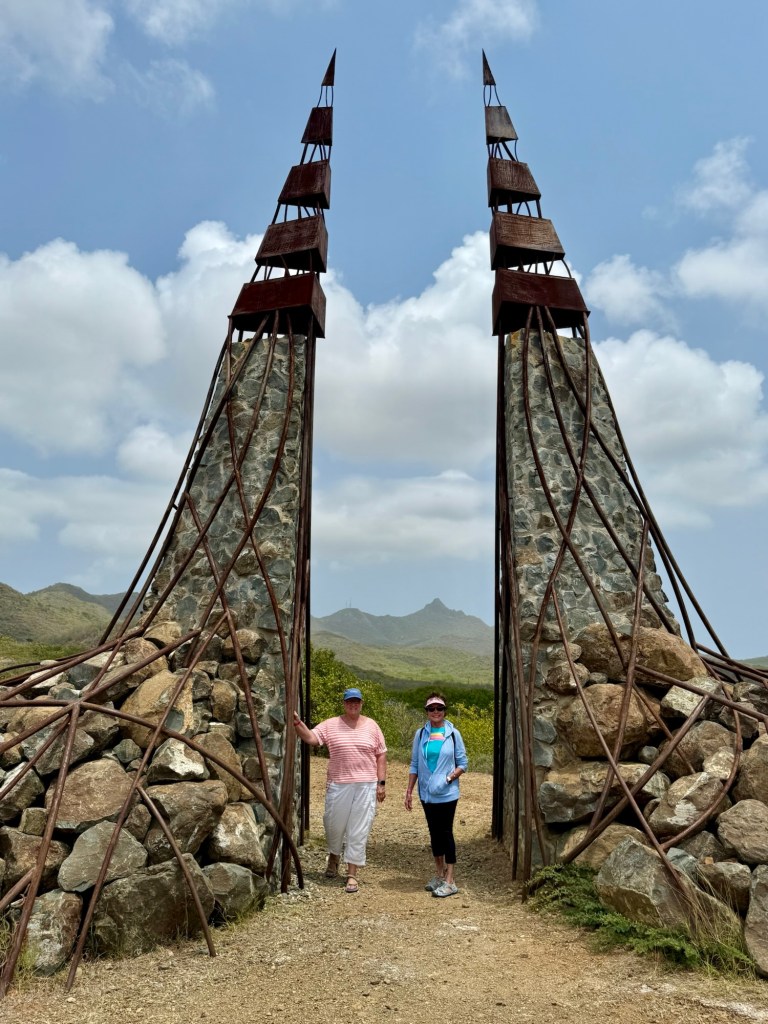
We got our exercise from the walking, but also from climbing the Stairway to Heaven which is a long, long stone staircase build from ground level to the crest of a hill giving us a fabulous view of the plantation, and surrounding area, including another peek at Mount Christofell through the hands of the work of art “The hands of God”.  The plaque explains that “the hands of God are symbolic for life; everyone aims to achieve the highest possible.” 

Seeing the Hands of God from the valley floor
Adrienne and I at the Hands of God
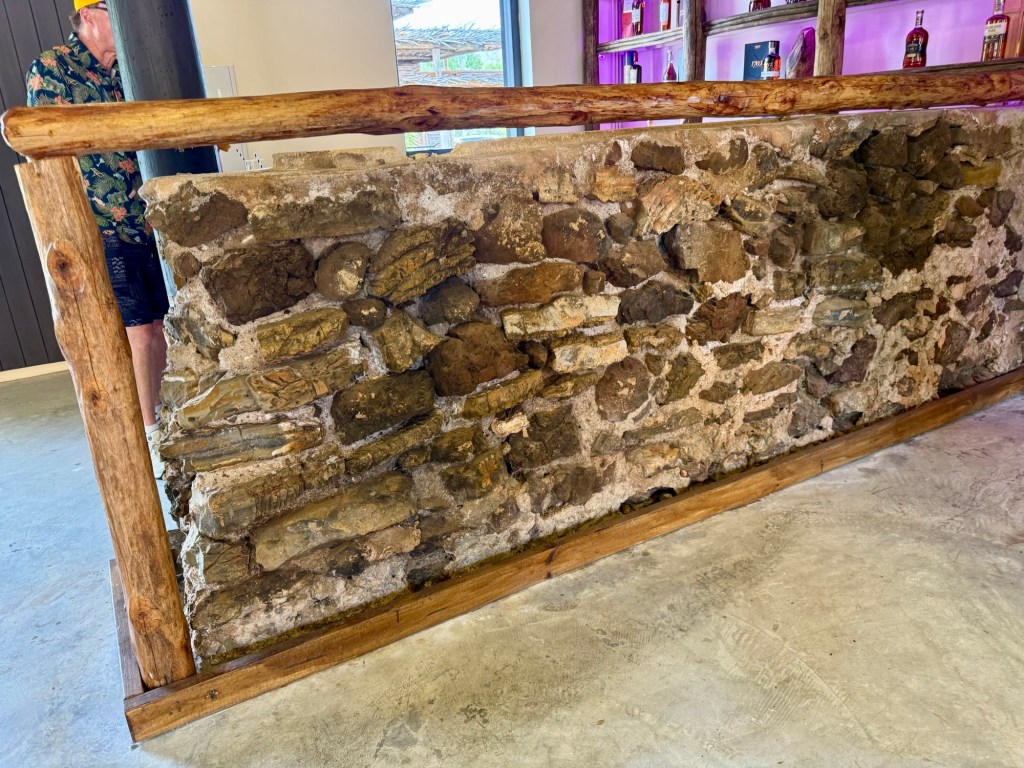
Original wall of distillery

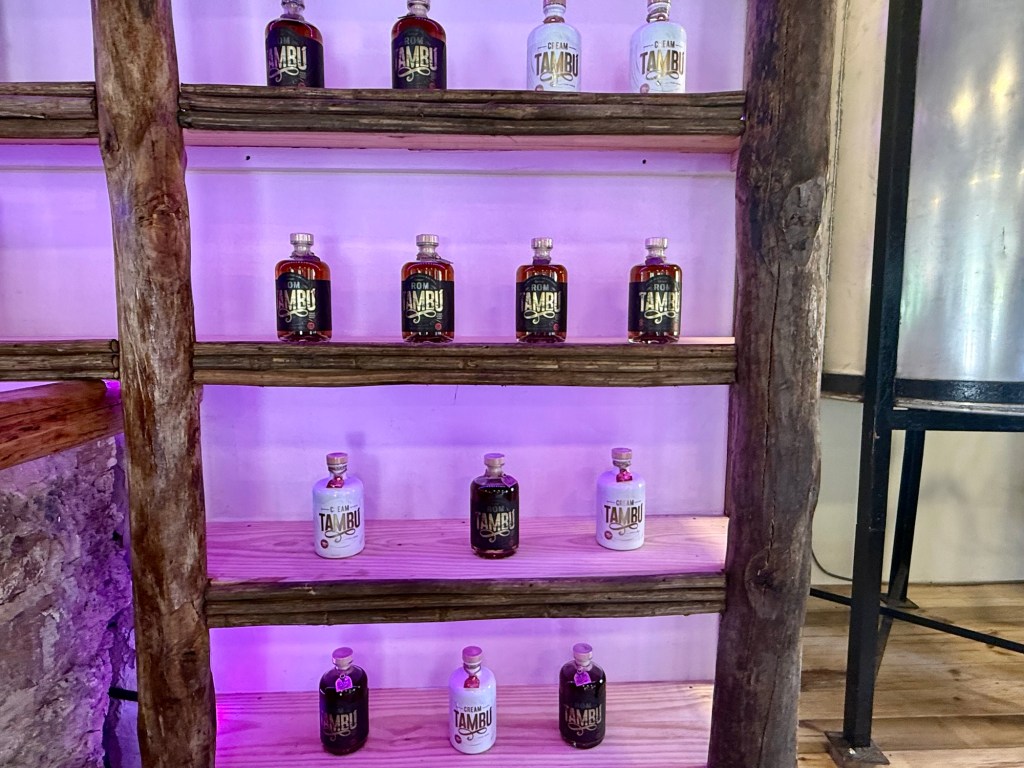
We made a stop at the distillery on the property which made a liquor from the mangos grown there called Tambu. Those that wanted a taste, (I was not among them) were provided with both the original recipe and a more modern version. 

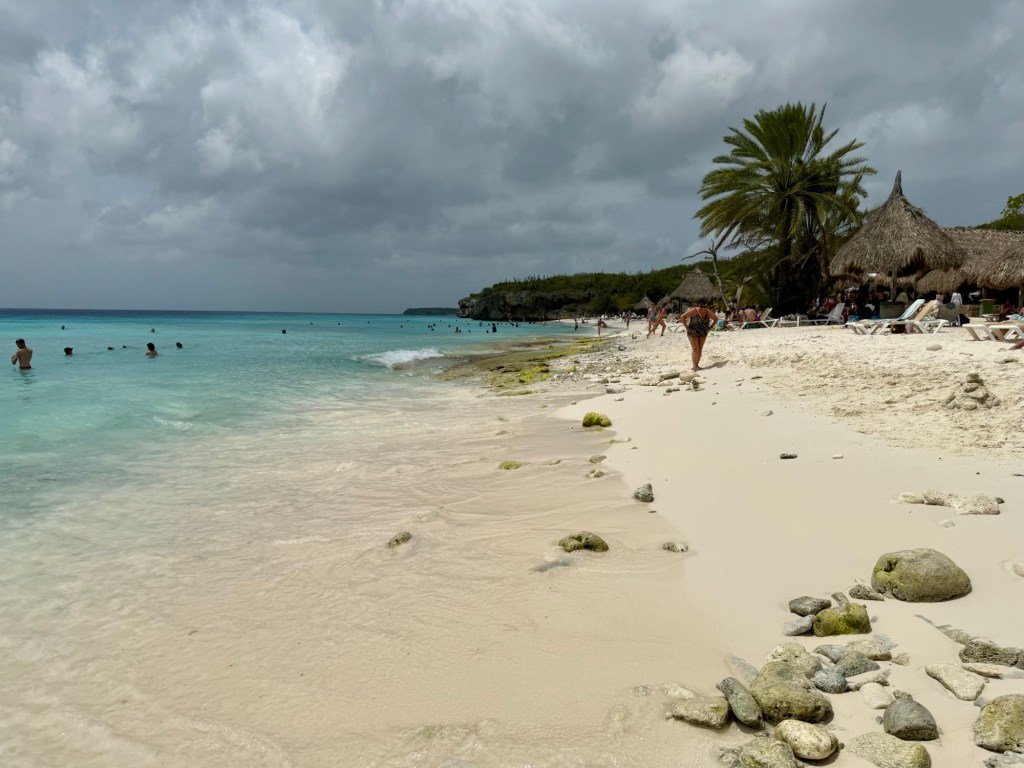
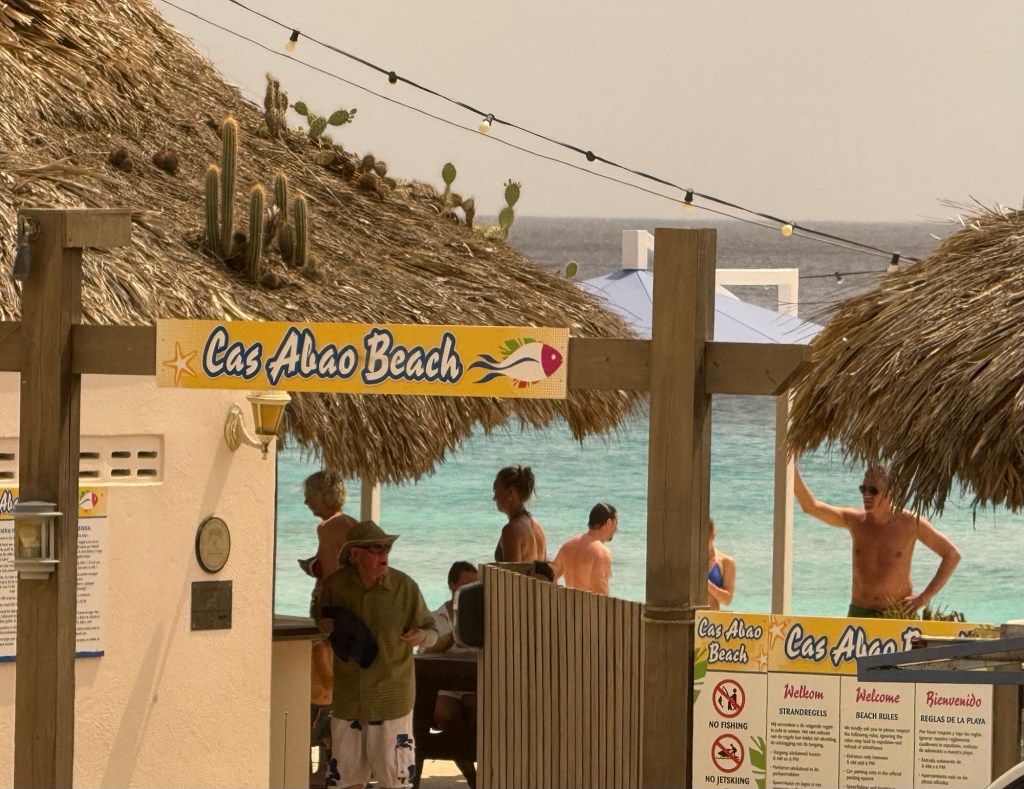
Further south, toward Willemstad, was our third stop at Cas Abao Beach, reportedly one of the best beaches on Curaçao. The white sand was beautiful, and there was abundant shade under trees (which we found out after we’d been there for a bit were poisonous to the touch). I decided not to bother getting into my swim suit etc. as we were only there for an hour, but Adrienne braved it out and even found her way in to the water over a difficult ledge of rock.

We didn’t get back to the ship until after 3 pm so snacks at the coffee bar were our lunch. It was a long day so we decided to nap, shower and head out to walk around Willemstad so as to make the most of our stop here. 

In the neighbourhood of Otrobanda
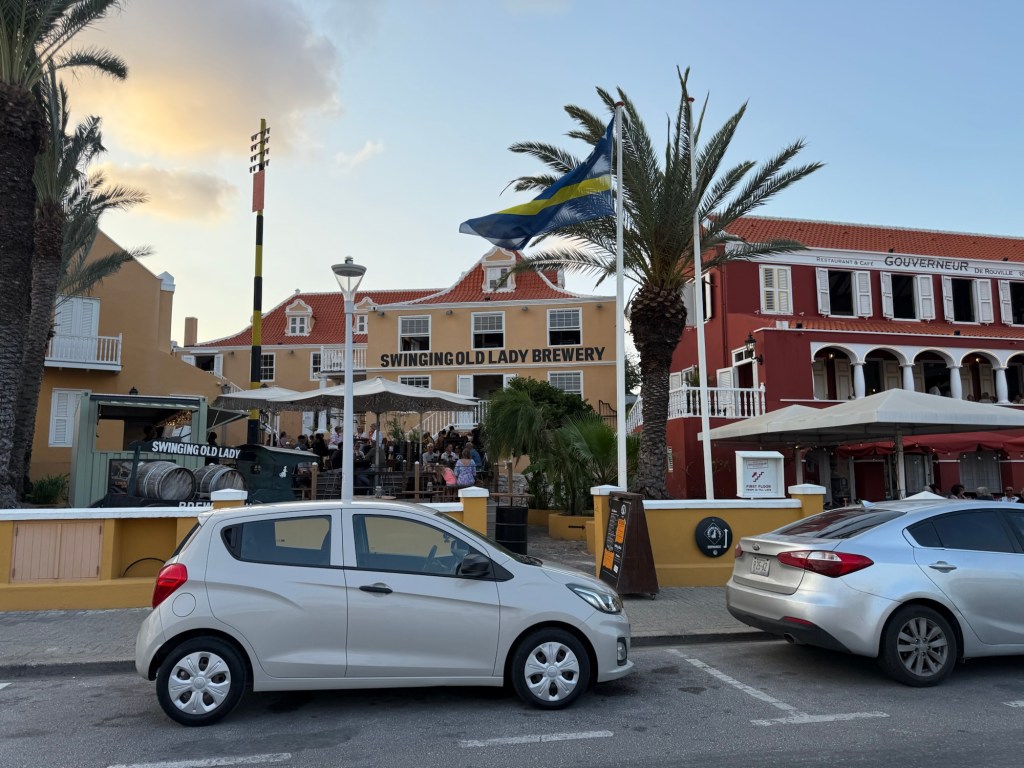
The Swinging Old Lady is the nickname of the Queen Emma Bridge

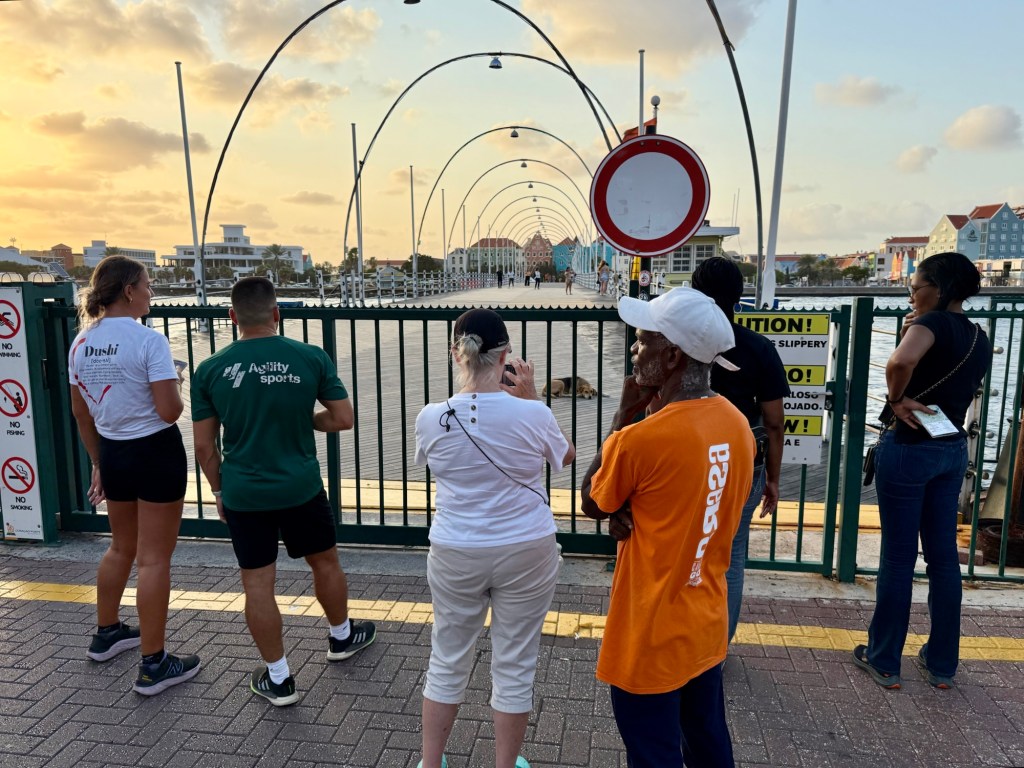
I think I described the Queen Emma Bridge in my blog last year, but it’s a swing pedestrian bridge that is supported on multiple pontoons, and it swings opens frequently to let ships in and out of the harbour. There is a flag system that visitors have to pay attention to because it may only open part way to let small ships through (10 minute opening) – an orange flag – or it may open all the way for 45 minutes – navy flag – to let a big one (like us) come or go.  If the bridge is open people can still cross the harbour on a ferry that is on standby.   

The bridge was under an orange flag so we watched the process

The Windstar was docked inside the Queen Emma Bridge, so as night fell, the lights on the bridge and on the buildings all around us made for a magical environment. And it was our deck barbecue night and dancing on the deck so it was all very festive and lively and our departure was celebrated by most passengers from the outside decks.  

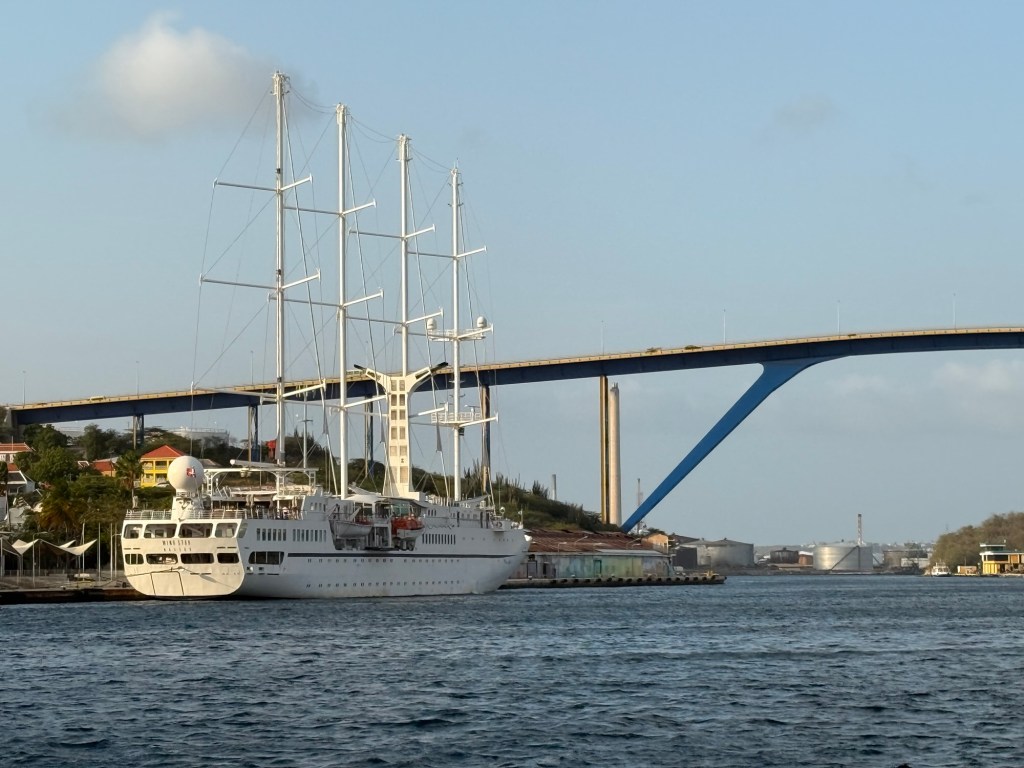
The Windstar docked for the day in Willemstad
Our deck barbecue with the lights of the buildings in Willemstad in the background.
Dancing on the deck, with Queen Emma bridge in the background.
The Queen Emma bridge opening up to let the Windstar head out while passengers danced away!

It was a great day and magical evening on Curaçao.  

2025 Cruise

The ABC Islands

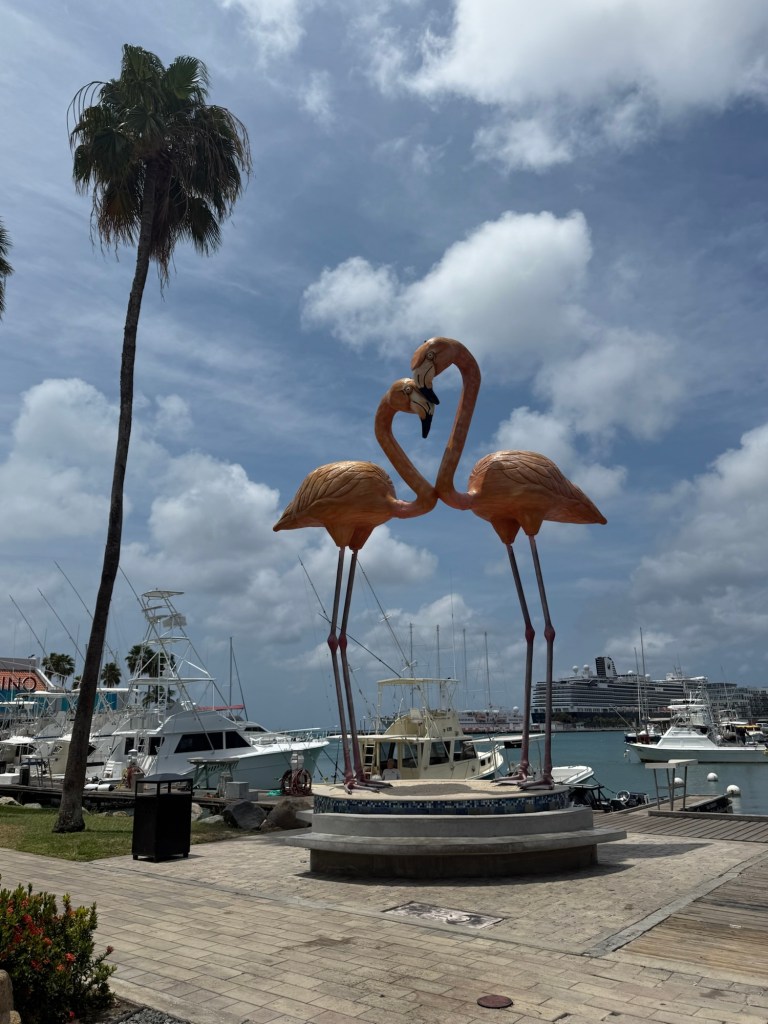
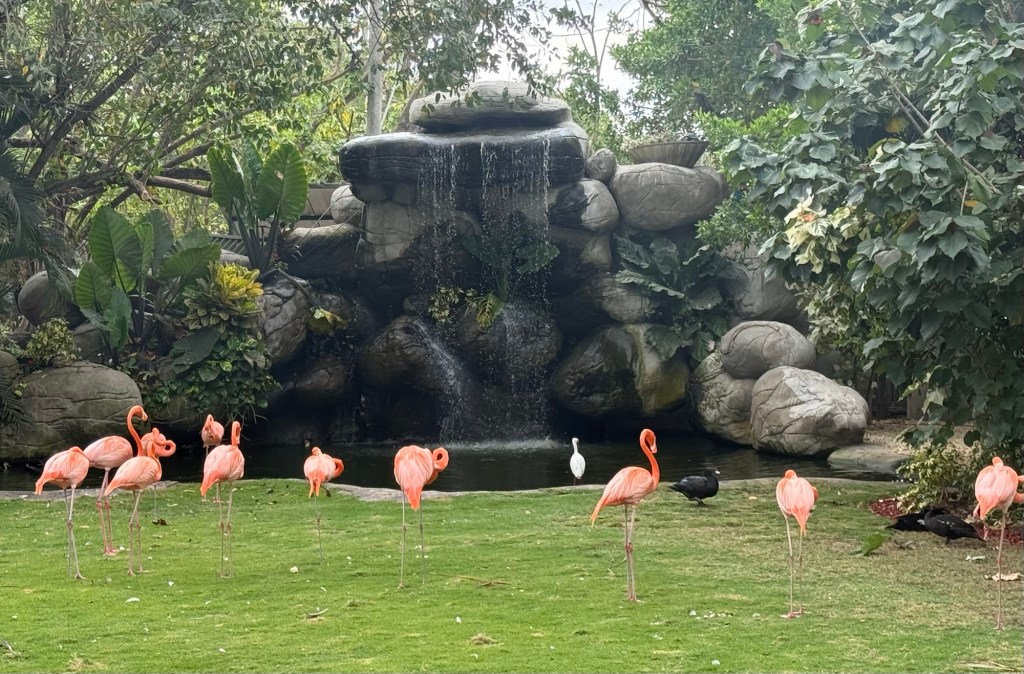
You can just make out our ship between the flamingos.

March 20

After two days at sea coming from Cartagena, we arrived at the port of Oranjestad on the small island of Aruba this morning at 10 am. We were here last year and did a snorkelling adventure at that time to see a battle ship that had sunk during WW II. I didn’t need to see that again and none of the other excursions looked that interesting so we decided just to explore the colourful capital.  

Our excursions director told us during the port talk last evening that Aruba is one of the most diverse islands in the caribbean, with more than 90 nationalities represented.  ( European, East Indian, Filipino and Chinese are among the world’s communities represented here).  Oranjestad (Orange Town) got its name from the Dutch royal family during the colonization era but apparently the locals just call it Playa or Beach.  Only 35,000 of the 110,000 people who call Aruba home live in Oranjestad which built up around Fort Zoutman in the late 1700s. 

Aruba is one of what are referred to as the ABC Islands: Aruba, Bonaire and Curaçao. Aruba joined the Netherlands Antilles in 1954 but broke away from it in 1986 and became an independent territory of the Netherlands. 

Fun facts: 

  • Aruba has a desalination plant that opened in 1930s to supply water to the workers on the refinery ( for Venezuelan oil) that was built in the 1920s.
  • Because of the prevailing winds, trees and plants lean towards the south west. 
  • One of the local beers is Balashi which means “by the sea”, seems appropriate. 
  • there is a lighthouse on the island but sadly we didn’t get to see it today.  I did get to see it last year, and have a picture of it from then. 
  • there are 4 types of turtles living in the waters around Aruba, Leatherback, Loggerhead, Green and the Hawksbill. 
  • baseball is the sport of choice in Aruba, with many players from here making it to the U.S. Leagues. 
  • Aruba, classified as a desert, only gets 15 inches of rainfall on average each year 

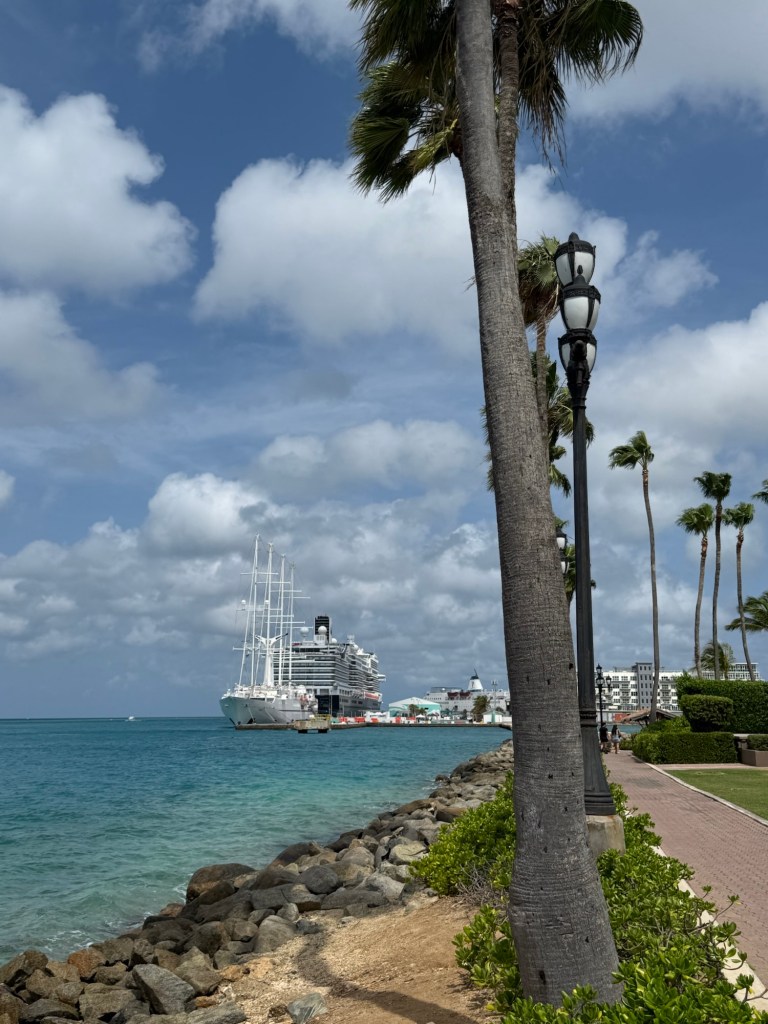
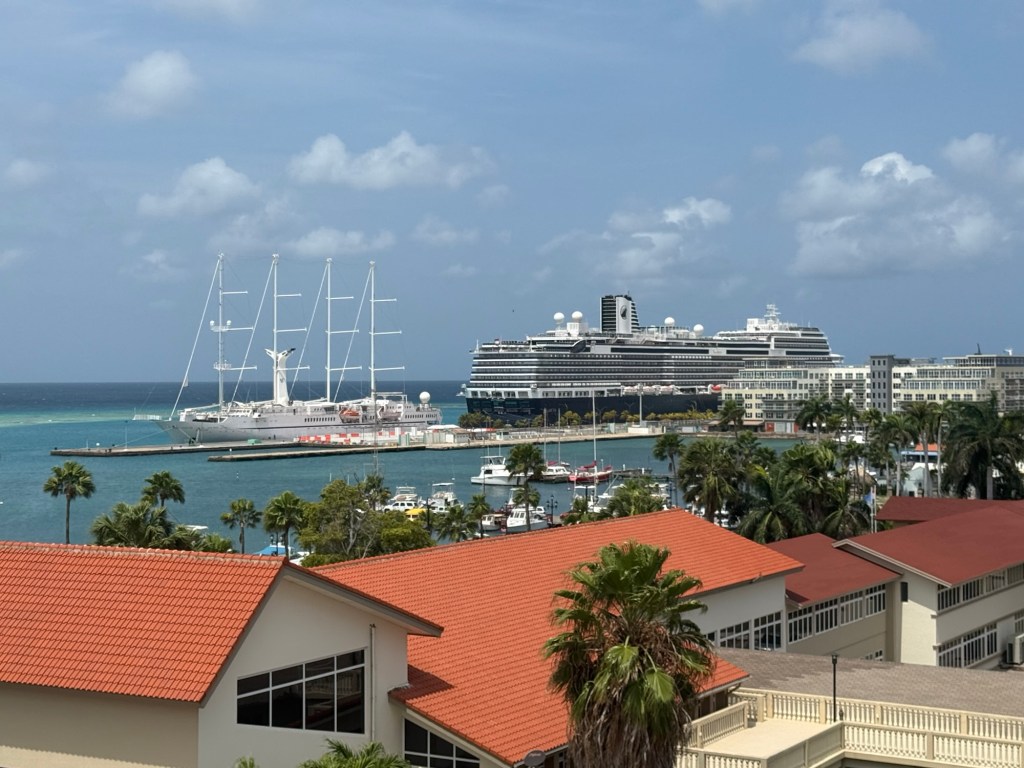
We left the ship once it was given clearance by the customs and immigration folks this morning and started our adventure walking along pathways following the water’s edge. We looked back to our mooring at one point and noted the difference in size between our little Windstar and the MS Rotterdam, which was also in port today. It’s one of the Holland America Line’s ships. She carries almost 2,668 passengers and 1,053 crew vs our 140 passengers and 100 staff. 

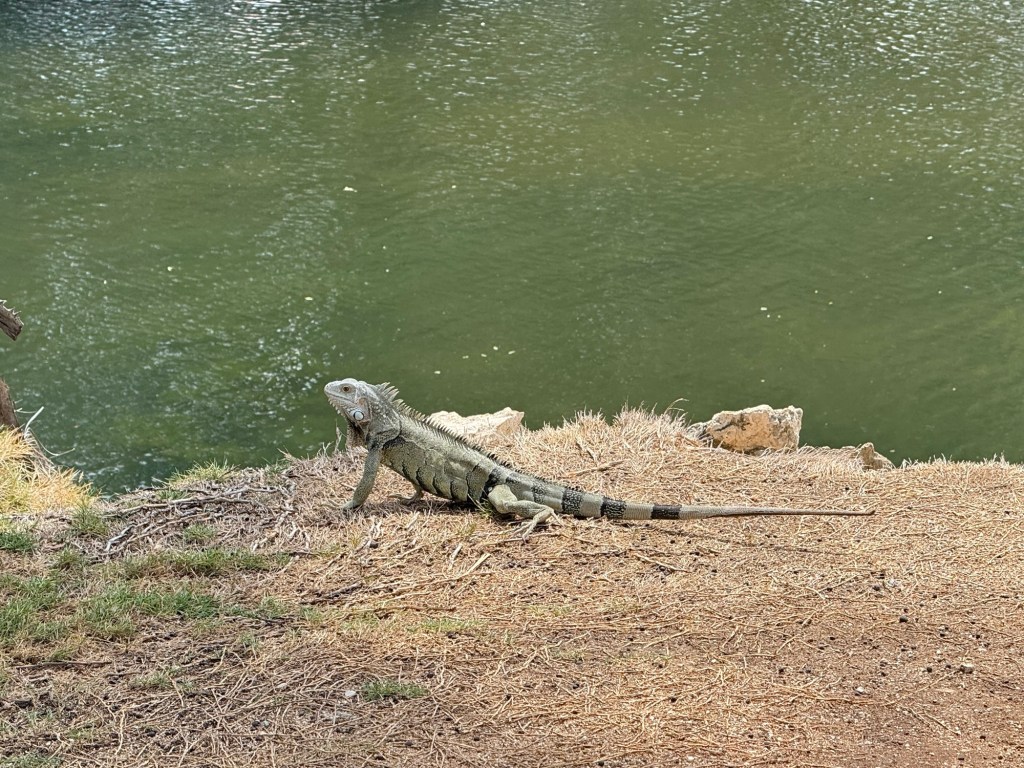
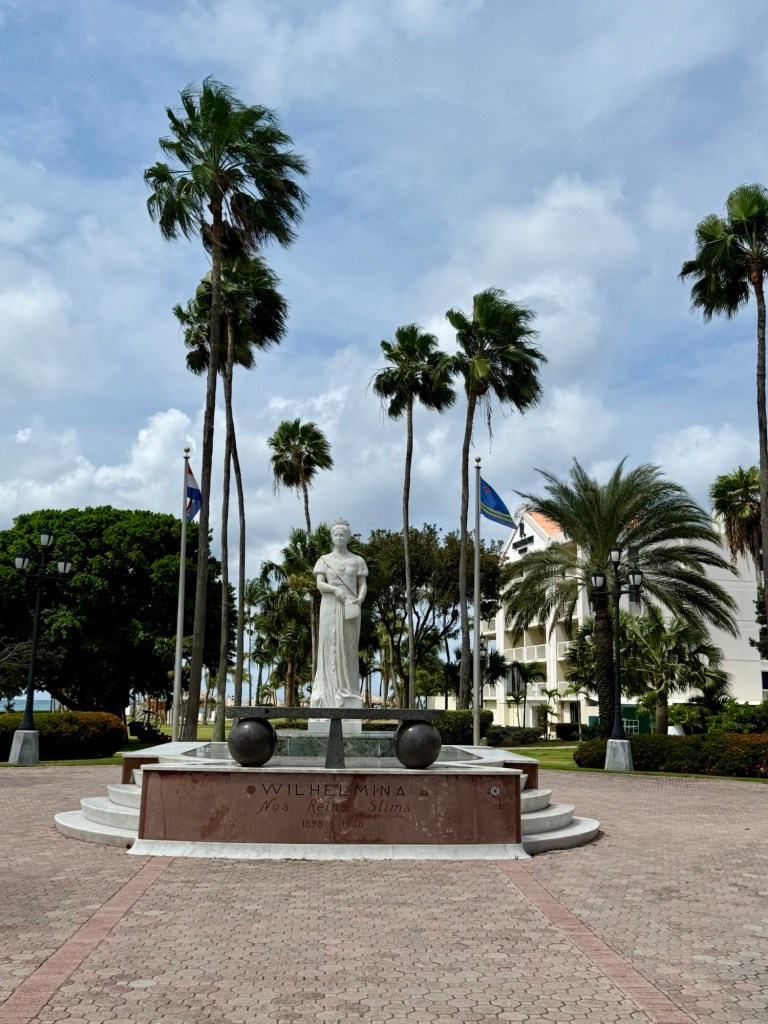
We successfully went past many retail opportunities and tip toed through the grounds of a luxury hotel on a path along the ocean, and ended up in a park named Wilhelmina Park which was adorned with a statue of said Queen Wilhelmina. She was the Queen of the Netherlands from 1890 until her abdication in 1948, nearly 58 years, longer than any other Dutch monarch. Along the way Clair was startled by one of her favourite, NOT, creatures, an iguana who was innocently making its way to the water’s edge. 

In navigating the downtown area of Oranjestad we discovered that the drivers are, for the most part, very courteous drivers here. It’s very busy and congested but people stopped to let pedestrians cross. 

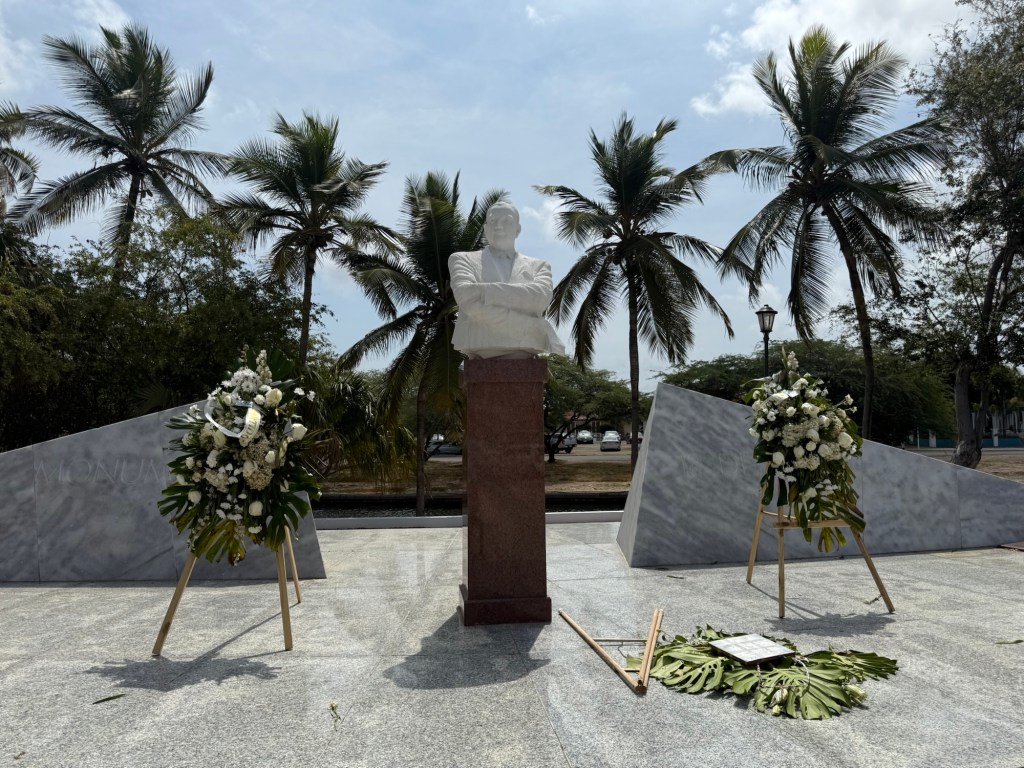
We came upon a monument that had some freshly placed flowers on it and stopped to read the sign to find out what it was all about. It was a monument to March 18, which is the National Day of Aruba celebrating its independence. In 1948 a petition signed by 2,147 Arubans, requesting their wish to be granted a separate status was presented to a Conference of the Netherlands, Suriname and Curaçao. The wish was granted and this started the ball rolling towards their full independence on January 1, 1986 but because of the significance of the motion granted on March 18, 1948 the Arubans chose March 18th as the day to celebrate. The bust on the monument is that of Cornelius Albert Eman who led the charge on the campaign in getting the petition signed. All of the names of the Arubans who signed that petition are etched in the marble of the monument. 

March 18 Monument

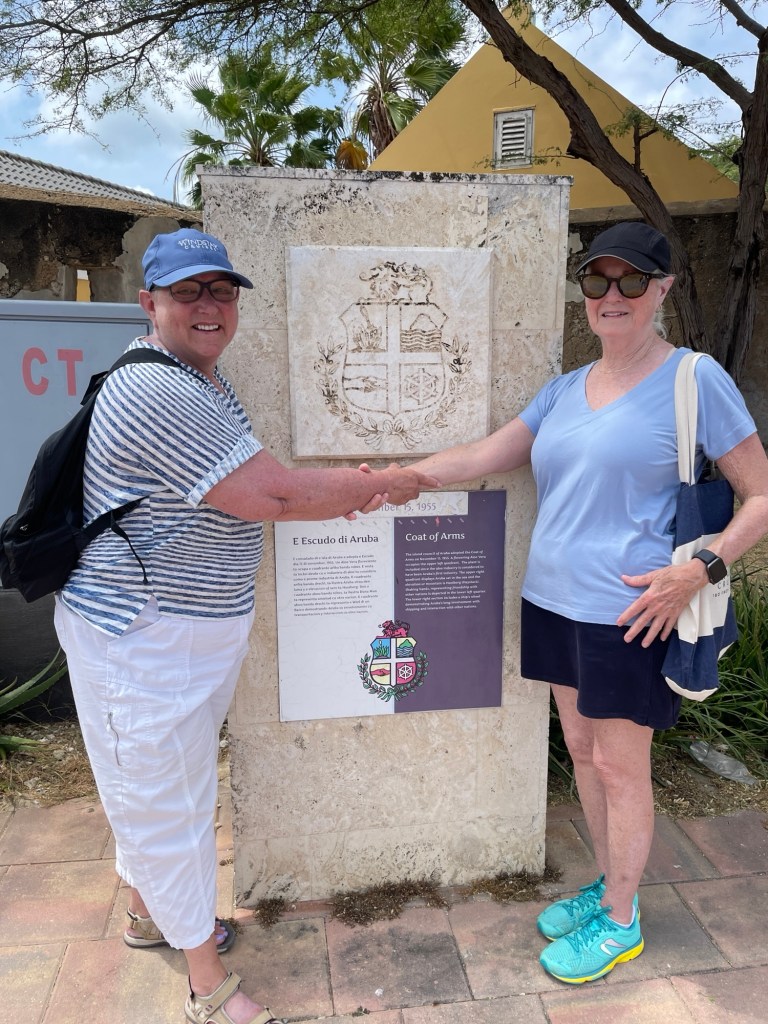
Near the fort we were headed to we found a picture of the Coat of Arms of Aruba and an explanation of the various symbols on it. One of the symbols is of two arms clasping each other in a handshake and it was meant to represent friendship with other nations. So Clair thought we ought to demonstrate our friendship and that of our two nations. Seemed like a fitting gesture these days.

The Windstar “handshake” as in Aruba’s Coat of Arms

As we were making our way to our next stop, we suddenly heard what sounded like a tsunami warning! We looked around to see how others were reacting and some fellows that appeared to be city workers were checking their cell phones and we thought for sure we ought to start running, but if you’ve ever been to Aruba you know it could be described as a big sand bar with very little in the way of elevation. We asked the city workers what the alarm was and it was indeed a tsunami alarm, however it was just a test of a new system that is just being installed. They proudly reported they were the first island to have such a warning. We were obviously very relieved to hear it was just a test. 

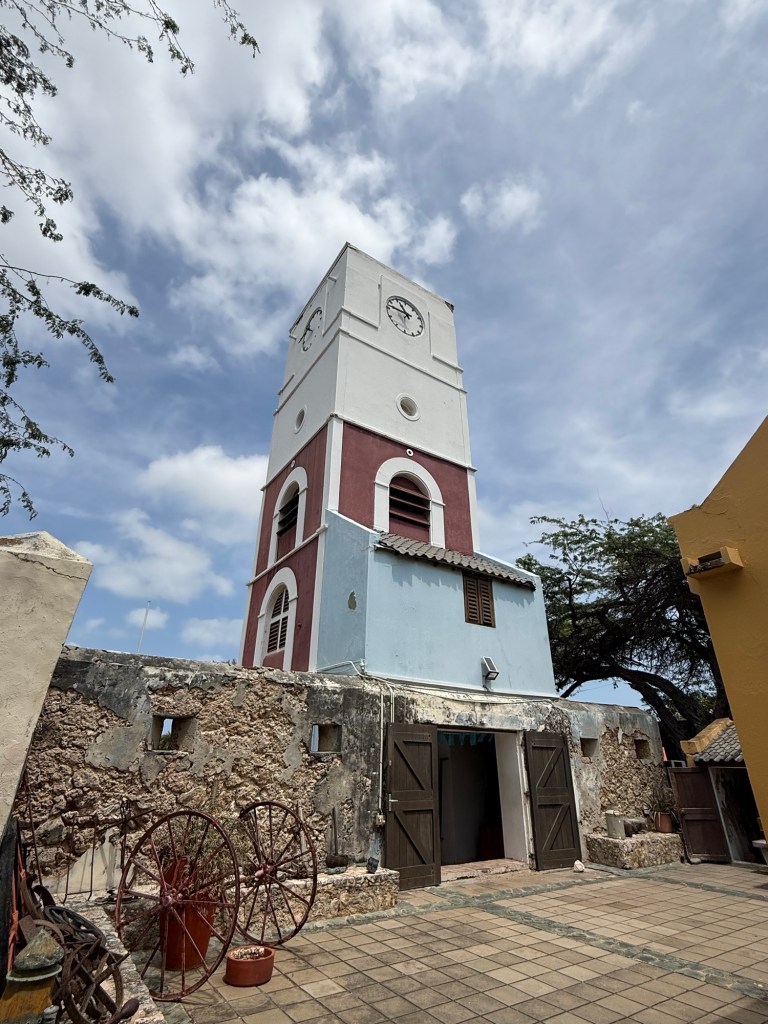
Next we made our way to Fort Zoutman, the oldest structure on the island. It was originally built in 1798 by African slaves, and is regarded by UNESCO as a “Place of Memory of the Slave Trade Route in the Latin Caribbean”. The tower to the side of the fort, built in 1868, and the fort itself were restored and re-opened n 1983 and houses the Museum of Aruba. 

Fort Zoutman
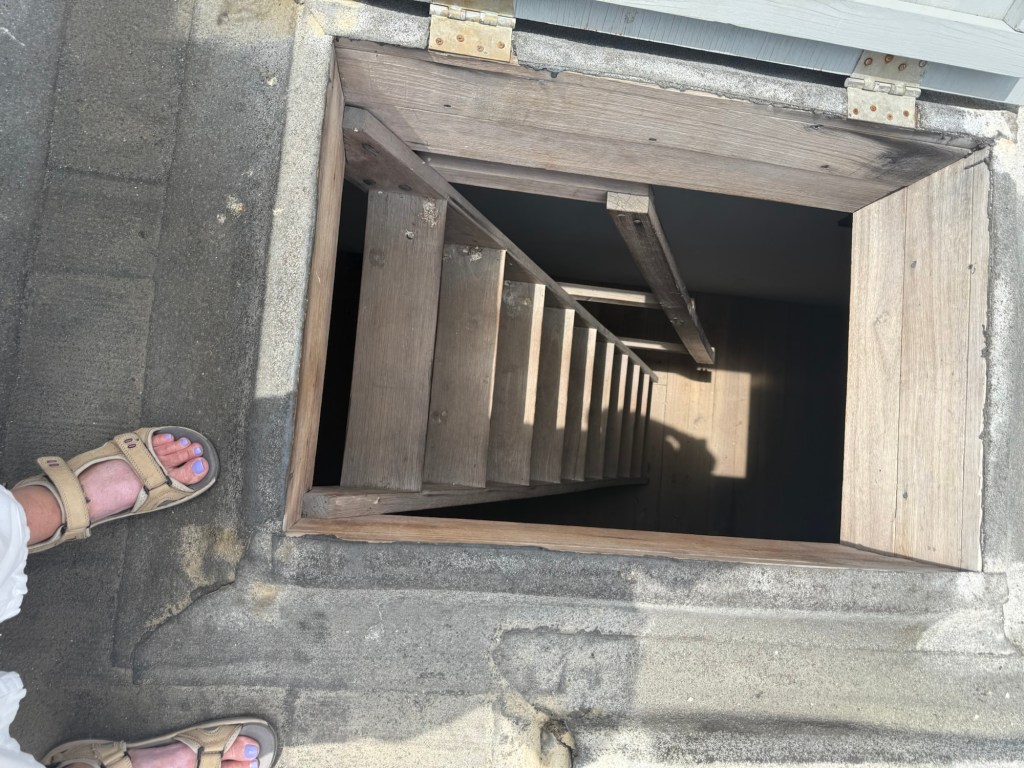
Looking down the “stairway”, read ladder, from the top of the tower

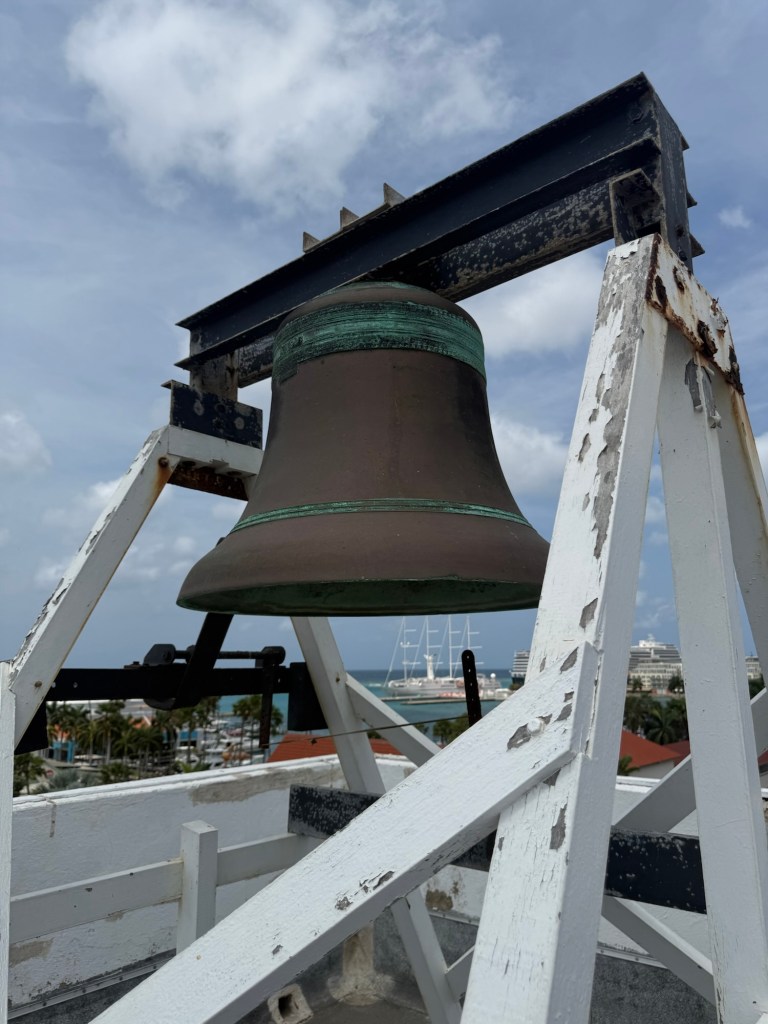
The tower houses the town bell and was named after King Willem III of the Netherlands and lit on his birthday on 19 February 1868. It also originally served as a lighthouse but in 1963 its light was removed.  We chose, perhaps foolishly, to climb the tower. It was about 6 flights, but they were not normal steps. It was more like walking up a step ladder a million times the steps were so narrow and steep. I think we could see to Venezuela from the top though, or at least had a great view of Oranjestad.

The Windstar and the Rotterdam

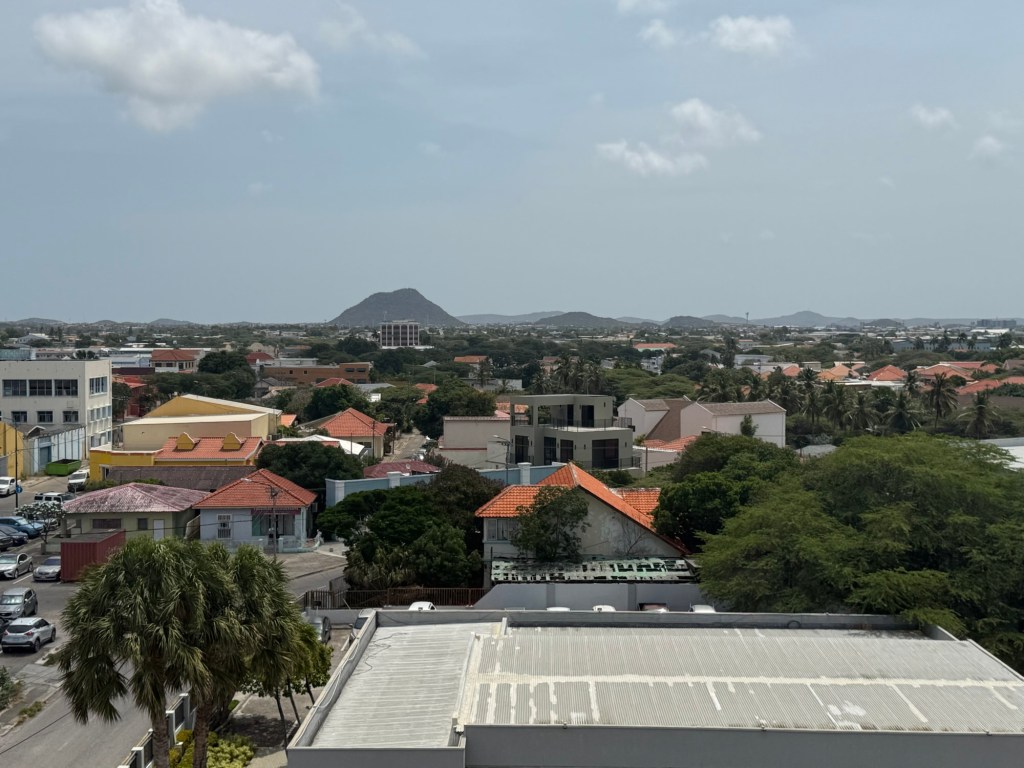
A volcanic formation standing 165 meters above sea level and named “Haystack” in English stands approximately in the centre of Aruba and it was an obvious part of the panorama. We appreciated the view from the top of the tower and then climbed down to look through a lovely little museum, which thankfully was air conditioned!  

Haystack

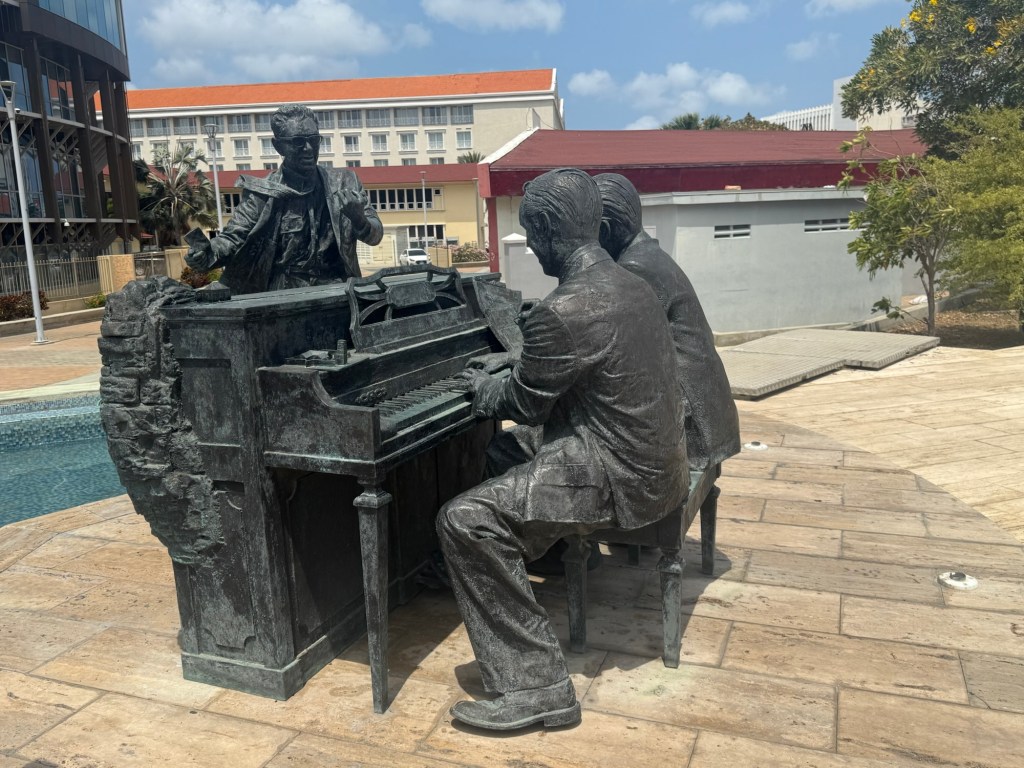
From the top of the tower we had seen an interesting piece of sculpture a couple of blocks away so we made our way over to it. There was no plaque explaining what the statue was but it was fabulous. Don’t know if you can see the model of the fort on top of the front of the piano. It reminded me of the statue of Oscar Peterson and his piano in Ottawa. According to Wikimedia it is a statue of the composers of the national anthem of Aruba. It was unveiled on March 17, 2017. Hoping they’re planning on putting up an explanation of what it is sometime! 

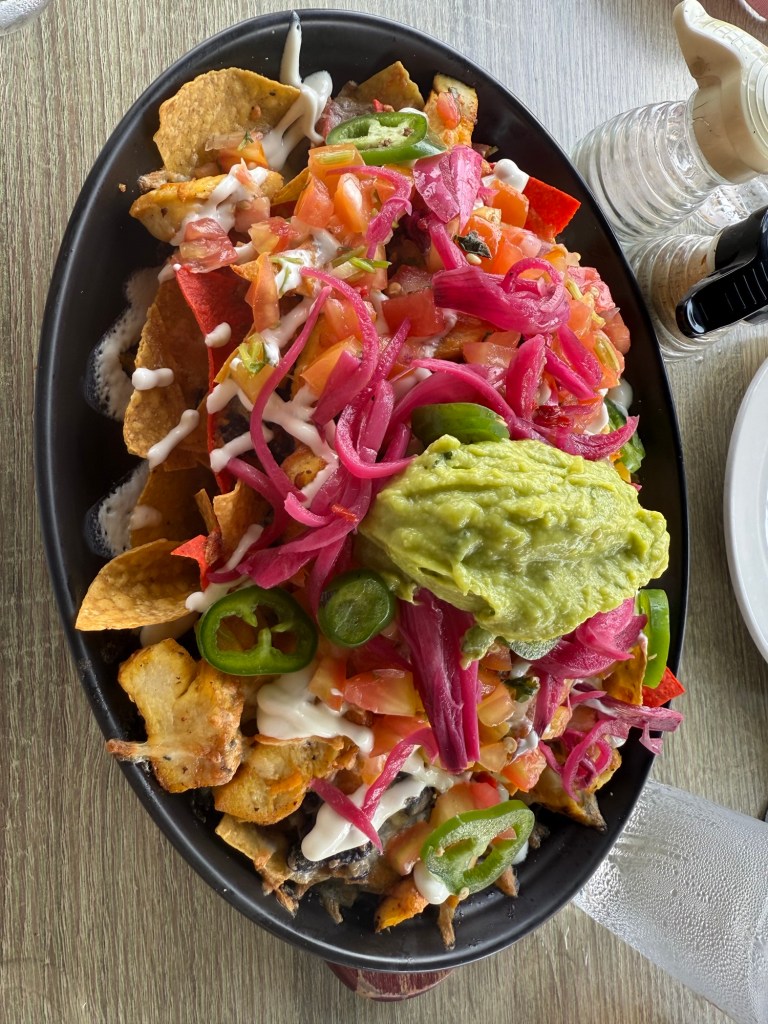
Of course, all this walking and climbing and seeking had heated us up and given us an appetite so we walked back to the waterfront and found a lively Mexican restaurant that fit two major criteria, it was in the shade and had a breeze. We ordered chicken nachos to share, that just might have been the best I’ve ever tasted!  I don’t normally take pictures of my food (sorry Cara), but I did of this dish because it was so colourful and believe me it was a delicious as it was pretty. 

Our chicken nachos!

We slowly made our way back to the ship via the souvenir shops and spent the afternoon relaxing. Tonight at 10:30 pm we’re on to the “C” island, Curaçao. 

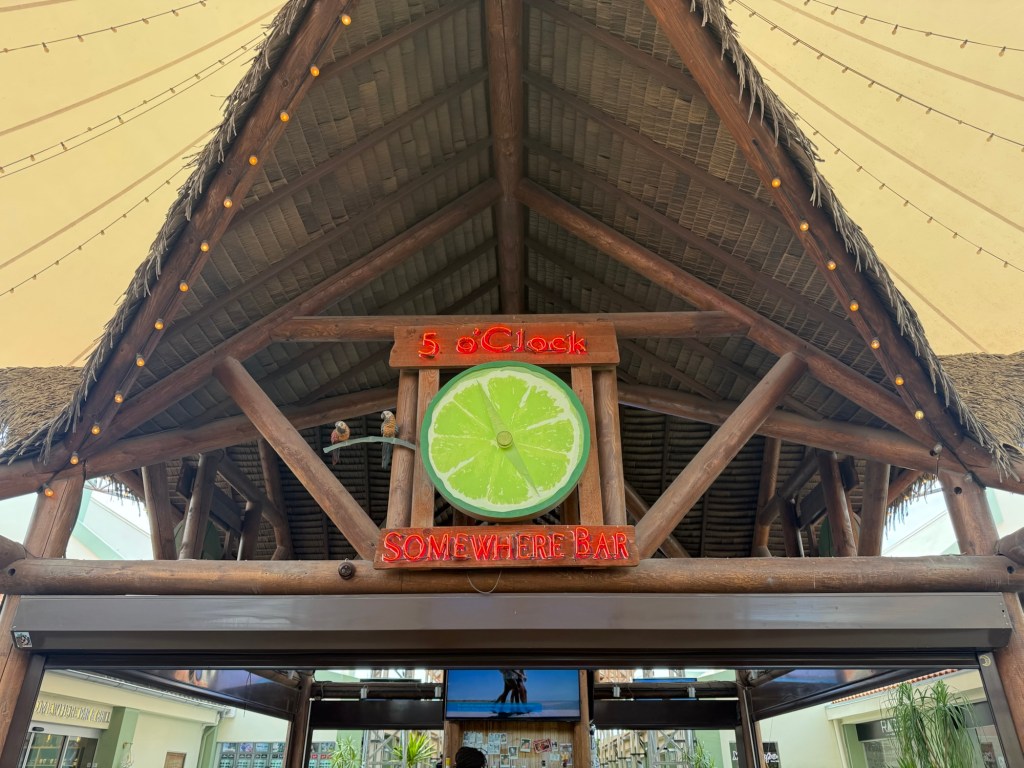
We didn’t stop here, but I loved the name of this bar.

2025 Cruise

Hot! Hot! Hot!

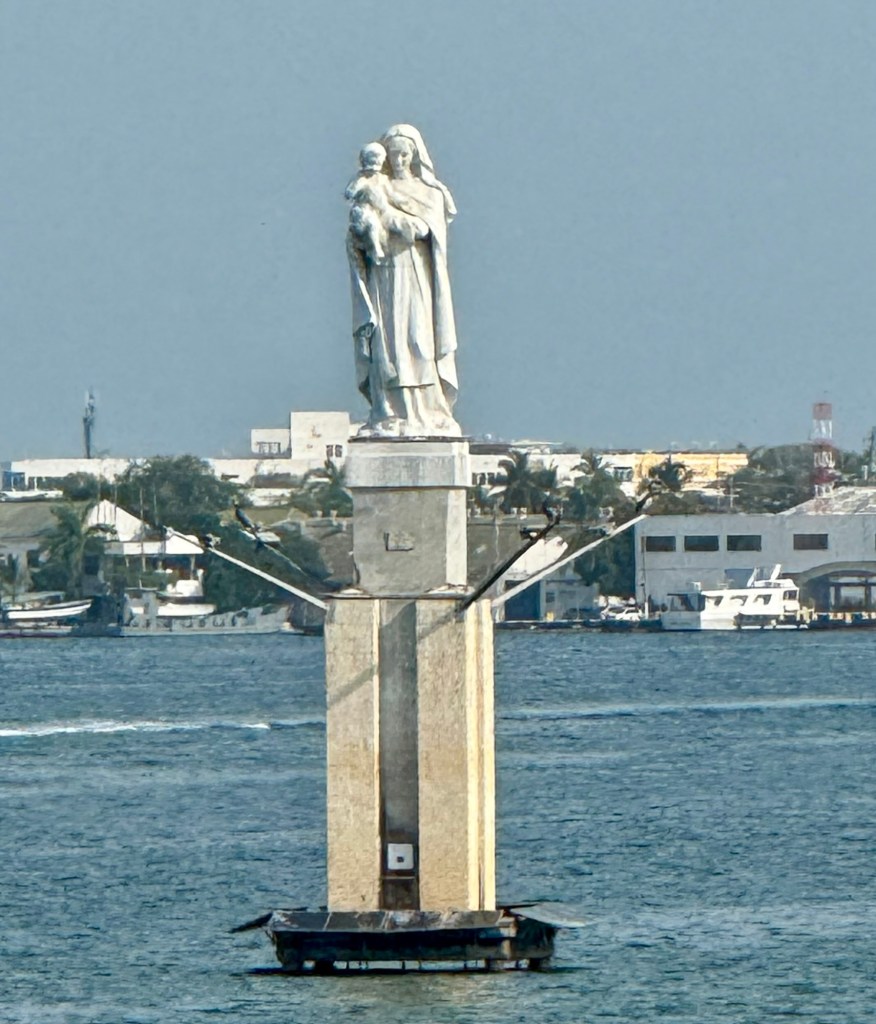
This statue of Virgin Mary is at the entrance to the inner harbour in Cartagena. She was struck by lightning in 2015 and split into many pieces. The Navy scuba divers were brought in to gather up the pieces and she was rebuilt in only a few months.

I haven’t been as hot as today since I was last in Cartagena.  

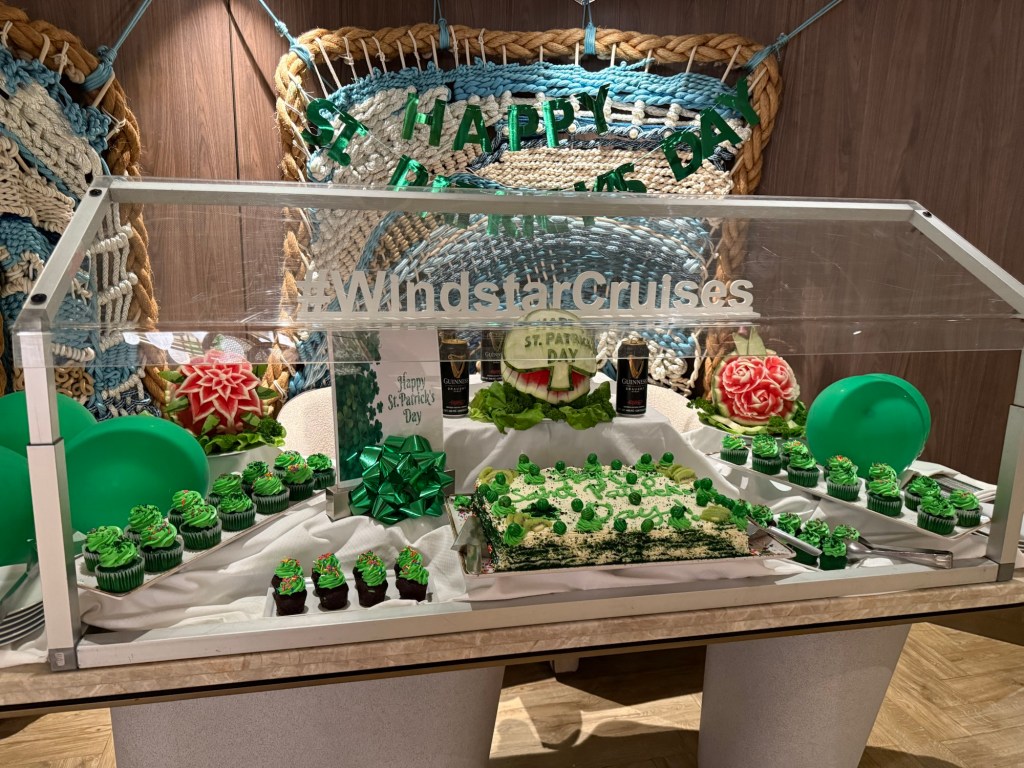
Happy St Patrick’s Day! Seems very weird to be celebrating it in Colombia! 

Today we will spend the day in one of my favourite cities, Cartagena. I was here last year on my cruise in January.  So some of today’s blog will be a repeat performance.  But all new pics.  

Cartagena is a port city and UNESCO World Heritage Site and the walled Old Town has such amazing brightly coloured, colonial architecture, churches, monasteries, plazas, and the street art is a level above anything I’ve seen. It’s often cited as one of the most beautiful cities in the world, and from those that I’ve seen I’d have to agree.

Archeologists have found evidence that people have lived in this area, from around 4000 BC. But Cartagena was founded in 1533 on the site of a Carib Indian settlement. It was rebuilt in 1552 after a fire destroyed many of it’s buildings. It quickly became a main port for the Spanish on the Caribbean coast. It suffered many attacks from pirates, including Sir Francis Drake in 1586, who demanded a ransom not to destroy the whole city. These attacks precipitated the building of a series of forts and a seven mile wall around the city and 22 bastions, which successfully defended the city from severe attacks. In one attack, 25,000 English soldiers and their fleet of 186 ships was fended off by commander Blas de Lezo, and 2500 poorly trained troops. Don Blas is considered the saviour of Cartagena and there is a statue of him outside San Felipe Fortress. Don Blas, it was said, was only half a man, having lost one eye, one arm and one leg, however it is also said he had 33 children by 25 different women!

Cartagena was one of the first cities in the Spanish empire to proclaim independence from Spain which it did in 1810. Spanish forces retaliated in 1815 and took the city after a four month siege during which 6000 inhabitants died of starvation and disease. But in 1821, Simon Bolivar’s troops defeated the Spaniards after freeing Bogata in 1819.

Fun Facts:

⁃ Colombia is one of 17 megadiverse countries of the world.

⁃ Although there are claims that Cuba was the originator of the Mojito, Colombia’s aboriginals are thought to be the origin. They came up with a mixture of rum, lime juice,mint, and sugar which is believed to be an antidote for dysentery.

⁃ Famous Colombians include Actress Sofia Vergara, Garacia Marquez, (Nobel Prize winner in literature) and singer/songwriter Shakira.

⁃ Coffee is the national symbol of Colombia. Colombia is a primary supplier of Arabica coffee beans to the world and it’s important to the economy. Also, it’s not unusual to see kids drinking coffee in Colombia.

⁃ It’s required by law for radio and tv stations to play the national anthem daily, at 6 am and 6 pm.

⁃ It’s believed that 70-90% of the world’s emerald market is from Colombia and that they are of the best quality. In fact one of the excursions offered is to an emerald facility.

⁃ Colombians like to put cheese in their hot chocolate. The saltiness of the cheese supposedly brings out the other flavours within the chocolate. They use a special cheese that is like a halloumi or mozzarella.

⁃ The condor is the national bird of Colombia

⁃ All men must serve in the military for 2 years when they turn 18 unless there is a medical reason, they are an only child, or if they are married. Our guide said many get married early in Colombia.

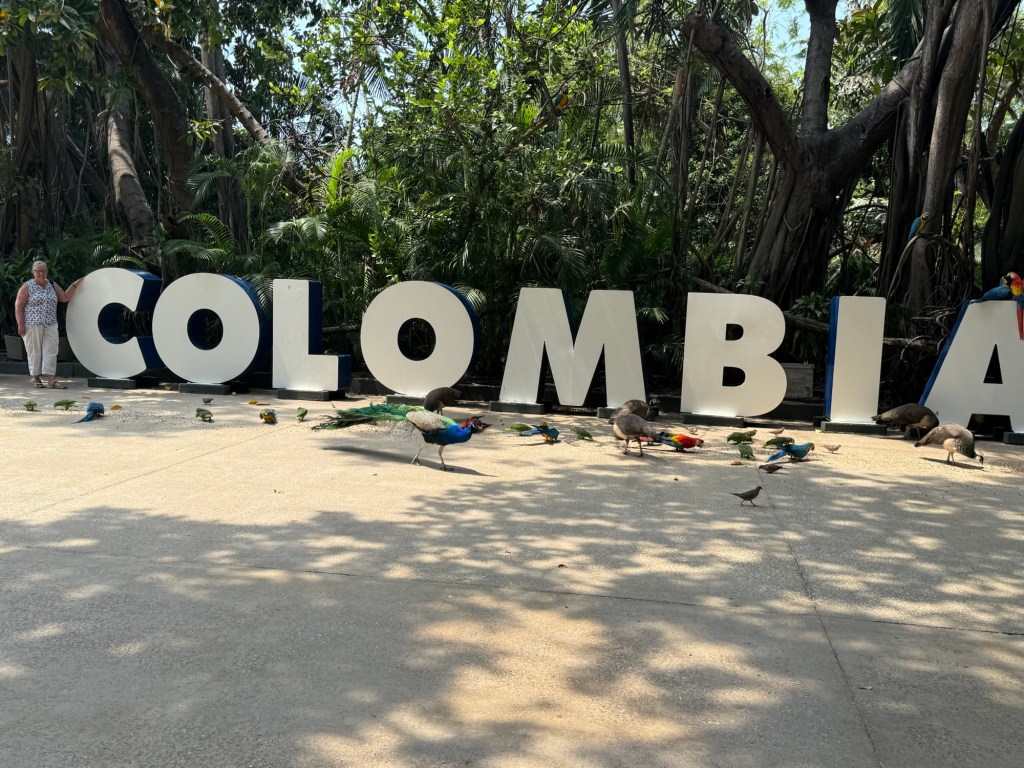
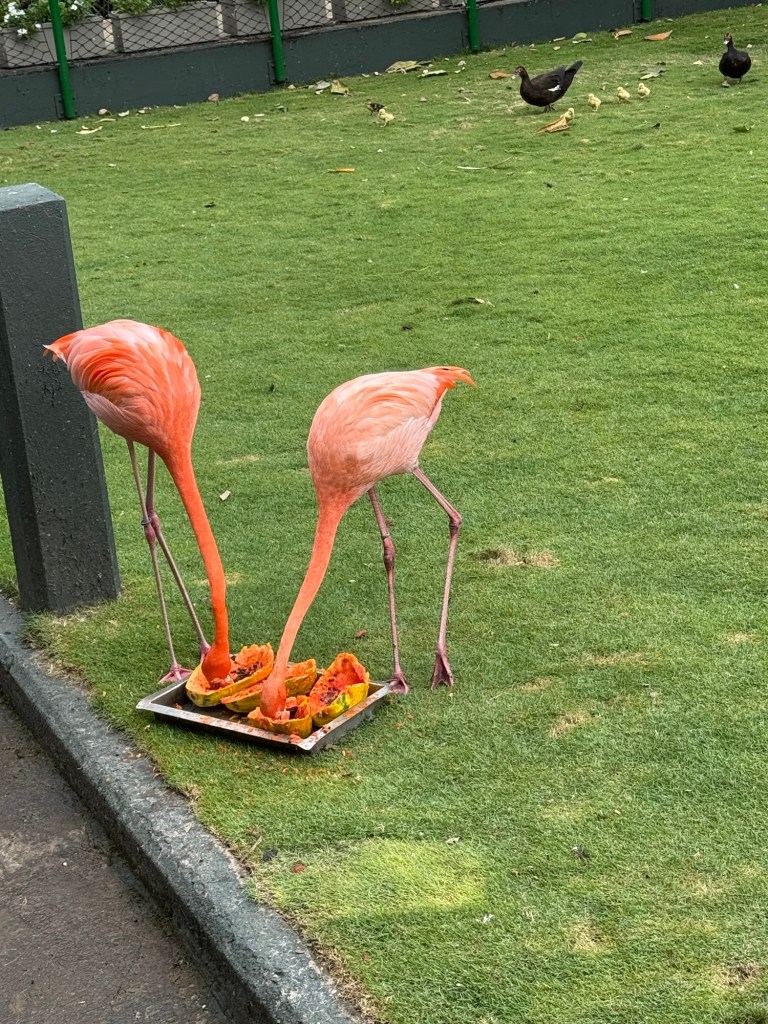
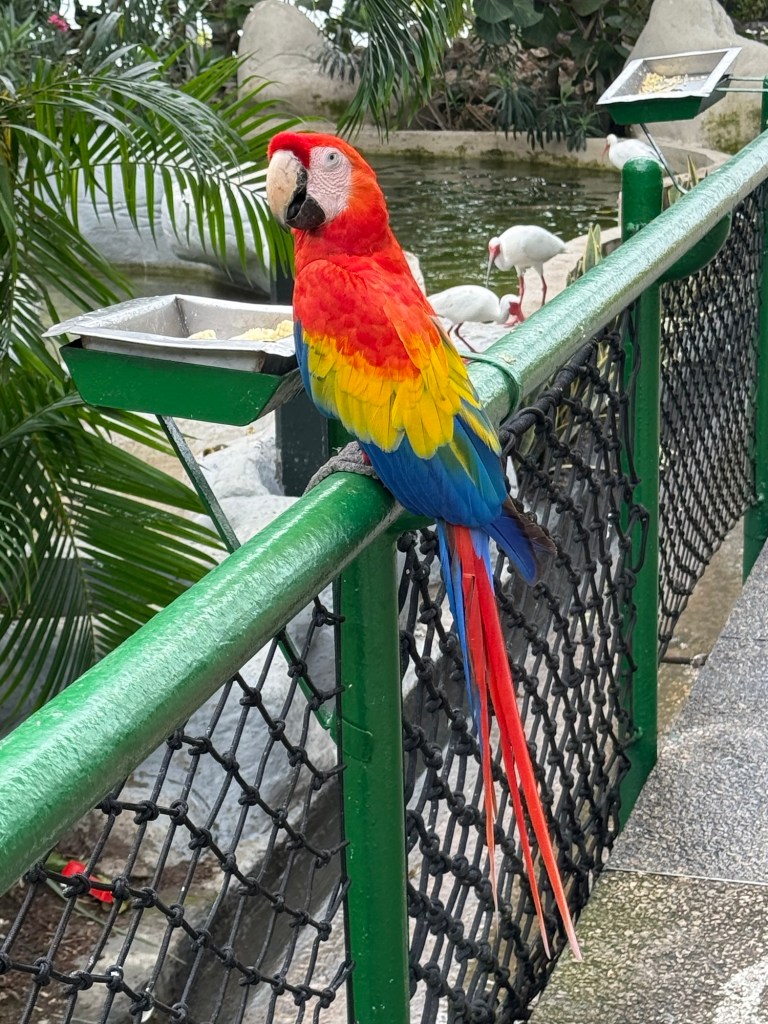
To start our day, we left the ship and were transported by bus through the working port area to the cruise ship terminal. After getting off the bus and going through a gate it was like landing in a zoo! Feeding stations throughout the treed area attracted hundreds of birds including Scarlett Macaws, Flamingos and parrots of various sizes and colours and several different kinds of monkeys! I didn’t get any monkey pictures because they were moving through the trees to fast that it was impossible. The area also included a building with a plethora of souvenirs of Colombia and Cartagena, including several display cases of the ever popular emeralds for which Colombia is famous. 

We had seen these Scarlett Macaws from far away in Costa Rica but great to be able to see their unbelievable plumage. But what a racket!

We grabbed a taxi outside the cruise ship terminal and after negotiating a fair fare we were transported through neighbourhoods of modern high rises, and commercial areas into the old walled part of the city. Our taxi driver was all set to come along as our photographer and guide, but he spoke little English and so after much hand gesturing, pointing to watches, etc, we agreed to meet him back at our drop off spot in 3 hours. 

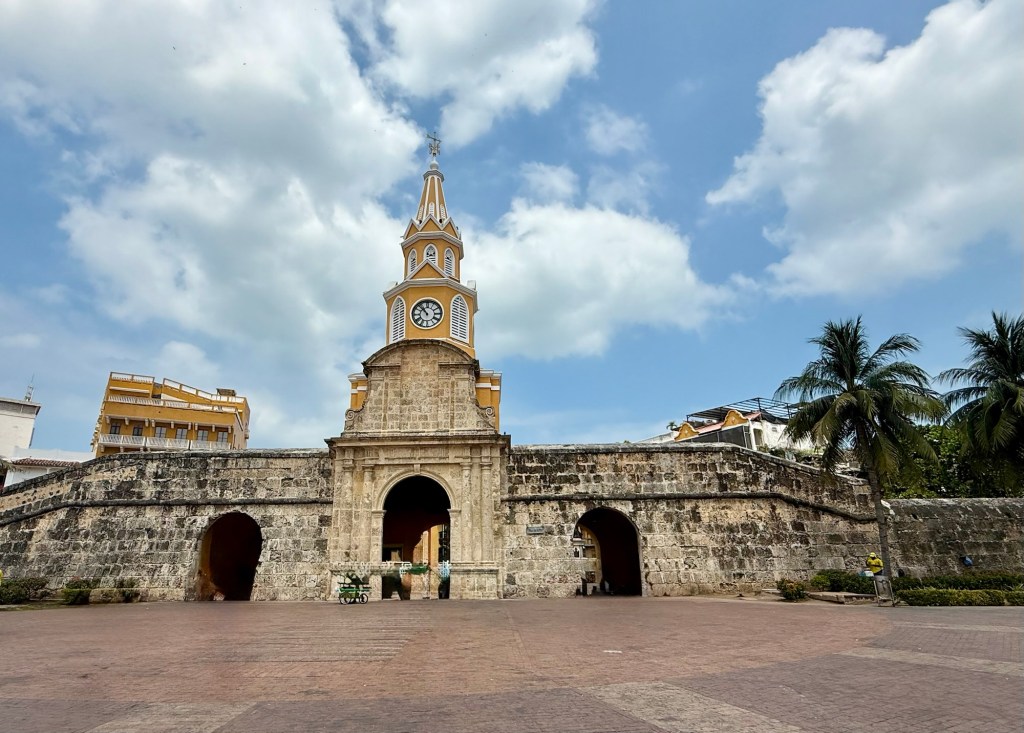
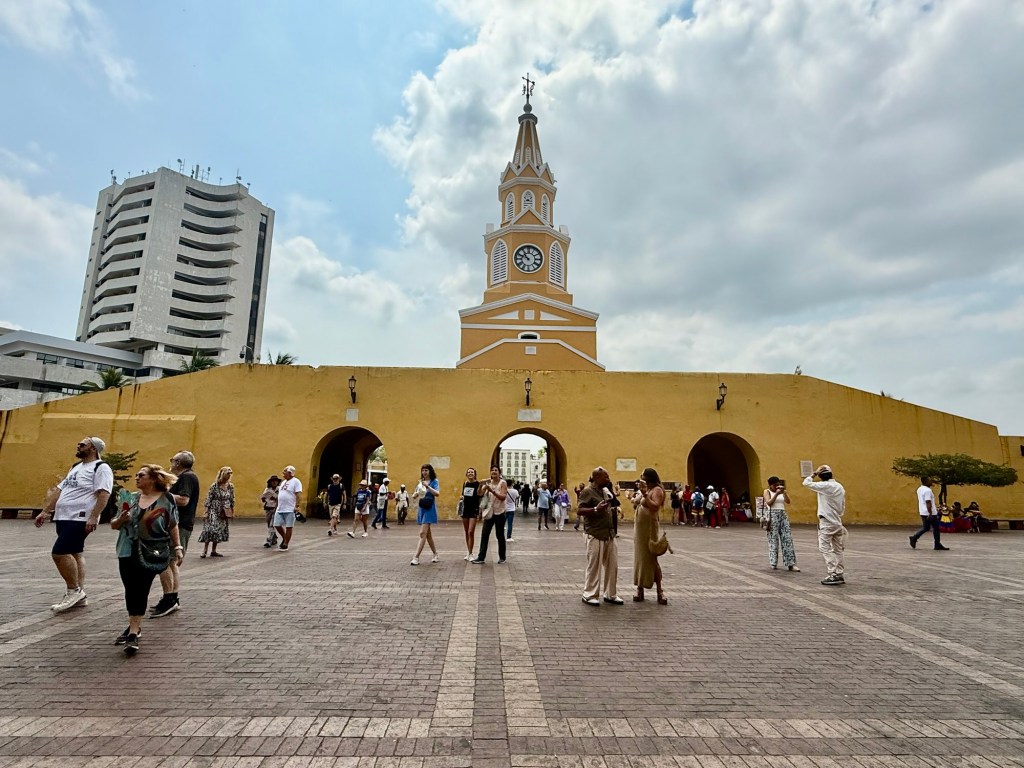
The famous entrance/exit to the old city area from the outside in/and then inside/out

We walked through the old walled area of the city, where the ancient buildings of the city have been preserved on the outside but renovated on the inside into boutique hotels and lovely shops.  None of us are particularly shoppers so we didn’t stop often. But after an hour or so we found a cute little restaurant where we stopped for a drink and to appreciate their air conditioning. 

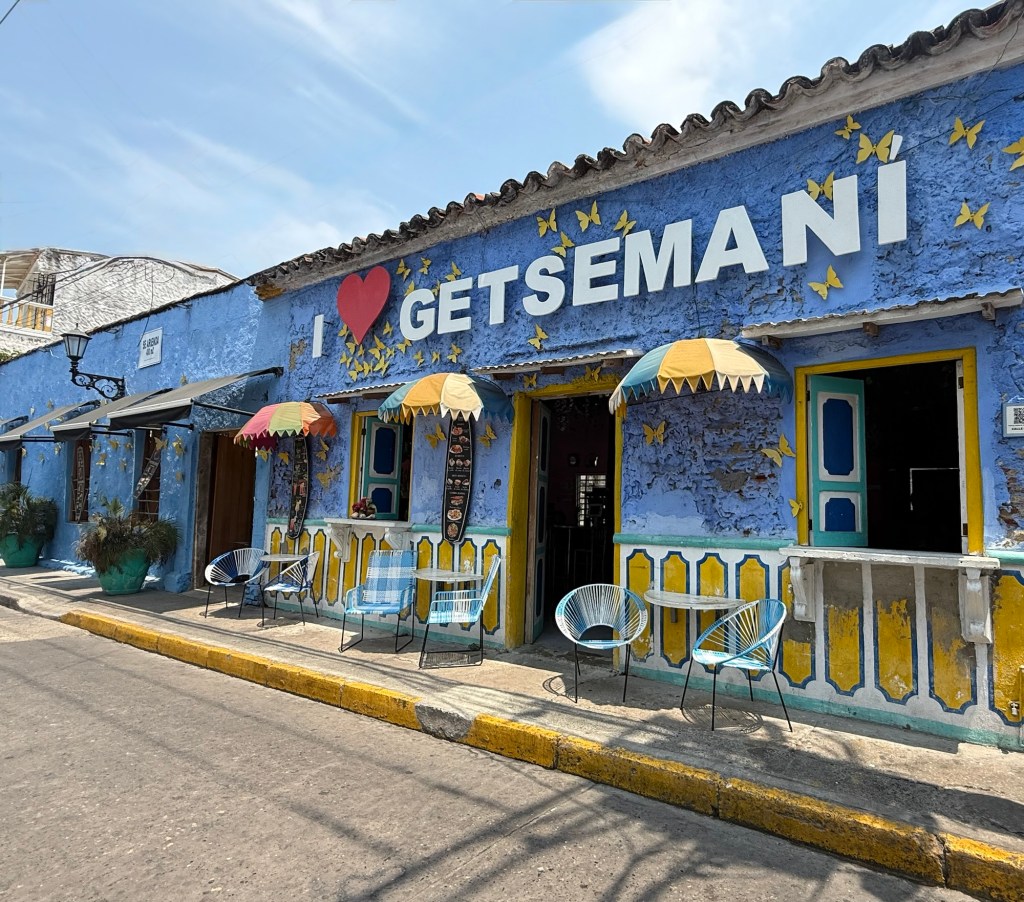
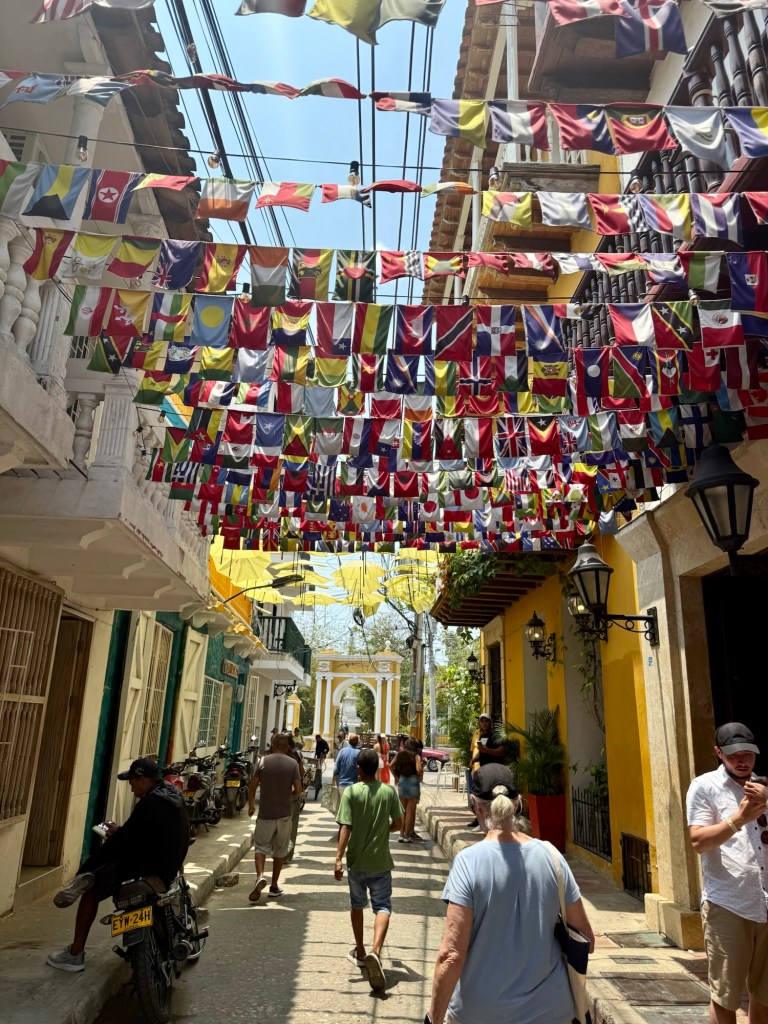
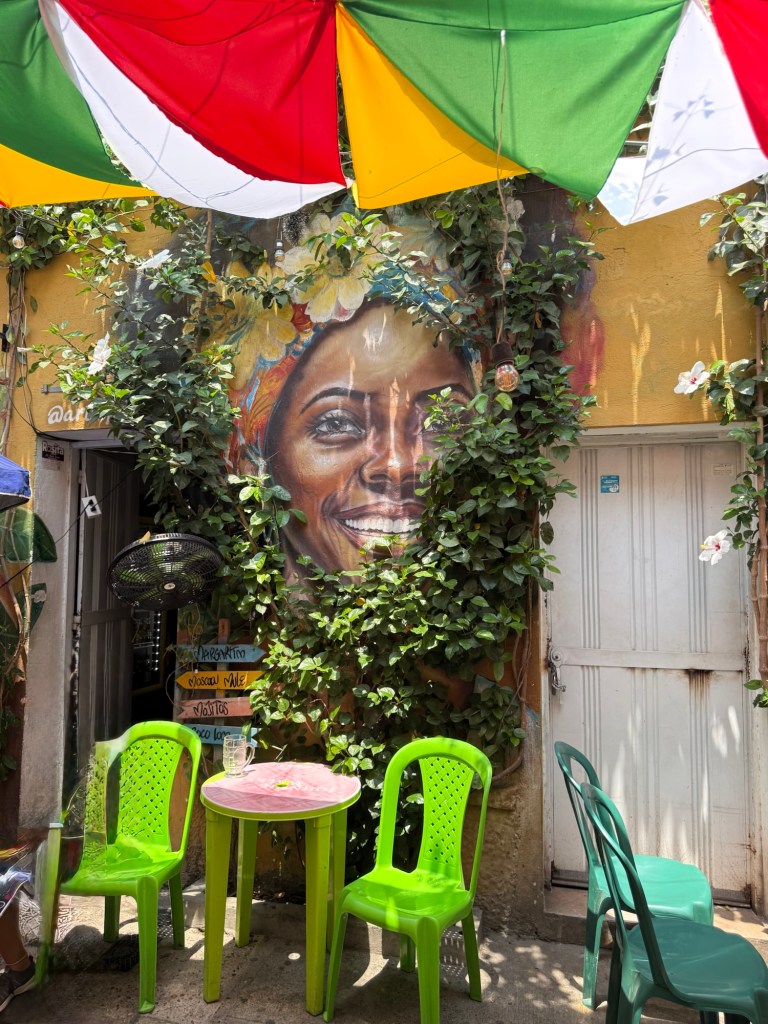
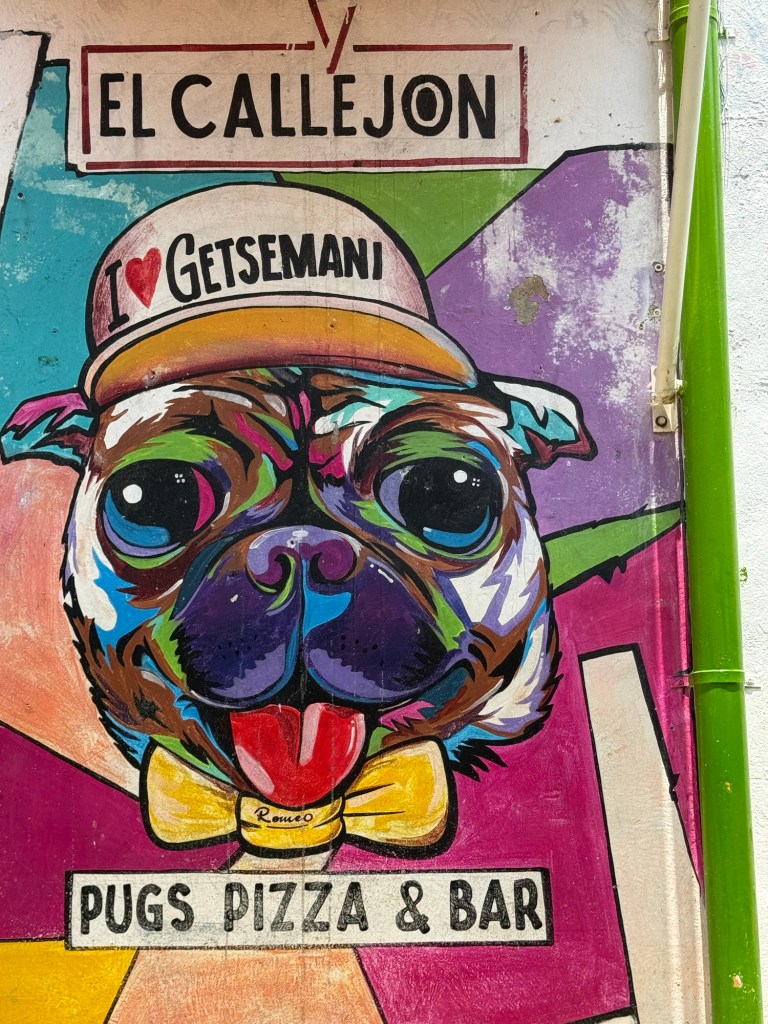
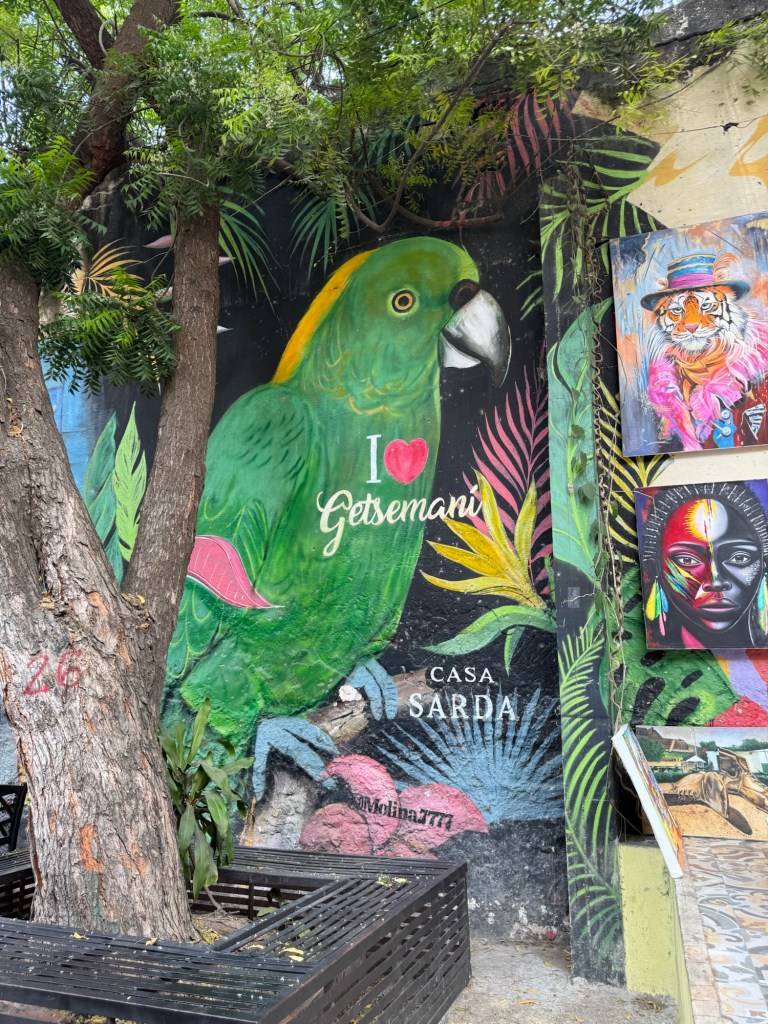
One of the many beautifully painted walls in the Getsemani neighbourhood.

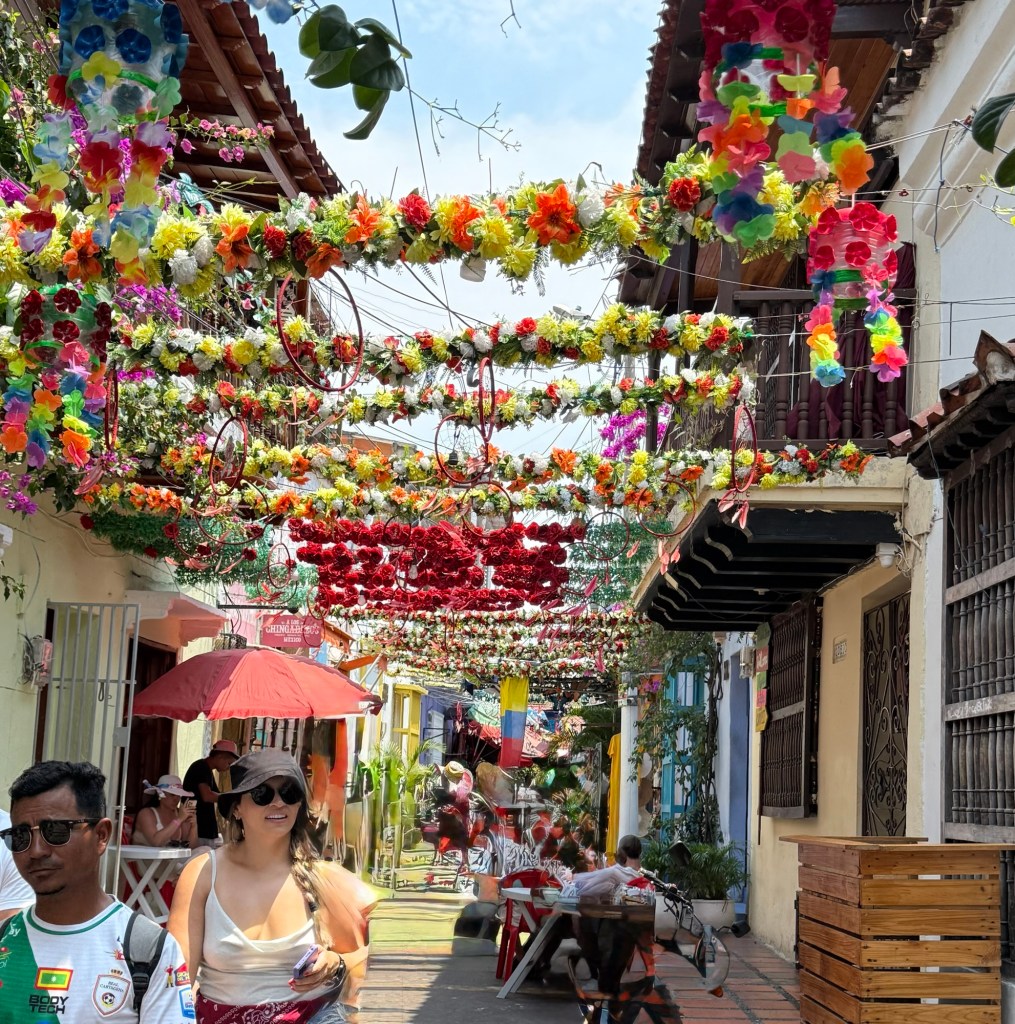
Next we headed to the Getsemani neighbourhood. This area is where the poorer of the people of Cartagena lived in early days, and it had become run down and once was the scene of a prolific drug trade. But in the last 10 years the area has been reclaimed and some of the old buildings of this neighbourhood are being turned into cute boutique hotels, and the main floors are retail shops, restaurants and bars. It’s now considered one of the “hippest” neighbourhoods. It was busier this year than when we toured it during the day last year.  

We criss crossed some of the most colourful streets and the street art is unbelievable so we stopped often to take pictures. We had started early to try and avoid some of the heat but failed. By the time we were done and as happened last year, I was literally soaked all the way through my clothes by the time we got back. 

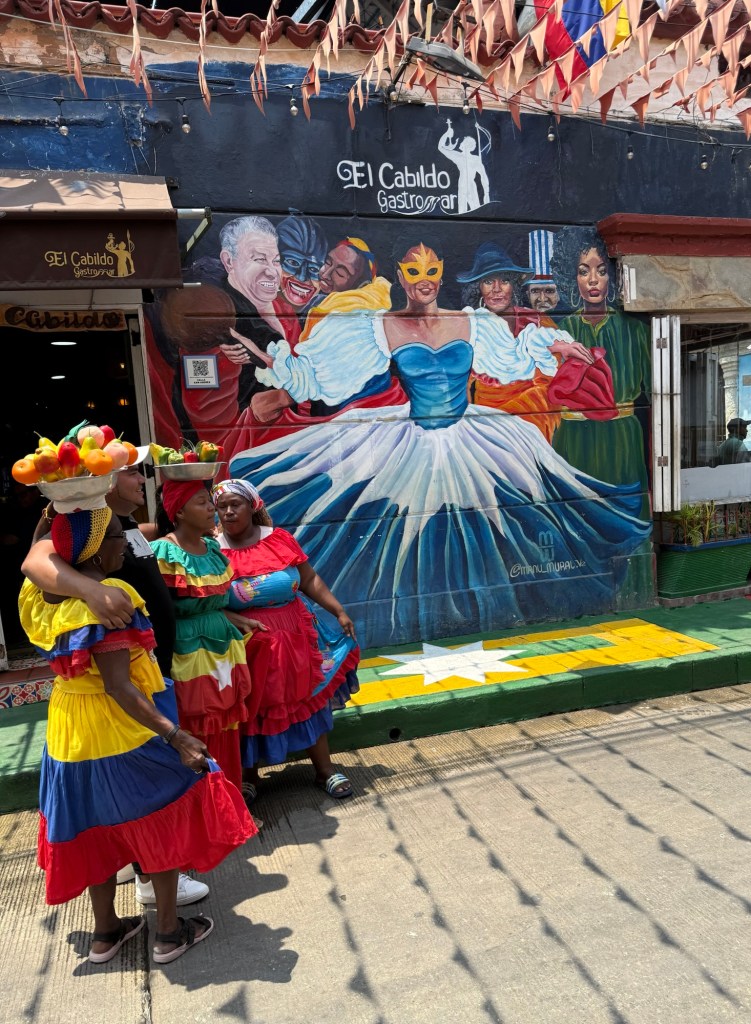
These ladies are wearing traditional clothing and are anxious to have you take their picture, for a slight fee of course.

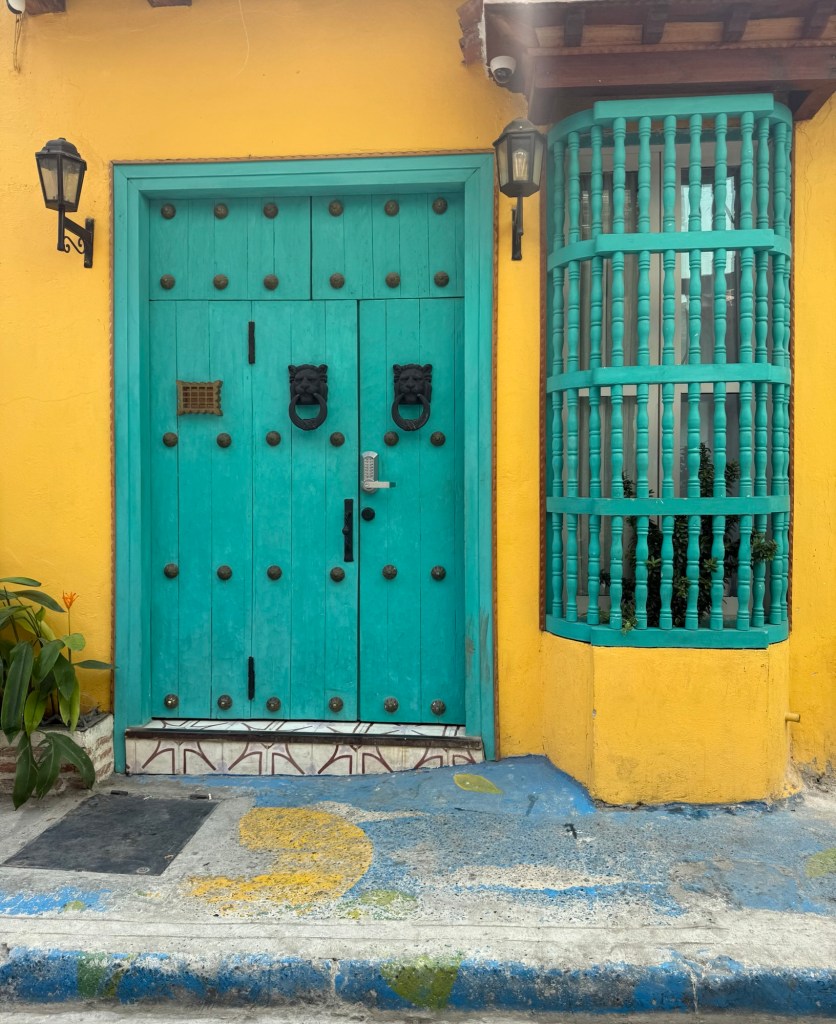
One of the things that I always find interesting when travelling are the doorways of the local architecture. And here it is even more interesting because there is meaning to the doors of the homes. Door knockers are very prominent and they even tell a story of what the role in the city the inhabitants played. Lion door knockers meant that this place was home to some in the military. A Reptile meant that they were politicians. A fish meant that these people were businesspeople and a hand meant that this family were close to the church, and the government. Also on most doors there were what our guide called nipples, small knobs of metal. If there were a lot of nipples, it indicated this family was wealthy and if only a few or none, not so much. 

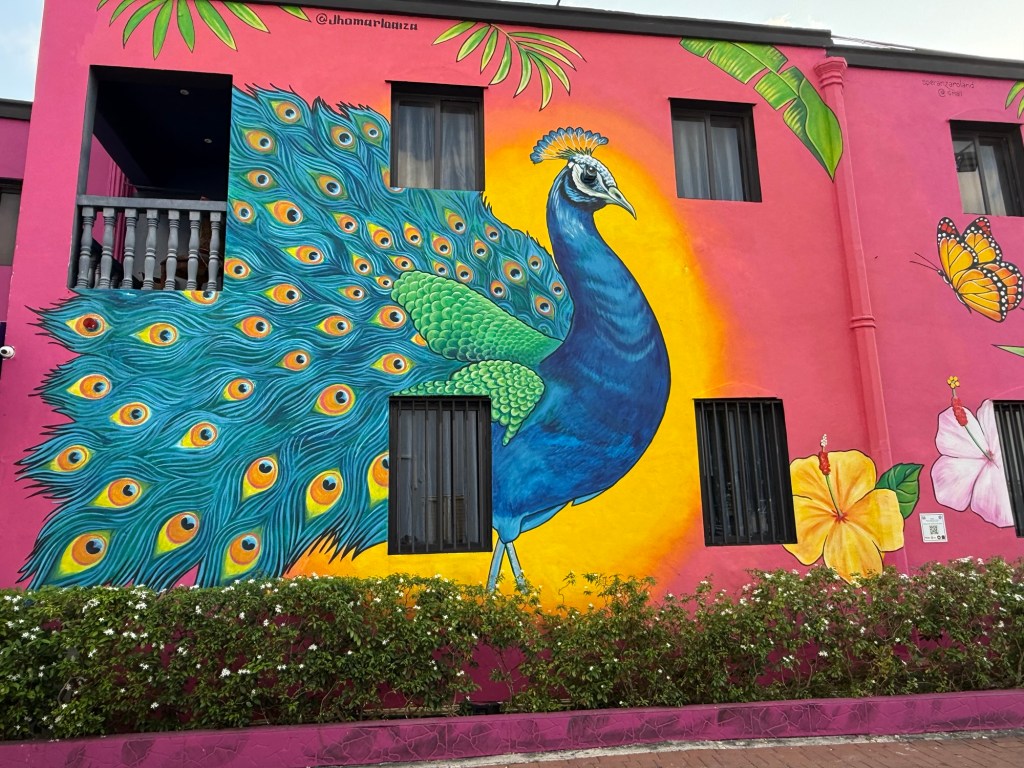
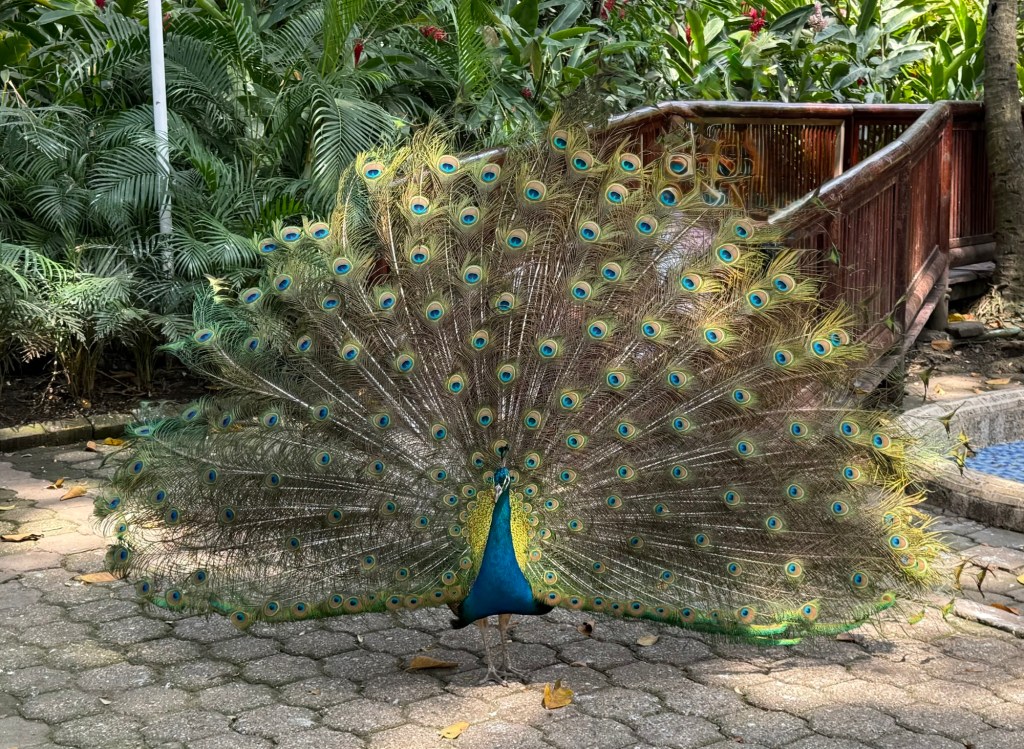
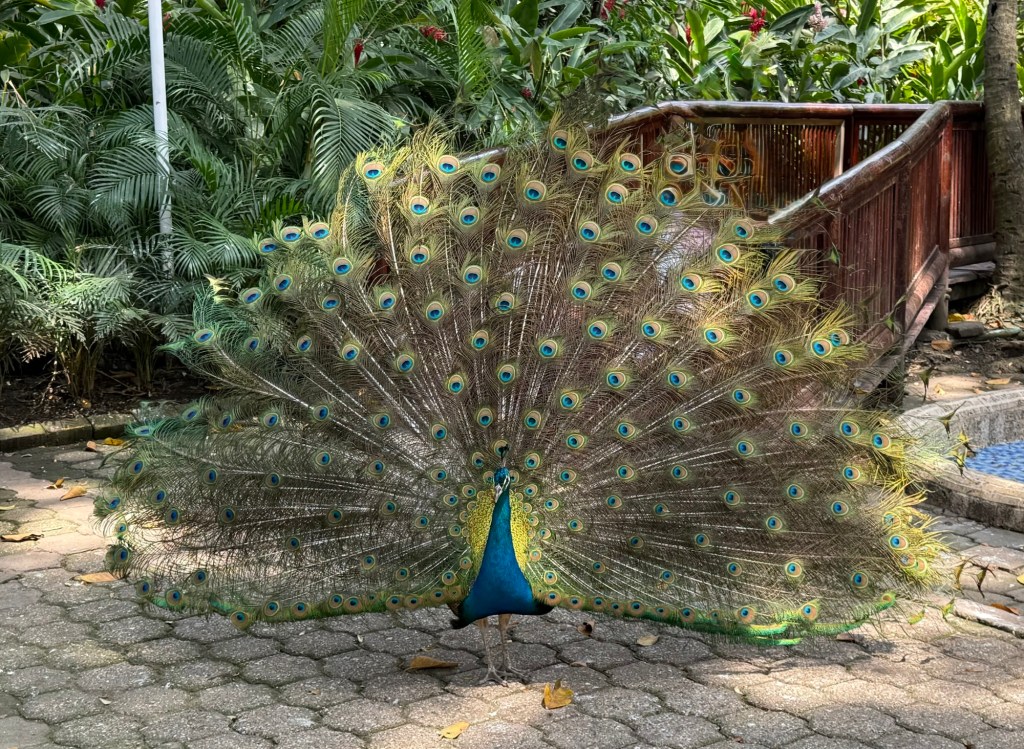
We made our way back to our meeting place and there was Alejandro waving to us from down the way, ready to take us back to the cruise ship terminal as promised.  We were greeted by a great display of peacocks strutting their stuff and the Macaws fighting.

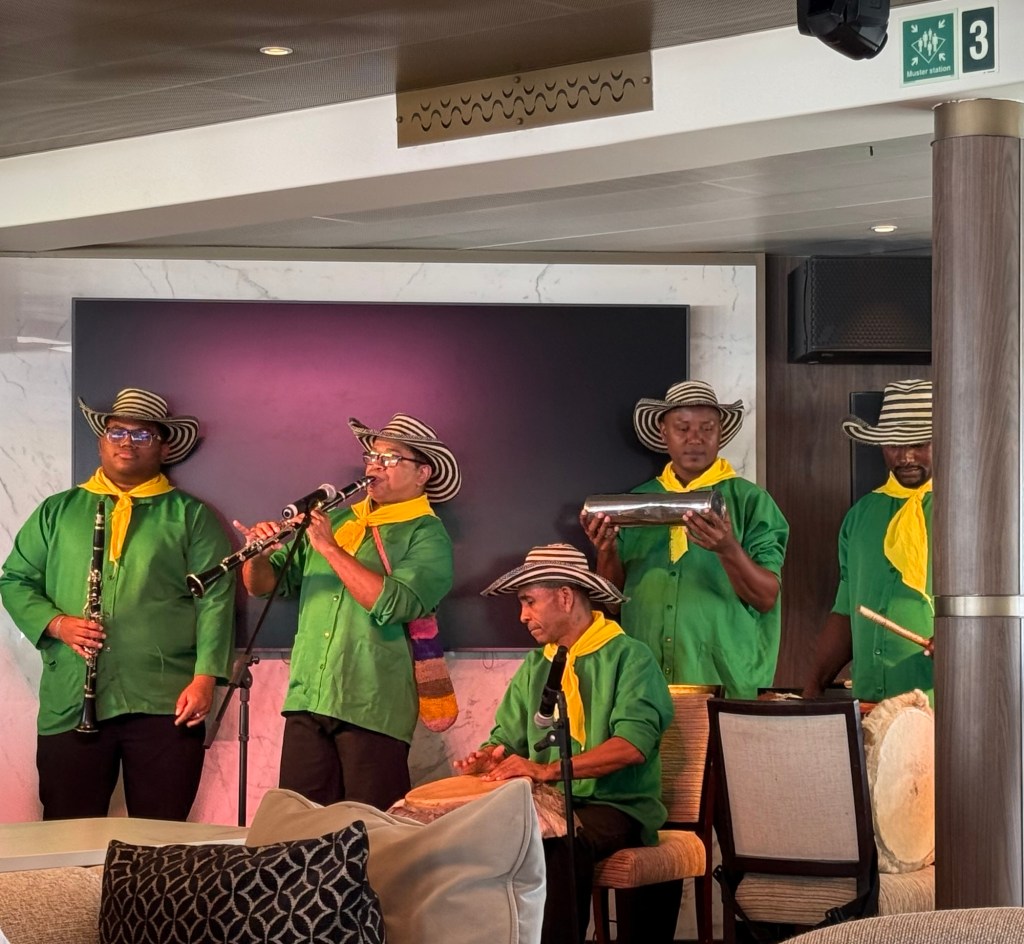
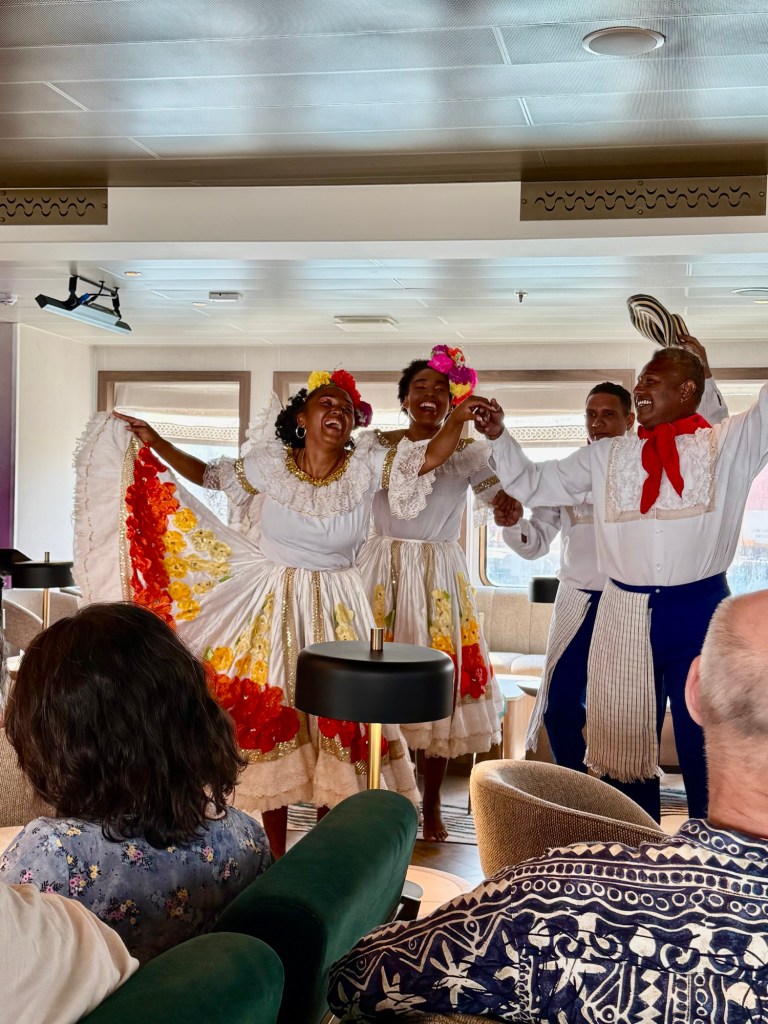
The Excursion Director had organized more cultural entertainment on the ship for late afternoon today. It was a band and colourfully dressed dancers from Colombian doing traditional dances. The leader of the group explained the meaning of each dance explained what was happening in each dance. It seems like most of the traditional dances from the various countries we’ve seen all have a similar plot that involves men trying to attract women and them being shy, or vice versa.

Tuesday, March 18: Sadly, the Captain advised us yesterday that he had made the decision to cancel our stop in Santa Marta, further along the Colombia coast due to bad weather.  He also told us to take any seasick medication that we might need as it was going to get rough for the next few days. I’m sad that the stop was cancelled but not surprised because staff and other passengers had said that this port is often cancelled due to heavy winds.  The ship has been pitching a bit, but not bad. I’m not prone to sea sickness but took some Gravol Ginger tablets just in case. Breakfast this morning was served in the inside dining room rather than at the outside space just in case of too much wind. It’s gray but not raining today and a little cooler than the previous few days.  A welcome relief, really.  

So we’re at sea today and tomorrow and will hopefully arrive in Aruba on schedule on Thursday morning.  

2025 Cruise

Defending the gold route

Colon, Panama 

March 15

After traversing the Panama Canal yesterday, we spent the night moored at the industrial terminal in Colon. There was no rocking, how was I supposed to sleep? Not sure why we were in the industrial terminal rather than the cruise ship terminal but we even had to take a shuttle through the terminal to get to our bus for our excursion today. 

This morning we said goodbye to many of the friends we’ve made in the past week as it’s time for those on the 7 day portion of the cruise to head for home, and a new batch of passengers to embark in Colon. I am on board for another 11 days as we head north west to our disembarkation in Barbados. After that the ship will carry on a repositioning cruise with just a few passengers across the Atlantic to Lisbon to do the spring European cruises.  

Colon is a major port on the Caribbean side of Panama near the Atlantic entrance to the Panama Canal and capital of the province of the same name. There is a large duty free trade zone for tax-free shopping but not a whole lot of other interest if I’m being honest. We travelled through some of the city by bus on our excursion and we saw a dichotomy of neighbourhoods as I guess we would with most cities. One area of huge, lovely houses in a gated community on our way out from the ship and another of decrepit three story walk-ups on our way back to the port. Our guide also showed us some areas of homes where workers on the canal lived where some have been significantly modified and other tiny ones that are the original design. 

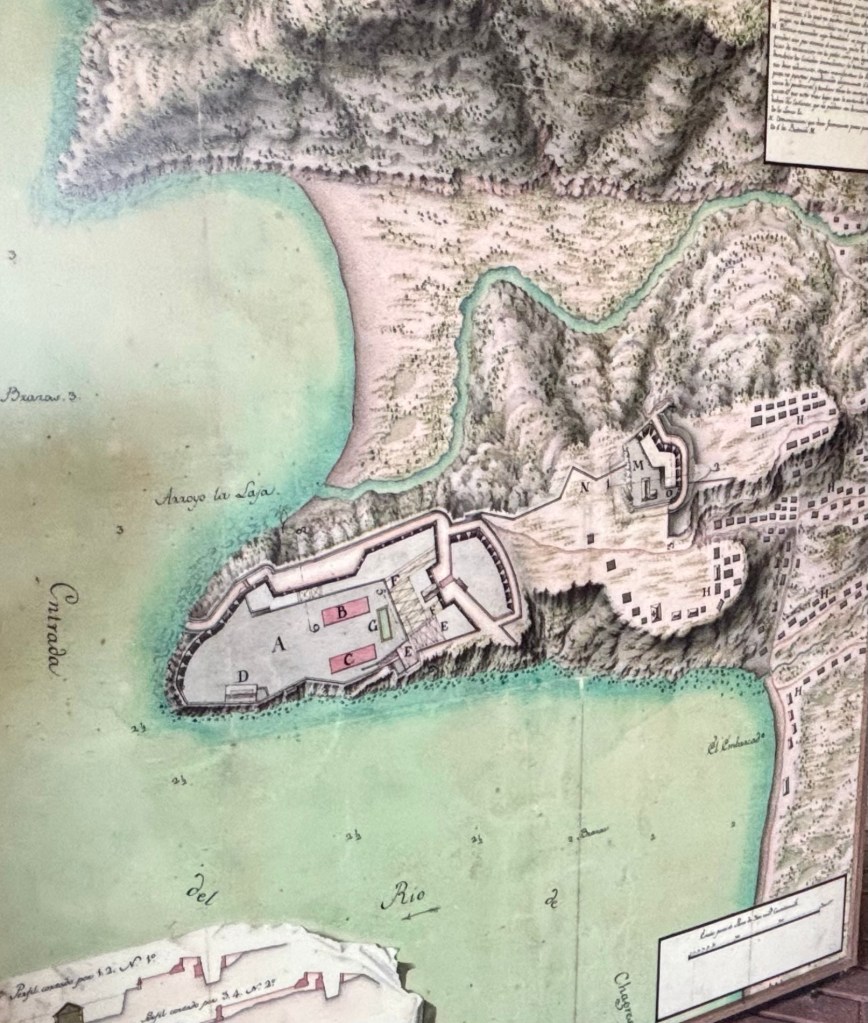
A drawing of Fort San Lorenzo and the small town surrounding it.

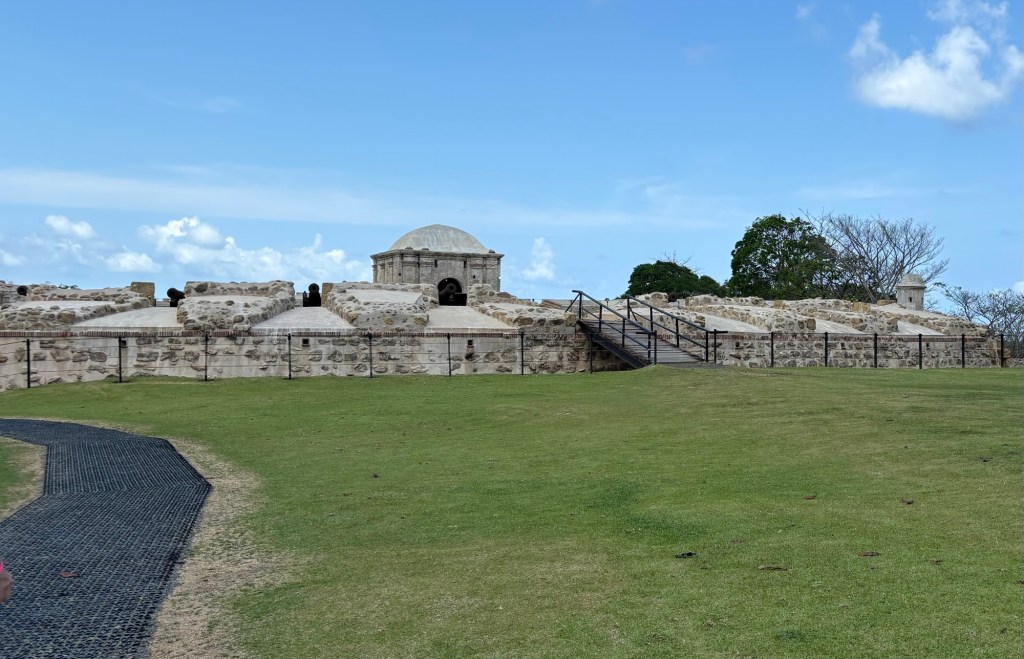
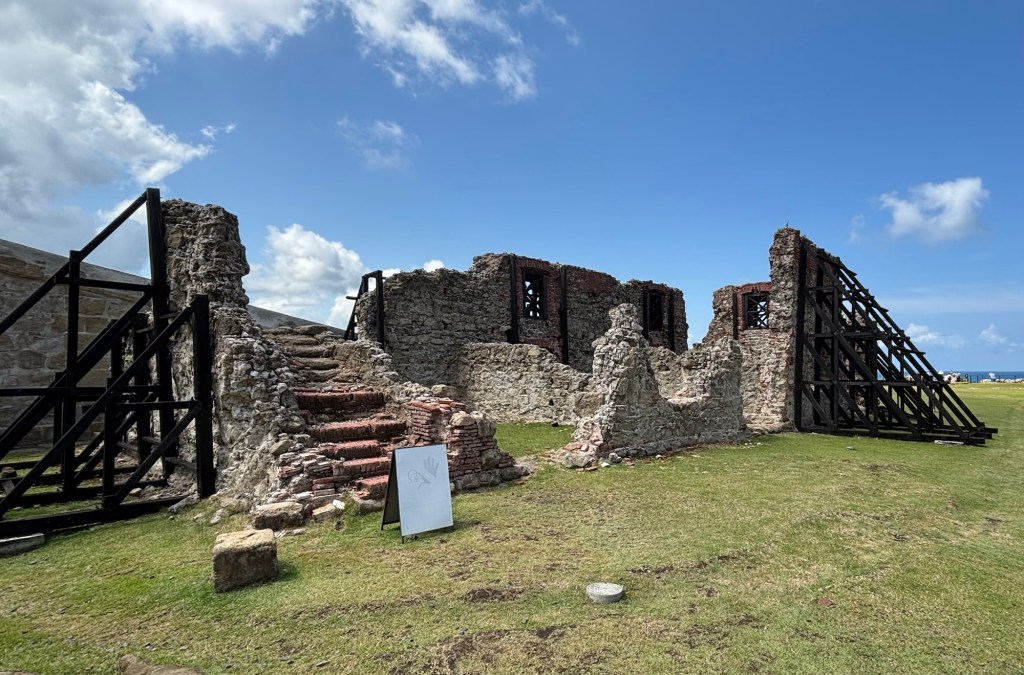
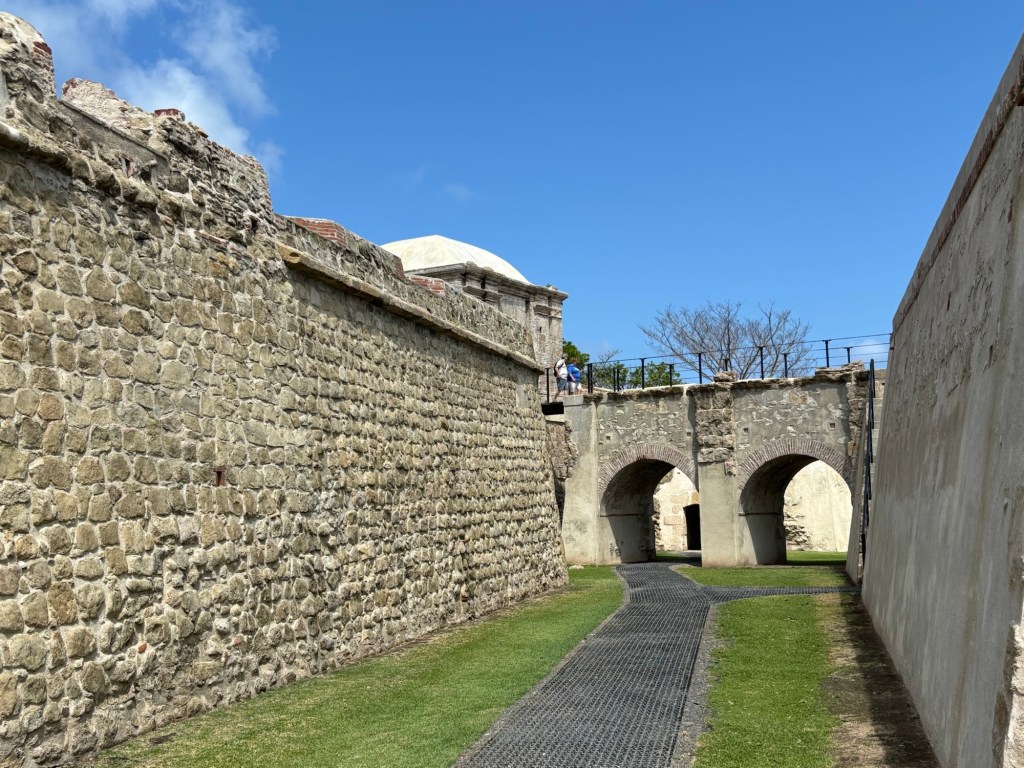
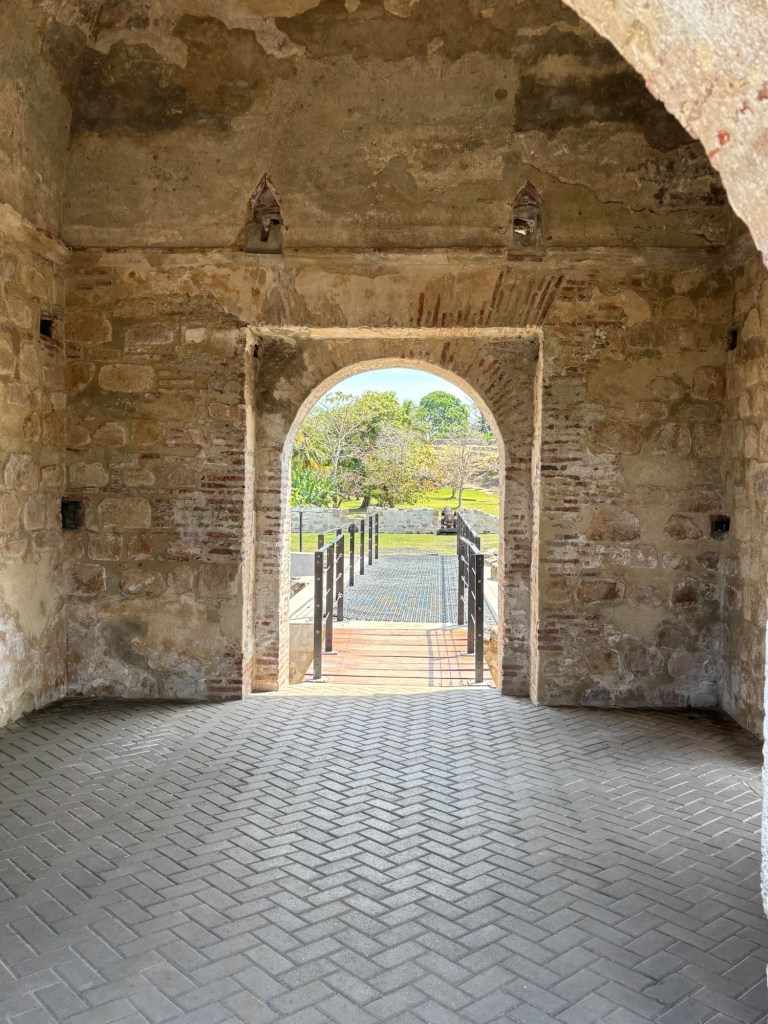
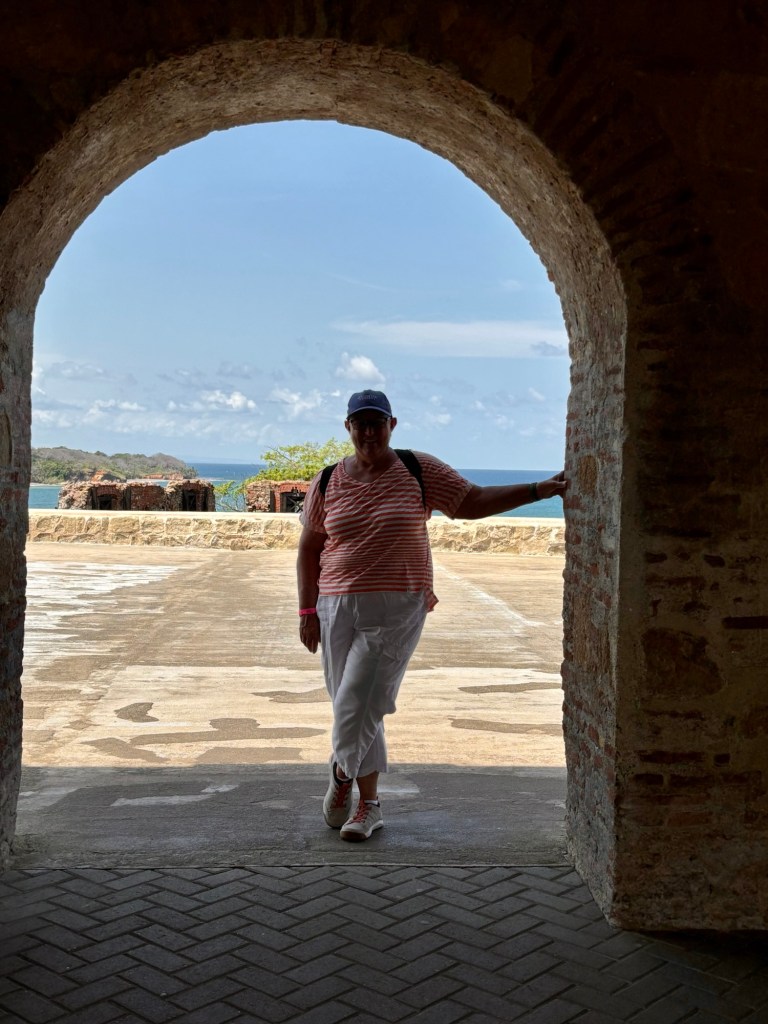
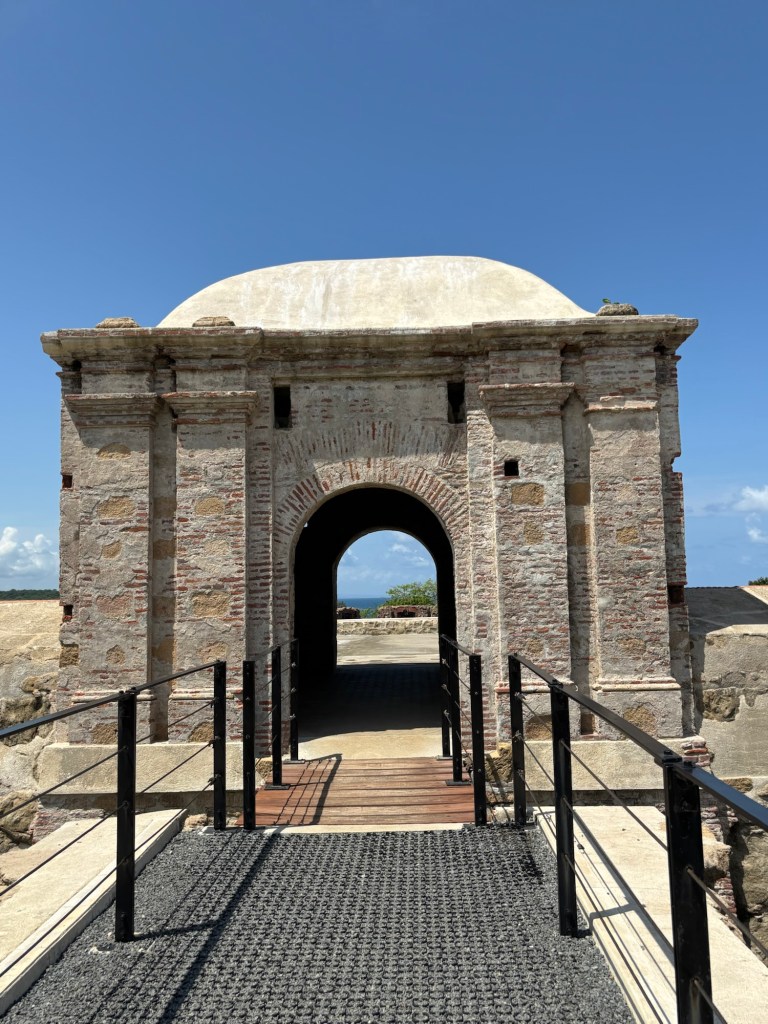
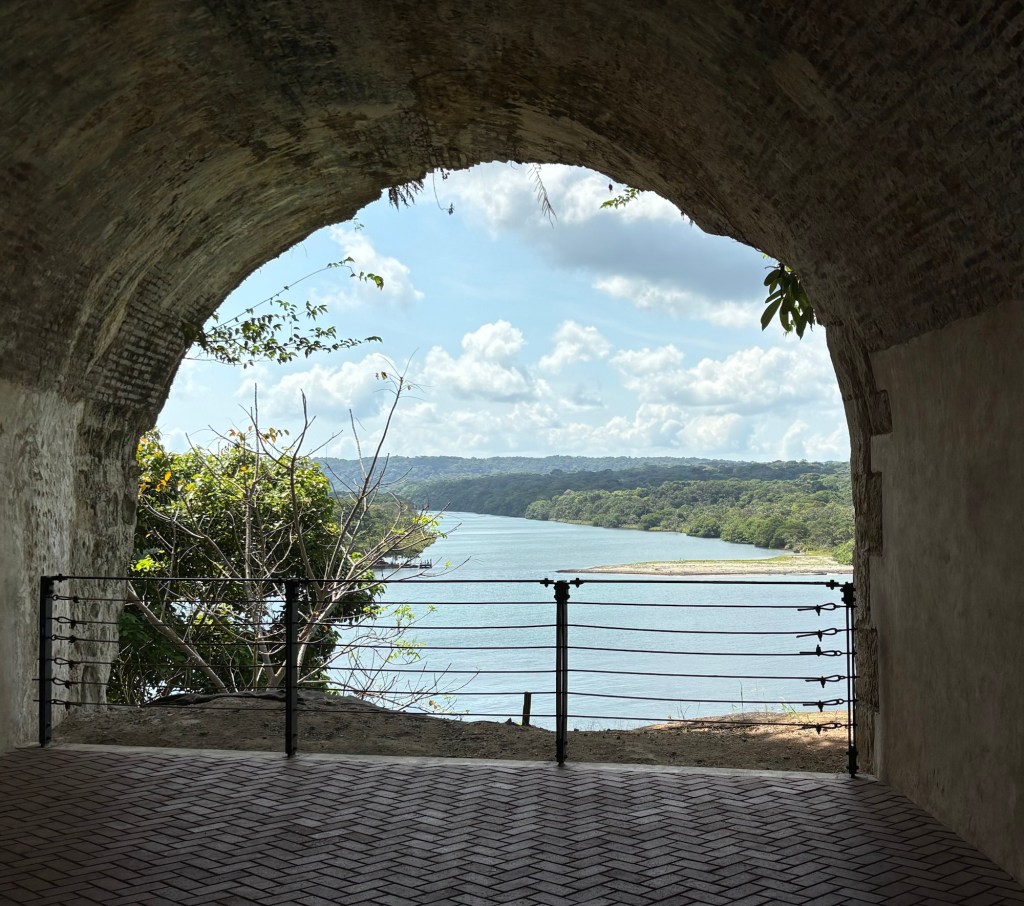
Our excursion today was to a UNESCO World Heritage Site just west of the city, Fort San Lorenzo, a well preserved ruins of the site of 3 different forts. The Fort is located at the mouth of the Chagres River, the entrance to the pre-canal overland route from the Atlantic to the Pacific. The Chagres River forms part of the canal in some sections and we overlooked it on our day to Gambo a couple of days ago. 

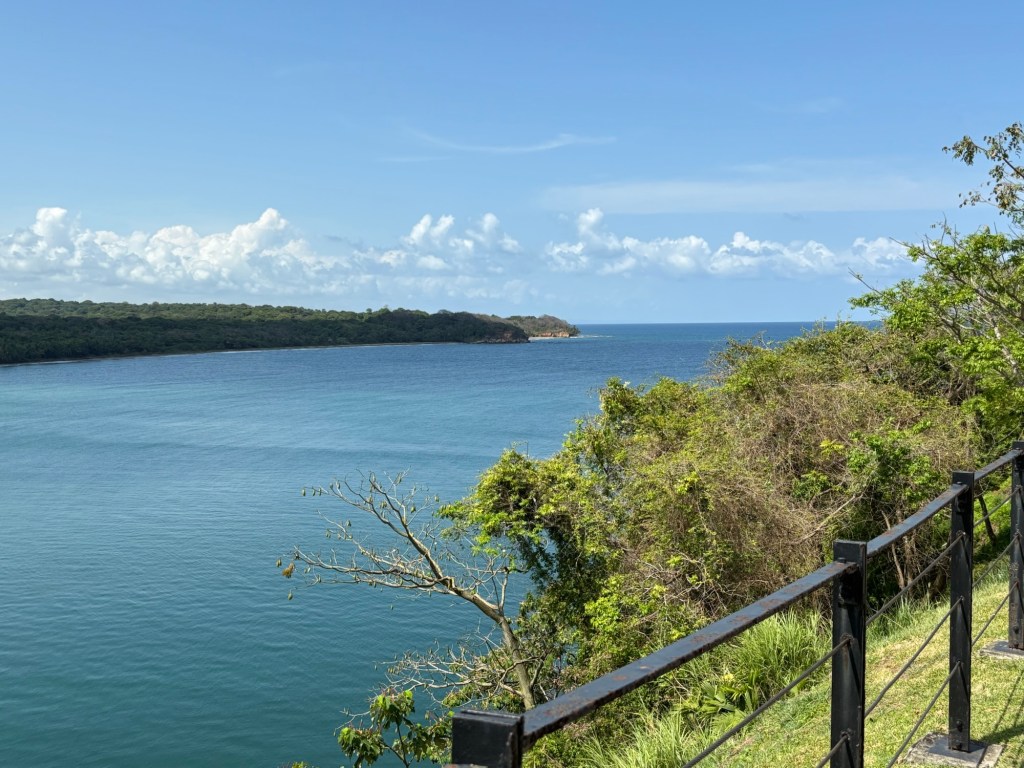
The mouth of the Chagres River where it enters the Atlantic
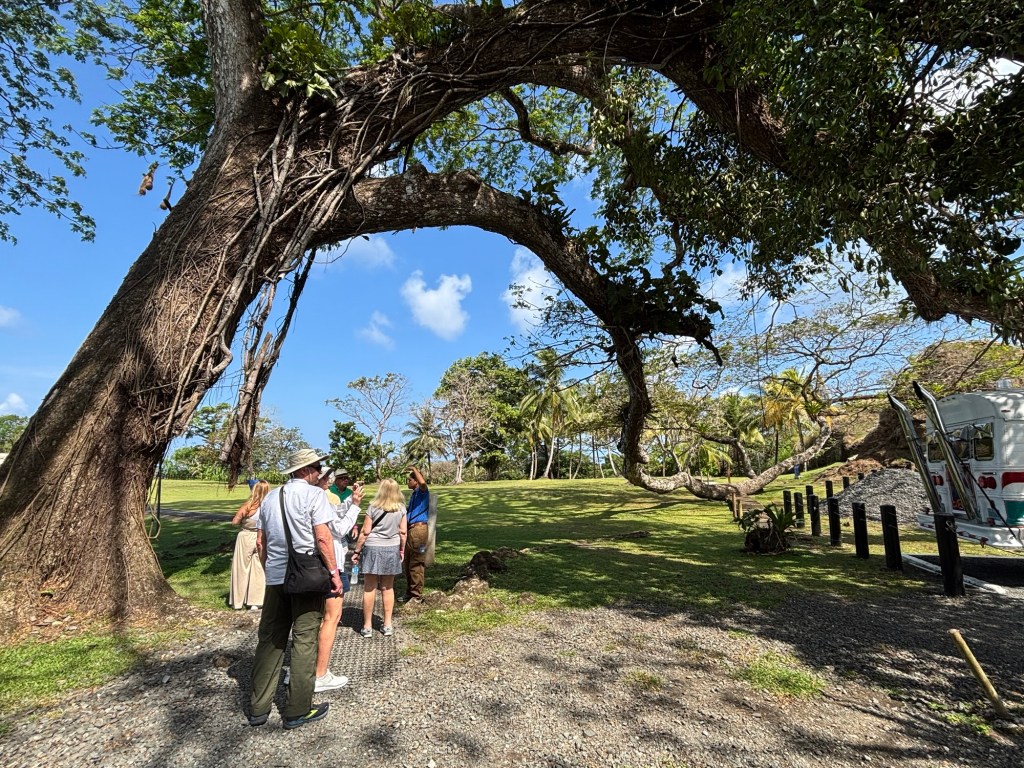
This tree was amazing. It was huge and you can see one of the branches running along the ground in the distance. It also has a Strangler fig tree wrapped around it which would eventually strangle the host.
In the 1500s, Spain was on their conquest of Peru and pillaging gold from the Incas and shipping it off to Spain using the Chagres River as part of their transportation route. Pirates soon got wind of the spoils and began attacking the coast and so the Spanish built Fort San Lorenzo at the mouth of the Chagres to protect their loot. It grew in scope from 1587 – 1601.  All was well with the fort and their supply route until buccaneer Henry Morgan had his guys attack in 1670. The Fort had been built to repel attack from the river and the Atlantic, but Henry Morgan’s troops come across land and they didn’t have the fortification or guns aimed in that direction. 

In the 1680s the Spanish constructed a new fort, 80 feet up the bluff and with additional protection on the land side of the fort, primarily in the form of a dry moat/drawbridge. Then in 1739/40, the British attacked the fort and the Spanish again refortified this fort and one upstream at Gatun. 

The dry moat surrounding the land side.

By the middle of the 1800s, the Spanish had abandoned the area and instead were travelling around Cape Horn instead of taking the overland route through Panama.

The location of where the draw bridge would have been located.

The Fort site has been preserved in the last few years and they are building a huge visitor’s centre that will be open in a few months which will add to the experience.  Our guide did a great job of bringing the fort alive in our imaginations and there are pictures and explanations of the various components of the fort throughout. 


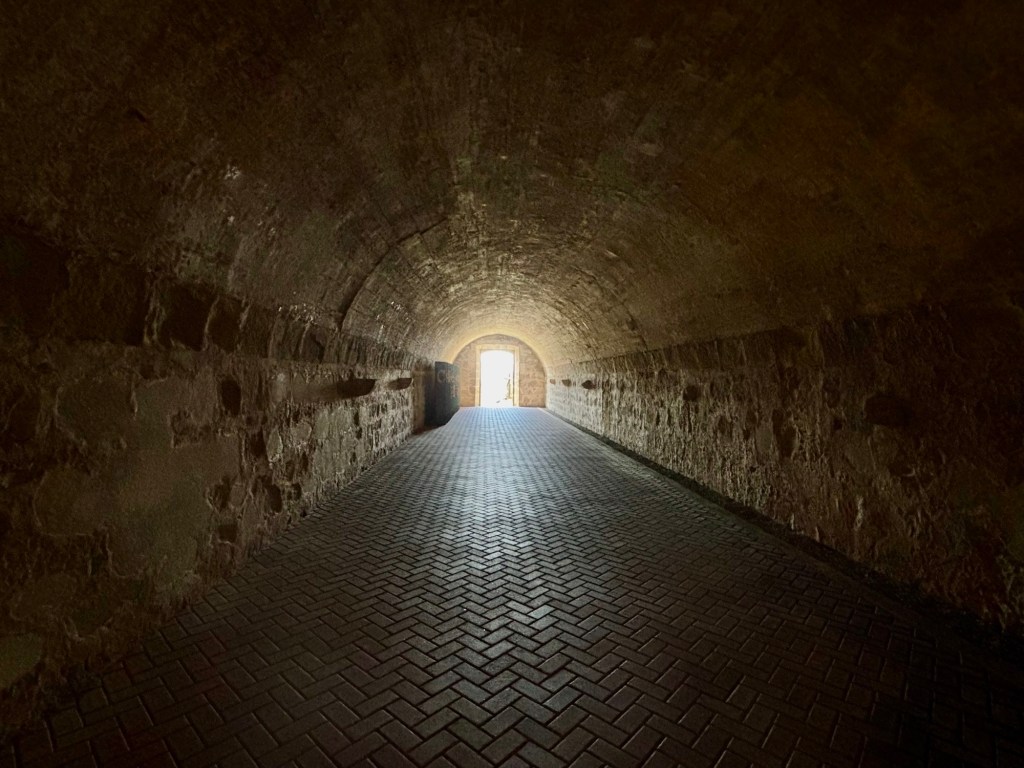
One of the many storage vaults.
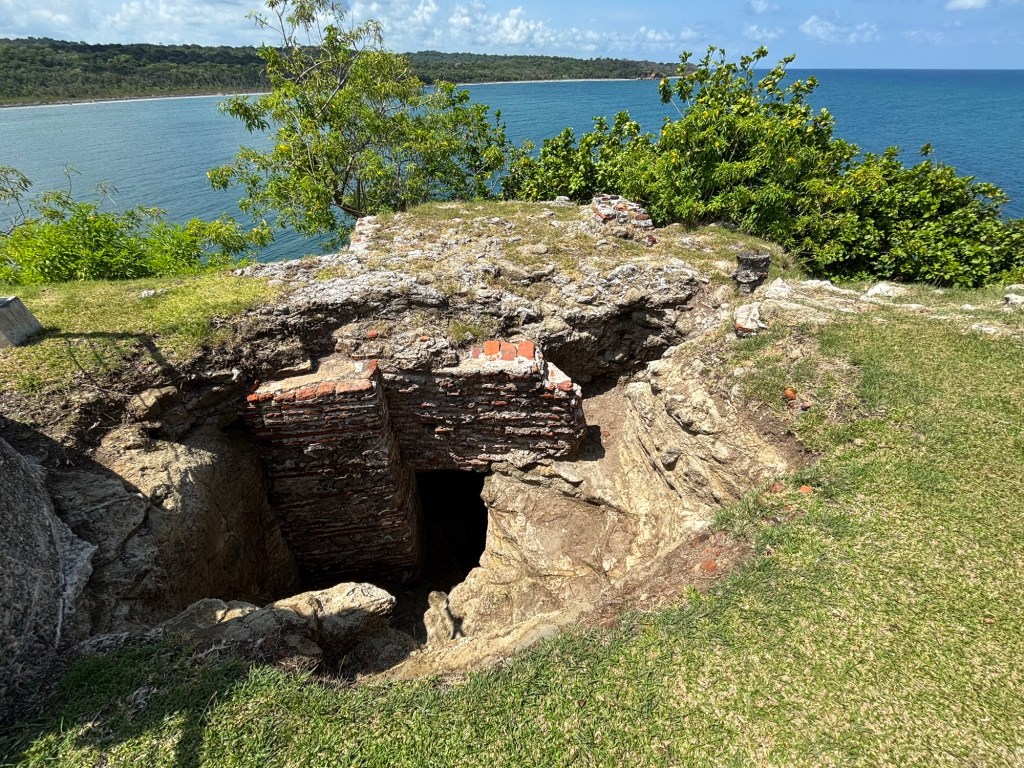
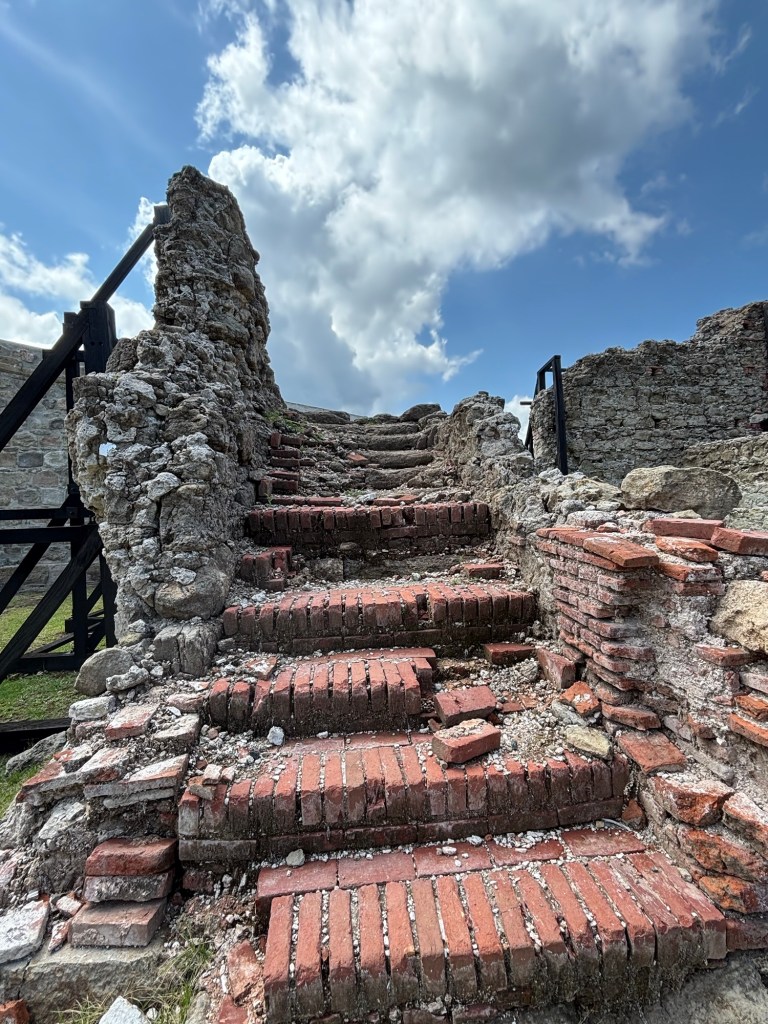
This stairwell led down to positions half way down the cliff where soldiers could shoot at passing ships.
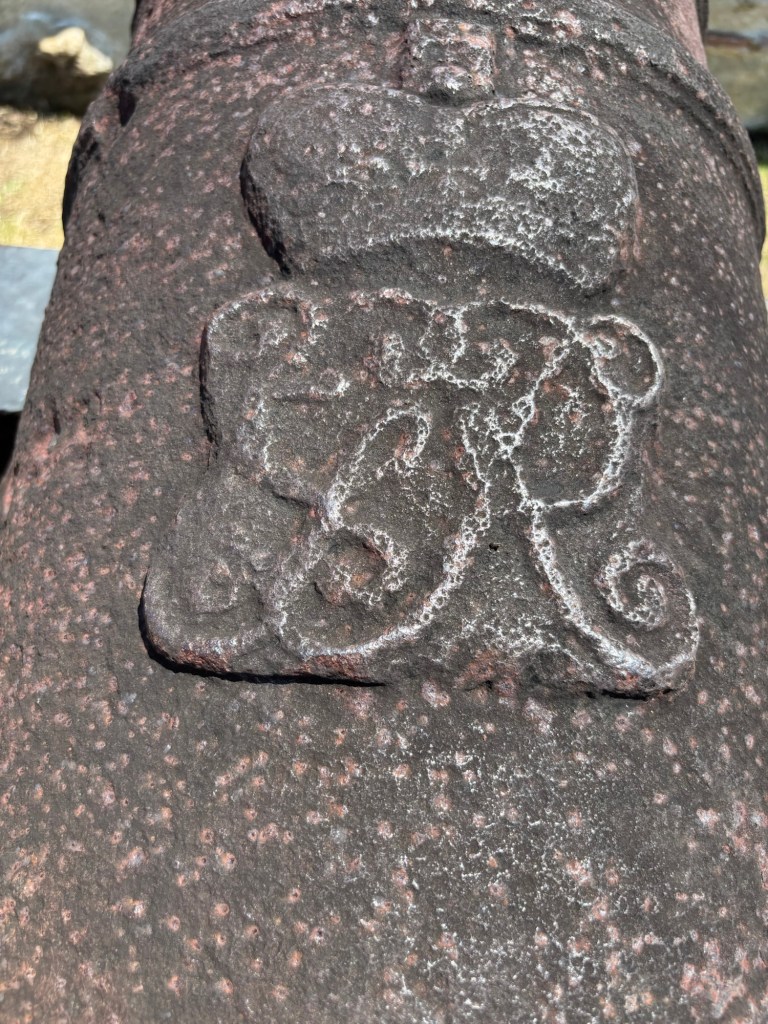
A Portuguese crest on one of the cannons
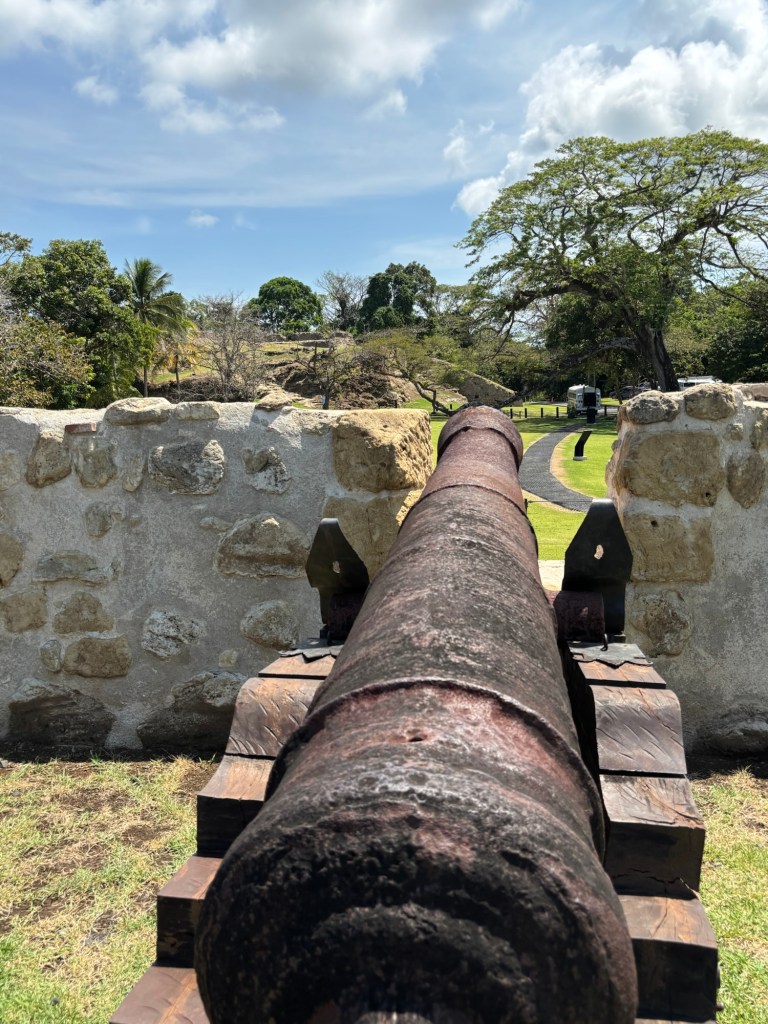
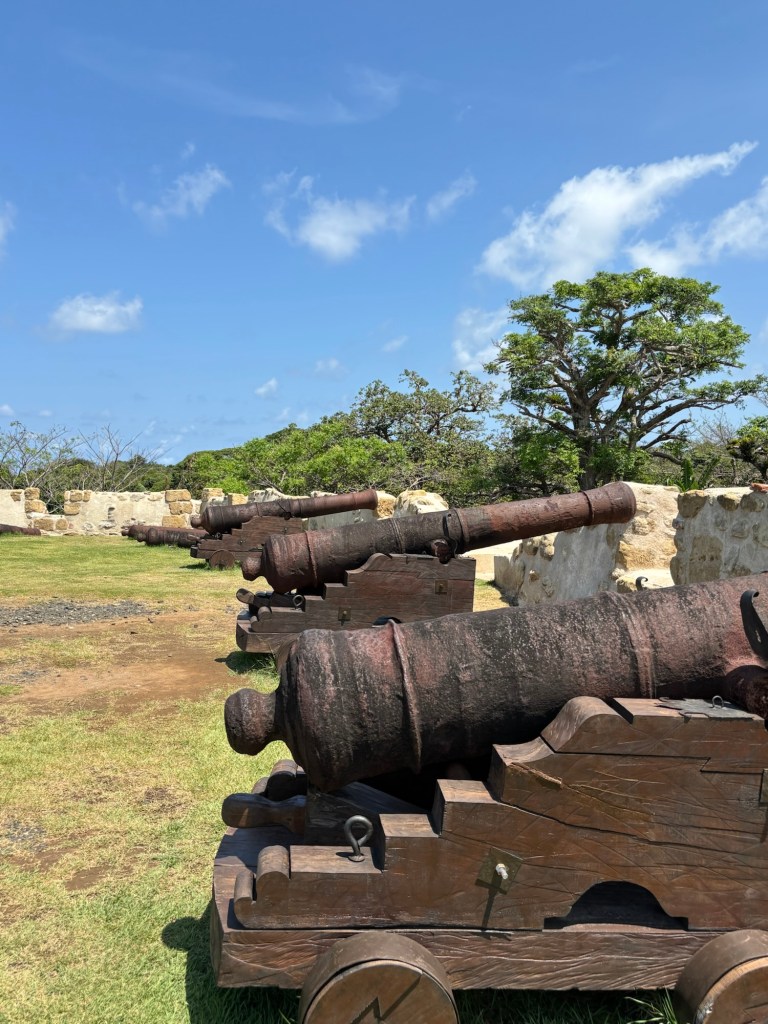
Canons aimed at potential overland intruders.
Moi
The main entrance
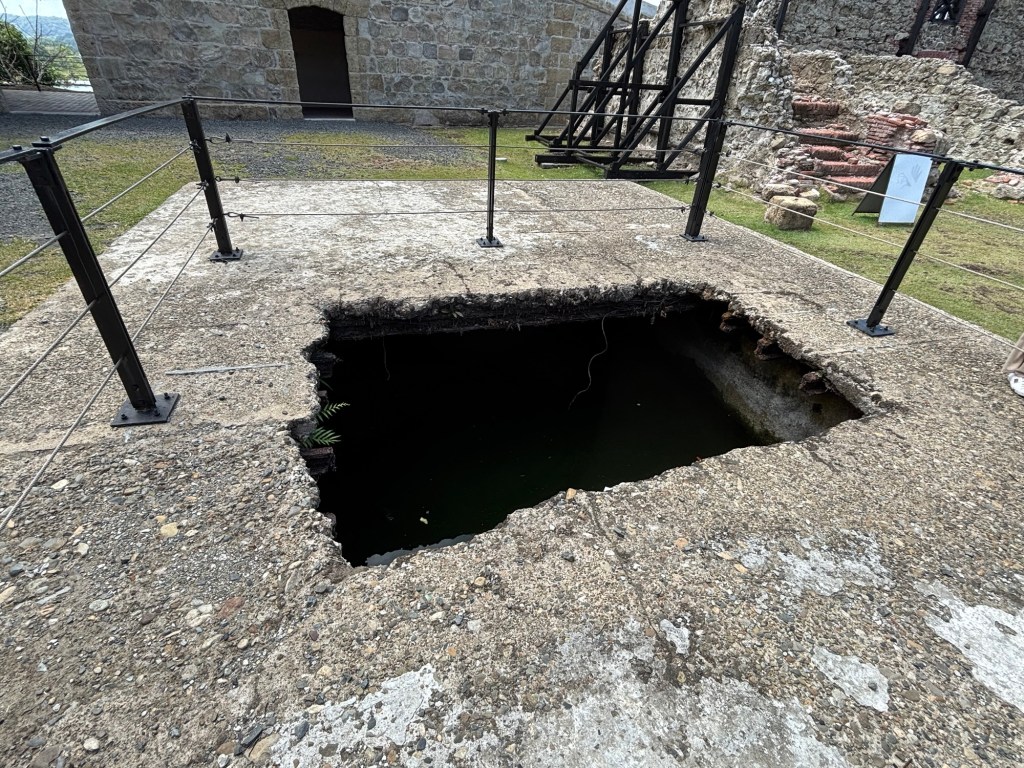
The cistern
Down the Chagres River

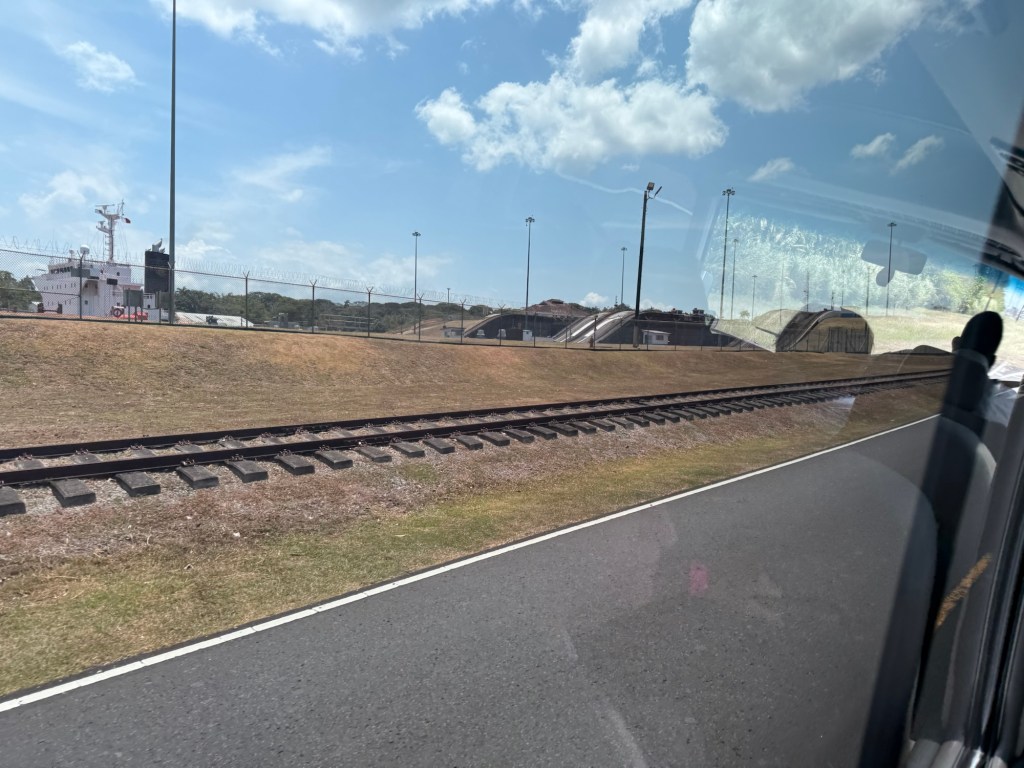
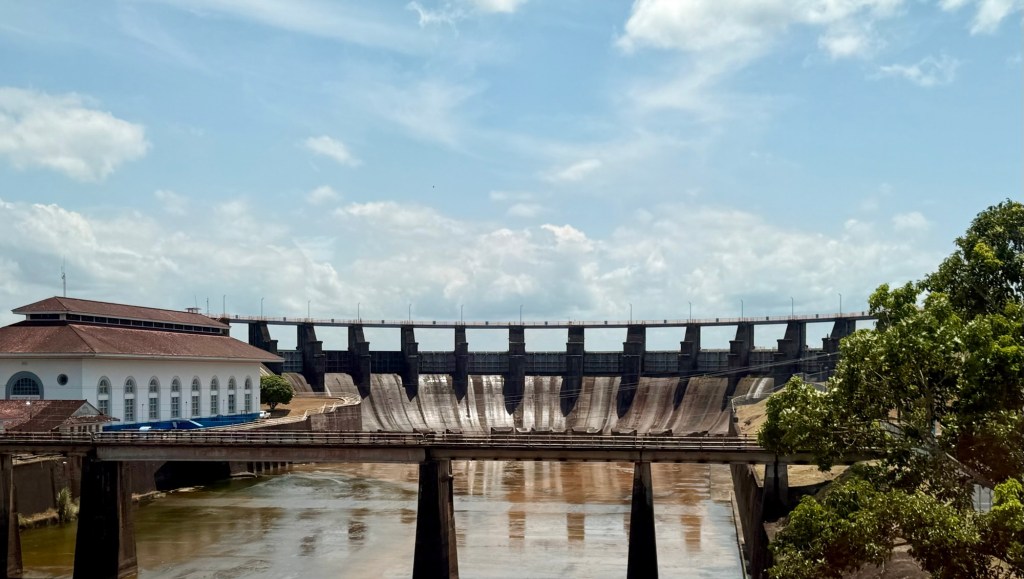
When we left the fort, the driver said we had time before heading back to the ship to see some elements of the Panama Canal from the land side. We weren’t allowed to stop or get out of the bus, so the pictures aren’t great, but hopefully they’ll give you an idea of what it looked like. First up was a drive by one of the lanes of the canal and to see the top of one of the freighters going through the Gatun lock. It was a strange perspective. Then our guide pointed out a huge grassy area which was fill from the excavation of the canal that was used to build the earthen dam of Gatun Lake, a substantial part of the Canal. This dam was the largest earthen dam in the world from 1910-1935 when it was surpassed by the Hoover Dam. And finally our driver took us over a small bridge to get a downstream view of the dam itself.

It’s hard to tell, but that’s a freighter going through the Gatun Lock
This may look like just an open field, but it’s actually the earthen dam to hold back the river to create Gatun Lake.
Here is the dam itself from the down river side

Then it was back to the ship to join all the embarking passengers for this leg of our journey and deja vu of last week when we went through the process of checking-in in Puerto Caldero. This time the smiling face of the ship’s doctor was not a stranger as we joined him for dinner in the beautiful Amphora dining room one evening last week.

Note: It’s actually Sunday, March 16 when I’m writing this and I just realized that I completely skipped over writing about crossing through the Panama Canal two days ago. We went through the canal in the opposite direction last year and have lots of info on it so if I’m feeling more energetic later I’ll do a quick run through. Otherwise, it’s a sea day so not much more to report today.

2025 Cruise

Balboa, Panama City, Panama

I have been in Panamanian waters for a couple of days now and really haven’t talked about Panama.  I visited Panama last year, but on the Caribbean side and this year I’ve been on the Pacific side.  Although the length of most countries in the isthmus of Central America generally run north south, the length of Panama runs almost completely east west.  

Last year I did a blog entry with a little info on Panama and so I’ve repeated it below with some modifications.  

Of the 4 million people in Panama, 2 million of them live in Panama City. 

Spanish is the official language of the country but most also speak English as children have been taught English in school for many years. Most Panamanians are Catholic, given its Spanish roots.

(Haha, last year, my post included this sentence which I think may have changed! “According to our guide, there is a good relationship between Panama and the US due to the support given to Panama by the Americans.” )

Workers are paid a minimum wage of US$650 a month paid twice monthly and our guide felt that anyone that wanted to get ahead could do so in Panama. University is free, they pay $1.25 a pay (or a month – sorry he was talking fast!), for education and $9.00 a pay (or a month) for healthcare. Rent in the high end areas is $ 2000 – 5000 a month, but that’s at the top end. Rent is reasonable in many other areas of the city. They pay 7% tax on all goods, and 10% on Alcohol and cigarettes.

Panamanians are required to vote in elections held every 5 years, and the President cannot run for consecutive terms. There are 7 aboriginal tribes, the Kunas who we visited and learned about in the San Blas islands in the Caribbean last year is the largest.

The 4 founding peoples of Panama and I’m sorry I missed who they were.

Our guide pointed out that the canal is the hub of the shipping of vehicles throughout the world and as a result the cost of cars and gas are very reasonable in Panama.

Spain started colonization of the area in 1503, and Panama remained a colony of Spain until 1821. At that time Panama joined Colombia and other formerly Spanish countries in a republic called Gran Colombia in its independence from Spain. Gran Colombia dissolved in 1831. Panama became a republic in 1903 with support from the US. A failed attempt at building a canal was started by France and the project was taken over by the US and completed between 1904 – 1914. (At the start of WWI) In 1955 the US also built a railway line that ran along side the canal across the isthmus. The US continued to exclusively administer the canal until 1977 when the Torrijos-Carter Treaty to completely transfer the canal to Panama effective Dec 31, 1999. Who knows what the future for the Canal will be? 

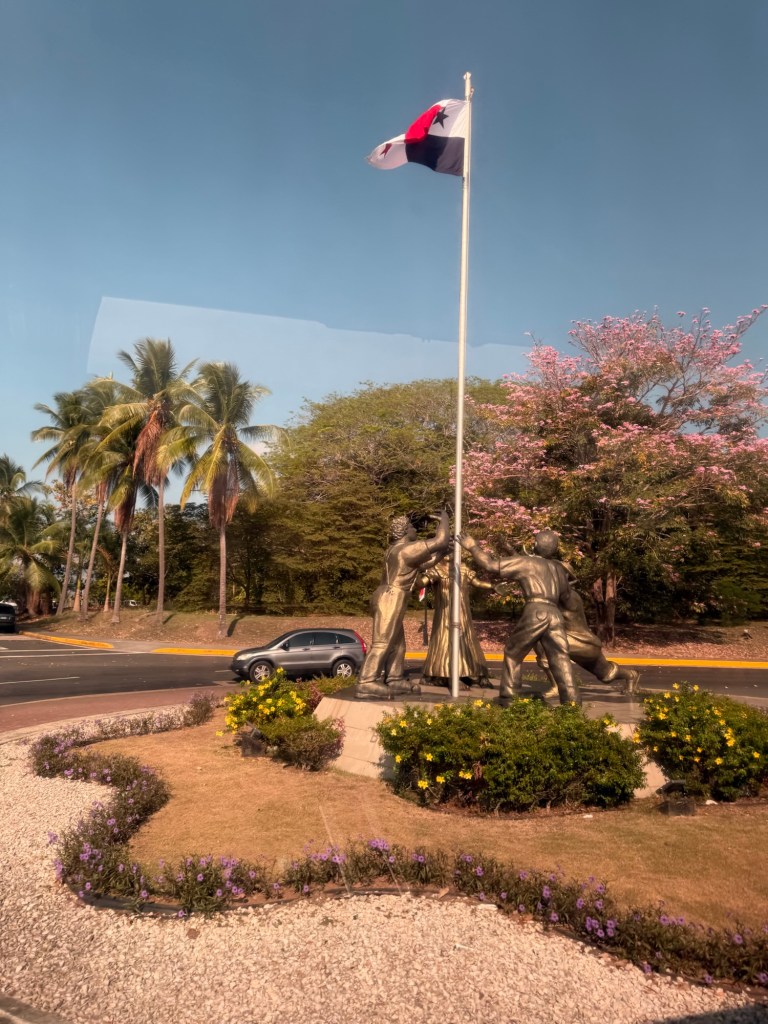
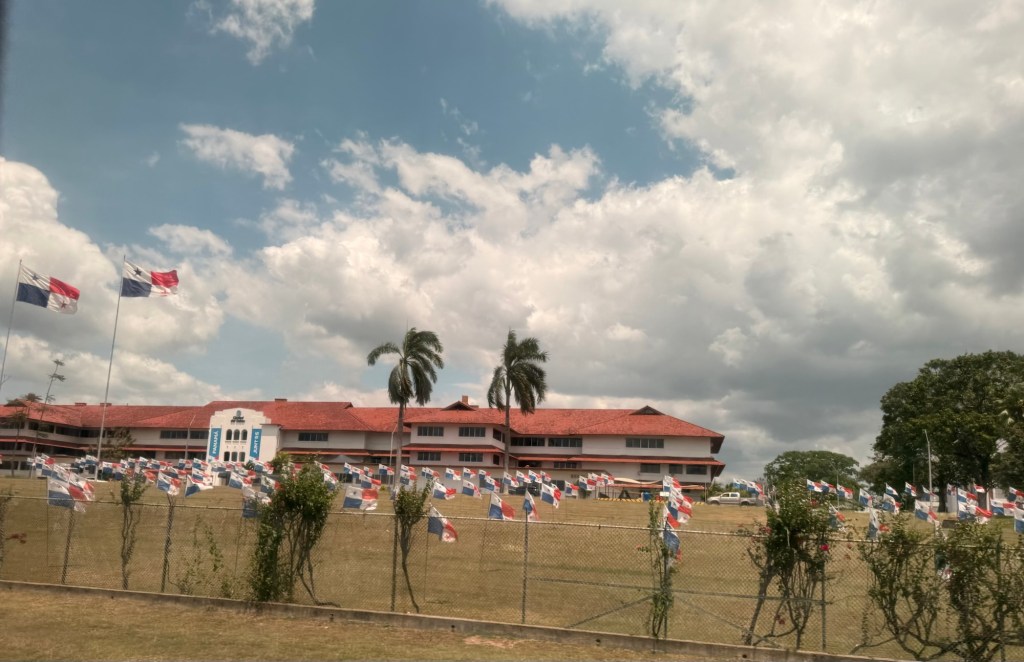
Marco Rubio, United States Secretary of State visited Panama recently and the Panamanians had this display of their patriotism to greet him.

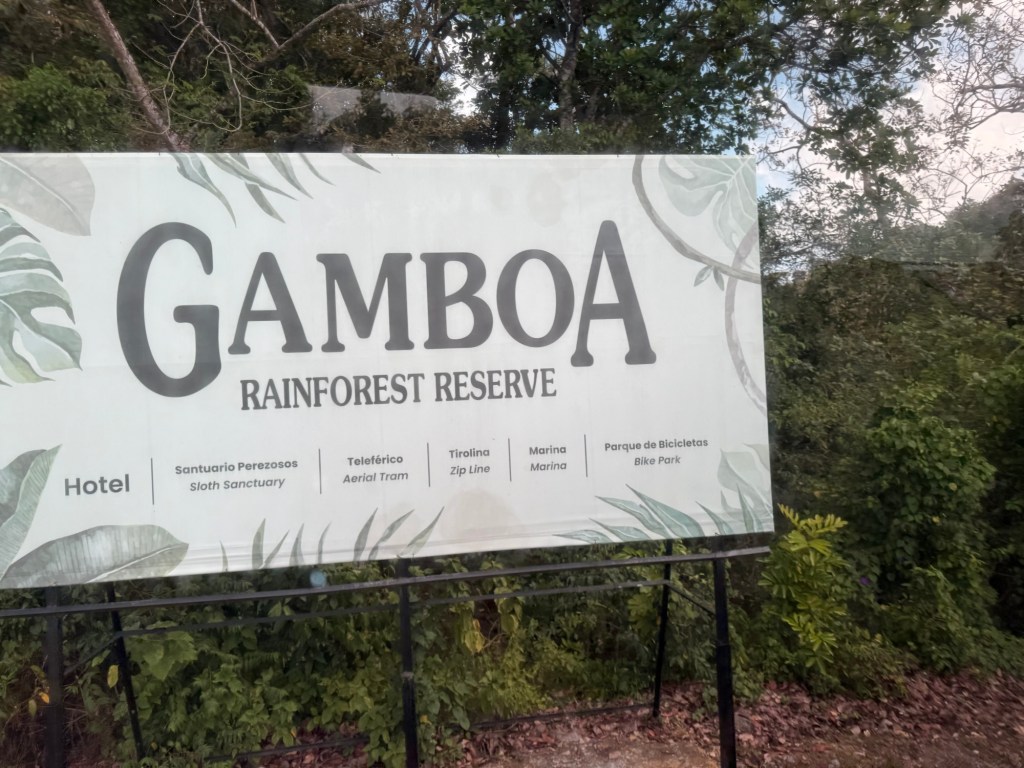
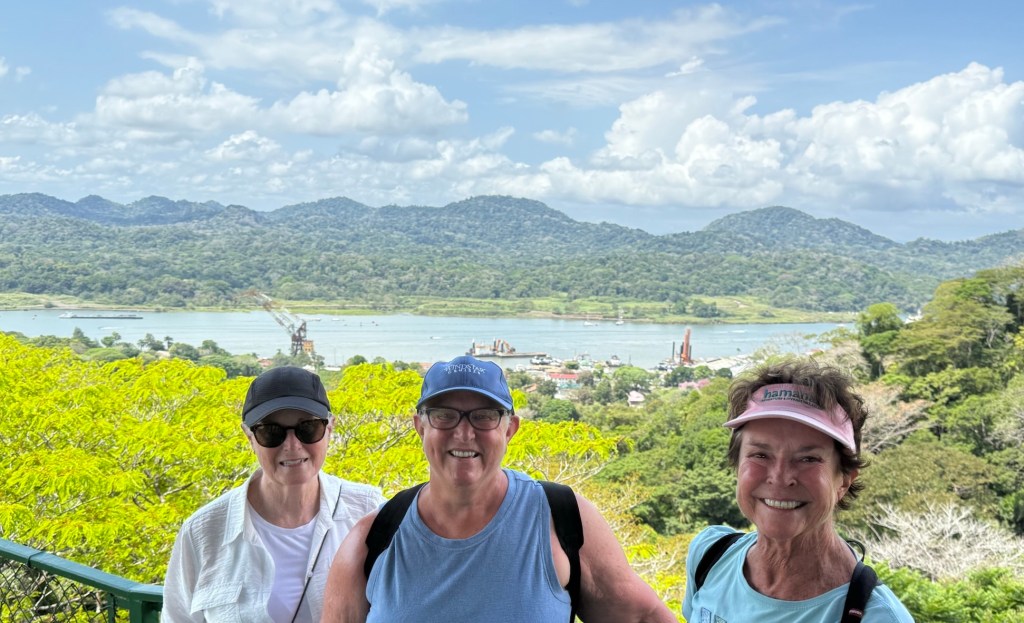
Today we did an interesting excursion to a resort located in a forested area along part of the river that forms part of the Panama Canal called the Gamboa Rainforest Reserve Hotel.  The resort uses some buildings that originally housed the workers on the Canal as satellite hotel rooms and residences. Many have fallen into disrepair though and sit vacant. The hotel main building was gorgeous with huge windows providing a panoramic views of the Chagres River and lovely pool area.  We stopped at the main building for some fruit punch and body break (thankfully) before heading out to explore the reserve. 

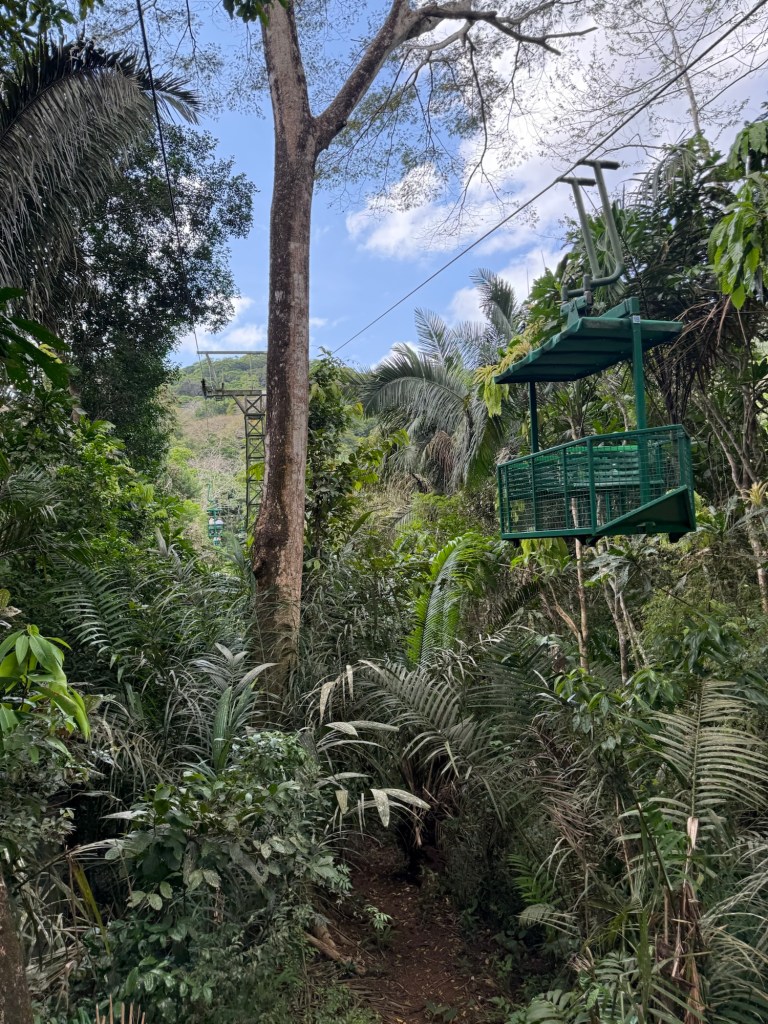
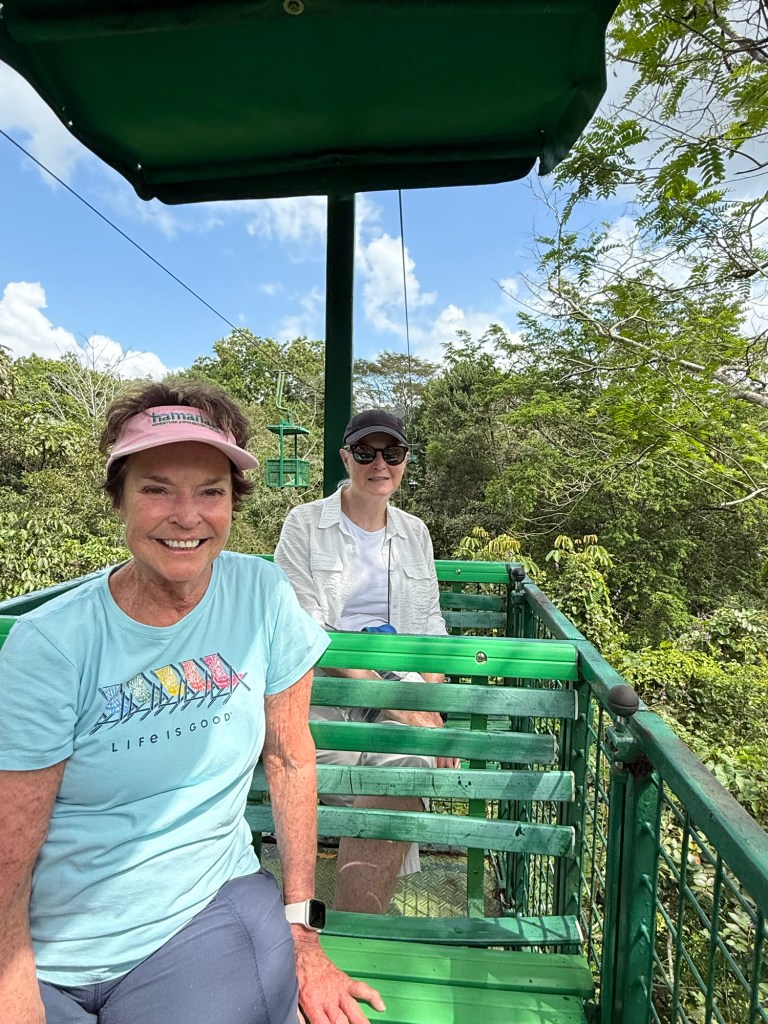
Our first stop was to take an aerial tram ride high up in the tree canopy, approximately 100 feet from the ground, up a hill near the river. Once we arrived at the top of the lift a short path took us to an overlook tour that gave us our exercise for the day/week. It was at least 10 flights up, fortunately ramps rather than stairs, to the top. But the view over the river and the canal was worth it.

That’s an existing river part of the canal behind us.

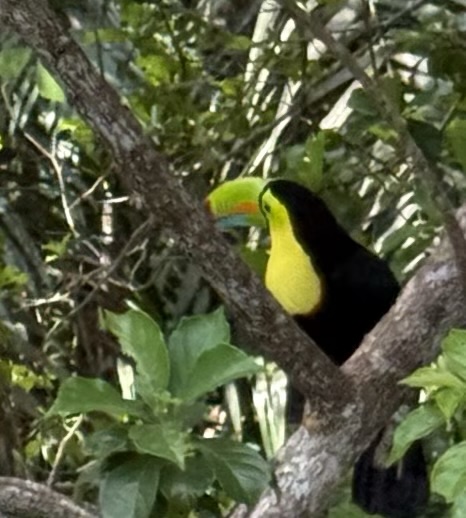
And in the tram on the way down we passed by a toucan sitting on a branch right beside the tram. I thought it was a plastic one put there by the tourism bureau at first. It didn’t look real. I hurried to get my camera on it but the shot was quite obscured and jiggly. Well, I was jiggly, the shot was fuzzy. 

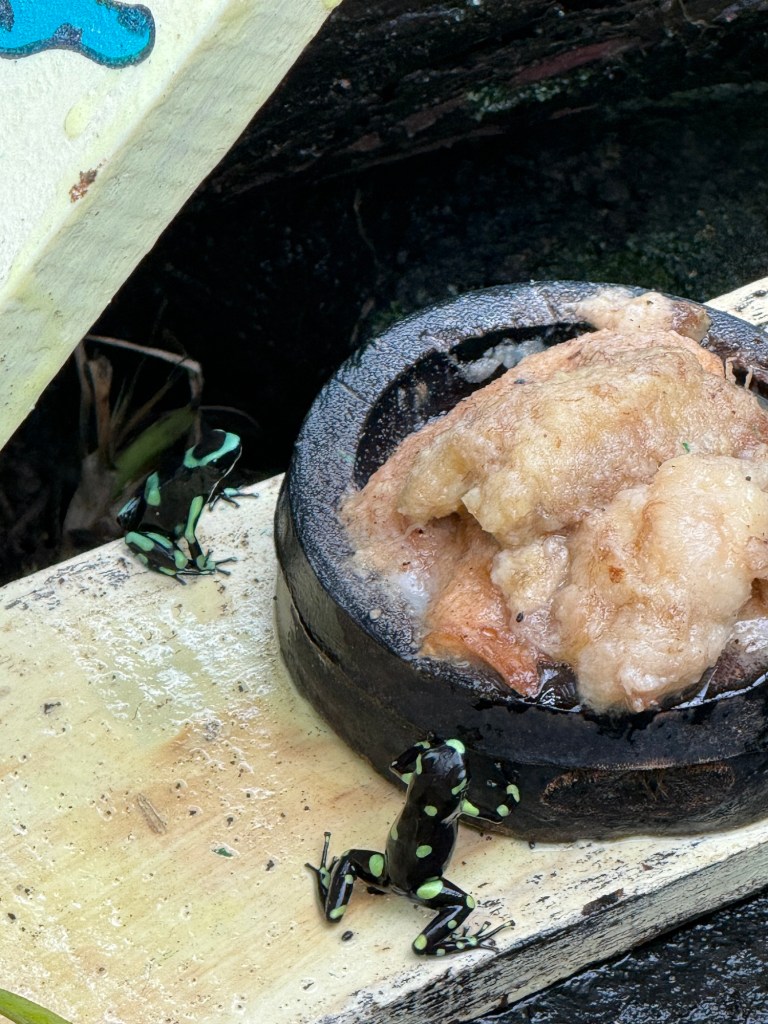
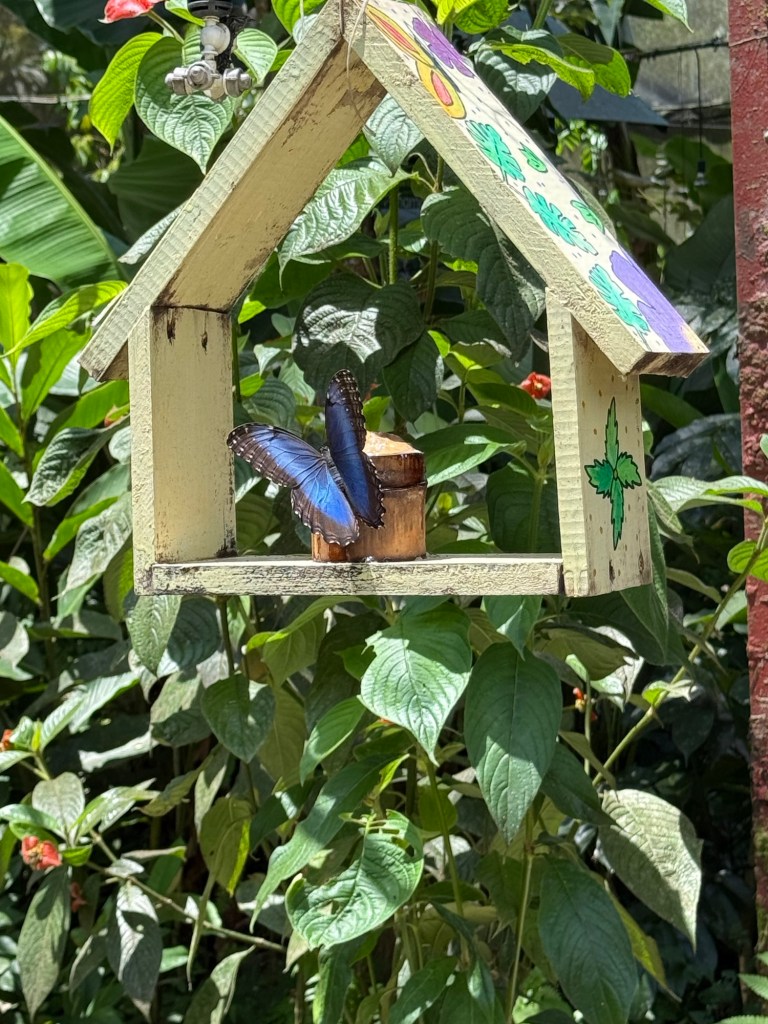
The reserve also had a frog house, butterfly enclosure and a sloth rehab centre which we were guided through. There are a tonne of little, colourful and interesting frogs in Central America, seems like most of which are poisonous even if touched. There are 1800 species of butterflies in Panama, and we saw only 100 or so varieties of every colour and combination imaginable. The Blue Morph is the most beautiful and largest I saw. 

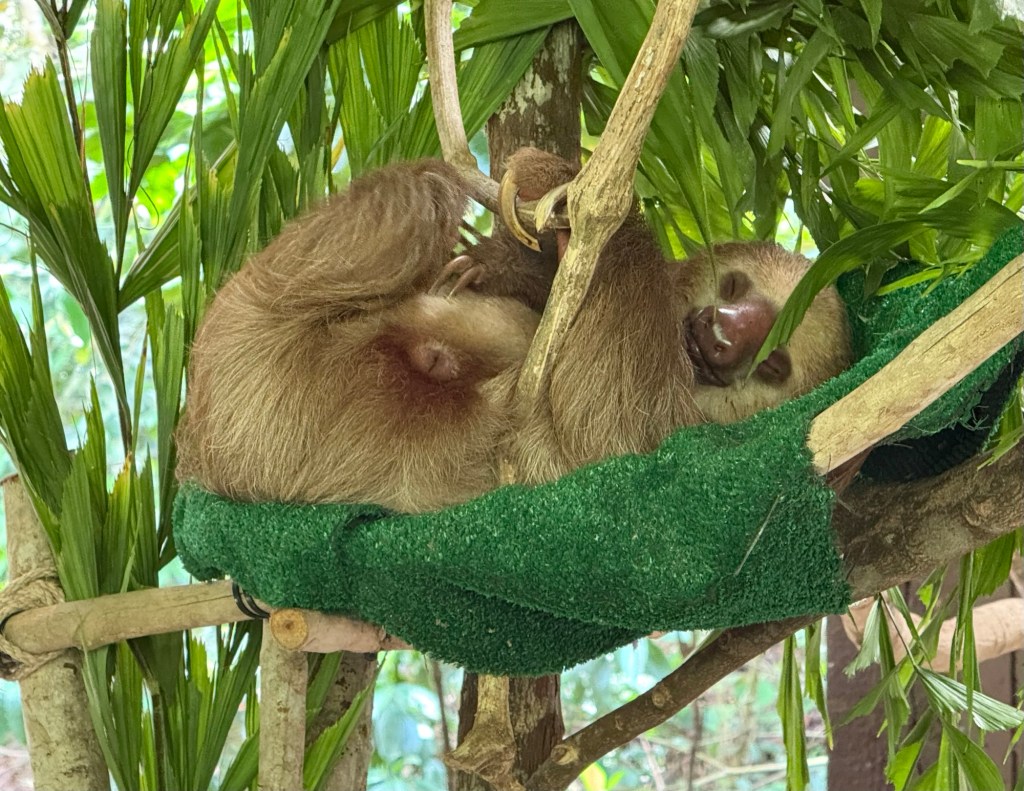
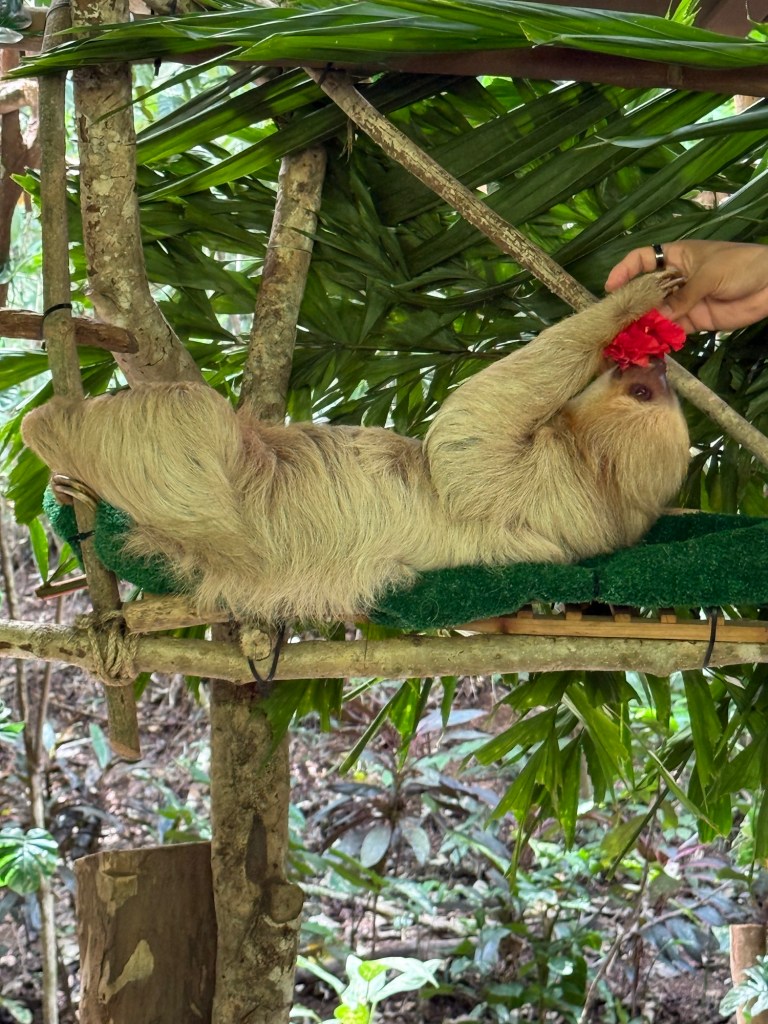
As you can imagine, the sloth area was the star of the show. So great to be able to see two and three-toes sloths nearby and safely for them and us. They apparently can be really aggressive and only one minder who they know and trust is allowed in their enclosure and to feed them. Any chance to see them in the wild is hard and then it’s typically just a blurb of brown fur high up in a tree.  These sloths are being rehabilitated to return to the wild, or kept if it’s been determined that they can’t be released as they can’t be taught the skills needed to survive. One sloth they tried to release 3 times and she came back to the reserve each time, so they’ve given up.  Our on-board naturalist did a whole 1 hour talk on sloths a couple of days ago and I could probably wax poetic about them but I don’t really think you want me to. 

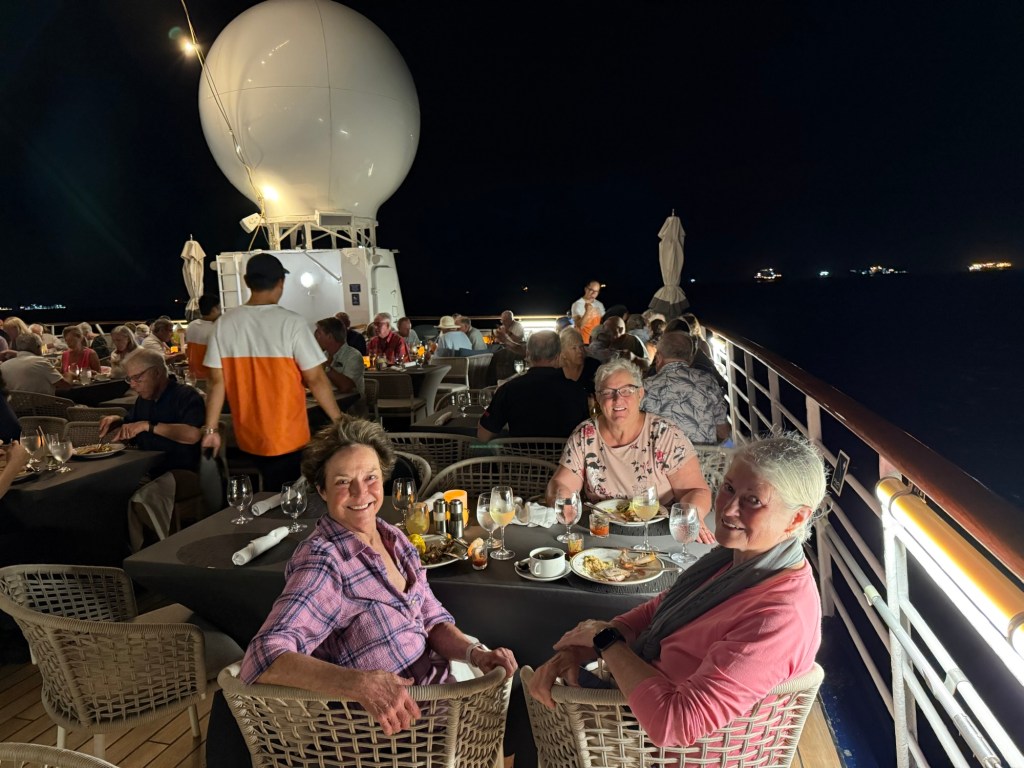
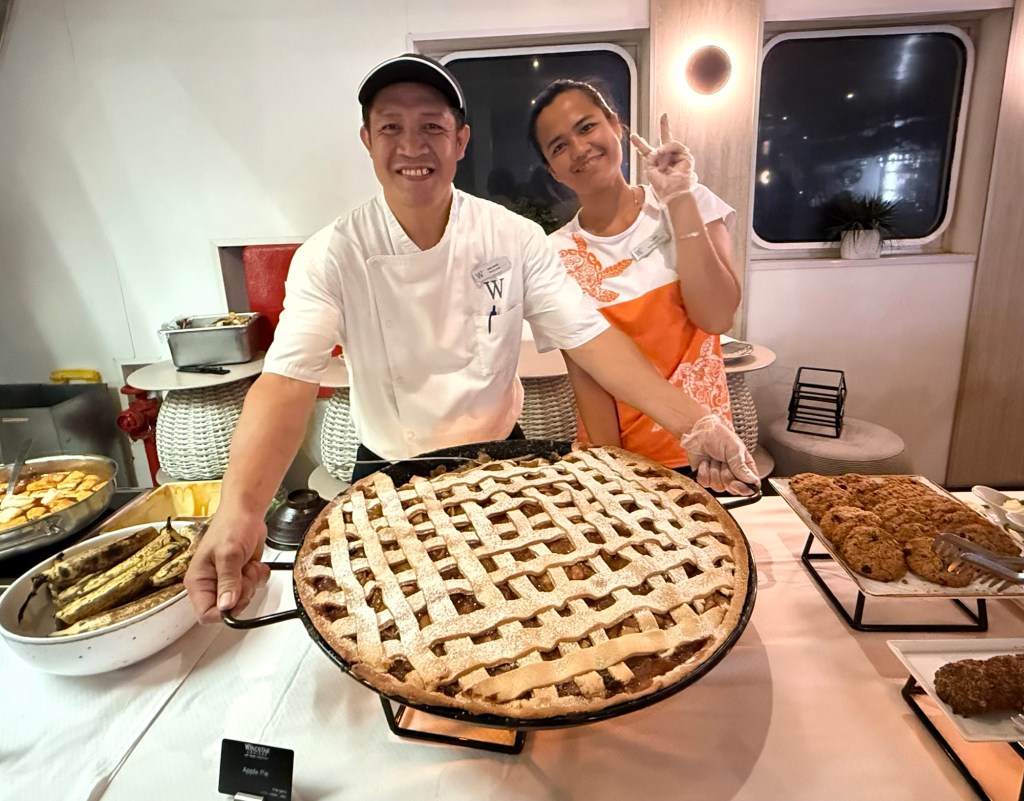
It was the deck barbecue tonight in a beautiful location in the harbour near Panama City with lights from land all around, and from all the ships anchored ready to head into the canal tomorrow. After a threat of rain earlier on, it was clear and beautifully less humid for the outdoor event this evening. The choice of food at the deck barbecues is a little overwhelming but I think tonight’s barbecue was the best of any I’ve had on my Windstar cruises. Maybe I just made the right choices. I’m not usually an apple pie kind of person, but I’ve had a taste of the gargantuan one made by the Windstar pastry chef before and saved room for it and a scoop of ice cream.  

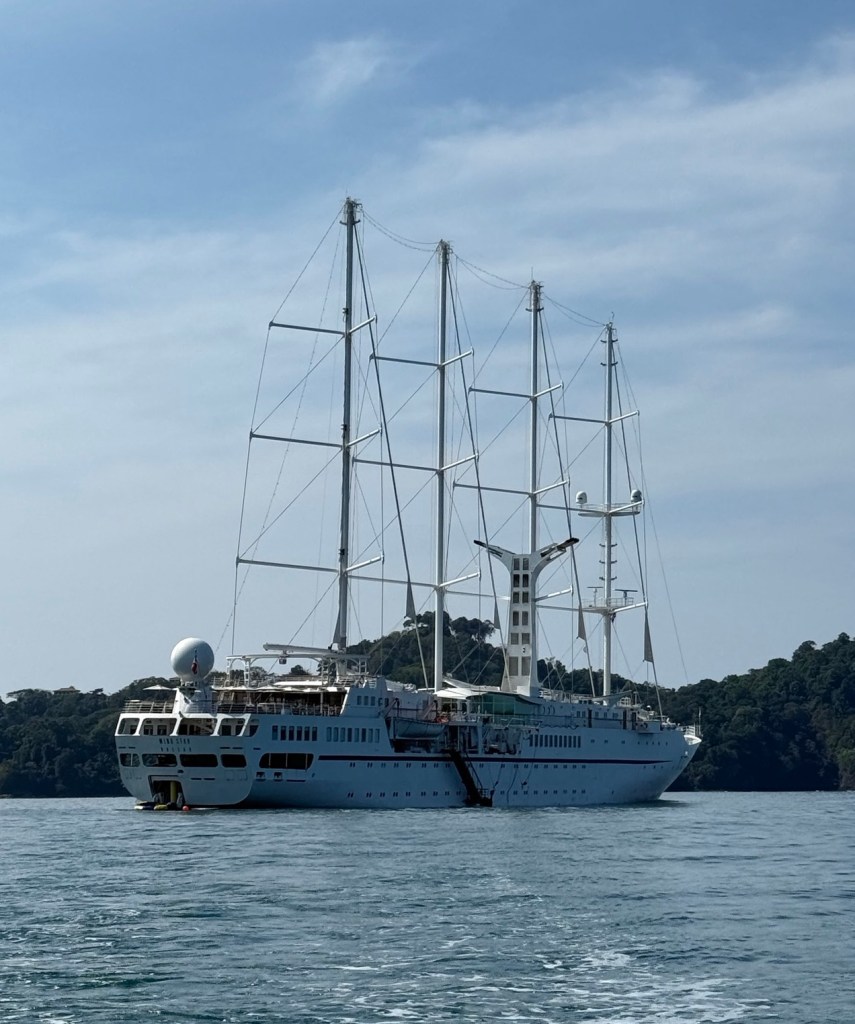
In the late afternoon the ship had been repositioned and anchored just before the Bridge of the Americas, that is the land connection over the canal at the Pacific side of the canal. We needed to be in position to go under the bridge at the lowest of tides. I hadn’t thought of it but the masts at 204 feet each on the Windstar are tall in comparison to the usual ship traffic through the canal.  Even at low tide there is only 20 feet of clearance between them and the bridge.  At 10:00 the Captain, gingerly navigated the Windstar under the Bridge of the Americas to the applause of the assembled passengers watching from the bow.  No pressure Captain.

It was a busy day and I’m looking forward to a slower paced day tomorrow, travelling through the canal. So bye for now.  

P.S. With thanks to Clair and Adrienne who have helped with research while we sat at the bar today.  

2025 Cruise

Panama or bust

Isla Parida, Panama

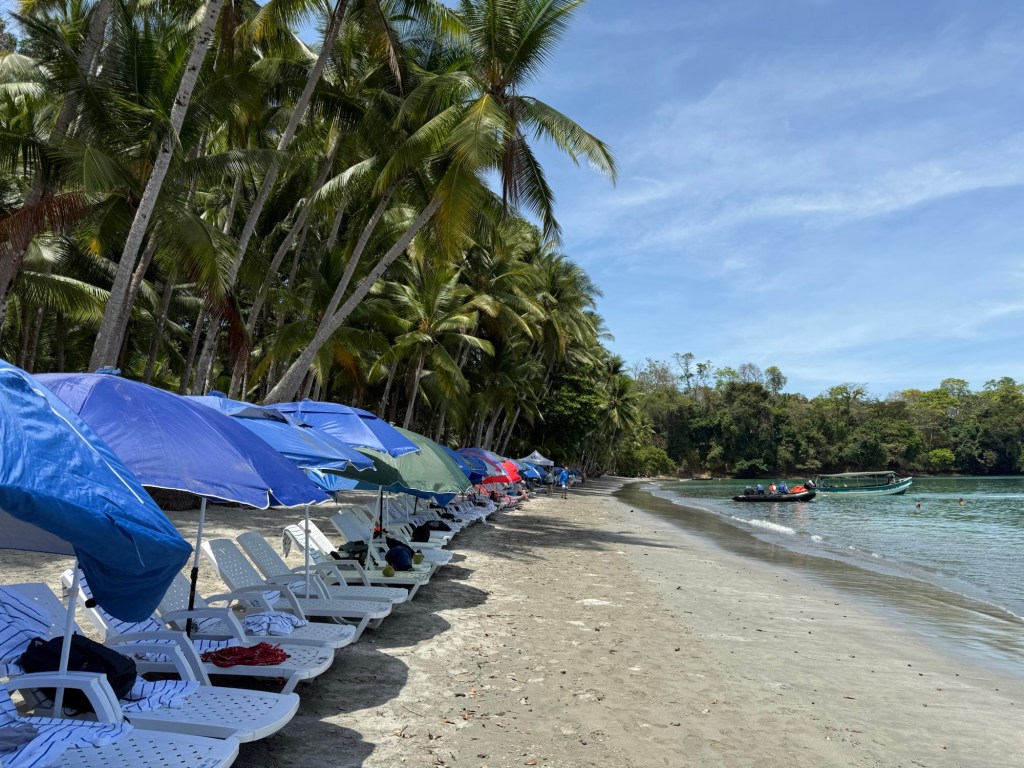
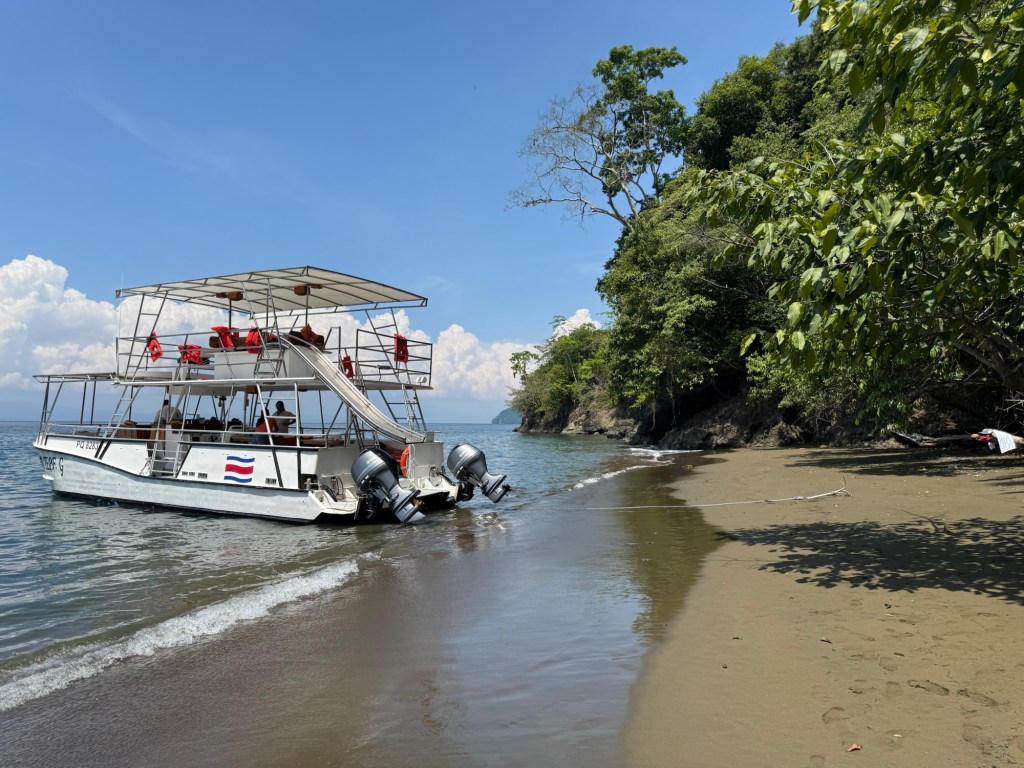
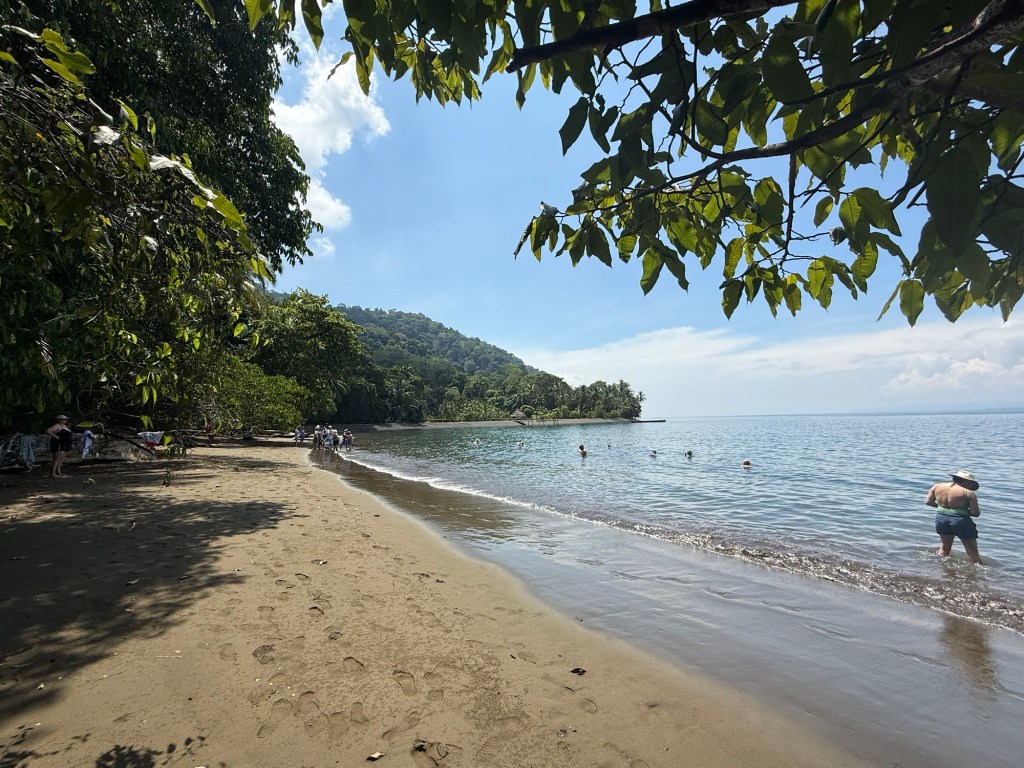
Our beach barbecue location

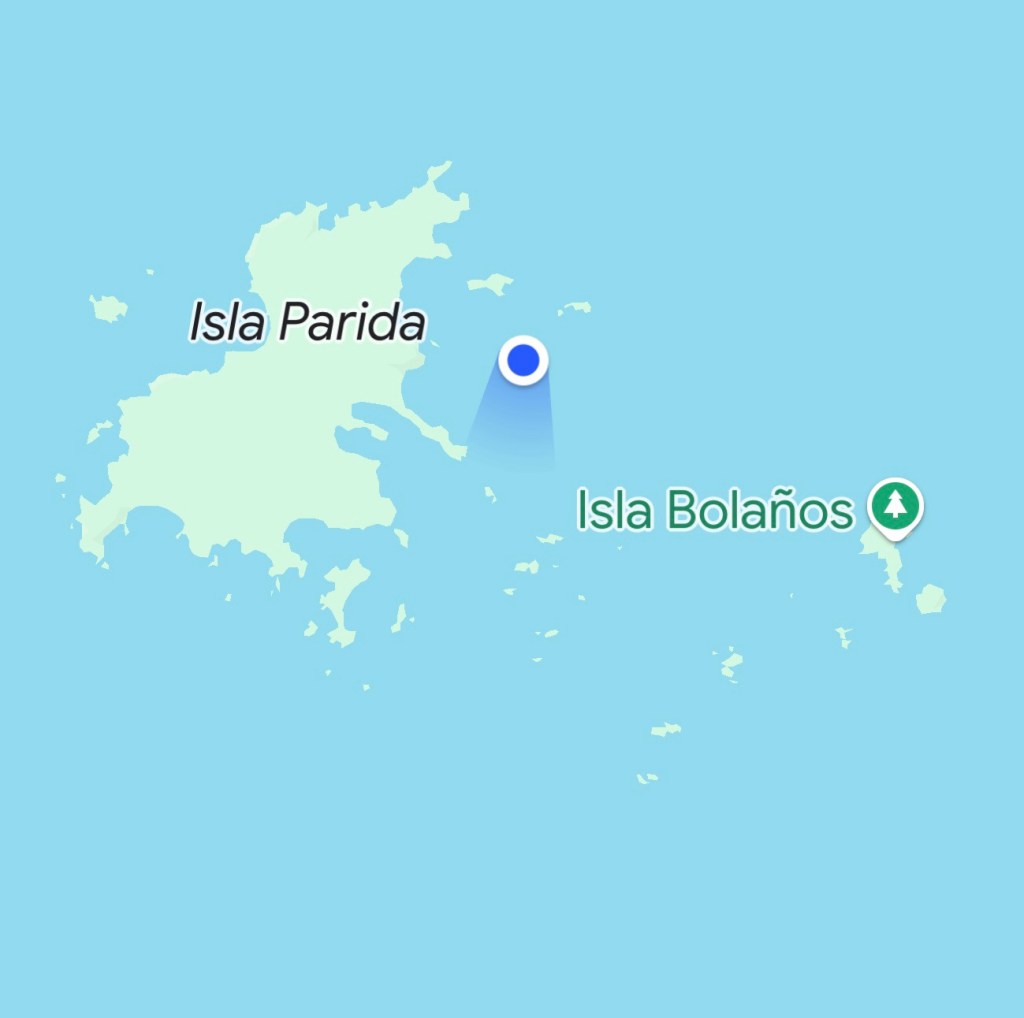
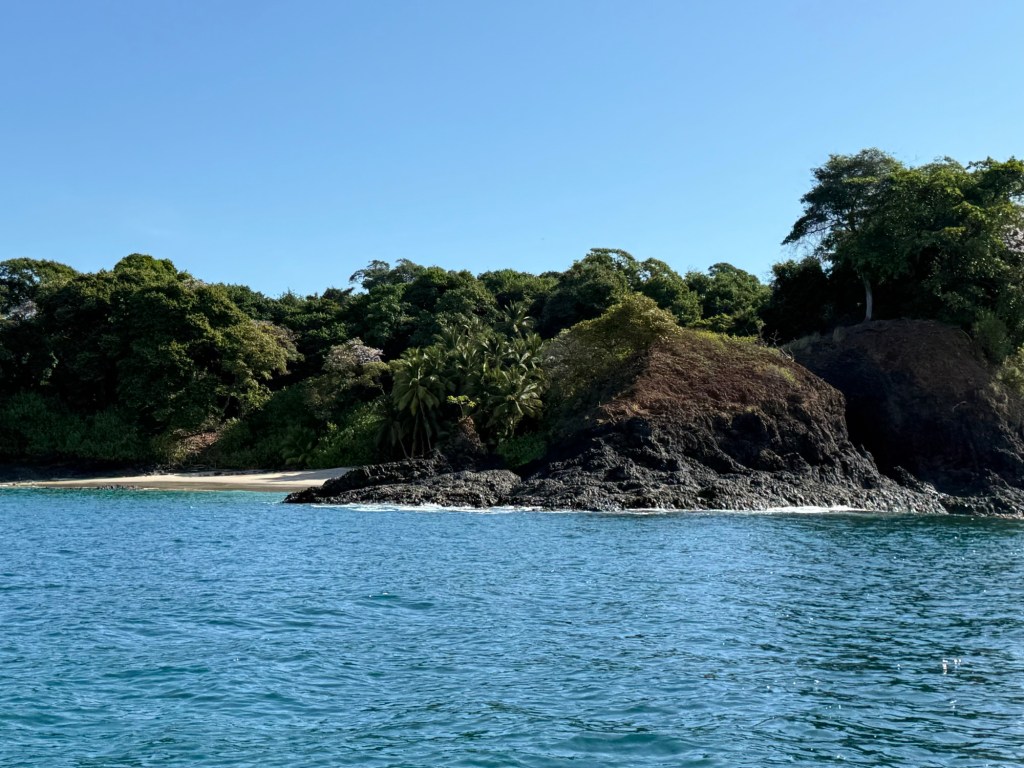
Today we entered the warm Panamanian waters and anchored in the middle of an archipelago, the largest island called Isla Parida, surrounded by 25 or so smaller islands, some only big enough for a couple of trees.  Last winter on the Star Pride, I travelled to some similar islands on the Atlanta side of Panama, the San Blais Islands. The San Blais Islands were more like sand bars with cocoanut palms on them but these islands are made of volcanic rock and while there are some palms, there is a wide assortment of other vegetation as well. 

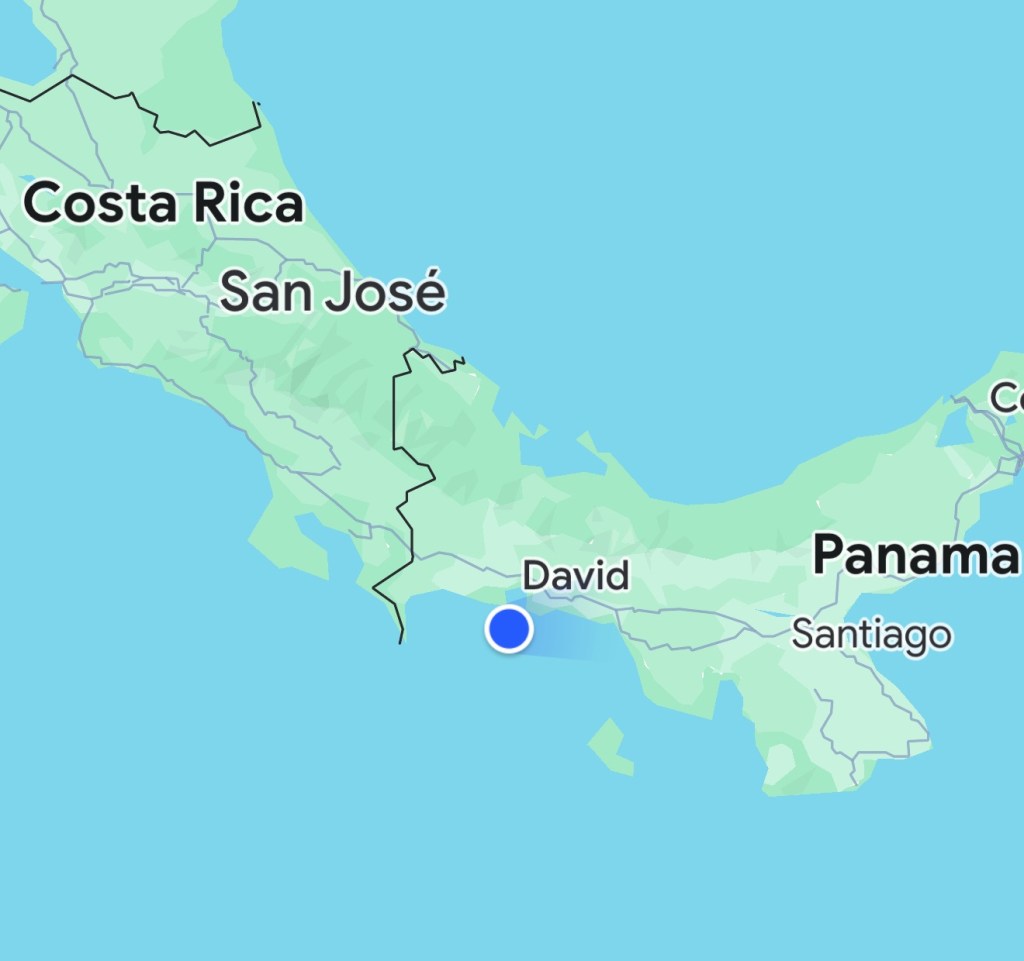
Here are two maps, one showing you the area, and another showing you our position relative to mainland Costa Rica and Panama.

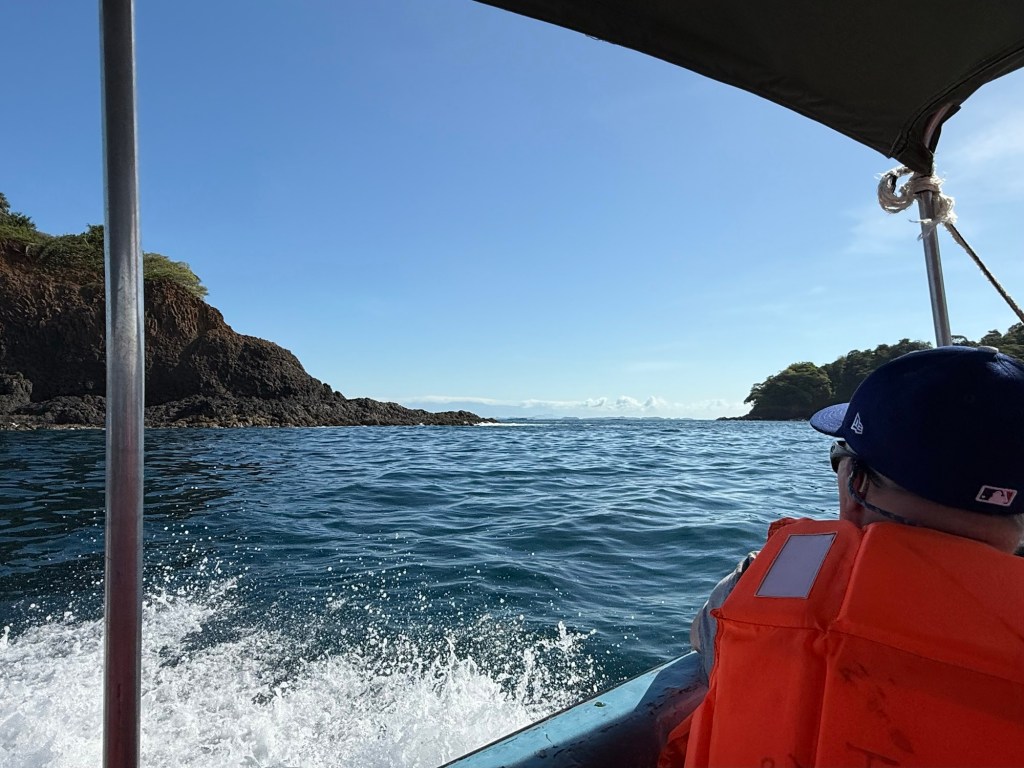
These islands are in the Chiriqui Gulf National Marine Park so the islands are protected and uninhabited.  The islands are home to monkeys, dolphins, whales, a plethora of birds and brilliant aquatic life. The aquatic life is what we were off in search of this morning with two snorkelling stops in among the islands. 

Our guides knew exactly where to go and in no time we were at our first stop. The first snorkel of the year is always a bit awkward getting used to the equipment, etc, and today was no different. And the boat we were in was not the easiest to get in and out of. We were next to a rock outcropping when we anchored and we had quite a long time to explore on our own. Some dive masters are very prescriptive about where you go and some even have you follow them, but these guys were happy to just let us meander in the warm water.  

And meander we did through rock covered in coral with sand floor valleys watching the aquarium of life below us. This is beyond a doubt the best snorkelling I’ve done in the Caribbean/Central American area in the past 3 years.  There were schools of small and large fish, and solo fish in all colours of the rainbow.  Some tiny florescent purple ones, some huge parrot fish, striped ones in various colours, some solid coloured ones in yellows and blues, yellow with spots, grey and white stripped, Angel Fish, butterfly fish, and even some star fish. I got caught in a channel between the rocks making my way back to the boat that was a little anxiety provoking as there was some swell pushing me to and fro requiring me to really boot it a couple of times. But I didn’t hit anything and saw some cool stuff along the way. There was some coral I hadn’t seen before, but none was very colourful or interesting. Was so great to do some good snorkelling after some disappointing excursions the last two years. 
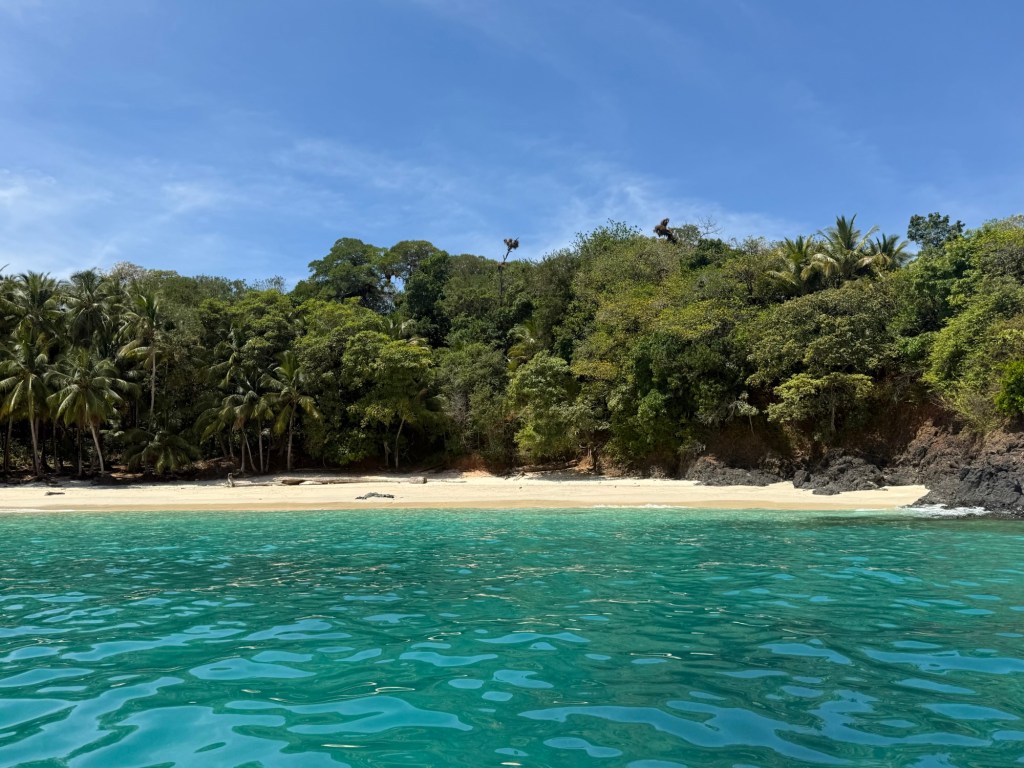
Then the captain moved the boat to another spot around another island, and there was a beautiful secluded beach where we dropped two of our passengers off to spend some time swimming and walking the white sand beach.  As we were getting positioned to do our second snorkel, our guide spotted the head of a large Green Turtle nearby. Once in the water we got close enough to see how huge it was and watch it eat. After a couple of minutes, the dive master had us move on to the rocky area so as not to harass the turtle even though we weren’t close.  Sadly this area was like a coral graveyard, with no live coral at all and lots of dead and bleached branches on the floor of the ocean. There were lots of fish in this location but not nearly as many as the first one. As Adrienne and I were headed back to the boat, she pointed out a huge white fish to me. It looked like a ghost. While we were watching, believe it or not, it changed colour into a grey and white striped fish!  If we hadn’t both seen it I wouldn’t have believed it.  Very cool. We’ll have to ask the on-board naturalist about it when we next see him. 

The snorkelling boat dropped us off on the private beach where the fabulous Windstar staff had spent the morning lining the beach under the cocoanut palms with lounge chairs and bright umbrellas. The kitchen staff, under the watchful eye of the head chef, prepared a fabulous lunch barbecue on the beach as well.  Especially having been on the water all morning, we were tired and ready for some lunch. It was sure good! 

I’ve showered and changed but thinking now is the time for a nap. So off I go to do that before I get signed up to do something else. Tomorrow is a day at sea so unless something really exciting happens you might not hear from me.

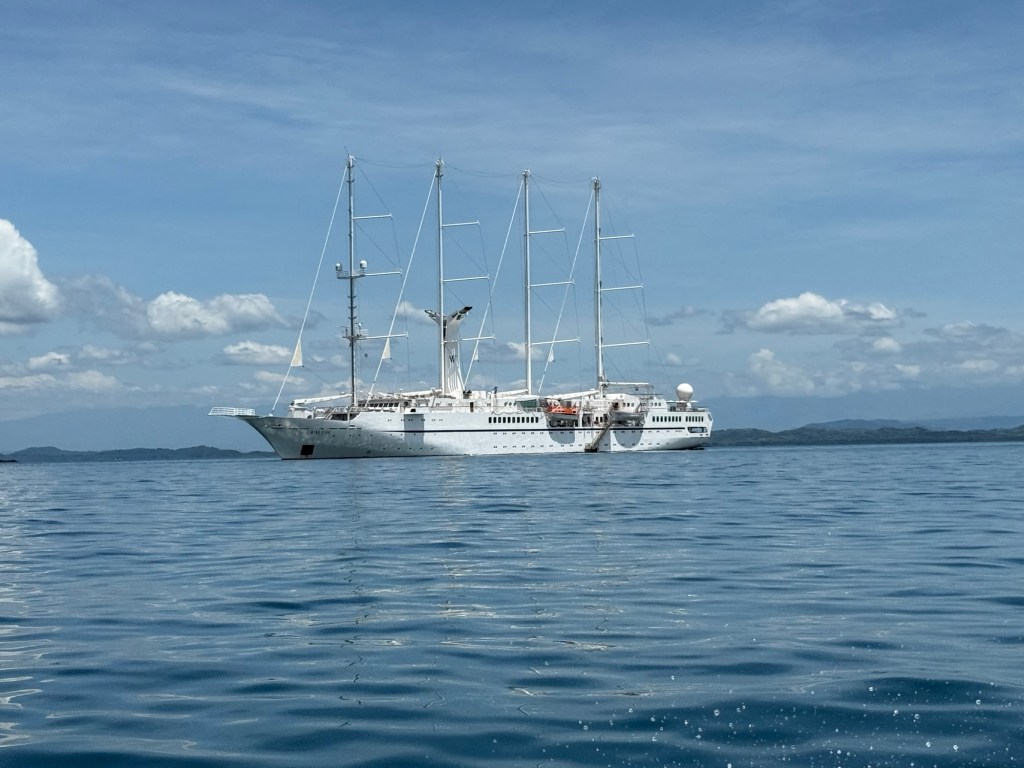
The Windstar waiting for us to return
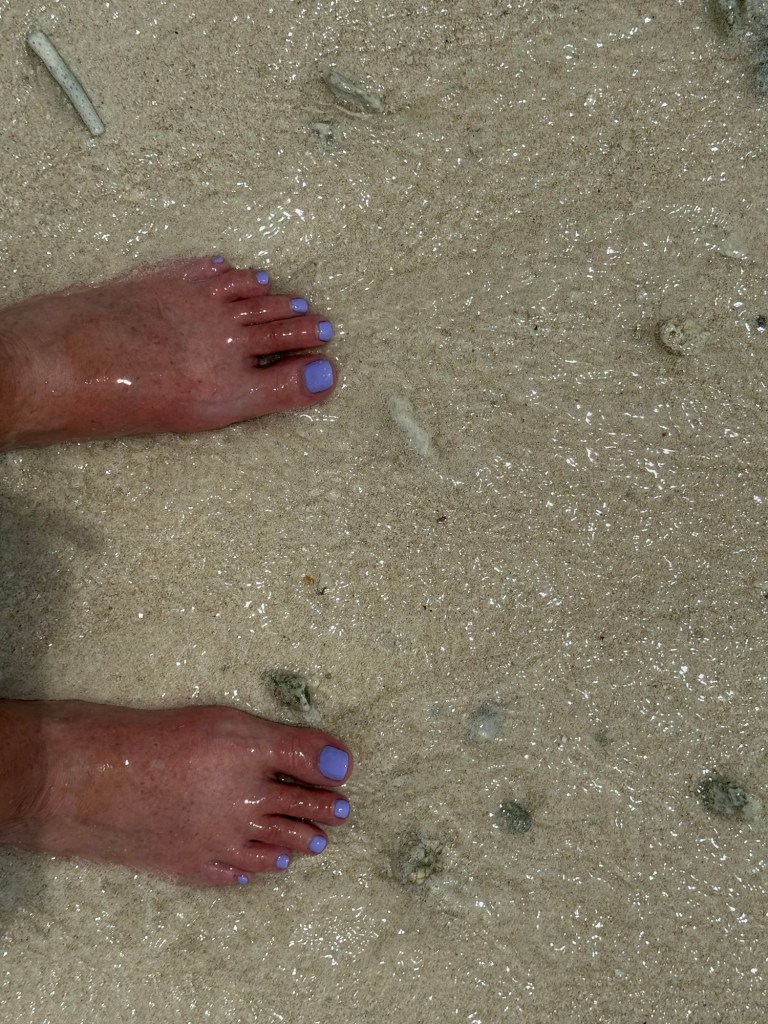
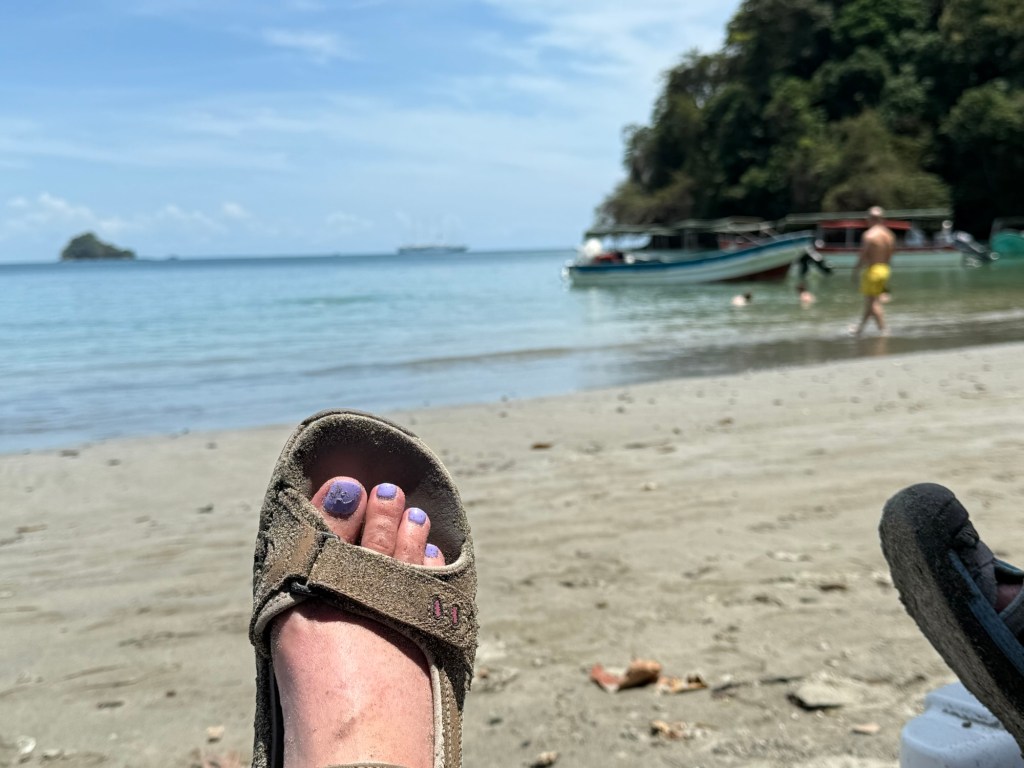
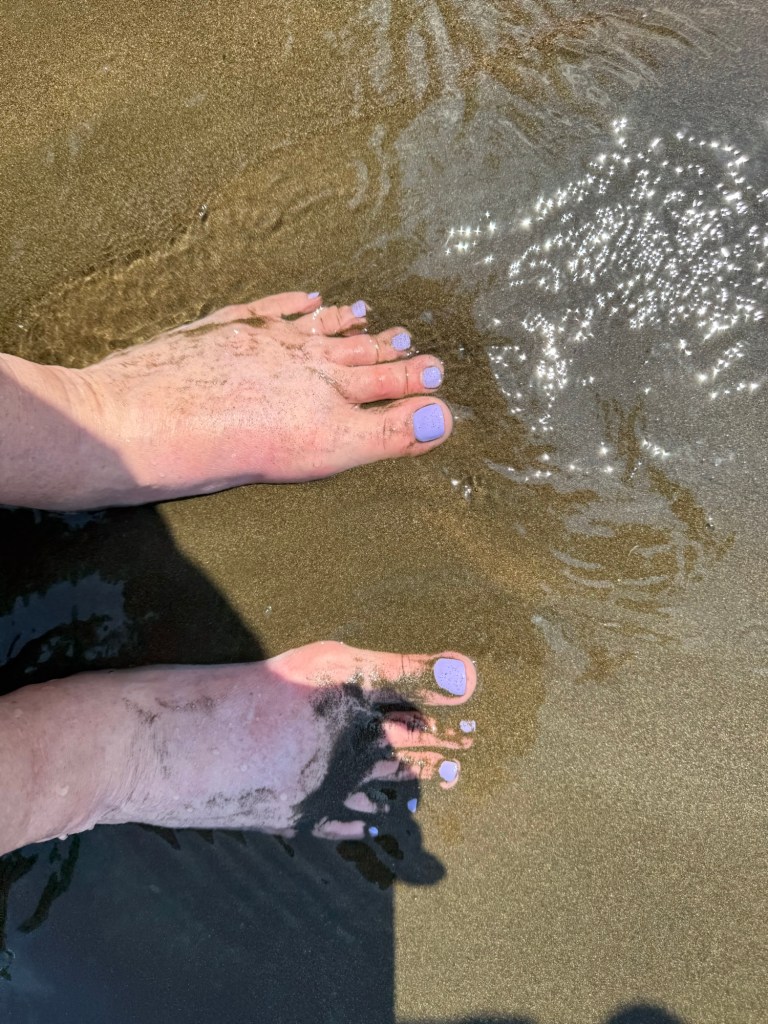
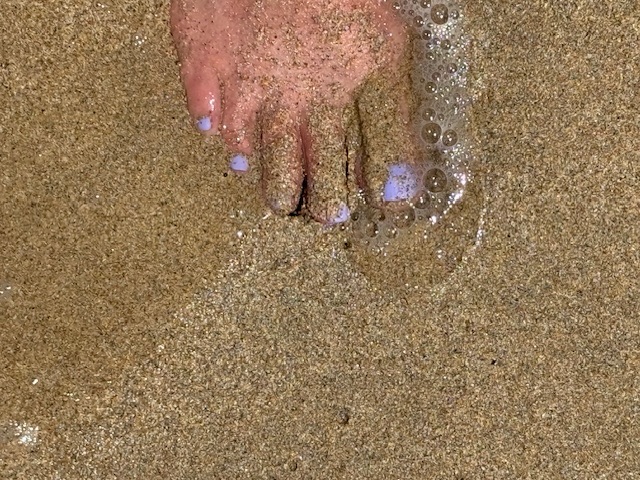
There’s those toes.

2025 Cruise

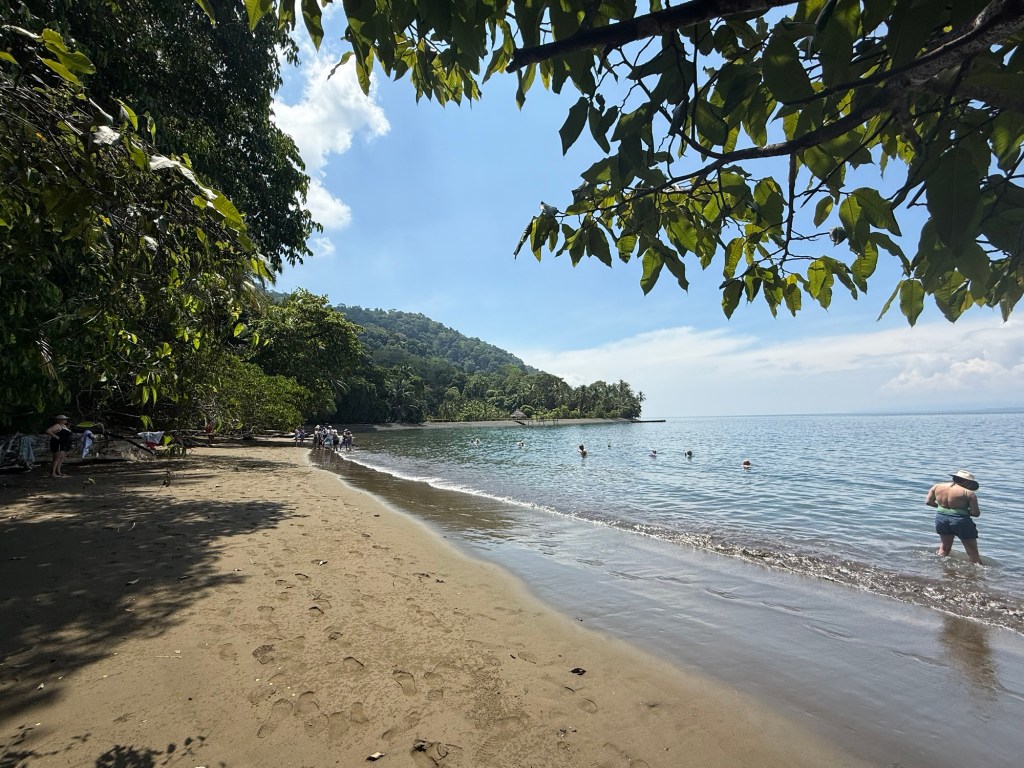
Our last stop in Costa Rica

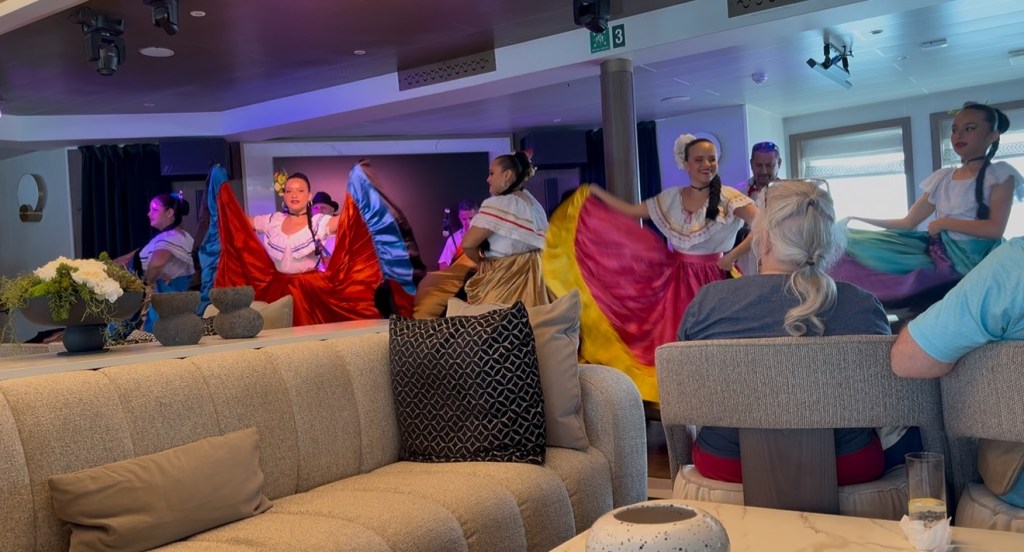
Before starting in on today, I’ll back track a bit to yesterday.  Just after posting my blog, we had the most lovely entertainment by some Ticos and Ticas from the Quepos area.  The 4 piece band played several different kinds of Latin music: Salsa, Merengue, Cumbria as well as some specific Costa Rican folk songs. One of the band members played the guitar and the Marimba, Costa Ricans national musical instrument. It is much like a xylophone but has a much more mellow and pleasing sound. For many of the songs, there were 8 young ladies in brightly coloured traditional costume doing traditional folk dances from Costa Rica.  They were all so talented!  Clair even got co-opted to participate in the “broom dance”. There was a tale about this dance that had something to do with trying to avoid getting stuck dancing with the broom.  

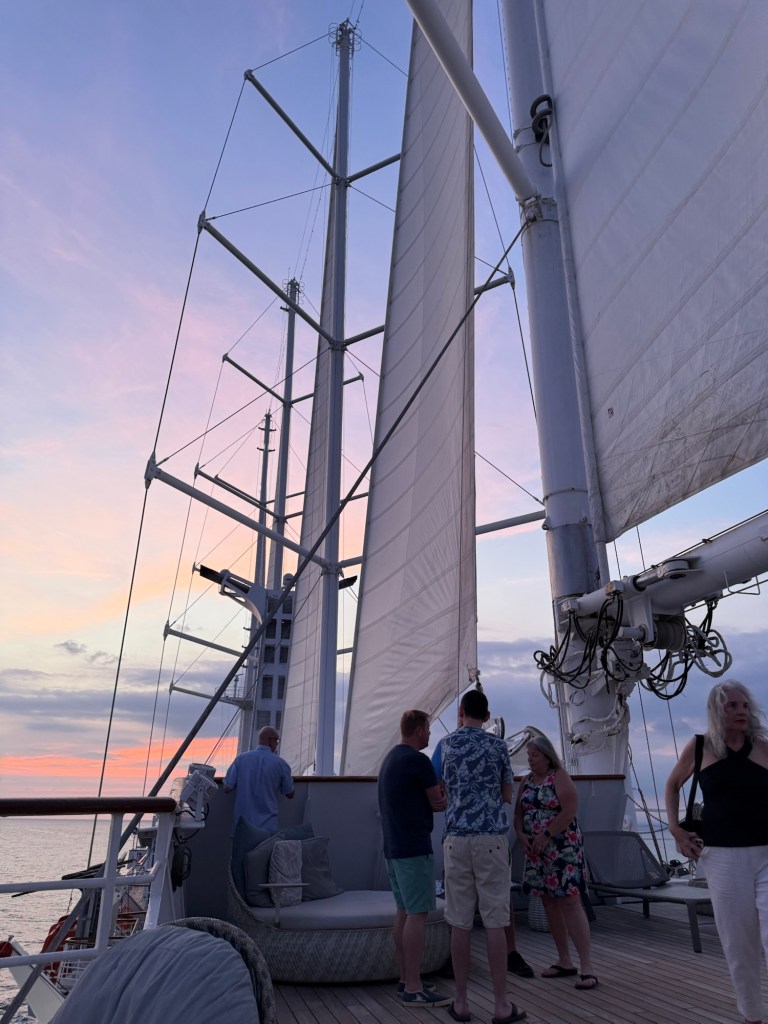
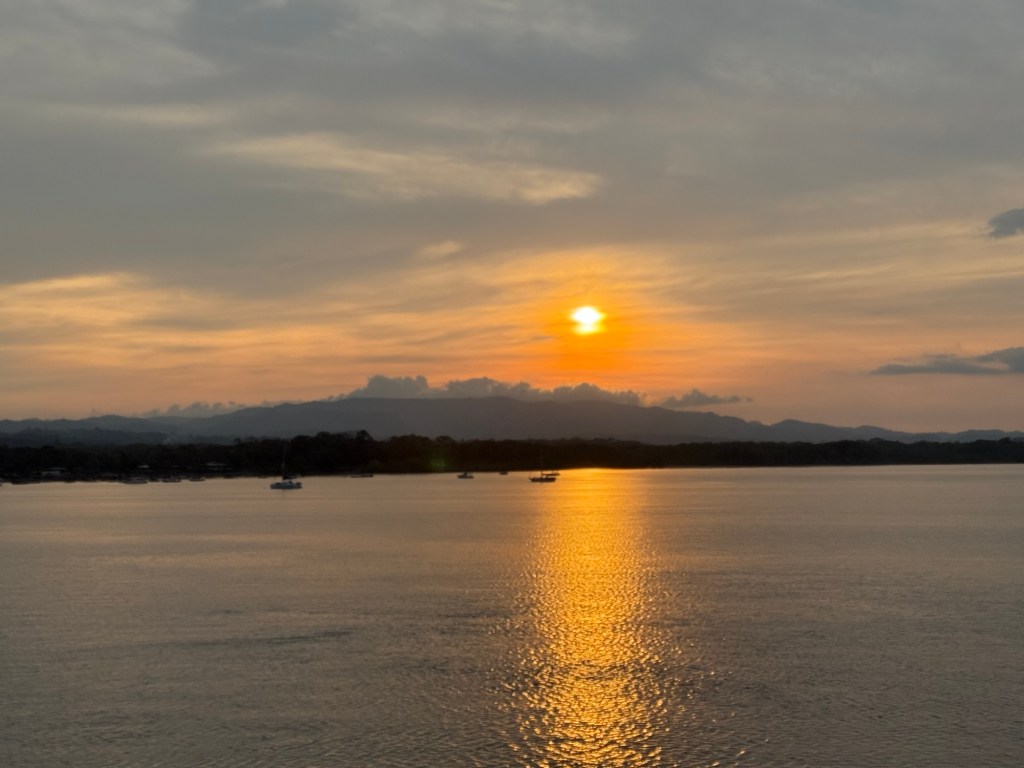
One of my favourite things on the Windstar is the traditional “sail away” and on the sailing ships, of course, the sails are unfurled instead of just the Windstar flag being raised to the stirring music of Vangelis’ Conquest of Paradise. Quite a sight. And to top it off there was a bright red sun set just as we set sail.  

Last night Clair, Adrienne and I were invited, along with another couple of folks to join Jan, the General Hotel Manager, for dinner. It’s one of the perks of racking up the sailing nights with Windstar and I’m pretty sure it was because of Clair’s nights, not mine!  But I’ll take it.  Jan was really interesting and fun, as were the other couple, and It was a very enjoyable evening.  
So on to today… 

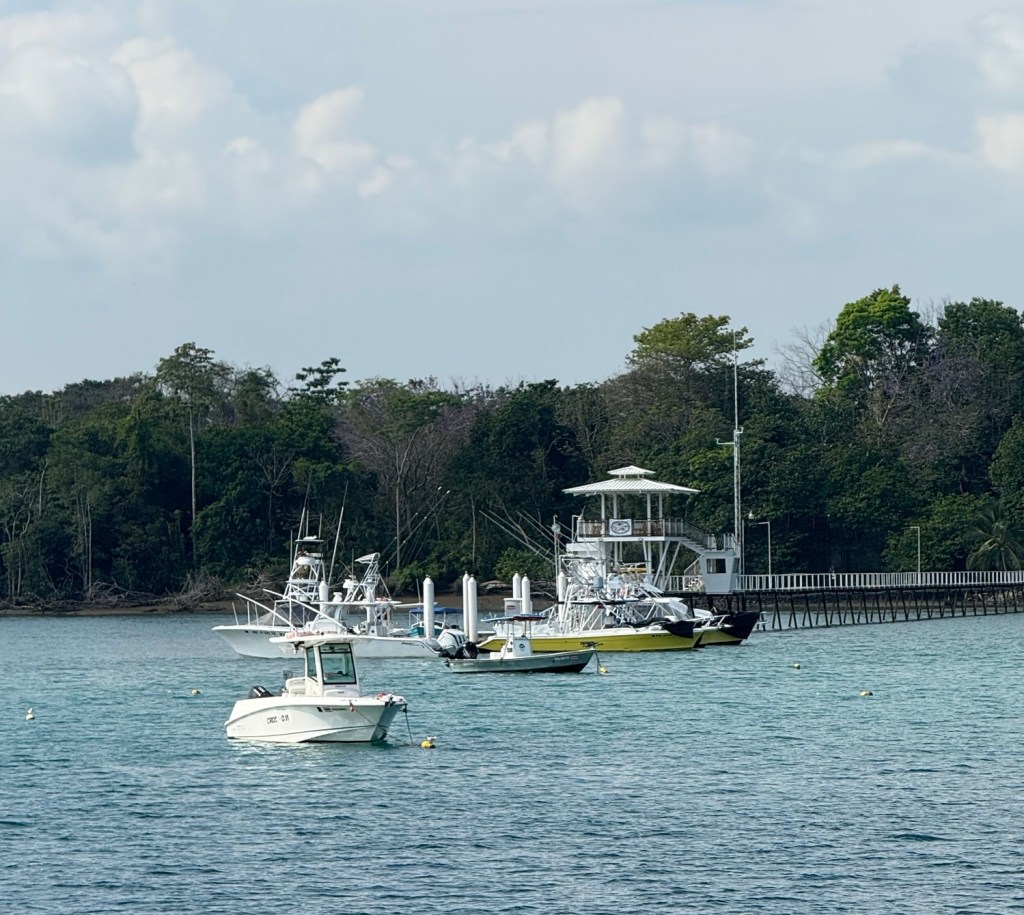
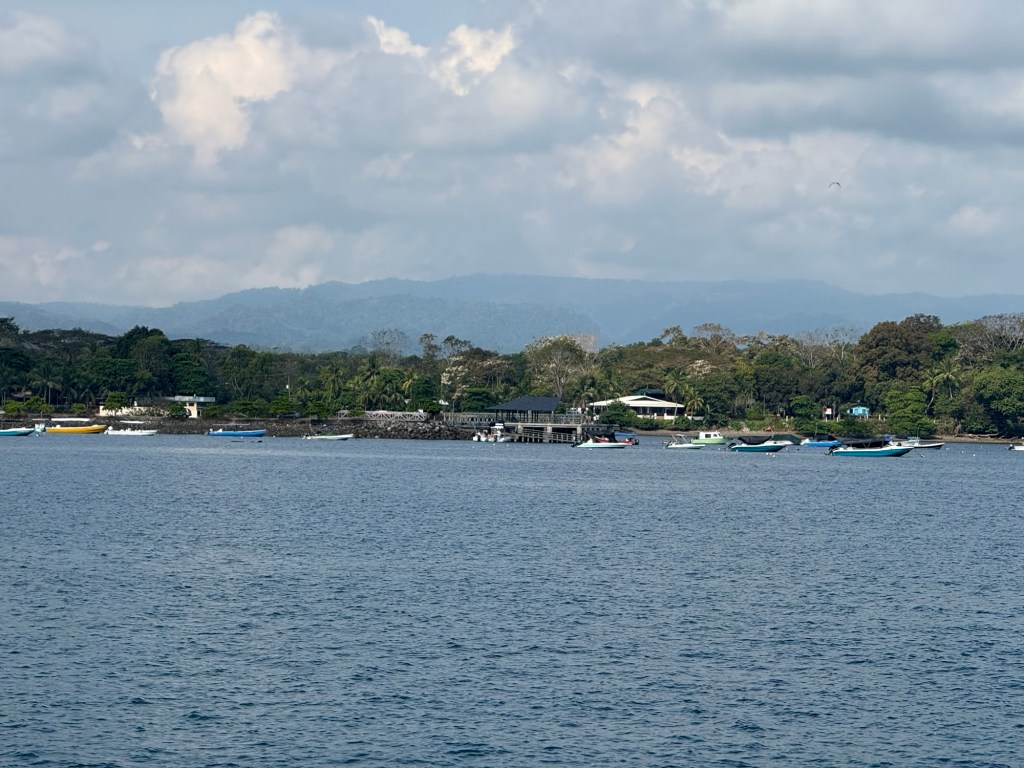
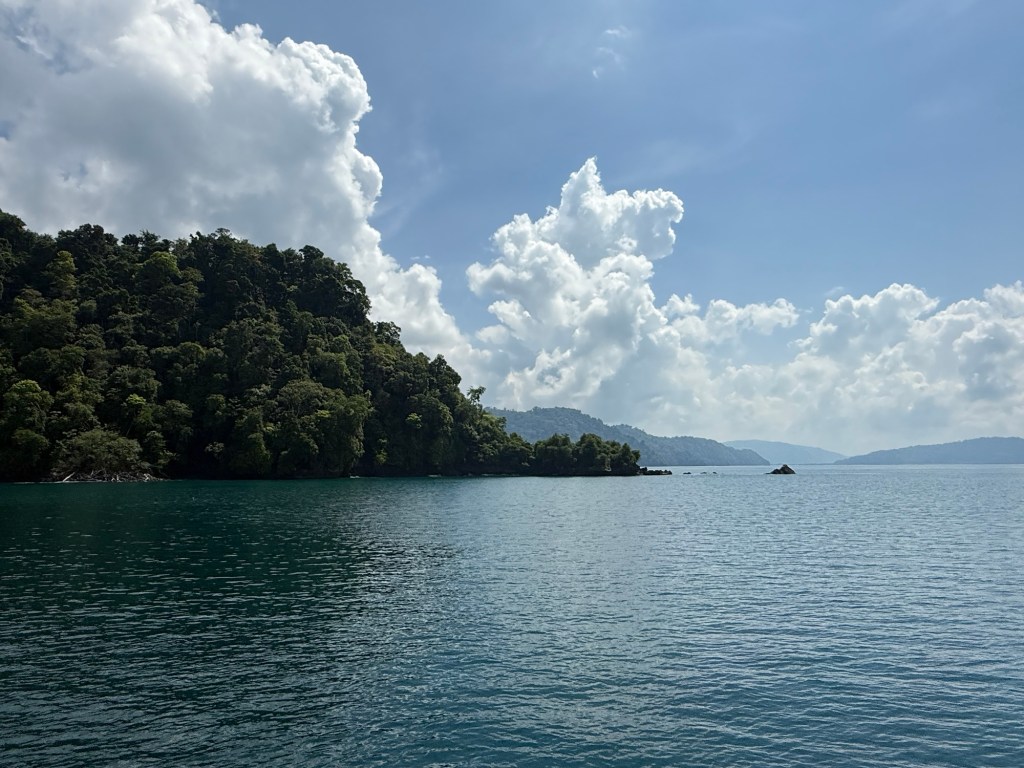
Today was a stop further south west toward Panama and offshore the small town of Puerto Jimenez, on the Osa Peninsula. There are very few roads into this region and those are dirt, dusty and bumpy so it’s not very populated or visited. We saw the National Geographic’s boat across the inlet which is a similar size to the Windstar, maybe smaller.  Other than that, we saw only a couple of other smaller boats all day in this beautiful serene area surrounded by hills covered with lush, green foliage. We were anchored just inside a huge inlet called the Golfo Dulce that is pretty much surrounded by national parks and nature preserves. The inlet is called a “tropical fjord” and is one of only 5 in the world and was created by the slippage of two tectonic plates. This area of Costa Rica is said by National Geographic to be “the most biologically intense area on earth”.  
In the 1960s logging arrived to the area, but during the removal of the valuable hard woods, something even more valuable was found in the streams criss crossing the area – gold.  Between logging and the removal of gold, the delicate ecosystems were in jeopardy. The government fortunately took action and created a series of national parks to safeguard the biodiverse ecosystem. Eco-tourism is now the biggest economic driver. We learned on a previous tour last year that the Costa Rican government also launched a campaign to document all known species of everything in the country in an effort to preserve it. As our naturalist said, if you don’t know what you have, how do you preserve it?  Then it went on an educational campaign to make Costa Rican and tourists aware of all the species and how important it was to save this diverse ecosystem. Our guide today explained that the biodiversity here was because as the Central American land bridge was forming, wildlife from South America travelled north and those from North America travelled south, and many species of all of them ended up in Central America.  

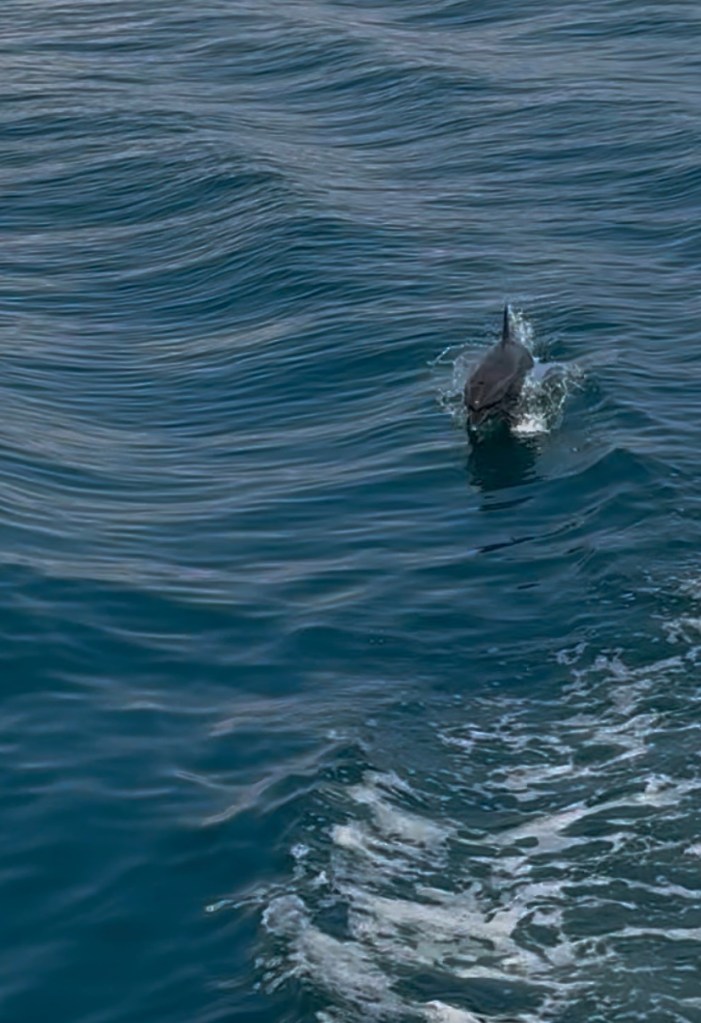
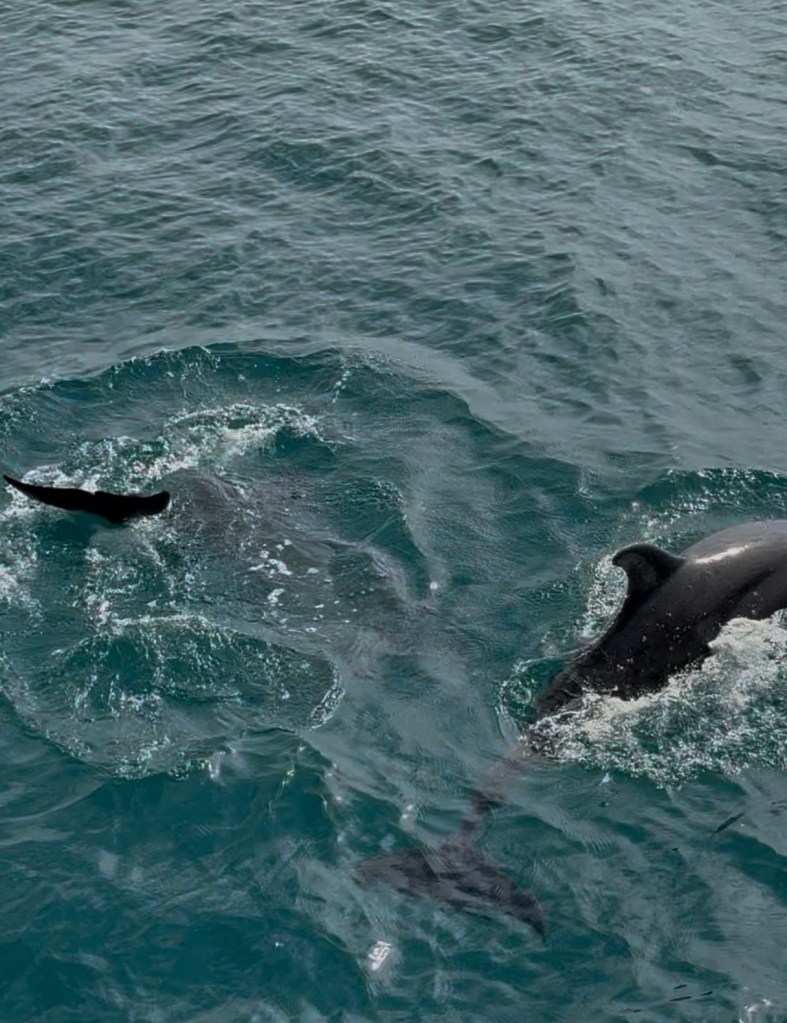
Today’s excursion was a 4 hour tour (…. A 4 hour tour….) to travel by small boat with a naturalist to see if we could find dolphins and to have a brief swim or walk along one of the many beaches surrounding the inlet. We had only been in the boat for about 2 minutes when we were greeted by the first of the two types of dolphins we would see today, the Bottlenose Dolphin. Later the Naturalist laughed and said he was just about to launch into his speech that we were going to look for dolphins but they are wild creatures and we couldn’t be guaranteed to see them today and there were a mother with two juveniles who literally came to us. I was surprise by how big they were as I’m used to seeing other varieties that are much smaller. The 3 spun around and jumped in the wake of the boat and went from side to side giving us a great show. Of course I have a zillion pictures of a bit of a fin but mostly just lovely blue water. The Bottlenose don’t hang out in large groups, just in 2 – 3 or 5. They live here year round and don’t travel very far from one area.  

We then traveled across the inlet toward Piedias Blancas National Park on the eastern side of the inlet where we saw dozens of the smaller Spotted Dolphins who do congregate in larger groups. We were told there were approximately 250 of them. We spun ourselves around looking in all directions to try and catch one or another of them spinning themselves out of the water. The naturalist gave us so much information I’ll never remember it all, but one thing I found interesting is that dolphins can’t go in to an unconscious sleep like we do because they have to control their blow hole as it goes directly into their lungs. So 50% of their brain stays awake at a time and the other 50% rests and then it switches out.  

After watching for a while, the captain headed to the far shore and did a beach landing in a small cove where we “wet landed” ie. no dock so we got into knee deep water on the beach. We walked the beach with the naturalist showing us various crabs and their holes, racoon tracks and various plants. Some people swam in the warm and clear water that is a more navy blue than usual. The crew had a lovely spread of fruit, cookies and corn chips laid out for us when we got back on board.

We followed the shoreline for some time and were able to see some beautiful Scarlet Macaws. I took a bunch of pictures but none really give you any idea how amazing they are, especially when in flight.

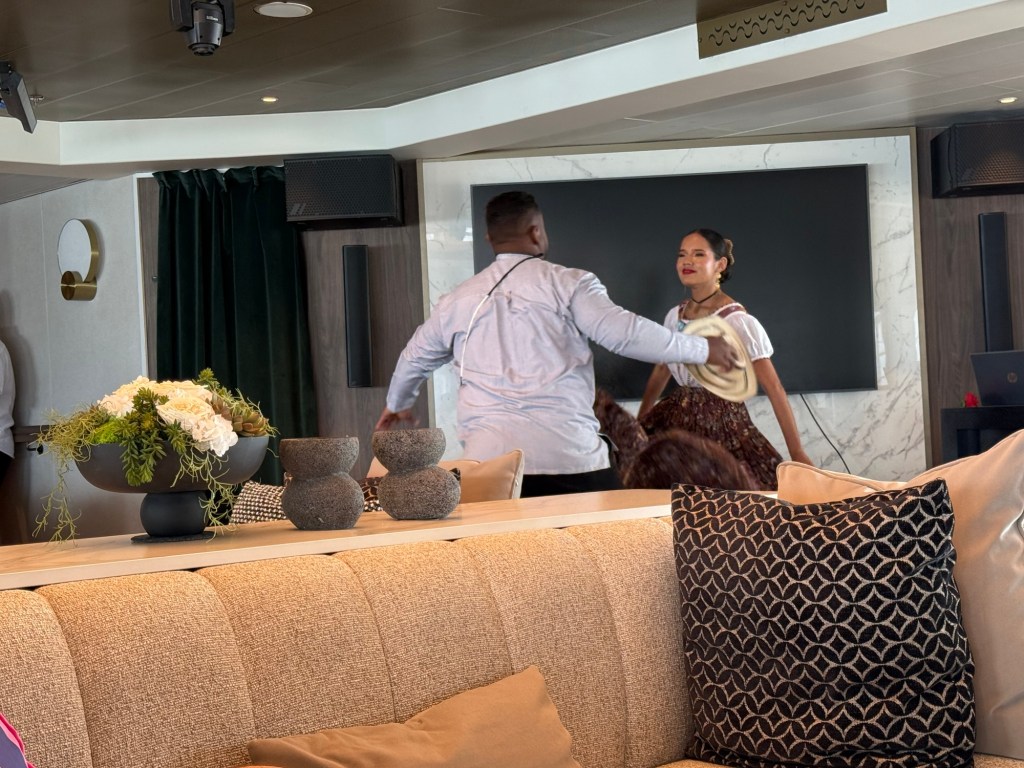
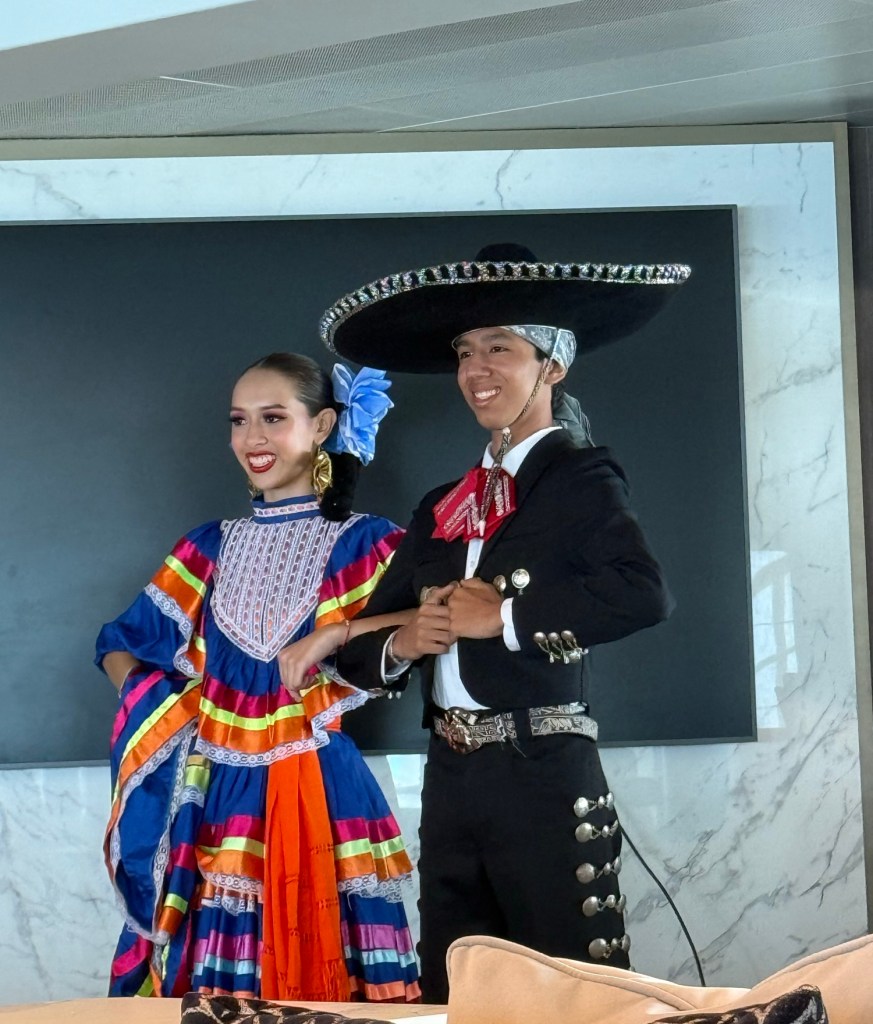
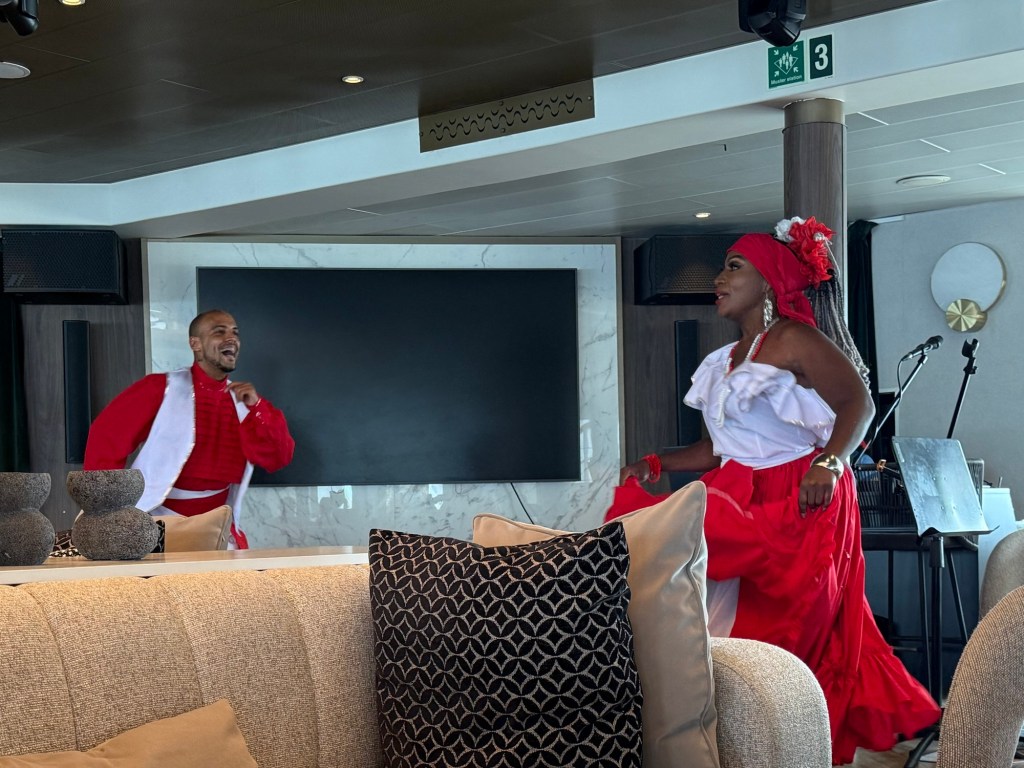
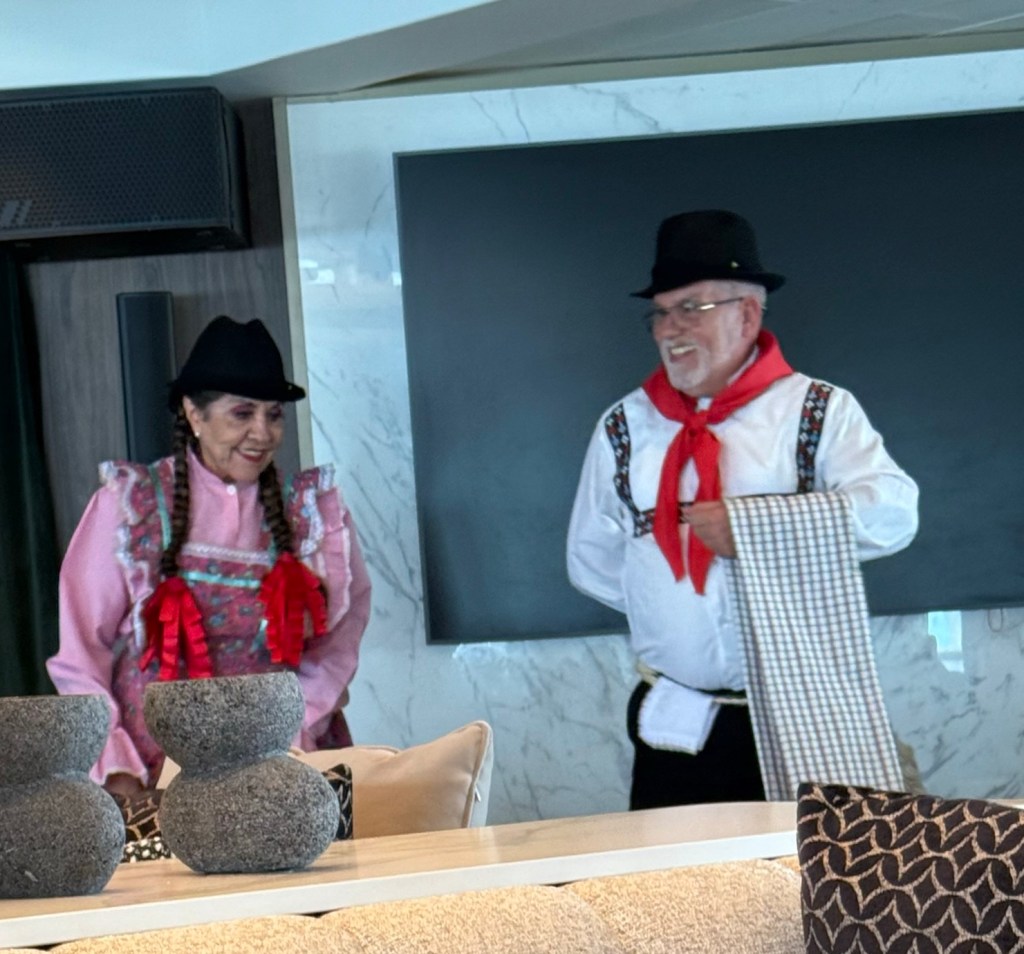
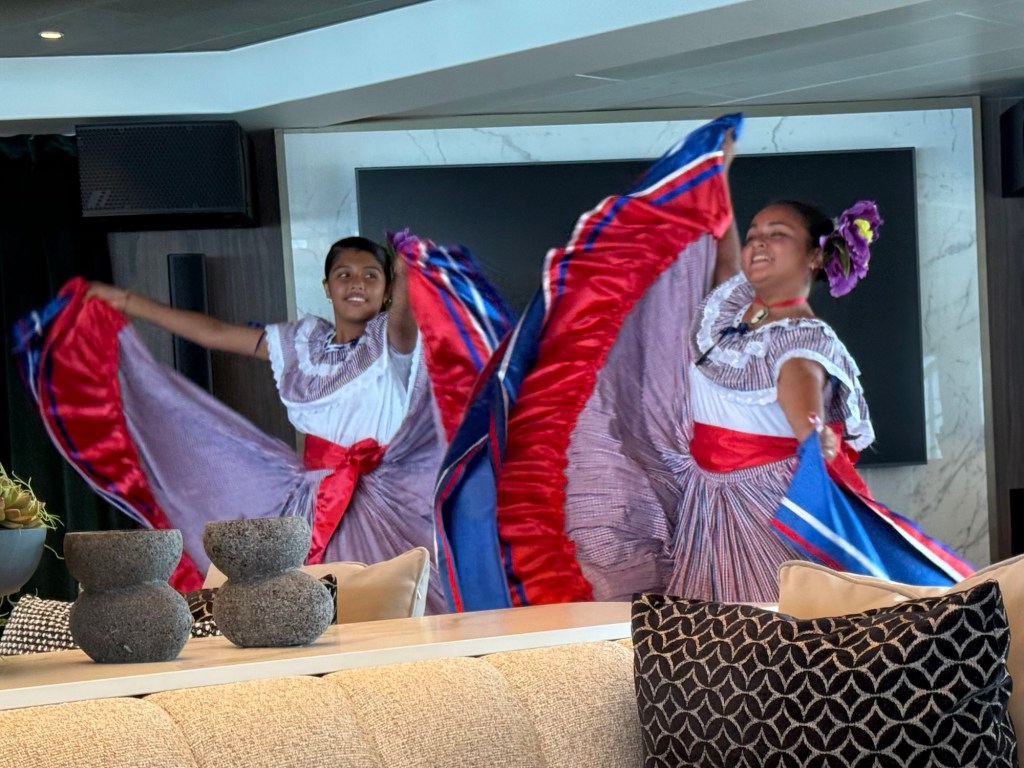
This afternoon’s entertainment were dancers from Panama, Mexico, Peru, Colombian and Costa Rica doing folk dances from their home countries. The dances were so much fun and their traditional clothes were so bright and beautiful. 

Panamanian dancers
Mexican dancers
Colombian dancers
Peruvian dancers
Costa Rican school children doing traditional dances

After the dancers Diego, the on board naturalist, spoke for 45 minutes about sloths and I found out an incredible amount of information which I’m not going to share for brevity except for a few facts in the Fun Facts section below.

Fun Facts:

  • The colours of the Costa Rican flag and their traditional dress represent the following: white to represent the fact they have no military, blue to represent the sky, and red to represent the hard working farmers red skinned from working under the sun.
  • The Orchid is the national flower of Costa Rica
  • Sloths sleep for 19 a day and have the slowest metabolism of any critter
  • Sloths are in the same family as anteaters, and armadillos, the xenarthrans. 
  • Sloths can rotate their heads 180 degrees.

Tomorrow it’s on to my second visit to the country of Panama.

2025 Cruise

Gone Bananas

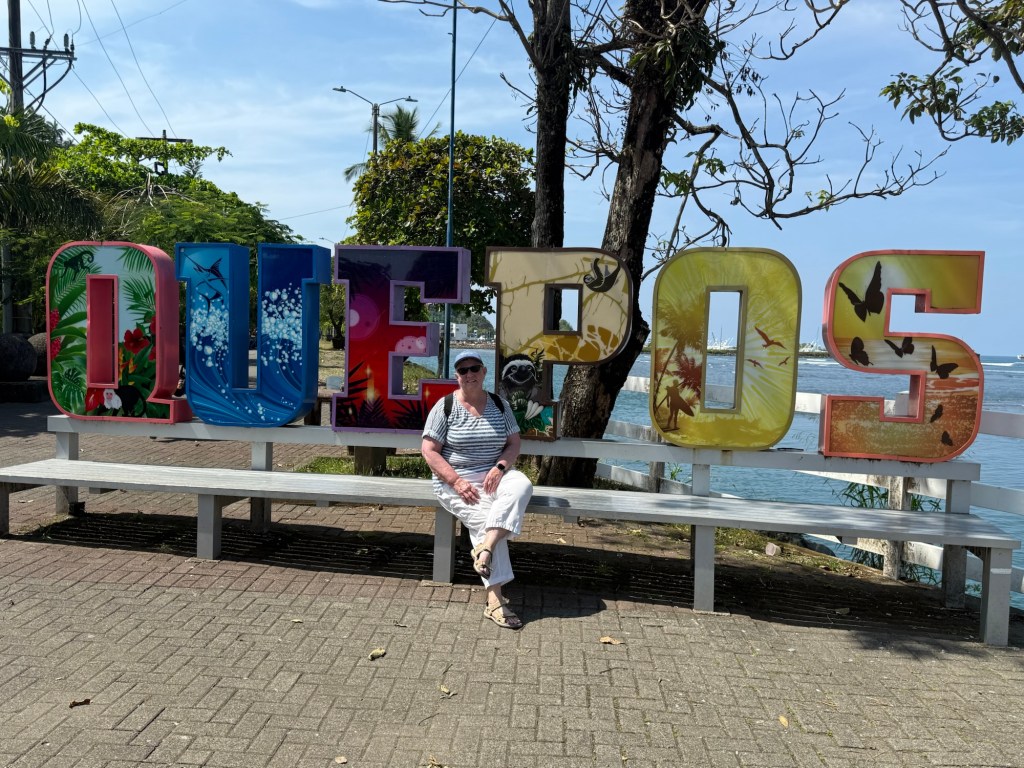
When I opened the curtains this morning, we had already arrived at our next destination, Quepos. It’s a small beach town with lots of small shops, and restaurants for locals and tourists, not particularly high end, that have been there for a long time.  But it also has a fabulous new marina complex with modern shops and restaurants which is where our tender dropped us off this morning. 
Historically Quepos was banana central in the 1930s and plantations belonging to the Chiquita Banana Company originally known as the United Fruit Company covered the hills in the area.  In the 1950s, floods destroyed most of the banana plantations in this area, and the growers switched to a new crop of African Palm Oil.  

Quepos is best known however for being the gateway to Manuel Antonio National Park, one of the most visited locations in Costa Rica.  It was established in 1972 to preserve this biodiverse area in a very small footprint.  I visited this park on my 2nd trip to Costa Rica and really loved the experience. 

In a short walk through the network of trails in the rainforest and along the mangroves and beaches you can see several different varieties of monkeys, three toed sloths, butterflies,caimans, snakes and iguanas.  There are over 100 species of mammals and 200 species of birds to keep you busy looking as you wander.  

Manuel Antonio Beach inside the park and Espadilla Sur Beach are beautiful with clear turquoise water for a variety of available water sports and are very busy spots.  

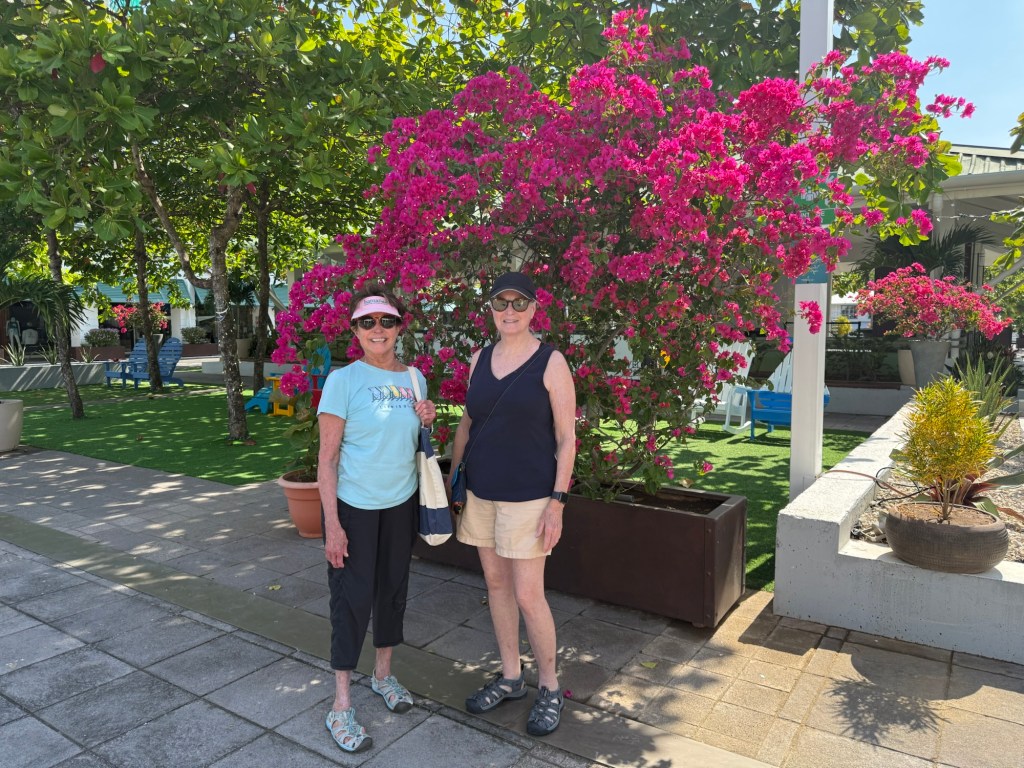
Adrienne and Clair

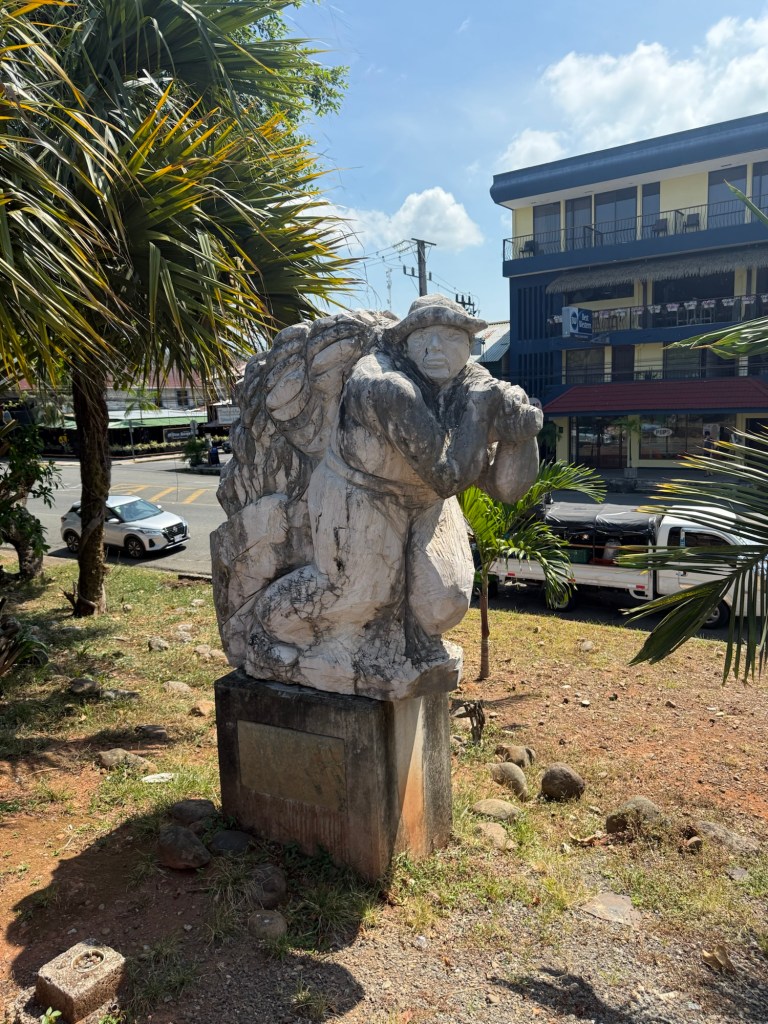
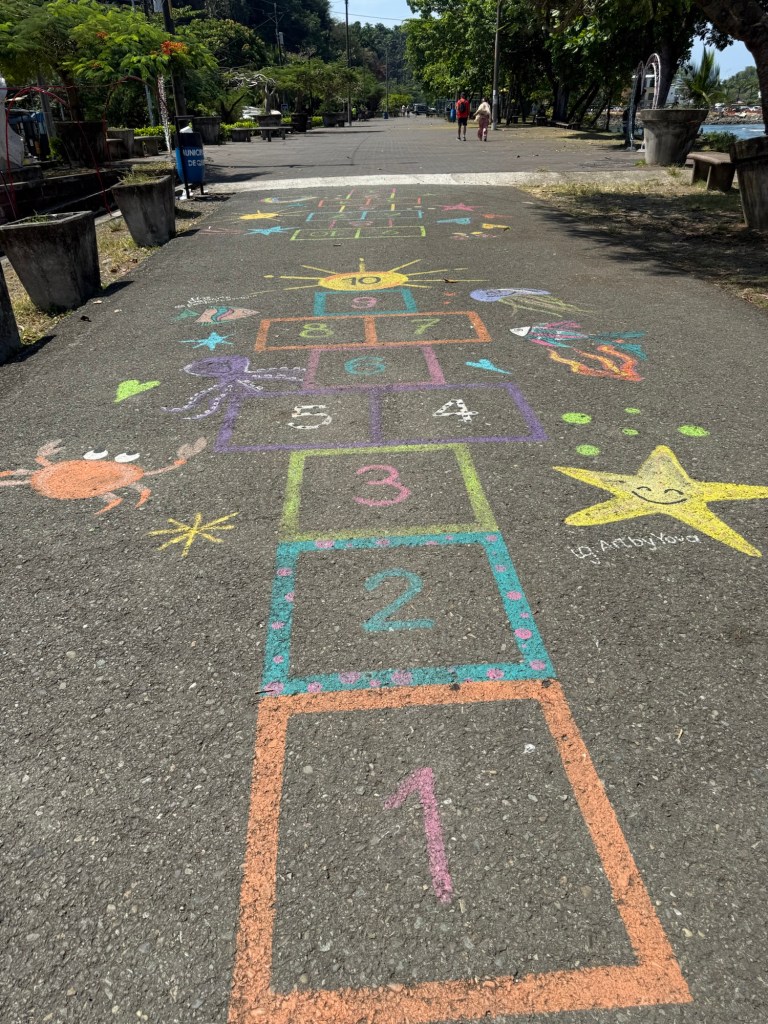
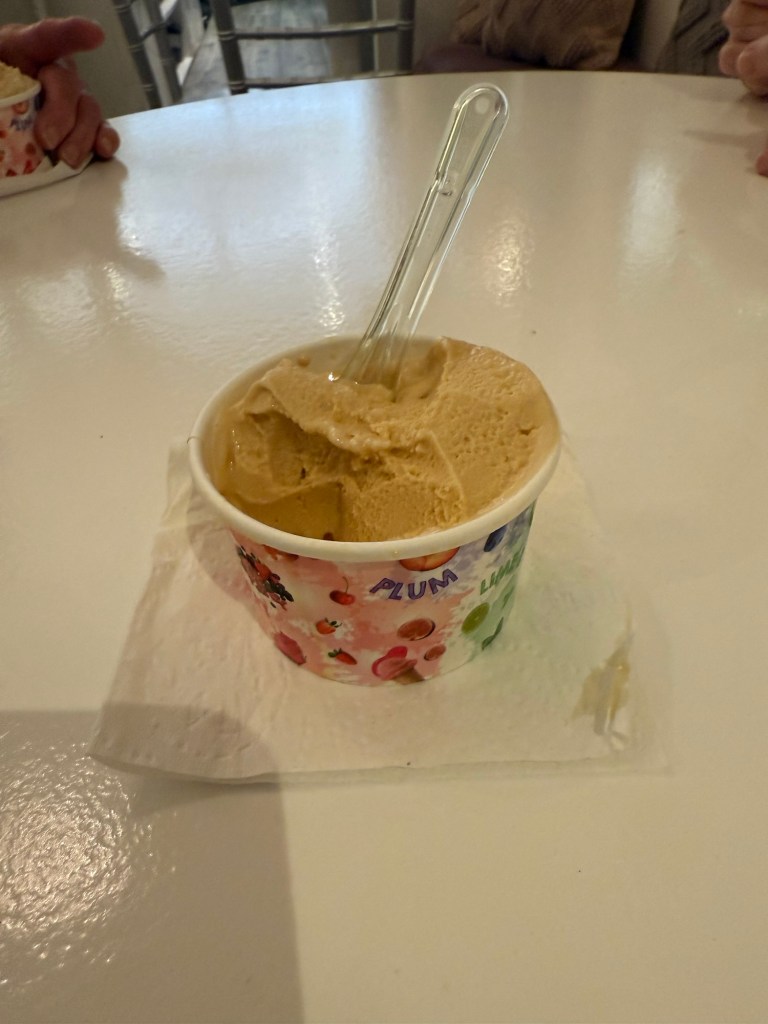
There was no availability on any of the tours we might have wanted to take today so we had a slow start to the day and went for a 2 mile or so walk along the Main Street of Quepos and a boardwalk along the waterfront to get some exercise, but boy was it hot! and humid! Not complaining though.  There were some really interesting statues along the boardwalk, but the plaques were eroded and faded, and also in Spanish, so I can’t enlighten you as to their origins. Oh, and we might have stopped for some ice cream along the way.

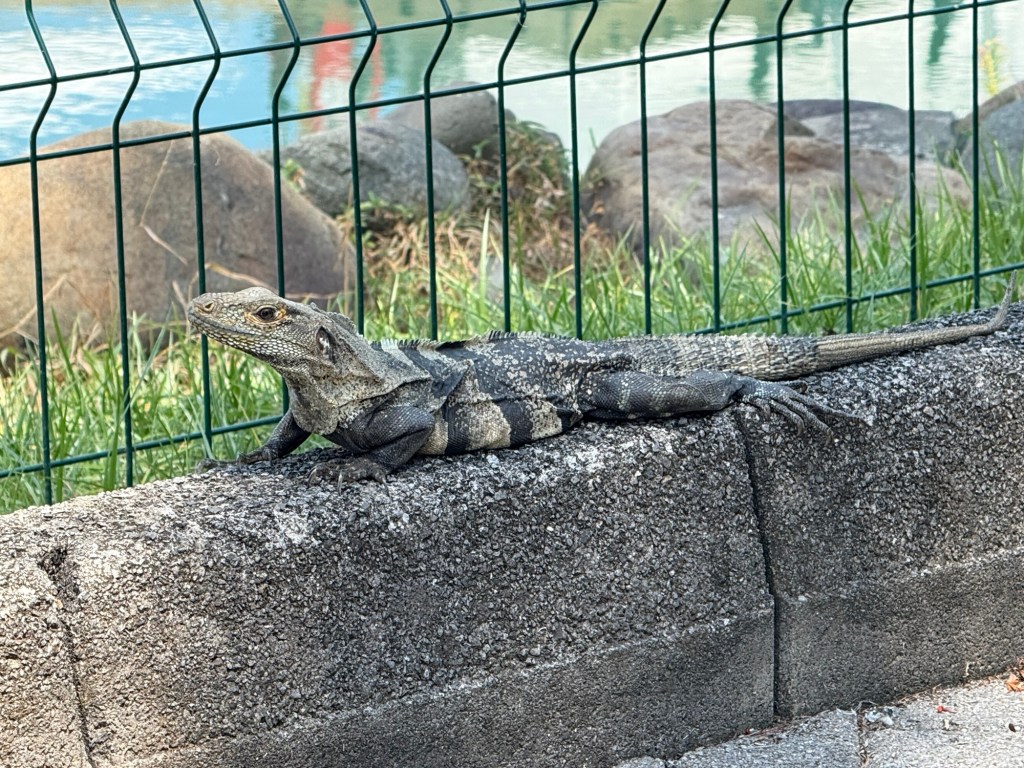
While enjoying the shade on a bench in the marina waiting for the tender to bring us back to the ship, we had some visitors.  Three or four iguanas came nearby to check us out. Thankfully they kept their distance.    

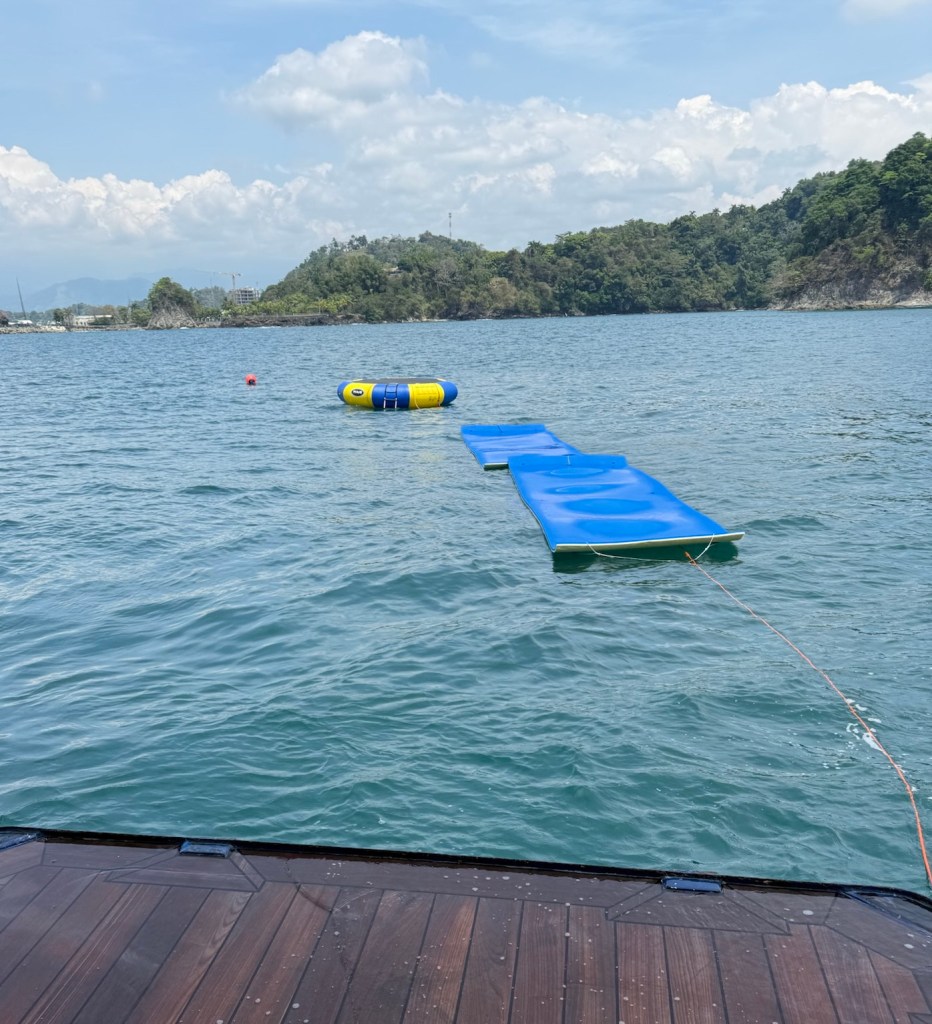
Once back on board, we quickly changed into our bathing suits and headed for the swimming platform at the back of the ship. The platform is only out when weather, sea and anchoring locations are ideal and today was one of them.  This was the first time that I’ve been able to take advantage of it on any of my cruises.  The water was warm and very buoyant, and very salty.  We had such a wonderful time getting cooled down a bit from our walk.  

The swimming platform on the back of the ship.

The rest of today will be engaged in ship activities such entertainment by a local group, trivia, dinner and visiting.  We’ve been invited to the General Hotel Manager’s table at dinner tonight, so guess we’ll have to behave.  Day 2 has been fabulous and we’re getting into the vacation groove.  I am now off for my afternoon nap.  💤