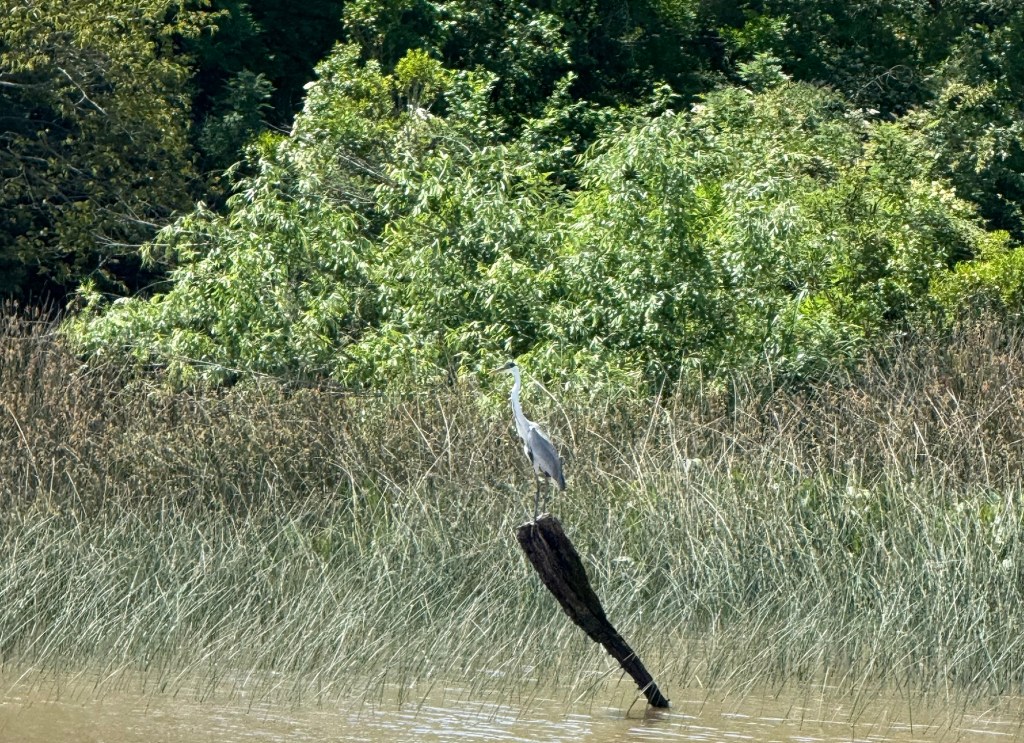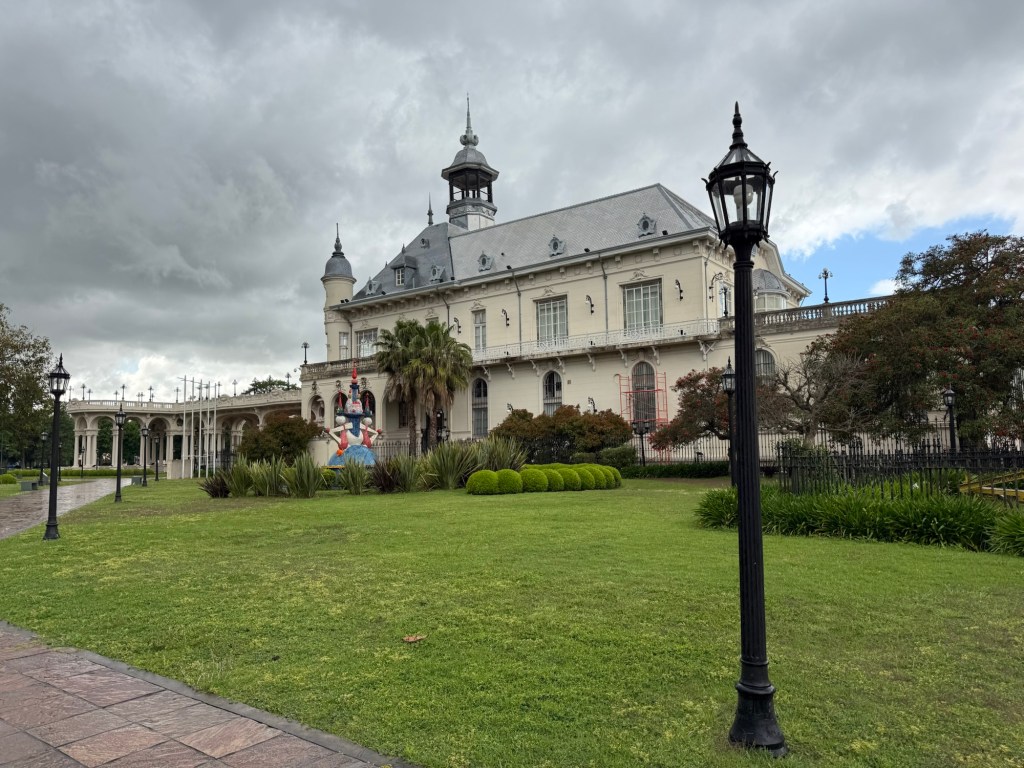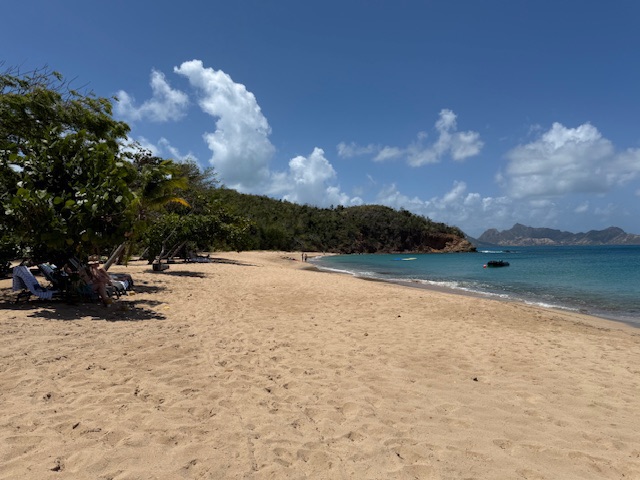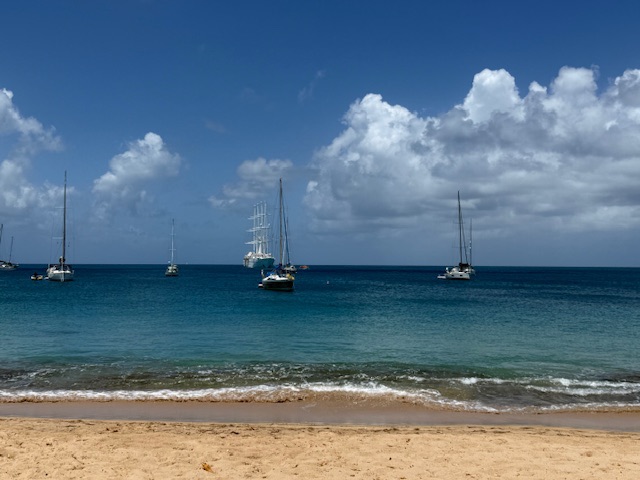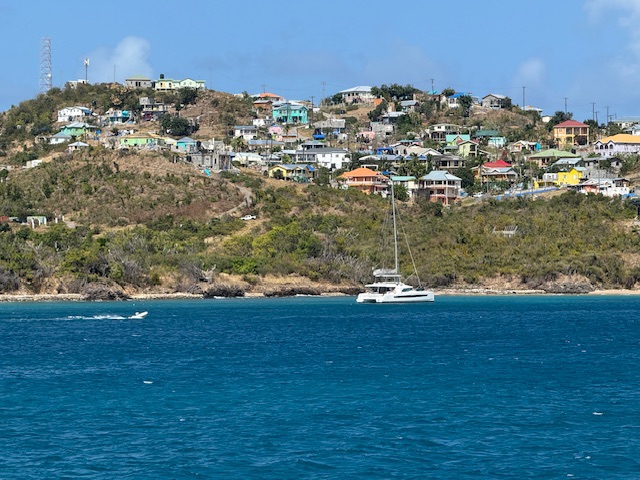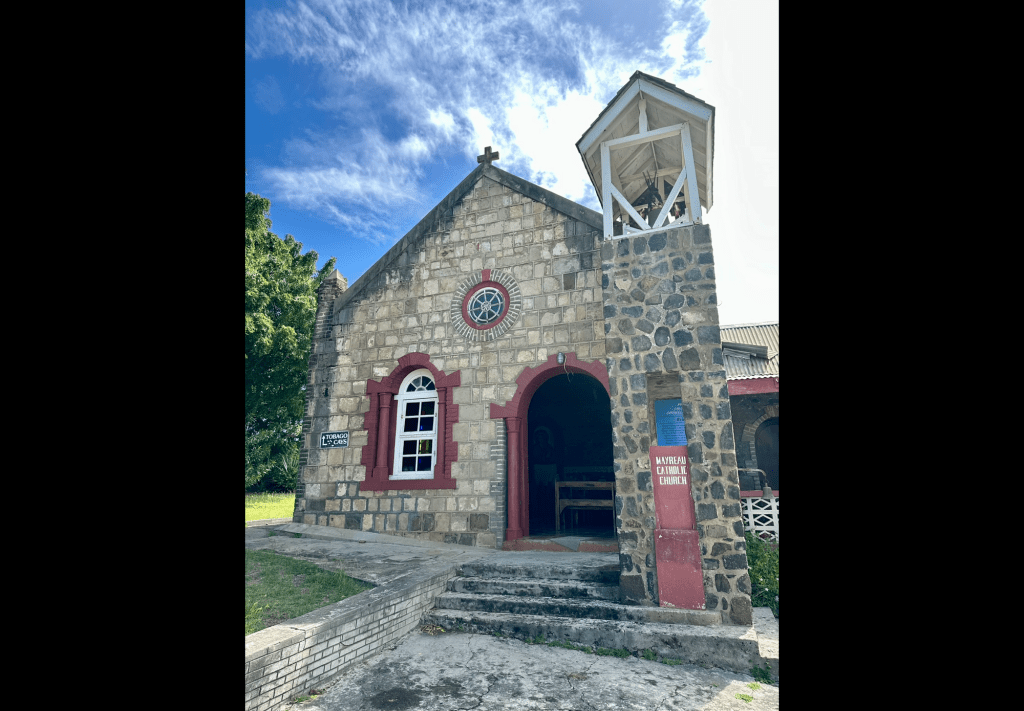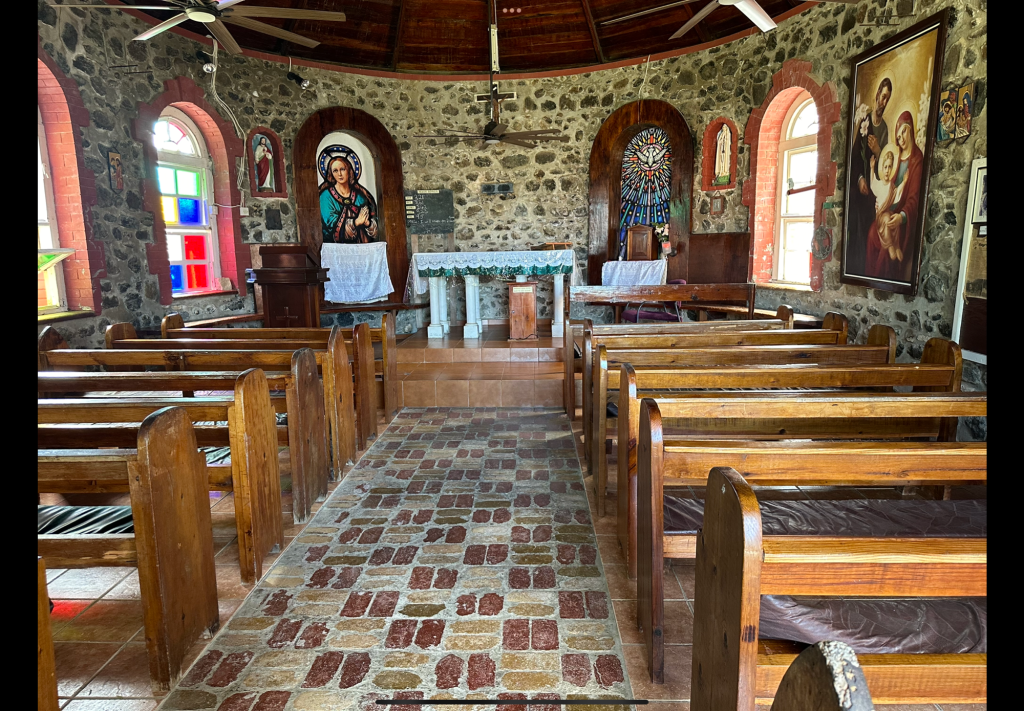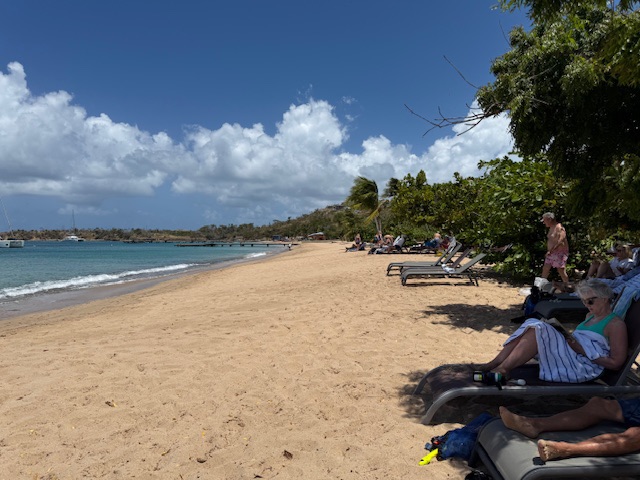
Today we entered the warm Panamanian waters and anchored in the middle of an archipelago, the largest island called Isla Parida, surrounded by 25 or so smaller islands, some only big enough for a couple of trees. Last winter on the Star Pride, I travelled to some similar islands on the Atlanta side of Panama, the San Blais Islands. The San Blais Islands were more like sand bars with cocoanut palms on them but these islands are made of volcanic rock and while there are some palms, there is a wide assortment of other vegetation as well.
Here are two maps, one showing you the area, and another showing you our position relative to mainland Costa Rica and Panama.
These islands are in the Chiriqui Gulf National Marine Park so the islands are protected and uninhabited. The islands are home to monkeys, dolphins, whales, a plethora of birds and brilliant aquatic life. The aquatic life is what we were off in search of this morning with two snorkelling stops in among the islands.
Our guides knew exactly where to go and in no time we were at our first stop. The first snorkel of the year is always a bit awkward getting used to the equipment, etc, and today was no different. And the boat we were in was not the easiest to get in and out of. We were next to a rock outcropping when we anchored and we had quite a long time to explore on our own. Some dive masters are very prescriptive about where you go and some even have you follow them, but these guys were happy to just let us meander in the warm water.
And meander we did through rock covered in coral with sand floor valleys watching the aquarium of life below us. This is beyond a doubt the best snorkelling I’ve done in the Caribbean/Central American area in the past 3 years. There were schools of small and large fish, and solo fish in all colours of the rainbow. Some tiny florescent purple ones, some huge parrot fish, striped ones in various colours, some solid coloured ones in yellows and blues, yellow with spots, grey and white stripped, Angel Fish, butterfly fish, and even some star fish. I got caught in a channel between the rocks making my way back to the boat that was a little anxiety provoking as there was some swell pushing me to and fro requiring me to really boot it a couple of times. But I didn’t hit anything and saw some cool stuff along the way. There was some coral I hadn’t seen before, but none was very colourful or interesting. Was so great to do some good snorkelling after some disappointing excursions the last two years.
Then the captain moved the boat to another spot around another island, and there was a beautiful secluded beach where we dropped two of our passengers off to spend some time swimming and walking the white sand beach. As we were getting positioned to do our second snorkel, our guide spotted the head of a large Green Turtle nearby. Once in the water we got close enough to see how huge it was and watch it eat. After a couple of minutes, the dive master had us move on to the rocky area so as not to harass the turtle even though we weren’t close. Sadly this area was like a coral graveyard, with no live coral at all and lots of dead and bleached branches on the floor of the ocean. There were lots of fish in this location but not nearly as many as the first one. As Adrienne and I were headed back to the boat, she pointed out a huge white fish to me. It looked like a ghost. While we were watching, believe it or not, it changed colour into a grey and white striped fish! If we hadn’t both seen it I wouldn’t have believed it. Very cool. We’ll have to ask the on-board naturalist about it when we next see him.
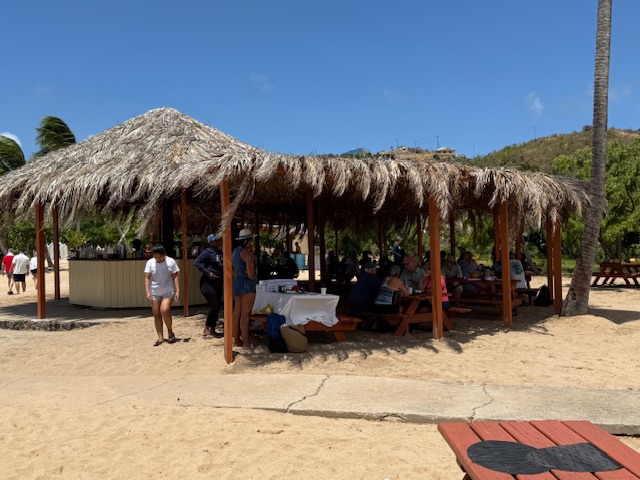
The snorkelling boat dropped us off on the private beach where the fabulous Windstar staff had spent the morning lining the beach under the cocoanut palms with lounge chairs and bright umbrellas. The kitchen staff, under the watchful eye of the head chef, prepared a fabulous lunch barbecue on the beach as well. Especially having been on the water all morning, we were tired and ready for some lunch. It was sure good!
I’ve showered and changed but thinking now is the time for a nap. So off I go to do that before I get signed up to do something else. Tomorrow is a day at sea so unless something really exciting happens you might not hear from me.
The Windstar waiting for us to returnThere’s those toes.
Before starting in on today, I’ll back track a bit to yesterday. Just after posting my blog, we had the most lovely entertainment by some Ticos and Ticas from the Quepos area. The 4 piece band played several different kinds of Latin music: Salsa, Merengue, Cumbria as well as some specific Costa Rican folk songs. One of the band members played the guitar and the Marimba, Costa Ricans national musical instrument. It is much like a xylophone but has a much more mellow and pleasing sound. For many of the songs, there were 8 young ladies in brightly coloured traditional costume doing traditional folk dances from Costa Rica. They were all so talented! Clair even got co-opted to participate in the “broom dance”. There was a tale about this dance that had something to do with trying to avoid getting stuck dancing with the broom.
One of my favourite things on the Windstar is the traditional “sail away” and on the sailing ships, of course, the sails are unfurled instead of just the Windstar flag being raised to the stirring music of Vangelis’ Conquest of Paradise. Quite a sight. And to top it off there was a bright red sun set just as we set sail.
Last night Clair, Adrienne and I were invited, along with another couple of folks to join Jan, the General Hotel Manager, for dinner. It’s one of the perks of racking up the sailing nights with Windstar and I’m pretty sure it was because of Clair’s nights, not mine! But I’ll take it. Jan was really interesting and fun, as were the other couple, and It was a very enjoyable evening.
So on to today…
Today was a stop further south west toward Panama and offshore the small town of Puerto Jimenez, on the Osa Peninsula. There are very few roads into this region and those are dirt, dusty and bumpy so it’s not very populated or visited. We saw the National Geographic’s boat across the inlet which is a similar size to the Windstar, maybe smaller. Other than that, we saw only a couple of other smaller boats all day in this beautiful serene area surrounded by hills covered with lush, green foliage. We were anchored just inside a huge inlet called the Golfo Dulce that is pretty much surrounded by national parks and nature preserves. The inlet is called a “tropical fjord” and is one of only 5 in the world and was created by the slippage of two tectonic plates. This area of Costa Rica is said by National Geographic to be “the most biologically intense area on earth”.
In the 1960s logging arrived to the area, but during the removal of the valuable hard woods, something even more valuable was found in the streams criss crossing the area – gold. Between logging and the removal of gold, the delicate ecosystems were in jeopardy. The government fortunately took action and created a series of national parks to safeguard the biodiverse ecosystem. Eco-tourism is now the biggest economic driver. We learned on a previous tour last year that the Costa Rican government also launched a campaign to document all known species of everything in the country in an effort to preserve it. As our naturalist said, if you don’t know what you have, how do you preserve it? Then it went on an educational campaign to make Costa Rican and tourists aware of all the species and how important it was to save this diverse ecosystem. Our guide today explained that the biodiversity here was because as the Central American land bridge was forming, wildlife from South America travelled north and those from North America travelled south, and many species of all of them ended up in Central America.
Today’s excursion was a 4 hour tour (…. A 4 hour tour….) to travel by small boat with a naturalist to see if we could find dolphins and to have a brief swim or walk along one of the many beaches surrounding the inlet. We had only been in the boat for about 2 minutes when we were greeted by the first of the two types of dolphins we would see today, the Bottlenose Dolphin. Later the Naturalist laughed and said he was just about to launch into his speech that we were going to look for dolphins but they are wild creatures and we couldn’t be guaranteed to see them today and there were a mother with two juveniles who literally came to us. I was surprise by how big they were as I’m used to seeing other varieties that are much smaller. The 3 spun around and jumped in the wake of the boat and went from side to side giving us a great show. Of course I have a zillion pictures of a bit of a fin but mostly just lovely blue water. The Bottlenose don’t hang out in large groups, just in 2 – 3 or 5. They live here year round and don’t travel very far from one area.
We then traveled across the inlet toward Piedias Blancas National Park on the eastern side of the inlet where we saw dozens of the smaller Spotted Dolphins who do congregate in larger groups. We were told there were approximately 250 of them. We spun ourselves around looking in all directions to try and catch one or another of them spinning themselves out of the water. The naturalist gave us so much information I’ll never remember it all, but one thing I found interesting is that dolphins can’t go in to an unconscious sleep like we do because they have to control their blow hole as it goes directly into their lungs. So 50% of their brain stays awake at a time and the other 50% rests and then it switches out.
After watching for a while, the captain headed to the far shore and did a beach landing in a small cove where we “wet landed” ie. no dock so we got into knee deep water on the beach. We walked the beach with the naturalist showing us various crabs and their holes, racoon tracks and various plants. Some people swam in the warm and clear water that is a more navy blue than usual. The crew had a lovely spread of fruit, cookies and corn chips laid out for us when we got back on board.
We followed the shoreline for some time and were able to see some beautiful Scarlet Macaws. I took a bunch of pictures but none really give you any idea how amazing they are, especially when in flight.
This afternoon’s entertainment were dancers from Panama, Mexico, Peru, Colombian and Costa Rica doing folk dances from their home countries. The dances were so much fun and their traditional clothes were so bright and beautiful.
Panamanian dancersMexican dancersColombian dancersPeruvian dancersCosta Rican school children doing traditional dances
After the dancers Diego, the on board naturalist, spoke for 45 minutes about sloths and I found out an incredible amount of information which I’m not going to share for brevity except for a few facts in the Fun Facts section below.
Fun Facts:
The colours of the Costa Rican flag and their traditional dress represent the following: white to represent the fact they have no military, blue to represent the sky, and red to represent the hard working farmers red skinned from working under the sun.
The Orchid is the national flower of Costa Rica
Sloths sleep for 19 a day and have the slowest metabolism of any critter
Sloths are in the same family as anteaters, and armadillos, the xenarthrans.
Sloths can rotate their heads 180 degrees.
Tomorrow it’s on to my second visit to the country of Panama.
When I opened the curtains this morning, we had already arrived at our next destination, Quepos. It’s a small beach town with lots of small shops, and restaurants for locals and tourists, not particularly high end, that have been there for a long time. But it also has a fabulous new marina complex with modern shops and restaurants which is where our tender dropped us off this morning.
Historically Quepos was banana central in the 1930s and plantations belonging to the Chiquita Banana Company originally known as the United Fruit Company covered the hills in the area. In the 1950s, floods destroyed most of the banana plantations in this area, and the growers switched to a new crop of African Palm Oil.
Quepos is best known however for being the gateway to Manuel Antonio National Park, one of the most visited locations in Costa Rica. It was established in 1972 to preserve this biodiverse area in a very small footprint. I visited this park on my 2nd trip to Costa Rica and really loved the experience.
In a short walk through the network of trails in the rainforest and along the mangroves and beaches you can see several different varieties of monkeys, three toed sloths, butterflies,caimans, snakes and iguanas. There are over 100 species of mammals and 200 species of birds to keep you busy looking as you wander.
Manuel Antonio Beach inside the park and Espadilla Sur Beach are beautiful with clear turquoise water for a variety of available water sports and are very busy spots.
Adrienne and Clair
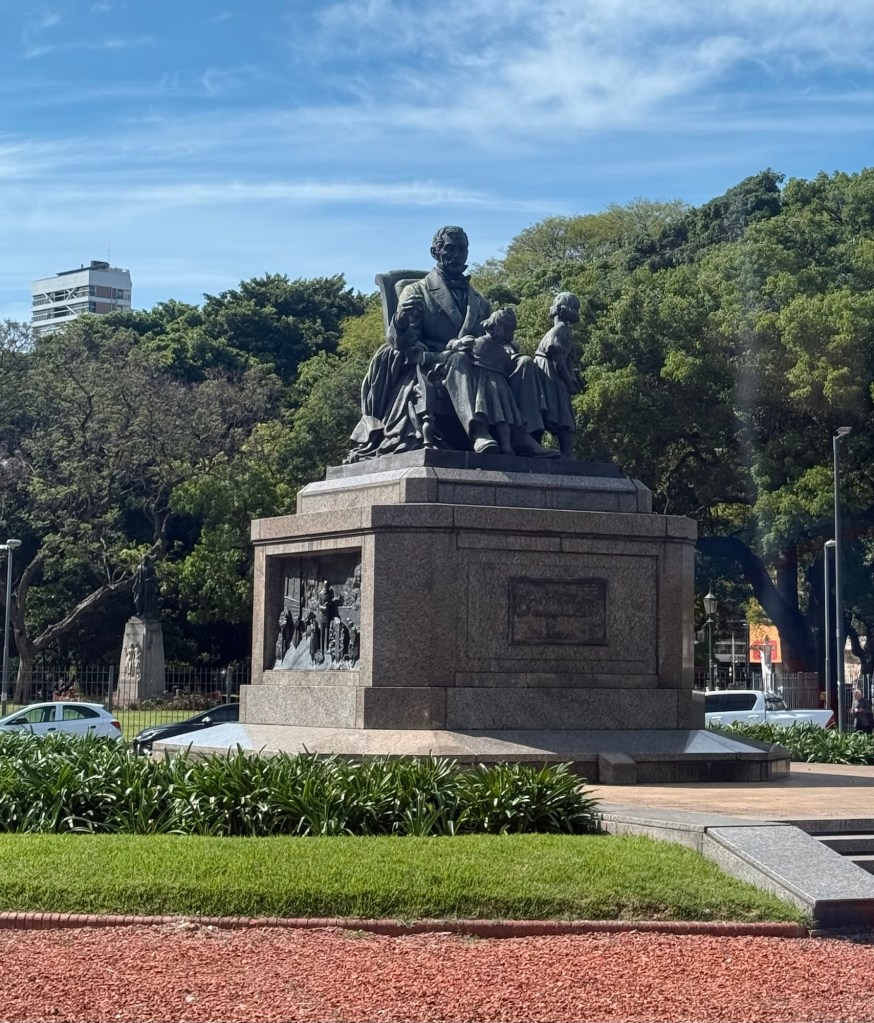
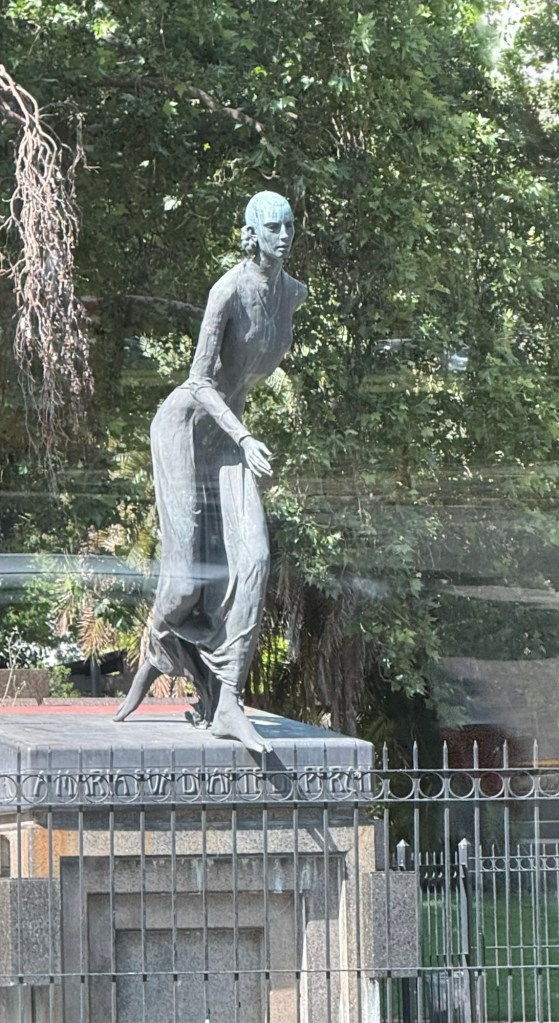
There was no availability on any of the tours we might have wanted to take today so we had a slow start to the day and went for a 2 mile or so walk along the Main Street of Quepos and a boardwalk along the waterfront to get some exercise, but boy was it hot! and humid! Not complaining though. There were some really interesting statues along the boardwalk, but the plaques were eroded and faded, and also in Spanish, so I can’t enlighten you as to their origins. Oh, and we might have stopped for some ice cream along the way.
While enjoying the shade on a bench in the marina waiting for the tender to bring us back to the ship, we had some visitors. Three or four iguanas came nearby to check us out. Thankfully they kept their distance.
Once back on board, we quickly changed into our bathing suits and headed for the swimming platform at the back of the ship. The platform is only out when weather, sea and anchoring locations are ideal and today was one of them. This was the first time that I’ve been able to take advantage of it on any of my cruises. The water was warm and very buoyant, and very salty. We had such a wonderful time getting cooled down a bit from our walk.
The swimming platform on the back of the ship.
The rest of today will be engaged in ship activities such entertainment by a local group, trivia, dinner and visiting. We’ve been invited to the General Hotel Manager’s table at dinner tonight, so guess we’ll have to behave. Day 2 has been fabulous and we’re getting into the vacation groove. I am now off for my afternoon nap. 💤
The sun sets over the Pacific as the pilot boat drops the tether and we’re on our own.
Today is the big day that we join the Windstar Cruise Lines sailing flagship, the 4 masted sailing vessel Windstar.
Breakfast at our hotel in San Jose
After another great breakfast, this time an omelette made in front of me at the omelette station on the beautiful outdoor deck looking out over a small valley and the further away mountains, we left the hotel in San Jose and traveled west toward the Pacific Coast of Costa Rica to the port of Puerto Caldero. (How’s that for a run-on sentence!) The 82 km trip took us one and a half hours which was good time according to our driver. The road was winding, and two lane most of the way.
It’s really hard to get a picture that does the scenery along the way justice. There were significant hills and dales all covered in vegetation and greener as we got toward the coast.
After we got out of the city, the drive was beautiful, travelling through rolling hills and deep valleys covered in a million shades of green. There was little evidence of houses along the way, although there were some cows. There were some market stalls along the highway as we got well out of the city, selling a wide variety of colourful and lovely looking fruit.
Puerto Caldero is on the Pacific, and specifically on the Gulf of Nicoya, just south of the popular tourist area of Puntarenas. Puerto Caldero is the largest port for cargo on the Pacific Coast of Costa Rica and really is just a port. Not very appealing to look at, but gets the job done. Iron, fruit, vehicles, tuna and general merchandise are shipped from here to the US and Asia.
We transferred from our bus to a shuttle to take us through the busy industrial area to our awaiting Windstar. The port was not conducive to picture taking but I’ll get a picture of her from one of next stops. After “processing”, (immigration forms, luggage inspection, medical forms, etc) we were welcomed aboard by the ship’s hotel manager and provided with icy cold face clothes to cool us down. I don’t think the temperature changed much, but the humidity went from relatively dry in San Jose to off the charts on the coast.
This is the lounge which is the centre of the action on the ship. Port talks happen here, this is where we gather to take excursions, etc.
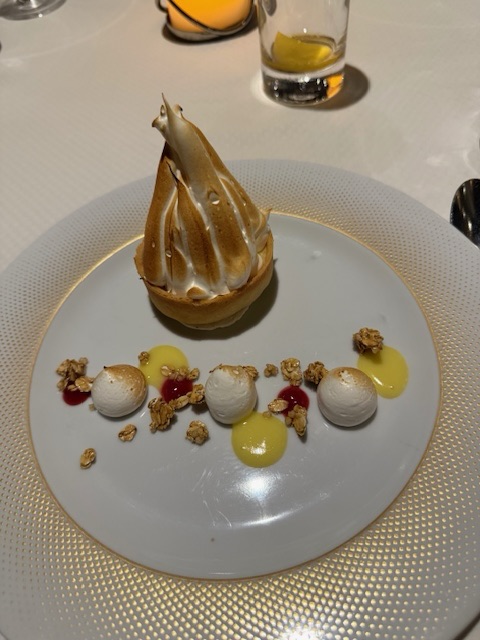
Lunch, excursions talk, life boat drill, nap, shower, unpacking, sunset watching, port talk, dinner, and walk around the deck all followed in rapid succession. Dinner was amazing – a tomato tart with creamy cheese, beef steak strips, something that tasted amazing that I think was a really light tempura battered deep fried basil, truffle fries, and key lime pie. It’s been a pretty uneventful day, but long and I’ll be glad to be rocked to sleep tonight.
My cabin aboard the Windstar. It’s not as big as those on the Star series ships from Windstar which I’ve been on lately but really comfortable and more than adequate. The Windstar is the sister ship to the Wind Spirit which I was on just before Covid going from Tahiti to Fiji.
Tomorrow is a stop in Quepos, the home of the very famous and therefore very crowded Manuel Antonio National Park. I visited the Park when I was last here on my land tour in 2011, and did the hike, spent some quality time on the beautiful beach and even went for a sunset catamaran sail. None of the available excursions sounded interesting so we’re going to go in to Quepos tomorrow to get in some walking time to work off some the calories I’m consuming!
Happy International Women’s Day to all the amazing women in my life!
I’m not sure if I’m so glad to be getting away because it’s been a typical Ottawa winter this year (i.e. very cold and very snowy) or because of the political drama acting out on the world stage (unfortunately with Canada in a principle role) at the moment. But let’s just say that I’m glad to be away from both.
To address the elephant in the room, no, I’m am not travelling to the U.S. I am once again going on a cruise with my favourite cruise line, Windstar. However, sadly, this year’s trip on Windstar will most likely be the last. I have just found out that Windstar is owned by an American billionaire who financially supports a certain political party to the tune of hundreds of thousands of dollars, as well as its leadership and I can’t in all conscience book a trip with them for next year. I booked and paid for this trip long before the current President was sworn in and the subsequent trade war broke out and since they don’t have insurance for that I have decided not to waste my hard earned dollars. I have written the president of Windstar to explain how insulted I am that the President of the United States of America has continued to press this notion of Canada becoming the 51st State and to call our Prime Minister “Governor” not to mention his decisions on the trade file and his indecent treatment of Zelenskyy.
So, now that I have that off my chest, on with the start of what I hope will be a relaxing and fun trip in the warmth of Central America and the Caribbean.
Here is the map of our 18 day trip starting on the Pacific side of Costa Rica, travelling south east toward Panama, through the canal (still owned by the Panamanians as I write), across the north of Colombia and Venezuela, with various stops in Colombia and some islands along the way and on to disembark in Barbados.
This will be my third trip to the friendly, green and inviting country of Costa Rica. The first trip was actually a business one, to attend a sales meeting and plant tour of one of the electronic suppliers our company represented for many years. We learned a lot but had some fun along the way as well. Then, in 2011, I took my first G Adventures tour, and did a 10 day land tour which touched on both coasts and the central region of the country. It was my first real travel on my own and I threw all caution to the wind and did all the adventurous things one can do in Costa Rica such as zip lining, canyoning (rappelling down waterfalls, and wading through creeks), and white water rafting as well as viewing (or trying to, it was fogged in) Arenal, an active volcano, soaking in hot springs, and exploring the canals of the Tortuguero region. We finished up hiking trails and loving the beautiful white sand beaches in Manuel Antonio National Park on the Pacific coast.
Yesterday I flew through Montreal and on to the Costa Rican capital city of San Jose for two nights and will embark the Windstar on Saturday to start the cruise. I got notice as I arrived at the Ottawa airport that my flight was going to be slightly delayed due to fog slowing things down on the incoming flights but no worries as I had lots of time in Montreal. But I managed to immediately get on to an earlier flight to Montreal so I had a longer layover in Montreal but it’s a larger airport and better to get comfie only once.
After a bit of confusion (I was early, my driver was late and the G-Adventures rep helped us find each other) I was met by a Windstar representative at Juan Santamaria International Airport and whisked away to the hotel for the first of two nights. I allowed for an extra night just in case of bad weather or other delays. The hotel is really comfortable and has a beautiful pool area where I am encamped for the day.
I met friends from Denver who I had met on a previous cruise at breakfast this morning and we had a gab fest to get caught up. We will spend the day chilling at the hotel and will be transported to the cruise ship port tomorrow morning.
I’ve been to many of the spots on this cruise before and so will not do much of a blog (or maybe cut and paste from a previous one :-)), but I’ll start with a bit of general info on Costa Rica.
Visitors come to Costa Rica for three main reasons. The sun/sand of the resorts on both the Atlantic and Pacific coasts, the abundant flora and fauna, and outdoor adventure. They often return for the Pura Vida lifestyle. The phrase pura vida (meaning “pure life”) is used to say many things, such as “hello,” “goodbye,” and “no worries.” When we had successfully managed our way through a difficult rapid when whitewater rafting on a previous trip, the guide had us all touch paddles over our heads and yell pura vida, so I think it also means, “thank god we made it”. But it’s more than that. It’s a way of life that embraces a more playful, flexible and laid back life style than other places. And one of the top five Blue Zones in the world (where inhabitants tend to live actively even past the age of 100) is in a town called Nicoya is located on the western coast. So maybe they have it right!
So if you’ve read my previous blogs on my trips to the Caribbean you’ll know that Christopher Columbus was prominently featured, and the history of Costa Rica holds a place for Chris too. He first visited in 1502 but Spanish colonists didn’t establish a permanent settlement until 1563. In 1949 after a short-lived civil war, Costa Rica’s constitution was passed. It has a stable, well functioning democratic government with an elected president and two vice-Presidents and a legislature with a multi-party system..
Costa Rica dispensed with an army in 1948 to instead pay for an army of teachers with a view to make their population as close to 100% literate as possible. Today the literacy rate ranks among the highest in the world. Spanish is their mother tongue but a large part of the population of 5 million or so, speak English and French as well, making Canadians feel so welcome that many of them are snow birds to Costa Rica or have permanent homes there.
Among the cultural taboos in Costa Rica is placing your feet on furniture which is seen as disrespectful, and pointing is also considered rude. One is advised to use the whole hand to gesture and not point it directly at another person. Also it’s considered bad form not to sustain eye contact during conversations as it’s seen as dismissive. Despite the pura vida lifestyle where tardiness is acceptable in social settings, being on time for business and professional meetings is considered a matter of courtesy. Haggling is considered disrespectful in Costa Rica, however asking for a discount for multiple purchases or cash payment is acceptable.
Some fun facts about Costa Rica:
Costa Rica is incredibly biodiverse – only .03% of the earth’s surface but approximately 5% of the world’s biodiversity with over 500,000 species of flora and fauna. (900 are birds including 50 species of hummmingbirds
Costa Rica’s 200+ volcanoes date back over 65 million years. 100 of them show signs of activity and five are considered active, including Arenal which was considered one of the most active volcanoes in the world
Costa Rica has ambitious plans to become carbon neutral by 2050 and it already generates more than 99% of its electricity from renewable sources (hydroelectric, geothermal, solar, biomass and wind)
It is also a leader in sustainable tourism with tour operators, wild life preserves and lodges committed to minimizing their environmental impact
Coffee is a staple or the culture and economy of Costa Rica for over 200 years and it’s Arabica beans are popular around the world. I visited a coffee plantation and actually helped pick coffee beans as part of my G Adventures tour back in 2011.
Locals affectionately call themselves Ticos and Ticas, because of their linguistic habit of using tiny suffixes such as tico and tica. (For example, “perro” (dog) is known as “peritto” (little dog), no matter its actual size).
Patriotism is running rampant in Canada at the moment (for obvious reasons) but the Costa Ricans beat us hands down with their daily playing of the national anthem on radio stations around the country every morning at 7 am!
Visitors are warned not to mistake short distances for short trips. The roads conditions and weather can often lead to delays
Street names are not regularly used in Costa Rica and instead addresses are given in terms of distance from a local landmark. For instance the address of my hotel is Costa Rica is: “700 Meters West of Firestone/Bridgestone”
Charlene’s trip home on Monday was uneventful but very long. Unfortunately mine was a bit of an adventure with my first flight being cancelled by United just as we arrived at the airport. The new routing and a mechanical problem delay had me dashing through immigration, to the inter-terminal train, through security and sprinting to the finish line which resulted in me being the last passenger on the flight from Newark to Ottawa. My Nexus card, and having just carry-on luggage made it possible and the snafu actually got me in to Ottawa earlier than my original flight, so all good.
Scottish National War Memorial, Edinburgh Castle
I’ve had time to catch up on some sleep, get some movement (besides walking) back into my body through a physio appointment and a yoga class, and go through all my posts and pictures and to contemplate the trip a little. And what a great trip it was!
High Tea at Edinburgh Castle
First of all, having my sister, Charlene, experience the Gaelic Explorer with me was so fabulous. She’s a great traveller and despite getting a cold part way through, she was a trooper and wouldn’t waste a minute of the time we had by resting to try to shake it. We have similar interests and getting to do the hikes on the Isles of Man and Mull together was a special opportunity. And of course, the day on Skye when we were able to get a picture of the McKinnon Clan castle was very special and so grateful to share that with Charlene.
Eilean Donan Castle
One of the main impressions I’m left with is the kindness and friendliness of the people of Ireland, Northern Ireland, the Isle of Man and Scotland. People were willing to help or just chat wherever we travelled. Another take away was the Norse influence in the region. I had no idea how long the Vikings had stayed in the places to which they had travelled and how much influence they had on the English language. This was especially apparent in Kirkwall in the Orkney Islands, but also in the Isle of Man.
Charlene on the Coastal Pathway on the Isle of Man
Our weather was amazing, cool but with sunshine for most of our days- perfect for touring and all the walking we did. (We averaged 12,000 steps per day) The one day we did have rain, wind and really cool temperatures was in the Orkney Islands, where it seemed to add to the experience rather than take away from it. When it counted, we had really usable weather, even if that meant layering up with fleece and rain jackets for breaking the wind. And a couple of days were downright warm and I almost put on a sleeveless shirt one day.
Temple Bar, Dublin
We had amazing guides along the way and the excursions put together by Windstar were terrific. We missed out on a couple of experiences because we left it til too late to book, but I think in both cases, it worked out that the ones that we chose as back ups were great if not better. Windstar did its amazing job of service and food. We had one little hitch on board. Our travel agent didn’t specify that we wanted separate beds and we were in a cabin where the beds were not easily separated. Housekeeping managed to make it work, and in the end, Charlene got a wonderful little window seat because the bed was pushed up against the window.
Lighthouse just outside Tobermory, Isle of Mull
I have added some of my favourite pics from the trip to this final blog on our Gaelic Explorer. Thanks for your kind comments about the blog and thanks for coming along on the adventure.
It’s our last day in Edinburgh and we wanted to make the most of it so we decided to do a historical walking tour of the old town. We had walked the Royal Mile up and down a couple of times on our way to Tea and the Castle tour yesterday and doing a bit of looking in the shops the previous day but wanted to do it with a guide who could fill us in on some of the rich history of this amazing city.
Edinburgh Castle from Princes Street
As directed, we met up with our guide Georgia at a coffee shop on a side street off the Royal Mile just east of North Bridge. As more and more people arrived it appeared we were to be a very large group but turns out there were two guides and so we ended up in a very nimble group of about 15. The sea of humanity along the Royal Mile got denser and denser as the day progressed and as we got nearer the Castle. Georgia took us through closes into courtyards and around the back of buildings such as St. Giles Church along the way so that we could get away from the crowds and we could hear her. She mentioned that next month it will be even more crowded as the Festivals and the Tattoo attract even more visitors to the city.
(I will take this opportunity to remind readers that my interpretation of things said by guides may be wrong and, as I’m sure you can believe, some of the stories have been embellished somewhat to make them more interesting. I’m not an expert in this area and am only conveying stories that were told to us by the various guides throughout our trip as I remember them.)
I’ll also take this opportunity to apologize for the length of this and some of the other blogs on this trip. Just so much to talk about!
Our first stop was outside the oldest house on the Royal Mile, built in approximately 1400, that became the house of John Knox. Knox led the Protestant reform movement in 1550 and who, in 1559, declared himself the high minister of St Giles. Queen Elizabeth I was not keen on Knox because among other things he made no secret of his dislike for female monarchs.
The oldest house in Edinburgh where John Knox once lived.
In the 1600s, there were active witch trials in Edinburgh and women were very careful not to exhibit any signs that they might be a witch. Just outside the John Knox house was one of the few remaining (and capped) stone cisterns that showed wear on the left where women would put their left knee as they used their right hand to gather the water. One of the beliefs at the time was that witches were left handed. There were over 300 women burned at the stake in the Old Town and Georgia explained why there may have been so many. If they wouldn’t admit to being a witch, suspected witches were placed in a barrel into which nails had been hammered and then they were rolled down a hill until they pleaded guilty!
Our guide Georgia, and one of the last remaining cisterns
Throughout our travels with Georgia she pointed out that in the 1600 and 1700s, Edinburgh was not such a great place to live but that hundreds has flocked to the city because the countryside was even worse. Edinburgh was crowded and polluted and was a rough place. She showed us areas where public hangings took place and other forms of punishment were dished out. In a square in front of St. Giles Church what is now a stone monument was originally made from wood, and anyone convicted of theft would be nailed through the hand using large iron pegs and left there for 24 – 48 hours. They could try and get free from the peg, causing even more damage to the hand or stay to endure the additional humiliation of townspeople coming by to spit, or through rotten food or excrement at them until they were released.
This monument originally was a wooden structure where criminals were punished by various means.
In this same area there is a heart formed by the stone work on the ground which is where the door to the jail was located. As townspeople went by the jail they spat on the ground at the entrance to the jail to show their disgust for the crimes committed by those jailed there. The tradition of spitting on that spot has continued and even to this day, our guide said people sometimes do participate in the tradition more for the shock value than anything else.
We stopped in a courtyard named Makar’s Court, where Georgia described for us what it was like to live in the 1600’s in Edinburgh. Then 16,000 people were already living in this area, in buildings that were 4 -5 stories on the front side and 8 – 10 on the back. The poor lived at ground level, with the middle class living on the floors in the middle and upper classes on the top floors. Of course there was no sewage system back on the 1600s, and chamber pots from the upper floors were dumped out the window in the evening after dark, falling on the ground outside the windows of those on the lower level. The good news for them is that because of being built on the hill, the sewage ran off, aided by the frequent overnight rains. There was smoke in the air from the many fireplaces and industries making the air sometimes unbearable.
A young lad was buried by a 7 story building collapsing on him here but was rescued and survived after yelling out “Heave awa’ lads, I’m no’ dead yet!”
There seem to be lots of stories of the dark side of Edinburgh and even “haunted” tours and nighttime tours with stories of witches and covens and body snatchers in the earlier centuries. In the 1800s, the City built over 120 underground vaults and roads under the surface roads in the west side of the city near South Bridge with the notion that they would be rented out to shop keepers and it would become an underground shopping area. However, they didn’t build them with any water proofing and the vaults got flooded out. The city sealed up the vaults in 1865, but there are still some passages into them under businesses in the area, known to the local guides and people who work there.
As we walked along the Royal Mile, we came across a statue of Adam Smith, and Georgia used the opportunity to speak about the period of Scottish Enlightenment in the 18th century, early 19th century of which Adam Smith was a part. The period’s culture was based on the gathering of deep thinkers in Edinburgh, in the Societies and Clubs there and around the 5 universities. Voltaire called Edinburgh the home of civilization in referring to this period. Adam Smith (1723-1790) was one of those deep thinkers, a philosopher, and economist who some called the Father of Economics or Capitalism. Our guide remarked that the pigeons seemed to enjoy sitting on Adam Smith’s head and the streaks of guano on his head made one wonder if not everyone, or at least not the seagulls thought his ideas were sound.
Also at the same location on the Royal Mile is a statue of David Hume, part of the Scottish Enlightenment movement who was a philosopher and critic of the church and who looked at economics and medicine through a scientific lens. I don’t know how it started or the significance of it, but apparently rubbing the bronze foot of the David Hume statue will bring the person doing the rubbing good luck. Lots of people must believe it because Hume’s foot has the patina rubbed off. And apparently putting construction cones on his head is a “thing” as well.
David Hume
Literary writers and other artists such as Sir Walter Scott and Robert Burns established the city as a center for literary excellence. Also part of the Enlightenment period, James Watt, a mechanical engineer improved on the original design of the steam engine which was fundamental to the success of the Industrial Revolution. James Braidwood, whose statue is also in this area was the innovator who came up with the concept of putting all the fire equipment in one location and dispatching from there. Up until then, fire trucks in different locations would be engaged by different people and a fire might be right next to the location of the fire truck but the truck would not attend that fire since they were not engaged to do so. Theories of geology also progressed and became a modern science during this time primarily through the work of James Hutton, an Edinburgh geologist.
James Braidwood. I captured the seagull just seconds before he swooshed just over my head
We stopped to look at the courtyard and the city council building just off of the Royal Mile and Georgia used it as an example of the fact that because the “High Street” (Royal Mile) ran along the back of a ridge between Edinburgh Castle and Holyrood House and the land sloped away on both sides, the buildings were like ice bergs. We could see the top 4 stories of the City Hall, but it was actually 14 stories with 10 of them going down the side of the hill.
Charlene in Writer’s Courtyard Writer’s Courtyard In Writer’s Courtyard
Georgia told us stories of some of the people for whom pubs have been named such as the Deacon Brodie Tavern. Brodie was a deacon in the church, a city councillor, a cabinet maker and locksmith, who turned to robbing the very people he made cabinets for to be able to finance his mistresses and his lifestyle. He did such a good job of his double life that Council appointed him to be in charge of the investigation into the robberies which he had committed. When he was finally caught and hanged there were 40,000 people there to see the hanging. It is thought that the dichotomy of Deacon’s personalities fascinated Robert Louis Stevenson and he based the book the Strange Case of Dr. Jekyll and Mr. Hyde about it.
And jumping ahead just a bit, after the tour we ate lunch on a patio in the Grassmarket area called the Maggie Dickson Pub. The Reader’s Digest version of the story goes that Maggie was abandoned by her husband and so went out to work as a bar maid. She fell in love with the bar owner’s son, and got pregnant by the son which she hid for the duration of the pregnancy. She abandoned the baby which got traced back to her and so she was sentenced to be hanged. She was hanged in the public square but scared the pants off the hearse driver who removed her body by sitting up in the back of his hearse. Because she had technically been hanged, just not killed, they let her off the hook, the husband came back and they lived happily ever after.
Georgia led us down what she called the most Instagrammable street in Edinburgh, Victoria Street in the Grassmarket area. It should not be difficult to figure out where the area got its name. Not only was feed for cows and horses sold here, but also the cows and horses. There is a street just down from Victoria called CowsGate, yup, where the cows were driven into the area. We had visited this area yesterday, and yes, you’ll notice pictures of it in my post.
Our last stop was around the corner from Grassmarket in the Greyfriars Cemetery. This cemetery is famous for two things. The first of which is that JK Rowling did much of her writing of the Harry Potter books in a nearby pub, and some of the names of characters in the books came from the gravestones in the cemetery. When she had writers block, she would also walk through the graveyard to clear her head or look for inspiration.
Just behind our guide’s head you can see a building with the windows boarded up. This is the pub where JK Rowling sat to write much of the Harry Potter books.
The second reason for our visit to the graveyard is to see the grave of a Skye Terrior named Greyfriers Bobby. The story goes that after his master John’s death, Bobby stayed by his grave every day for 14 years until his own death in 1872. It’s said that at 1 pm every day, when the 1 o’clock gun was fired he left for a short time to get his lunch which was provided by the neighbours and friends of John who were moved by the dog’s loyalty. A Disney movie and novel have been written about this story, and it even has its own conspiracy theory that it was actually 4 different dogs who were trained to stay by the grave over the 14 years and not just one. Who knows, but makes for a nice story. There is also a statue of Bobby on the main street near the cemetery whose nose has been replaced 4 times because so many people stop to rub its nose.
Greyfrier’s Bobby’s graveThe Church at Greyfriers Cemetery
Although we toured only the Old Town portion today, we have driven through the New Town, just to the north of our hotel on our Hop on Hop off bus trip. We talked about the New Town area with the guide because someone asked about a partly finished monument on Calton Hill that can be seen from high spots in Old Town and which looks rather like a Greek monument. The monument started in 1826 apparently was part of a move during the Enlightenment to spruce up Edinburgh and live up to its nickname, Athens of the North which it received because of its deep thinkers. In the 18th century New Town was planned and laid out to reflect the shape of the Union Flag, but was too intricate to work. The new design included wider streets to allow for horse and carriages to turn around, open squares and Grecian-style buildings.
Fun Fact’s:
⁃ Edinburgh had a knick name of Old Reekie back in the day and our guide explained that it was because of the dense population and lack of sanitation that it got that name. Gardens were planted in the courtyards of by many of the people who lived there.
⁃ We heard the song we typically only hear at New Years, Auld Lang Syn, played by pipers throughout our visit to Edinburgh. It is based on a folk sound and poem written by Robert Burns and the current version comes from 1799.
⁃ the national animal of Scotland is the Unicorn, a demonstration of how much the Scots and the English didn’t get along. A Unicorn was chosen because it’s the only animal that can best a lion, the national animal of England.
Hard to see, but this white unicorn at the top of this monument is the official animal of Scotland.
– oh yes, and on the Royal Mile there is another institution, the Starbucks.
At the end of the day we were bushed, but after a short rest we walked east on Princes Street looking for both our tram stop that we need to take tomorrow to the airport and maybe something to eat. Instead we found a huge festival parade happening. The following are some not very good pictures of it. We feel really lame eating dinner at our hotel again rather than finding a cool place to eat, but we were just so tired with all the walking this week that we couldn’t talk ourselves into walking more today. Instead we got packed and enjoyed a light dinner at our hotel. Not a fireworks way to end the vacation but that’s all that we have left in the tank after a very busy and satisfying week.
From the time I started planning my trip to Scotland, I have been dreaming about this day. High tea at Edinburgh Castle. I didn’t even give Charlene an option. But I’ve started half way through the day so let me back up.
The Royal Mile – noonish on a Saturday
After yesterday’s sunshine we were a little disappointed in the light rain today, but it really wasn’t more than a bit of a mist, kind of like Vancouver rain. And it had stopped by the time we were at the Edinburgh Castle end of the Royal Mile.
We started out just after 10 – having let ourselves have a wee lay-in this morning – and slowly made our way along the Royal Mile. There were already crowds along the streets and sidewalks, people wearing all manner of rain wear, or not, or dangerously carrying umbrellas.
The sound of bagpipes reverberates through the city almost constantly.
This young lad wasn’t the best bagpiper we have encountered but he certainly looked the part! I love the sound of the pipes and have really enjoyed hearing them pretty much everywhere we’ve gone. There was one young girl playing the fiddle further along the street but it was too crowded with people to get a picture.
St. Giles Church, where Queen Elizabeth lay in repose before travelling to London for her funeral.
We wandered in and out of some shops, and of course found some samples of our McKinnon Tartan. We both bemoaned the fact that with only carry on luggage, shopping to any extent is quite out of the picture. So frig magnets it is. As we wandered we poked our heads down various “closes” running off of the Royal Mile. They are so intriguing pathways through the buildings lining the roadway, some leading to courtyards and some heading down what looks like endless stairs. We have been intrigued as well by the multi levels of the city. It seems quite confusing but I guess you get to know what close or road takes you to the right place.
Overlooking Victoria Street in GrassMarket area
We wondered down a side road off the Royal Mile and found a lookout over a lively street below. It was Victoria Street in the GrassMarket area. We went down the staircase to the street level and walked down this vividly coloured street full of restaurants and shops. I’m not particularly into Harry Potter but if you were, there are lots of spots to check out. The pub where JK Rowling wrote most of the books was lost to a fire a few years ago, but there is still a store of Harry Potter themed things and some other references to places that inspired the books.
Victoria Street in GrassMarketVictoria Street in GrassMarketThe bleachers in front of the entrance to Edinburgh Castle where concerts and the Tattoo take place.
Then it was time to head up to the castle for our 1 pm entry time. You pretty much have to pre-order timed tickets for entry into the castle, for guided tours, or for tea at the Tea Rooms and I got our tickets ages ago. Today, the castle entrance was sold out long before noon.
This large area before the castle entrance is used for various concerts and the famous Edinburgh Tattoo which happens in August. It rather takes away from the entrance to the castle but I can imagine it provides a great venue.
Charlene in front of the Entrance to Edinburgh Castle
Despite getting a map and directions from the info desk as to how to find the Tea Room, we had to ask another staff member once we were further along into the castle. It is huge, with winding pathways and many levels. We were lots early, so stopped to see some of the buildings along the way.
Scottish National War Memorial
The Scottish National War Memorial building was one of my favourites but no photography is allowed inside so don’t have pictures. It has various panels for various different wars in which the Scots have participated. It’s beautifully done. One in five Scots who enlisted during the First World War never came home.
High Tea is pretty amazing anytime, but how you could you beat having it at Edinburgh Castle?
Then it was time to head to the Tea Room in the Queen Anne Building across the courtyard. The interior of the building was modern in start contrast to the rest of the castle we’d seen so far. It was a large room, and not even half full, so guess High Tea isn’t everyone’s “thing”. But my goodness did I enjoy it. Every last morsel on the stand was so tasty and presented in such an artist manner.
The tray of goodies, and yes there was one of these for each of us.
Among my favourites were the Cranley Farm coronation chicken finger with cucumber ribbon, Black Crowdie and leek quiche topped with Katy Roger’s cream (whoever she is) (the wee round on on the middle shelf didn’t look like much but was so full of flavours it was amazing), Sticky Toffee, and the orange macaroon which was a sunny burst of flavour in my mouth. The scones and clotted cream and preserves were delightful as one would expect. The Empress Hotel in Victoria comes close to this experience, but Edinburgh Castle might be just a tad cooler location.
The Honours of Scotland: the Scottish Crown Jewels
After our tea, we waddled out and made sure to see the Scottish Crown Jewels, called “The Honours”. There was a queue but it moved quickly. In an area with thick vault doors on either side, and displayed behind thick glass were the oldest Crown Jewels in Britain: the Crown, Sceptre and Sword of State used in the coronation of Mary Queen of Scots, in 1543. The Crown Jewels were removed from the castle to keep them from Oliver Cromwell’s army and in 1707 they were locked in a chest and sealed away only to be discovered by Sir Walter Scott. Again, no photography was allowed.
Note the crown even on top of the light fixture.
The tour then went through the Royal Apartments and the Birthplace of King James VI, son of Mary Queen of Scots. The room where King James VI was born was tiny and because of the way the walls were set, they had mirrors to show you around the corner, but I couldn’t see much, if anything, in the room.
The photo doesn’t do it justice but this fireplace is huge!
This fireplace in the living area of the living quarters was outstanding. It is hard to get perspective but it was the full height of a room that had unusually high ceilings.
One of the canons along the fortifications.
We wandered around the various outside walls and fortified areas and stopped to have our picture taken at this particular canon, because it was aimed almost right at our hotel!
It’s aimed right at our hotel! Our hotel is just to the left of the dark gothic monument to Walter Scott in the distance. It’s the one with the white portal windows on the top floor. Our room is on the side facing to the side street and we’ve got a pretty good view of the castle. The Scottish National War Memorial from the other side.
One thing that struck me wandering through the castle was how well they have presented the castle grounds. There are grass patches and flowers where available and greenery where it can be used. The front of the National War Memorial is a good example. We also talked today about how clean Edinburgh and really all the places we’ve travelled on this trip have been. Especially for such a windy place.
Looking out toward Leith where the cruise ship terminal is locatedThis area is a dog cemetery used since Queen Victoria’s reign as a burial place for regimental mascots and officers’ dogs. At the other end of the Royal Mile from Edinburgh Castle is Arthur’s Seat.
We had originally thought we might be able to climb up Arthur’s Seat, but by the end of the trip we decided the increase in elevation just required too much time and energy and we’d have to give up seeing something else.
Great Hall
Different parts of the Castle were added at different times. The Great Hall was completed in 1511 for King James IV. It has beautiful beams in the ceiling and a wooden roof. In the picture of the Great Hall you can see a black square to the right of the fireplace and half way up the wall. This was a window from the King’s apartment so he could keep an eye on what was happening in the Hall. The room was adorned with all sorts of armour and swords, guns and pistols. The King, however, died in battle in 1513 so he didn’t have long to enjoy this Hall.
St Margaret’s Chapel
St Margaret’s Chapel is a lovely, very wee Chapel, and the oldest building in Edinburgh (1130). They still hold weddings and Christenings here.
St Margaret’s ChapelLooking down on to Princes Street GardensGreenery and flowers throughout the propertyThe One O’clock Gun
The firing of the One O’clock gun dates back to 1861 and there was a huge crowd to witness its firing today while we were on our way up to tea. This gun is obviously not from 1861. In 2001 this gun was installed.
Monument to Sir Walter Scott
Our legs done in for the day, we wandered a different route back to our hotel where we collapsed and rested long enough to be rejuvenated enough to enjoy a very nice Edinburgh Gin and tonic in the lounge of our hotel where we also had a light dinner. (After our huge High Tea lunch!)
A celebratory Edinburgh Gin and Tonic. Fantastically smooth gin.
Sadly, we said goodbye to the Star Legend this morning.
After a great week that started in Dublin we came to the end of our fabulous cruise adventure this morning. It was hard to say goodbye to the luxury and service of this great ship and cruise line. The good news is two fold. One, I’ve already got my next cruise with them booked and two, we still have 3 nights in Edinburgh to enjoy so it’s not the end of our adventure.
Upon exit from the cruise terminal on the harbour of the Firth of Forth there were several volunteers who were helping people make disembarking arrangements. Many were waiting for taxis, but we opted to take the newish tram into the city with helpful advice from a volunteer. It was fast, efficient, cheap and an adventure. Our hotel was about a 3 minute walk from the tram station and we found it no problem. The hotel is an older one, but comfortable enough and more reasonable than many others I researched. It was too early to check in so we dumped our suitcases off at the hotel and went exploring. Once again we chose a hop-on, hop-off bus to give us an overview of the city and allow us to get oriented. We first did a tour of the Old Town area where the live guide gave us a pile of great info, little of which I remember.
I do remember a story of Sir Walter Scott, to whom one of the most iconic landmarks in Edinburgh is dedicated and stands directly across the street from our hotel. In addition to being the poet and author that he’s known for, it is said that he was knighted for neither of those, but for the fact he located “the Honours”, the crown of the King of Scotland after they had been hidden to keep them from Oliver Cromwell’s army.
My companion is rather quiet today.
After doing one loop of the Red Line we hopped off and walked to the Royal Mile to find tea and a scone. By now the early clouds had burned off and the sun had broken out and it was a glorious blue sky day. Still it wasn’t too crowded on the Royal Mile and we found a great little spot where the scones were excellent.
I didn’t take too many pictures today and I have to say that to this point, Edinburgh was a bit overwhelming. I couldn’t decide what to aim the camera at so I didn’t aim it at anything and just took the experience all in. So much to see, so many stories to hear, so much fabulous architecture, so many levels to the city, and so many scones to eat.
Fun Facts about Edinburgh:
– Edinburgh Castle, which is an overwhelmingly dominant feature of the city is perched atop Castle Rock, which is an extinct volcano. At one p.m. every day, the “One O’Clock Gun” fires a shot from the castle.
– The Royal Mile is actually 1 mile, and 107 yards long.
– Edinburgh is supposedly the most green city in the UK, with more trees per person than any other city.
– Edinburgh was JK Rowlings inspiration for the Harry Potter books and she wrote much of them in this city.
– they spell whiskey, “whisky” here.
– Sir Sean Connery was born in Edinburgh (1930) as was Robert Louis Stevenson, the novelist, essayist and poet (1850)
– when driving over the cobblestones of Edinburgh, the buses tend to shake and rattle a bit and that’s called being “shuggled”.
Here we are on a hop-on-hop-off bus again.
Next it was on to the HOHO Bus again and this time to the Blue Line which went a little further afield than the Old Town. It headed north toward the Firth of Forth through interesting neighbourhoods along the way. We decided it was such a beautiful day that a walk in the Royal Botanic Garden would be nice. And it was. We have missed the rhododendron and azalea blooms as it’s too late in the season, but the woodland forest trails, and the rock garden were beautifully done. We spent about an hour wandering the trails and then were off again to the next destination.
The Royal Botanical Garden Edinburgh EntranceOf course there was a bridge so a Kodak momentPlaying with portrait modeThis grouping of daisies was stunning. Why is it that we feel like we need to take pictures of people when we see bridges in the gardens. They had a beautiful rock garden so nicely done. Some sort of exotic thistle
The bus headed toward and along the Firth and past the New Haven Harbour and we arrived at the Royal Britannia exhibit, back at the cruise ship terminal area where we landed on the Star Legend this morning.
New Haven Harbour along the Firth of Forth. Say that three times.
The tour of the Britannia was really interesting. They are still working on the infrastructure for the exhibit and it will be a really great experience when they’re finished. We got to see pretty much all areas of the ship from the Commander’s post to the medical centre.
The ship’s Bell from the HM Yacht Britannia Sitting room off the private deck said to be one of the Queen’s favourite rooms. The Queen’s bedroomThe formal dining room. The place settings were meticulously laid out and even measured with a ruler to be precise. The entertaining space
We took the Blue Line bus back to the start and headed on foot to our hotel beat after nearly 13,000 steps and 8 km of walking today. Luckily the hotel has a really comfortable lounge and dining room as we didn’t feel very adventurous and certainly didn’t feel like hoofing it anywhere this evening. We were tucked in pretty early but anxious to get exploring in the morning.
Leaving the ship to travel to Loch Ness – pic from the bus so not great quality.
We have sailed south through the North Sea, and in to Cromarty Firth (an estuary or narrow inlet) and we are now anchored in the busy deep water port harbour at Invergordon, Scotland. This port was a naval base during the 1st and 2nd world wars and now is a transportation hub and servicing hub for the North Sea Oil Rigs.
Inverness on the River Ness, where it meets Moray Firth.
We left the dock very early this morning for our excursion because the ship will be leaving port early afternoon to make the long haul to Leith (Edinburgh) for tomorrow morning. Our route took us through some gorgeous scenery of the highlands and through Inverness, 24 miles to the south, the capital of the Highlands. Inverness has a population of 80,000 and has a strong economy based on Life Sciences companies and tourism.
The area around Inverness is rich in history, and the Jacobite uprisings to restore the House of Stuart to the British throne. The Battle of Culloden is nearby, where the Jacobites were outnumbered and out powered by the British and they were weak from fatigue and hunger fighting for Bonnie Prince Charlie. There are stories of Flora MacDonald and how she was able to help him escape to the Isle of Skye after the battle of Culloden in 1746. Prince Charlie was dressed as “Betty Burke”, Flora’s Irish maidservant, and they escaped to Skye just moments before the British militia landed nearby.
Our guide gave us some information regarding the Highlands as we travelled the country side. I have to admit that I’m getting pretty brain dead and just enjoyed the ride for most of today without taking notes or really listening at times.
Fun Facts about the Highlands:
– a population of 240,000 are spread throughout a huge territory, producing a density of only 12 people per square mile, some of the lowest in all of Europe.
-Whisky is “The water of life” in Gaelic.
– 1.3 million bottles of whisky per year are produced in the Highlands, and shipped to many countries – top 3 France, India, and the US.
– the main industries are Forestry (farmed), Farming, tourism
-43% of highlanders are employed in the tourism industry.
– difference in rainfall from east to west of the Highlands ( Isle of Mull has 240 days of rain whereas the East has only 150)
-Highland cows or coos are the oldest bred of cattle in the world. They have shaggy coats (which keep them warm in the brutal Highland winters) and horns and are raised mostly for the meat. They can live for 20 years.
Harry the Highland Cow or Coo
After an hour or so we arrived at the Loch Ness Boat mooring, on the Caledonian canal (designed by Thomas Telford, a very prolific engineer and designer of infrastructure throughout Scotland). The Canal joins 4 lochs and allows boats to navigate the 65 miles from Inverness to Fort William.
Our “boarding pass”On board our boat heading down the Caledonian Canal on our way to Nessie huntingThe Ness River nor the canal are deep, and this is a spot where the the river and canal divide, and apparently a good fishing spot
Fisher in the middle of the river, only up to his hips. Great salmon fishing apparently. The Scots pronounce the “l” in salmon.
A hidden boat house Some incredible mansions along the river/lakeWhere the Ness River enters Loch Ness
The first Loch the Caledonian Canal empties into is our destination for today, Loch Ness. It is 23 miles in length and up to 230 metres deep, the largest body of water in Britain by volume and the 3rd deepest lake of Europe.
Another mansion on the lake Char on the look out for Nessie
You will all have heard about the legend of the Loch Ness Monster, Nessie. A surgeon, Robert Kenneth Wilson’s photo of 1934 which supposedly showed the head and neck of the monster, has been considered a hoax since 1994 and the photographer has admitted to it being a doctored picture. But that hasn’t stopped the world-wide interest in hunting for Nessie, including sonar explorations and DNA surveys. There is a fellow who lives on the Loch who has sold all his worldly belongings and lives in a travel trailer and spends every waking moment on the lookout for Nessie. We didn’t see her.
We did however see Urquhart Castle ruins and we left our boat to take more passengers on the return trip so that we could tour the ruins.
Our first sighting of Urquhart Castle ruins
Urquhart Castle was built in the 13th century and was once one of Scotland’s largest castles. Control of the castle passed back and forth between the Scots and the English and the last British soldiers garrisoned here during the Jacobite Rising blew up the castle when they left. The north tower is the only element of the castle still somewhat intact.
The tower of Urquhart Castle Oh look, we were together on this trip! Some of the remaining walls of the castle.Going into the dungeon, no, not really. coming down for the second floorAbsolutely beautiful countryside Tourism around the Loch Ness Nessie
As you can see, a lot of local tourism has sprouted up around the Nessie legend. There are themes parks, hotels, playgrounds etc all dedicated to the search for Nessie.
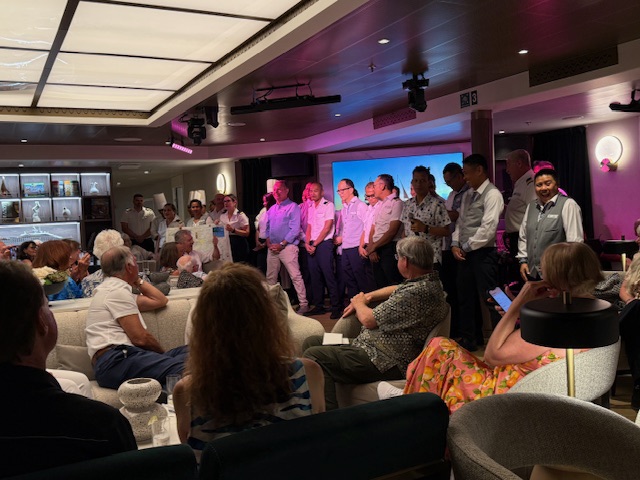
We made our way back to the ship and sadly spent some time this afternoon packing to leave the ship in Edinburgh tomorrow. There was a farewell event in the lounge for the Captain of the ship to introduce the officers and as many of the crew as could abandon their posts. They are the hardest working team, and yet they seem to have some fun along the way. Windstar does some things good, and some things great. And their onboard staff make them great.
The Farewell to the passengers from the Captain and crew of the Star Legend.
Sadly we leave the ship, but happily we have 3 nights in Edinburgh before heading home.