Uncategorized

From the cloud forest to the Amazon basin jungle

Writer’s note: It’s now May 9th and I’m back in wifi range so here is one post that I wasn’t able to send from the jungle lodge.

************************

Well, the morning started off raining and ended that way. But in between, when it counted it stopped. We spent the day in a Cloud Forest and the Amazon Basin Jungle, so really what were we expecting.

On a trip like this where you’re doing well to just see the highlights, there are many places where we would have liked to stay longer. Papallacta, and the Termas Papallacata Hot Springs, in particular, was one of those places. However, the tour must go on.

As I mentioned yesterday, our journey today went from 3300 metres to 600, so as you can imagine we spent most of the time heading down hill. The roads are not that bad, but there were a few places where recent washouts caused small landslides and in one instance the guard rail was gone and the valley was a long way down. The views were spectacular, with green hills and waterfalls all over. Yes, they get a lot of rain. The roads were really windy, and so as you can imagine we couldn’t stop to take pictures.

Our first stop of the day was at the Guango Private Reserve. Ecuador is one of the top countries in the world for the diversity of species of hummingbirds, with 50 different varieties from the size of a bumblebee to that of a pigeon and 15 of them are found at the Guango Reserve. The number of them was overwhelming and some of them were really pretty and of course different than the ones we see in Canada. But I have to say that I was somewhat disappointed in the muted colours. It might have been that it was overcast and we weren’t seeing the true colours. You can see by the picture below what’s required to get a good picture of a hummingbird: huge lenses; lighting; tripods; etc.

But one very exciting discovery was “Slo-mo” on iPhone. I took some slow motion pictures and if nothing else it will give you a sense of how many birds were flying around. We often heard the buzz of them as they went by our heads flapping their little wings at an average of 80 times per second. Something I didn’t know was that the hummingbirds go into an almost dormant state overnight called a torpor state of temporary hibernation when their heart and respiration slow right down. I figure that’s the only way they can keep up their wing flapping during the day.

After our fill of picture-taking we were off for a nature walk, and because it had been raining for a few days we were issued rubber boots for the walk. Our CEO again amazed us with her knowledge of the flora and fauna of the area. We saw a duck that is apparently one of the most prized finds on birders’ “life lists” (who knew birders had life lists!). It was called a Torrent Duck and was sitting just off shore on a rock in the torrent of the river. There were lots of species of birds including a couple of different varieties of Tanagers, and a really beautiful bird called a Blue Trojan which has a bright red belly with an iridescent green back and blue head.

There were all sorts of beautiful wild flowers, orchids and special mushroom varieties. Ecuador exports Hearts of Palm and since I normally see them coming out of a small can, I assume they were small plants, like asparagus or something. Not so. They come from medium size palm trees and the pieces are cut from the inside of the trunk of the palm. And we even managed to see the back end of a kind of rodent the size of a rabbit disappearing into the undergrowth.

After about 45 minutes we looped back and handed in our rubber boots.

On the bus once again, surprisingly, it was already time to eat again and we stopped a short distance away, to a pre-arranged set lunch at a restaurant/bar overlooking the most beautiful valley. It was a little surreal as they were playing North American county western music. Turns out the proprietor was an Ecuadorian who had lived in New Jersey for a few years and loved country music. The first course of our lunch was tomato soup, served with a side of popcorn. Yup popcorn. Marie Sol explained that instead of putting crackers or croutons in soup, they use the ubiquitous corn, this time popped, to add some interesting crunch to the soup. It was actually very good. The restaurant/bar owner had a beautiful garden in back of the restaurant and he took us on a tour before we headed off for our afternoon of adventure.

Before long at all, we came to a spot where in front of us was a bridge that obviously the bus was not going to be able to go over. It was for cars and pedestrians and we became some of the pedestrians on our way to the small town of Misahualli were we hoped to see some monkeys indigenous to Ecuador, Capuchin monkeys. We had in mind that we’d have to truck through another jungle to see them but in fact they were hanging out in trees of the main town square. The shop owners around the square have a feeding post set up and the monkeys come in from the jungle to feast then move on. There were 5 or 6 of them playing in the trees and stopping in to nibble. Our guide told us that the monkeys normally behave for the shop owners and don’t try and eat the things in their stores, but they have been known to create havoc with the tourists who come to visit.

A little while longer down the road, at a town called Tena, we came across another river, and another bridge that the bus couldn’t cross. This time instead of becoming pedestrians we climbed down stairs to the side of the river and became passengers in “motorized canoes” that would take us to our resort for the next two nights. You’ll notice I didn’t say down to the “dock”. There were some cement steps most of the way down but only mud at the bottom of the stairs. The logistics of climbing in for the first time was hilarious, but we figured it out and no one fell in or got their fingers crushed between the two boats. Score one for the tourists.

It was only a 10 – 15 minute ride in the power canoes down the Arajuno River through the mist and clouds to home for the next 2 nights, the Itamandi Lodge. We weren’t sure what to expect, but none of us expected to find such a fine establishment so remote in the Ecuadorian Amazon region. The lodge has only 23 rooms, with only our group of 16 and one other group of 16 (from Germany primarily) staying here. I’m writing this after having been here for two nights and the food has just been fantastic. Not huge portions, but really nicely seasoned, obviously fresh and interesting. The dining room is outdoors, with a high roof over because of the frequent rains, with the sound of the river to enjoy with our meals, and with a bar and swimming pool adjacent. The picture of the plugs below is a station in the dining room where we could plug in our cameras and other electronics for recharging since there weren’t plugs in the rooms.

My room is one of the furthest from the main area, and the walls facing the river are all just screens, not walls. It’s delightful to get the occasional breeze through, and it’s really quiet except for the cacophony of sound from the insects, frogs and other jungle life. My white noise is the sound of the river as it makes it way to the Napo River, and then after that to the Amazon.

The Lodge owners are very supportive of the local indigenous community, ecologically sensitive, and concerned with using sustainable technologies. The whole lodge is run on solar panels, they recycle, even though that means sending it out on the power canoes, and they even supply special biodegradable soap for our use here. One of their codes of conduct is to use canoes that are rowed, but thankfully we didn’t have to use those since the distances we covered on the river were pretty vast. (But now I’m getting ahead of myself since I’m writing this the day after.) And they hire all of their staff from the local community.

After dinner tonight the first group of 8 went on a night walk and I am with the group that goes tomorrow. Tomorrow promises to be busy and interesting. Not expecting anyone will have time to use that lovely pool.

Uncategorized

Still higher!

Tonight I’m sleeping at the highest elevation on my tour of Ecuador. And to get here, we went through a pass at over 13,120 feet (4,000 m). We travelled from near Otavalo, north east of Quito to Papallacta to the south east of Quito on our way ultimately to the Amazon Basin. Papallacta is at 10,827 feet (3300 m) above sea level and is reportedly one of the highest towns accessible by car in the world.

But let me go back to this morning. We didn’t have to leave our lovely hacienda until 12:30 pm because we couldn’t check in at the Hot Springs Lodge at Papallacta until 3:30. So we had several options for things to do this morning. Some people opted to just sleep in, and wander the property, and there was the opportunity to go horse back riding if you weren’t allergic to horses. But our CEO offered a morning of activities, and that’s what I signed up for – the FOMO Tour. That’s the Fear of Missing Out Tour.

We unfortunately had to start out at 8 am but the early morning was well worth it and we got a jump on the other tourists in the area. We started with just a short drive back through Otavalo to the Cascada de Peguche. It was overcast with a bit of a mist, but it just seemed to enhance the experience, not take away from it. An easy 20 minute walk through a eucalyptus forest had us arriving at a viewing platform at the base of the Peguche Waterfalls. Waterfalls have special significance to the indigenous peoples as they believe they bring renewal and cleansing. In the spring of each year there is a ritual bathing by the men only where they stand on the bridge you’ll see in the pictures, facing the waterfall they wash themselves in the waterfall to cleanse themselves for the coming year. We didn’t get in the waterfall.

Some of the water gets diverted for irrigation purposes.

This is a 100 year old eucalyptus tree beside the pathway on the way to the falls.

This is a pic of fellow traveller Jeff from Australia, who is hilarious despite his serious job. He is a pilot in the Outback for the Royal Flying Doctors organization.

On our way back from the falls to the parking lot we were met by travellers with one of the huge coach tour companies so we were glad that we’d been able to have our time at the waterfall with just our little group.

Although the weather wasn’t ideal for going to see the nearby crater lake, we decided to go anyway and see what we could see, and at least we’d get a great walk out of it.

This eco-reserve is called Cotacachi Cayapas and it surrounds a lake that formed in the crater of a now extinct Cotacachi Volcano. We went to a lower viewing place thinking we might see more through the clouds and mist from there. But no such luck. So off we went to a trail higher up where, although we couldn’t see the lake at all, we did have a lovely walk. It was serene, and enlightening. Our CEO Maria Sol, is an expert at botany and she must have told us the use for 30 different plants along the way. At one point someone asked what a particular flower would be good for, and Maria Sol answered that its job was just to be beautiful.

When we finished our walk we descended to the other lookout to see if the fog had lifted at all and it had a little and I was able to get this pano shot. Not really impressive in the picture but it was beautiful.

Our next activity was a stop at a local Sunday market in the town square of a nearby town. The 6 of us walked through the market, with Maria Sol explaining the various foods that we didn’t recognize. I’m sure no one noticed we weren’t from around there.

Potatoes are a staple in Ecuador, and there are over 300 species grown. This vendor had just a few varieties.

Yes, this is a whole roasted pig in the “food court” where market goers could chose from a variety of weird and wonderful looking things.

Then it was back to the hacienda to pick up the rest of our group for the long windy trip to Papallacta. We stopped for some fabulous sandwiches that Maria Sol had pre-ordered in Otavalo and ate on the way. BTW, the bread is wonderful here. I may not come home.

The views along the way were absolutely stunning, especially when the clouds parted for a bit and we were able to see more of the mountains in the distance. You could see the vegetation change as we went further and further up towards our destination.

This lodge is wonderful in every way. Our group occupied rooms which circled 3 different hot spring pools and one cold spring pool. So all we had to do was go out the door of our unit and walk into the steaming hot water. Not to worry, it wasn’t boiling water, but the air temperature was just much lower than the water temp. The rooms are incredibly well appointed with thermally heated tile floors and a dispenser for safe drinking water in every room.

I soaked and chatted with my fellow travellers for at least an hour and it was heavenly. I could barely drag my sorry butt out of the water to go and get cleaned up for dinner. Several of us didn’t join the group for dinner tonight but rather chose to stay at the hotel to just have something light. I’m finding my digestive system has slowed down to a snails pace and I’m always feeling full. Hard to believe! They say to avoid protein which for some reason is hard for the body to metabolize at altitude and to eat more carbs. So hey, pass the rolls!

Tomorrow is an action packed day as we descend from 3300 metres down to 600 metres in the Amazon Basin with lots of activities along the way.

Uncategorized

Today was mostly about shopping…. Quito to Ovatalo

My brain is almost as packed with facts learned today as all the bags I brought with me are packed with wall hangings and other artisan products.

After a great night’s sleep I was up even before my alarm to jump on the bus to head out of town today. Our destination was 1.5 hours north of Quito in the Andes to Otavalo. It is the site of the largest artisan and produce market in South America.

We drove through beautiful green rolling hills with the occasional peak of a dormant volcano thrown in. I was surprised to learn there are Acacia Trees here, like we saw in Africa only without the giraffes. OK, I stole that joke from our CEO. The highway we drove along is part of the 48,000 km Panamerican Highway and approximately 4 hours further north is the Colombia border.

As we drove along our CEO regaled us with factoids about Ecuador. Each of the provinces of Ecuador is named after either a volcano or a river and since there are 84 volcanos on the mainland, there are lots of names from which to chose. Fortunately only 9 are active. There are 4 regions and I will visit 3 of them on my trip. Quito and Otavalo are in the Highlands – the Andes. We will reach the Amazon region day after tomorrow and after the Peru portion of my trip I will return to Ecuador to visit the 3th region, Galapagos. The other region which I won’t visit is the coastal region. Not widely known for its beaches, Ecuador has some nice ones nonetheless.

One of the current political issues here is that there are a lot of Venezuelan refugees coming into all countries surrounding it and Ecuador is taking its share. Ecuador is a Democratic Republic and they elect their President every 4 years. The current President is Lenin Moreno and he leans towards the left politically.

I won’t go into too much history here, but the indigenous people were first conquered by the Incas, who were only in this region for less than 100 years before the Spaniards ran them out and took over. Ecuador gained its Independence from Spain in 1822. Simon Bolivar factors prominently in Ecuador’s history as he does in Bolivia and Venezuela.

The Otavalo Market was really something. Once again, I got so caught up in the moment that I didn’t take any pictures other than the one above of me with the lovely lady who negotiated hard with me on the purchase of a hanging. There were artisans with lots of textiles, silver, musical instruments, as well as food. A pile of chickens was sitting on one table, with chickens feet on another. And the ubiquitous corn in a million varieties, along with lots of different kinds of beans and grains. The people were keen to sell their wares, but not overly aggressive and they expected you to bargain. Now I’m the worlds worst bargainer. I just want to pay the price and be done with it, but one of my fellow travellers helped me get into the spirit of it and it ended up being fun. Maybe because the people are so warm.

It was getting to be lunch time and we were expected at a community educational centre, both for lunch and for a demonstration of some of the local culture. Jose, seen in the picture below explained all the symbols in this huge wall art to us, and I ended up buying a much small version of this in a woven wall hanging.

Corn is a hugely important part of the Indigenous people’s diet. Hmm, where have I heard that before. Almost everywhere.

Jose showed us how to use this Spanish style loom, which they use to make the most gorgeous work. Table runners, hangings, scarves, blankets, etc. Most with some alpaca in it mixed with sheep’s wool.

You can see some of the gorgeous hangings on the wall behind our group. The colours were amazing and there is such symbolism in the art. Everything seems to have a meaning.

After learning an incredible amount we moved into the dining area for an amazing lunch, which is the largest meal of the day for Ecuadorians. We started with two kinds of soup, with all sorts of things to add according to our taste; cheese, grilled corn, avocado, beans and more. Then potatoes (they grow 300 varieties of potatoes in Ecuador!) corn on the cob and the most fabulous chicken cooked in an oven that looks a little like a pizza oven. It was so tasty. Desert was this unusual fruit shown below – a tree tomato. It grows on trees much like a pear, but has pulp and seeds inside that are just like a tomato. They prepare this desert by putting the fruit in a syrup and it was an interesting texture but delicious.

Next it was off to learn about a more primitive loom, the Backstrap loom. As you can see, the fellow below has a backstrap, made from reeds in this case, but also sometimes made of leather, which holds the loom in place. This is painstaking work and the product is so refined looking.

Here he is working on a larger piece. The wooden paddles that he uses to make the pattern are not light and my back hurt just watching him.

We learned all about how the wool is cleaned, carded, spun in to skeins and died.

And here are some of the products…..oh, and I might have left some $$ behind here as well.

We managed to time it right so that we missed most of the rain this afternoon, it’s rainy season so we will expect rain every day at about 3 pm.We drove the short distance to a lovely historic hacienda where we’re staying tonight. It started as a 7000 hectare cattle range but now only 16 acres are still held by the 7th generation of the same family. The current owner’s father, who passed away just last year, was a horseman, and won many trophy’s and international jumping competitions. There are still horses on the property and we had the option of going horse back riding tomorrow. Yeah, not going to happen as horses are one of the two things to which I’m allergic.

After a bit of a rest and downloading my pics from today I wandered some of the property and the main house. It was converted into a hotel 22 years ago, but is now a little tired. But it still maintains its charm in a huge way.

After a meeting with our CEO is this beautiful bar area (sorry for the tiny pictures. Wifi issues) we were offered cinnamon tea and a welcoming shot of something. I’m not entirely sure what it was. An Andean Band entertained us with pan pipes and flutes, and their beautiful voices. It will be one of the memories I cherish about this trip. Then it was on to the dining room for some potato soup, a Ecuador specialty. It’s served with cheese and avocado. That and a bun was all that was needed as our lunch was so huge.

We’re up high and with the dampness it was cool this evening, but I came back to my room to find a hot water bottle between my sheets. Ah. Nighty night.

Uncategorized

Mitad del Mundo or Middle of the World

As I noted yesterday, while in Ecuador, one of the must do’s in my book is to take the chance to straddle the equator. So that was today’s mission.

As agreed, Hector picked me up at the hotel at 9:00 am this morning to try and take advantage of all we could in one day. We headed for Mitad del Mundo, but went slightly beyond it to stop at the now dormant volcano Pululahua GeoBotanical Reserve. Sounds like a Hawaiian adventure, doesn’t it. This volcano crater is one of two in the world that are inhabited. There are 14 families that call Pululahua home, and they farm the land at the bottom of the crater very successfully and without the use of chemicals to enhance the land because the volcanic ash provides the necessary elements for great crops. Just outside the crater is one of Ecuador’s Cloud Forests and while we were there we watched the clouds come into the crater and then back out several times teasing us.

Next it was a short distance back down the road to the Intinan Museum which is now known , using GPS technology, to be the REAL middle of the earth or equator. The monument you’ll see further down this page a bit was built between 1979 and 1982 to highlight what was then though to be the exact location of the equator and commemorate a French scientific expedition from the 1800’s. In the reading I did, some people were complaining and calling it fake news since it wasn’t the real location. However, my thoughts were, really, in the 1800’s they got the location that close!

But I digress. At the Intinan Museum, they took advantage of the draw of the real equator to educate tourists about the life of early Ecuadorians. It was a little kitschy, but got the point across.

This woman is spinning alpaca wool to be used in weaving and other artisan products.

Mom and Dad slept with the kids in one set of hammocks until the kids were 12 and then they sleep on the floor. But don’t feel bad, they were married off at the age of 14 or 15 and then they got their own set of hammocks.

This is a gravesite, I think he called a “sink”. The Ecuadorians believe in the afterlife so all of their possessions that they would need there were buried with them. In the higher ranking families, it is assumed the wife would not want to leave her husband and so she was buried alive with him.

Like in many other countries, these cute little guinea pigs that we have as pets regularly appear on Ecuadorian menus.

They also demonstrated the process of making chocolate from cacao fruit. Ecuador has won many awards for its chocolate and in fact one year in an international competition took all three awards, Gold, Silver and Bronze. We were told that while Toblerone is made in Switzerland, the cocoa to make it comes from Ecuador. We were able to taste the product all the way along through the process and I know I’ll be picking some up at the airport on the way home.

They of course had a few demonstrations about how things are special at the equator, such as being able to balance an egg on the head of a nail, how the water in the same vessel drains clock wise on the south side of the line and counter-clockwise on the north side. (I’m not convince about that one yet but can’t for the life of me figure out how they did it).

This picture is of my guide Hector (to the right) successfully balancing the egg.

And of course there were the compulsory photo opportunities.

Next it was down the road to the Monument at the site originally thought to be the equator. Again the required photo ops. Why do some people think that at the most visited tourist site in Ecuador that they’re going to be able to get a picture of themselves in front of the moment with no one else in it?

The boulevard leading up to the monument lined with busts of previous Presidents.

And these hummingbirds which also line the boulevard were all painted in different colours. I’m told there are 50 varieties of hummingbirds in Ecuador!

And we were able to climb to the top of the monument to look at the imaginary line of the equator and the surrounding countryside from the top. On each landing of the stairs to the top they had a display about one of the 38 different traditional groups in Ecuador, their costumes, tools, instruments, etc. I’m convince it was just done as an excuse to allow us to rest at each landing before proceeding to the next stair case but I was more than OK with that. Sorry Nanci, I didn’t count the stairs.

There were museums and little shops selling all sorts of artisan products, but given that I’m at the beginning of the trip I decided I best not stop at any of them yet.

Then it was back to the city, and to Old Town where we managed to squeak a half hour walk in just to give me an orientation for the next time I stop in Quito (I’m here 3 more times on my way to and fro) when I will have a chance to explore more. Going back to where Hector parked his Jeep I almost died. It was very steep up hill, we’d been on the go all day and with the altitude and my general lack of breathing capacity, I had to stop often on the way. Hector was very gracious and found fun things to tell me about the city along the way. None of which I can now remember unfortunately.

Just a taste of what’s to come when I do get back to Old Town. This is one of 7 churches on one street. This is the Basilica, with it’s Galapagos native iguanas as gargoyles.

We got back to the hotel, just in time for me to attend the meeting of the tour group with our CEO (guide). Only 11 of the 16 people were there but that will make it easier to try and remember names. Some of the group will return home or head to the Galagos after our 7 days in Ecuador, others will carry on to Peru with me. The CEO, Maria Sol (both are given names that she goes by because there are so many Maria’s in this predominantly Catholic country). I know so far that there are 5 Canadians, 5 Americans, and one Aussie.

Although Maria Sol had a plethora of recommendations for us to check out for dinner tonight, Deborah (from Whitby who I met at breakfast yesterday) and I opted for a quick dinner in the hotel dining room. Her room mate from Courtenay, BC arrived and joined us for a drink.

The first day of our great adventure starts tomorrow with only a 1.5 hour bus ride to Otavalo which hosts the largest outdoor artisan and food market in all of South America. I might be dropping some cash tomorrow, storage space be damned.

Uncategorized

If you don’t like the weather wait 30 minutes

After arriving in Quito to fog and cool temps at 2:30 am this morning, I woke up at about 7:30 am because of the bright sunshine sneaking in around the edges of the curtains in my room which faces east. I was thrilled when I opened the drapes to see the most gorgeous views that I hadn’t been able to detect last night.

The above picture shows the profile of the Andes all around Quito with a layer of fog in the valley to the east. I’ll post below a series of pics taken from pretty much the same location throughout the day at about 10, noon and 3 pm.

It started out quite warm as early as 10 am this morning when the fog had rolled out and the sun was out in full. And it’s not that cold this evening, about 12 degrees, but feels much cooler because of the fog that is now all encompassing as it was when I arrived last night.

Breakfast this morning was buffet at the restaurant on the 7th (top) floor of the hotel, which turns out to be one of the best known hotels and iconic restaurants. I can vouch for the fact that the view is certainly spectacular. The two pics below were taken from my table at breakfast but as usual they don’t do the actual view justice. You can check it out at the following website.

En.hotelquito.com

After a lovely breakfast, I wandered around the property and spent some time sitting in the shade by the pool. I was afraid to go swimming because apparently the best way to get over the first couple of days of altitude sickness or avoid it all together is to take it easy and not exert yourself too much. So far I’ve experience no headaches, but I do feel out of sorts, and after walking up one set of stairs I feel like I might have done the Grouse Grind (no of course I’ve never done the Grouse Grind, but you get my point). And a little light headed. It’s been a tough day because my brain is saying get out there and explore and my body is saying, oh no you don’t.

Below are some pics of the hotel and environs. Haha, when I arrived last night I had no idea it was painted to match my toes!

I spent some time this afternoon in the 7th floor bar, drinking only water I hasten to add, and reading and thought to myself, oh.my.goodness, I’m sitting here in Quito, Ecuador.

I have organized a private tour guide for tomorrow to take me on a city tour and out to Mitad del Mundo (middle of the world). I figured visiting a monument on the equator would best be done in the country named after it!

Then tomorrow evening I will meet up with my Tour group and our CEO (Chief Experience Officer) will give us the important details of the next 15 days. Can’t wait!

Uncategorized

From one capital to another

I will apologize in advance for the length of this blog post, but you gotta understand I’ve been on 9 hours of flights and 4 hours of layovers today.

Today I begin my first real South American adventure and as you can see I have sported purple for this particular trip. These toes likely won’t see daylight again until the last part of my trip but one always needs to be prepared.

I did stop briefly years ago in Caracas, Venezuela, when the cruise lines were still stopping there. It was a much less volatile time, but even then we boarded the tour bus in a compound surrounded by barbed wire, had a police escort, entered a hotel through a secure loading dock for our luncheon, and the tourist areas we visited were blocked off to locals. We visited a Murano Glass factory out in the countryside that was amazing.

On this trip I will visit only two countries, Ecuador and Peru, over the next 28 days on small group tours with my favourite tour company, G Adventures. I have previously travelled with them to Costa Rica, Turkey, and The Balkans and I already have a trip booked with them for next year to Israel and Jordan.

The past few weeks have just flown by and I can hardly believe that this trip is here. I’m embarrassed to admit that aside from the detailed itinerary provided by G Adventures I hadn’t read anything about the places I’m going but I have downloaded a couple of guide books and got a start reading them on the flights today. Looks like I’m in for some unique experiences. And on a day when we sadly learn of the sudden death of Gord Brown, MP, at a too young age of 57, life is all about experiences and carpe diem.

Living at Lansdowne in Ottawa has been a delight, but sometimes it creates some interesting challenges. Most of you will know that the Red Blacks CFL team (and league champions year before last) plays at the TD Place Stadium here. When there is a home game the area is full of fun and chaos. Unless you’re trying to get in or out of the parking garage and then it is just chaos. However, there is also a soccer team, the Ottawa Fury FC of the United Soccer League who are at the beginning of their season. It never occurred to me to check the schedule mid-week, mid-day, but alas, today was a specially scheduled game to allow 10,000 students from across the area to arrive, you got it, just as I was about to grab an Uber. Fortunately, in my normal Mrs Fines mode (for those of you who don’t know, my Mom, Mrs Fines, was always copiously early for everything) I was early. So I walked south on Bank Street to grab an Uber on the other side of the canal. Fortunately that was the only hiccup with getting out of town.

The first of 3 flights, this one to Toronto, was on time, with just a little bit of turbulence to assist in my nap. Once in Toronto, I had to change from D gates to E gates, for my next flight to Bogotá, Colombia. My goodness, the hallways went on and on. I had no trouble getting my steps in today, even with the aid of moving walkways.

My first Air Canada Rouge flight from Toronto to Bogotá, Colombia was next and this 6ish hour flight actually ran a bit early. I didn’t notice that the seats were very much closer together on this down-scale version of Air Canada’s offering but when you’re only 5’3” that’s not all that critical. A rare benefit to being short. There was a complimentary meal service that was relatively tasty, although as you can see from the pic, it was the teeniest meal I think I’ve ever seen. Alcohol is available but you have to pay for it. A hint if you’re flying Rouge for the first time, there is no on-board entertainment so download their App before flying to use your tablet or phone to show movies enroute.
My final flight was on Air Canada Partner Avianca From Bogotá to Quito. It was less than 2 hours, but this late into the day seemed to take forever. It’s a really nice airline though, and the flight attendants (all female) wore striking red capes and hats as they traveled through the airport. They fed us a snack that appeared to be a cheese wrap. And I’ve already made an amazing discovery, parsnip chips taste just like potato chips.

This flight was a little late getting in, but the special service I got going through customs made up for it. Must be the blue eyes or maybe the confused look, but I was directed to a kiosk with no line up and after a very simple and friendly interview by the customs agent I was on my way.

The capital city of Ecuador, Quito, is at 9350 feet above sea level which makes it the second highest national capital in the world, second only to La Paz, Bolivia. This of course means that altitude sickness is a real possibility with its symptoms of head ache, difficulty sleeping, feeling like you can’t catch your breath, vomiting, dizziness, etc. Sounds like a pharmaceutical ad, doesn’t it?

I have to admit that I’ve fretted a little about this, OK a lot, but I have taken some precautions to mitigate the effects of going from just 300 feet above sea level to 9350 feet in one day. I’ve come 2 full days ahead of the start of my tour to give myself a chance to acclimate to the altitude before starting out. I’m going to try and stay hydrated, avoid alcohol, and I’ve started taking medication that is supposed to help. So far, I’m feeling a little light headed and I take an involuntary deep breath every once in a while, but no issue with walking up stairs or briskly with the porter. We’ll see how tonight goes as the effects don’t really hit for 24 hours or so.

I was picked up outside of the baggage area by a delightful young man named Hector. (arranged by G Adventures, I didn’t just go with the first good looking guy that came along). He is very knowledgable about languages and we had an interesting discussion in the 45 minutes from the airport. He studied journalism in University and has a plethora of jobs.

So I’m stowed at the hotel for the night and I likely won’t do anything terribly adventurous tomorrow. Thanks for coming along on another adventure.

Uncategorized

Where next you ask?

IMG_1590

When last we talked I had just finished a fantastic tour of southern Africa – South Africa, Namibia, Botswana, Zimbabwe and (accidentally) Zambia. It was the tour of a lifetime.  But did you really think I’d be content to stop there? Ha!

After putting a toe in the water of the African continent, I decided it was time that I hit another continent so this time I’ve chosen South America. I’ve stopped briefly in Venezuela on a cruise, and visited Costa Rica and Belize in Central America but this time I’m headed for Ecuador and Peru!

Screen Shot 2018-03-09 at 1.46.52 PMScreen Shot 2018-03-09 at 1.55.03 PM

I’m doing back to back tours with my favourite small group adventures group, G Adventures. I’ve previously travelled with them to Costa Rica, Turkey and the Balkans.

https://www.gadventures.com

The first tour is 19 days on a “Journeys” Tour which are tours G Adventures has developed in conjunction with National Geographic and which includes some pretty special activities. Here is the description from G which says it much better than I could.

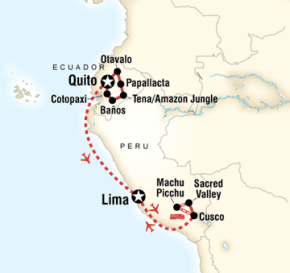
“Experience some of South America’s incredible sites on a 16-day adventure that brings together the awe-inspiring landscapes of Ecuador and the vivid cultures of Peru. Explore the Amazon rainforest and sleep under its living, orchestral canopy during two days at our jungle lodge; follow in the footsteps of the Incas at iconic Machu Picchu; and feel at home among the people of the Sacred Valley. From the cacophony of the Amazon to the silent beauty of the Andes, echoes of this experience will resound long after the trip is over.”

The tour starts in Quito, Ecuador and I’ll spend 3 nights there, acclimating to the elevation before the tour starts. It’s at near 10,000 feet above sea level. Then we take off and tour some really interesting looking spots in Ecuador, including a couple of nights at a lodge in the Amazon jungle. Then we fly to Lima, Peru and on to the Sacred Valley for some interesting experiences before heading by train to Machu Picchu. No, I’m not doing the hike.

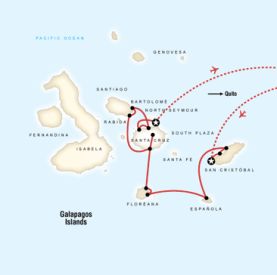
Then it’s back to Lima for my flight back to Quito to join up with the second tour in the Galapagos. For 9 nights, home will be the 20 passenger Montserrat, although we’ll only have 13 passengers on board.  During that time we’ll visit the Central, South and East Islands of this amazing part of the world.

Screen Shot 2018-03-09 at 2.47.27 PM

Again, in G Adventures words:

“There’s simply no better place to appreciate the magic of this precious little blue planet of ours than the Galápagos Islands. Join us aboard the roomy Monserrat for a mind-expanding cruising adventure through the archipelago’s central, southern and eastern islands. Hike the dramatic black lava flows of volcanic Bartolomé Island, snorkel with sea lions and other aquatic beasts, go for a hike on Española or opt to laze about on her white-sand beaches instead. With a pair of naturalist guides on hand to answer your questions, you’ll come home with a perspective you simply can’t put a price tag on.”

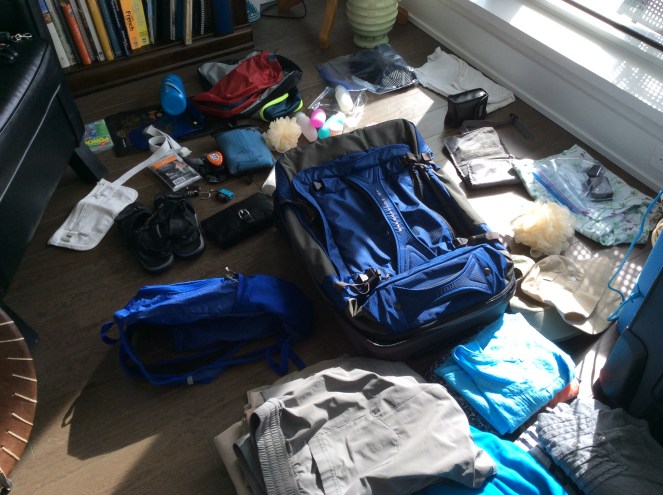
This adventure is not without its challenges. I’ve already mentioned the altitude. For much of the 19 days we’ll be at high altitude so I’ve got pills that may help to mitigate the undesirable effects and I have booked 2 extra nights in Quito before my tour starts to help adjust before doing anything strenuous. In addition, I’ll also have to deal with potential seasickness. I am a good sailor and I’ve picked a time that is supposed to be more calm than some, so I hope I make out OK. And the third is the usual one, packing for all sorts of different climates. I’ll be going from the cool highlands of Ecuador and Peru to the hot and damp jungle and the warm marine weather of the Galapagos where I expect to spend most of my time in the water. I’ve bought a new suitcase that is soft sided carry-on size and hope to take only it and a backpack on this trip. No more 50 pound bags for me.

But of course, part of the adventure and fun of travel is overcoming the challenges and having those stories to tell. With only 55 days before my adventure the anticipation is building and that’s helping me get through days like today………..

IMG_1591


Uncategorized

Johannesburg, South Africa (Wed, Sep 13)

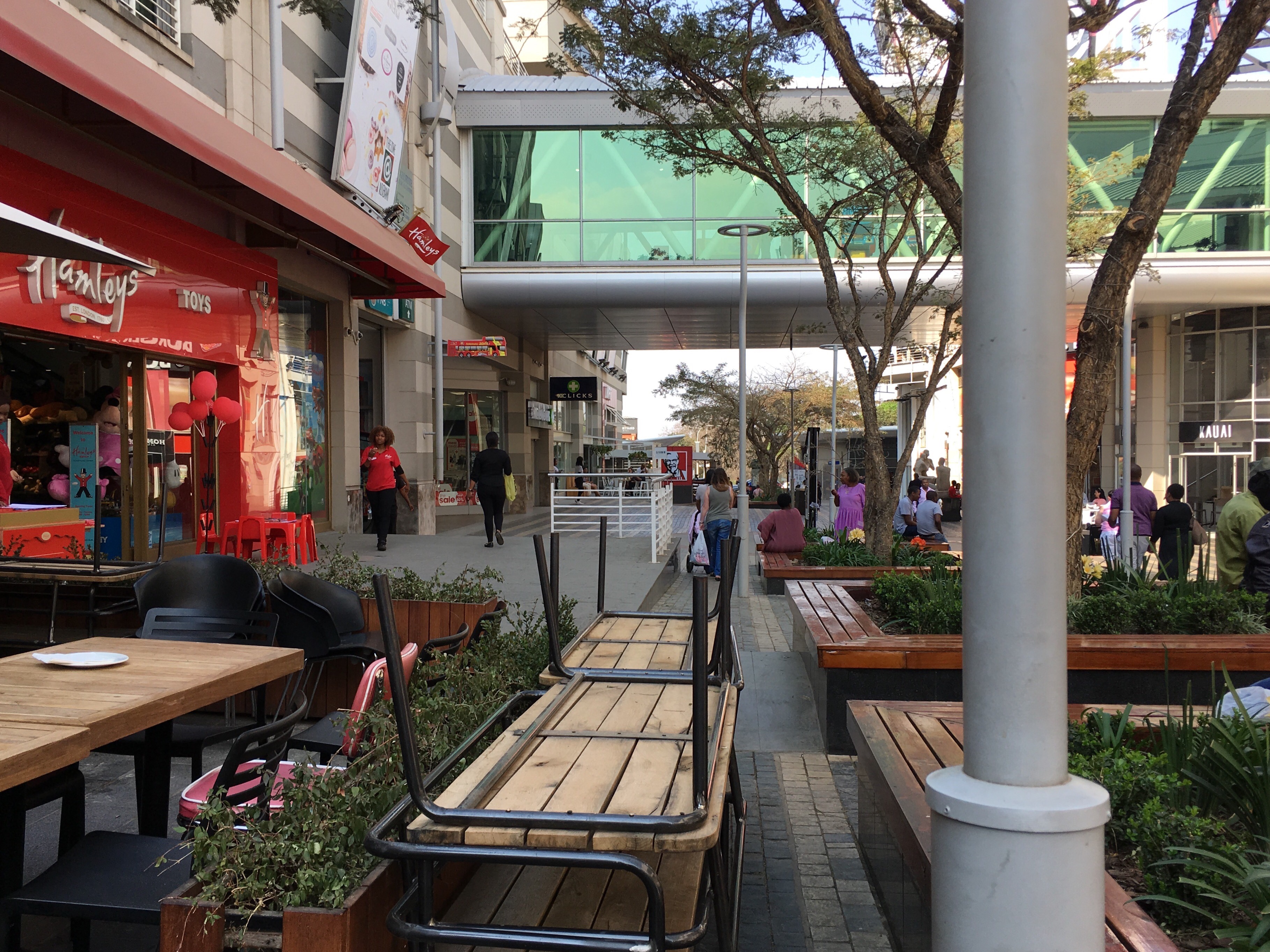
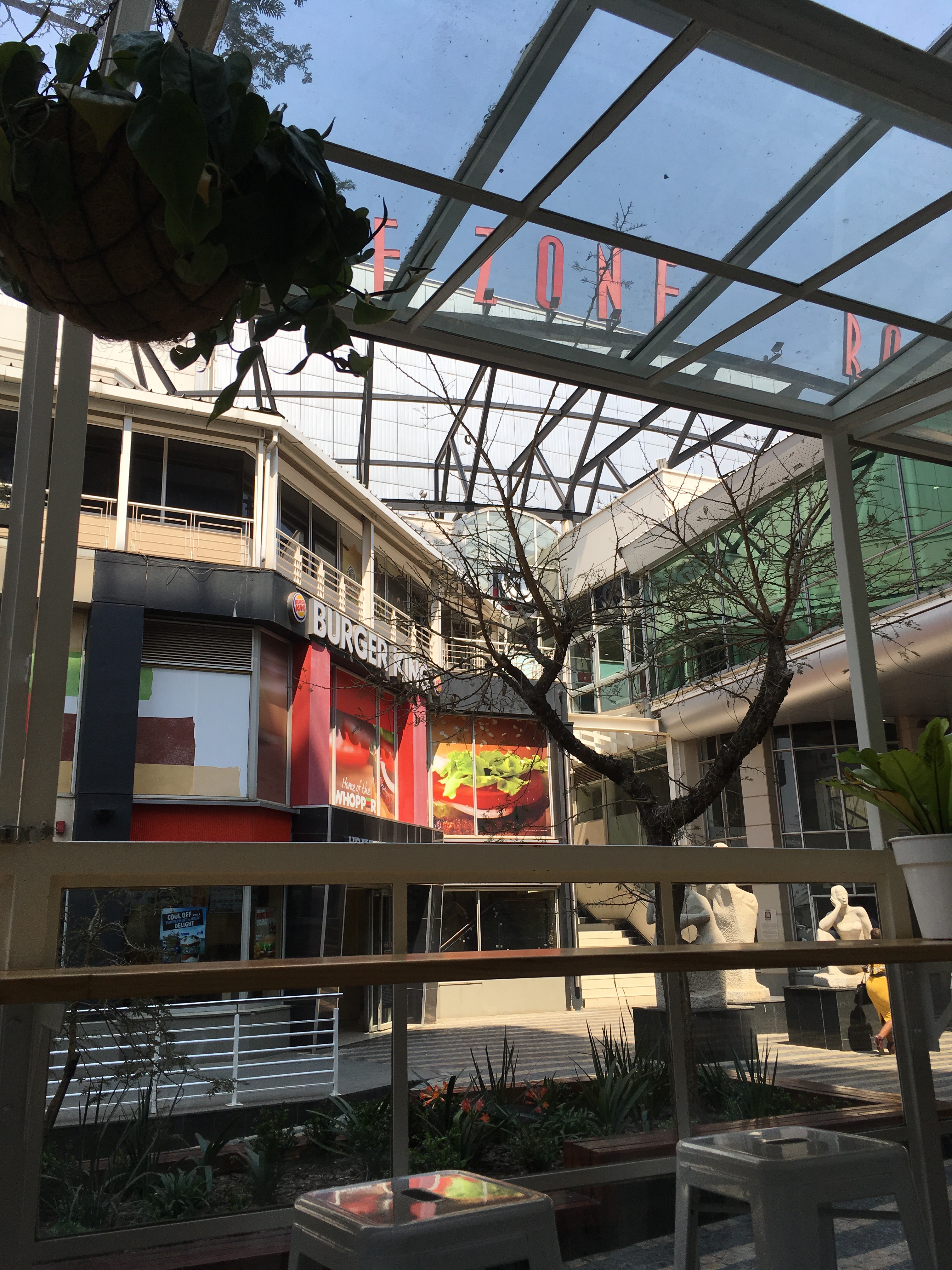
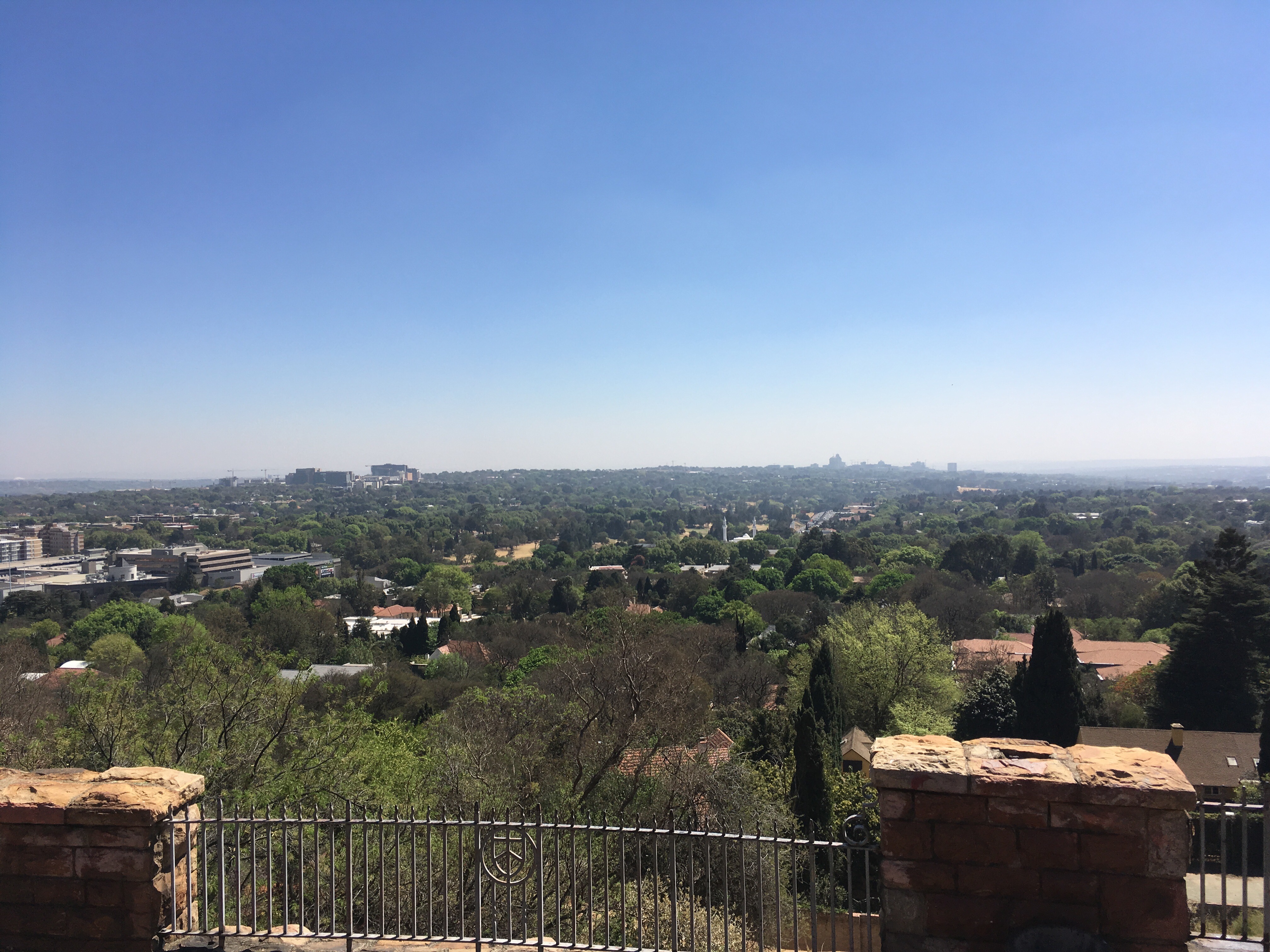
I have been chilling out at the Holiday Inn Rosebank this week, preparing for my trip home (sadly, instead of my 5 day tour to Kruger National Park). Rosebank is in the lovely green suburbs north of downtown Johannesburg. It’s quite the head fake after travelling through rural Africa and game parks to suddenly arrive at a modern hotel which could be anywhere in North America. Even more bizarre is that it’s attached to an ultra-modern complex of shops, restaurants and entertainment. I have to say I’ve rarely been more pleased to find a Starbucks.

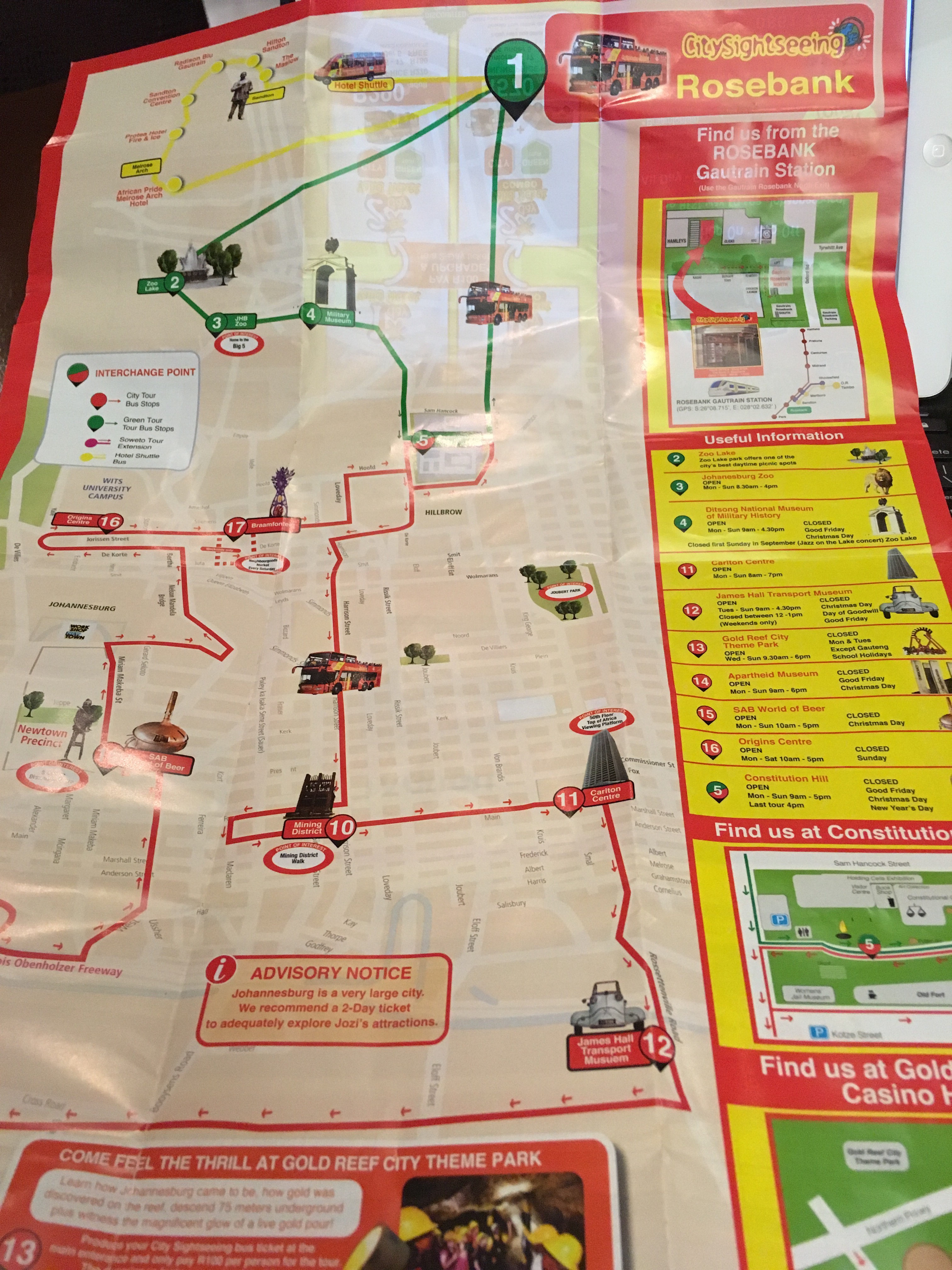
I’ve been laying low and gradually building back up my food intake and I was feeling sufficiently renewed this morning to spend a day exploring Johannesburg on the Hop On, Hop Off Bus with an extension into Soweto. I made a point to not tire myself out by doing anything challenging and stayed on the bus, listening to the audio, other than transferring HOHO buses.

The HOHO Bus system here is really easy to use and part of the international group. The Green Line Bus started out touring the green spaces here in the north end of the city, such as Zoo Lake and the Zoo. Seems almost like cheating when all you have to do is drive out of town a bit to go get such exotic specimens! Next we headed south, up the hill towards downtown, through neighbourhoods of beautifully landscaped and huge mansions of the early and more recent wealthy inhabitants of the city.

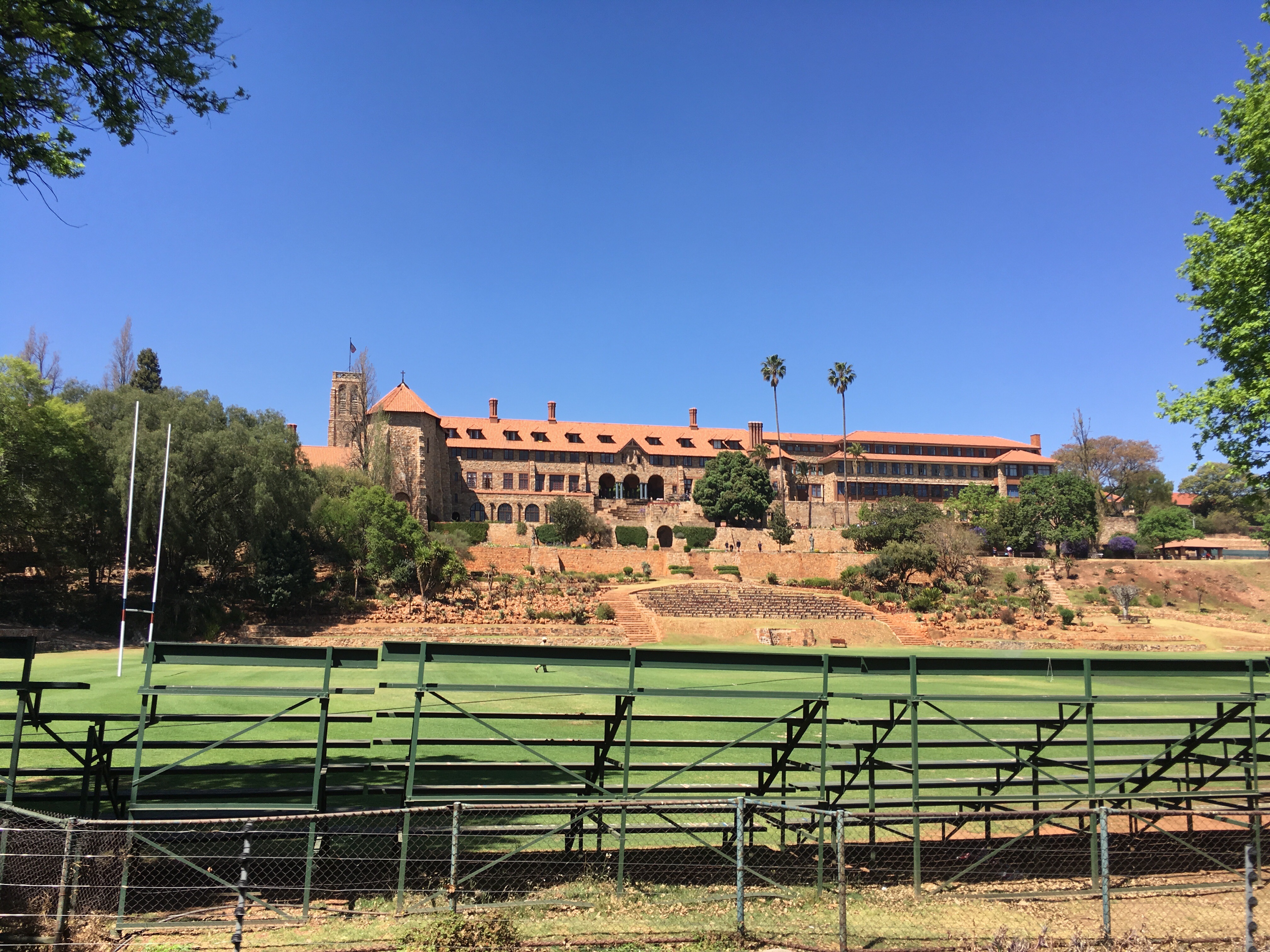
Below is the very posh St. John’s private school where many of the next leaders of South Africa are being educated located in the northern suburbs.

Before heading towards the Central Business District (CBD) the bus stopped at the spot for us to change buses to the CBD HOHO Red Line at Constitution Hill.

Maybe I need to fill in a little history here – and believe me it’s a little, because I have to admit to not fully paying attention today. I intentionally left my camera behind and decided just to take it easy.

It’s very unusual for major cities to be located so far from access to an ocean port for ease of incoming and outgoing trade, but Johannesburg is one such city. It’s also at an unusually high altitude for a large city, sitting at about 6000 feet. It’s also a relatively young city, being founded in 1886 as a result of the discovery of gold in the area and resulting gold rush. The city planners of the day expected the town to peak and then die as most gold rush cities have, and so they set up a relatively small grid of streets for the downtown core. Oops. There are now upward of 4.4 million living in the city, with approx 8 million in the metropolitan area.

In the early days a fort was built at the top of Constitution Hill and it eventually became a collection of prisons. Under Apartheid, the prisons became swollen with political prisoners, especially during the anti-pass campaigns in the 1960s and the Soweto student uprisings of 1976. Nelson Mandela and Oliver Tambo were both incarcerated here during their treason trials in 1956.

By 1983 the prisoners had all be transferred and the prisons had all been abandoned until 1990 when discussions began on what to do to revitalize the whole area. After much discussion and public consultation, the new democratic South African Constitutional Court opened on Human Rights Day, March 21, 2004 and the rest of the site including museums, tourist attractions and public facilities opened to the public.

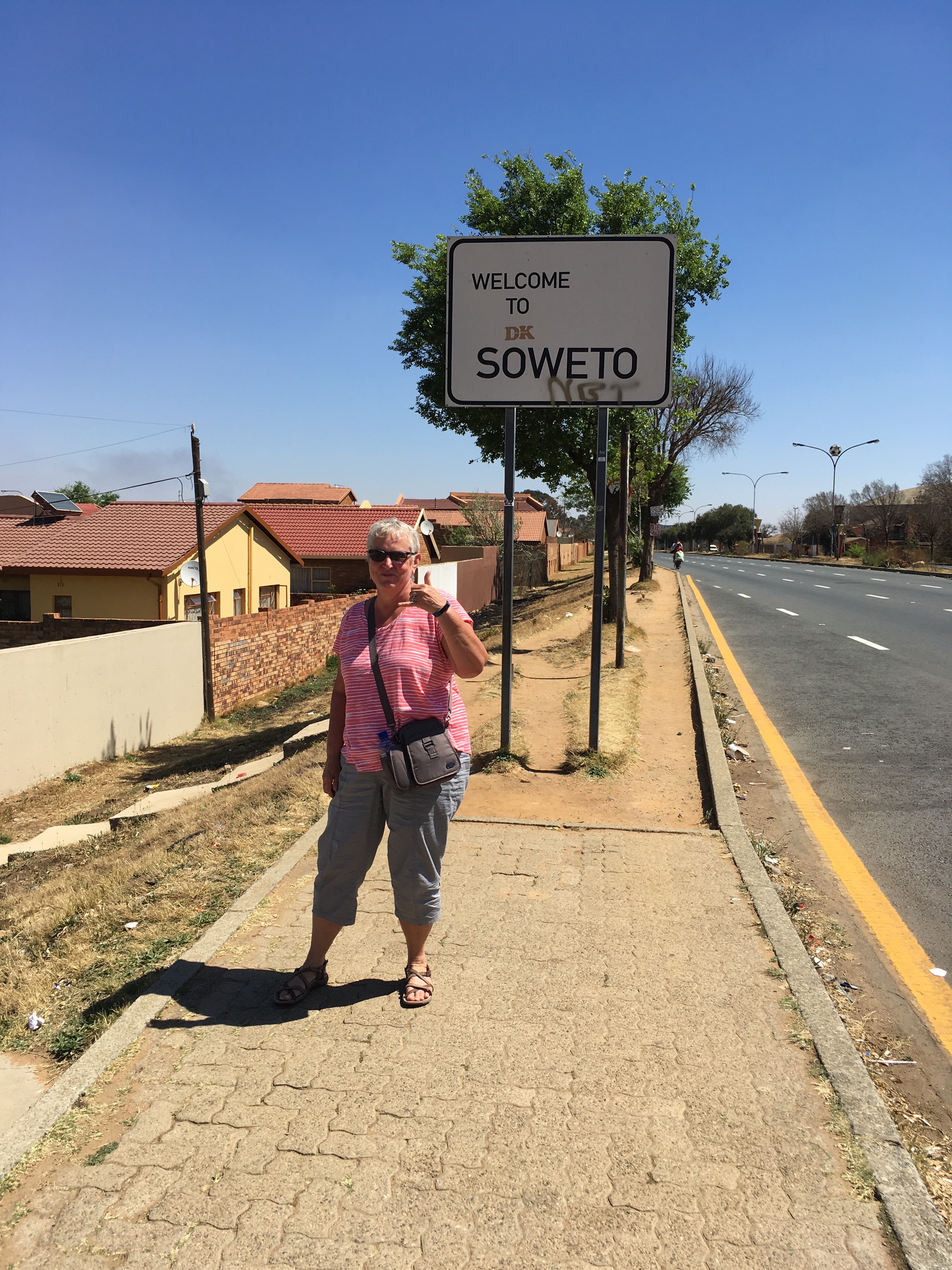
After changing to the Red Line, the route took us through downtown to see landmark buildings including Carlton Centre, with it’s 50 story viewing platform, and the mining district, obviously an important part of the city’s growth. Not far from the core, the bus turned into the parking lot of a huge casino near a mining theme park complete with Ferris wheel, and other rides where I transferred to a small van for the tour of Soweto. The young man who was our guide, gave me my African name, of “Palessa”, probably spelled wrong, meaning flower. Turned out to only be 2 of us, Tom from San Diego, here for a family wedding, and myself. So off we went.

Where do we get our preconceived notions of places and things we know nothing about? Well, I’m embarrassed to say that I was so totally wrong about Soweto. First of all I knew that both Nelson Mandela and Desmond Tutu had both lived in Soweto. But I was expecting a smallish Township, and a quick in and out tour. Two hours later I am much better educated but still have many questions.

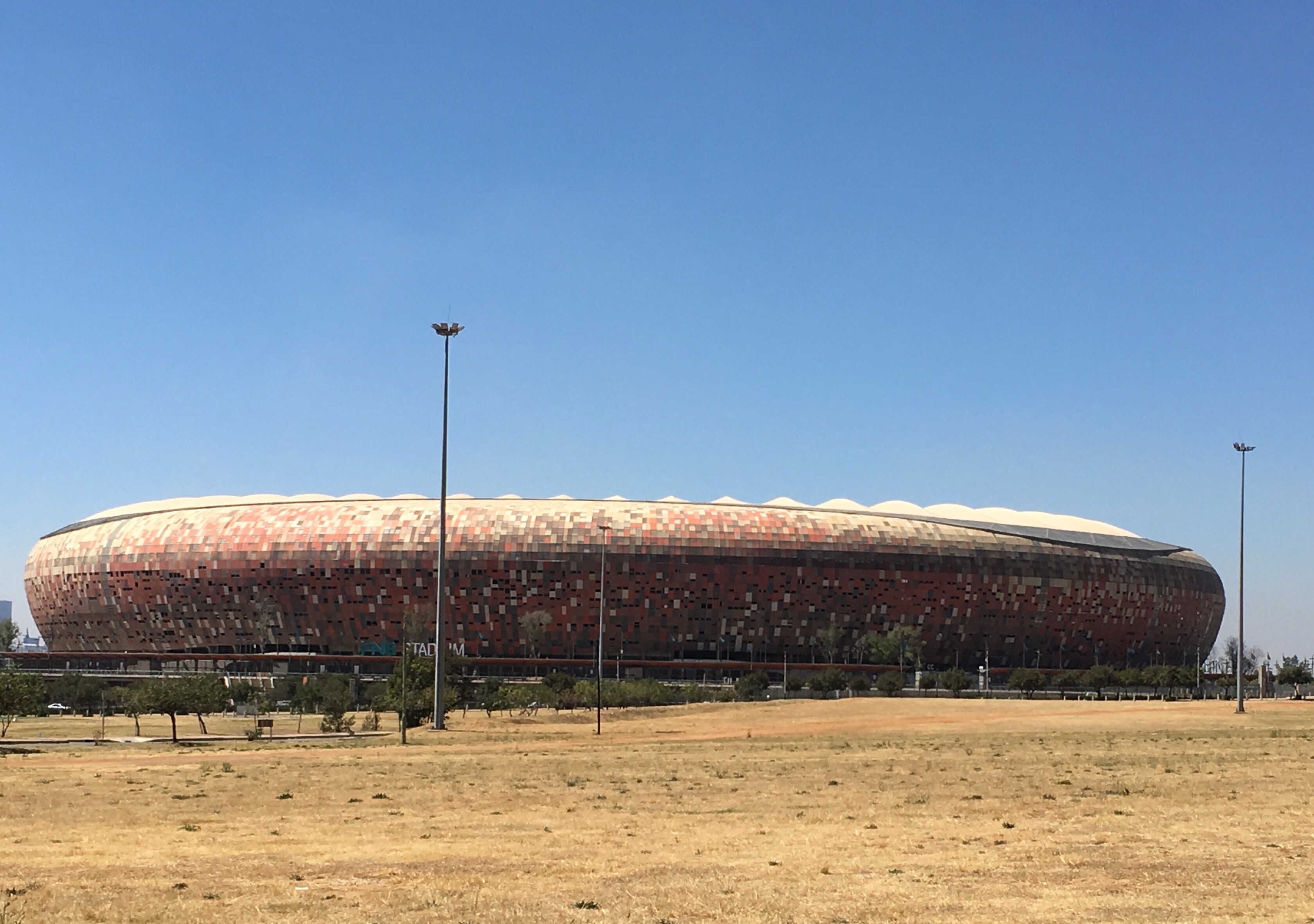
Our first quick drive by, was the now iconic stadium, officially known as FNB Stadium (FNB is a major SA Bank), but also referred to as the Calabash or Soccer City. If you know what a calabash is you’ll immediately see what it’s called that – a gourd or ceramic pot made for making/serving beer. See the suds on top? And some of you will recognize it as the venue that was used for the opening/closing ceremonies for the 2010 FIFA World Cup and the first and last games when it was known as Soccer City. But I remember it as the venue for the very emotional 2013 memorial for Nelson Mandela. It’s also hosted such super-stars as Madonna, and sigh, yes Justin Bieber. At least our guide admitted to liking Drake more.

Then it was on to Soweto. So first of all, Soweto is not the name of a single township but rather stands for South West Townships, and it’s made up of several different townships – 29 to be precise. (Don’t l look like a total geek?)

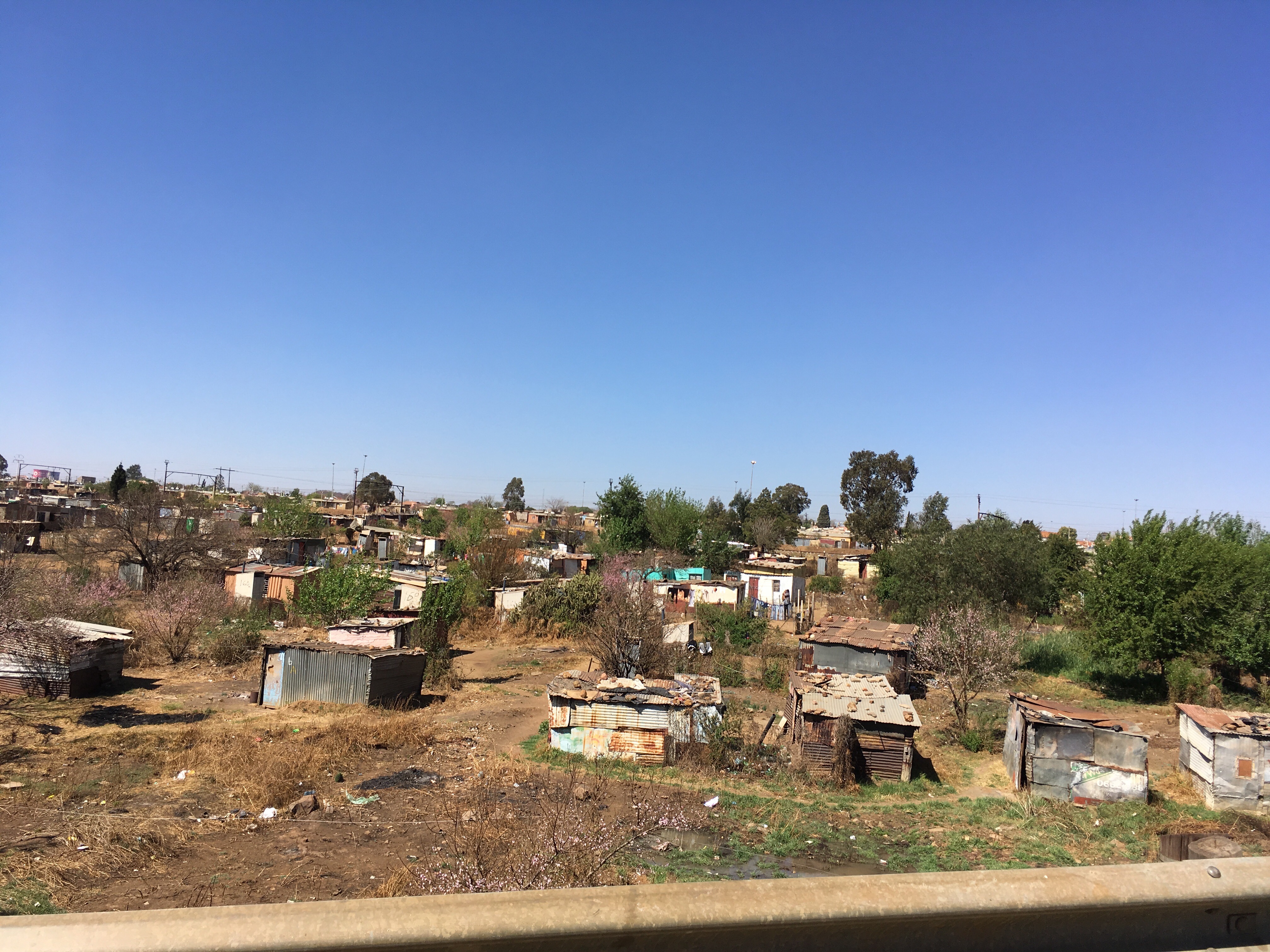
And the townships are not all monolithic. Yes, there are the tin-shed kind of areas like we saw in Capetown, but see the houses to my left in the picture above? They are in the townships as well. There is infrastructure like power and water and gas stations and Pick and Pays. And there are close to 2 million people and the largest hospital in Africa with more than 3000 beds.

As some of South Africa’s black population becomes more affluent, many are moving into the traditionally white neighbourhoods, but many are staying in the townships because they don’t want to leave the sense of community that exists there. However, there are now BMWs parked outside some of the homes, and a second story has been added.

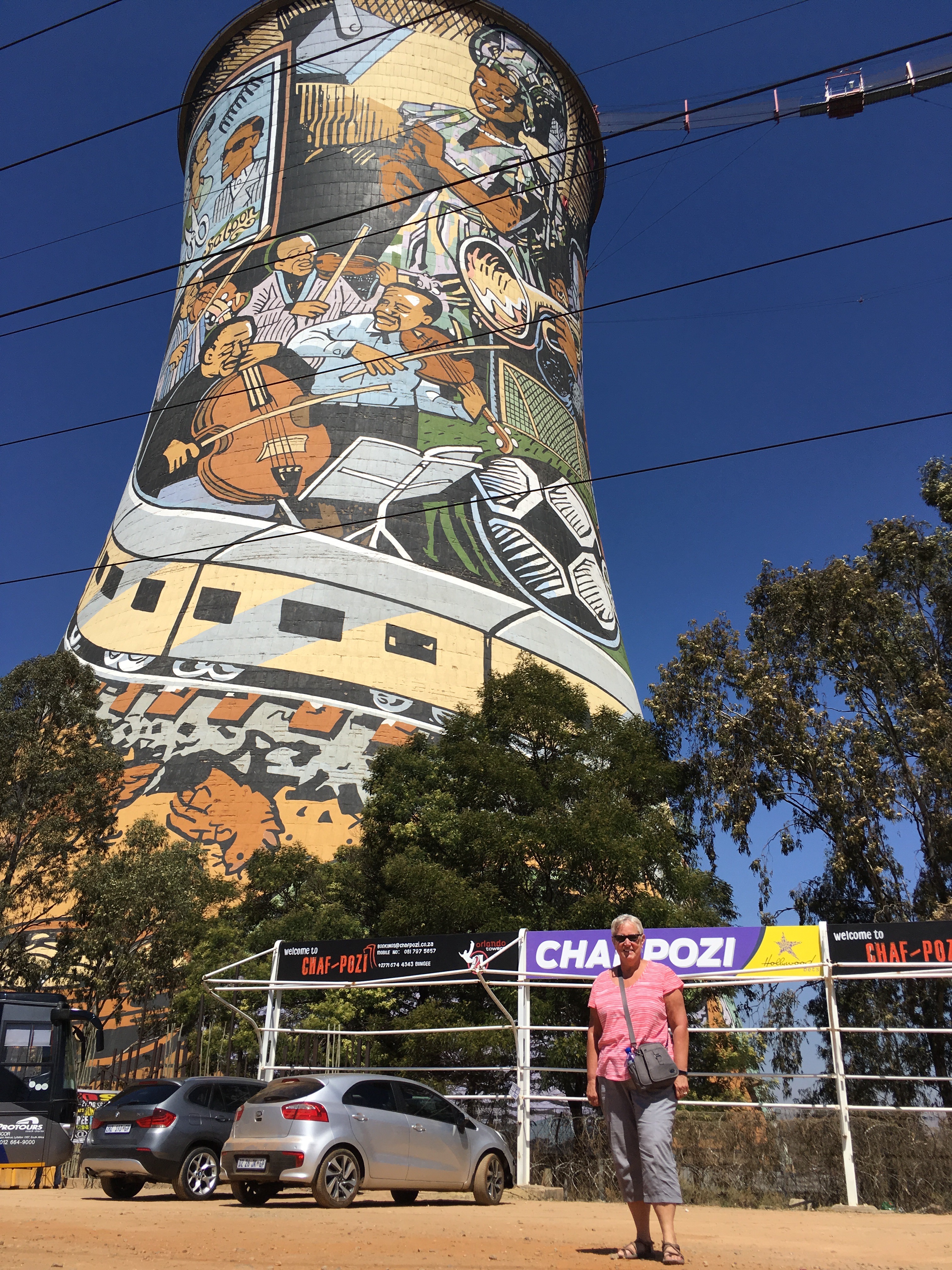
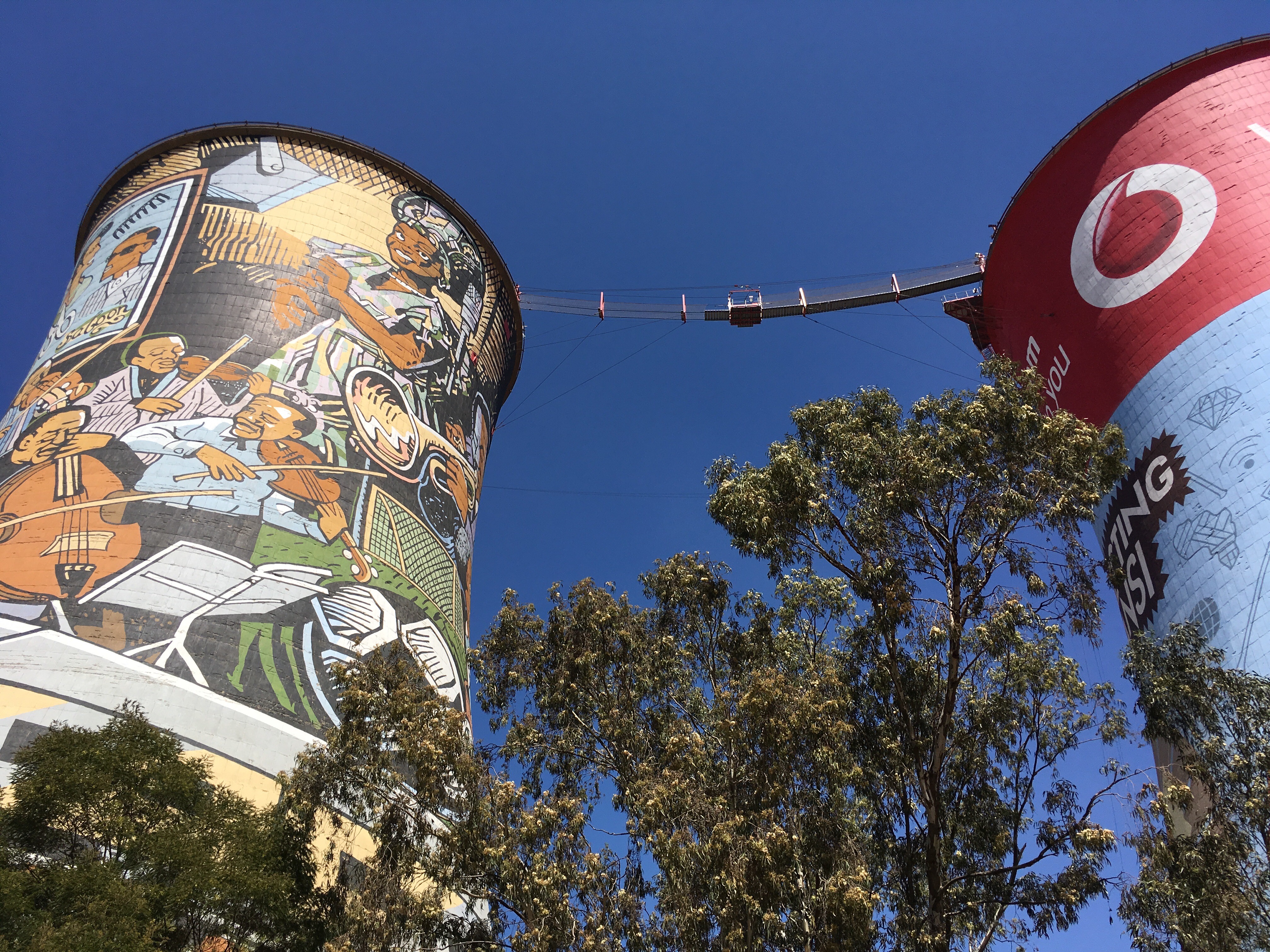
We stopped briefly at another iconic site in Soweto, to get a quick pic. These towers used to be coal generated power plants, and when they were decommissioned, they decided to turn them into a symbol of the community and use them to display images of life in the ‘hood. They now house a bungee jumping venue (outside) and free fall flying (inside) which so sadly was closed today, NOT.

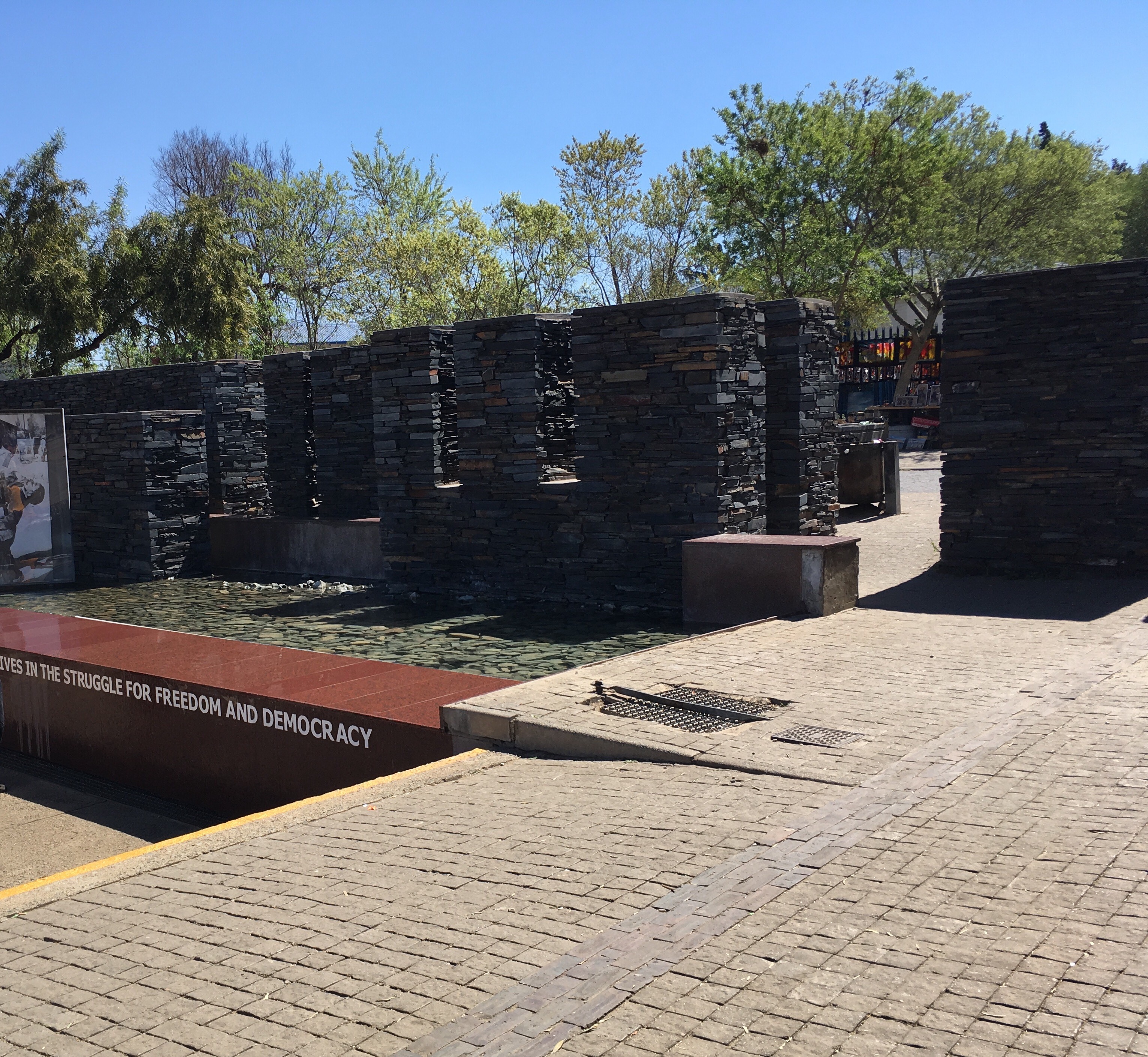
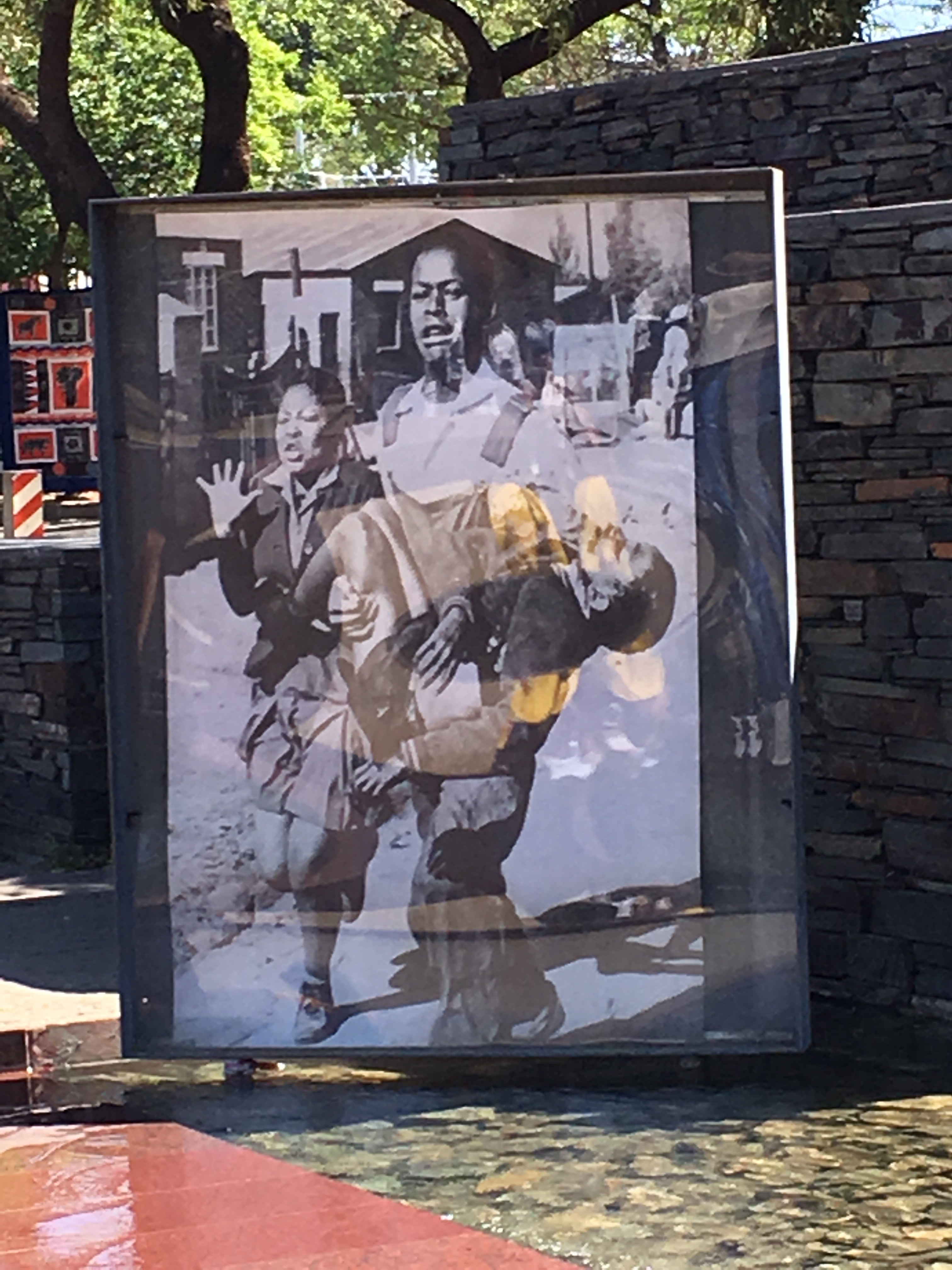
On a more serious note, we then headed to the Hector Pieterson Memorial. Hector was 12 when he was shot during student protests against the use of Afrikaans in the schools just 400m from this spot June 16, 1976. 20,000 students participated in the protest and although official count of deaths that day was 176, other counts have been quoted as high as 700. June 16th each year is a public holiday named Youth Day. Sorry, there were multiple groups of school kids visiting the memorial so it made it difficult to get good pics.

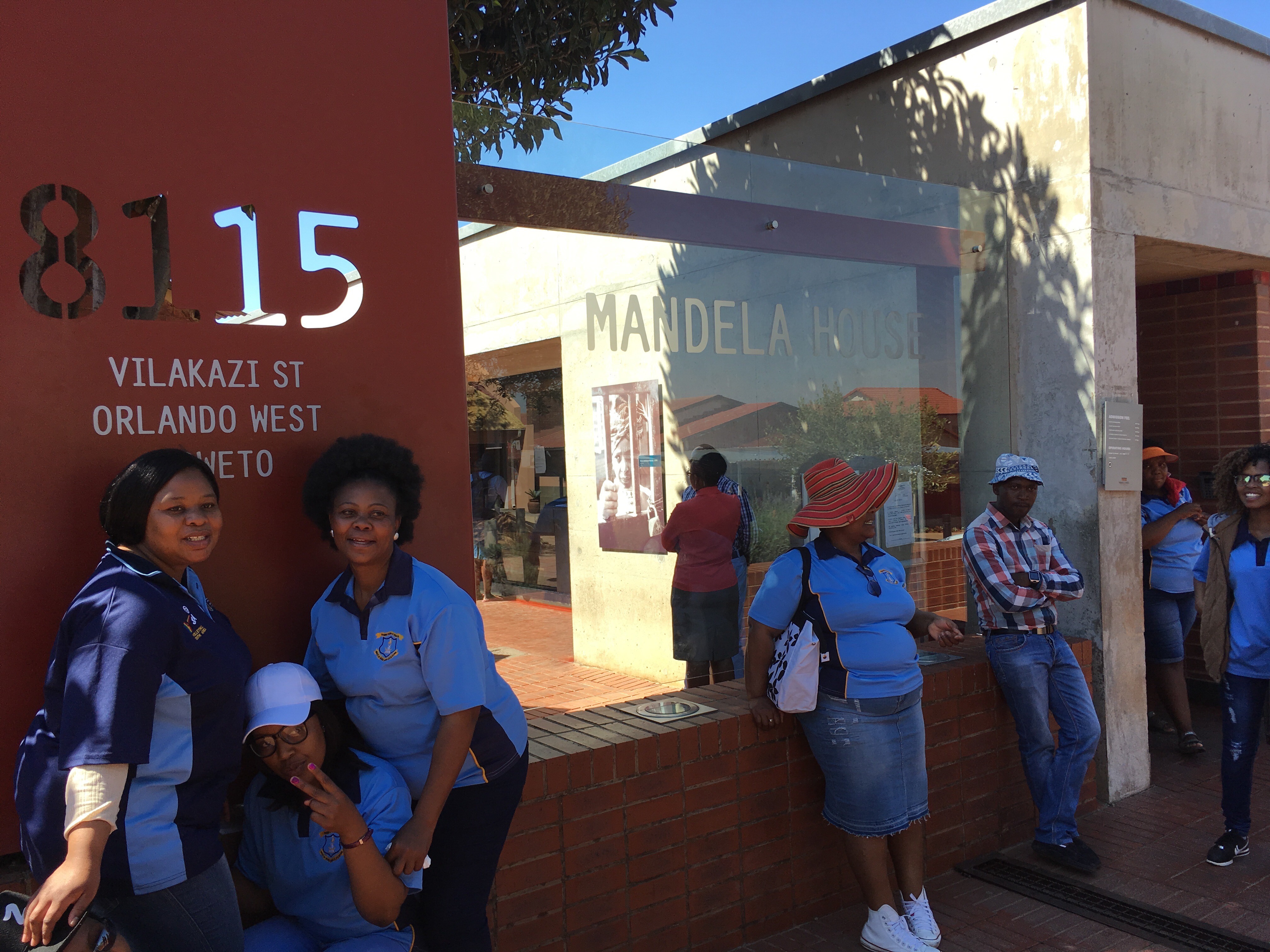
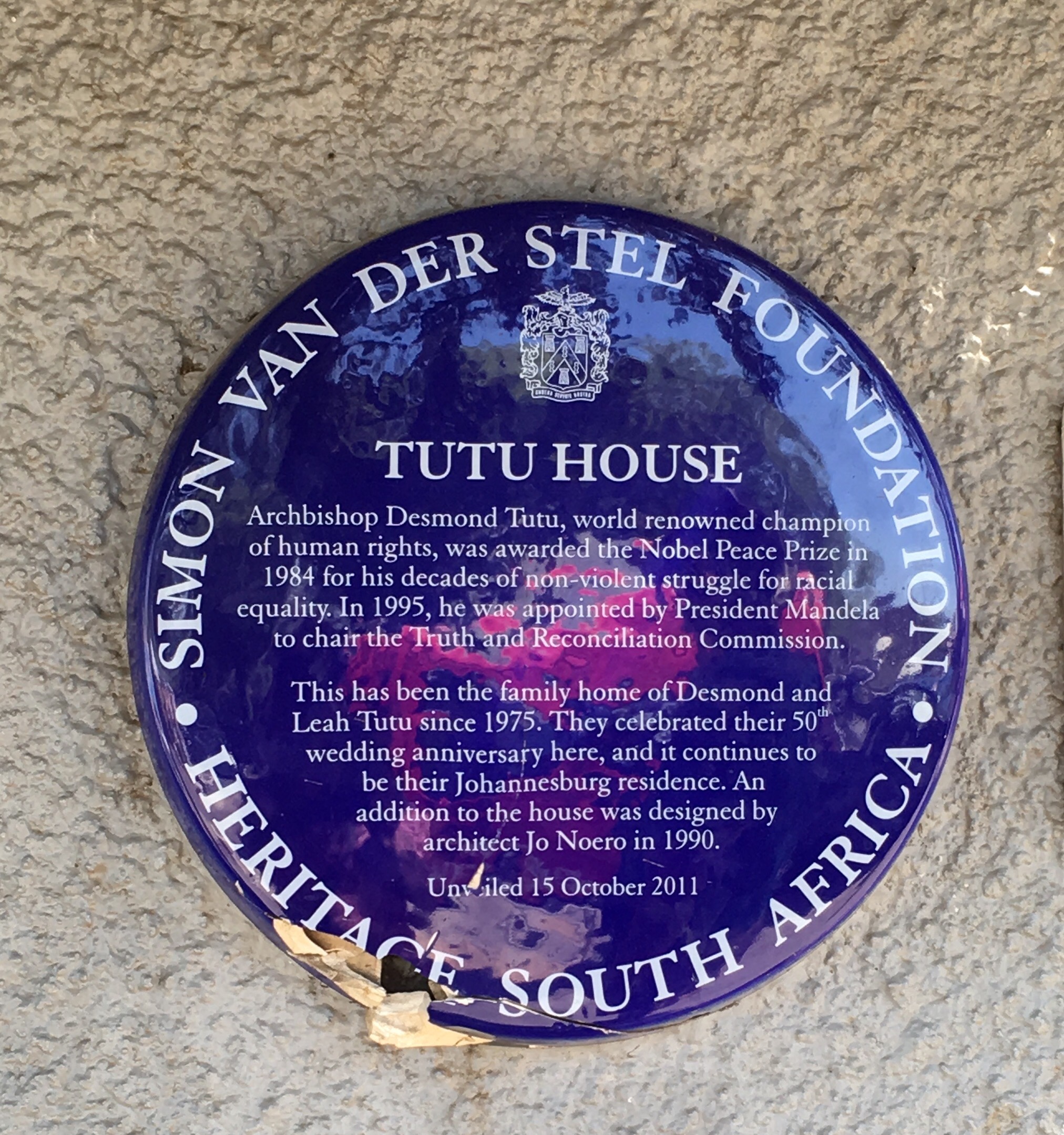
And our final stop was a street in the Township of West Orlando which is the only street in the world where 2 Nobel Laureates lived – you’ll have guessed Nelson Mandela, and maybe that the other was Rev. Desmond Tutu. (Especially if you’d been reading the whole blog today) Mandela’s home has become a museum and there wasn’t time to visit it. For security and peace and quiet reasons, Rev. Tutu now lives in Cape Town, but his family still owns this home and they visit frequently.

Johannesburg is obviously a very complex city and I have only more questions now than when I started today. But I hope to take the “lessons learned” from today to try and learn more before developing opinions. OK, who am I trying to kid. I’m human. But I have learned how little I know about this complicated and interesting multi-dimensional city and country.

So now that’s a wrap. I’ll head to the airport tomorrow afternoon and start the long, long, journey back to my reality.

Uncategorized

My Southern African Adventure is a wrap

My Southern African Adventure is almost over and I’ve had a couple of days to chill, recover from my stomach problems and contemplate the last month.

I started this contemplation by re-reading my blog posts starting from the beginning. First of all, I apologize for all the typos, horrendous grammar, and missed words or thoughts. (Special apology to Mr. Red Pen himself, Leif. I think of you often when re-reading my errors and knowing how you must have cringed.) When I’m back home with good wifi I’ll go back and fix the most egregious of the errors. In my defence, the blog posts were most often written under less than ideal conditions, in a hurry, at the end of a long day, with poor wifi taking forever to make edits, on my knees in bed hoping not to wake up my poor roommate or offline on a bumpy bus ride.

I realized, in looking back over my blog, just how rich in experiences the time has been. And at this point in my life, that’s what it’s all about – experiences. While this tour is rated as “Comfort”, it wasn’t always that. Some of the lodges were less than we’d normally accept, the days were often long and dusty, and going “bushy, bushy” isn’t ideal, but to be able to experience more than a postcard view of this region is worth every little bit of discomfort.

The beginning of the trip brought slight physical challenges, with paddling on the Orange River (which seems like a lifetime ago!), and climbing Dune 45. Both amazing experiences and Dune 45 was certainly unique!

Culturally the whole time has been interesting and diverse, with special effort made to take us to remote and interesting locations – house boat in the Okavango, lodge run by the San people, Gweta to go Meerkat hunting, stops to experience the Himba and Herera people and a walk through a truly rural Botswana village.

Seeing the variety of landscapes made the “African massages” (from corrugated and pot-holed dirt roads), dusty and long days worthwhile. Some have described the desert landscape as boring and uninteresting, and many on our tour dozed through the days. But I loved the dynamic and sometimes dramatic desert landscapes and found something to look at all day, everyday (save one which I talked about in my blog).

And of course, the wildlife. I will never forget the excitement of the first giraffe and zebra sightings, and how my heart leapt at seeing those first elephants in Etosha. I completely underestimated how exciting it would be to see wildlife in the wild, learn about them and have a chance to watch them do what they do.

Finally, the people. I cannot say enough about the warmth and hospitality extended to us by almost every single person we came across. Well, maybe not that one guy who ran us out of his restaurant for using the toilets!

I can’t say enough good things about our Intrepid Tour Leader, Innocent and our Driver, Sandile. They kept us safe and happy and put up with our silly questions, requests, and even dealt adeptly with some unreasonable demands and difficult fellow travellers.

Our interactions with the staff at the lodges, restaurants, gas stations, etc were 90% positive. You mostly got the impression that the people were happy doing what they were doing, well except for maybe that porter at one lodge that grumbled all down the walkway about the confusion about where the bags were supposed to go. They smiled, joked and were engaging and over the top helpful. And they sang and they danced with passion. I loved the rhythms and beautiful melodies of the traditional African songs, and the energy of the dancers.

Are there lessons learned on this trip? Of course, shoot me if there should come a time when that stops. From a practical perspective, I think I was mentally and physically well-prepared for this trip, probably the most unique of all my trips taken to date. I did a not-too-bad job of packing for this trip, especially considering how challenging it was because of the temperature fluctuations of the desert, length of the trip and limited weight. But once again, I probably did bring a little too much of everything. I hate washing out clothes at the end of long days, having them hanging everywhere, and wearing synthetics, so opted to get laundry done every time we stopped two nights. If I’d known in advance that was going to work, I might have been able to cut back. Oh, and don’t leave your sunglasses on the seat of the bus. On a more personal level it was once again reinforced that I am less and less a social animal. I know that is not a healthy situation especially entering my senior years (don’t really like the way that sounds!) and that my daughter will find it worrisome, but it’s a reality. How I deal with that remains to be seen.

Do I have recommendations for Intrepid? Dump Lampert’s Bay from the itinerary unless it’s a tour specifically for bird watchers. The hotel facilities weren’t that great, the smell of the guano put off many of the group, and it was a very short day. I’d add another 2 night stop in the itinerary since there were so many places where we barely got to appreciate the great facilities because we were in late and out early. Dump the lodge we used in Kasane. It wasn’t quaint. It was poorly run and a dump. And since so many of us got sick after staying and eating there, I’d suspect their food-handling ability. I was going to suggest they use a canopied power boat to get to the house boats, because it was pretty warm on the way out to the boats, but it was freezing on the way back so it was nice to have the sun! And find other options for at least a couple of the picnics. They got so tiresome and repetitive and I’d have been willing to pay for quick sub sandwich or fish and chips in Walvis Bay, for instance.

Would I recommend this trip to anyone asking? In a heartbeat. Gripes listed aside, it offered up more than I expected, and I expected so much I was deathly afraid I’d be disappointed. I was disappointed that because I was sick I didn’t get to see Vic Falls or get to Kruger, on this trip………..and I’m disappointed I forgot to take more toe pictures!

Once again, thanks to my loyal readers (all 2 or 3 of you) for coming along on this adventure with me. I get so much more out of documenting my trips because it serves as a diary for me to remember, and forces me to pay attention and do some research.

So where to next?

Uncategorized

Victoria Falls, Zimbabwe to Zambia to Johannesburg, South Africa (Sat. Sep 9)

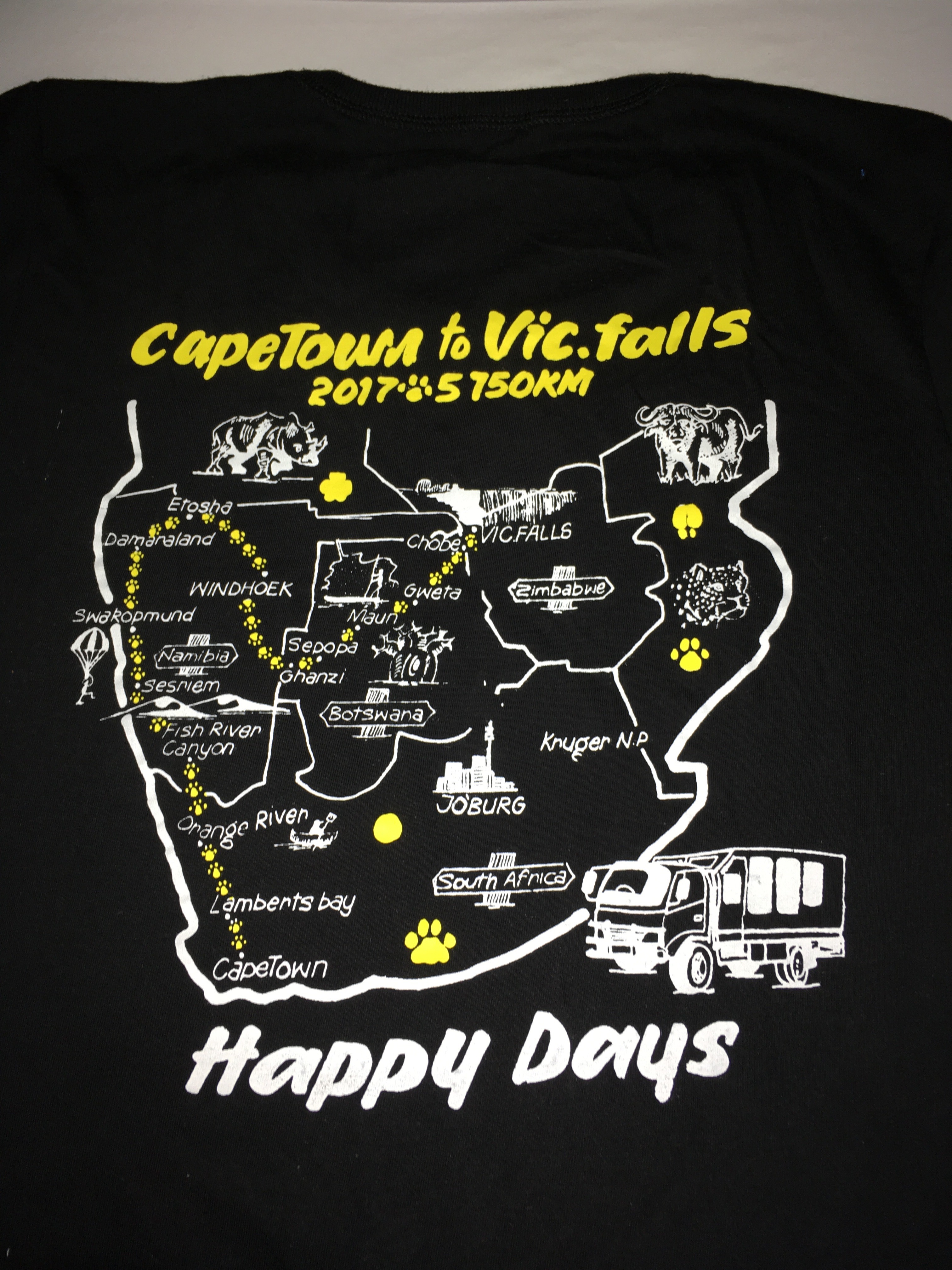
This morning after 22 days, 5,750 km in our trusty truck/bus, several thousand pictures and many adventures, our Cape Town to Victoria Falls Tour is over this morning. “Happy Days” is the favourite expression of our Leader, Innocent, so it seemed appropriate to have that added to our custom t-shirts.

After an “unsettled” night, the antibiotics, Imodium and Gravol kicked in and I finally stopped the upchucking etc. However, I felt like a wet noodle.

We are transferring to Vic Falls International to head to Johannesburg today so I struggled to get my sorry butt out of the bed and get packed up. We said our goodbyes to our travel mates who we saw at the breakfast (carefully avoiding the smells of food which threatened to re-kindle the gag response). Some of them I enjoyed being with and with whom I will stay in touch. Some I’ll cheerfully forget.

Before heading to the airport, we had a stupid mission to accomplish this morning. For paperwork reasons I won’t get in to here, we had to go across the Zambian border this morning and back again. I was not in the mood for this bureaucracy but we had no choice. So off we went to the border crossing over the Zambezi River. This crossing was as chaotic as the Botswana/Zimbabwe one, with the added interest of wild baboons wandering around looking to steal food out of people’s luggage or pockets, and dozens of locals making their daily journey back and forth across the border to get to work. Many of the transports here, coming from Zambia, were flat beds with multiple moulded metal chunks which turned out to be copper. After crossing the border, they apparently joined an armed convoy for the trip down to Durban because of the expensive cargo making it a target. Sorry I didn’t get pictures of any of that. First of all, no pics allowed at the border, but I also wasn’t of clear enough mind.

After our business at the border was complete it was time to head for the airport for our uneventful trip to Johannesburg where I was scheduled to start my 5 day tour to Kruger at 5:30am tomorrow. I have cancelled that portion of my trip. I’m just not up to the travel.

I’m disappointed but at least I did see the Big 5 plus so much more already. And it’s an easy trip to just fly into Vic Falls, when the Falls are more full, and down to Kruger from there. Easy, but not cheap and involved the long flights to get here. So we’ll see.

We were safely transferred to our hotel, mercifully, a Holiday Inn. After 21 days of adventure, and not feeling myself, it was wonderful to be in familiar and comfortable surroundings. After checking in, we both immediately crashed. Nanci is here tonight and then she is heading home on an overnight flight. I’ve decided to hang out here and give myself a chance to recover completely before the long flights home, and besides it was going to be over $1000 to make the changes to leave earlier.

I’ll put together some final thoughts about this amazing adventure over the next couple of days. Despite the crappy ending (pun intended), it has been as much as I’d hoped and more.