Sunday, February 9 & Monday, February 10
Yesterday was a sea day and relatively uneventful so I didn’t blog. I did get up in time to do yoga on the flying bridge of the ship at 7 a.m. with the sun coming up. If you do yoga, think about that for a minute. I don’t know about you but I have enough trouble holding poses with a solid floor under my yoga mat. Doing it on a rolling ship created all sorts of new challenges. I figure if I lived on a ship my core would be like cement. And I did attend a lecture about the migration of peoples in this region in the continuing series by Dr. Kess. (Although I have to admit to nodding off a couple of times).
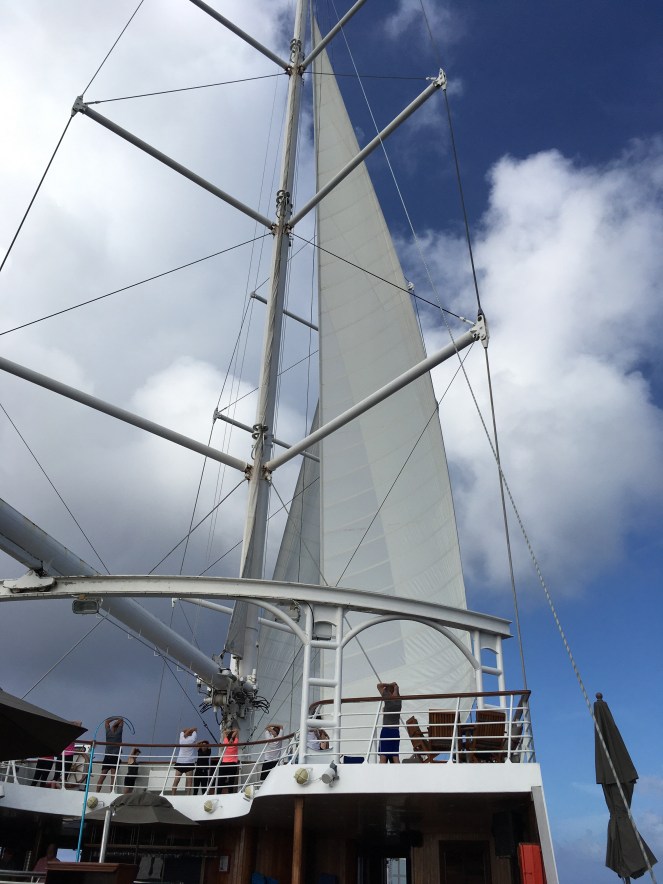
Other than that, I spent my time eating, napping, reading, and generally being lazy. The weather couldn’t have been more perfect. I sat in the sun for only about an hour and then sought out shade for the rest of the day. I found a quiet place on the flying bridge where there was shade from the sails and gentle breezes. It was delightful.
We arrived on the north side of Rarotonga as planned this morning. Not planned were the large swells that meant tendering in to the main pier from this position off the north shore was not going to be possible. Two larger cruise ships that were supposed to disembark on Rarotonga had already made the decision to leave and skip the island all together. Our captain however, wasn’t will to give up on our Raratonga experience and he had a Plan B.
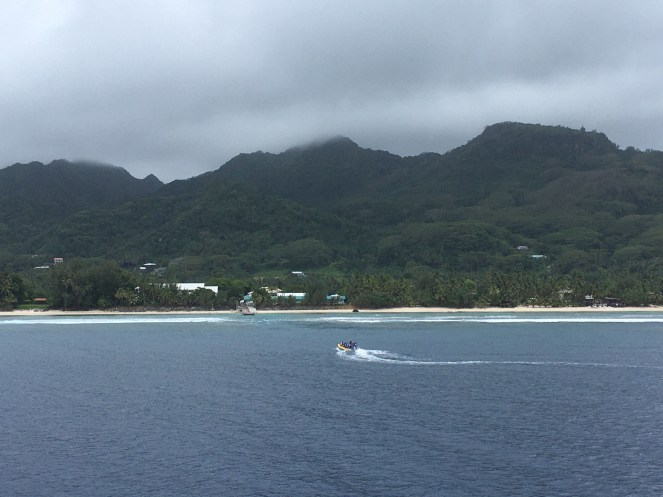
But let me start with a little about Raratonga. It is the largest island of the 15 making up the Cook Islands group and the capital is in the town of Avarua. Their flag has a blue background with the flag of New Zealand and 15 stars representing the 15 islands. Cook Islands is self governing, with a British style parliament on Raratonga where MPs represent each of the islands in numbers commensurate with the population. It is in a “free association” with New Zealand and the residents of Raratonga carry New Zealand passports. The population of the Cook Islands is 18,500 and 14,000 of them live on Raratonga.
Cook only briefly stepped foot on the Cook Islands long after they had been settled by Polynesians from Tahiti but the islands were named after him in any case. They first European explorer to visit them was thought to have been in 1873 by Captain John Dibbs who was exploring around New Zealand and Society Islands.
Today, tourism is the main economic driver of Raratonga, with visitors numbering approximately 160,000 annually. By comparison, French Polynesian sees 260,000 visitors a year, and Hawaii sees that many in a single day. There are 2 international flights a day and many more local flights taking people to and from the other islands. There are many small villas and hotels as well as AirBnbs on the island but none of the major chains has a property here. Many of the families on the island had built large The secondary industry is the export of tropical and citrus fruits. It is also the second largest producer of black pearls after French Polynesia.
So, now back to the Captain’s plan B. There was a landing spot on the west of the island, that would allow the much smaller zodiac type boats to land. But they had to get through a very small opening in the coral reef and it was quite shallow. So they repositioned the ship, waiting for high tide at 10 am and sent off a recon boat to check it out. All the while the most curious of the travellers were on the bow of the ship watching the comings and goings. Finally we got the signal that the zodiacs were a go, and they would be starting to take 8 passengers at a time.
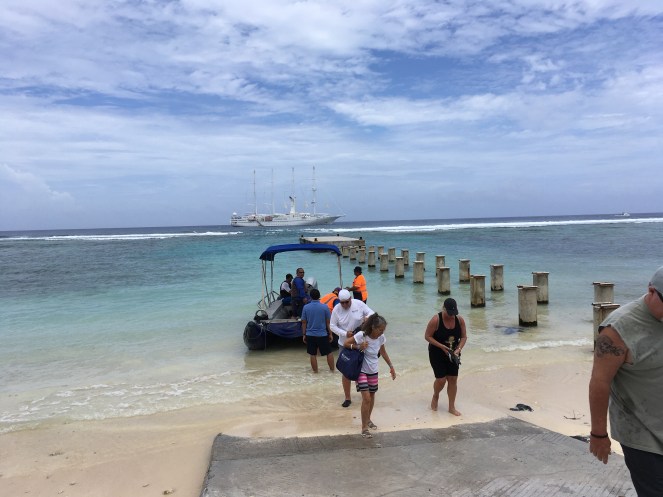
It took a while to get everyone off the ship, but 3 hours later than scheduled we arrived on the island, to the music of the island and lei greetings. Within minutes everyone started off on our various tours. I had chosen a 4X4 tour of the island, that did both on-road and off-roading around the island. It was similar to the tour I took in Moorea.
The main road, which is at sea level and circles the island, is 32 km around. There is bus service on the island, one red one going in one direction and one blue one going in the other direction on the main road. We met our two guides, Useless (his name tag actually said that), and Chocolate, and the two trucks started off to circumnavigate the island primarily on the secondary side roads of the island as well as some parts that were off-road.
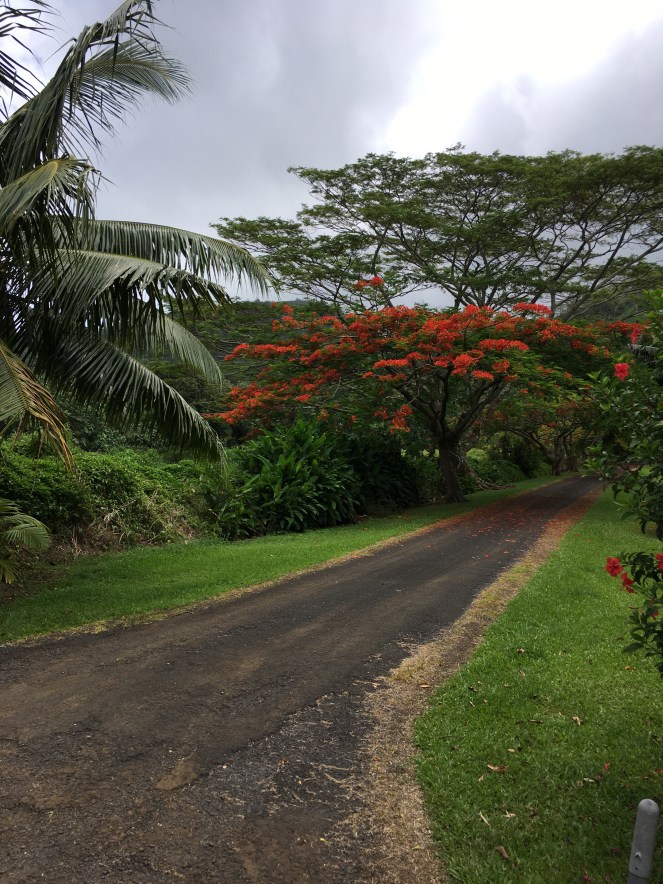
We headed off the main road on to a road a little further up the hillside, passing fields and small very neat homes. The driver explained that the health department of the government comes out periodically to make sure that people have kept their yards tidy and grass mowed. It’s not for aesthetic reasons, but rather to keep the mosquito population down. Like the other islands we’ve visited, there was no rubbish or litter on the side of the roads. Most of the yards are planted with bountiful shrubs and trees that in Canada we try desperately to keep alive as houseplants.
Along the way, Chocolate gave us some information about how the islanders live and some history. And Useless gave us talks when we got to any of the stops.
On Raratonga, land is owned exclusively by the people who have inherited it from their ancestors. As families grow, the land is divided to make way for the next generation to build their homes. The family of a couple that marries will meet to decide what plot of land the new couple will get from the family land, and if the male’s family have nothing that is appropriate for building (lots of hills) then they will go to the wife’s family to ask for land from them. They claim there is no homelessness on the island as a result.
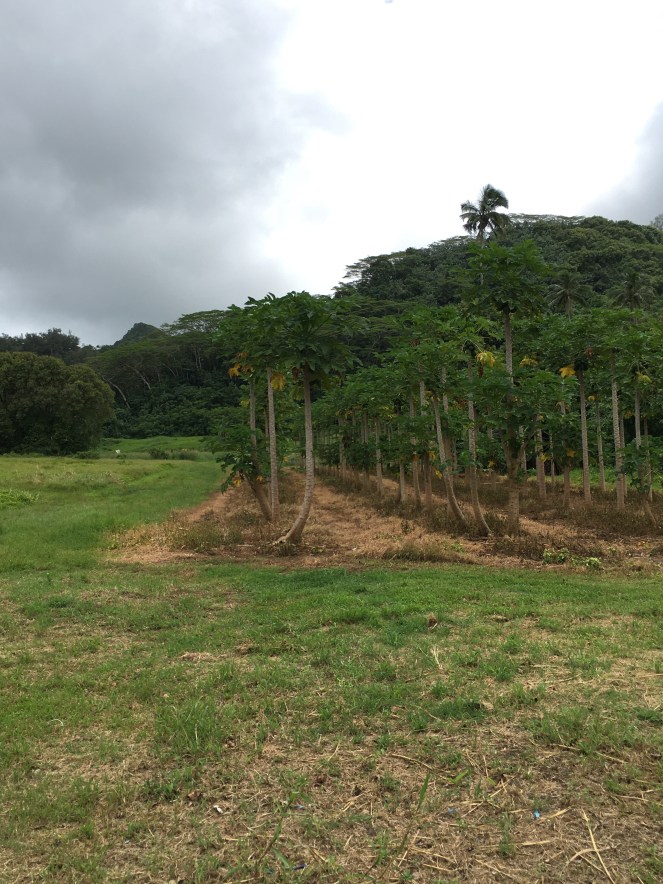
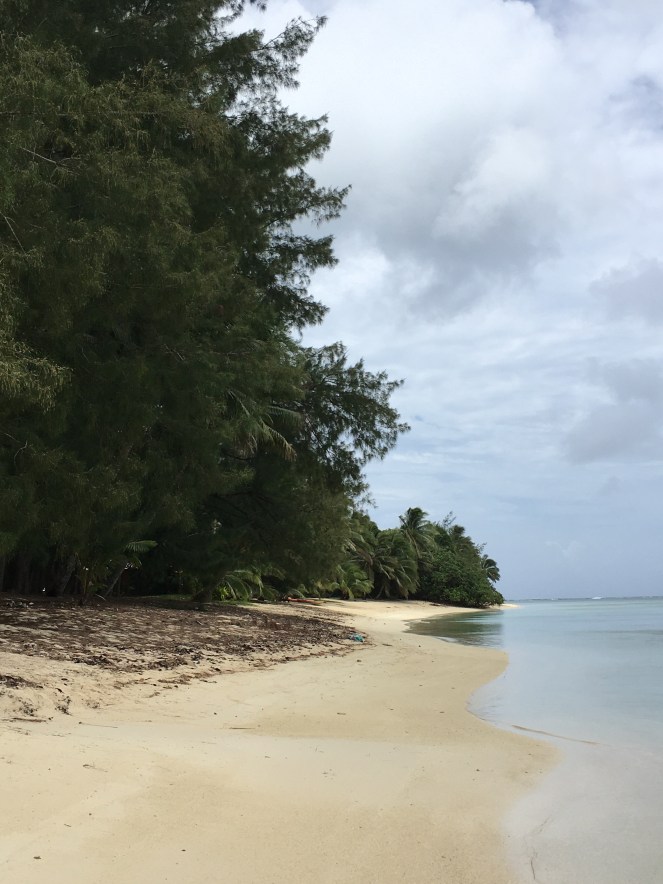
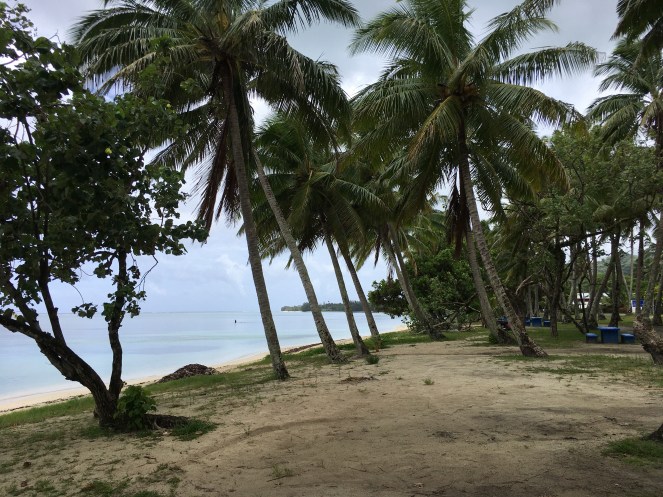
Chocolate stopped several times to show us various crops growing, (tapioca, taro, pineapple, mangos) flowers, and some great view points. Our first stop was at a beautiful white sand beach where there were three couples enjoying the warm water on a long stretch of beach that was otherwise deserted. It was calm inside the barrier reef which was quite near the island and small fish skirted about as we waded in the water.
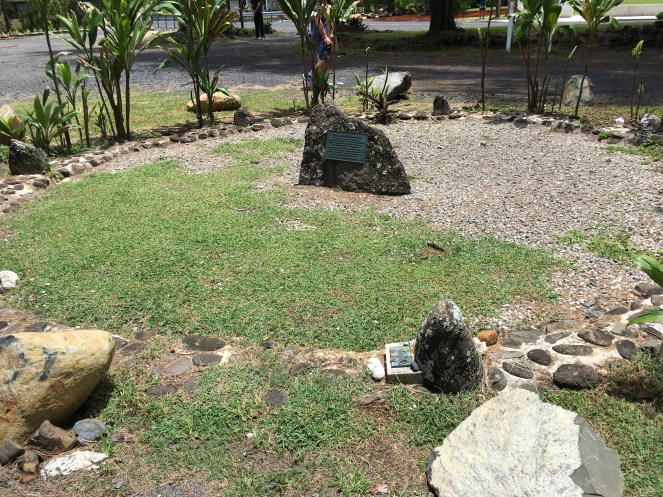
The next stop was “The Famous Polynesian Traditional Vara Voyage Departing Site” which Useless explained to us. In 1300 35 local people departed by a double hulled canoe to start an exploratory voyage that lasted them 9 months. They didn’t have any destination in mind, but they ended up in New Zealand. They know the voyage took at least 9 months because one of the women got pregnant along the way and the child was not born until they arrived. The rocks represented gods that they had prayed to.
We saw the remains of a road that had been built by the earlier people as well as the remains of a house that was built for one of the chiefs of the 4 tribes that were living inland when the missionaries came to Raratonga. They encouraged the first people to move down to be near the ocean to attend the schools that they provided for them. There is still a Seventh Day Adventist school on the island.
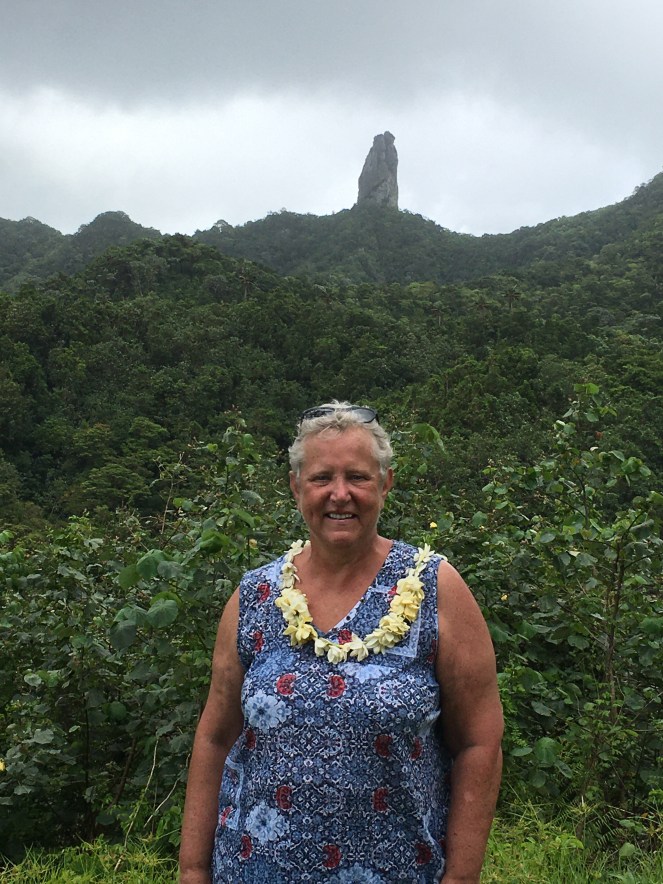
Then we head for the off-road portion of our trip, and up a slope to a look out point to get a good look at “The Needle”. There was a gravelly and grassy road up, that required the Jeep to be in 4 wheel drive and which practically shook the fillings out of my teeth. But it was only for a few minutes so tolerable. It was cloudy but we did see The Needle at the peak of Te Rua Manga at 650 metres.
By now we were 3/4 of the way around the island and we came upon the major town of Avarua. Chocolate was telling us that every August, there are dance competitions that each of the Cook Island participates in and there are 7 teams from Rarotonga. I asked him if it was folk dancing and he guffawed. I didn’t think it was that funny but turns out he thought I said pole dancing, which of course really was funny. It was folk or traditional dancing, complete with costumes.
It was a small town with lots of tourist facilities such as hotels, and restaurants, dive shops etc. There are no stop lights but there are a couple of roundabouts.
In no time we were back at the pier on the west side and we caught what was almost the last zodiac back to the ship. It was a great tour. So great to see so much of the island and learn a little about how they live.
We had missed lunch by now, and so we ordered room service. When it became obvious that although everyone was back on board (we knew the zodiacs had been stowed), there was an announcement that the winch to raise the anchor had broken and the crackerjack engineering crew were working on getting it working again. It amounted to a 2 hour delay, but really didn’t affect our day at all. It was another terrific day in paradise.

 Lois' Adventures
Sounds fabulous!
LikeLike