
Today we left the cities and freeways behind and travelled up and over the highest pass in Morocco in the High Atlas Mountains to the town of Ait Ben Haddou.
The road was much more interesting today, presenting new challenges for the the driver. Instead of dodging cars and motor scooters he was clinging to the side of the mountain. There is a lot of construction on the road as the government is upgrading the original road put in by the French but it didn’t stop us or really slow us down at any point. It snaked up the north side of the High Atlas Mountains and along the way we passed many small villages tucked into the green hills. The villages disappear into hillsides because the outside of the houses is covered in the mud surrounding the village so the colour is identical to area it’s in.
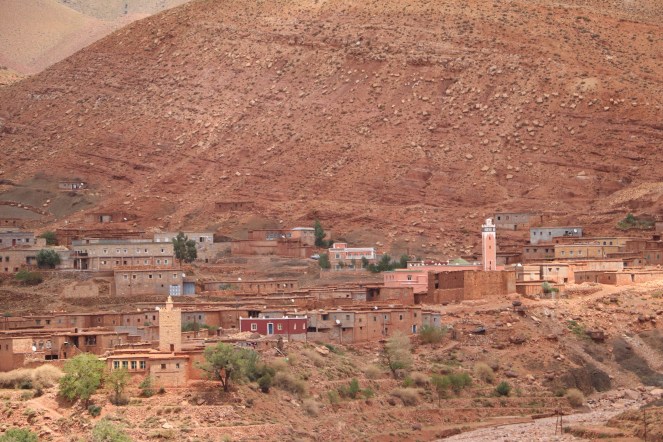
Early on we drove through agricultural areas, with olive tree groves but as we got higher the slopes required terraces to be built in order to grow things and small mixed farms sustain the villages.
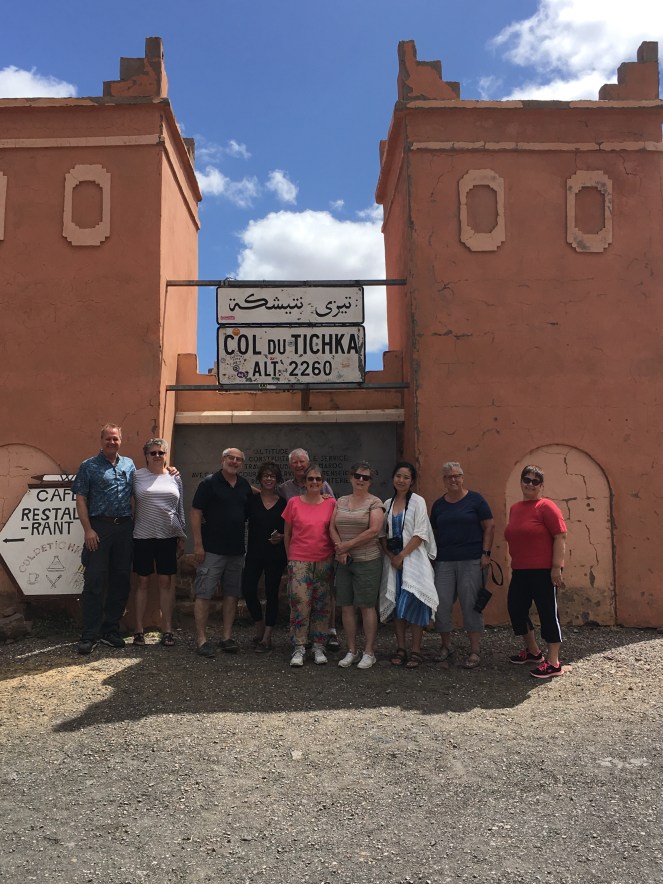
We stopped for a photo op at the summit of the pass, at 2260 metres, the highest pass in Morocco and it was delightfully cool. It was also very blustery!
The Atlas Mountains divide Morocco into the north and south, with the north being cooler than the south, with Marrakesh, nearest the mountains being the hottest of the northern region. In the south, it is much hotter and eventually becomes the Sahara Desert. There it can get as hot as +50 and as cold as -2! And they get snow in the high peaks of the mountains.
Some tidbits of of info we learned today:
-Although there are 15 golf courses in Marrakesh, Moroccans generally don’t play golf. They’re put in for the tourists.
-There is shale oil, gold and silver in the Atlas Mountains but it’s so expensive to get out of the ground that they don’t do much mining of any kind.
For lunch we stopped at a restaurant in the mountains, and I had something quite different – a Berber Omelette. It was eggs, with tomato and onions cooked in a tajine. I was looking for something light and this fit the bill. It was lovely. The restaurant was along the highway between two small towns and while we were there we heard the Call to Prayer first from one of the valley and then it started at the other end. Both were quite melodic.
As we drove today our guide talked about the political system in Morocco. He reiterated that he would only talk about it at a very high level, like our religion discussion yesterday. And a disclaimer again, I’m sorry if I got any of this wrong or misinterpreted anything he said. He was very careful not to express any opinions and those expressed here are mine alone.
So, Morocco has both a King and two elected bodies – the House of Representatives and the Councillors. To understand the relationship between the King and the parliament our guide gave us some historical perspective.
When the French came in to “protect” Morocco, they moved the current King, and his family first to Sardinia, and then to Madagascar. They tried to start a feud between the Arabs and the Berbers to destabilize the country. They then tried to get another relative of the King to take over but the Moroccans weren’t having anything to do with him. Eventually Morocco gained it’s independence from France in 1956 when Mohammed V became King.
In 1961, Hassan II became King, and in 1999 his son, King Mohammed VI, took over upon his father’s death and he is the present day King. He has a son so the lineage is preserved.
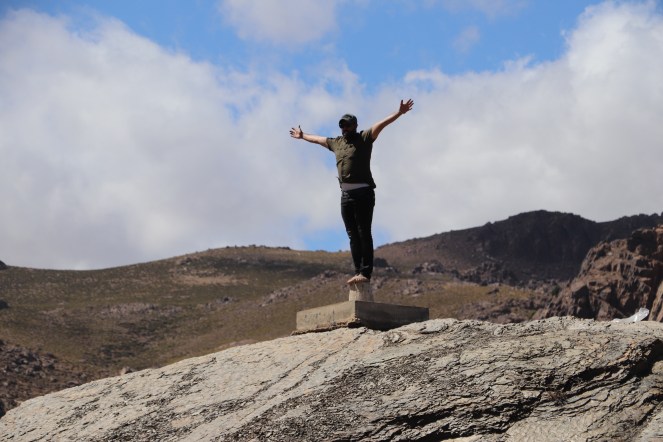
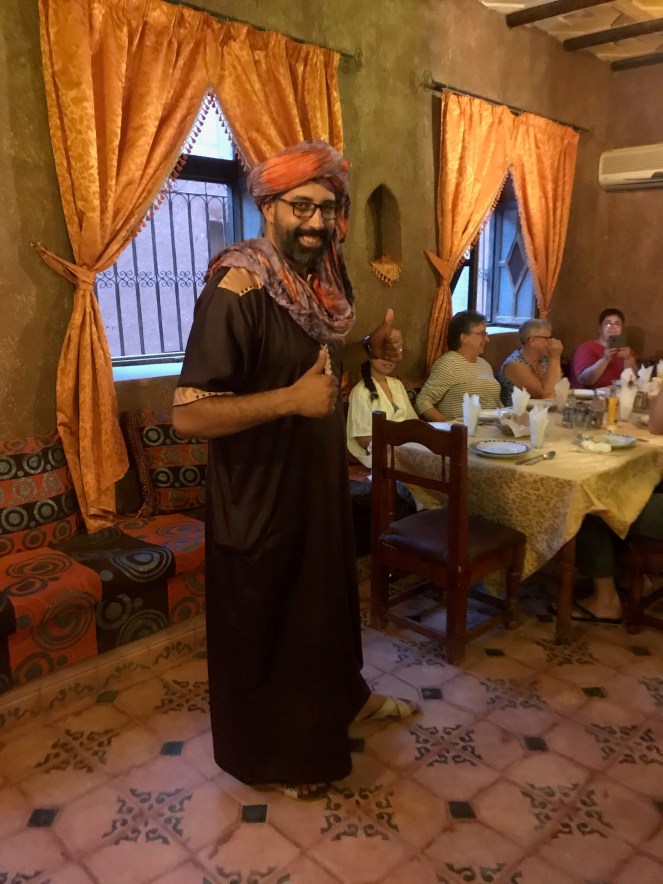
The picture above is our guide Abdul goofing around. There is another picture of him at the end as he came to dinner tonight. His home is in the High Atlas Mountains and so he changed into his traditional garb.
There are 12 administration regions in Morocco and representatives are elected from each of them every 5 years. There is one year left in their mandate. There are currently approximately 33 political parties (not unusual for emerging democracies), with 5 or 6 being the main one. Since 2011 there have been some positive constitution amendments such as Berber becoming a second official language. These were put in because of the Arab Spring unrest in the Arab countries. The King headed off unrest in Morocco by implementing these changes pre-emptively. The significant one from a democracy perspective is that it used to be that the Prime Minster of Parliament was appointed by the King, but that has changed now and the head of the Parliament is now the President and, as in Canada, the leader of the Party winning the election is the President. But read on, there are some safeguards put in place to ensure there is control by the King over certain areas.
You are able to vote at the age of 18 but it’s not obligatory to vote. Recent elections have seen approximately 40% turnout. The winning President appoints the government ministers with two exceptions. And here is where the control by the King come in. The Minister of Islamic Affairs is chosen by the King and there is no Minister of Defence as the military reports directly to the King. The reason for this is that in 1971 King Hussan II was celebrating his birthday when an attempt was made on his life and it turned out to be traced back to the Minister of Defence, so since then he has maintained that portfolio.
So is this situation good for Morocco? They have achieved some democracy but there is still control by the King through his control of the military and control of the message the Imams deliver at Friday prayer. Perhaps it is because it gives the country stability, and certainly it does appear stable compared to much of the Arab world and middle east. It’s certainly an evolving democracy and has a long way to go on that front, but it’s at least making some headway. We were told there is a free press, and that they are able to publish whatever they want except the King’s family is off limits. We aren’t able to tell if that’s true or not. And then there is the judicial system. We haven’t talked about that, and I’d be surprised if we do. All makes for interesting discussion, but really we’re here to see the beautiful country, meet its people and to learn about its history and culture, and of course to eat its food! Not to solve the worlds problems.
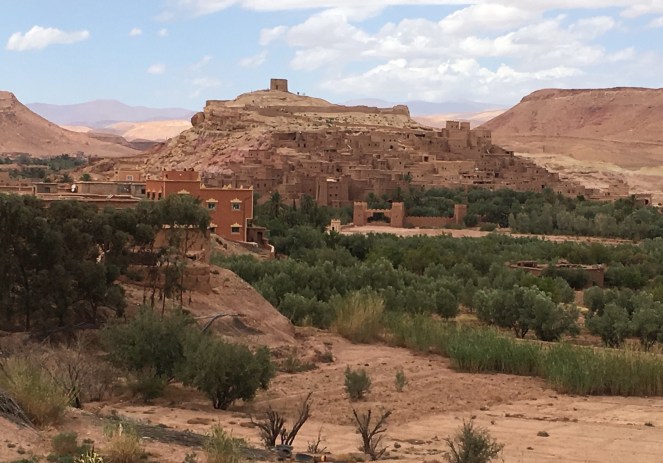
We arrived at our overnight stop around 3 pm and it’s a lovely Riad with a real pool and garden in the courtyard and our rooms all around it. After our welcoming mint tea, I jumped in for a quick swim, and believe me it was quick because it was frigid. I have no idea how they have kept it so cold given how hot it normally gets here. But it felt great after so may days in the heat and most of the day on the bus.
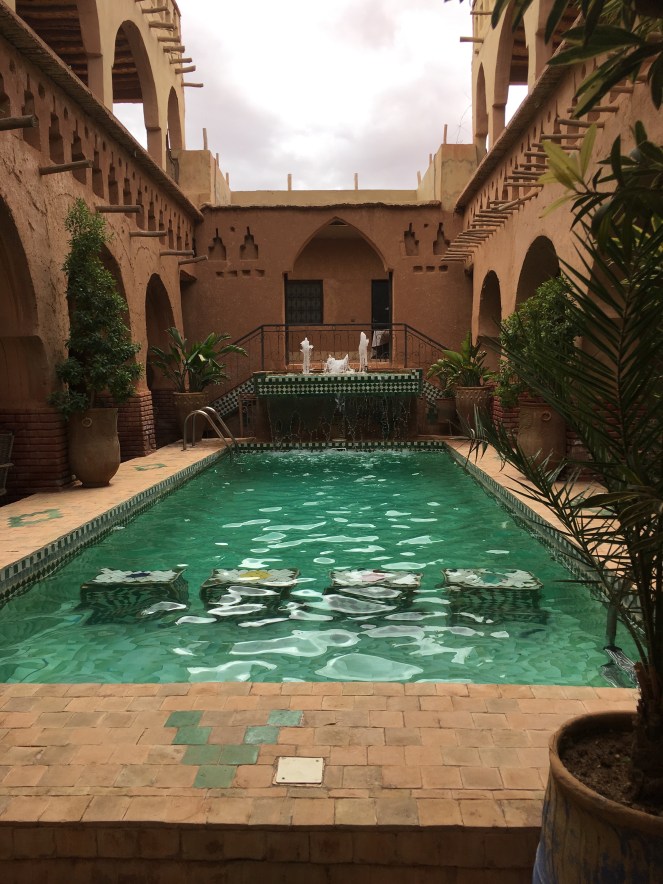
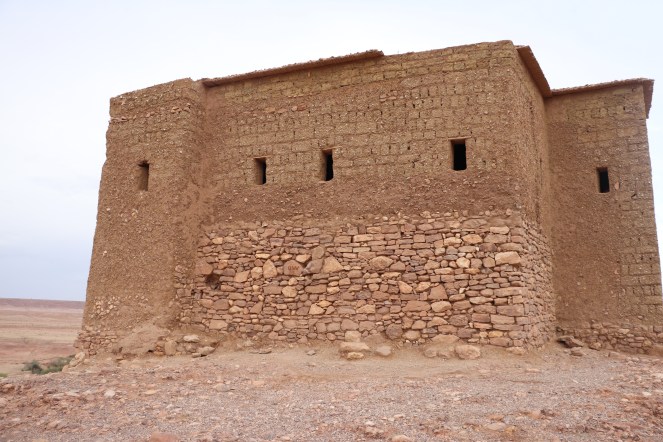
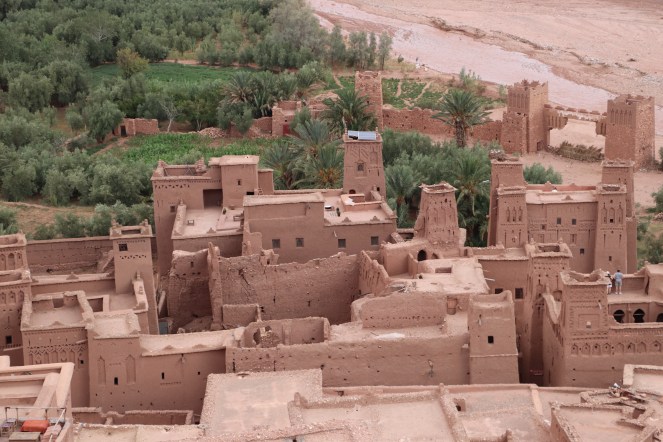
We rested a bit and then headed off to climb up to the Kasbah at Eit Ben Haddou, which is a UNESCO World Heritage site and is apparently one of the most preserved of this type of construction in the country. If you look at the tourist brochures for Morocco it’s often one of the profiled iconic shots.
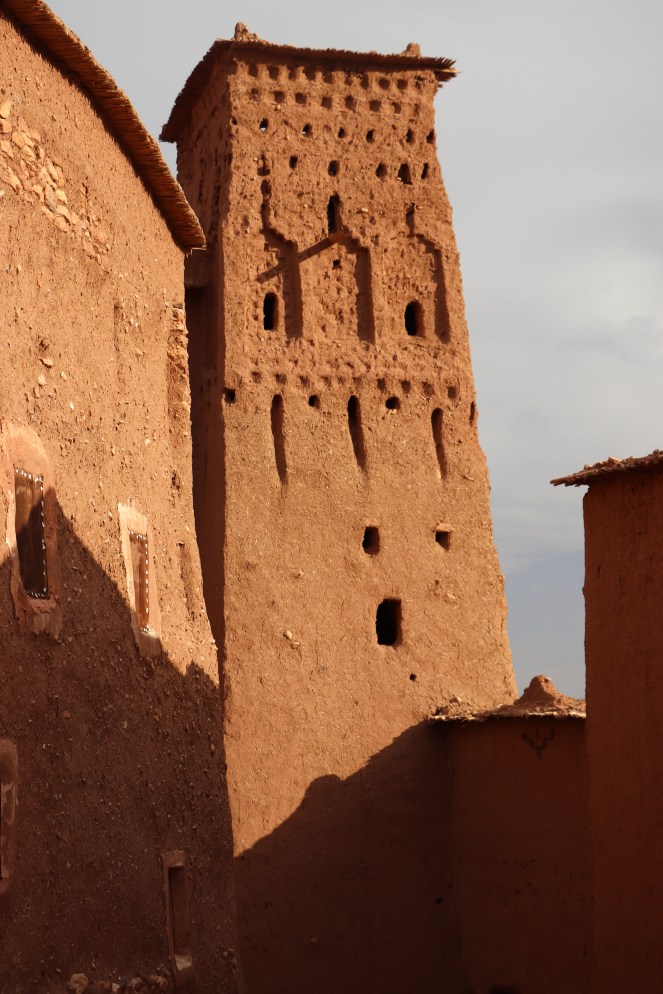
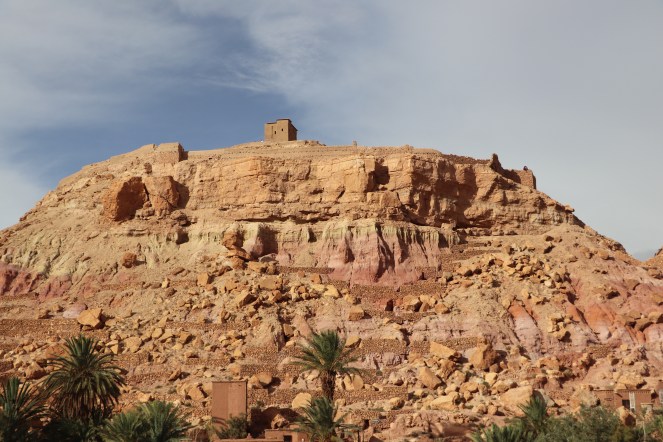
My Fitbit says I did 63 flights of stairs and it felt like that. Thankfully for our comfort the sun went behind some clouds, but just before it did, it was the most amazing light for picture taking and so I was disappointed when it deserted us. Every little village had a Kasbah for two reasons, as a final defence against warring other villages and as a safety deposit box for the villagers valuables. Every family had a small space where they could put their silver, jewellery, or money. UNESCO is restoring part of the town buildings around the kasbah.
We came back down from our visit to the Kasbah and it was time to eat again. This was one of the places where G Adventures covered our meal and Abdul ordered skewers of turkey meat for us tonight because we have been having a lot of tajine and couscous and he thought we’d like a change. The salad before dinner was a variety of cooked, pickled and fresh vegetables, and the desert was the standard fruit. Everything was really nicely prepared.
Off to bed to dream about our adventures tomorrow. There may be camels involved, but you won’t know for a couple of days because there isn’t any wifi at the Bedouin camp where we’ll spend the night tomorrow.

 Lois' Adventures